
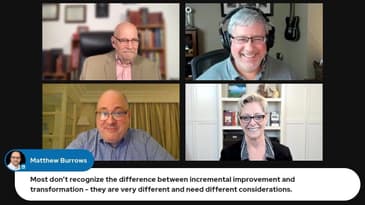
Roy Atkinson https://www.linkedin.com/in/royatkinson/
𝗚𝘂𝗲𝘀𝘁𝘀:
Patti Blackstaffe https://www.linkedin.com/in/pattiblackstaffe/
Ken Gonzalez https://www.linkedin.com/in/kengon/
Greg Sanker https://www.linkedin.com/in/gtsanker/
🔑 𝗞𝗲𝘆 𝗜𝗻𝘀𝗶𝗴𝗵𝘁𝘀
This episode explored the pivotal role of service management in driving digital transformation across modern organizations. The discussion highlighted how service management extends far beyond IT to influence governance, culture, and business outcomes. Thought leaders shared practical guidance and real-world examples of aligning strategy, governance, and technology to achieve lasting transformation.
[00:00] Intro
[[03:46] Service Management Fundamentals in Transformation
[05:50] Governance and Aligning Policies with Business Outcomes
[08:46] Business Outcomes: Focusing Service Management on Value
[10:16] Governance: Beyond Command and Control
[12:13] The Evolving Scope of Service Management Across the Enterprise
[15:31] How to Initiate Outcome-Focused Business Conversations
[18:49] Common Pitfalls in Transformation: Customer-Centric Service Management
[21:40] Integrating People, Processes, and Technology for Organizational Success
[23:45] Designing Service Management for Supportive Relationships and Value
[26:20] Changing the Perspective: Governance as Enablement, Not Control
[27:45] Technology as a Tool, Not the Starting Point for Transformation
[29:52] Modernization vs. Transformation and the Limits of Process Maturity
[31:50] The Crucial Role of Organizational Culture in Transformation
[32:53] Closing Remarks and Replay Information
🔑 𝗞𝗲𝘆 𝗜𝗻𝘀𝗶𝗴𝗵𝘁𝘀
🔗 Governance as an Enabler: Effective governance was emphasized not as rigid control but as a framework that aligns policies, procedures, and knowledge with organizational goals. Instead of limiting autonomy, good governance enables teams to act decisively and deliver value.
🎯 Starting Where You Are: The conversation reinforced the importance of leveraging existing strengths and tools rather than discarding them during transformation. Starting from the current state enables organizations to adapt essential practices for new challenges instead of reinventing the wheel.
🤝 Business Outcomes First: A recurring theme was the necessity to center service management and digital transformation around customer and business outcomes. Attendees learned why understanding who you serve and what they value leads to more impactful and sustainable change than a narrow focus on technologies or process maturity.
🧑🤝🧑 People and Culture Matter: The panel reminded viewers that technology alone does not drive transformation. Culture, empathy, and collaboration are essential components for enabling individuals to embrace new ways of working and adapting to rapid change.
💃 𝗙𝘂𝗻 𝗙𝗮𝗰𝘁: 🕺
Roy, Greg, and Ken are “recovering musicians.” Roy highlighted that successful governance in organizations can be compared to making music: creativity thrives within constraints, much like musicians work within scales and time signatures.
🔮 𝗘𝘅𝗽𝗲𝗿𝘁 𝗔𝗱𝘃𝗶𝗰𝗲
🧑🤝🧑 Patti emphasized that transformation required a focus on relationships and broad enterprise collaboration, highlighting that service management extended across departments like HR and facilities, not just IT. She advised organizations to rethink governance as a way to empower autonomy while aligning to business outcomes, rather than viewing it solely as compliance or control.
💡 Greg stated that successful transformation hinged on integrating the organization’s vision with day-to-day execution, stressing that governance should enable adaptability and agility rather than create rigidity. He recommended leaders actively listen to stakeholders and focus on measuring what mattered most for the business, instead of just chasing process maturity.
📈 Ken suggested beginning transformation efforts by clearly identifying customers, understanding their needs, and assessing their satisfaction with existing services. He cautioned against over-focusing on maturity levels and technology, instead encouraging organizations to let customer value drive change initiatives.
🎙️ Roy summarized that technology acted as an enabler or "force multiplier," but was not the heart of transformation; he urged viewers to start with business outcomes and people rather than tools. He concluded by highlighting the critical role of organizational culture and support for change, noting that successful transformation demanded putting people and processes first.
👀 𝗪𝗮𝘁𝗰𝗵 𝘁𝗵𝗲 𝗥𝗲𝗽𝗹𝗮𝘆!
Catch the replay to discover more behind-the-scenes stories, critical shifts in digital business thinking, and pragmatic advice that can reshape your perspective on digital transformation.
𝐒𝐮𝐛𝐬𝐜𝐫𝐢𝐛𝐞:
https://www.youtube.com/@InstituteDigitalTransformation/?sub_confirmation=1
𝐅𝐨𝐫 𝐦𝐨𝐫𝐞 𝐢𝐧𝐟𝐨𝐫𝐦𝐚𝐭𝐢𝐨𝐧 𝐚𝐛𝐨𝐮𝐭 𝐭𝐡𝐞 𝐈𝐧𝐬𝐭𝐢𝐭𝐮𝐭𝐞 𝐟𝐨𝐫 𝐃𝐢𝐠𝐢𝐭𝐚𝐥 𝐓𝐫𝐚𝐧𝐬𝐟𝐨𝐫𝐦𝐚𝐭𝐢𝐨𝐧:
https://www.institutefordigitaltransformation.org/