
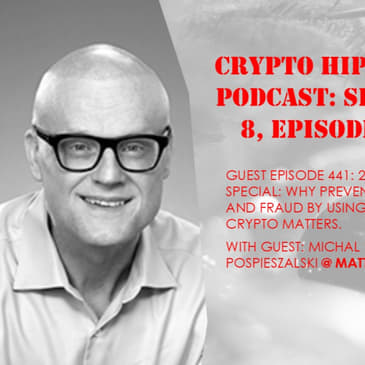

Michal “Mehow” Pospieszalski is a seasoned tech leader with a track record of pioneering innovative solutions in the crypto world. As the CTO and co-founder of SwissFortress and CEO, co-founder, co-inventor of MatterFi, Michal merges visionary strategy with hands-on tech know-how, propelling both companies towards defining the future of digital asset management.
Check out Crypto Hipster's Top 100 podcast ranking for 2024:https://blog.feedspot.com/cryptocurrency_podcasts/
[00:00:00] Hello everybody and welcome to the Crypto Hipster Podcast. This is your host Jamil Hasan, the Crypto Hipster, where I interview founders, entrepreneurs, executives, thought leaders, amazing guests all around the world in crypto and blockchain. And today I have a repeat guest. I interviewed this man less than a year ago. It was a fascinating conversation. I asked everybody to tune into the first one and to this one. He is the CEO of MatterFi. His name is Michal Mehow.
[00:00:30] Michal Pospieszalski.
[00:00:32] Got it.
[00:00:34] Yep. Practice.
[00:00:37] Michal, welcome to the show.
[00:00:39] Great to be here.
[00:00:41] Thank you. Thank you. So, for those who didn't tune in the first time, what is your background and is it logical for what you're doing now?
[00:00:55] Well, my background is being a white hat hacker. So, it's highly logical for what I'm doing now because we're not going to be a white hat hacker.
[00:01:02] What I'm doing now is creating a piece of tech that is highly unhackable. Right? So, you know, my biggest personal thing is that I'm tired of everybody getting, you know, thefted and frauded and their funds stolen and digital assets. It's just, it's become like normal. It's like normal. It's like, oh, oops, 10 million disappeared. Oh, I got, I lost 75K.
[00:01:26] Or I lost this or that. And everybody's just used to it. It's like, we've normalized it. Right? It's just like the recovery is okay. Sorry, you know, tough. Don't do that again. You know, don't fall for scams.
[00:01:40] And 90% of these things are because of addressing, the fact that we have to use crypto addresses. So, there's all these clever ways that hackers exploit that, mostly through phishing and social, you know, social manipulation, social hacks.
[00:01:56] And, you know, they get, they convince users to sign, you know, assets over to the attacker's address instead of the address that they think that they're going with.
[00:02:05] So, that's what we fixed at Matterfire. We fixed that whole problem where there's, there's, you can use crypto all day long or there's no more addresses. You don't have to deal with them at all.
[00:02:15] So, and the, and the addresses are private because there's been other solutions where like, you know, you can use a name, but then everybody knows how much money you have, which is a whole nother problem.
[00:02:24] So, you know, with the increased rise of, you know, people getting, you know, physically assaulted, kidnapped, threatened, et cetera, because, you know, they know they got, the attackers know they have crypto.
[00:02:35] It has to be private. It's like a safety issue. It cannot not be private. You know, if you got big bags and, you know, those are attached to a name, that's, that's your, you know, EID or your, you know, great chance you're going to be in trouble.
[00:02:52] So, I mean, I, yeah, so my background is white hat hacking and breaking kind of into everything, slot machines and airliners and websites.
[00:03:02] And I wrote an Intel system for the U S Navy. So I, yeah, I've, I've done a lot in the security space and this is my answer to like FDU hackers.
[00:03:18] I like that. A few hackers comment because I got hacked for a 40 K in August, you know, and I'm like, I thought, you know, it's an interesting case and I don't want to bore you with it, but it was.
[00:03:31] Well, tell me, I mean, I'm, I'm pretty sure I know what the story is, but I, I, you know, I'm always, I'm always, I'm always down to hear more.
[00:03:41] I use, okay. I mean, I used, I used EIDU wallet since 2017. And then one day I read an article that ocean was, I had ocean, I had Unibright in there and I read an article that, that ocean was merging.
[00:03:57] So I said, Oh, it's a good time for me to kick it out and sell it. So, um, I try to restore my wallet, which I had done for years.
[00:04:05] Um, and Apple had replaced, had not, uh, had taken it off the Apple store and then not allowed me access to it anymore.
[00:04:13] Um, so my friends are frozen there. So I go to the police, I say, Hey, my funds are frozen.
[00:04:18] And I said, Oh, here's a website. You know, that seemed like the EIDU website, but it wasn't, it was a phishing site.
[00:04:24] Uh, so, you know, my, my seed phrase didn't work in any other wallet, like trust wallet didn't work.
[00:04:30] So what they did was that seed phrase wasn't an Ethereum decentralized seed phrase, which I thought it was.
[00:04:37] Um, initially it was centralized and then that, um, operation was shut down.
[00:04:42] And then the hacker set up a phishing site. And then I want to put my seed phrase in there.
[00:04:45] My money was poof gone sent through, uh, sent through, uh, uh, what a mixture is and everything gone.
[00:04:50] Um, so, okay. Classic phishing this time. They, they got, they convinced you to give you their seed phrase, which obviously you should never do.
[00:05:00] Right. But they were like, Oh yeah, use this. Your wallet doesn't work in. So use this wallet. Right.
[00:05:04] And then that wallet is, uh, an attacker wallet. That's just stealing your seed phrase.
[00:05:09] Um, so yeah, I mean, obviously like, you know, the way we're fixing that is making it so that every project has a custom wallet. It can be in the iOS store, you know, it's not banned. It's just a legit wallet.
[00:05:23] Um, and everybody knows to use that wallet, which won't steal your seed phrase. So yeah, I'm sorry. Sorry to hear that.
[00:05:33] Sorry. Sorry for this week. It was like a friend around 75. And then in the news, you see really big ones. Like the ones where like somebody lost 40, 50, 75. Um, you know, they, uh, they don't, they don't make the news. Like there was a, last week, there was a guy on Twitter that, you know, said he lost one, 2.5 million in assets off his treasurer or his ledger. I think it was his treasurer.
[00:05:59] Um, and, uh, you know, the, the allegation was that, you know, he signed, uh, he transferred the money a couple of, a couple of years ago via phishing to some address. And again, that's the problem we solve. So, and then on the custody side, you also have these, you know, endless problems where, oops, so the exchange lost 200 million.
[00:06:18] Like happens once a month or once every two months. And, you know, we've, we, we believe we've solved that here as well. So, yeah, I mean, the theft and fraud have to stop. It really is just crushing the, you know, every, yes, digital assets are great. They are the future. You know, now we have an administration coming in that looks like, you know, they're all about it.
[00:06:41] Right. Which is just going to make the fraud worse unless the tech catches up. And that's what I'm here to, you know, deliver, which is why like our tech is available by API, by white label, like, wow, whatever form you want it in, I have it ready for you. So, um, so yeah, I hope I answered your question.
[00:07:01] You did, you did. Um, and what I wanted to find out also, you know, since the last time we spoke, you have had some very important updates, um, and matter fi, you know, what are they, um, specifically?
[00:07:16] Well, when did we speak last, you know, do you recall? Cause I, I remember we did, we, we, we talked, but how long has it been?
[00:07:22] It wasn't eight months. I think it may be eight, eight months now, eight, not eight or nine months.
[00:07:28] Yeah. So, you know, Swiss fortress, the wallet, which was an early beta back then now is in late beta is going to go into production and in Q3, sorry, Q1 25. Um, we were doing a token raise there. We're in private round one. Um, and I can't say it probably till the first week of January, but we have like the biggest KOLs on the planet, all, you know, on board this launch. It's going to be one of the bigger token launches of 25.
[00:07:56] Um, we're going to have, uh, we're already, you know, getting in the process of getting listed on an exchange, like a pretty major centralized exchange that we're targeting for, for May. Uh, we're doing a $10 million token raise there.
[00:08:10] Um, and so that's, you know, super exciting cause that, that's going to be the first production deployment of all this, you know, send secure, send to name tech that I'm talking about.
[00:08:20] That wallet supports Ethereum, Bitcoin, all the Bitcoin sort of derivatives majors. So like, like, like, like, like coin e-cash dash BCH.
[00:08:30] Um, we also got Ethereum and Casper in there. Uh, we're going to be adding Polygon and we're going to be adding Solana, uh, a lot of these other, uh, projects that are pretty significant.
[00:08:40] Cardano almost certainly, um, is going to be in that wallet as well. Uh, but at launch it's going to be, you know, Ethereum plus all the Bitcoin plus ERC twenties.
[00:08:49] Um, and so that's, you know, so that's really exciting. And then, you know, matter if I completed it's, it's first two rounds of funding in this, well, the first one was three years ago, but the second round was completed over the summer to raise almost $5 million total.
[00:09:04] And now we're in our series a, and we started to collect the beginning of the series a funds at a hundred million pre valuation.
[00:09:11] Um, and then we continue our deployment at our enterprise clients, which I can't mention yet because that information is not public, but there's some really big clients that are, uh, you know, household names essentially that was going to be, are going to be using our tech, uh, which is fantastic.
[00:09:30] So, um, you know, I'm very proud of the team's progress in that regard.
[00:09:35] Awesome. Awesome. So, um, I saw this and I don't want to know it.
[00:09:41] I don't know what it means. I don't want to find out rhetorical future. What is the rhetorical future of AI for crypto transactions?
[00:09:52] Rhetorical future. I don't know what that specifically refers to.
[00:09:55] Yeah, I saw it. I was like, what does it mean? What is the future of AI for crypto?
[00:10:00] Like, I mean, I would call like the rhetoric, that's a silly phrasing. I think the question's valid. The phrasing's a little, I don't know who put that out there, but that's, you know,
[00:10:10] that's a little silly. So one of the things that we developed is an AI agent that runs on top of the crypto wallets, right? And it's an autonomous agent that runs on your local machine. So, so the thing controlling your wallet is not controlled by the cloud. It's not, you know, doing things or being told to do things by the cloud.
[00:10:27] It, it's, you know, it's an autonomous agent. And the only person will listen to, to, you know, send or receive or do transactions is you, the user.
[00:10:39] And that's really cool because now you can chat to it as if, you know, it's a chat bot, right? But we, we wrote our own, what's called a model of context protocol server that runs locally.
[00:10:51] And then our, our local AI, which is pretty intelligent now has these 70 tools and it can call out to chat GPT and open AI and, and well, open AI is chat GPT and cloud and, and, you know, and check the news and get all this Intel. So you can ask it things like, Hey, you know, what, what token is, you know, hot right now? How should I get it?
[00:11:13] And then because of the send to name tech, you know, so since we talked last, like we didn't talk about AI, I don't think at all last time. Right. So, and that's because we were working on our AI stuff sort of in stealth mode.
[00:11:25] The sent to name that we have solves this huge problem for AI, namely how, how do you prevent the robots from being targets, right? For theft and fraud, because, you know, right now, if, if a robot's in transacting for you,
[00:11:40] then there's it's getting its addresses from somewhere, right? So there's some centralized authority or like an unprivate decentralized authority, like unstoppable.
[00:11:50] That's, you know, saying, I got robot, you know, me house robot. This is his Ethereum address. This is his BTC address. And what happens is now that the end users, you know, everybody can see how much money a robot has, right. And what it's doing.
[00:12:04] So humongous problem, right? Cause the robot's not going to get on telegram and be like, bro, what's your receive address?
[00:12:09] It would have to be incredibly intelligent to do that. It would have to be human level to do that. And, you know, even then it's like, that's how people get fished. That's how you get fished. Right. Oh, go to this website. This is a great deal.
[00:12:22] How's the robot tell that website from, you know, from, from a, from a real one. So we've completely solved that problem with the sent to name system because the robot could just check the name and the KYC proof attached to the name because we have decentralized KYC running.
[00:12:36] And now it knows for sure as, as much as humanly possible that it's dealing with the right counterparty. And if it's providing its name to the counterparty and that counterparty sends it money, the counterparty does not know how much money the robot has.
[00:12:49] So it, it not only is secures the transactions from the point of view of money going out from the robot, but also the money going into the robot. So it's private both ways. And it's as strong as it can be in terms of identity yet.
[00:13:04] But it's still an on-chain transaction. Cause if you recall, like what our system does is it, it doesn't, we don't modify any of the chains. We would like, we don't modify Bitcoin to have all this work. It's just that our wallet knows how to compute the counterparties receive address automatically. Right. And it competes a unique one that's on their curve. That's unique to just the sender and the receiver, only the sender and receiver. No, if somebody else sends that same person, it's going to go to a different address on that recipient's curve. Cause recall, if you have a seed,
[00:13:32] you don't just have a single seed with a single, you know, master public private key, there is a master public private key, but then there's a derivation algorithm where essentially you have a curve that's defined in, you know, two dimensional space, this mathematical curve, and you can have an incredibly large amount of keys on that, on that key space.
[00:13:51] So what we do is our algorithm lets the sender compute, the recipients receive address on the curve, and then lets the recipient find that address on their curve as well in an efficient way.
[00:14:03] So it's incredibly important for AI and just people, right? So our sort of motto at Matterfy is we make FinTech, it's extremely easy to use for humans and AI to get along.
[00:14:15] So to me that, you know, as far as that fit in the future of AI, well, you know, we're very quickly going to have a ton of robots doing stuff for us.
[00:14:25] But if we don't have the security infra, then we're going to be screwed, right?
[00:14:29] So we're going to be releasing our AI stuff initially completely cost, cost free.
[00:14:36] That's our business model right now to drive adoption of the FinTech, which is, in my mind, required for the AI to work securely.
[00:14:44] But the AI is just super cool. I'll be able to share that with you in January.
[00:14:51] It's very nearly baked. We already did like one release, which is really cool.
[00:14:57] And now we're working on the second one.
[00:15:00] Awesome. So one of the things I've seen recently and, you know, is a lot of different startups have AI agents.
[00:15:10] And there are some that are on Solana that are similar to some of the name that are Ethereum or there's a lot of them popping up.
[00:15:18] Right. Yeah.
[00:15:19] What do people need to watch out for when it comes to hacking and phishing and fraud?
[00:15:24] And why do you guys have an optimal solution, whereas some of those, you know, are just like a name place?
[00:15:34] I mean, what's the difference between us and Unstoppable? Is that what the question is?
[00:15:39] I didn't necessarily mean Unstoppable, but yeah, between you and some others, you know.
[00:15:44] So you got Unstoppable, ENS, Friend.Tech, MasterCard system, the Proton sent a name.
[00:15:52] So they're all variants of one of two things.
[00:15:54] So like the Proton Bitcoin sent to email, like you generate addresses inside your wallet.
[00:16:00] You give those addresses to the Proton centralized authority and then it hands them out to people.
[00:16:05] So you still don't know if the address you're being handed is actually the right address.
[00:16:10] Like there's no, because there's no computation, like there's no decentralized computation that does that.
[00:16:15] Same thing with the system, the Fireblocks network, right?
[00:16:21] So Fireblocks network is essentially names mapped to receive addresses for various custody systems and custody wallets.
[00:16:30] So again, it's static and it's public because for it to function has to be public, right?
[00:16:35] So you can query the system and just get this list of users and their addresses.
[00:16:41] And the usernames are designed to identify people.
[00:16:45] Like they are like JoeBob at so-and-so domain.com.
[00:16:48] So it's like you know who this belongs to.
[00:16:50] And then what you can do, and this is true for MasterCard system, Unstoppable, ENS,
[00:16:56] then what you can do is just look up their balance, right?
[00:16:58] So it's a privacy problem, right?
[00:17:04] Now, if people were to use those names, it's way easier for a user to be able to tell if a name is correct versus an address, right?
[00:17:12] So using those systems is a good idea for security, but there is a lot of resistance to people using them for the problem I just described, right?
[00:17:21] One of the issues we have with decentralized security is if somebody knows that I got crypto,
[00:17:26] they know I got a hardware wallet somewhere in my house or on my person that's got all that crypto in it.
[00:17:32] So it's way easier to rob me than it is to rob Wells Fargo, right?
[00:17:37] To like rob a bank, you have to commit a number of really obvious felonies to rob a person.
[00:17:43] You're still committing a felony, but it's obviously way easier because I don't have bank level security at my house, right?
[00:17:49] And neither does anyone else, right?
[00:17:52] Or if they're traveling, like they, you know, they're not like Elon and they got a security detail or Trump, right?
[00:17:57] They're just people.
[00:18:00] So you've got this problem where both things have to be solved.
[00:18:04] You have to solve the privacy.
[00:18:07] So no one knows how much money you have.
[00:18:09] Otherwise you're a target and you have to solve the phishing,
[00:18:13] meaning you have to be able to tell for sure that the addresses you're interacting with are actually the addresses of the intended party, right?
[00:18:22] And so that's what we fix.
[00:18:23] That's what I would just describe in that whole solution for, you know, since we started.
[00:18:28] I like it.
[00:18:29] I like it.
[00:18:30] I wish I had your solution before August.
[00:18:34] Well, it wasn't, it wasn't out yet, but it's going to be out, you know, the first quarter of 25.
[00:18:38] So you can go to Swissfortress.com there.
[00:18:40] We have a whole page for the, you know, token launch for the presale.
[00:18:44] You can, you know, you can check that out.
[00:18:47] You can download the beta.
[00:18:48] You can, you know, get in the beta.
[00:18:50] The names are free.
[00:18:51] So you can just like come up with a name and then, you know, we have a whole telegram group.
[00:18:54] You can get in the telegram group and be like, Hey, my name is so-and-so.
[00:18:57] Send me some crypto and you'll see it work.
[00:19:01] So there's obviously a lot of, you know, I think our exit's going to be, we're going to get acquired by, you know, some big play that really finds this useful.
[00:19:11] Elon X.
[00:19:13] Yeah.
[00:19:14] Because it's like, you already have this system of names.
[00:19:17] The names are all unique, right?
[00:19:19] Which is what we need for our system.
[00:19:21] And now you want a universal crypto wallet that is actually decentralized, but keeps everybody safe.
[00:19:29] Decentralizing keeps everybody safe and private.
[00:19:31] Right.
[00:19:31] So, and then I'm also, you know, some of the people that I mentioned earlier that, you know, have a solution, but it's not private.
[00:19:39] We're talking to them about incorporating our API so that our software development kits so that, you know, this little piece of code runs inside of their wallet locally.
[00:19:48] And it does this computation now, like MetaMask, for example.
[00:19:52] And I'm not saying that that's a deal we have pending or anything.
[00:19:55] I don't want to, not investment advice, not, not saying any, I'm just giving examples.
[00:20:00] You can make any wallet in the world work with our sent to name.
[00:20:04] And, and, and from an end user point of view, it's like, they just pay, you know, an upgrade fee or they buy a name, for example.
[00:20:11] They already have a name that would be like a privacy upgrade.
[00:20:15] And it just works.
[00:20:16] And that's all they have to know, right?
[00:20:18] On the backend, we have a whole infrastructure, including our own, you know, our own chain, essentially, that, that makes sure that this all works.
[00:20:25] But it's, it's not, the user doesn't have to understand DeFi or anything.
[00:20:31] It's not like, you know, to use the wallet, oh, you know, buy our token and then have to deposit the token.
[00:20:36] That's not how it works.
[00:20:38] We will be making a sort of power user wallet that if people want to, you know, just, they want to manipulate the token, they can.
[00:20:46] But for the, for most users, we don't expect that to be the case.
[00:20:49] So the first thing we're releasing is the, the thing that doesn't have that.
[00:20:53] That's just like PayPal for all the crypto.
[00:20:56] That's good too, because a lot of people get confused about the technology.
[00:20:59] So if they can have the user use it and not, not have to understand anything in the background, that's great.
[00:21:07] So pretty soon, I don't know how long, everybody will have their own AI agents, right?
[00:21:14] When do you think the adoption, how do you think the adoption arc is going to look?
[00:21:18] And when do you think everybody's going to have their agent?
[00:21:21] I mean, I think it's going to rapidly accelerate over the next couple of years.
[00:21:28] But there's, there's still a lot of dev and security issues to work out.
[00:21:31] And there's also like this sort of mess where you don't have a clear leader, right?
[00:21:37] Right now, there's not like somebody that's like, all right, we got the best AI.
[00:21:40] It's autonomous.
[00:21:41] Trust us.
[00:21:42] And then here's the wallet tech that works with that.
[00:21:44] Like that has not happened yet.
[00:21:47] Like there hasn't been like, so at some point there's going to be an emerging project.
[00:21:52] And we, I mean, we're white label.
[00:21:54] So like, I don't care what, you know, whether you use the Matterfy wallet that you're using
[00:21:59] or it's somebody else's wallet that's powered by Matterfy and you don't even know it's Matterfy.
[00:22:03] But that's, that's what we're doing.
[00:22:05] We're, we're basically integrating, trying to integrate with all the projects possible
[00:22:09] so that, you know, mid 2025, there's a bunch of projects already using our tech.
[00:22:13] And then whoever becomes like, you know, the main autonomous AI provider might be us,
[00:22:18] you know, for all I know.
[00:22:19] But I mean, we're certainly not like just being like, oh yeah, let's just white label.
[00:22:23] Right.
[00:22:24] We are, we are, you know, we're here to cooperate with instead of compete necessarily to make
[00:22:32] sure that, you know, the revolution actually happens in the way that I personally want it.
[00:22:38] Because like what I think is there in place right now sucks and it's just going to result
[00:22:43] in you getting rotted and pretty much like everybody in crypto.
[00:22:48] So it's had, it's like everybody I talked to has been rotted at least once.
[00:22:53] Like the only person that's had no crypto stolen is me.
[00:22:56] Like that's the only person I know that's literally had zero crypto stolen.
[00:23:02] And I've had some other hacks, but they didn't get very far, but they, they tried.
[00:23:06] But like, I just, you know, I'm very careful.
[00:23:08] Not, I'm not being like, oh, it's never going to happen.
[00:23:11] No one can hack me.
[00:23:12] No, I just want the tech to be better.
[00:23:14] So it just happens less.
[00:23:16] Right.
[00:23:16] Like that's my mission in life.
[00:23:20] As long as it was not my first time.
[00:23:22] And so, you know, multiple, multiple time victims.
[00:23:28] But, you know, I, so yeah, I like the fact, I like to see us not normalize it anymore.
[00:23:34] And speaking about that, you know, how do you, how do you see this AI improvement, the security improvement, AI agent sector impacting the growth of the crypto market?
[00:23:48] I mean, AI is going to drive crypto even more.
[00:23:51] I mean, particularly if like, you know, we get to CR, like, hey, here's an autonomous chatbot.
[00:23:56] You can talk to it and how you can use crypto.
[00:23:58] Hey, you know, you can just ask the chatbot.
[00:24:00] Hey, I want to stake some, you know, Solana or which Solana token is the, you know, is the hot stuff right now.
[00:24:05] Right.
[00:24:05] Like that is going to massively scale adoption.
[00:24:09] But again, for that to happen, you pretty much have to use our tech.
[00:24:12] And I don't want to be like, our tech's the only answer, but seriously, it is.
[00:24:16] Like, I don't know anybody else that solved this problem.
[00:24:18] And the feedback I get from other people that are big in the space, and I want to mention names, but some really huge people, you know, like Michael Turpin is one of our advisors and investors.
[00:24:27] Like, that's a name I can mention.
[00:24:30] 100% behind the project because no one has solved this problem.
[00:24:34] Like everybody, like no one knows how to automate, you know, generation of counterparty receive addresses in a private and secure way that's decentralized.
[00:24:42] And we do.
[00:24:43] And so that, like, you know, when you've got a wallet, we have multiple financial agents and you have a robot, like walking around buying groceries.
[00:24:52] It's going to need a wallet, right?
[00:24:55] So, I mean, I think if done properly, the AI will massively accelerate everything.
[00:25:03] If done improperly, it'll crash and burn and result in a bunch of theft, fraud, and scandal.
[00:25:08] So the world's going to learn one way or another, and somebody's going to emerge, whether that's, you know, us or not, that's going to have the answer to the security problem.
[00:25:16] Because if you don't have the answer to the security problem, automating everything is just going to result in automated theft as opposed to automated gains, right?
[00:25:24] So, yeah, that's my answer.
[00:25:30] Michael Turpin, he was sim hacked, you know?
[00:25:36] Yes, he was.
[00:25:37] That's one of the reasons he invested in us.
[00:25:40] Yeah, that's what I was going to say.
[00:25:43] His sim hack is fairly, you know, fairly well known.
[00:25:47] I mean, his sim hack was that they, you know, they got a bunch of his email and then there was a seed phrase somehow in email, something like that, if I recall correctly.
[00:25:56] And then they basically stole some crypto that way.
[00:25:59] So, like, our tech wouldn't fix that.
[00:26:03] But it, like, what our tech does fix, you know, if you're storing seed phrases in email, you're, you know, that's a problem, right?
[00:26:14] But this was, like, you know, long time ago.
[00:26:16] This was, like, five, six years ago.
[00:26:17] So, and I, you know, I'm not, like, 100% up on the story.
[00:26:21] I read it, like, maybe three months ago, like, what happened there.
[00:26:23] But the sim hack, you know, with our system is, the sim hack with our system is that there is a, in our wallet, so say your phone was sim hacked, right?
[00:26:43] The reason people want to sim hack your phone is because they want to steal your credentials and reset them, right?
[00:26:50] So, what they want to do is, like, they, you know, now they've hijacked your phone.
[00:26:53] So, now they want to go to Coinbase and hit reset password, right?
[00:26:57] And now the phone gets the password reset link, the attacker's phone.
[00:27:01] And now they, you know, can reset the password and withdraw the crypto.
[00:27:04] That's the classic sim hack.
[00:27:06] That's how most people lost money with sim hacks.
[00:27:08] It wasn't what happened to Michael Turpin.
[00:27:11] The classic way is your phone got sim hacked and then some credentials were reset.
[00:27:16] Now, the way our system prevents that is our custody system does not require username and password at all.
[00:27:21] It just works with the keys, the private keys both on and off chain.
[00:27:26] So, there is no password to reset at all.
[00:27:28] And if you sim hack like a phone that's got one of our wallets on it, that does nothing for you because there's no username and password to reset because the sim hack doesn't steal the data, the private keys off the original phone.
[00:27:42] It just hijacks the phone line.
[00:27:43] And the only way you can hijack the phone line as an attacker and make that good for you is by exploiting 2FA, a phone, you know, 2FA to be able to reset a password, right?
[00:27:55] So, in our system, that whole thing is completely unnecessary.
[00:28:00] So, that sim hacks don't work in our system.
[00:28:04] If an enterprise deploys our custody system and our wallets to their end users, sim hacks are now impossible.
[00:28:11] They do nothing.
[00:28:12] I mean, they're not impossible, but they just do nothing.
[00:28:14] Like, they don't get you – they don't get the attacker anything, and it's obvious to the attackers that that's the case just from understanding how our system works.
[00:28:22] So, I don't think they'd even attempt it.
[00:28:26] That's good.
[00:28:27] That's good.
[00:28:28] So, AI agents.
[00:28:30] Say people are using these AI agents in crypto to trade, right?
[00:28:34] Right?
[00:28:35] So, and everybody has access to an agent, and everybody's using their agent to trade.
[00:28:43] Doesn't that remove competition?
[00:28:45] And, you know, how does that impact the price discovery and the market making?
[00:28:50] Okay.
[00:28:51] So, yeah.
[00:28:51] So, let me answer that question, right?
[00:28:53] So, like, the difference between – so, say you've got a centralized AI agent, right?
[00:28:58] And that centralized AI agent sort of sharing its strategies with everybody, that would quickly fail.
[00:29:02] So, what you have to have is you have to have prompt – fintech prompt secrecy, essentially.
[00:29:07] You have to have an autonomous agent running locally, and what you tell that agent to do is your business and no one else knows, right?
[00:29:14] So, that's how you solve that problem because what you don't – so, what we're doing is we're going to be releasing sort of a library of prompts that people can get started with, but ultimately people are going to develop their own prompts.
[00:29:24] We're not going to be handing out prompts that are financial advice, right?
[00:29:27] We're not going to be saying, like, oh, run this thing because it'll make you money because that would create all sorts of, you know, regulatory problems as well.
[00:29:34] It's like, hey, Mija, you made a robot that, you know, lost me money, right?
[00:29:38] So, our goal is to make a robot that just understands your instructions exactly and does not mess them up, and it's going to be on you, the user, to make the instructions, right?
[00:29:50] So, now there are other platforms out there that, you know, provide that type of intel, right?
[00:29:57] So, you could get the instructions from someplace else and develop your own strategies.
[00:30:02] Now, whether you share those or not, you know, that's up to you, but my guess is most people with successful strategies won't share them, which kind of brings me back to like the whole, you know, the hilarious biz op pitch, which is all these biz op gurus, follow my method, you make all this money.
[00:30:16] It's like, bro, the way you really make money, you're not telling anybody because if it's a trading strategy, you're not sharing that.
[00:30:23] Like, because they're always limited, you know?
[00:30:26] Like, you can give people general advice on like, okay, well, these are the general patterns and trends and like basics you should learn, right?
[00:30:33] But like, if there is an algo that's making you money, then why not 10x leverage it and not tell anybody?
[00:30:43] Or 100x.
[00:30:46] Interesting.
[00:30:47] I can tell my localized agent, say, for example, let's use Litecoin to Bitcoin ratio.
[00:30:53] If the Litecoin to Bitcoin ratio goes below 0.008, then buy, but if it goes over 0.025, then sell.
[00:31:05] Yeah.
[00:31:06] You can tell at that.
[00:31:07] Yeah.
[00:31:07] So, it'll understand those.
[00:31:09] It'll understand more complicated stuff.
[00:31:11] It'll also make suggestions.
[00:31:13] Like, you can say, hey, go out and look at this and tell me what you think the right pattern is and see if the AI comes up with something, you know, intelligent.
[00:31:22] So, that's entirely our goal, right?
[00:31:25] So, our goal is like, you can do all this sophisticated crypto stuff and it like the whole fintech security is just transparent.
[00:31:32] You just don't have to worry about it.
[00:31:34] And now you got to, you know, just get creative with, you know, what you want to do with your digital assets.
[00:31:39] Like, that's the level of freedom we want to create here.
[00:31:44] I like it.
[00:31:45] I like it.
[00:31:46] So, what can we look forward to in 2025?
[00:31:50] You don't have to name names, but like, what do you envision for this year for your company?
[00:31:56] Well, there's going to be a lot of Matterfy enabled wallets are in production starting with Swiss Fortress.
[00:32:01] There's another one called Space Dogs, which was one of our OG clients that's, you know, coming out right around the same time.
[00:32:09] It's a meme token that's going to have one of our wallets.
[00:32:12] And then we have a bunch of enterprise clients and also some big projects that I can't mention, but like well-known crypto projects that, you know, we're going to be making wallets for as well.
[00:32:23] And then some well-known pre-existing naming projects that will hopefully be adopting the tech.
[00:32:30] And then we're also going to be releasing our custody system as a SaaS with a partner that's one of the biggest fintechs in the world.
[00:32:36] You know, I can say they're a publicly traded, you know, company on the NYSE.
[00:32:42] That's one of our clients and partners.
[00:32:46] And those guys, you know, we will be doing a big launch to sort of, you know, I would say unseat fire blocks or at least create competition for fire blocks with our, you know, way, way, way more secure infra.
[00:33:02] So that, and then, you know, we can anticipate the sex listing of the fortress coin out of Switzerland around May.
[00:33:13] And then you'll see the launch of the main net probably later in the year as well.
[00:33:19] And then when we're launching, we're using other chains to do the same thing.
[00:33:23] But then when we are launching with our chain, it will be even better.
[00:33:26] Even, I mean, we're talking like we're splitting hairs and security here, but like there is sort of like an optimal version of everything that, you know, I want to see fully deployed at the end of 25.
[00:33:37] But I don't want to bore you with like the, you know, Vitalik Buterin level technical, you know, craziness.
[00:33:46] Because it's like, I love Vitalik, but it's like every time he talks, he's just like, oh, here's like a shit ton of algos and stuff.
[00:33:53] And like right away, you're like, ah, I'm a regular user.
[00:33:56] I'm lost, right?
[00:33:59] So I don't really like to, I mean, I wrote a bunch of patents and I do all this work, but like I like to break it down simple, like for people.
[00:34:07] We're just initially getting to know each other, like on this podcast.
[00:34:12] Awesome.
[00:34:13] Awesome.
[00:34:13] Well, I appreciate you talking to me today again, and I love talking to you.
[00:34:17] And this is really fun.
[00:34:18] And I have one last question.
[00:34:20] Really, it's simple.
[00:34:22] How can people find more information about you, about Matterfy?
[00:34:25] So they can go to my Twitter.
[00:34:27] I'm a Mihal Hacks on Twitter.
[00:34:29] M-E-H-O-W-H-A-C-K-S.
[00:34:32] There's a bunch of videos up there.
[00:34:34] They can go to SwissFortress.com.
[00:34:35] They go to Matterfy.com.
[00:34:38] They can get in touch with our chief marketing officer and PR team, which is Cara at Matterfy.com or Yakub, which is Y-A-K-U-B at Matterfy.com for the, he's our VP of sales and investor relations.
[00:34:51] So, and then I'm, I'm, I'm, I'm, I'm Ni-Hau at Matterfy, which, you know, I already get lots of spam on that email, so I don't mind saying it.
[00:34:59] But like, you know, you can hit me up on email.
[00:35:02] So, yeah.
[00:35:03] So it's M-E-H-O-W-M-A-T-T-E-R-F-I.com.
[00:35:09] Or you can just DM me on Twitter as well.
[00:35:12] Awesome.
[00:35:14] Awesome.
[00:35:14] Thank you very much for your time today.
[00:35:16] No worries, Crypto Hipster.
[00:35:18] Great to be on again.
[00:35:21] Wish you much success.
[00:35:22] And hopefully, you know, 25 will be the, the year where everybody's got huge bags and, you know, crypto is like fully taken over, you know, the fintech on earth, which I'm, I'm excited to see that, you know, we certainly have an environment where it's possible.
[00:35:35] So it'll be exciting to see this grow and happen.
[00:35:38] Peace.
[00:35:39] Awesome.
[00:35:40] Peace.