
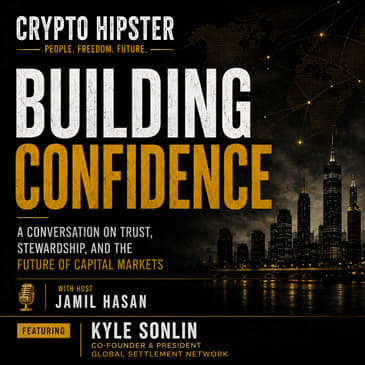

What does it take to build trust in an industry that has lived through repeated cycles of hype, collapse, and reinvention?
In this conversation, I sit down with Kyle Sonlin, Co-Founder & President of Global Settlement Network, to discuss the founder's journey behind the technology.
Rather than focusing on products, we explore:
• Building through multiple market cycles
• Leadership under pressure
• Stewardship versus ownership
• Lessons learned from the FTX era
• What institutions need before they'll trust new technology
• Why confidence—not hype—is the foundation of lasting systems
This is a conversation about resilience, leadership, and the people building the future of capital markets.
#CryptoHipster #Leadership #Entrepreneurship #Blockchain #Tokenization #CapitalMarkets #Stewardship #DigitalEconomy
[00:00:04] This is the Crypto Hipster Podcast. This is not a traditional interview show. These are perspective-driven conversations with founders, builders, and independent creators shaping what comes next.
[00:00:26] We go beyond headlines, beyond hype, and beyond price to explore ownership, freedom, and opportunity in the digital economy, where builders talk freedom, not price.
[00:00:47] Welcome back to another episode of the Crypto Hipster. This is Jamil Hasan, where I explore the people building the digital economy on this podcast. My guest today is Kyle Sonlin. He's the co-founder and president of Global Settlement. Kyle has been working in blockchain and digital assets since 2015, building out the interaction of capital markets, tokenization, and institutional finance.
[00:01:15] Along the way, he's founded companies, raised capital, authored a bestselling book, and spent years helping bridge traditional financial markets with blockchain technology. Kyle, welcome to Crypto Hipster. Jamil, thank you for being here. It's a pleasure to be able to chat with you today. I'm looking forward to this. So, thank you. So, I want to find out first, before we get into blockchain, before you get into... I want to find out, what was your journey before blockchain?
[00:01:45] Yeah, well, look, I mean, I follow somewhat of a young entrepreneur's pathway. I've been working in the blockchain industry, as you mentioned, for a decade plus now, and I'll be 30 in October. So, before I was in the blockchain crypto space, I was at the University of Miami. I'm from Philadelphia, the greater Philadelphia region in Doylestown.
[00:02:12] And there I was a trader doing a lot of stock market work and small entrepreneurial ventures. Then I came to the University of Miami on a scholarship. They sent me down, and Miami was actually a big crypto hub even at that time. And so, very quickly kind of fell into the tech and venture scene in Miami, where I still live, and raised my first venture round when I was in college for my first business.
[00:02:39] We grew that business to 20 plus employees. And we can dive into some of the things that company did. And then I sold that business, and now I have a new one. And so, it's kind of been in my blood, building businesses and working in the blockchain space have gone hand in hand with pretty much the entirety of my professional career.
[00:02:59] In 19, you go to college, you're from Doylestown, which is the Rust Belt. You know, you go to my, and you get into crypto. Like what sparked your interest in financial markets immediately? And what made you believe that this technology could become foundational? Sure. Yeah, well, look, I started trading stocks. And the thought process there was that I knew I wanted to be an entrepreneur.
[00:03:26] But at the time, I always felt that I wasn't creative enough to think of the idea that was going to make me a billionaire. And I say that with a little bit of tongue in cheek, because knowing what I know now, it's about everything else much more than it is about the actual idea. But as a young person, I just didn't know where to start. And certainly back then, there were much less options with respect to using AI to find resources on how to build a business.
[00:03:53] It was also much more geographically locked where, again, somebody in an emerging market or in a small town, I think had a much more difficult time building a tech business than if you were in San Francisco proper, right? And today, it matters much less. It still matters quite a bit, but it matters much less.
[00:04:14] And so my theory was, maybe if I learn how the market responds to decisions that companies are making, that is going to be the most productive way for me to understand what decisions I should be making with my future business. And so I started in the big tech category because I was interested in technology.
[00:04:38] And, you know, I had a few pretty huge winners in the mid-2010s that propelled my intensity and I helped manage a variety of capital across different people in a very informal way. But I had a view for what these tech companies were doing. And obviously, looking back, making bets on Tesla or Amazon or NVIDIA in 2012 or 2015, you know, everybody would look at those companies today and say that's a no-brainer.
[00:05:07] At the time, it wasn't that clear. And so as that became a bigger portion of my portfolio, that's where I was exposed to the Bitcoin sector. Always been a philosophy guy. I took Latin for seven years. I really enjoyed Greek poetry. And philosophically, I found the concepts around Bitcoin very interesting. And that's where I began deploying there.
[00:05:34] And again, as that became a larger portion of the portfolio, you start to pay attention a little bit more when your stocks are going up. And so that started to drag me into it. And I happened to be in Miami, which was a, at the time, and still is, a hub for a lot of that sector. And I attended the North American Bitcoin Conference a few years.
[00:05:53] And one of those years led to an opportunity to work with a firm building blockchain technology solutions who needed a sales business development kind of face of the Western market as they were Asian-based. And I took that opportunity and ran with it, traveling to probably a dozen countries while in college on stage, jet-setting around the world, talking about blockchain technology. And I could never get enough.
[00:06:23] Awesome. Awesome. So before I get into the first company, Greek poetry. I just took my son to see The Odyssey yesterday. So I thought it was great. Yeah. Yeah. I thought it was amazing. So, okay. So you're in college. You're at big tech. 2015, Amazon is the big tech doing well by 2015. They weren't doing well in 1999.
[00:06:48] You were in college in 2015, and you saw something that everybody else overlooked. Well, you just said it. You know, what was that thing that you saw that everybody else didn't see, but you did? Well, look, I think across my career, you know, an early mentor of mine recommended if I wanted to learn how to trade stocks on the market to read The Intelligent Investor by Ben Graham.
[00:07:14] And if anybody's not heard of this book, Ben Graham was the teacher at University of Chicago for Warren Buffett. So this is kind of a old school, you know, 1950s economics professor who wrote this tome. It's quite literally, it's a dense read. You better be prepared.
[00:07:40] And it discusses quite a few things that I think have been lost to our investment community these days around book value investing, which is the idea of if you strip away marketing, if you strip away the supply and demand economics, and just look at what a company is actually worth from its nuts and bolts.
[00:08:03] If you can buy companies that are worth, that are trading for less than what you think the nuts and bolts of the company is actually worth, then you are never going to lose over a long enough timeframe. And that is essentially overly simplified, but the Buffett-Munger entire strategy of Berkshire Hathaway is buying companies that have more value in the company than what the market thinks.
[00:08:31] And that often usually means they're boring businesses or they're not something that's trendy, but that's where the value lies. And again, long enough timeframes was a really large lesson that I took. And I think that I've consistently across my career prioritized the compounding interest of my time.
[00:08:53] And I recognized as a young person that the one value that I had over any investor on the market generally was that I was willing to and was able to take long tail bets on the things that I'm investing in, knowing that I am looking for 30 to 50 to 75 years of compounding interest on an investment. And I'm competing against guys that just don't have the same timeframe.
[00:09:20] And I've taken that approach with most of my companies as well, where I was comfortable being early to a market, knowing that as long as I can survive long enough in that space until it does mature, I will have incredibly strategic position by being early into that sector.
[00:09:38] And I think the difference in the public markets is that even taking a two to three quarter view on a particular company at the time and even today generally seems to be longer term than what the average investor is looking. Everyone, and it's only become more prescient today, everyone's looking for the headline overnight.
[00:10:04] Everyone's looking for the immediate 2x of their money or 10x of their capital, or everyone is really focused on immediate dopamine returns of the investment that you made. And I think my priority has pretty consistently been, I would much rather buy things that I believe in from quarter to quarter and look at where I think it is today and where I think it might be in three, five years from now.
[00:10:28] And if I'm comfortable with the idea that five years from now, I think it'll be worth more than what it is today, then it doesn't really matter what the stock does tomorrow. Because I'm pretty confident that it'll be worth more than what it is today.
[00:11:08] Right. Right. But you have been a builder who's experienced multiple market cycles, right? So what period in the past 11 years has tested your conviction the most? And were there moments where you questioned even staying in the industry? Well, for sure. The test question is a very interesting one.
[00:11:32] I think that the answer to when I was tested the most and if I questioned staying in the industry probably are aligned, right? As your worst moments professionally are also the ones where you consider other options. I think that the collapse of the FTX debacle was, I think, the most difficult for me.
[00:11:56] You know, at the time I had built a business with a business partner that was a data company. It was called Security Token Market. And we were the largest provider of secondary market data for broker dealers around the world that were trading tokenized specifically securities. So equity, real estate, debt, a variety of other what they now call them real world assets.
[00:12:24] At the time we were calling them security tokens, which were just tokenized versions of securities products, investments. And we built that business on the back of multiple fundraisers from family offices and venture capital firms around the world. And I was leading up the operation at Security Token Market as CEO. And we grew that data business to about $25 billion worth of assets trading around the world.
[00:12:52] And worked with a variety of different brokers and exchanges on, you know, marketing and advertising. We did a variety of content. We had the largest podcast, the news show in the industry, created research reports. And it was a pretty big operation. We also did a lot of consulting work to help issuers in structuring their products, as well as how to list those products onto exchanges and things like that. And so we had been building this company.
[00:13:22] And as we had mentioned, it was really the first venture backed business that I had been a part of, that I had started with my business partner. And when the FTX situation fell apart, it was really tough because we had no exposure to the actual exchange. We didn't hold anything in crypto.
[00:13:42] But coupled with how hostile the regulatory regime was at the time, coupled with how durst the venture capital market was at large during the Biden presidency, where just the 2021 vintage got crushed by venture capital. No one was returning on their funds.
[00:14:06] The NFT boom was a total bust, of which I was calling from the beginning. And I felt that we had maybe missed our moment, that maybe the market was rejecting this idea of tokenizing securities. You know, when FTX collapsed, what went out with it was most of the other venture backed companies and their funding. So it was very difficult to raise capital.
[00:14:33] It also was very difficult to find revenue because most of our customers were venture backed businesses. And so if you can't raise money, you're also not spending money. So we kind of got hit on a few different fronts. And it was at that time, my mother also had aggressive stage four lymphoma. And it was her second battle with aggressive cancer. And I remember it was October as FTX was collapsing.
[00:14:58] And my mother brought us brought the family on a phone call at 9 a.m. in the morning on a Thursday and prepared to say goodbye to us and told us that that she loved us. And she's a nurse, but she she did not think the direction of her health was going up.
[00:15:15] And so I think that all of those things having to handle 20 plus layoffs, incurring serious debt, managing and maintaining my company and selling my strategic investment positions just just to keep the business afloat while dealing with with some pretty strong personal situations. I think that by 2023, I was in a I was in a rough spot as the market didn't really improve. And and I didn't know who I was.
[00:15:43] Right. And my entire business and personality and life was was this industry and specifically this company. And and that's when I had the opportunity to turn it around with with some persistence and with God as I'm a faithful man. But but yeah, so I think that that was a pretty a pretty tough position. But but look, I've dealt with the boom and bust cycle before. That was probably my third or fourth bear market.
[00:16:09] And I knew at the I knew as long as I just kept surviving that you just got to keep keep one foot in front of another and and find your opportunity to build again. Yeah, I agree. I agree with 95 percent of what you just said. I'm sorry about your mother. I lost my father when I first came into the to the industry. That's OK. That's it. It's been a while.
[00:16:33] Oh, 2017. But you said the NFT was a total bust. It wasn't a complete bust. There was some usefulness out of it and the usefulness. And I just reexamined that. And one of my latest books is what lasted. What's evergreen is the artist and founders philosophy. That that held up beautifully.
[00:16:59] Talk about the token, about the art, about the tokenized art and all this. That stuff fell away. But like their life journeys, their life stories, their backgrounds, they've all held up and their philosophy evolution has held up. So I know that, you know, during FTX, your philosophy was different than your philosophy is now. So how has your philosophy changed in those years since FTX? And how do you feel you're in a better position today?
[00:17:27] So one of the difficulties of building a data company and just to maybe close the loop on that, the fortunate news is that that business did survive. And it was acquired by Redstone earlier this year after quite a long journey, you know, eight years or seven or eight years of that business's life cycle. So it did, you know, recover and have a successful ending of that chapter of my life.
[00:17:55] And all credit goes to my business partner in negotiating that deal after I had started working on the next project. The problem with running a data company is that I wanted to get my hands dirty on the actual deals.
[00:18:11] And if you're an objective media person and you're a data company with which your customers would be your competition, if you were to be actually working in the industry, I felt very handcuffed in how I could get engaged in these actual transactions.
[00:18:29] And so when I was able to take a step back, when the market slowed down, when it was time to kind of readjust focus in 23 and 24, I wanted to go back to the drawing board and figure out, you know, what's the reason why these tokenized assets have not been adopted? And I kept going back to try to be adopted. What were the quantitative, quantifiable benefits to tokenization?
[00:18:58] Why tokenize? Because no one in a large company or institution is going to risk their professional career and reputation on an evangelistic cause. Thinking that it's interesting or exciting or novel or even embracing that this is the future.
[00:19:17] Those are not compelling from a quarter to quarter key performance indication based management style, which is what most investment companies focus on. And so if we were to convince the world that tokenization is the future, I need to be better at communicating and perhaps need to build a business whose sole focus is delivering a lower cost of capital.
[00:19:46] Or higher revenue. And if you can't reduce the cost in a measurable way or increase the revenue in a measurable way relative to the traditional way of doing something, there's nobody in the market that's going to use your solution.
[00:20:03] And so that was a really important reframing for me where it went from, hey, the technology is super innovative, which is I think where we started to, wow, this is capital markets infrastructure that helps me get real deals done.
[00:20:19] And by communicating it that way and by positioning my new company, Global Settlement, as a solution to a variety of money movement problems all around the world and actually addressing those things with numbers, with facts, with stats and with real world transactions.
[00:20:43] We, I think we're able to break through the simple, wow, that looks really cool, but you're too early because I can now demonstrate in a variety of ways how we're immediately delivering returns to our clients and our customers in a way that I'm not sure anybody else in the blockchain sector is.
[00:21:03] And so that is a really important differentiator and perspective shift that I had only after actually getting my hands dirty and actually seeing where the problems lie in a transaction and solving for those things instead of what sounds sexy on social media. That makes all the sense in the world to me. And so it's building the back office and the front office at the same time, really.
[00:21:31] It's doing stuff that people are actually willing to pay for. And it sounds crazy or oversimplified. I think a lot of it does come down to, you know, compliance, for example, is a lot of back office work. And so to your point, some of those things for sure are incredibly valuable. But I mean, front office is maybe a good way to describe it as well, right?
[00:21:56] There does need to be somebody that is interfacing with the financial institutions at their level, as opposed to trying to force these companies to come on to our rails. That's just probably not how it's going to work. And that's how everything, that's how most protocols have been designed in this industry over the decade. It's like you're building this, you come up. Yeah. Yeah.
[00:22:17] And I think that's just a very failed strategy in the capital markets lens, perhaps in other industries or use cases that can work. But in my experience, if you're a broker dealer, you are a financial services company. And it's a very competitive space.
[00:22:39] And the last thing that a broker dealer wants to do is also have to try to be a tech company so that they can build integrations into your blockchains. And these blockchains, in my opinion, have failed dramatically because they've raised so much money and they have these huge token treasuries. And yet none of them actually invest resources in building usable applications for the financial sector on top of their system. Everybody builds a blockchain and then just as to your point says, hey, come build on us.
[00:23:09] And I just think that that is a really inefficient approach. And I think we've seen that in the sense that not much actual banking activity happens on chain aside from maybe stable coins. Pretty much everything else has been very slow growing. And I think that a big part of that is because none of these firms in the tech space are actually building what the financial services firms need in order to do these deals. Got it. Got it.
[00:23:35] So what has to exist before institutions trust the technology? Well, there's a couple things. So one, we mentioned it earlier, compliance runs the financial services industry. And this is something that a lot of people don't like and is very frustrating, but it doesn't change the fact that it is what it is.
[00:23:57] Like you don't get to just decide to drive at 150 miles an hour on the highway because you don't like the speed limit. Right. Like you're going to go to jail. Right. Like whether you like it or not.
[00:24:12] And this idea that we could just build permissionless decentralized systems and that there are going to be firms that are going to be comfortable taking on not only the existing risk that they're used to, but now additional risk and liability because of the fact that there's nobody else on the other side to provide that kind of counterbalance on the risk and liability side. That just if you really think about it, it makes no sense.
[00:24:41] And so one of the big things that we saw is that KYC, AML, all of the compliance based logic for enforcing licensure and enforcing anti-money laundering and a variety of these things is not communicated very well using traditional blockchain solutions. They do not store enough metadata in the transaction. So a good example of this is Coinbase.
[00:25:08] If you have Bitcoin in Coinbase, you are not able to transfer that into a brokerage account, even if the brokerage account could custody Bitcoin. And the reason why is because a lot of these Bitcoin transactions don't comply with something called the travel law.
[00:25:26] And the travel law states that if a financial institution is accepting capital for a client, the sending bank or institution also needs to send your compliance information so that they can double check that the funds came from both sides. And if I send Bitcoin from a different institution that doesn't comply with travel laws, that receiving bank or firm will not be able to accept those funds.
[00:25:55] They'll either return them or they won't accept them because it doesn't follow the anti-money laundering policies that they're required to follow. And a lot of that is on the blockchain side because many of these blockchains don't store enough data or have the capacity to store enough data to even comply with this, even if we wanted to. And I certainly understand that some people don't want their information online. They don't want to have their identities exposed. That's OK.
[00:26:24] You can use whatever you'd like. But most people don't mind. And most people prefer that they have systems where if their stuff gets stolen or hacked, that they can call somebody and have that transaction reversed or have those funds recovered. And I think that in a variety of situations, not only that, but when you talk about securities, you talk about ownership in a house. If you lose the password to your MetaMask wallet, that shouldn't mean that you just no longer own your home.
[00:26:54] Right. Like like like that's not how the real world works. You still own your home. So so having having and building solutions that allow for us to maintain living in the capital markets society that we already prefer and exist in. And by the way, the one that is maybe the most liquid ever in history, maybe we don't need to disrupt every piece of it.
[00:27:17] And one of those things that I don't think actually needs to change is how institutions are held accountable for transacting between each other and preventing fraud, money laundering and a variety of these types of systems. And so that's one example I can dive into a few more of, I think, where crypto has not met banks, where they where they are and where they have to be, according to Dodd-Frank and a variety of other very strict rules.
[00:27:45] Following a huge financial crisis that almost ruined the entire economy. Right. It's not like these rules were were put in place for for nonsense reasons. You're the first person other than me who mentioned Dodd-Frank and the 600 plus people I've talked to. So good on you, you know. Yeah. I have my background's AIG, so I know all about that. But sure.
[00:28:10] You said something interesting was that and I could dive into that for hours, but I'm not going to. You could I guess you could sell your Bitcoin at a Coinbase and then get a brokerage account. Yeah. You know, you could do that. Right.
[00:28:26] But listening to how you spoke there, you know, I want to find out, you know, at some point, you know, founders stop simply building products and begin, you know, not just owning systems, but stewarding them and making sure the next generation is able to inherit them. Right. Sure. So what is what does stewardship mean to you and how do you balance innovation with stability?
[00:28:55] Two wonderful questions. And while they may be intertwined, could both go in totally different directions. Stewardship is something that that I think about quite a bit. You know, I'm going to be getting married soon. I'm spending a lot of time thinking about my family's legacy and how I'm writing my own chapter of what that looks like.
[00:29:22] And hopefully there are, you know, many future generational chapters to come. And I think a lot about the stewardship from family, from relationships, but also professionally. And as somebody that's been building in this particular vertical, and I mean this in a humble way because in a lot of it's not necessarily like it made me that successful.
[00:29:51] One of the earliest builders in the tokenized securities in RWA space. There weren't that many of us back in 2017. I've thought quite a bit about the legacy of changing the world and making an impact on the world. And when I look at one of the most compelling phrases in the crypto space, banking the unbanked.
[00:30:20] That is a just such a tremendous opportunity. And I feel that with the business that I'm building, we are maybe one of the most direct solutions to that particular adage. We now work with eight different governments and have conversations with dozens more in building direct payment solutions for their populations.
[00:30:48] Helping them finance infrastructure projects all around the world that deliver jobs, deliver opportunity to a variety of markets where they have a lot of value, but have been shackled by the traditional swift banking system, to be quite frank with you.
[00:31:07] And one of my favorite fun facts to tell to clients and partners is that there are 14 countries in Africa that use the French dollar as their national currency. And the French don't even use the French dollar, right? The French use the euro.
[00:31:25] And so these African countries are forced to bank through the French banking system for all of their central bank policy and are unable to transact outside of it. And so think about the implications of that if all of your currency has to be exchanged through a franc system,
[00:31:48] with which there are very few forex trading pairs because there are very few French francs out there outside of France. And so these 14 countries are not the only ones that experience severe economic colonization. It's just the most extreme case and the easiest one to explain on a podcast. But there are dozens of countries that have no or very little economic sovereignty.
[00:32:17] And what that translates to, as I mentioned, I like to quantify the benefits that are provided. That translates to in the first country that we announced that we have a partnership with is Uganda. And we work with a multi-billion dollar gold mine in Uganda. And so when you look at NVIDIA, Tesla, all these companies that are building AI, building rockets, building drones, building batteries, it's very natural resource intensive.
[00:32:45] And the problem is that nobody wants a mine in their backyard, which means when we need to get more resources to build the chips and to build all these data centers, you got to go to emerging markets to get the resources. And as this market has boomed, the demand has also boomed. But also the size of the capital has also dramatically and exponentially increased.
[00:33:09] And what I'm sure NVIDIA or Tesla or SpaceX or whoever has faced problems with is that you can't just wire $500 million to Uganda and expect that you're just going to get $500 million worth of gold back. That's not how that works. Not only is it overwhelming to deal with all that capital in the region and making sure that financially they can have the infrastructure to support it.
[00:33:34] We also know that if you wire money in or out one way into Uganda, for example, the average cost is 7.8% just on clearing, just on the settlement of those dollars. So that's 16%, 15%, 16% round tripping your capital in and then out of Uganda.
[00:33:58] Just before you get into regulatory taxes, and then obviously you want a risk adjusted return because you're sending money into the middle of sub-Saharan Africa. And so what that leads to is it pretty much only allows for investing in projects that are going to be generating a 40-plus percent return on your investment because you got to cover all of these hurdles before you even talk about making money on your money.
[00:34:26] And so that naturally incentivizes either super high-risk projects, which often fail and then leaves the country in a worse position than it was before, or incredibly predatory economics for the people because of the fact that the outstanding firm knows that they have to do that. They quite literally need to in order to make it work financially.
[00:34:49] And so a lot of what we do is help these institutions, help these governments build settlement, capital settlement infrastructure that allows them to receive hundreds of millions or billions of dollars of infrastructure investment projects. It also allows U.S. companies and other companies around the world to get the natural resources that they want. And it allows the people to have jobs, to build their economies.
[00:35:17] And of course, a byproduct of this is that if we build these rails for trade finance, for example, for gold, for oil, these things, we also can use those same pipelines for peer-to-peer payment. And these types of people are experiencing 20-plus percent fees to Venmo or Zelle money to each other. This is a real thing for a huge sector of the population today.
[00:35:43] And so those are a lot of those things that when I think about stewardship, building systems that allow for billions of people to feed their families, to grow and develop and building a world in which these people can have a fair shot at living their best lives, and spreading the values and benefits of capitalism around the world, and providing healthy and effective capital markets for the future generations of our world.
[00:36:13] That's something that I think really motivates me and is only possible with a blockchain system, which can be automated and decentralized in a way that it doesn't rely on me or my particular firm to steward it forever. At some point, we will be able to bring on others and individuals that I may never know that are leveraging the systems and softwares that we build to change lives of millions and billions of people. Sounds wonderful to me.
[00:36:44] Yeah. I went to a World Bank summit a couple years ago, and I was in this big, massive room, and I was right in the middle, and I asked, does anybody need hearing aid? I'm like, yeah, I need a hearing aid. And then the leaders of the different countries, African countries, sat on the panel, and they all spoke French. And I don't understand a word of French. I was there in the room for three hours listening to French speak. We had no clue what they said. Oh, God. But yeah, but I hear you there.
[00:37:14] So markets are definitely built with technology, but institutions are built with trust, right? So looking back over your career and today, do you think your real job has been building software, building a global settlement company, or have you been building confidence?
[00:37:29] I think over my career, I have been building. I think the easy cop-out answer is both because I have been building a lot of software and making people feel some type of way about it across my career.
[00:37:57] I think that I hope that just as much in confidence, we have been building excitement, excitement for capital markets, because I love doing deals. I love transactions.
[00:38:16] And I really do see the rails that we're building as a way and a means with which more transactions can happen for more people in more industries all around the world. We enable clients to collateralize and get loans and leverage against some of their less than liquid assets, which then allows them to redeploy that capital into a variety of sectors.
[00:38:41] We focus on investing in income-producing assets all around the world and scaling the private credit industry, empowering emerging markets to fire up their refineries, to build on top of their natural resource production, build on their import-export businesses, manufacturing all around the world, and financing that for market-leading rates for everyone.
[00:39:09] Because of the fact that we don't have to pay the traditional fees that most firms and competitors in the industry have to provide. Because of the fact that we own the rails, which is only the first step of our puzzle, we built the rails so that we can build these real capital market applications on top, taking advantage of the fact that we own vertically the entire system.
[00:39:32] We can deploy capital more efficiently, return better returns to our investors while still giving more equitable packages to the issuers and clients that we work with. And I do think that in a lot of ways, as I said, it just comes down to a quantifiable cost of capital position. And so I like what you're saying around, are you building confidence? I think that I'm helping build confidence in the narrative of why tokenization.
[00:40:02] I feel that when people ask me why tokenize, why use the blockchain, I feel very strongly that I have two or three great answers, some of which I've already given here on the call, of why tokenization is incredibly important for the business that we do, and why that matters and why it can't happen without it and what the benefit is. Not from a, this is really fun. This is really cool. This is really interesting.
[00:40:30] Not from a, yeah, in the future, you'll be able to X, Y, and Z. No, today, this is what happens. Without tokenization, we did a $75 million oil refinery leveraged buyout that would not have happened without tokenization. The family offices that we worked with on the equity of this deal could not move their capital out of their bank accounts in the Latin American regions with which they were based.
[00:40:58] The money was stuck in region. We couldn't get the money into the U.S. because the U.S. banks did not want the foreign currencies, specifically at that size. The firms in LATAM did not want to send U.S. dollars because it's expensive and difficult. There was a lot of compliance issues around getting the banks to work together, and we were on an explicitly tight timeline due to regulatory approval for the deal.
[00:41:26] And the deal would not have happened if we were not able to use stablecoin infrastructure to move capital out of these emerging markets into the U.S. We were fully compliant. We worked with money transmitters, money services businesses. We did full KYC AML onboarding of everybody, every counterparty involved. But without tokenization, the deal doesn't happen. With tokenization, we led a $75 million leopard buyout of an oil refinery.
[00:41:53] And we are doing this with clients all over the world and are reducing the cost of capital, increasing turnover rate, which is a big one, right? Not having to wait for three to five business days every time you send a bank wire allows us to do high frequency transactions and lending, which allows us to take lower fees because we can take higher transaction rates.
[00:42:16] And also, a lot of deals are getting done that just simply would not have happened or would not have been able to have happened without streamlining the capital markets facilitation of the capital. And so I think that we build confidence in knowing that this is the right direction for the firms that we work with beyond a reasonable doubt.
[00:42:39] And a lot of that, as I continue to harp on, comes from actually looking at the dollars and cents and being able to communicate why this saves everyone money or why it makes them more than if they were to not use tokenization at all. Great. Great. One last question. I want to thank you for that answer. One last question. How can people find out? How can my listeners learn more about your company, Global Settlement, and follow your work? Well, look, I really appreciate being here.
[00:43:06] And yeah, I think this was a really fun interview because I like that you spent some time talking about more of the human elements of building a company and of building these things. And I'm not a robot. I don't think you are either, right? We are people. I think that people like to do business with people. People like to invest in other people. I think we all want to see others succeed and specifically good people.
[00:43:31] And I'm very thankful to God that despite the challenges that we discussed on the show today and many others in my life that we've recovered. I mean, fortunately, my mother survived her very aggressive cancer experience. And, you know, that's a story for another day. But, you know, the business that I was, you know, destroying my financial situation over at the time, you know, ended up getting acquired.
[00:44:00] And, you know, I've built a new business and now I'm getting married. A lot has changed for me over the last four or five years. And, you know, I just want to tell anybody listening, like, you could be in that situation too. And no matter how good or bad things are going, things generally revert back to the mean.
[00:44:19] But that is an important reminder that just keep moving, keep delivering, keep inspiring, stay positive, stay close to your faith if that's something that's important to you. Do good in the world. And if there's a way that we can work together, you can find me anywhere, Kyle Sondland, on LinkedIn, on X. My email is Kyle at and then my website is globalsettlement.com.
[00:44:48] It's easy enough to find us online. Global Settlement is our business. And, you know, I'd love to work with anybody that has, you know, interest in working in the commodity sector. If you have deal flow or everybody knows somebody doing something in the commodity sector. So if you have relationships in the space, I'm happy to take a look or find a way to collaborate. And otherwise, you know, I try to be as responsive as I can. I'm always happy to help.
[00:45:17] Never hesitate to reach out if there's an opportunity to work together. So. Awesome. Congratulations on your engagement and thank you very much for your time today. Thanks, Jamil. I really appreciate it. Thank you. Thank you.