
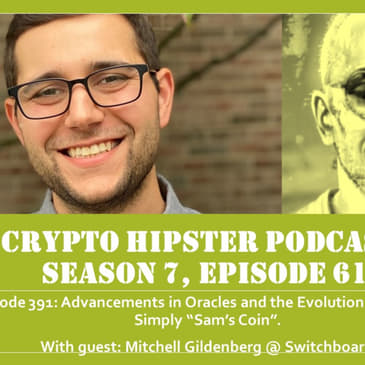

Mitchell Gildenberg is the co-founder and Chief Technical Officer of Switchboard, a fast, permissionless, and customizable oracle network that allows any developer to build the custom feed they need. Mitchell is a former third-level software engineer and technical lead of cloud services at Google, where he worked for over four years. He graduated from the University of Michigan with a master's degree in computer science.
[00:00:00] Hello everybody and welcome to the Crypto Hipster podcast. This is your host, Jamil Hasan, the crypto hipster where interview founders onto ProNores, executives, thought leaders, artists, you name it all over the world of crypto and blockchain globally and I have another amazing guest for you today.
[00:00:19] Most of my almost all my guests are amazing and have been so for quite some time. So today I have, after it's a repeat company in the past month I interviewed CEO, months ago. Today I have Mitchell Gildenberg who is the CTO at Switchboard. Mitchell welcome.
[00:00:41] Yeah thanks so much. I love the energy here. It's awesome. Thank you very much. I enjoyed you. Yeah, yeah, that's great. It kicks me off. I like it. Awesome. Let's talk about, first of all, the first question I'm going to ask you is your background.
[00:00:58] What is your background? Is it a logical background for what you're doing now? Sure. So yeah, I got undergrad masters both focused actually computer security and I was actually during this time actually in academia
[00:01:14] I had a hard time with the computer security class at university machine for a while. I left that and I did work around the industry a little bit on Silicon Valley. I ended up working at Google for about five years.
[00:01:28] Mostly on network security, kind of following the thing and working Google hardware and then I led a team actually on Google Cloud because I loved sort of the systems things I could just let you worry about scaling and applying without or having to worry about
[00:01:45] really the meat of actual physical allocations. And I got into that world and worked on network security between virtual private clouds. So basically protecting your data in corporate settings or between different services from bed actors.
[00:02:06] And from that scope, you know, the lines with self custody and guidelines or the whole blockage case and I can go into that a bit more here. Bad actors. What kind of bad actors talk about talking about scam or we talked about?
[00:02:23] Someone who would actually try to break it to your systems breaking your network.
[00:02:28] So if you have some exploit or some open work on your network that lets you win on one machine, there's a million ways you can have a cascading effect so they can infect your whole network.
[00:02:38] Take whatever information they want take whatever they want and really when you are interacting with these higher level applications. It's kind of like a service agreement saying, oh I'm working with this application. These are the guarantees that I am assuming make sure it works that way.
[00:02:54] I'm the guy who make sure it works that way. Interesting. Interesting. Yo, with your background now switch board as a CTO. What are you focused on? Yeah. So with switch board we are what we call a permissionless Oracle. Anyone can actually go make their own data feeds.
[00:03:14] I believe Chris covered this last month a bit. But really what this comes down to is if you actually look at the landscape of D5 today, what I think what is it? 167 billion dollars in that volume on D5.
[00:03:28] $63 billion dollars of that are supported by some sort of Oracle or external information from online chain. So when people come into the blockchain, they kind of assume that they have full custody of their funds. No one else can control it.
[00:03:42] But we just showed them to those stats that more than half is actually custody by these Oracle's or data providers. So really it's not so much as code is law. As what is actually confident safe data?
[00:03:55] So when we think about that, how do you actually verify what safe data? How transparent are these Oracle's actually? And that's really a big open question and only really broaching it.
[00:04:06] People have people have but it's not really broached and what the quick board is doing now is we are making a whole verifiable system. We're even the data is verifiable. Not only that, people can sort of say from all these other Oracle's.
[00:04:19] So even if one Oracle has some type of data issue that could be malicious, you can make sure to agree with all these other Oracle's and all these other sources. So it's ultimate safety over your funds that control over half of all the data.
[00:04:34] It's a different for the definition, good data and bad data. What is it?
[00:04:45] Yeah, no so imagine this. If you have some type of perp layer training, you are measuring the quotations off the price price of BTC as the underlying asset if an Oracle says BTC went to zero.
[00:05:00] All these people that were longing Bitcoin will get liquidated and all their funds will be gone. And in that case, it just destroys these protocols. It destroys these users and takes funds away and completely misaligns the trust in our your that block transfer's both bring.
[00:05:17] Even if it didn't go to zero in actuality did right. It's basically bad data and maybe maybe even. It might even be the case that these Oracle's pay properly and maybe there was some ill-equipped event on their data source.
[00:05:35] Let's say that there is only a hundred dollars of liquidity of BTC trading on whatever they're getting the price from and someone just pulls it out out. It's not technically a hack, but it's bad data and you've got to protect yourself from bad data from decentralized points.
[00:05:50] Okay, that may sound yep. I see bad narratives all the time. But you know Oracle's are supposed to circle that most of that stuff. So recent advancements and Oracle's. I'm interested in learn what they are and then why are permissionless Oracle's able to develop.
[00:06:12] It will offer developers, you know, the opportunity to build whatever they want and need. So the recent developments in Oracle's and I'll go over this first because a lot has actually been developing.
[00:06:24] So if you're familiar with Shane think which I think most people who trade are and see how the price is update, once every 30 minutes if the price goes beyond 1% change.
[00:06:34] They do this because it is really expensive to keep the price perfectly accurate on Shane and keep pushing that that there would be a lot of money for these Oracle's to actually spend to keep the price perfectly up to date on Shane.
[00:06:47] So what they do is if it varies this much, then they push the update only that gauge is passed and threshold.
[00:06:55] What's happening now is all these Oracle's are making their own data layer and then the users can bring on the most recent value that the Oracle actually broadcast. So in this case you can always get the exact freshest data.
[00:07:09] So you can really go into like much more high fidelity, much more finely grained data and not a world's. This actually lets these protocols let you trade on much higher leverage because it could be on much more accurate on prices.
[00:07:24] So we can be much more accurate you know if you have a very very skim liquidation price.
[00:07:30] You need very accurate very very very fast data so that's why they launched switch to this model and it really just opens up a lot of new use cases for freedom or just very fine grained pricing. Got it yeah familiar with the familiar with chain link. Yeah.
[00:07:54] Sergey Nazra was my hero until I went to consensus this. Is that what's that? Is there a story in that? Yeah, I went to meet him and like I said hello and he said talk to my assistant. Oh, oh. I was a holder back in 2017 buddy. Yeah, yeah.
[00:08:15] So I guess not doing the next episode. No. Yeah. Let's talk about risk management because he said you wanted to talk about some risk management perspective, you know. What are the techniques? What are the risks? You know what what what what's the latest when it comes to articles?
[00:08:37] Yeah, so I say risk management in terms of when somebody is building their platform. Let's say you're building a platform that you want to people borrow and then they go, yeah. How do you make sure you use or say are safe?
[00:08:53] Because when you want to borrow Bitcoin, you got to or when you want to lend Bitcoin and actually you know make some money off of lending it. You have to know how much the collateral you're giving will be priced relative to what you're giving.
[00:09:08] So basically if you borrow some type of asset, you have to front something in return to the protocol and how do you measure how much you have to front oracle's tell you how much.
[00:09:21] So if those pricing are bad, then your collateral could be almost nothing for borrowing let's say a hundred BTC. So if you're only relying just on one data source or that data source is a back box.
[00:09:36] These oracles like you just assume are very, very trustworthy could destroy your company could destroy your or chest could destroy your users.
[00:09:45] You really have to understand what data you're getting and everyone thinks oh what's on chain I have the full introspection I have full insight into who has custody this protocol's cost to me. Now it's really the oracle because the oracle's control in the train.
[00:09:59] So if the oracle has some not saying that the protocol has bugs I'm saying if the data is not fully transparent or not kept up to date you are at risk.
[00:10:09] So it's which we're does is we make a medium to bring all of these oracles for us together and make sure that those come to consensus first to take that bottleneck in risk away. Interesting.
[00:10:28] You guys do the push pull and there's one other method that you created to yes the call back method but that one's a little more complex usually people up for the pull one because it's the cheapest one and it covers most of the security cases based on how you actually implement it.
[00:10:46] But that's more so for the people developing these protocols not so much to users. Got it. I want to pull that or work for me. What's that? As a user I would want to pull that up to work for me so I can tell them.
[00:11:02] Yeah, basically that's where all the oracles are going out. Chainling just offered one there still in a private beta I think you have the information that sucks I think by the GMX is there one customer on right now.
[00:11:14] Then you know, Pith is a bit famous for an out for making their own out one around it and that's just the cheapest way to broadcast data at the highest speed.
[00:11:24] But you got to make sure when you're bringing this data on chain nobody can bring on older data and say oh this was still from Pith. So it's a valid price but no it's actually an hour old which was 5% less than the current spot.
[00:11:40] So you have to be very careful even with these protocols to make sure that the way they relay data is secure.
[00:11:49] So yes, I would I break it into two categories there's protocol risk for these oracles which you don't really see from a user's perspective of these depths and then there's the data risk side and those two on combination is where switch really thrives and making sure there's all things safe to you.
[00:12:07] I make sense. So you mentioned Pith yes. So I don't want to talk about Pith the moment I do want to talk about a blockchain that Pith has supported all along and that's a lot. Yes.
[00:12:24] So and then when you talk about data you talk about like I don't know what it was but as on telegram and I and I I saw all the feeds from all the tens of thousands of mean coins like up to the minute minute and I'm like I don't know what to think of it.
[00:12:41] So most being coins drawn to so I want to find out what's go with the latest is on the salana network. And you know I guess Pith's relation to chip with them and what's going on is a lot.
[00:12:53] Yeah definitely so I would say salana is definitely our home base. We have a lot of a clientele on salana most of our volume and we've about two billion dollars locked using switchboard on salana right now.
[00:13:06] And you know really we chose salana because it was so high speed and so cheap they could actually implement that original Oracle push model in a reasonable manner and still maintain the fidelity of just a few seconds.
[00:13:21] As salana has mature so as the scope of the transactions and switchboard you know switchboard I think encompasses three to five five percent of salana's traffic at the moment it's quite a lot of traffic.
[00:13:34] So when you look at actually scaling these solutions to more and more feeds for people it becomes a bit difficult and we know you know the difficulty around the historically.
[00:13:45] So when salana launched back and what was in May 2020 and I think we're on there they just had a flat fee for sending transactions. And it was all about just landing it on the validators on the leader as the network mature.
[00:14:04] It became very competitive to even get to the leader to land these transactions and since there's no mimpul if you don't land it in time your transaction just drops. So people saw in late 2021 and through 2022 up to FTX and then you know the post that story.
[00:14:24] They weren't even trouble landing anything and getting their transactions through as they had to span the network which made a problem just worse worse and worse.
[00:14:32] So to fix this salana actually implemented priority fees which is much like gas fees but in a different sense where the validators are more likely to choose your transaction the higher fuel give. Not so much so around just how much gas it takes to execute your transaction.
[00:14:54] So I'll pause there because as a lot but I can keep going on this vein of all the things that are new and different and how it's actually gotten a lot better. No I do want to know about that vein and continue with the question because you know.
[00:15:08] It's funny thing is maybe just my perspective but being now that all these beam quints have come on board and salana is focused on scaling. No security like breakdowns and the times that salana has halted and stopped has kind of ceased right.
[00:15:29] So how do you see the network being stressed tested is that improving the security? I think people are less incentivized to spam because of the priorities really working nowadays.
[00:15:43] Your transaction is not landing. People don't exactly have the incentivized to just try and keep spending or the validators are very good at dropping those ones now and not worrying about them.
[00:15:52] So really if the network gets congested the priority fees it takes to land a transaction just go up and people will adjust in that scope. And as long as your priorities are high up and you reserve the minimum amount of block space possible in your send your transaction.
[00:16:07] The more likely you'll be able to land your TX and it's gotten significantly better.
[00:16:12] So really there's been in the scope of what it was between 2022 and now it's you know Helen having interesting so besides priority fees what are the other things that this happening on salana to improve its performance and.
[00:16:30] Yeah, yeah so so I mentioned gas fees before basically you can say the mass gas then they need for triggering our transaction on eTH.
[00:16:39] On salana they kind of have a different way so they have something called compute units and you can choose the upper bound of how many compute units that your transaction can take.
[00:16:51] And how validators work is that they pack transactions into blocks by the number of compute units and it's kind of you ever heard of the napsack problem.
[00:17:00] It's kind of them trying to to to do a best fit of all these items of different sizes into a bucket as efficiently as possible. And it's actually a really complex problem to do really fast in that scale.
[00:17:13] But the smaller you make your transactions compute unit, the more likely you can land in a block because you take up less space of the block. Interesting so I would think just hearing this from the first time.
[00:17:34] Meme coins don't have a lot of utility they actually help lower the block size.
[00:17:40] I would say if you have a meme coin that is getting really popular on salana you're going to have a spot market and then you're going to have maybe some borrow them markets around that so it's just going incentivize more trading because what are mean coins there just speculation.
[00:17:56] Other than network traffic or spam depends how you look at it. So as people trade these mean coins, it really just became becomes more competitive to make it into the blocks and even for oracles it becomes more competitive to get price updates into the blocks.
[00:18:11] So in that vein why bother with competing to get into blocks when oracles can just become their own day the layer and that's why all these oracles are moving to the pole model so they don't have to compete on change to push price updates.
[00:18:25] This is beginning to make sense to me. Great. So our our goal is going to be there so okay put it in this all together then. The meme coins have really made a difference as far as the oracles are concerned and have really changed.
[00:18:49] It's more users want to compete for the blocks based traffic and just de incentivizes the oracles because especially on salana you are guaranteed landing your TX. Eventually like you can be on east depending on how you set it up.
[00:19:04] And if you're not guaranteed that people need these price updates they needed to run markets they needed to to to to the funnel value from a point of point B.
[00:19:13] So if this is such a necessity you have to go on a different competitive plane between people trying to trade.
[00:19:20] So oracles by necessity had to remove themselves from that equation because the amount of traffic that's which were as pushing and the amount of traffic that piss was pushing.
[00:19:31] Takes away from the capacity for traders which is the real market and makes it a devopsed acre you know a service providing headache for themselves. So you're really transforming the way Oracle and done.
[00:19:49] Yeah so really when we're looking at the plomodel there's now now you really like following the next step here so with pith they have their own data layer that only pith which is price updates to and then users can bring prices from that.
[00:20:05] Switchboard on demand which is our new oracle we're totally different. So what we're going to do is we don't have a bound on any data that people can bring on chain. We let users send a request for Oracle saying I want data from it could be anything.
[00:20:20] If you from ESPN dot com if you want to run some prediction market on the game it doesn't have to be a price.
[00:20:25] You said I want this piece of data now you're going to send that request to the Oracle's the Oracle's are going to do the works specified in the workload that the user requested and then they're going to put that on chain.
[00:20:37] Now they have the score let's say the Super Bowl really really alive and then they could say oh this site that this switchboard data feed said they're the Super Bowl is over and let's say Detroit lines one which would have been my dream too bad but would have been my dream.
[00:20:59] Now you can have this free form layer of the you know verifiable data providers on chain anyone in the internet it's basically now a connection between the internet and the blockchains.
[00:21:14] But more than that we wanted to capitalize on all these oracles becoming this pull air and it's all very well documented how they do their verifiability.
[00:21:27] So through switchboard anyone can actually use chain link or use pit feeds and we verify it on chain for them and they can use all these other Oracle sources inside a single data feed to switchboard and that's where I was talking about.
[00:21:44] Data security and data integrity and reducing risk because you can have multiple oracles that have multiple data sources aggregated into a single data feed that keeps you the safest. I think I'm like all of this went off. There you go there you go.
[00:22:03] I learned something new every day. Oh yeah, I learned something new after you know three something years are working on this so you know it's been a adventure.
[00:22:13] I got to tell you though yes I think you know the lions are going to be more than just Barry Sanders team. They're good team. They're going to be perfect for this year I really really hope so you know I'm I'm still based in Detroit.
[00:22:30] I'm a team's in Miami, but I go back and forth but I'm a big fan. Great so in that vein you know the lions are more than as Barry's team and so on is more than just Sam's coin right. Yeah yeah you know it's sorry.
[00:22:47] I was just how how it has it transformed you know. Yeah no it's interesting I remember in the you know salon a break point twenty twenty one on the walls there is a little QR codes get to get the Sam NFT.
[00:23:02] You know you know it's very much a meme or he was almost like a mascot in the day for you know.
[00:23:10] And you can be a mascot you know it's it's for him he was a personality and it really was and then that was also something the character he was playing you know he played into that and he admitted to playing into that.
[00:23:22] For this fight or this turn type of person on that was really directed to that. And since that it's his going he never developed it. He recognized it as a strong potential as you know a really good technology stack and he built the first.
[00:23:41] Claw on it which was serum which really bootstrap liquidity for the Jane and got a lot of community there. But that didn't mean there's any less value to this market or less value to basically a blockchain that was actually cheap to use.
[00:23:57] Because there's no blockchain currently that has that to put. And if you actually look at what's coming have you ever heard of fire dancer yet the salon a project fire answer I heard it earlier days.
[00:24:09] So the original benchmarks that salon I was doing between like a hundred validators or so was 50,000 TPS. Didn't actually make it to that because when you have more notes to have the form of consensus with it comes a little less you know efficient so in reality.
[00:24:27] Well you have is closer to 5000 6000 TPS. On the benchmarks or fire dancer which is being rewritten from scratch it's benchmarked at a million TPS.
[00:24:40] So if this comes to fruition on their original back benchmarks we could see transaction be that much cheaper for salon and that much more scalable. There's less competition which means more volume because there's more capacity for more trades.
[00:25:06] I'm trying to think who that's how fast it had there. How fast is it there I don't know if that's right.
[00:25:14] Like they're supposed to be the most with a million a million TPS that's that's that's that's the original claims and there is some documentation that they were going to do something very cool fire dancer which is.
[00:25:25] Basically a way to do validator extensions and I'm not sure how familiar with the Gdo but Gdo basically custom wrote a validator for custom ordering transactions for you know. Meth and like optimizing extractable value from order and transactions.
[00:25:43] There's a way that any new validator can come on and basically make a mark a place for plugins for ordering transactions which could be a very, very interesting tool. If the Meth market really expands.
[00:25:58] I'm not sure how much it will right now but it's a very, very attractive market because you know it takes work but some people do make it big there. I remember a few months ago there was a case where somebody made 24 million on a single trade.
[00:26:12] And then in the in the M. maybe more yes. I've only heard things about the risks on the M. maybe market and the concerns that it was a very plenty concerns plenty of concerns because they could.
[00:26:26] be damaging user trades which could be you know a malicious act if it's fear. You know targeting 90 these unbeknownst actors and they have basically on the UI of let's say a radium they believe they're buying something at.
[00:26:41] $50 and then someone could try sandwich them and make them buy it for $70. These platforms are getting smarter control that but you got to make sure that as a defy platform you're entering a you know a fair service agreement with the user. When they're trying to buy something.
[00:27:00] And what could the user do to protect themselves from rapid loss? You know it's actually really difficult without knowing the internals and you would have to like have a technical space to understand it. It really comes down to the protocols implementing these securities using these trusted protocols.
[00:27:19] I think that's a very good idea of advertising a price there could be not even slippage because it's up to these trades that happened beforehand.
[00:27:27] That could alter the price but making sure that you have a min and max range that you're willing to buy and ask that out because then you're protected from stepping across from that. And switch work and help with that.
[00:27:42] Help with the data sourcing what I'm talking about here is if somebody's trading on a radium which doesn't use oracles because that's an AMM. So that's a different case that's not oracle bound.
[00:27:57] And when met when met is involved it's involved in every aspect and even in AMM transaction ordering. So it's a wider market than just where all goals can actually pay a roll in.
[00:28:10] So I'm wondering if I'm a defy user and like the first time and I don't know what's going on mean I do to an extent. What safeguards can I as a user put in place so that I'm not caught up in this. You know. A theft.
[00:28:29] Oh, you want to call it theft or whatever you want to call it. Yeah, well you know it's really coming down to using these more bolster platforms and these platforms and implement even safeguards. Which are not perfected yet.
[00:28:43] They should really implement safeguards where you have an agreement on the price range of your asset. What's some do? Some do I gotta go there by which ones that I want to say a platform incorrectly here and encourage people to trade there but.
[00:28:56] It's getting there and they are recognizing this risk. And even Gito is helping out to make sure that there's that some user safety while helping people the transactions and you know the to self optimization self you know so you know so but those trading from themselves too, but.
[00:29:16] I want to protect all users as well. And I would think that so on is improving their user safety and security along the way. Oh, definitely definitely they don't have as much to do it actually.
[00:29:30] What transactions the validators choose in their ordering because in a reality it's up to the validators to do that. So a lot of doesn't have control on which code base these validators that are running actually use if they use a Gito validator it's their choice.
[00:29:46] So it's not really up to salon to choose that it's up to all the people running salana no it's that she's there. Got it interesting days. Oh, there's so many layers now. Yeah, yeah. Yeah, yeah. I really need to improve my tech shops. Yeah.
[00:30:11] Maybe maybe we can do some live action time you know walk those of these in some point. That'd be great. Yeah, thank you. So for now and I thank you very much for your time. This has been educational for me. I have one last question. Please.
[00:30:33] How can people find it more information about you about switchboard how can they start to use switchboard how can they do that definitely so switchboard.xby z. We've already launched our on demand model on EDM chains and on salon.
[00:30:48] You can really bring any data securely on chain now and if you want to use any oracle or if you're worried about the security of your oracle and want to bolster that. You can use our platform to bring all those sources together to keep your users safer. Great.
[00:31:09] Thank you very much for your time today and go lines. Go lines, go blue. Thank you. Yeah, that.