
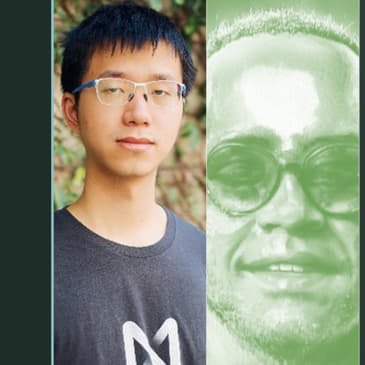

Bowen Wang is the Founder of NEAR One, the core research and development team advancing the technical frontier of the NEAR Protocol.A foundational figure in NEAR's evolution, Bowen was the original architect behind key innovations such as Nightshade, NEAR’s sharding design, and Chain Signatures, a novel way to enable cross-chain interoperability. His deep expertise in distributed systems and software engineering has been instrumental in scaling NEAR into one of the fastest and most efficient Layer 1 blockchains in the industry.
[00:00:03] Hello everybody and welcome to the Crypto Hipster Podcast. This is your host, Jamil Hasan, the Crypto Hipster, where I interview founders, entrepreneurs, executives, thought leaders, amazing people all over the world of crypto and blockchain. And today I have another amazing guest for you. I'm looking forward to this interview. I think this coin, not coin, but it has a coin, which I think is in the top 20 or top 30. It's pretty good.
[00:00:28] But this man today, he is the head of protocol at NEAR. His name is Bowen Wang. Bowen, welcome to the show. Yep, it's great to be here. Thank you for joining me. And let's kick things off and ask you first, you know, what is your background and is it a logical background for what you're doing now? Well, logical background for crypto. I'm not sure what that actually means. I mean, people in crypto comes from all sorts of different backgrounds.
[00:00:58] So, I mean, how I got started NEAR was very interesting. I was doing some machine learning research when I was back in college. And I read this paper published by Alex and Elia on neural program synthesis, which is basically, you know, what all sorts of AI tools does today for code generation.
[00:01:24] But obviously, it's more powerful now than, you know, eight years ago. So, but anyways, I got in touch with them. And yeah, so basically I joined NEAR initially for AI. But then there is this pivot from AI to blockchain happened back in 2018. So that's how I got into space. You could say that's not logical anyway, but, you know, people got into crypto for all sorts of reasons.
[00:01:54] I agree. I agree. It's only one time asking that question didn't work. It was the other day when I asked a logician. It was logical. It was like, I was like, oh, wrong question. So I want to find out what NEAR, you know, is all about, including your role, your focus and your mission.
[00:02:13] Yeah. So NEAR is all about building the user owned internet. So what that means is that we want to build this world where people own their data, money and power of governance. So this is a very grand vision and includes many layers from, you know, the infrastructure or having this very scalable blockchain that can process hundreds of thousands of transactions or a million transactions per second.
[00:02:40] Two things building on top that the transaction work that we're doing that connects different blockchains together to extract away the complexity for the end users. And then to the kind of more things building on top of those things, because we think that AI will be the interface to the internet for the future. So if you want to build user owned internet there, you know, this AI component is very essential part of it.
[00:03:05] So that's why we're also invest heavily into building this user owned AI. So including a bunch of things, verifiable inference or viable training and all the, you know, agent hosting and so on and so forth.
[00:03:21] So I think for myself, yeah, mostly focused on building the infrastructure layer, building the most scalable protocol and the most scalable blockchain, but also the chain of abstraction work on top, including chain signatures and Omnibridge, which connects different blockchains together and have NEAR be the gateway to all other blockchains.
[00:03:48] So before I get into all that, you have some pretty exciting news, right? You just launched something, you know, congratulations. Can you talk about what your major news is? Yeah, yeah. So just actually just this week, our mainnet, we reduced block time by half to roughly from 1.1 seconds to 600 milliseconds.
[00:04:12] So that is a very big change means that, you know, not only the block time is reduced, but also the time to sanity is reduced to 1.2 seconds. I think that's, you know, NEAR one of the fastest blockchains, both in terms of block time, but also in terms of finality. So that basically improves the user experience across the board. Like now the transactions become much faster. And yeah, every application on NEAR just suddenly gets faster.
[00:04:40] And I think, you know, something, you know, this kind of reduction of this scale, I don't think it happens a lot in blockchain. Right. So 1.2 second finality. Why? That sounds like it's really important. Why is it? Why is that a major, a huge deal? Yeah. So this is because, you know, when people use blockchains, you know, a lot of times they do financial transactions.
[00:05:08] And that's why they want to make sure the transaction is final, cannot be reverted. There's no like, you know, other forks, right on the, on the blockchain. So that's why the time to finality is very important. And the 1.2 second finality basically makes, means that, you know, it's the, from the time that you submit transaction to it being final, you know, it's like, just like one second. And it's really, really fast. And also it makes near like one of the, the best in terms of time to finality.
[00:05:38] Got it. Got it. I used to work at AIG and I used to, I wasn't on the settlements team, but I worked collaborative, collaborative way with the settlements team. And sometimes it would take three days, four days to settle transactions.
[00:05:53] Like I see this being a game changer for, for companies in the financial services sector, the triadify companies, you know, how do we get them to be aware and, and, and adopt, you know, your protocol to help with that, you know, they get rid of the three day thing. Yep. Is that a serious question? You could be. So, yeah. Yeah.
[00:06:21] I mean, I, I, I, I do think a lot of the traditional finance infrastructure could be revolutionized by, uh, blockchain. I mean, you already see this with payment, right? Like, um, people see the, um, the kind of convenience efficiency and, um, uh, just like reduction of costs when payments go through stable coins, uh, instead of the traditional financial system. Uh, and I think, yeah, more of that, uh, will come.
[00:06:47] So, uh, yeah. Got it.
[00:07:17] Um, for, uh, um, uh, blockchains to scale horizontally.
[00:07:47] we can change that by putting the split network into shards. So each shard can almost think of it as its own blockchain. And, you know, the nodes within the shard does the same computation during the verification, but you have a lot of shards. So that's why you can scale the network in that way. So that is, I mean, it is kind of complex. It is a, you know, difficult technical solution. And that's why many blockchains avoided it.
[00:08:15] But NIR has been doing sharding since day one, you know, since we started in 2018. And yeah, over the past several years, we've built this amazing infrastructure that can scale the blockchain linearly with number of shards. So basically the more shards you add, the better performance it becomes, better throughput it has. Yeah, so basically last year we completed this final milestone in the sharding roadmap.
[00:08:45] By implementing serious validation. And after that, the blockchain becomes fully sharded. Both the state and transaction processing are now fully sharded. So yeah, now we actually completed that original vision where the blockchain scales linearly with number of shards. And yeah, that's a great achievement on its own.
[00:09:09] And then for airchain signatures, basically this is another piece of infrastructure built on top of the blockchain itself to help abstract away the complexity of different blockchains, right? So you know that today there are thousands of blockchains out there, and it's really hard for people to reason about them. And you know, if you as a user, you can actually have like accounts on like, you know, like eight or ten different blockchains, it becomes really confusing, hard to manage.
[00:09:38] And especially for end users who are not really familiar with blockchains, let's say they want to use some app, but then suddenly they need to like, you know, log in with this wallet that they don't have, right? And problems like this are pretty common. So the idea of chain signatures is that you can use your account on NIR as kind of a control plane or like this controller that controls all of your accounts on other blockchains.
[00:10:05] So what it does is that through this multi-party computation or advanced cryptography, it generates kind of an address for your NIR account on every other blockchain. And you can directly sign transactions for other blockchains on NIR, and then there would be some relay that takes a transaction and executes on other blockchains. So what this means is that you now use a user,
[00:10:30] you can suddenly interact with a lot of different blockchains just by using the same account on NIR. And that's not even the end of it. So it's not just accounts. Well, I mean, accounts on NIR are smart contracts are also accounts on NIR. So meaning that smart contract can also have addresses that they control on other blockchains. And it means that a smart contract can natively sign transactions that can be executed on other chains.
[00:10:58] So it basically enables a lot of more interesting use cases. For example, you can have like this bridging without like actual bridge, like bridging, but then the transaction is actually natively executed on other chains because the smart contract itself actually controls the addresses. So it's a very powerful technology that brings this interoperability across different blockchains.
[00:11:25] I want to get into that interoperability in a minute. You mentioned account abstraction, right? So about a year or two ago, everybody on my show was talking about account abstraction, right? Recently in the past year, no one's been talking about account abstraction. So is that, is it because it's already been completed? It's already done? Or is there still, or is it abandoned?
[00:11:54] Or what is it, what are the challenges left with, with account abstraction? And how can your innovations help do that? So just to clarify, what I talk about is chain abstraction, not account abstraction. Those two are different. So account abstraction is basically the idea that you can have smart contract controlled accounts. You can have custom logic for how the account is being controlled, potentially multi-seq controls or whatever complex logic you may have,
[00:12:24] rather than having just the EOA account controlled by just one key pair. So that actually Nier already has from day one, right? So this one, we built it back in 2018. Yeah, we have this like very flexible account structure. You can have different keys added to your account and not just not tied to a specific key, but also you can have what do we call like access key?
[00:12:52] That allows the front end to control key that signs on user behalf, make it easy for users to interact with different applications. Yeah, those things are like we already have from day one. So chain abstraction is basically this idea that you want to abstract away the complexity of different blockchains for the end user. So the user can interact with different applications on different blockchains without really thinking about the underlying chain itself. So, yeah, that's a different concept.
[00:13:22] Got it. So I'm looking at like a bicycle wheel, right? And there's always been talk of, you know, developing this multi-chain world. So if I look at the bicycle wheel and I see Nier, I see Nier as the hub and all the other chains as the spokes in order to create this wheel, which is a multi-chain world, right? How can we deliver that multi-chain world absent of fragmentation?
[00:13:51] And what can this cohesiveness enable? Yeah. So I think, as I said, right, what we wanted to enable is it's just like smooth and frictionless experience for the end user. Because for, you know, I mean, yes, today there is relatively large amount of people adopting crypto. But that's still, you know, when compared to the consumer market, it's still a very small fraction of them.
[00:14:18] And I believe or we believe that one of the main difficulties to get to like mass adoption is that, you know, today users have to navigate this complexity of the multi-chain world that they need to think about. Well, first, you need to like even like understand that there are like applications built on top of like different blockchains. If you want, if they want to use an application, you know, they may need to get tokens for the underlying blockchain and all sorts of, you know, get a wallet and all sorts of complexity like this.
[00:14:47] And I think even for like, you know, for the crypto curious people who doesn't really have prior experience, this is something that can scare them away. It's just way too complex. And even for experienced like crypto native users, you know, when you start, you know, you have to deal with like eight different L2s, have balances there and moving across them takes like 30 minutes. You're like, yeah, this experience is not great.
[00:15:13] So, yeah, what do we want to do is we want to abstract away that kind of friction and having this unified experience for people to kind of move their assets, but also to, you know, trade their assets and so on. So we build the signature technology to have this ability to have account on air controlling other accounts on other blockchains.
[00:15:37] And then we build the kind of Omni-Bridge solution on top that allows people to bring assets from different blockchains back and forth. So now the token can not be on one blockchain, but simultaneously on a lot of blockchains. And then on top of that, we build Near Intense, which is this intense-based platform that allows people to trade digital assets. I mean, for now, but potentially physical assets in the future.
[00:16:06] So that's a place where you can do, you can easily trade like Bitcoin for XRP or like Bitcoin for Ethereum or like Savannah for Near. You can basically have this like frictionless experience to navigate this multi-chain world. So then you're not going to need to wrap Ethereum with Bitcoin. You're not going to need to wrap it anymore. You can do all that trading with Intense, right?
[00:16:33] Yeah, it's basically like for the end user, it's like, yeah, for them it's like trading Ethereum for Bitcoin and things like this, right? So in their front end, they'll just see that they're trading Ethereum for Bitcoin or Bitcoin for Solana or whatever that is.
[00:17:17] Got it. Yeah, that's correct. Yeah, that's correct. So in my opinion, they're going to be trading with Bitcoin for Bitcoin.
[00:17:45] They're going to be trading with Bitcoin for Bitcoin for Ethereum or Bitcoin for Near or like all sorts of like combinations like this very easily. And then, you know, on top of that, a lot of things can be built, right? You can have this multi-asset lending platform, right? You can borrow Bitcoin for Ethereum and borrow Near for Solana and do all sorts of like combinations like this because the idea is that they actually have balances in one place.
[00:18:09] So it makes building kind of additional infrastructure, like this very easy. And then on top of that, you can build like even build like multi-chain index on top of this, right? And you talk about institution adoption. I mean, I think, I mean, yes, there are people like what you said that believe in one asset, but also a lot of people like they, you know, like an index would be very appealing for them basically to get exposed to a variety of different assets.
[00:18:38] You bring up a good concept. Multi-chain index. Right now, there are several ETF applications that are going through the SEC and they've been denying them and putting them off and delaying, right? Are we going to need an ETF? If you have multi-chain index and you're able to create mutual funds, I guess, from there, would you even need a single crypto ETF or would you want to go to the multi-chain, you know, combinations?
[00:19:08] What do you see as being possible because of what you've done? Yeah, I think the multi-chain index is definitely like something that's very new. And I think there are different people trying to work on it. But yeah, I think, you know, with any institutional adoption, it takes a long time, right? It's, you know, from the idea being there to something being available to like an institution actually adopting it. I think that does take a pretty long time. Yeah.
[00:19:36] And from a retail perspective, what opportunities do you see for retail investors? I mean, retail, we've been relegated mostly to either buying a single crypto or meme points, right? Right. So what products do you see being able to come out down the pike? Yeah, I think just for a regular user, yeah, there's like a lot of things they can do, right?
[00:19:57] So as I said, like, you know, multi-chain, like asset lending and borrowing and just kind of a lot of this DeFi primitive that we have today can be easily composed in this multi-chain world, right? So, yeah, pretty much I think anything you can think of that exists in the DeFi ecosystem today through this transaction approach that, you know, we can bring to the multi-chain world, right?
[00:20:20] So let's say today only exists in the, you know, Ethereum ecosystem or like it only exists in the Solana ecosystem, then it can be brought to the multi-chain world. Got it. So that sounds exciting to me. The other thing we want to go back to what you said towards the beginning was about AI and inference and training, right? How do you tackle those areas?
[00:20:45] Because there's been a lot of companies try, you know, but I want to see, you know, how you're attacking the inferencing and the training and how near innovations can apply. Yeah.
[00:20:58] So, yeah, I think you probably talk about companies that's doing very complex cryptography, whether that is, you know, zero knowledge proofs for verification, like for machine learning, or it's more like, you know, FHE based approach to kind of encrypted model training and inference.
[00:21:20] I think, yeah, those are definitely, you know, cutting edge technology, but I think the problem there is that they're still more in the research stage because basically they're not yet super practical just because the overhead is super high, right? So I think the best knowledge prover today is probably as like somewhere between like 1000x to 10,000x overhead, right?
[00:21:47] And if we want to do inference, for example, you don't want to wait like 5,000x longer than, you know, what a centralized inference server can give you. So, so I think, you know, those things are, I would say like, you know, promising in the long term, but I would say right now it's not really practical. So, so Nier is taking this approach with trusted execution environment.
[00:22:13] So it is something that is, that got, that got a lot of improvements over the years, especially in the, in the recent years, which the latest Intel CPU supports TDX, trusted domain execution. And, and also it's, and also it's exported on the latest NVIDIA GPUs as well. So that actually allows you to have end-to-end verification for things like model inference or model training.
[00:22:39] So basically you can verify the signature that attests to the computation being done correctly. It is basically, I think it's good trade-off between this decentralization, but, but also speed. So this, this approach gives you very, very low overhead, right? So compared to something like, you know, what do you get with zero knowledge proofs?
[00:23:02] This thing only adds about like, you know, five to 7% overhead, you know, in comparison, like the knowledge proofs, like more than a thousand x overhead, right? So it's just like huge difference. So this is what makes things practical today. And, and yeah, that's what we are putting a lot of effort into. So we actually can, with solution approach, we can actually have like, even like on-chain inference, right?
[00:23:25] Basically what we can do is that, let's say you have some smart contract on-chain and you want to call like a machine learning model to, to get, to do like inference. And then actually can happen because on-year, on-year protocol, there's unique feature that allows you to basically pause a transaction. And then, you know, you can do something like off-chain computation and then resume it later.
[00:23:44] So inside a smart contract, you can, you can call this like model off-chain and then later when the results come back, you can verify that, oh, indeed, this is, this computation is down by the correct model. And then, yeah, after you verify that, you resume the transaction on-chain. Interesting. So I want to talk about, you know, NVIDIA and the GPUs.
[00:24:10] People are confused about, you know, what NVIDIA's role is compared to blockchain's role. You know, NVIDIA, people say NVIDIA just makes chips. You know, other people say it has a bigger role and responsibility in the AI future. You know, with this inferencing, how do you think you, how do you think blockchain could collaborate with what they do and then with what you do? Yeah, I think, I think, you know, which, like, with blockchains or not, right, you still need GPUs for model training and inference, right?
[00:24:39] That, that, that doesn't really change. So the, the hardware part doesn't really change. And, you know, today NVIDIA still offers the best GPUs and they're constantly innovating on getting, getting better GPUs. So, I mean, I would say that part needs to happen regardless. And then blockchain just adds this, I would say, verifiability to things and also enables the decentralization of, you know, whether it's model training or like inference.
[00:25:06] It, it enables additional things, but like, you know, fundamentally you still need GPUs to do the computation. Got it. That makes sense. Awesome. So I have a couple more questions. One is, the first one is, what should we expect from your team going forward? Again, congratulations on, on the 600 millisecond blocks. It's great. What can we expect from, from you, for, from your team for the near or medium term going forward?
[00:25:36] Yeah. Yeah. So a number of things, actually, we have a lot of stuff on the roadmap for this year. So yeah, one, I think one big direction is that we're trying to push the limit of scalability, right? So I think last year we completed this kind of architectural change that makes the blockchain really scalable. And now we're trying to unleash its full potential. And we have a goal of getting to 1 million transactions per second by the end of this year to demonstrate the superior scalability of near.
[00:26:07] And then on top of that, we're building this idea of sharded smart contracts. So basically enable smart contract to fully leverage the sharding infrastructure that near has so that the smart contract can also scale linearly with number of shards. And this is not really something that people have done before. So yeah, we're very excited to, to be working on that.
[00:26:31] And then, yeah, on the, the chain abstraction side, yeah, we are keep adding, keep improving the, the chain signatures, making it more decentralized, adding more nodes and also improve performance. And yeah. And so on. And then, yeah. And then, yeah. And then, yeah. And then, yeah. And then, yeah.
[00:26:53] There's also a lot of exciting work that's coming up on near intense and near AI side pushing the, yeah, the boundary of what this chain abstracted word that we can offer. And I look forward to seeing it. I look forward to seeing the intents and how that works too, you know. Yeah. It's all, it's all, it's, it's, it's exciting to me. So thank you, you know, and I want to thank you very much for your time today. Yeah. Thanks. Thanks.
[00:27:23] I have one last question. Oh. It's, it's, yeah. It's how can people find out more information about you, about near protocol and follow what you do? Yeah. You can follow me on, on Twitter. So Twitter handles 0118. And yeah. Follow, for near protocols, Twitter as well. Go to like near.org. That's where our website is. And you can find a lot more information there. Awesome. Thank you very much for your time today. Yep. Thanks a lot.
[00:27:53] It's great to be here.