
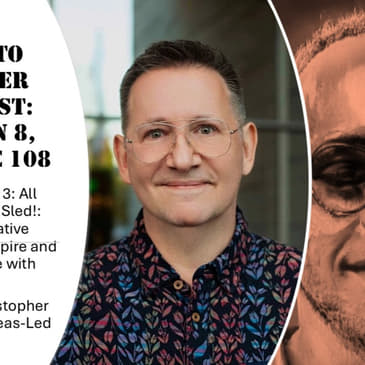

Christopher G. Fox, PhD, Founder, Ideas-Led Growth. Chris amplifies voices. As a communications and marketing strategist, ghostwriter, and mentor, he helps people who have a passion for change to develop and deliver messages that influence and inspire. He works with founders and C-level executives in fintech and financial services organizations of all sizes. He also helps innovators and entrepreneurs increase their presence and impact in the communities they serve. Prior to his corporate world career, Chris taught literature and culture at the undergraduate and graduate level. He holds a PhD in French Literature from The Johns Hopkins University.
Linkedin: https://www.linkedin.com/in/christophergfox/
Newsletter: https://www.ideasledgrowth.com/newsletter/
[00:00:03] Hello everybody and welcome to the Crypto Hipster Podcast. This is your host, Jamil Hasan, the Crypto Hipster, where I interview founders, entrepreneurs, executives, thought leaders, amazing people all over the world of crypto, blockchain, and really amazing entrepreneurs as well. You know, I have an amazing guest for you today. He's the founder and CEO of Ideas-Led Growth. His name is Christopher Fox. Christopher, welcome to the show.
[00:00:31] Thanks for having me, Jamil. I'm really excited to do this. You're very welcome. I'm glad you're here. And let's kick off the same question for everybody. What is your background and is it a logical background for what you're doing now? That's a fun question. I'll start with the logic part first because it's an absolutely illogical background for the work that I do now.
[00:00:56] So I started off my journey into professional adulthood as an academic. I got my PhD in French literature. I was all set to be a university-level professor. I did that for two years. And I realized that I was very passionate about the topic. I loved the research. I loved the teaching.
[00:01:19] The professional environment was toxic at a level that I just could not possibly imagine sentencing myself to a life of that. And so I escaped. And I moved into kind of a variety of roles on my journey to being an entrepreneur.
[00:01:39] I worked at a consulting firm. You know, you kind of can see the relationship between literature and the academic world. And like, well, what's the nearest analog for that in business? Well, content. So I was a content engineer way back in the days where, you know, we're working to get with clients to pull together, you know, what's the information architecture for their digital platforms? What kind of content do they put in there? All of those kinds of things.
[00:02:07] And then over time, that evolved into more strategic and more consultative roles around, well, not just what's the content, but what's the point. And that's really what has led me to what I'm doing today, which is you'll see why it's so illogical is my expertise and the purpose of ideas led growth is working to do strategy and writing.
[00:02:33] For any company that's in the kind of institutional finance and capital market space, whether it's a traditional institution or a fintech or a crypto innovator or a blockchain innovator, any of those things, and to develop their thought leadership strategies and then to write the content around that thought leadership. Awesome. Yeah, awesome. I do something similar.
[00:02:58] You know, my podcast, I call them thought leadership podcasts, which are, you know, grab people's information more than just like, what is your token price? What do you token do? What is your, you know, who are you? Where are you from? What are you doing? Why? You know, so I want to find out, you know, and why is important because you have a company ideas led growth.
[00:03:21] You also have another one called Syncrisys, right? What are they all about? And how do you focus on translating complex innovations like blockchain into compelling stories? Yeah. So let's start with talking about the two companies. So Syncrisys is the old name of the company. I started Syncrisys in 2007 and we were really focused on a range of industries.
[00:03:50] I had clients in financial services. I had clients in healthcare, clients in education, and we were really focused on, I guess the simplest way to put it would be high quality content and high quality user experience to deliver that content. Over time, I got more and more focused and started to shed some of these clients and other industries because the thing that was most intriguing to me was finance.
[00:04:19] You know, dealing with clients that are really working kind of the internal plumbing of the global financial system and how the global economy actually works. Like, wow, that's fascinating. The clients that I had, you know, I think this is true for any entrepreneur, a combination of strategy and good luck to build some relationships with clients that are truly driving the global financial system.
[00:04:44] I was like, wow, this is really, really fascinating. And so I sort of telescoped in more and more to capital markets, institutional finance, and not just any kind of writing like education or product marketing or whatever it might be, but really focusing on thought leadership.
[00:05:03] Mostly because that's the hardest stuff to approach in these things where you really need to understand the full asset lifecycle, whether it's a traditional asset or a novel asset on a blockchain. You really have to understand the institutional ecosystem where, you know, assets are created, they're traded, they're interactive with, they're accounted for, they're regulated.
[00:05:28] So you have to understand the regulatory environment as well. And that really just lit everything up for me. Like, wow, this is so hard and so exciting. And I love writing about it. I love figuring out what to do. And so I, I think it's at this point, it's two years ago, I changed the name Synchrosis, which no one ever understood what that was about. It's a very obscure ancient Greek reference. Like, why would anyone get that?
[00:05:55] What's really obvious and clear is you call it ideas led growth. And exactly what that phrase says is what I do, which is I work with clients to identify their ideas and to articulate those ideas in a way that makes them a source for growth. Because what I believe is that every product, and this is true in finance as well as pretty much any technology environment.
[00:06:21] It's an idea about change, right? Why else would you commit all of your time and energy and put your livelihood at stake as an innovator if you don't have some belief about change in the world? And so I wanted to work with clients to help them get their ideas.
[00:06:40] Like, I call it the black hole of content marketing, where you're just constantly like generating more and more content for no purpose and no reason other than to rack up engagement numbers and do things that don't mean anything. And so my vision was to let's focus on those ideas and look at those ideas as an engine for growth.
[00:07:02] And then once you really understand, well, why are my ideas different about the market than some competitor or someone else? That gives you the place to say, like, OK, well, stories, storytelling, everyone loves to talk about storytelling. But stories are only compelling when they're about something. And when the person you're telling the story to can see themselves in the story.
[00:07:26] So it was helping clients understand that, like, that ideas generate growth and that without the ideas, you're just kind of generating empty content or telling stories for the sake of nothing. Versus pursuing these connections between ideas and really driving innovation in the market. Not just I have a product and I'm going to market it with a piece of thought leadership because everyone does white papers.
[00:07:52] But I'm actually intentionally creating change in this market. I love it. I love it. It's what I try to do with my podcast. So I do want to see how you are successful. And so the important thing is to ask you about the grace method, right? What is the grace method all about and how does it work? Yeah.
[00:08:20] So the grace method is really the kind of the mechanics of what I was just describing where, OK, you have all these big high level philosophical notions about ideas led growth. Well, how does it really work? So the grace method, it's an acronym. It stands for generate, reorient, act, communicate and expand. And I'll just quickly highlight what all those are.
[00:08:45] So generating ideas, you know, a lot of a lot of times you think, well, I'll just sit and I'll brainstorm or we'll brainstorm in a room together and we'll come out with some ideas. The generate phase is much more systematic. It's taking, you know, whether it's a large established company or a startup, you start with their strategic intent. What are you actually trying to do in the world?
[00:09:08] And then you break that down into brand values and then you say, well, like these are the nugget ideas we have. You know, let's say we're looking to use the blockchain to decentralize the issuance of. Of of a bond like instrument, for example.
[00:09:27] Or let's say we're using a particular accounting method to make it easier to do reporting for hedge funds so that they can meet the regulatory and compliance requirements that they're subject to and they can meet their investor needs. So it's something like that, being able to break that down into root level ideas.
[00:09:50] The next phase is this is something that I don't really see other like so-called content strategists doing, which is it's not just generating the ideas, but reorienting your business around those ideas. It's great to have some idea about straight through processing. But if you're delivering your services to clients in these weird silos that don't actually talk to each other, there's something wrong. Like what you're saying and what you're doing don't align.
[00:10:19] So in really simplistic terms, the reorient phase is more changing how you talk to customers and how you deliver service to customers in a way that's consistent so that what it matches what you do is what you say. And so that's the reorient phase.
[00:10:36] And it's really important to do that because for thought leadership to be credible, you have to have whether it's a proof of concept or a really robust point of view or a survey driven approach or based on client experience. You still need to act on your ideas. And that's why the A is in the middle, because without the action, it's just fluff. You're just talking. It doesn't matter as much.
[00:11:03] It can be interesting enough, but it doesn't really change the way your particular slice of the market works. And now you think, OK, well, here's this guy and he's a thought leadership consultant. Like, where's the thought leadership? Well, now we're there at C, which is that's the communicate part. You have to do all of those things. In a reasonably robust way in order to be able to communicate effectively.
[00:11:28] That's why communication, you think it was the first part, but no, the communication is actually the output of all of these other processes. Generating ideas, reorienting your business, acting on those ideas. Then you actually have something to communicate. And by communicating it, either outwards to the rest of the market or if you're a larger organization, like you have to communicate it internally.
[00:11:54] Your sales teams need to know how to simply like talk the talk and walk the walk. Right. And also your innovation teams, if your innovation is on a particular trajectory and your product development teams are off doing something unrelated to that, something's wrong. They're not they're not going to come together. And so that's why I believe that thought leadership actually expands your business because it creates a growing and more solid platform.
[00:12:24] And so that's the grace method is really putting thought leadership in context as an engine for growth. Interesting. So your clients, mainly entrepreneurs, corporations, right? What's the mix and how do you deal with each separately? Yeah.
[00:12:41] So the mix is I'd say it's about 75% more established companies, truly like, you know, multi-decade, even century old financial institutions. Like people that have been around for a while, they really understand the inner mechanics of the traditional financial system. So that's maybe I'm just kind of making up numbers here, but that's like 50% of the client base.
[00:13:09] 25% are the startups that have made it through kind of like the unicorn type startups that have built their platform. They, you know, they've got a really solid piece of business. And then 25%, I do work with some startups and newer organizations that are doing new and innovative things because I see all of that as it's kind of like an environment, right?
[00:13:38] Like the big, in the institutional space, the big institutions and the big fintechs kind of work with each other, right? Like there's a back and forth, they provide services to each other. And then the more startup type companies are bringing additional innovation in on the edges, but they're often pursuing these institutional clients, right?
[00:14:03] Like if you're a 20 person startup with, I mean, really just pick a technology. I keep coming back to DeFi, but you've got some kind of decentralized finance innovation that would be relevant in the traditional investment lifecycle. You have to sell into these big risk averse, sometimes very cumbersome and bureaucratic mega institutions. And so you need to figure out how to do that.
[00:14:31] And it actually works out really well for me in that I'm able to see clients at every stage of maturity and help them interact with each other because they all know what each other is worried about. It's really powerful for you as a product innovator to know what the chief risk officer at a multibillion dollar bank or a multibillion dollar investment manager actually worries about all day, for example. And the same thing vice versa.
[00:15:00] If you're in this big institutional bureaucratic space, you might not have the time or bandwidth to be attuned to what innovators are doing really on the leading edge of things. And then you get caught by surprise because these things become more established. Got it. So this is something that I see. Like, how do you how do you as far as institutional clients? Right.
[00:15:28] Why should people go with you instead of I mean, going with like a McKinsey or a Bain? Why do you find that people go with you instead of that? Yeah. So I think there's a there's a few pieces to that. So, um, one being like you kind of have two paths when you're talking about this. If it's strategy driven, yes, it's definitely firms like McKinsey or Bain as does like the big brand names or smaller boutiques that will do your strategy.
[00:15:58] But then they just kind of drop this strategy on you. Like, here you go. Go, go, go, go, go, go, go, go do. And the difference being that, like, I actually work side by side with the clients as the thinking partner to take these strategies. And, you know, at the end of the day, I'm sitting side by side with the CEO or the COO and writing and thinking with them in their voice and getting like using this messaging as a lever to make things happen.
[00:16:27] I don't see the big consulting firms as doing anything like that. They can do a much more robust and analytical strategy than I can do because they've got armies of junior consultants playing around with spreadsheets and like making making up a lot of numbers. I'm not necessarily doing that. But what I am doing is, you know, the difference is that you can rely on me to sit side by side with you and then make those things happen. Which I think is very different to the to the typical consulting model.
[00:16:57] The other model is kind of like the like the marketing agency model. Like, oh, we'll do this. We'll bring a writer and the writer will interview you and. The writer will ask you all of these really generic stereotypical questions like, oh, explain it to me like I'm I'm five. And they'll like they use all of the very stereotypical framework kind of content tactics. But they're not thinking with you.
[00:17:23] They're just dictating your thoughts and in a sense downgrading them to make them accessible. But the audience isn't the audience that matters when you're making something generically accessible. But your actual audience is, you know, let's say I'm a fintech and the company that I really, really want to get my hands on is like Goldman or Morgan Stanley.
[00:17:48] You should really just be writing for that, like that one client to try to try to win that client over and write it right about things that matter to them. And that's really the difference is being that thinking partner, not just interviewing and writing, but meeting the clients where they are and being able to kind of not only write in their voices, but think in their minds.
[00:18:12] It sounds a little mystical, but it actually does work out that way where you develop this relationship of trust because you I'm able to speak my client's language and they feel that they're not explaining it to me as if I don't understand anything. It's almost like they have to defend their ideas to me. And then I'll challenge their ideas and push them forward. So that they're as crisp and as articulated as possible.
[00:18:40] And then the writing part is like the last piece of the puzzle. It almost does. It almost it becomes so easy at that point to do it that way, which I think is not something that on the agency model, they're just not able to get that closeness. They don't know the topics. Yeah. So I'm interested to find out about the appetite, the risk appetite of the people you're interviewing.
[00:19:05] From what I, from my, from my experience, and this is a few years ago, a lot of managers would prefer to go with a, with somebody that where they could afford to be wrong. Instead of actually wanting to be a thought leader, they, they saved their job by going, Oh, it's, it's their fault. We messed up. It's not my accountability that I took on a thought leadership opportunity.
[00:19:30] So what, what, what's your, how do you assess people's appetite to actually be thought leaders instead of being secure and safe in doing the wrong thing or be in their job? Well, it's, it's, it's funny that you mentioned that because in, you know, in terms of the thought leadership projects that go wrong, that honestly is a big source of my business. It's where a thought leadership project has been going on for months and months and months.
[00:19:55] And you've got this massive mega report and they've, you know, they've spent tens of thousands of dollars plus on doing this report. And they realize like, this is a piece of garbage. It doesn't say anything. It doesn't do anything. We can't publish this. It's not going to help anything. Now we need help because we've got all these sunk costs and we'd better do something. And so there, there's that aspect of like the people within my network and kind of my, my extended network.
[00:20:23] No, like, Oh, everything fell apart. Call Chris. Like there's, there's that kind of connection. But on, on the more proactive side, you know, a lot of it, this, this is an industry where people know each other. This is an industry where people typically will go from one firm to another as they take positions. And the way that I've grown my own business has been in some ways it's, it's very, it's very organic.
[00:20:52] And it's just kind of the slow spreading of, you know, like I alluded to earlier, I had some good luck in terms of just personal connections that I had that brought me in on various projects. Then you meet more people and more stakeholders within those firms. And then those people move on to other firms. It's a really common situation when some, when one of my clients leaves their current job, they go to a new firm and they want to bring me to that new firm as well.
[00:21:22] Meanwhile, the old firm that they've left behind still needs help and support. So it's like a, you know, like when you see a cell splitting, like one, two, three, four or five, like it's like that kind of growth strategy. And it works well. Like, well, I'm, I'm not looking to become a Bain and company. I'm not looking to become a massive advertising agency. I like what I do. I like having that hands-on approach with my clients.
[00:21:48] Yes, I've got a team behind me supporting and doing a lot of the work, but ultimately everything does come through me. And I'm, I'm that point of interface. And at least for now, for the foreseeable future, that's the model I want. So it's interesting that you're, you're, you're, you're basing your, your, your business model on the concept of trust and you're working in technology with blockchain and AI, which is trust less, right?
[00:22:15] How do you strike that balance so that you're the person that your clients can trust and you're working with the, with the technology that they don't need to trust anybody? Yeah, no, it's, I mean, it's, it's a great question.
[00:22:27] And that's one of those things where, you know, a lot of the places that I'm working are at the kind of the boundary or the interface point between those trustless architectures that are, you know, still relatively new and innovative and highly regulated, structured financial markets, like, you know, traditional capital markets.
[00:22:47] And what, what's kind of interesting about that is that companies that have a story to tell about the trustless space need to be able to describe why that's relevant and interesting in, in the traditional investment or financial flow ecosystem. Because if they can't, they don't get those institutional buyers. And, you know, it's fine to be a retail crypto platform if that's what you want to be.
[00:23:14] But the companies that I work with don't want to do that. They actually want to drive innovation. They want to bring the best of a no trust platform to, you know, a highly risk managed investment environment.
[00:23:34] And, yeah, there are, there's, there are really interesting points of friction in terms of how you, how you tell that story in a way that, you know, the advantages that you have on a decentralized platform in terms of speed of throughput, in terms of, you know, efficiency, reporting, transparency, all like all those kinds of things are there. And it's figuring out how to create a hybrid of those two.
[00:24:03] That's often one of the things that the clients are most interested in. So, I don't want to sound cliche-ish in my next question, but there's this, I think you coined the phrase, right? An ideas sled. What is an ideas sled and why should thought leaders get on board with the sled? Yeah.
[00:24:29] So, so I, I kind of touched on this with, when I'm talking about the black hole of content marketing, what life inside that black hole is really unpleasant. You're just like churning out stuff all the time. It's painful. It's slow. A lot of these institutions, you know, there's, there's 20 people, like there should never be 20 people working on a thought leadership initiative, but everyone's got a little job title and everyone has a little slice of it.
[00:24:54] And by the time you push it through the bureaucracy, it's this painful, slow, annoying process. And if you are someone who's in the right position to be a thought leader, you know, a senior exec, a strong innovator, someone with a really market leading point of view, the last thing you want to do is get involved in another one of these marketing train wrecks.
[00:25:21] That like months later, you end up with the thing that the writer delivered. You're like, I don't even know where to start on how to fix this. And this happens very often. The idea sled is like, what I'm really trying to say is it's the opposite. I know this word gets used a little bit too much, but it's like, it's more of like the vibe of thought leadership where like, instead of seeing it as like this big, cumbersome marketing driven bureaucratic process.
[00:25:49] What if you just don't do it that way? And you think about thought leadership being fast and fun and fearless, like being willing to go out on a little bit on a ledge in terms of some of these ideas or, you know, you go up, maybe the hill is kind of steep and you're going to go down really fast.
[00:26:07] It's going to be that forward momentum, but that's really, it is like creating an approach to thought leadership that if you are a thought leader or stakeholder or an expert, you want to do it. It's fun. You want to go on that ride again. And that's, that's a lot of what I, what I try to instill with my clients, not just, oh, we did it. We finally published this thing after six months. It's, it's no, we did it and we want to do another one. Let's, let's, I want to go again. I want to go again.
[00:26:36] And that's, that's why I call it the idea sled. It's also a fun pun because I, the, like the part of the origin story of this is that when I thought of renaming my company ideas, led growth, the first, one of the first things I pictured was what does that domain look like? Well, it's ideas, led growth.com. And then I had a moment of hesitation. People are going to see ideas, led, not ideas, led.
[00:27:03] And then what I realized is, oh, that's actually the story. I get it now. It's a, it's a fun little play on words, but it, it, it also kind of, you know, that that's the kind of fun that I like to include, you know, thought leadership is going to be very serious and very, very deep, but the process of engaging in it, it should be fun. Got it.
[00:27:29] So fun, fast, fearless AI. AI. What's the best ways to use AI in financial thought leadership? Yeah. So there, there are a lot of ways that when AI first started to crop up, the first of all, we're talking about earlier generations of models. You know, I like to think of myself as somewhat tech forward. So I experimented with them.
[00:27:55] I did the obvious, which is tried to generate like, you know, let's see if we can generate an article using these earlier model, earlier chat GPT. Models or, you know, earlier instances of cloud or whatever it is. And you generate it. And you're like, wow, this is, this makes no sense. This is terrible. I'm not worried as a, as a writer. I'm not worried. But I think that's just the entry point. AI is a part of the process that I use and my team uses, but we do it kind of at an angle.
[00:28:25] In other words, one of the first things I'll do is if I'm working with a client and we're talking about, you know, what, what is the real idea here? I now use AI to ask that question because AI will spit back to you what's conventional wisdom. And so when, when I feel like my clients aren't pushing things far enough or aren't thinking hard enough, I actually use AI to show them like, look, everyone already knows this.
[00:28:52] If this machine that's really just like a blender that spits out the rest of what everyone already knew is telling you this, that means you have to drive your idea to the next level. So I use it as, as kind of a conventional wisdom machine. There's also ways that are just like really tactical and useful.
[00:29:09] It used to be that I would, you know, let's say I'm writing on a particular topic and then I'd have to plow through hundreds of pages of regulation on how you securitize particular types of asset. Like, you know, like complex European regulations or, you know, going through and understanding what all of these different pieces of regulation might mean in a particular context.
[00:29:37] I love that AI, you just take all of these, these regulatory reports and position papers and everything. You just give it to the AI and say, summarize this for me, ask some questions about it. Yes, you still have to go back and validate it, but it's a huge time savings just to be able to crunch. Let's say you've got a client that wants to do a white paper on a topic that's similar to five other things that have recently been published.
[00:30:03] You can use the AI to just kind of crunch, crunch the text the same way that you might crunch numbers. So that's another good use case. Another use case I've found, and I don't, I don't necessarily always do what it says, but I will often share my article or whatever else I've written with AI and said, I act as a developmental editor. I give it a whole set of prompts around what I'm looking for.
[00:30:30] And basically I want it to tell me whether it thinks the thing that has been, you know, the thing that I've put together makes sense. You know, is it coherent? Are there missing topics? Are there missing angles? Are there missing angles? Are there missing angles? And, you know, occasionally it's, I'd say 35% of the time it comes up with something like, oh, I actually didn't think of that. And maybe I should include this. Other times it's just nonsense feedback and that's fine. This is the same kind of feedback you'd get from a human editor.
[00:30:59] You take it with a grain of salt. It's based on, you know, whatever so-called cognitive biases the AI might have, the same way that a human has cognitive biases when they look at content. But that editorial feedback is helpful. And then the final piece is, you know, thought leadership is one type of content. But, you know, you do ultimately, you want to repurpose thought leadership into multiple content formats.
[00:31:27] I never enjoyed the process of like, okay, now that you've finished this position paper on a particular topic, what are the five LinkedIn posts that you have to draft for it? Like, I hate that stuff. And it's also like, it's such a predefined genre in terms of what works well on these social platforms. I love it.
[00:31:50] I love using AI as the repurposing machine for, you know, for social posts, for, you know, short emails, for all of those kinds of things that, in my belief, you kind of have to do, but they don't add a lot of value. It's just a really simple way. You know, you still have to clean up what it's done. It'll emphasize the wrong angle. It'll put things, it'll use words that aren't quite right.
[00:32:14] But it's a huge time savings versus just starting from zero on that kind of repurposing. So those are my main use cases for AI. Some conventional wisdom, some research support, and then some stuff on the back end. The actual writing, I still, I don't know, maybe my standards are too high, but I'm not a fan of the output from these tools yet. I just don't like the way they write. Yeah.
[00:32:44] I do all the writing. That's not all the writing myself. I convert my podcast into books about two or three years from now, maybe four. This conversation will be a book, you know? And I don't, I haven't found a tool that, I mean, I don't let, you know, AI write it. I do all the editing and all the stuff manually. So it takes time, you know? But I'm going to ask you about this because I might be going off on a limb here. But I interviewed somebody a couple weeks ago.
[00:33:13] He had me watch a video beforehand, even before we spoke. And it was about these companies like a McKinsey, like a Bain, like using AI tools to automate the doorman. So that you would no longer need a doorman and a building at an event. Instead, you have this manual door opener. So it creates operational efficiency. And we're all happy about that. And it costs tens of thousands or maybe hundreds of thousands of dollars. The problem was with the doorman, though.
[00:33:43] The doorman is if you go to an event, the doorman knows everybody. He knows who to talk to, you know? So you can't really get rid of the doorman. So, like, the doorman is the most important person in the building. So how do you navigate, you know, that situation where people have had only a portion automated when the whole thing needs to be looked at in its entirety? And how do you get people to see things in their entirety? Yeah. I mean, that is a really complicated question.
[00:34:11] And, you know, I think that the reality is that in many situations, it doesn't really matter. Let's come back to writing. It doesn't really matter whether AI is a good writer. There still will be executives who decide from a cost perspective. The tradeoff between cost and quality, it makes sense to go with AI, even if there's a sudden plunge in the content quality.
[00:34:38] Because it doesn't matter to the – if you're a CFO and you're looking at just looking at the numbers, you're looking at, like, well, what does it cost to have a doorman staffing this event? You just see that number and you're not really thinking about some of those qualitative things. Some people are just going to make that decision anyway. And I firmly believe that. Like, it's not going to be based on necessarily the most holistic decision-making. Like, we're talking about this doorman example.
[00:35:07] Like, yeah, the doorman is the person who knows if someone is stuck back in the line and they're an important person, you, like, you bring them up front. You bump them in. That reminds me of, like, my old clubbing days in New York where, like, the doorman would spot me. Like, no, no, you come up – you get away from that line and you come right in. Those kinds of things are – it's really hard to imagine how that would be replicated by any kind of automated system. But someone still might make the financial decision anyway.
[00:35:36] And I think that's really the situation that we'll be wrestling with over the next few years is what happens when some companies make the decision anyway and some don't? And how does that affect their perceptions in the market?
[00:35:57] It's kind of an odd comparison, but it's almost like, you know, there's all of this craziness around the companies that have decided to drop their DEI programs. And the companies that are saying, no, we actually still really care about diversity and inclusion and how that's affected their brand perceptions.
[00:36:15] Like, Target is just getting routinely beat up and has had massive problems because they alienated a big chunk of their customer base when they said it made – like, for whatever reason, it made sense to them at the time to abandon diversity and inclusion. Because, you know, they felt that it was just, I don't know, part of the political climate or whatever it is. It's gotten them in a huge amount of trouble with a lot of the customer bases that matter to them.
[00:36:45] And they've seen the numbers affect them versus a company like Costco that didn't do it. So, it's kind of an odd combination or comparison, I mean. But the point of it being is that there are companies that will take the leap, I think, and say, like, we're going to automate this stuff anyway. And there are companies that won't do it because they believe in some more kind of humanistic or qualitative aspect as well as the financial aspect. And we'll just kind of have to see.
[00:37:18] It's going to be interesting next, you know, five, ten years. So, yeah. So, I want to thank you very much for your time today. I enjoyed speaking with you. It's great to learn about your company and you. And one last question. How can people find more information about you, about ideas, live growth? How can they get on the idea sled? Sure. So, really, three simple answers to that. One is I'm very accessible and visible on LinkedIn. So, look for Christopher Fox.
[00:37:48] If you're watching the video, you'll see the picture of me. I'm the only Christopher Fox who is the founder of Ideas Led Growth. So, it's easy to get me on LinkedIn. Ideasledgrowth.com. No hyphens, no spaces, nothing like that. Just ideasledgrowth.com. That's the website. When you go there, you also have the option to subscribe to the Ideas Led, which is the name of the newsletter that I write every week where I talk about different aspects that are, you know, very much related to the content. And that's the conversation that we've just had now.
[00:38:18] Awesome. Thank you very much for your time today. Yeah, thank you. It was a real pleasure.