
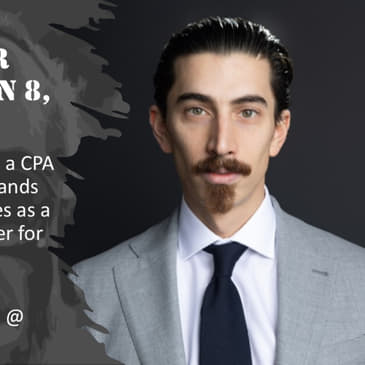

Patrick Camuso is a CPA and the Founder of Camuso CPA, an industry-leading firm working closely with cryptocurrency investors and web3 businesses that was among the first CPA firms to specialize in crypto taxes back in 2016. As a pioneer in the field, Camuso CPA was also the first firm to accept cryptocurrency as payment, setting a forward-thinking example in the accounting profession.
Patrick is the host of The Financial Frontier podcast, where he explores the latest trends in crypto, tax, and finance. He also runs the Digital Asset Digest, a newsletter delivering insights on blockchain, digital assets, and tax compliance. Patrick is also the author of Navigating the NFT Sales Tax Maze, Wayfair 2.0 for Web 3.0, an essential resource for navigating sales tax in the digital asset space
In addition to his publications, Patrick frequently produces content across his channels and teaches CPE events, courses, and training sessions alongside other industry professionals.
Patrick Camuso, CPA
Camuso CPA
Office: 704-249-3179
[00:00:02] Hello everybody and welcome to the Crypto Hipster Podcast. This is your host, Jamil Hasan, the Crypto Hipster, where I interview founders, entrepreneurs, executives, thought leaders, amazing people all around the world of crypto and blockchain. And today I have another amazing guest. He is a CPA. His name is Patrick Camuso. He's a founder of Camuso CPA. Patrick, welcome to the show. Thanks for having me. I appreciate it.
[00:00:27] You're very welcome. So let's kick this off and ask you first, what is your background and is it a logical background for what you're doing now? Yeah, I would say it's pretty logical. I started in the big four in the investment management group. So we were doing the accounting and taxes for mutual fund companies, hedge fund companies, private equity companies.
[00:00:49] So dealing with, you know, very large data sets of financial transactions and normalizing and adjusting them for tax purposes and then reporting the taxes on them. So, you know, that's where I started my career. And then I very early on got involved in Bitcoin and cryptocurrency and launched my firm in 2016 to serve. So, you know, at that time, you know, at that time, mostly Bitcoin investors and Bitcoin miners.
[00:01:16] And then it's just basically expanded with the industry through all the iterations now, you know, from just Bitcoin and Ethereum, then ICOs and DeFi NFTs and now Web3. So, yeah, I would say it's pretty logical. Awesome. Awesome. So you see yourself more than more than just a CPA firm doing taxes. You see yourself as a strategic partner to organizations. So how's your vision and approach help those companies?
[00:01:46] Yes. So, you know, companies usually come to us with an initial pain point. And that is usually the fact that they have all these transactions on chain and they can't account for them appropriately. So that's usually where we start for them. And really, that is, you know, the best starting point because you need to have accurate financial statements to do anything else from a business perspective when it comes to making decisions.
[00:02:12] So once we're able to get that in order, there's several different things that we can do. Obviously, we can do their tax preparation, but we can also do their strategic tax planning. So, you know, looking at their current entity structure in business operations and making sure that that's optimized from a tax perspective to legally save taxes and to also protect from any tax issues that can arise in the future.
[00:02:36] Additionally, like once the accounting is complete, we can help with financial modeling and building cash flow budgets in helping to assist companies that have maybe done a TGE event with maintaining their company properly and planning for the future properly to make sure that, you know, they're going to be managing their funds in the correct way. So it usually starts with the accounting, but then it can branch off into some of these other different areas.
[00:03:06] Awesome. And then you see, so I want to get into CFO services a little bit later, but I want to get into some of the tax things, right? Industry shifted dramatically, you know, over the past few years, right? So what do people need to look out for this year as far, and they had a change of precedence, right? What do they need to look out for this year as far as tax strategies, trends? What do they need to look out for?
[00:03:32] Yeah, well, firstly, with the new administration, they've signaled that they want to make significant changes when it comes to cryptocurrency taxation. So we definitely want to keep an eye out for that. There's, you know, not much yet, but there's indications that there'll be changes in the future, which will likely take impact on future years. I think it's pretty unlikely anything to be retroactive.
[00:04:00] So as it stands now for this year, a few things. Number one is last year we had revenue procedure 2024-28 implemented, which requires a shift from universal accounting to account-based accounting. So everyone has to basically shift the way that they've been accounting for their cryptocurrency starting January 1st, 2025.
[00:04:29] That's one big important change. And this account-based reporting, once you do make that shift and you allocate your basis and you're under this new accounting regime, there's some tax planning opportunities related to that because, you know, under the account-based reporting, the cost basis is going to be tracked on a per-wallet basis rather than just a per-asset basis. And, you know, this creates an opportunity to have more control over –
[00:04:58] if you manage your flow of funds correctly, you can start to have more control over your cost basis that you're going to be spending related to an asset. So, like, you know, you may have, like, a very high-cost basis Ethereum, a very low-cost basis. Once sitting in different wallets, you can strategically send one rather than the other for tax purposes to optimize your tax position for any transaction that you're going to do going forward now with this account-based reporting.
[00:05:23] So, you know, there's these types of opportunities that, again, you know, start with getting accurate accounting in place and then, you know, start getting strategic from there once you have that base built for yourself. Additionally, I would say loss harvesting. Anytime you're in a position that's underwater, you know, you need to consider loss harvesting, consider the fact that wash sales generally don't apply to cryptocurrency transactions. There does need to be an economic substance associated with the transaction,
[00:05:51] but, you know, there's really no exposure when it comes to wash sales. So, you know, especially with the drops we've seen lately, loss harvesting could be a great opportunity. And, you know, there's many other tax opportunities with crypto, whether it's putting it in your retirement account or, you know, looking at charitable giving and other tax planning strategies like that.
[00:06:15] But I think the biggest low-hanging fruit is probably the account-based reporting change and the loss harvesting right now for people. I remember I was in consensus in May, and there was accounting pronouncement that got relaxed by the SEC, and then everybody was cheering about that, and I didn't really understand it, you know. How has that played out so far?
[00:06:43] I think it was some kind of accounting pronouncement. What are your thoughts? You said an accounting pronouncement from the SEC. I think it was a relaxed ability for banks to hold crypto or to be administrators, I think. Probably SAB-121 and SAB-2. That's it.
[00:07:13] Yeah, that's it. Yeah, so that does create a big opportunity for how companies are accounting for their crypto before they were going to have to include the crypto as a liability that they were holding for their clients. And SAB-122 rescinded that so they don't have to treat it as a liability. So, you know, it removes that requirement,
[00:07:40] and it makes it, like, much more favorable now for companies to be holding crypto because it's not going to get reflected negatively on their balance sheet. So how is it playing out? I think it's positive overall. I mean, these institutions, like, move kind of slower, too. So, you know, I think that level of adoption does take some time. But that is, like, an avenue that's opened up,
[00:08:05] and I think that, you know, we're going to start to see more adoption because now that that issue is cleared. But I don't think it's not, like, necessarily, like, they piled in right after it was rescinded. But I do think that it's going to continue to, you know, pick up. Got it. Okay. So you said things – you said something interesting that I did not know. You said you don't have to account in terms of asset anymore.
[00:08:34] You have to account in terms of wallet. Now, there are different – Yeah. There are different kinds of wallets, right? There's – you know, let's look at them. This year I had to restate. I had to restate my crypto because I got a distribution from Celsius. So, you know, as far as the regular crypto wallets, what are the opportunities in that restatement of, you know, cost basis and how do you capture, you know, any, I guess, arbitrage
[00:09:03] or any opportunities from that tax opportunity and then bring it into your next reporting periods for the future? Well, the way that it works, it's like with the revenue procedure, you need to do your accounting through, say, like, the end of 24, and then you need to allocate your calculated basis to where your actual holdings are. So, that's the start of it. It's like allocating the basis.
[00:09:31] You need to allocate the basis in a consistent manner. There's a few different ways that it can be allocated. There's an opportunity to optimize things there based off of your basis. Then the bigger opportunity is how you manage those assets going forward because now those cost basis are allocated and they're associated with, like, specific tax lots. And you have the freedom to take those tax lots
[00:09:59] and move them into another wallet and segregate them. Like, if, you know, if you had costs allocated to assets on a wallet that you're going to be transacting in or, like, an exchange, you can then segregate those tax lots to another wallet and then control when those tax events happen. So, if it's a low basis, you may want to keep them segregated. If it's a higher basis, you may want to strategically use those sooner.
[00:10:28] So, it gets kind of situational, but you can start to control the basis a little bit if you control your flow of funds on chain. And there is that allocation opportunity before that, too. Another important thing related to this is that... There's also this requirement now that for standing orders. It's always been this way that the default accounting method is FIFO. In the past, though, people were, you know,
[00:10:58] they'll, years after the fact, sometimes apply HIFO or some other method under the guise of specific identification. The IRS has identified that as more... as an abusive tax practice. And now they've implemented the account-based reporting and the secondary requirement, which is standing orders. So, you're defaulted to FIFO unless you leave standing orders. And what are standing orders? Standing orders are basically you saying
[00:11:27] what accounting method you want to apply to specific assets. So, if you just don't document standing orders in your wallets and don't document them with brokers, you're on FIFO from here on out. If you do take steps to document standing orders, you can get on LIFO or HIFO or other methodologies. You had to pronounce... You had to say that at the beginning before, you know, you can't shift in later years. Yes. Oh, yeah. Like, you can't come like a year later and say,
[00:11:57] oh, I wanted to do HIFO for these assets. You have to dictate an accounting method before the transactions take place. I guess I'm on FIFO. So, my plan is just to hold on to it, you know, and hold on to the cryptos for a long time. And we're not in any danger of having... of being taxed for unrealized gains, right? No. I mean, you know, that got thrown around in the past, but that was just kind of headlines at the time.
[00:12:26] I don't really foresee that. Okay. So, let's talk about the different kind of wallets. Also, you know, do you have the regular crypto wallets? Most people have these NFT wallets, right? And the artists aren't making any money anymore, or most of them, you know, and the cost of the, you know, these, you know, NFTs are not a million per NFT. So, how do you, like,
[00:12:57] is the NFT market going to come back someday? And if so, you just hold on to it long-term? Or can you really tax harvest your losses on the NFTs? And if so, how do you create a basis on that? Yeah. Well, you know, what's tough with NFTs is that they're tougher from, like, liquidity standpoint because they're not fungible, right? So, it's much tougher to sell them. And you do need to dispose of them
[00:13:28] in an arm's length transaction in order to be able to harvest a loss. So, you do have to sell them. I've seen some services out there where people are buying a lot of these cheap NFTs. So, you can maybe, like, sell it to something like that, potentially. But, yeah, you know, if you want a loss harvest, you have to dispose of it in a transaction. So, you'd have to sell it, basically.
[00:13:56] So, if you do, then, yeah, like, you absolutely can take losses on it at that point. And it can help you from a tax perspective. In terms of establishing the basis, that would be based off of what you purchased it for. You know, whatever the mint price was plus the gas to purchase it, usually it's going to be with the basis it's equal to. Got it. And then, theft. That has been a thing in this industry.
[00:14:27] You know, either phishing or hacking or, you know, you put your money on it and it's gone. You know, I was, I had about 14,000 in market value stolen from me in August through a phishing attack. How do you, my accountant in Connecticut is telling me I can't count that as a loss at all as part of business. He said what's it? I probably didn't hear you. It's just part of, it's just part of business. It's like, that's part of the risk of being in the industry and I can't, you know, report that as a loss
[00:14:56] even though I have a police report. How do people begin to start to get a tax breaks for their theft? Well, the problem is is that theft and casualty losses used to be deductible on the Schedule A and if I recall that was removed as part of I think the Tax Cuts and Jobs Act in 2020 or so. So that used to be the avenue to do that and
[00:15:26] it's no longer available. So, you know, there's really not a good way in most cases to take those types of deductions unfortunately. Now, something like Celsius you know, you can take a capital loss on whatever the difference is between what you originally lost and what they've given you back more recently. But yeah, like if you're just talking like, you know,
[00:15:56] someone scammed you out of your wallet or something usually there's not much tax opportunity there at this time. Got it. Well, there should be. So, so I want to I want to shift gears a little bit away from taxes and talk more about how you like strategic really, you know, executive CFO kind of, you know, functionality or, you know, you offer CFO services, right? Organizations.
[00:16:26] Why should they take you up on that offer? Well, you know, I've been working with Web3 businesses for a while. I've been through you know, token generation events and have seen the challenges in terms of like a lot of the business models and, you know, managing their treasury. So, I would say those are the reasons why, you know, I've just sort of have sort of seen a lot of
[00:16:56] the issues that they're facing and we're uniquely positioned to be able to, you know, help them from the CFO perspective while also providing, you know, the accounting and tax side as well. Got it. So, what do you say to founders and entrepreneurs are like, what I found is most founders and most entrepreneurs like, don't want to deal with the boring stuff which is finance and accounting, right? Yeah. They, like, you have to convince them why they need the FFO. So, what's your pitch?
[00:17:26] How do you convince them and say, hey, you need this? Um, what I'll find is like, um, usually after an initial raise and when, when investors get involved, there starts to be somewhat more of a desire for these companies to, you know, actually have more of like a mature financial management. Sometimes that comes from the investors, sometimes from the founders, sometimes from both. Um, you know, overall, it's still an afterthought and to a degree, I can understand that for the
[00:17:56] founders to a large degree because they're, you know, they have many different competing, um, things for their time and attention, basically, you know, all these different aspects of running their business. But ultimately, you know, the finances and the accounting is one of the most important pieces and it really what should be driving the, this most, most business decisions. You should at least be looking at them through that financial lens.
[00:18:26] So, yeah, you know, it's, it's, it's tough. I try to make it as hands off for, for the, for the founders as, as, as possible. And, um, you know, once we get into a good rhythm, we can make it pretty efficient for them, um, you know, to look at the financial models, look at the, the quarterly budgets, the financial forecasts, and, you know, compare them to where we're tracking. We can get into a pretty good flow with that. Um, so I just try to really make it as streamlined as possible and say, like,
[00:18:56] look, like, you know, if you're raising money, if you're planning to do a TGE event, you're going to be managing a large treasury. You can't just, you know, you can't just kind of like phone it in with this. You need to actually start implementing best practices before you have, you run into some issue that's going to actually hurt your company. And those best practices will enable them to do what? To ensure that they're
[00:19:26] managing their funds appropriately. Like, usually, you know, one of, you know, some of the things we focus on is budgeting and forecasting to a large degree. So, you know, putting quarterly budgets in place, putting financial forecasts in place, creating financial models associated with their whole entire project, marketplace, token ecosystem. However, you know, they're planning to monetize whatever their business is. So, that's where a lot of the
[00:19:55] value is with that. Yeah, I agree. I just, I just think what I found through the years is that, you know, even me included, is our current educational system doesn't teach us how to be financially literate. You know, I had to work at AIG for a dozen years. I had to go through a training program Northwest Mutual and understand financial planning. I didn't get that job, by the way. I was in crypto in 2018. They threw
[00:20:25] me out. But, you know, how do we go from an overall collective of not being financially literate to begin to embrace how to be financially literate? And, you know, how do we start to do that as a society? That's a tough question, I would say. I mean, I've always been focused on being financially literate, I guess. So, I think you have to just stress the
[00:20:54] importance of it. And I would say teaching it as early on to people as possible would also be important and just sort of making it a way of life for people. So, yeah, I would say, I guess early education would be important. Awesome. Yeah. Or changing the entire education system. So, you know, so you have a podcast as well, right? So, how do you want to find out
[00:21:24] the story about your podcast? How came it be? How do you end up turning that into your business? How it supports you and supports your guests? How's it going? Yeah. So, I started the podcast maybe about like, I guess maybe like a year or so ago, a year and a half ago. Not too long. It really started because I was just doing a lot of LinkedIn lives and talking about basically like a lot of the topics I was talking about already.
[00:21:54] I was getting pretty good feedback on it, so I formalized it more into a podcast called The Financial Frontier. And really, I'm talking about different topics related to taxes, accounting, and finances in the Web3 and crypto world. So, it really just kind of started with, I was talking about these topics, I was getting good feedback, and I was like, let me formalize this more as a podcast. Then I started bringing on guests, like different people within
[00:22:24] my network, whether they're other CPAs or CFOs or financial advisors or valuation experts or building retirement platforms or lending platforms, these types of things. So, I started doing those types of interviews. And that's kind of where it's at right now. It's a mix of me interviewing different industry experts like that and then also doing my own episodes
[00:22:54] where I'm just discussing a specific topic or sometimes also looking at different current events that are going on. I just found like over the past year or two that, you know, the regulatory environment has just been moving very quickly. So, I guess that's why I started first doing the lives and it's kind of just like led into the podcast. financial advisors. I took an exam. I think I was one of the first hundred people. It was one of those, you know,
[00:23:23] not series, but like it was a professional crypto certification exam. So, but I didn't go into podcasting instead. So, but I want to find out what are the pain points of the crypto financial advisors? You know, what's their area of focus? What are and how are they solvable? You know, yeah. Are they are they butting heads with the
[00:23:53] yeah, I would say like with the financial advisors, you know, they really sort of started focusing on this probably maybe about a year or so ago. And, you know, like that was like early on and they're starting to sort of trickle in more. So, I think, you know, there's been a lot of legitimacy added to the space over maybe the past like two years or so. And I think that that has allowed them to or maybe it's even pushed them to some
[00:24:23] degree. So, you know, having to have these conversations with their clients to a higher degree. So, I think right now a lot of financial advisors are trying to get like a deeper understanding of it, figure out how, you know, they're going to maybe like fit this into a portfolio or speak to clients with it. There are a few financial advisors that are, you know, much more well-alonged than that and actually are like very crypto literate.
[00:24:52] But I would say as a whole, it's kind of like in the early days for them. And, you know, they're like learning and very few of them are working with crypto. crypto. But I think the trend is going to move towards it having to get integrated into their financial plans in the future. So, I would think that they're only recommending Bitcoin, maybe Ethereum right now.
[00:25:23] Yeah. Yeah, for the most part, yeah. Okay. Unless they have clients, you know, there's some advisors I know that have clients that are deep into crypto. So, you know, if you get someone deep into crypto, they're going to have more than that. So, you know, you got to address that then if you're working with those types of people. True. True. So, the financial frontier. Some people will tell you that the financial frontier is DeFi and DeFi only. You know,
[00:25:53] so, how do we, and I would think it's DeFi too, I mean, but how do you get the TradFi folks to embrace and understand, you know, and embrace, you know, that the future of crypto, the financial frontier is decentralized? You know, the ethos of decentralization and a lot of, you know, what Bitcoin was started around as well, like all of
[00:26:22] those ideas, I don't necessarily know if they fully translate over into TradFi. I believe in them, but I think it's like a conundrum for the industry as a whole, you know, like I've been in crypto for a while myself and you've seen these different adoption phases and like with each adoption phase like kind of the people that come in are different than the last group of people basically. You know,
[00:26:52] it's like a different culture to a degree is another way to say it, I guess. So like, you know, you had these ideological early Bitcoin adopters that were very like freedom oriented. Does the whole entire space include that ethos anymore? Probably not. So as we start to see like TradFi and Web2 come in, are they going to just share all of our ethos with that and or with, you know,
[00:27:23] decentralization movements that we've seen? I don't know. That, you know, the fact that we're working with, you know, permissionless blockchains hopefully means that as long as we get some regulatory protection, we can still have decentralization and maybe some people won't value it and we'll go to other places where they won't have it. I mean, look at like even, you know, like with the Bitcoin ETFs, you know,
[00:27:52] like a true Bitcoiner is going to want to hold their own Bitcoin basically. But a lot of these, you know, to get wider adoption to get people into it that aren't going to do that. We start to see these things. So I don't know. I don't really know how it's going to play out. But I'm hoping that the options remain. We just saw some news where it's looking like the broker
[00:28:22] definition isn't going to be applied to DeFi in terms of the 1099 requirements for the IRS. which is big. So, you know, like not having that requirement and knowing that this is still going to function the way it is in the States, to me, that's important because we can still have decentralization there. And if people want to go and hold their keys on Coinbase, it's kind of their option. And I think it's going to be like a mixed bag. time.
[00:28:52] Yeah, I agree. I agree. Well, I look forward to see what happens this year. So, you know, you mentioned ETF and they just postponed the Litecoin ETF until May. You know, so that's the SEC is making the SEC is more favorable now than the Gensler SEC. So, you know, how do you think the SEC view is going to help crypto in the next four years at least? I mean, I think having a friendly SEC
[00:29:22] can be great. There's tons of legal challenges for these companies. A lot of the Web3 companies I work with have token generation events that take place in international entities and like different places like Cayman, BVI, Panama. So, you know, I think with a friendlier SEC, we can start to hopefully have more of that be within the U.S. going forward.
[00:29:52] And I think that could be great for the country and for the founders of these businesses. I agree. Yeah, sounds good. Well, I want to thank you very much for your time today. I enjoyed speaking with you, learned a few new things. I have one last question. It's simple. How can people find out more information about you, about Camuso CPA? How can they become clients? How can they do that? Yeah, definitely. The best way would be to visit my website, camusocpa.com,
[00:30:21] C-A-M-U-S-O c-p-a.com. There's, first of all, a ton of resources available that will educate you on all these various topics we discuss. And of course, there's a contact us page there where you can reach out, complete a form submission, and we can set up a time to have a video consultation and discuss your portfolio and or your business. So that's the best place, but I'm also on LinkedIn, I'm on Twitter. So, you know, definitely follow me there, reach out to me
[00:30:51] there as well. And, you know, I'm always happy to have a conversation. Awesome. Thank you very much for your time today. Absolutely. Thank you. I appreciate it.