
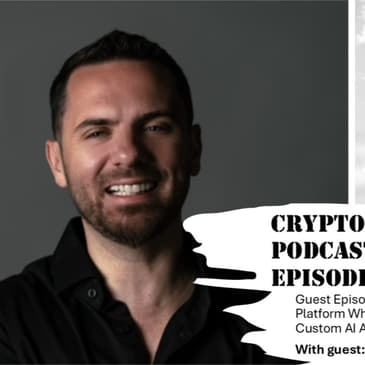

Colin Fitzpatrick is a seasoned entrepreneur and technology professional with over 20 years in top tech companies such as Oracle, Salesforce, and Hubspot. A multiple founder having launched a business in web 3 to a $300m market cap and also founded a business in AI building digital humans. Colin is a recognized thought leader in AI and web 3 with over 20,000 followers on LinkedIn. And he's extremely passionate about the space and loves to share and impart his knowledge with everyone.
[00:00:00] Hello everybody and welcome to the Crypto Hipster Podcast. This is your host, Jamil Hasan, the Crypto Hipster, where I interview founders, entrepreneurs, executives, thought leaders, amazing people all around the world of crypto and blockchain. And I have, today I have a repeat guest from about three years ago, maybe two and a half years ago. And it was a really great conversation back then and I'm really looking forward to this conversation today.
[00:00:26] So, I have Colin Fitzpatrick, who's the Chief Business Development Officer. He is with Griffin AI. Colin, welcome back to the show.
[00:00:37] It's great to be back, Jamil. Thanks for having me again.
[00:00:41] You're very welcome. You're very welcome. And my first question is the same one for everybody, but I'm going to change yours up a little bit.
[00:00:50] The first question for everybody is, what is your background and is it a logical background for what you're doing now?
[00:00:56] And then I'm going to add, what have you been up to in the past three years?
[00:01:01] Okay, cool. So, my background is basically working for big tech companies, Oracle, Salesforce, HubSpot, Dell, mainly instead of business development, marketing, operations type roles.
[00:01:13] I made the jump to crypto partially because I got made redundant from one of the companies when I was right in the middle of COVID.
[00:01:23] I just moved to Dubai. I just started a new job and then it was axed.
[00:01:29] I did manage to get another job for a little while, but thought I'd take things into my own hands.
[00:01:33] I've been in crypto for quite a while as a personal venture.
[00:01:35] Love the space and long story short, a friend of mine, you know, called me up with an idea.
[00:01:39] And I don't even know what happened, but we spit rolled and all of a sudden we were launching our own crypto project.
[00:01:46] And it was a crazy, wild, amazing time, fun experience.
[00:01:50] A lot of gray hair out of that experience, but it was brilliant.
[00:01:55] Since then, I suppose, you know, like a lot of people, when AI exploded onto the scene and I saw ChatGPT,
[00:02:03] I went, this is the most transformational thing I've ever seen in the world.
[00:02:05] I really want to do this. And I basically made a bit of a pivot.
[00:02:09] There was a buddy of mine who had some metaverse tech, like some avatar and motion capture tech.
[00:02:16] He came to me with an idea and I was like, no, mate, you want to put ChatGPT under that and turn it into like a digital human,
[00:02:24] you know, for brands to use for customer service and support trained on all their own data.
[00:02:27] So we did that and we built it. And I was just, you know, head first in AI.
[00:02:34] And then I kind of met my current founders, which are bringing the world of AI agents to Web3.
[00:02:38] So does my background match it?
[00:02:41] Well, I was always reasonably techie and nerdy in my younger years.
[00:02:45] I, you know, discovered the Internet. I'm 44 now.
[00:02:48] So it was in about 95, 96.
[00:02:51] And I immediately wanted to know how it worked.
[00:02:53] So I taught myself HTML, started building websites and basically put myself through college kind of, you know, doing that.
[00:03:00] But then I was a sales guy for a really long time.
[00:03:02] And even though I enjoyed it and I was reasonably good at it, I kind of wanted to do something else.
[00:03:07] So the I suppose the jump into the startup world and entrepreneurship is quite a big one.
[00:03:13] It just sort of happened for me.
[00:03:15] It was never when I it was always something I thought about it.
[00:03:17] I never really knew how it might happen.
[00:03:20] My father was an entrepreneur, but yeah, it all fit together.
[00:03:24] And I suppose right now I'm happy that I'm able to utilize several of my set of key strengths in a couple of different areas of which most of these are really on the cutting edge of tech.
[00:03:36] And that's where I like to be.
[00:03:40] Awesome.
[00:03:40] So I want to find out, you know, what Griffin AI is all about, including your vision and mission.
[00:03:46] And you also mentioned you found your co-founders.
[00:03:51] Your co-founders are pretty impressive.
[00:03:54] Yeah.
[00:03:54] Impressive histories in this industry.
[00:03:56] So maybe you could talk about both what Griffin AI is all about and how it is working with it.
[00:04:01] Absolutely.
[00:04:01] So Griffin AI is a network and a platform for developers to build, host and monetize AI agents on chain.
[00:04:11] What that means, just in case, because I think most people do not properly understand what an AI agent is yet.
[00:04:17] And it's different from a bot, which, you know, a lot of people make a mistake.
[00:04:20] An AI agent is an autonomous piece of software that can operate independently, that can work with other agents, that can use logic and reason and problem solve.
[00:04:32] And it can complete what are called goal oriented tasks.
[00:04:36] You give it a major goal, like asking ChatGPT, it'll make a list of 25 different things to do.
[00:04:41] And then a swarm of different AI agents will go off and complete those tasks.
[00:04:44] So some of them will go off and do research and some of them will go off and, you know, use some tools and some others might make a purchase and then they might come back and write something up and maybe even build software, whatever it is.
[00:04:57] AI agents to me are going to be the next transformational wave in technology because they really bring AI to life.
[00:05:03] So if you think about right now, ChatGPT, as incredible as it is, it's still just a box.
[00:05:10] You type a question, you get an answer in text.
[00:05:13] And as amazing as that may be, it doesn't really do anything else.
[00:05:16] But in the future, AI agents are actually going to do meaningful work for you.
[00:05:20] They're going to complete tasks.
[00:05:22] The best way I think to describe it is just going to be like having a, you know, a team of kind of virtual assistants.
[00:05:28] You know, you'll give, you'll tell them to go off and do some research and then you'll tell them to write that research report up and then, you know, build kind of strategy for this.
[00:05:35] And then, you know, eventually it'll be okay.
[00:05:37] I want to start a company and I want you to set everything up.
[00:05:40] And then I want you to, you know, go out and do some business development and find my first customer.
[00:05:45] And, you know, I really think that what we're going to see in 2025 is an explosion of these AI agents on across the board.
[00:05:52] Now, what Griffin does is that we primarily build a series of AI agents and enable developers to build them for Web3.
[00:06:03] So for crypto companies, for dApps, for wallets, for DEXs, etc.
[00:06:08] And to me, what's exciting about this is that we enable solving a lot of problems in the world of AI and crypto.
[00:06:17] Because I've been in crypto since 2017 and then DeFi, you know, 2020, 2021.
[00:06:22] It hasn't really got much easier.
[00:06:24] It's still a mess.
[00:06:25] It's still horribly complicated.
[00:06:27] The learning curve is so high and it's so confusing for most people.
[00:06:31] I mean, I know the basics of DeFi, but a lot of it I kind of get lost in.
[00:06:36] And what we've done is we've built AI agents to automate that.
[00:06:39] So one of our agents is ChatGPT for your wallet.
[00:06:42] Literally that.
[00:06:43] You can go to our website.
[00:06:44] You can connect your MetaMask and you can talk to your wallet like you would talk to ChatGPT.
[00:06:48] So you can ask it about past transactions.
[00:06:51] You can ask it, when did Jamil send me $150 on the Polygon network?
[00:06:54] You can ask me how many times was I sent money from, you know, this address?
[00:07:00] Make a report for me.
[00:07:01] But then it can send, it can swap, it can bridge, it can stake.
[00:07:06] Really anything on DeFi that can be done, that can be automated, we can do with our agents.
[00:07:10] And AI agents, our ones are able to transact autonomously.
[00:07:14] And that's kind of what's different.
[00:07:16] Now, in this ChatGPT setup that we have called the transaction execution agent,
[00:07:22] we don't actually hold your money.
[00:07:23] It sets up the transaction and then you confirm your wallet, confirm the transaction in your wallet.
[00:07:28] So it's fully secure.
[00:07:30] But in the future, we see a place where AI agents are going to be transacting all over the place autonomously.
[00:07:37] And they're going to be operating, you know, with your data and with your money.
[00:07:41] So the vision and mission here is in a future that we see where AI agents will be operating everywhere.
[00:07:49] Do we want them being completely beholden to the Microsoft, the OpenAI and the Meta and Facebooks of this world?
[00:07:56] Or do we want to create a permissionless and secure environment where these agents can operate autonomously,
[00:08:03] yet within the boundaries of our own personal rules?
[00:08:07] And that's really what we're setting out to do.
[00:08:11] Okay.
[00:08:12] You opened a pen to a box.
[00:08:17] I'm thinking about the crypto landscape and I'm thinking about how many people want to make 100x, right?
[00:08:24] So these agents are doing trading.
[00:08:27] They're doing investing for on behalf of people, right?
[00:08:30] How smart are these agents?
[00:08:32] Like, you know, are they going to be able to, like, who's training these individual agents to do the trading?
[00:08:41] Because I see still there's a human need to program them, right?
[00:08:44] Or is that going to work?
[00:08:47] Well, the agents we've built are not really about trading.
[00:08:51] I mean, there are algorithmic trading bots and they've been in them for many, many years.
[00:08:56] They might utilize AI and, like, a lot of software does.
[00:09:00] But, you know, this is slightly different.
[00:09:04] Number one, we set out not to build all of the agents that we ever want to build,
[00:09:09] but just to build a few that are an example of what can be done.
[00:09:13] And we picked DeFi.
[00:09:16] Now, you mentioned my founders earlier.
[00:09:19] My CEO is a guy called Oliver Feldmayer.
[00:09:22] And his wife is called Olga.
[00:09:27] Olga sort of assists us with a number of things in the business.
[00:09:31] Olga's been in crypto over 10 years.
[00:09:33] She was christened the Crypto Queen of Switzerland.
[00:09:36] She used to work for a company called Zappo,
[00:09:39] who built the first sort of custody wallet and then sold it to Coinbase for $50 million.
[00:09:43] She's been around a really long time.
[00:09:45] She's been doing the conference circuit for 10 years.
[00:09:48] After that exit, herself and her husband decided they wanted to create a digital assets exchange.
[00:09:54] And they did that in Switzerland.
[00:09:56] And they built the first ever licensed and regulated crypto exchange in that region.
[00:10:01] They built that up and then they floated it in the Nasdaq for $100 million.
[00:10:04] So they really do have very, very significant experience here.
[00:10:07] And like me, they saw the future coming of AI agents and they started to build a few specifically for their exchange to help their customers.
[00:10:16] You know, help them with onboarding, customer journey, you know, creating baskets of different cryptos to invest in, etc.
[00:10:23] But what they figured out straight away is that you need to create a ton of very sophisticated underlying infrastructure to make an AI agent work on the blockchain and be able to communicate and transact with Web3 dApps.
[00:10:38] And it was probably a lot more than a normal project would want to take on on the realm.
[00:10:43] But they thought, hey, you know, this is a project on its own.
[00:10:45] We build the infrastructure.
[00:10:46] Everyone wants to come and easily build these agents on top of it.
[00:10:49] So we've got an AI builder where with low code and no code, you can build your own AI agent to do whatever you want.
[00:10:55] Or you can take one of the existing ones and modify it.
[00:10:57] And that's basically what we've done.
[00:10:59] So because of Olga's investment banking background, she wanted to bring the power of an institutional team to individual traders.
[00:11:10] So an institutional team, when you're a high net worth individual, you would have a research manager, you have a transaction manager and then a risk manager.
[00:11:19] So you would have all of those three people.
[00:11:21] And that's what we've built as AI agents.
[00:11:23] So our first one, and you can check it out on our on our agent playground is it's the research assistant.
[00:11:30] So I could go in and go, I want to know about Solana or, you know, tell me what sort of, you know, mean coins are popular at the moment and what's going on in that market.
[00:11:38] And about a dozen different agents will go off and they will scour the web.
[00:11:43] They will search 150 data sources that were plugged into.
[00:11:46] They will search on chain data, off chain proprietary data.
[00:11:50] They will come back.
[00:11:51] They will assemble it all together.
[00:11:52] They will write up a report.
[00:11:54] And then they will go through that report again and cross reference and check all of the different sources and then produce you a 10 to 15 page PDF in anything you can think of.
[00:12:04] So you can imagine how much time that would save you if you wanted to be researching your crypto coins.
[00:12:10] And we enable anyone to integrate that technology into their own wallet or exchange or DAP or anything like that.
[00:12:17] And then the same for the transaction execution agent.
[00:12:19] And, you know, we've got an awful lot more coming as well as a meme coin hunter and a very simple sort of trading app as well.
[00:12:30] I like the concept of the meme coins hunter because, you know, I'm looking at it from a generational perspective.
[00:12:37] I'm a jet exter.
[00:12:39] I'm 10 years older than you.
[00:12:40] I have no pulse on social, you know, the memes.
[00:12:47] How's that?
[00:12:47] How each meme is going to do?
[00:12:48] And a lot of younger people do, you know.
[00:12:51] Oh, yeah.
[00:12:53] Be very useful and try to navigate the social structure and everything.
[00:12:57] So.
[00:12:58] Yeah, I mean, I'm the same.
[00:13:00] I don't really get the meme thing.
[00:13:03] Maybe I bought two memes in my life.
[00:13:05] I probably got rugged on both of them.
[00:13:07] I'm not too sure.
[00:13:08] But, yeah, I know some other people who are Gen Xers or millennials and they're there, you know, watching the latest trends and, you know, finding anything.
[00:13:18] And, you know, I don't know if you know that one called Pump.Fun.
[00:13:21] There's literally thousands of memes launching every day.
[00:13:24] It's insane.
[00:13:25] But 99.9% of them are zero within a few days.
[00:13:28] So I personally don't have time or the inclination to do that.
[00:13:33] So, you know, what we can do is build an agent that is plugged into Telegram and Discord and X and is, you know, seeing what people are interested in and seeing what is growing and seeing what the sentiment analysis is saying and making recommendations for you.
[00:13:48] And that's the cool thing that AI agents can do.
[00:13:50] Now, to go back to your previous question about, you know, what people think agents are chatbots.
[00:13:57] They are really, really formal in that.
[00:13:59] A chatbot is that, you know, stupid thing where you go onto your mobile phone provider and there's a chatbot there and you say what you want to do and it makes some guess at a recommendation, but it doesn't actually understand you.
[00:14:12] And it just, you know, they're bots.
[00:14:14] There's other bots that plug into Telegram and things like that and we're familiar about those, but really agents are intelligent and they can, you know, they can really use logic and reason and they can problem solve and they can work together and now we can make them transact on chain.
[00:14:30] So we're only really beginning to see the glimpse of the future in this, but there's plenty coming along in the Web2 world as well.
[00:14:36] You know, Apple are going to start plugging them into Siri and Googler, but bringing them into Gmail and even into Macs and things like that.
[00:14:43] So we will see an awful lot more of these next year.
[00:14:46] The first most impressive ones that I've seen recently are the coding ones.
[00:14:51] I'm not a program, not a coder, but I do like to pay attention to what's going on.
[00:14:55] And there's a couple of AI agents now that, you know, proper coders are just using to like the way if you were a writer and you'd use chat GPT to write for you.
[00:15:05] So it's doing the same with coding, just maybe to a slightly lesser extent, but it's getting really, really good.
[00:15:11] So that would have been helpful this past weekend when I was at a hackathon and I don't know how to code.
[00:15:17] And I think I did 25 years ago when I forgot how to do them and I felt crippled.
[00:15:24] And I was like, I can't do anything, you know, so that I would.
[00:15:27] Well, there's one called, there's one called Devon now.
[00:15:30] And there's basically four screens and it's like chat GPT and you just tell it what you want, you know, set up this environment and, you know, use these plugins and integrate these apps and it'll build a fun chain for you.
[00:15:40] It'll do everything.
[00:15:40] It's quite incredible.
[00:15:42] And there's more coming.
[00:15:44] Awesome.
[00:15:44] There's another one called Cursor as well.
[00:15:46] That's just like the most incredible predictive text for coders that it just speeds them up several times, makes them two or three times more productive.
[00:15:54] Wow.
[00:15:55] We did come in second.
[00:15:56] We would have won.
[00:15:57] So next time, you know, so you're talking about this wave, right?
[00:16:06] What do founders and business owners need to know about this upcoming wave?
[00:16:11] And how are they going to be important for them going forward?
[00:16:17] Well, it's a good question.
[00:16:18] Number one, you know, there really isn't anything to be afraid of here.
[00:16:23] That's what most people are thinking.
[00:16:25] There isn't.
[00:16:27] AI agents are coming to take a lot of the heavy lifting, a lot of the repetitive and boring tasks away from us.
[00:16:34] That's really the way it looks like.
[00:16:35] I mean, Jensen Wang came out the other day, the CEO of NVIDIA.
[00:16:38] And he goes, don't worry about AI taking your job because it's going to be a fair long time before AI can do the whole of your job.
[00:16:46] But AI will be able to do 50% of your job within a few years.
[00:16:52] But it will need you to manage that.
[00:16:54] So if you bury your head in the sand and never want to use an AI, you're probably in trouble.
[00:16:58] However, if you like try and stay somewhere towards the forefront of this and see what tools are coming out and try and use them and things like that.
[00:18:05] We're just sort of overseeing it like a boss.
[00:18:10] Awesome.
[00:18:11] So you mentioned DeFi earlier.
[00:18:16] You've been in DeFi for a few years.
[00:18:18] So I want to find out how AI agents are going to really transform DeFi and maybe transform Wall Street altogether and be the future of finance.
[00:18:33] DeFi, I think, is extremely interesting because it is this area where it's permissionless finance.
[00:18:43] And what we've really seen and we could talk about this for hours with the importance of Bitcoin, which is literally kicking new highs as we speak right now.
[00:18:53] It's very, very important that we take back control of our money.
[00:18:56] I like to call Bitcoin freedom money.
[00:18:58] You know, that's what I think people in the States should really call about it.
[00:19:01] There's nothing Americans love more than their freedom.
[00:19:03] And they don't like it being taken away from them, you know, and they don't want overreaching governments.
[00:19:07] So we should be talking about freedom.
[00:19:09] But the banks screwed us in 2008.
[00:19:16] And we need the ability to be able to transact globally in a permissionless way.
[00:19:23] And you know what the greatest growth is in the job market at the moment?
[00:19:31] It's remote workers.
[00:19:33] It's young people who are, you know, I'm 44.
[00:19:36] If I was 10 or 15 years younger and didn't have a family, I would definitely be traveling in the world and living in Asia and, you know, being a digital nomad.
[00:19:44] And these digital nomads are traveling around the world and they don't want to be, you know, paid in Thai bass and things like that.
[00:19:51] No, you know, we want one digital currency all around the world.
[00:19:54] And I think that's really where I was having this conversation earlier about someone who was a bit of a crypto skeptic.
[00:20:02] And they were saying, oh, you know, does blockchain really solve any problems that can't be solved the other thing?
[00:20:07] So I was like, well, you know, the whole remittance thing, we're spoiled in the first world.
[00:20:11] We're spoiled because we all have banks that work and Visa cards and, you know, Venmo and PayPal and things like that.
[00:20:17] But, you know, go to like some African country or Russia or somewhere like that and, you know, those problems persist.
[00:20:25] So we need this sort of global currency that I think is very, very important.
[00:20:30] We can go to a complete rabbit hole of all of the benefits that Bitcoin brings for the impoverished around the world and the people whose currencies are being completely diluted and things like that.
[00:20:41] But at the end of the day, the banks are traditionally big and slow and they rely on the startups to innovate in the area.
[00:20:49] But I think they're catching up.
[00:20:50] I mean, look what's happened with the ETFs.
[00:20:53] It's also happening now with a lot of companies, sorry, large banking companies coming out and endorsing this Bitcoin strategic reserve, which I think is incredible.
[00:21:01] I mean, slowly but suddenly, it really is that.
[00:21:04] You know, one minute we're a load of scamsters and the next thing we're, you know, thinking about propping up the US dollar with our magic internet money.
[00:21:11] I mean, it just shows you how fast these things can change.
[00:21:17] It does.
[00:21:18] It does.
[00:21:20] People are like, yeah, so some of the DeFi, I don't want to talk about price of coins, but some of the DeFi coins have not caught up to Bitcoin's growth over the past few weeks.
[00:21:30] And I'm like, we got to practice patience.
[00:21:33] You know, it'll come.
[00:21:36] It'll come.
[00:21:37] Bitcoin will go up first.
[00:21:38] And then everything else.
[00:21:40] Bitcoin always goes up first.
[00:21:42] And I've said, well, there's a fair few coins that have been pumping the last while.
[00:21:45] Now, to be honest, I'm like mostly Bitcoin.
[00:21:48] I'm just a Bitcoiner.
[00:21:50] So I don't have a ton of other.
[00:21:52] I just don't have the time to spend six hours a day following everything.
[00:21:57] And I'm not a trader.
[00:21:59] So but I've seen a bunch do, you know, two, two and three X over the last like few weeks.
[00:22:04] So maybe it'll come.
[00:22:05] But I mean, if I want to be pessimistic here and just be honest with you, I think this cycle will be a bit different.
[00:22:11] And the reason I think that is that in 2017 and in 21, you had a massive influx of retail that had never really been in before.
[00:22:22] And they came in and they swarmed in and they pumped up the coins and things like that.
[00:22:27] And I don't know if it's going to be the same this time.
[00:22:30] You know, I think this so from a from a person who has been a founder of a project.
[00:22:37] OK, and I know how it works from the inside.
[00:22:39] And I'm doing it again right now, launching a project on exchanges, dealing with market makers, doing the marketing and all that stuff.
[00:22:47] Number one, the market has matured a lot, like a lot.
[00:22:51] OK, but number two, it.
[00:22:55] Well, let me go back.
[00:22:57] It is matured in the fact that, you know, you can't just raise a ton of money on nothing.
[00:23:02] But, you know, an idea like we did before.
[00:23:04] You have a white paper and you can raise millions of dollars.
[00:23:07] And we did it.
[00:23:07] Now you've got to show real product and real traction and all that sort of stuff.
[00:23:12] But the other thing is that there's just so much more competition.
[00:23:15] I mean, you know, there was a few thousand projects launching now.
[00:23:20] There's tens of thousands of legitimate projects and they're all vying for attention.
[00:23:27] So it's even more of a gamble going which coin is going to do, you know, a 10x or a 20x.
[00:23:36] And will those 100x or 1000x be around like they were before?
[00:23:41] I'm not really so sure.
[00:23:42] Or I think the market's a little bit different now.
[00:23:44] I don't know.
[00:23:45] What do you think?
[00:23:49] Excluding meme coins.
[00:23:51] You know, I think there are quite a few DeFi coins and quite a few L1 coins that are undervalued.
[00:24:02] You know, based on the technology that has been created and the use cases for it, the price does not reflect that yet.
[00:24:12] And, you know, I don't know when it's going to, but I'm like, I look at it and I'm like, for one example is Avalanche.
[00:24:19] It's 30 something dollars.
[00:24:20] And if you look and I went to ConsenSys in May and I looked at what they built and I'm like, that's a lot more than $30 to me.
[00:24:27] You know, people just there's a disconnect between what the value is in the market right now and what the value is going to be going forward as far as infrastructure and tying things together and being used in AI as well.
[00:24:41] So I'm waiting for the cash up.
[00:24:46] I mean, one of the things that I was completely wrong about this cycle going back a year or more is that I really said, I said, I think this year is the year that the quality projects will shine.
[00:25:00] And no, it's the shitty mean coins.
[00:25:04] You know what I mean?
[00:25:04] But I mean, look, I had a project in the metaverse and NFT space and I used to talk a lot about why NFTs have value.
[00:25:16] Now, hands up.
[00:25:17] I never bought any.
[00:25:19] OK, because it's just, you know, really my thing.
[00:25:21] But that doesn't mean I don't still believe in the underlying technology.
[00:25:26] I still do see value in the likes of CryptoPunks and Bored Apes and things like that because they're digital history and they are, you know, identity for people who they don't necessarily care about the Rolex or the Ferrari, but they want to be a baller online.
[00:25:45] And that shows everyone via their Twitter profile or whatever it is that they are.
[00:25:49] And that's something that maybe an older generation can't really go after.
[00:25:53] But meme coins are a flash in the pan.
[00:25:56] OK, you know, Dogecoin is one.
[00:25:59] And then you've got Dog with Hat doing, you know, 100,000 percent or whatever the hell it is.
[00:26:05] Some of them I do and some of them I don't.
[00:26:08] But like it or not, that's where we are right now.
[00:26:11] You know, that that is what is popular with the kids.
[00:26:16] And I think it's just going to go on for a while until whatever the next thing comes along.
[00:26:22] Yeah, I keep telling myself that Amazon really took off in 2016, but it was founded in 1998.
[00:26:30] So, you know, it took a while.
[00:26:33] And I remember your project was animal concerts.
[00:26:37] And I thought it was a great idea, you know, to have concerts.
[00:26:41] And I'm thinking AI Asians could help people, you know, get tickets to everywhere to NFT, like to be able to do that.
[00:26:48] So in addition to DeFi, you know, how should or why should people who are trying to get ahead of the wave, like AI Asians, think about them in practicality terms?
[00:27:00] Well, at the end of the day, AI agents can take away the learning curve in software.
[00:27:05] OK, so the example I like to give is as follows.
[00:27:11] It was my birthday a little while ago and I was having a party and I wanted an invite made for that party.
[00:27:18] So I went to Chachi PT and I said, make me a birthday invite.
[00:27:23] And I said, here's the text.
[00:27:24] And I said, I want the Dubai skyline in the background and I want a boat and I want this, that and the other.
[00:27:30] And in five seconds, I had my my amazing, beautiful, shiny invite.
[00:27:37] And I made a few changes to it and I was done.
[00:27:40] Two years before that, I would have had to been extremely skilled in Photoshop to be able to achieve the same thing.
[00:27:48] I would probably take me a day or at least several hours.
[00:27:53] I would have had to, you know, years worth of work or I would have had to pay someone else to do it.
[00:28:00] So that is coming to, you know, across the whole scope.
[00:28:04] So, you know, people that work in big companies use all these horrible applications and things like that.
[00:28:09] And there's such a pain in the ass to use.
[00:28:11] And you don't know how to you know what you want done.
[00:28:13] You just can't figure out how to do it.
[00:28:16] That's what agents are going to take away from us.
[00:28:18] They're going to take away that pain of having to figure out how to do that.
[00:28:23] Basically, a lot of different applications now will just have an LLM style chatbot interface.
[00:28:28] And it's like, what do you want to do?
[00:28:29] Okay, I want to update this record.
[00:28:31] I want to connect this and the other.
[00:28:32] Blah, blah, blah.
[00:28:33] Here's some stuff.
[00:28:33] But, you know, and the AI agents will sort of sort all of that out.
[00:28:38] Because, you know, like we were mentioning, we've seen companies like Klarna.
[00:28:44] You know Klarna are the ones that do the buy now, pay later.
[00:28:46] They've literally used AI and AI agents, including the software development agents, to replicate their entire process within apps like Workday and Salesforce.
[00:28:56] And then they just threw those out saving the millions of dollars.
[00:28:59] And then they have their own one.
[00:29:00] So if you think about how that is going to permeate into software into the future, we will get much more customized software where, you know, a large language monster chatbot will talk to us in natural language.
[00:29:14] We will understand what you actually want done.
[00:29:17] We'll be able to go and do it for you and then come back and tell you when it's complete.
[00:29:20] And that is the future that I see over the next couple of years panning out.
[00:29:24] And, you know, next year in 2025, you're really going to see that start kicking off.
[00:29:31] So it's really going to help people in our daily lives.
[00:29:36] Yeah.
[00:29:36] And even if I think about my mother, who's, you know, 81 years of age and she's trying to rip her head around technology, which is very, very difficult.
[00:29:47] What's easier than a conversation?
[00:29:49] You know what I mean?
[00:29:49] I mean, audio is a very big thing that I've been talking about for a very long time.
[00:29:53] When we choose to communicate, we always choose to communicate verbally with each other as a conversation.
[00:30:02] Sometimes you can't, you know, you got to text or whatever.
[00:30:05] But, you know, for the most part, that's how we talk.
[00:30:08] The big benefit with, you know, LLMs and NLP is you can talk naturally to a computer and it'll understand it.
[00:30:19] But previous to that, we had to know how to talk to a computer.
[00:30:22] Like the way right now, when you talk to Siri or Alexa, you got to know what to say to it so it understands you.
[00:30:29] And if you don't speak properly, it's just not going to have a clue.
[00:30:32] Those days are over and that's going to be transformational over the next couple of years.
[00:30:37] Awesome.
[00:30:38] I look forward to it.
[00:30:39] I look forward to another hackathon and saying, hey, agent, do this for me.
[00:30:45] Exactly.
[00:30:46] No, it really will.
[00:30:46] I'll send you, Jamil, I'll send you a, there's a video I saw online where a guy is, he's built this himself.
[00:30:52] And he literally talks to his computer and he builds software in front of him and he never touches the keyboard and he builds an app.
[00:30:59] Wow.
[00:31:00] Awesome.
[00:31:00] So imagine the future that we will have when literally anyone can build an app just by asking for what they want.
[00:31:07] Now, I don't know how to build the underlying, you know, the database and this infrastructure and connect.
[00:31:13] I don't know how to do any of that, but I'll just go, I want the app to be able to do this.
[00:31:16] I want it to look like this.
[00:31:17] I want it to talk to that.
[00:31:19] I want it to connect to that.
[00:31:20] And it will figure out the rest.
[00:31:23] Awesome.
[00:31:25] Awesome.
[00:31:25] Sounds great to me.
[00:31:26] I look forward to it.
[00:31:30] So hopefully I'll ask, you know, I might ask it to make me a hundred X.
[00:31:34] Yeah, exactly.
[00:31:35] How about make you a meme coin?
[00:31:39] The hipster meme coin.
[00:31:40] How do I make it for me?
[00:31:41] You know?
[00:31:42] Exactly.
[00:31:42] Yeah.
[00:31:43] Good idea.
[00:31:44] So think about that.
[00:31:46] So I want to thank you very much for speaking with me today.
[00:31:48] I enjoyed our conversation and it was great to have you back.
[00:31:52] I have one.
[00:31:52] It was a pleasure.
[00:31:54] I have one last.
[00:31:54] Yeah.
[00:31:54] Thank you.
[00:31:55] I have one last question.
[00:31:57] How can people find out more information about you?
[00:32:00] About Griffin AI?
[00:32:01] How can they start using platform?
[00:32:03] How can they do any of that?
[00:32:05] My platform of choice is LinkedIn.
[00:32:07] So if you want to follow me, it's Colin Fitzpatrick, which is C-O-L-I-N Fitzpatrick.
[00:32:12] Company is Griffin AI.
[00:32:14] You can follow us on X or on any of the major platforms.
[00:32:19] But yeah, go check it out.
[00:32:20] We have launched what's called our AI agent playground.
[00:32:22] So you can go and actually play around with these.
[00:32:24] There's the transaction execution agent.
[00:32:26] There is the research agent.
[00:32:28] There's a voice agent.
[00:32:29] There's a fun one where you can chat, you know, with an influencer.
[00:32:33] And I think there's a couple more coming next week as well.
[00:32:37] So definitely follow along.
[00:32:39] And we're going to be announcing some really cool stuff over the next couple of months.
[00:32:44] Awesome.
[00:32:44] Awesome.
[00:32:45] Thank you very much for your time today.
[00:32:47] Thanks, Jamil.