
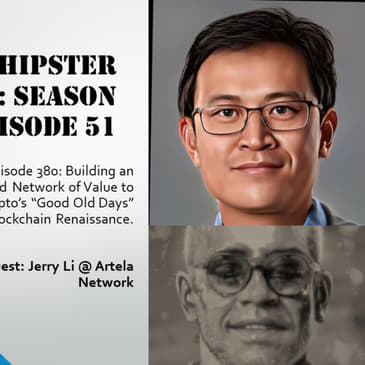

Jerry Li is the co-founder and CEO of Artela Network, an extensible blockchain network enabling developers to build feature rich dApps. Previously, he served as the Chief Architect of AntChain, the blockchain platform of Ant Group. Jerry is also the founder of one of China’s top NFT marketplaces, Jingtan. In addition to his experience in crypto, Jerry has an extensive background in tech as the head of Apple’s engineering team in China.
[00:00:00] Hello everybody and welcome to the Crypto Hipster podcast. This is your host, Jamil Hasan, the Crypto Hipster where I interview founders on Fanoires, executives, thought leaders, artists and even Renaissance people. And I'll tell you a little bit about what I'm going
[00:00:20] to introduce my guest today, Jerry Lee, who is the founder and CEO of Artella Network. Jerry Welcome to the show. Thanks for having me to know. You're very welcome, you're very welcome.
[00:00:35] So let me ask you something to start off with the first question is this, what is your background and is it a logical background for what you're doing now? Yeah, I actually I've been in Crypto Space for about seven years and before that, I spent most
[00:00:53] of my career in Silicon Valley 12 years with Alphoh, the engineering and product design work. Then in 2017 I joined Antigroup used to be called Antifonential, which I think today is still the largest, the Intercom happening in the world by a lot of metrics,
[00:01:16] one billion users and a lot of transactions and as an management, all that. But that time, a seven years ago, I was leading the new technology team at Antigroup. We're looking at the new technologies different new technologies, how they can help
[00:01:38] and group business going forward. And blocking became apparent. A choice, something that's going to be a very important part of the future of the internet. So that's how I got into it. I started working on blockchain technology. We built a team from very small, like 10 people
[00:02:01] to a much larger close to 1000 people eventually. And we did a lot of a blockchain technology development and some of use cases, particularly within the Alibaba and ecosystem while I was there. Then about 18 months ago, I started our tele because we wanted to take our learning from building
[00:02:27] blockchain within Ant and take that applied to the larger, outside world. What is the answer all about? Yeah, right. The name that we give to our incentive user campaign. Our tele is in topic test net at face. We actually have been in topic testing for like a few
[00:02:55] month. But we started this incentivized user engagement and testing face about a month ago. And this will last about three, four month before we do the men that launched later this year. So summer around September, we will do our men that launch.
[00:03:15] So yeah, we call it renaissance is really because we feel like we want to bring back the good old days of crypto. I feel like you know, apparently this industry has been growing and we demand this rate. But in a way, which you're like, it's getting
[00:03:37] a little dull. We used to have ICOs, last cycle we had at T's. We had a D-Fi, a lot of innovations. But now this cycle, there's a lot of price movement and the madness on mean coins. But we have not seen a really meaningful breakthrough
[00:03:58] in terms of larger scale adoption in terms of applications. So that's something we want to see going forward. I think adoption is a key. And you know, for both renaissance, we want to just bring back the original that the passion we had when we first came into
[00:04:19] this field and really keep building and just to bring the adoption to the crypto world. I love the concept of the good old days. You and I came at the same time. I came
[00:04:35] in as an ICO advisor. I want to get your, your, your definition with good old days mean to you. And then I can share with them what they meant to me. Yeah, I think when I first got into crypto, I read the Bitcoin, you know, white paper
[00:04:59] and just I was really amazed by it. And just in a way I was shocked by how this could be done and a permissionless way you can do the electronic payment and transactions without middleman.
[00:05:17] So it was quite some innovative idea and apply engineering principles. And you can build a larger scale network around it, right? So that was really cool. And when I first got into crypto, I was really hopeful for the future of, you know, this permissionless new wave of
[00:05:39] internet called Web3, quite, you know, blockchain business. What have you, but, you know, just just this real fire, you know, a passion about something new, right? And being able to be early, early adopters and be part of the contributor. So that was the, I guess
[00:06:03] what I would call the good old days, you know, just getting inspired by this new wave of innovations. I like that. I like the inspiration. I can really be to the inspiration. The ICU days were,
[00:06:20] were fraught with, I guess some of the same things that we're fraught with today. Yeah, I mean, because this is this industry in the grant scheme of things is still very early. You know, there are scams, there are fraught, there's just a lot of bubbles, right?
[00:06:39] But just underneath of what's happening on the surface is really this amazing blockchain technology. And the potential to build the premises, internet services for future, you know, that's going to fix a lot
[00:06:54] of the issues we have today with these web 2 type of services. So yeah, I, I'm very, very hopeful for the future. I think, you know, that's the reason I started our telon and trying to build a infrastructure that's really clear towards larger scale applications for really mass adoption.
[00:07:18] People talk about mass adoption, but we really, if you look at the web 3 or crypto today, the number of users are, I'm kidding, users are so small, right? It's not even, you know, I see some numbers like maybe 5 million total users
[00:07:34] but you can't really use the AU. It's just compared to web 2, it's so small, right? It's not even 1%. So I see we have a long way to go and to grow and we need to build, keep building the solid grant for infrastructure.
[00:07:50] We also need to build something new, you know, native applications. So we could work on that at a little bit of a forked that or a little bit of a crossroads, right? Crypto, if you're a main a fridge industry or you can get that adoption, right?
[00:08:06] If you're way right now, what are the factors that would help us become adopted? And what are the factors that would help us, you know, stay as a fridge industry? Right. Yeah, I think that's a very good question. And adoption is the keyword.
[00:08:30] How can we onboard the next million or even tens of million or hundreds of new billion users? That's the challenge that this industry faces today, right? So much money has been invested into it.
[00:08:46] And a lot of people, a lot of very smart people started building in the last few years. But really, it cannot be something that's just limited in this small circle for people, right? We want to grow the industry.
[00:09:04] We want to bring new users through new use cases, through, you know, just integration into somebody maybe, Web two like type of services, right? I think there are two key things. One is the, on the still the infrastructure. That's far from being mature.
[00:09:27] If you look at today's L1 or L2 just blockchain space, all these blockings are still not ready for mass adoption, right? Ethereum or Solana or whatever have you, right? They're not ready for web two scale mass adoption.
[00:09:47] So there's long way to go before we have a solid infrastructure like AWS, like, you know, Google type of services, right? There's that. And another thing is how can we make the UI UX use a friendly? So people, you know, just everyday people like my mom,
[00:10:11] we feel comfortable using these services. Instead of, you know, you have to use work-knock wallet, you have to wait for the transactions to go through and, you know, sometimes they don't. Then you have to, sometimes you have to bridge using a different blockchain.
[00:10:28] It's just so confusing even for people in this industry, right? And yeah, so yeah, I think it would come down to these two things. One is the infrastructure and another one is how do you design a UI UX to serve much longer scale users?
[00:10:50] It's always been the UI UX. It's always been the way to make a lot of devs ability with, they think people want instead of asking people web two what they want, what they need, right? So I want to talk, yeah.
[00:11:06] I have some ideas that I want to run by later. I want to jump into that word meme, right? I'm quoting you and you're saying Bitcoin is the world's largest meme coin. And I'm thinking like, maybe it is.
[00:11:24] So let me want to find out why you think that and what can we do about it? Yeah. So don't get me wrong. I love your content. But when you, this goes back to Satoshi's original vision.
[00:11:44] His white paper was titled Bitcoin, the peer-crupeer electronic cash payment system, right? Although I mean, Bitcoin as a asset has established itself to be digital gold narrative is pretty much in grain. And it's getting a lot adoption with the ETF and all that right.
[00:12:11] So that's great for Bitcoin, but Bitcoin as a blockchain is not really being adopted. I don't know about you. One was last time do you know anyone used the Bitcoin blockchain? Right. So the technology adoption is really not there.
[00:12:36] So this is kind of like the meme coins that people talk about it and maybe some of the meme coins get a lot of followers in certain communities, but nobody really using these meme coins, right? There's no utility value through these meme coins.
[00:12:54] So in this way, I said, well, a big coin without meaningful adoption is just kind of like meme coin. Right? Yeah. It is. People use Bitcoin though to, to, I guess people can use meme coins by things, right?
[00:13:19] What do you think needs to happen to what are used a Bitcoin blockchain as a blockchain? Well, yeah, this is interesting because even I think a few years ago, last cycle. People are building payment rails on public Bitcoin, right?
[00:13:40] And, gosh, I don't remember what's the name of the lightning. Well, of course, lightning. See, you know, people forget it, right? Lightning was supposed to bring, you know, this cheap fast payment on top of Bitcoin when people can trust and sack with a sack, right?
[00:14:03] It has not materialized. You know, I had trouble just thinking about the name. So that just helped you that Bitcoin as a blockchain to support larger scale, you know, users to transact anywhere in the world.
[00:14:23] This has not, has not become a reality and probably the way this is going, it will not be a reality going into the future. It may be something else. This is probably not Bitcoin. It could be some other blockchain network or network of block chains.
[00:14:44] It does not necessarily have to be once it could be just all these block chains. Somehow, they form a global settlement layer that is super fast and secure. And anywhere you go, you can just, you don't need to understand what's the underlying network or protocol.
[00:15:05] You can just use it in a permissionless way to transact freely with your stablecoin or a token of your choice. As long as you both could agree on it.
[00:15:17] So I see that being the future does not necessarily have to be Bitcoin being part of this payment or a settlement layer. Bitcoin is kind of its own thing in a way. It's now innovating that much which could be, well, which is not necessarily that thing for Bitcoin.
[00:15:40] Right, because it's a digital goal. That would take me so, you know, well accepted already. I think, oh yeah, it's great for investing. Yeah. But there are three schools of thought here as far as payment. You might think, let me think to another one.
[00:16:03] One of the schools that thought is Hedera. Another school of thought, able coins like Tether. And another school thought, when I subscribe to is like Win.
[00:16:16] Would be like if Satoshi were writing the way paper today, you know, one of those three avenues would be one of the ones that would go people would go down. What do you think? I don't have a preference here as a mail. I think we're so early.
[00:16:35] I think the future is still to, you know, it's so early to predict what the end game of this. But I think eventually it's going to be a network of blockchains. It's not a winch game. That I know. But which chance we don't know.
[00:16:55] I'm certainly hoping our tele will be part of that. It will be a network of interconnected blockchains. These chains are compatible. They talk to each other. They are decentralized. And a user does not care and does not need to know what's under underneath. What's blockchain they use.
[00:17:18] The application may will automatically roll through the easiest, the cheapest, the fastest way. You know, this is like global interconnected web from the value of writing. That's the future icing. I like it. How do you bring together these chains that are so disparate?
[00:17:41] Where communities are fighting each other, like the Ethereum community. But in a community, it's basically how to land community. How do you create a network? How do you do it? Like where everybody is working together. Yeah.
[00:17:55] I think that's one of the challenges that's facing industry is you have these tribes fighting for the narrative, you know, the position of the market. But I think it's slowly and sometimes it's energy wasted, getting into these fights. We all need to build together. And compatibility is important.
[00:18:27] You know, it's going to be all interconnected. You can now build a silo and just limit yourself to this small community or this because eventually it's all about network effect. Right? You want to connect it to everyone in the world.
[00:18:45] And everyone can easily have access to this network of values and network. That's again, that's provisionally, that's the key ethos of blockchain. So the standards will probably take time to play out as far as being interconnected, being compatible. And we talked about defy being a money Lego, right?
[00:19:15] But I see on the protocol level, she'd also be a protocol, right? That's how they can talk to each other and then they can roll through each other. The only you are open to this, the future, the vision of the future.
[00:19:33] You could be integrated into this interconnected web. That you can, I think that's the way the project, the infrastructure project can survive, can be relevant for future. Yeah. I want to talk about it for an example, right? So there are quite a few people out there.
[00:20:02] I don't know if you had a chance to go to consensus this year. But I talked to a number, I went for the first time in person.
[00:20:13] I talked to a number of people there who think that on the protocol level, zero knowledge could be the next gateway to the next 100 billion people. What can be built on zero knowledge? And why could that be a catalyst for the next exciting time in crypto?
[00:20:35] I think Zika is important to scale blockings and to solve some of the unchain interaction and our rent. But that's following still, that's one piece of the many puzzles we need to put together.
[00:20:59] Some of the others like you to solve the storage issues, because the blockchain they can now continue to grow and take too much computing resources. Another thing is how to scale these blockchains in a dynamic way.
[00:21:17] Meaning, you eventually want to serve the applications that's on top of the blockchain. That's taking advantage of the blockchains capabilities. You don't want to waste your block space, but you want to scale it in a dynamic way. That's kind of like the cloud service and analogy more elastic.
[00:21:42] You want to have the performance to meet the peak hour.
[00:21:49] In China, we call the W11, the shocking festival right that peak hour that you have millions of tens of millions of orders coming or similarly in America would be black Friday right the transactions just go through the roof right so it needs to be elastic needs to be dynamic.
[00:22:09] And you don't want to waste all these block spaces one that demand is low right so yeah. So ZK is only part of it in a storage and dynamic scaling. I think all of these will will take more technical breakthroughs together.
[00:22:33] People have been talking about zoonology for a few years. I think quite a few projects are getting close to to to have breakthrough there, but one thing about ZK is still it's very computing intensive.
[00:22:51] So yeah, so it's not necessarily all the transactions you would need to use cases. Yeah, I think it needs to be coupled with some other technologies as well.
[00:23:08] It's interesting to talk about the storage and you could remember that lightning network there was another thing that came out in Bitcoin in the past years called tap. Right, that was just a storage capacity right.
[00:23:23] Effective has that been you know and our other James building something similar and how how could that be a vector growth. You know, Jamel, I have not quite followed to prove or in some of the new work Bitcoin ecosystem L2 us now that closely.
[00:23:49] I am on the camp that maybe just leave Bitcoin alone. Just yeah, these go that's good great investment vehicle that that's also getting out of the new adoption so for traditional people so that that's all good.
[00:24:13] I think fundamentally if you want to have a blockchain as the decentralized computing platform probably Bitcoin is now the best choice. You want to have build it's my contract platform so I would look at some newer chains instead of.
[00:24:34] Although I cannot be so sure because there's some interesting projects I'll be to come up to recently though. There are the ordnals I don't understand them at all. I want to talk there is there is one vector that is in game steam.
[00:24:58] I thought it was a long tail but it looks like it's been hot recently and people are like clamoring for a for an AI summer. What's your thoughts on AI being either an an-focaching or catalyst for blockchain? Yep, that's a very good question.
[00:25:22] That's one topic people have been talking a lot in this industry. I think eventually AI and crypto will converge. When you think of AI what does the best is to create a new.
[00:25:48] Just digital abundance I call it because you know the generative AI they can generate new just like videos, pictures or just so many things right. The AI can do right. Then what what blockchain does really well is to create digital scarcity right.
[00:26:11] AI needs a lot of computing power and a blockchain as a decentralized computing platform. At his core compared to centralized the call service for example, the blockchain will always be less efficient. But blockchain does the best is to bring more. The blockchain will be more trustworthy.
[00:26:40] So I think that's going to solve some of the issues that AI eventually will come to face because AI creates so many new content new images and videos are that in what's real what's not real. That's going to be a challenge in the future.
[00:27:05] It's already happening. You see a video but you don't know if it's real or fake right. But I see a combination where number one blockchain can help address something that was real was not real.
[00:27:19] The problem number two is that blockchain can help create new business models with these AI creation or AI agent. I was thinking all along that Bitcoin closes the trust deficit between web two and web three.
[00:27:43] And what you just said maybe I shouldn't have been thinking a bit Bitcoin doing it. I should have been thinking about the blockchain doing it because AI creates mistrust and blockchain closes the trust deficit so it works to validate what's real and fake.
[00:28:01] And not only that, not only what's real was fake but I think some of the new business models will emerge at the blockchain for AI and crypto. That might be the next exciting thing. Interesting. Wow.
[00:28:27] Okay. So I want to talk a little bit more about you know, you said in the beginning about your, um, have a couple of that. A couple more questions. One is your testing situation. You're testing right now. People are helping you test your net.
[00:28:42] How's that going? What do you need still more people testing or status of it? Yeah. Like I said earlier, Artella has been in public testing that face for a couple of months and I'm happy to report that we recently crossed 200,000. Just individual participants in our campaign.
[00:29:06] And we want to see more of that. We are going into the second phase our test net July early July. So in a couple weeks it will be second phase. So we'll bring more applications that's built on top of our tell us blockchain.
[00:29:23] It'll be some of the more interesting applications that would be working on people welcome to come to our website or tell us that network to check it out. It's it's been a very exciting few months.
[00:29:43] We released the public test net, you know, just battle tested because we're the bots and new applications there different data services.
[00:29:56] We have issues with but I'm happy that our tele test net is getting stronger and I feel very confident we're going to have a successful launch going into the net launch. I look forward to it.
[00:30:12] I want to thank you very much for trying today and to speak to you through and my final question is have a few more information about you at a battle tell and a work.
[00:30:25] Yeah, our tele ART.net work is our website and our tele network is a very active on Twitter there's a lot of the. information know topics and materials that we publish throughout Twitter and throughout website.
[00:30:47] And myself, Jerry dot ARP, I'm also on Twitter. So I do welcome to yeah to thank you very much for your time today. Nice talking to you, Jamel. Thank you for having me.