
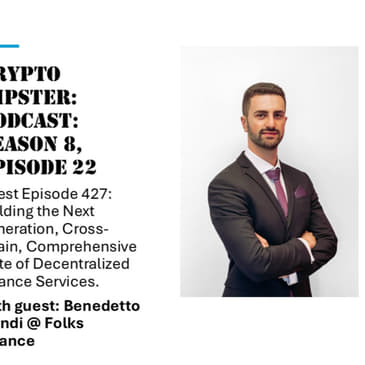

Benedetto Biondi is the CEO of Folks Finance, a premier cross-chain DeFi protocol that delivers a comprehensive suite of services, including lending, borrowing, trading, and liquid staking for digital assets. Driven by a passion for innovation, Benedetto serves as a mentor in Techstars Web3 and various other accelerator programs, where he nurtures emerging talent in the blockchain space. He is also a DeFi advisor at Climatecoin and shares his extensive knowledge as a lecturer on DeFi in the Economics and Law for Digital Assets course at the University of Florence.
Socials:
Personal:
https://www.instagram.com/benedetto___/https://x.com/BenedettoBiohttps://www.linkedin.com/in/benedetto-biondi-030248199/
Folks:
https://www.linkedin.com/company/78074359https://x.com/FolksFinancehttps://www.instagram.com/folksfinance/?hl=en
[00:00:00] Hello everybody and welcome to the Crypto Hipster Podcast. This is your host, Jamil Hasan, the Crypto Hipster, where I interview founders, entrepreneurs, executives, thought leaders, amazing people all over the world of crypto and blockchain. And today I have an amazing guest. He is the founder and CEO of Folks Finance. His name is Benedetto Biondi. Benedetto, welcome to the show.
[00:00:26] Thank you for having me here. Very exciting and good pronunciation. It's not that easy for my name.
[00:00:34] Awesome. Thank you. Thank you. I do my best. So, awesome. Let's kick things off and I'll ask you first, you know, what is your background and is it a logical background for what you're doing now?
[00:00:49] Yes. So, I'm South Italian. I moved to Milan studying mechanical engineering. So, a bit not related to what I'm doing right now.
[00:01:01] I used to work as a mechanical designer for a bit. I really felt that that wasn't my goal. So, I switched it after a few months. I did a master's degree in management and innovation engineering.
[00:01:16] Because, like, when I used to work as a mechanical designer, I felt my role, it wasn't to be, like, a designer or, in general, like, just staying on the desk and doing my work on the laptop.
[00:01:32] It wasn't enough for me. I would see my boss talking with clients, doing deals. And they feel like I need to do that. Like, I have the skill for that. I have communication skill. I don't want to just be at the laptop.
[00:01:48] That's why I decided to take this master's degree in management engineering and innovation.
[00:01:53] And that's where I met blockchain technology in one of the innovative IT courses. And later on, I started to work as a project manager for the largest webtree software house of Italy.
[00:02:06] And from there, we had the idea of building this DeFi protocol and I became the CEO. That's how it went.
[00:02:17] Very cool. Very cool. So, let's see. Folks Finance. I want to find out what you do, what makes you unique, and what you're all about.
[00:02:28] Folks, in simple words, is a one-stop shop of DeFi tools, including lending, borrowing, liquid staking, trading, leverage, and leverage liquid staking.
[00:02:43] And we're also saying that just for disaggregation, it's unique because there is nothing compared in the industry, especially in DeFi.
[00:02:54] Plus, we are now launching our cross-chain technology tool. So, basically, we had this one-stop shop on a single chain.
[00:03:05] Now, this is evolving into a cross-chain one-stop shop. And the uniqueness of this is I like to compare it with telecommunication.
[00:03:17] So, imagine if every one of us had a smartphone but could call just their career, just the network they use and isolated from everyone else.
[00:03:31] That's what happened today in DeFi. So, usually, we use one network. Let's say we use Ethereum and we interact with people only on Ethereum.
[00:03:40] We use liquidity on smart contracts that is only on Ethereum. So, the DeFi apps support different networks, but those are isolated.
[00:03:51] They don't talk to each other. Okay. With cross-chain technology, now those start to talk to each other.
[00:03:56] They can send data. They can send liquidity. So, the main advantage of what we are doing is interoperate those networks.
[00:04:05] So, the comparison is like we use our smartphone every day and we are able to call everyone and message everyone, not being isolated.
[00:04:14] Definitely, this brings a lot of advantages. The most direct one are the efficiency in the operation
[00:04:23] because you are able to aggregate liquidity from multiple networks.
[00:04:28] And another one is the user experience because we abstract to the end users network selection, gas fees.
[00:04:34] So, the user journey in DeFi became much more simpler and closer to centralized exchange.
[00:04:46] So, you're saying it makes sense if you're working on Ethereum, you're only working on Ethereum.
[00:04:51] So, the comparison would be like if I was able to make only phone calls using AT&T.
[00:04:57] Yes. And just call AT&T, only users.
[00:05:01] Got it. So, I thought that DeFi was already cross-chain because of the middleware like Chainlink and others are...
[00:05:10] Yes. For example, we use Chainlink. Correct.
[00:05:12] Like now, we're starting to have...
[00:05:15] Listen, Chainlink CCIP is the cross-chain interoperability protocol of Chainlink.
[00:05:21] And it's very new. This went live in September.
[00:05:26] Like the final main version.
[00:05:30] Before, like there are other messaging layers, but these new technologies are very new.
[00:05:38] They are taking... They're being trendy right now.
[00:05:41] So, we will see more and more app like Volksfinance adapting to cross-chain technology.
[00:05:48] Because before, we had multi-chain, which is yes, you support multiple network, but they are isolated.
[00:05:56] They don't talk to each other.
[00:05:57] Now, they start to share liquidity.
[00:05:59] They start to share data.
[00:06:01] And this allowed to build much less friction and application.
[00:06:09] Okay. So, your L1s are able to speak to one another through what you're doing.
[00:06:15] Correct.
[00:06:15] Got it.
[00:06:16] But there is still a problem with Ethereum and Bitcoin communicating or not communicating, right?
[00:06:21] Correct.
[00:06:22] You are very knowledgeable.
[00:06:25] So, because Bitcoin per se does not allow a direct interoperability through those messaging layer like Chainlink.
[00:06:36] But there are the Bitcoin layer 2s.
[00:06:38] For example, I saw this week was announced that the first Bitcoin layer 2 was connected to Chainlink.
[00:06:46] And that's a very big milestone.
[00:06:48] So, you have now layer 2s that are able to be connected to Ethereum.
[00:06:56] Got it.
[00:06:56] So, we're starting to see that then.
[00:06:58] Yes.
[00:06:59] And you will see more and more.
[00:07:00] It's just upcoming.
[00:07:01] I said, it's getting trendy right now.
[00:07:05] Okay.
[00:07:06] And I believe in the next bull cycles, there will be a lot of apps under this narrative that will take place.
[00:07:13] Because the previous generation of apps in general, whether it's DeFi or might be also another field of Web3,
[00:07:21] if they don't update, they will have competitors that have a much better solution because they use cross-chain technology.
[00:07:30] Got it.
[00:07:32] Got it.
[00:07:32] So, I want to talk about your hub and spoke model with iChain.
[00:07:38] Right?
[00:07:38] Yeah.
[00:07:39] Yeah.
[00:07:39] How does that work and what are the benefits?
[00:07:42] So, this is specifically one of our cross-chain tools and it's the first one that we delivered.
[00:07:48] It's called X-Chain and it's a lending protocol using hub and spoke model.
[00:07:53] So, the way it works is we have a hub chain that is Avalanche and the hub chain is connected to many Spokes chains and allows the interoperability between the Spokes as well.
[00:08:07] So, consider the hub chain as an accountant and considers the Spokes chains as all of the careers that we were talking about before that wants to talk to each other.
[00:08:19] So, but here we are talking about lending and borrowing.
[00:08:23] So, how it works is the practical example.
[00:08:26] Imagine I have Ethereum on ETH on Ethereum and usually I want to keep the native ETH on Ethereum.
[00:08:36] Right?
[00:08:36] Like, I don't want to move it around.
[00:08:39] And at the same time, I may want to, I don't know, buy a meme coin on Avalanche.
[00:08:47] So, what I...
[00:08:48] Or let's say on base.
[00:08:49] That's a better example.
[00:08:50] Let's use Ethereum as where I have ETH and I want to buy a meme coin on base.
[00:08:56] So, what I'm going to do with Fox Finance and what the laws is that I can lock my ETH as collateral on Ethereum, borrow USDC on base.
[00:09:08] And with this USDC, I can do whatever I want so I can buy the meme coin.
[00:09:11] But my initial capital, that is the one I want to leverage to do this trade, let's say, is staying in the native chain.
[00:09:19] And as an end user, compared to what I should have done, it's much, much simpler because I would need to
[00:09:27] or transfer my Ethereum to base through the layer 2 and sell it there.
[00:09:35] Or, and I'm involving also the bridging, or I would need to sell my Ethereum on ETH and bring the USDC later on to base.
[00:09:46] In this way, I'm leveraging the capital efficiency of my assets on the chain that I have it natively and borrow somewhere else.
[00:09:55] But the use case can be many.
[00:09:57] The powerful thing is that as a user of multiple networks, I can leverage both of those without need to bridge.
[00:10:10] And Fox Finance can be the facilitator of that.
[00:10:15] So, I can use different assets on different chain for different purposes in a very simple way.
[00:10:21] The hub in this part is basically, as I said, the accountant.
[00:10:26] So, it doesn't matter where on Fox Finance you take the loan.
[00:10:31] The hub chain, which is Avalanche for us, keep track of your debt.
[00:10:35] So, you may have a loan on Ethereum, you may have a loan on Base, on BNB, wherever you are connected.
[00:10:42] But there is like a debt balance that is happening on the hub chain.
[00:10:46] Plus, because of the cross-chain nature of some stablecoin like USDC, the hub chain serves as collector of a concentrated liquidity of stablecoin.
[00:11:04] Let me explain this.
[00:11:06] On the standard multi-chain lending protocol like Aave, which is the biggest, you have USDC liquidity deployed in each network.
[00:11:15] And this is extremely inefficient by definition.
[00:11:18] Because if you have, let's say, 10 networks with the 1 million liquidity, which is an example of USDC, that means that your protocol has $10 million liquidity of USDC.
[00:11:33] But those networks are not interoperable.
[00:11:37] So, the biggest loan that you can take out of this 10 million is still limited to 1 million, right?
[00:11:45] Because it's in one network.
[00:11:47] In concentrated liquidity model, these 10 pools are aggregated into one.
[00:11:52] So, in the hub chain for us.
[00:11:54] And it means that the liquidity that you can consider for the biggest loan is 10 million.
[00:11:59] So, it makes it more efficient simply by aggregating it.
[00:12:04] And the fact that you are able to take with the same liquidity in total, bigger loan, it means that you create this network effect where if you can take bigger loan, you are going to have bigger lenders.
[00:12:22] And it's a loop, right?
[00:12:24] It just facilitates the natural grow out of a pool.
[00:12:30] Because if you fragment it, it's going to be more difficult to grow it.
[00:12:36] I understand.
[00:12:37] So, do you think your model at some point is going to make Aave, I don't know, extinct?
[00:12:45] Or do you think there's going to be room for both?
[00:12:47] By the way, Aave has already published a plan to update towards this model.
[00:12:53] But their plan is in one year.
[00:12:56] We did this one year in advance.
[00:12:58] So, we have one year of, say, time in advance where we can compete with them.
[00:13:07] And, you know, like one year is not a short time in crypto.
[00:13:11] Yeah.
[00:13:12] Yeah.
[00:13:12] One year is an eternity.
[00:13:13] So, cool.
[00:13:16] Very cool.
[00:13:19] So, you are doing cross-chain messaging, right?
[00:13:23] So, I want to find out the benefits of that.
[00:13:25] And then how, I didn't know that there are different stages in the messaging lifecycle.
[00:13:32] But it looks like you have done some improvements in each area.
[00:13:35] So, how does that work?
[00:13:37] So, regarding the messaging, it's not ourselves doing it.
[00:13:41] We use different technology to do that.
[00:13:45] So, we use Chainlink, CCIP that I mentioned.
[00:13:49] And we also use Wormul.
[00:13:52] The differentiation between folks and other competitors is that we created the first smart router for messaging layers, for cross-chain messaging.
[00:14:02] And, basically, our router, based on the network, based on the operation, it's able to smartly select the cheapest or the safest.
[00:14:14] So, basically, it adapts on what you're doing and select one of each other or other.
[00:14:20] And also, like, it's also in terms of reliability.
[00:14:23] If one of the two is, for any reason, not working, we still have the reliability for the user to use the other one.
[00:14:32] Also, our smart router potentially could accept and integrate other messaging layers.
[00:14:41] It's, you know, it is flexible.
[00:14:44] So, it's a very good point in our, let's say, competitive model when we compare it to other cross-chain lending protocol.
[00:14:57] Very cool.
[00:14:58] So, I'm sure there are complexities, right?
[00:15:03] You know, these cross-chain interactions.
[00:15:04] And I want to find out what you see as the best practices.
[00:15:07] And then, I was interested in, yeah, let's talk about that first.
[00:15:12] And then, your relationship with Algorand.
[00:15:18] Algorand, yeah.
[00:15:20] So, the complexities related to the messaging layer, first of all, it's a very new technology, right?
[00:15:27] It's something that is picking up right now.
[00:15:30] So, even, for example, in terms of UI and UX, our designers and developers had to build something totally new.
[00:15:41] And we call it account ID.
[00:15:46] It's basically a way to create account abstraction where you connect multiple addresses from different networks under the same account.
[00:15:56] And this account doesn't matter on which network you are connected.
[00:16:03] It's able to sign transactions on also different addresses and network on other chains.
[00:16:08] So, it's a kind of account abstraction.
[00:16:11] But we had to do for the first time.
[00:16:14] And it was a huge work in terms of developing, but also actual code and actual design.
[00:16:22] And we decided to do it so well that we wanted to be a standard for the industry.
[00:16:30] We want other apps to use our model.
[00:16:33] Definitely, this is a challenge because users are needing to learn a little bit of new way of connecting to the app.
[00:16:43] Because it's not the standard connect, MetaMask, and that's it.
[00:16:47] You need to, let's say, set up your account for the first time.
[00:16:51] And it's only for the first time.
[00:16:54] So, it adds a little friction, but it's only for the first time.
[00:16:57] The friction that adds at the beginning, it's way less compared to the friction that it removes from having the needs of all the time-signed multi-chain transaction on other protocols.
[00:17:10] In addition, the protocol also, by using external technologies, definitely brings in external risks.
[00:17:26] Because the more technologies you use, the more this is obvious.
[00:17:32] But at the same time, at Volks, we are always very savvy regarding security.
[00:17:40] So, for example, we have time-limited bridge amounts between chains or borrow caps.
[00:17:48] So, everything is, let's say, controlled in a safe environment.
[00:17:56] If anything would happen in any of the technology, let's say, for example, we have two for reliability.
[00:18:01] But also, we have time-limited amounts that can be transferred between a chain and another or between loans.
[00:18:11] So, everything is, let's say, limited in terms of risks.
[00:18:15] We understand it's an additional risk that we bring inside.
[00:18:20] But again, if you want to do innovation, you need to consider those.
[00:18:26] And it's normal to have.
[00:18:28] But with time, we have seen that bridges are more reliable.
[00:18:33] And we trust those technologies to be safe more and more in the future.
[00:18:42] Regarding the Algorand part, of course, we were born in Algorand.
[00:18:47] Algorand is our home.
[00:18:48] We are the biggest DeFi protocol on Algorand, holding like 75% of the total TVL in the chain.
[00:18:58] For us, you know, we started in Algorand only with the lending.
[00:19:02] And that's where we learned that we needed to do a one-stop shop.
[00:19:05] We added the liquid staking, the swaps, leverage trading, leverage liquid staking.
[00:19:13] I think that the Algorand protocol is an extremely good product.
[00:19:20] And the cross-chain one is like, it's our way to expand what we built on Algorand to other networks.
[00:19:29] Obviously, as you know, the protocol wants to be serving many chains.
[00:19:36] And the Algorand network will be also integrated in X-chain.
[00:19:43] It's just for us that at the very beginning, it's easier to integrate EVM networks.
[00:19:50] Because the Algorand one takes a little more time, but it's not going to come.
[00:19:55] Yeah, I know some people in that foundation and they're working really hard.
[00:19:59] I also saw that, you know, you mentioned that your hub was Avalanche.
[00:20:03] And I saw that they had a couple of things.
[00:20:06] They had an amazing event in Argentina.
[00:20:09] Yeah, I was there.
[00:20:12] And, you know, I'd like to learn more about that.
[00:20:14] And then I heard that, you know, I saw that they had a new game come out this week.
[00:20:20] So why did you choose to build on Avalanche?
[00:20:23] I mean, I went to ConsenSys in May and I saw a presentation and I couldn't understand.
[00:20:28] I know it's complex.
[00:20:29] I couldn't understand it.
[00:20:31] So I want to find out what the strengths are and why you chose that one.
[00:20:35] So in general, it is an easy answer.
[00:20:40] We had to choose between layer one or a layer two EVM because the new version of the protocol was going out all EVM.
[00:20:50] And we have also, as I said, we use other technologies.
[00:20:55] We use Chainlink, CCP, Wormo, CCTP for, Circle, CCTP for USDC transfer.
[00:21:03] So we needed the network that supported those technologies and that had low fast finality and low fees.
[00:21:14] So as in the EVM space, it's a clear answer that Avalanche was the best.
[00:21:20] Also because with layer two, we would have the problem of having a finality of 20 minutes in many operations.
[00:21:30] And definitely you understand that you cannot deliver tools that has all the time finality of 20 minutes.
[00:21:38] Maybe we'll get better through time, but we needed something ready right now.
[00:21:43] That's why Avalanche was announced.
[00:21:47] Regarding the general updates and also in the events, it was launched at Avalanche 9000.
[00:21:53] That is this very cool new way to spin layer ones on Avalanche that are interoperable.
[00:22:03] And you can customize your layer one in a very easy way.
[00:22:08] You can set up the fees and you can set up how public or private it is.
[00:22:14] And this is, for example, very good for games.
[00:22:17] And there is this very cool new game called Off the Greed, if I'm not wrong.
[00:22:23] We saw it, we played it.
[00:22:25] It feels like a very, very good game, not even on blockchain compared to the play to earn version of games we had before.
[00:22:36] This is totally another level.
[00:22:38] And it's very mainstream.
[00:22:39] It's really comparable to big games that we have on console.
[00:22:45] And I believe Avalanche facilitates also this through this new innovation.
[00:22:52] In general, I think it's a good technology, a very good team behind.
[00:22:58] So we find us comfortable with the choice as well.
[00:23:03] Sounds good.
[00:23:04] Okay, so I think the market agrees with you because you have grown your platform successfully to 12,000 monthly users, which is really cool.
[00:23:16] So how do you envision further growth happening?
[00:23:20] And what do you see as the next iteration of the DeFi Summer 2.0?
[00:23:31] So as I said before, I really believe that the next DeFi Summer will be led by cross-chain apps.
[00:23:42] Because, again, simply the efficiency that you are able to bring in, it's another level compared to the fragmented version.
[00:23:51] And we see that more and more networks are picking up.
[00:23:56] So if we consider how the TVL is moving between networks and spreading, yes, Ethereum is still the biggest there.
[00:24:03] But a lot of liquidity is moving in the new chains.
[00:24:08] And if you really want to take advantages of this liquidity everywhere, there is no way that you are not going to use a cross-chain technology.
[00:24:19] And you can already kind of forecast that because, let's say, the things that Wormall is doing, CCIP is doing, but also their messaging layer like Layer Zero.
[00:24:32] So you already can feel that this partnership, that now our partnership is going to evolve into actual technology in place, in apps being built.
[00:24:47] But I think that DeFi in the next cycle, yes, will be better and will be more mainstream adoption.
[00:24:55] But DeFi has to be more and more of an infrastructure.
[00:24:59] It is needed to empower the other trends.
[00:25:02] Let's say we have the RWA trends that is, let's say, in the hype right now.
[00:25:09] It will grow, but it will grow also because underneath you have a very good infrastructure of DeFi.
[00:25:16] So let's say, like, you are able to use those RWA on DeFi permissionlessly to take law and out of it.
[00:25:25] That's what is going to bring the real adoption.
[00:25:27] So having a good infrastructure of DeFi that at some point will be able to accept real-world assets as a collateral, for example, in a lending protocol, it's really, really powerful.
[00:25:40] I remember when in Algorand we listed, we were the first lending protocol listing tokenized gold and silver as collateral.
[00:25:49] And this is super cool because so far, when you were, let's say, investing in commodities, whatever is the app that you want to use, you are not able to take a loan out of that.
[00:26:03] In DeFi, it's one click.
[00:26:05] You buy the tokenized gold.
[00:26:06] Okay, you are investing gold.
[00:26:08] You need money out of it.
[00:26:09] You take out a loan, a few clicks, and that's it.
[00:26:11] No one is going to stop you.
[00:26:14] And this is just one example.
[00:26:16] If you start to think of how many valuable assets we invest in in TradFi and those could be brought on-chain, it's going to empower a secondary liquid market that is totally new for retail users.
[00:26:40] That's what I want to hear.
[00:26:42] Retail users need to come back.
[00:26:45] I don't think they're back yet.
[00:26:46] They were here before the FTX implosion, right?
[00:26:51] So we're building the infrastructure.
[00:26:53] We're waiting for retail.
[00:26:55] That could wait.
[00:26:55] It could be a long time or there's something we can do to prompt them to return, right?
[00:26:59] How do you think we're going to bring retail back in?
[00:27:03] Yes, the answer is there.
[00:27:05] We need to build a better infrastructure underneath.
[00:27:08] So if the core infrastructure of DeFi, for example, let's say I believe that when users were hyped about FTX, it was a good product, right?
[00:27:21] If you come, let's say if you're back to that cycle and you think of the level of product of FTX compared to DeFi, there is no way a retail user was going to choose DeFi.
[00:27:33] DeFi is just much better than decentralized exchanges.
[00:27:40] But now DeFi is getting better and better and better.
[00:27:43] So a user that understood and still understands that with centralized software, you can have this type of problems is going now to look into DeFi where you don't have definitely the problems of centralization.
[00:28:00] You had other type of friction, but this friction is getting less and less.
[00:28:05] So using cross-chain technology allows to close the gap between the user experience that you have on centralized exchange like FTX and DeFi, but keeping the quality of DeFi products.
[00:28:23] Got it.
[00:28:25] So that makes sense.
[00:28:26] So my next question is going to be this.
[00:28:31] You know, you're in Hong Kong.
[00:28:33] You travel around a lot.
[00:28:34] I'm in the U.S., right?
[00:28:37] And I'm wondering when the next DeFi summer is going to be and where it's going to really originate from concentratedly because we don't know what's going to happen with our election here in the U.S. in 10 days.
[00:28:51] If there's going to be an appetite for DeFi, but I know there is around the world.
[00:28:54] So where do you see the initial spark coming from and when do you see it?
[00:29:02] So we all know that the U.S. is, you know, the biggest market in terms of capital, also in terms of innovators, because most of the brightest minds sooner or later, if they want to, let's say, expand to the next level, their startup, they need to pass from the U.S., right?
[00:29:26] And that's a very big pity that the U.S. right now, it's so harsh towards DeFi.
[00:29:37] I really hope that this will change.
[00:29:43] I really hope that the SEC is going to be more friendly towards us and welcoming.
[00:29:54] Personally, I think that there is really few DeFi protocols existing in the U.S. right now, and they are all very compliant.
[00:30:04] Otherwise, they are being prosecuted very quickly.
[00:30:09] And it's a pity.
[00:30:11] Like, it's just they are losing bright minds that needs to go somewhere else to do it.
[00:30:20] They are losing capitals and they are getting their citizens pissed off in a sense because they can't use apps that they would love to use.
[00:30:34] But they will.
[00:30:36] Hopefully soon.
[00:30:38] Yes, I think it just needs time.
[00:30:41] Like, also because when you start to lose markets and you see capitals moving somewhere else, then you wake up and I think you will come back.
[00:30:52] Yeah, I'm looking forward to the great, I call it the great wake up.
[00:30:57] So, awesome.
[00:30:59] So, I want to thank you very much for your time today.
[00:31:03] Thank you.
[00:31:03] I enjoyed speaking with you.
[00:31:04] I have one last question.
[00:31:05] It's probably the easiest one, but it's an important one.
[00:31:08] How can people find out more information about Folks Finance?
[00:31:12] How can they use your platform?
[00:31:14] How can they be defined users with you?
[00:31:17] And then also with you, how can they find out more information about you?
[00:31:20] Yes.
[00:31:20] So, folks.finance is our website.
[00:31:26] You should follow our social.
[00:31:28] We are very active on X.
[00:31:30] We also have communities on Discord, Telegram.
[00:31:34] So, please feel free to join.
[00:31:36] You can ask any question.
[00:31:37] You will be supported and welcomed in our communities.
[00:31:42] If you are new, you can learn through our Folks Academy.
[00:31:47] I think we are the only protocol in DeFi who does something like that.
[00:31:52] So, you have small videos, quick videos, like one minute of learning about crypto, learning
[00:32:00] about DeFi in general.
[00:32:02] And later on, you have a lot of tutorials on how to use the app, also with some questions
[00:32:07] to be interactive.
[00:32:10] So, definitely, if you are new, you can learn through our Folks Academy.
[00:32:15] You have a lot of documentation if you like to read.
[00:32:18] We try to make our websites as easy as possible to navigate and use.
[00:32:26] But again, stay connected with our pages.
[00:32:29] You will be updated.
[00:32:30] We engage a lot with our communities.
[00:32:32] We have social tasks on Galkse.
[00:32:37] We do a lot of campaigns with our users.
[00:32:39] So, it's pretty fun to be in our community.
[00:32:43] And we love to have engagement with our community.
[00:32:49] So, if you have good feedback, bad feedback, we are always happy to listen.
[00:32:55] And there is a reason why Folks is growing.
[00:32:58] And I believe it's a very good product compared to the industry standard.
[00:33:06] It's because we engage with the community.
[00:33:08] We listen.
[00:33:09] We want them to provide those feedbacks to us because it's very, very valuable.
[00:33:15] There is nothing better than a user complaining about something, really, so that we can learn.
[00:33:21] And regarding me, it's Benedetto BIO on X.
[00:33:28] Follow me on LinkedIn as well.
[00:33:30] It's Benedetto Biondi.
[00:33:31] My surname.
[00:33:34] It's B-I-O-N-D-I.
[00:33:36] So, yeah.
[00:33:38] I'm happy to stay in touch.
[00:33:39] Thank you.
[00:33:41] Awesome.
[00:33:41] Thank you very much for your time today.
[00:33:44] Likewise.
[00:33:45] I appreciate it.