
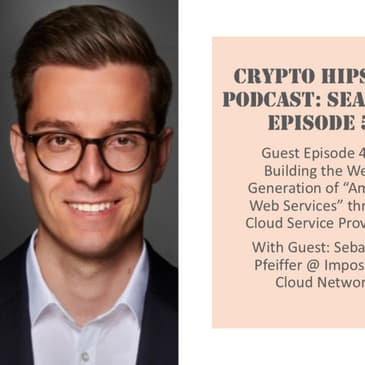

Sebastian Pfeiffer, Managing Director @ Impossible Cloud Network
Sebastian Pfeiffer is the Senior Director of web3 Growth at Impossible Cloud Network, where he is responsible for developing and implementing the company's growth strategy. His focus includes designing decentralized business architecture, tokenomics, legal frameworks, and stakeholder alignment.
Before joining Impossible Cloud, Sebastian was a Consultant at Boston Consulting Group (BCG), specializing in strategy development and execution for globally recognized companies across various industries, with a focus on social impact and industrial goods. He holds dual Master of Science degrees in Strategy and Corporate Development from Aalto University and Universität zu Köln.
[00:00:02] Hello everybody and welcome to the Crypto Hipster Podcast. This is your host, Jamil Hasan, the Crypto Hipster, where I interview founders, entrepreneurs, executives, thought leaders, amazing people all over the world. And today I have another amazing guest and he is, actually I forgot to ask him his title. I think CEO founder will find out. I have Sebastian Pfeiffer with the Impossible Cloud Network. Sebastian, welcome to the show.
[00:00:32] Yeah, thanks for having us. Really excited. I mean, technically my title is MD, it's Managing Director, but let's basically, I have an overview of the project, what we do, and I'm really excited to get this going. Awesome, awesome. Thank you for joining me today. So I'm looking forward to it. And let me ask you the first question I ask everybody is this, is what is your background and is it a logical background for what you're doing now?
[00:00:58] So maybe to give the audience a bit of background of myself, I have a business background and as most of the people probably that are listening in, it was, I kind of stumbled upon blockchain, right? During my studies, actually, the concept was introduced to me as kind of this vague new technology. Nobody really was familiar with it yet. Nobody really knew what the impact was going to be.
[00:01:21] So let's put a pin in that. Fast forward a few years, I did management consulting at BCG, this global consulting firm. And what the stereotype really does hold true is that you get introduced to the leaders of the world, right? So all these people in charge and you learn from scratch, really, about the thought process of these people. So I think it's a great learning opportunity. And I really enjoyed the time. It was a few years.
[00:01:51] And then Impossible Cloud reached out and that's where it kind of clicked, right? So it was this vague blockchain concept that was in the air. And I now have this experience of these thought leaders throughout various industries. And that's where it kind of came together. I mean, we'll touch upon that in a second. But quickly, what we do is we decentralized version of AWS. It's hopefully much bigger than that.
[00:02:15] But in the essence, that's it. And when I heard that first, it just kind of clicked, right? You know, sometimes there's these moments where it just makes sense. And for me, that was that moment. So essentially, we have all these really smart people in Web3 and these amazing projects, but they talk kind of a different language than what these Web2 enterprises are used to, right? And I think that what we have a chance here at Impossible Cloud Network to make happen is to join the two worlds, right?
[00:02:44] To bridge the gap in a sense and bring mass adoption by mass adoption. I mean, Web2 mass adoption. But not only that, introduce the Web3 concept and unleash its power, right? So that's what I think this opportunity offers us here at Impossible Cloud Network. Awesome. So let's get into it a little bit more. What is the Impossible Cloud Network all about? And how do you make decentralizing the cloud possible?
[00:03:13] I mean, a lot of people say they want to decentralize the cloud, but how do you do it? Right. It's not easy to take it away. So there's a few elements, right? So I mentioned already in a nutshell, it's decentralized AWS, but it's much more than that. We view it as the new open, the evolution of cloud, right? So what does it mean? So let's start at the base layer, the infrastructure layer.
[00:03:34] What we do is we have a global network of hardware providers across different types of hardwares, right? Essentially, we have an infrastructure layer that we then offer to service providers, so cloud service providers to leverage. We started with a first single service, which is storage, object storage, which kind of as a POC moment, if you will, right?
[00:04:03] So once that first use case is in place and you ensure, okay, that the system is working, then you can onboard more systems, more use cases. The storage side of things is Impossible Cloud. We have almost 5 million annual recurring revenue, and that's scaling quite nicely. And now the next step is kind of to onboard more service providers to make the system happen. Then there is a third element, which is nodes.
[00:04:29] Now, this is really the average Joe piece in this ecosystem. Anybody who wants to contribute but doesn't have enterprise-grade hardware in a data center that does not have the ambition to provide a cloud service, this is the node service. So these nodes ensure a lot of things, essentially the network's integrity, but also much more than that in the future.
[00:04:53] And then there's a fourth element, which is kind of embracing all of this, which is the decentralized control, right? I mean, at the end of the day, we want to replace a single entity being in charge of this or a few entities in reality to be in charge of this industry.
[00:05:13] And what we can allow for here, what the opportunity holds is an open ecosystem with these elements in place, insured by nodes, but in a decentralized fashion. So everybody's the owner. There's not a single entity in charge, right? And what this opportunity then brings is rather than somebody saying we go this direction, it offers the opportunity to be much more dynamic, right? So there's market forces in place.
[00:05:42] If there is a hardware provider that is exceeding the performance of another hardware provider in the same hardware class, sort of, right? Then that hardware provider will be leveraged over the other one. If there's a certain region that's needed, we have the superpower of crypto to essentially bootstrap that new region more or less overnight rather than going for a big data center with lots of capex, right?
[00:06:05] So essentially, maybe in a nutshell, what we want to do is an open cloud ecosystem, but evolution of an AWS. Got it. So I was drawing out the mapping here. And I remember a few months ago reading that there was a group of like 30 companies that was part of this decentralized cloud network, right?
[00:06:34] How do you see that playing out? Is that part of it? You know, how would that be like a governing body? Will you be part of that, support that? What is that all about? So essentially, I think there's different projects that try to achieve similar things, I would say, right? And what makes us unique is, A, I think we've kind of found product market fit in a sense already.
[00:07:00] And then two, we definitely want to become multi-service because that's where we believe the key is to really have this open ecosystem because of your single service. If you, for instance, just do, I don't know, storage or just do a GPU, I think it's attractive, right? But it's not going to be challenging the actual hyperscalers because people will have to pick and choose still for their business service.
[00:07:25] And what we want to enable is an ecosystem that truly replaces a centralized entity, right? So I think that's where we kind of see the vision and which also got me here because I believe that it just makes sense, right? It makes sense to me. Okay, so you have a network you're building. Why is using your network an improvement over traditional cloud providers?
[00:07:52] I think you gave me a good one answer so far. And in the efforts to build a sustainable Web3. Right. So maybe up front, I mean, I mentioned this, that we wanted this ecosystem. So we're not necessarily the cloud provider, but rather like overarching, if you will. But the question is still valid, right? So how is this ecosystem better than what's currently out there? And maybe let's start with the current situation.
[00:08:21] So big tech has somehow managed to create this tremendous market entry barriers. I read that AWS wants to spend, I think, roughly 100 billion US dollars this year on infrastructure, right? I mean, just let this figure sink in. It's just so much money. It's unless your name is Google or Microsoft, it's basically impossible to compete with this. Yeah, it literally is.
[00:08:48] So this allowed them to create this ecosystem. I mean, it's not bad, this ecosystem, right? That's where you're asking the question. So basically, once you have your foot in the door as a business, you leverage one service, they lock you in. You see this 200 plus services that can basically enable you to run what you want to do. And so once you have your foot in the door, it's really hard to get out again, right?
[00:09:14] However, you do start to see cracks in this facade, right? So AWS, for instance, said themselves that there is a high likelihood that they won't be able to keep up with the demand for their services because it's simply impossible to build a supply. It's just, it's from a monetary perspective, but also from like simply power perspective, it's not possible, right?
[00:09:41] The second one is every, it's still the single entity in charge. So politics aside, do you want as a business to put your data, your heart, blood and soul of your identity on a provider that could potentially shut you off overnight? And we've actually seen this, right? So I think those two combined enable us to come in. So to recap, again, we have this open cloud vision.
[00:10:11] What we want is we want more participants, more services to be able to leverage this tremendous business opportunity, natural competition between the elements that I mentioned, right? And we want service providers. I think that's what we started with initially touched upon in a second with the storage.
[00:10:31] We want service providers to always have the customer demand in mind when using this ecosystem, right? I mentioned the almost 5 million recurring revenue, which is, I mean, I've done this, the part of the business building, it's really not easy to get customers on board. They're not directly asking for all of the things that I just mentioned. I think for us, this is a visionary piece.
[00:11:00] But what the customer at the end of the day wants is a working service. And we are able to supply that. Any service offered that builds on this platform will be able to leverage enterprise-grade hardware. That's the requirement on the hardware side.
[00:11:15] And I think with the joint ownership or decentralized ownership of this ecosystem, I think this, at the very least, offers the opportunity to compete on a fair level with these traditional cloud providers. Awesome. Okay. So, yeah, you mentioned downtime. I mean, there was a time last year where there was an airport issue and Amazon went down.
[00:11:45] And then three years ago, I was having this amazing podcast with a woman out of Italy and I was trusting my platform. And I had this 45-minute conversation with her. We had to redo it because Amazon server stopped working that day and didn't tell anybody. Wow.
[00:12:28] Wow. What does that mean? Overhaging thousands of used computers. Of hours late people did. I was wondering, if you're listening to partners to smartphones, I'm thinking that happened. Do you have a ton of help?
[00:12:57] Like, yeah. Yeah. How do Oracle nodes help shape the decentralized cloud in VPN? Yeah, so I think they're more than an essential element. They're the key element, right? So what they are able to do is they are able to replace the traditional contracts, right? Which have ups and downs, to be fair.
[00:13:23] But at the end of the day, they want to monitor the functionality of the network. And thereby increasing transparency and trustworthiness of the system. Because if you can at all times observe the service, the hardware performance, this is a customer benefit, right? So instead of having a centralized entity do this work, it's the nodes doing this work.
[00:13:45] I do want to acknowledge though, and I think is also something that makes us one of the more unique projects in the Web3 space, is we view this as an evolutionary approach, right? So we see the caveat that Web3, as mentioned before, has this great technology and these great promises, but it's not fully there yet, right? So we view this as a step-by-step process towards full decentralization, right?
[00:14:13] So right now, they check upon the characteristics of the hardware, if the service, if the SLA is downtime, or the availability is where it should be. And then there's more functions to come in the future. And this combined will be the key trust-building mechanism in the evolution of the cloud, for sure. I like that word, trust.
[00:14:39] You know, I used to have different wallets. One was a BRD wallet, they're not around anymore. And I would ask for an annual transaction record. And the annual transaction record would come from Amazon. Like, I thought we were decentralized. Why is it coming from Amazon? You know, and you talk about getting more Web2 people on the Web3, and you talk about trust, right?
[00:15:07] And how do you get them? What's the future of, like, the cloud computing and Deepin to, like, create trust? And have people trust Web3 so that we can have that global adoption that you're seeking? Right. So, I'm not sure meme coins will help here. While they're popular now, I think that the... Why do people... Why are people excited about this, right? At the end of the day, it's a way to make money.
[00:15:37] Yeah, let's face it. So, what I think Deepin offers is a combination with actual use cases in an industry that is growing at a tremendous speed, right? Right. So, will somebody be paying you more money in the future for what you have right now in terms of meme coin? Might keep going. I don't know. Nobody knows. But what I can tell you is that the internet and infrastructure needs are not going anywhere. Yeah. So, that's what I think.
[00:16:07] It's a bit underrated in the sense that people have this realization of the potential of Deepin, but they haven't fully grasped what it's capable of, especially on the cloud side, right? So, architecturally, yes, the internet might change one or the other angle, but the infrastructure need will always be there, right? And fair enough, not all Deepin projects have a working business model, but I think we have found that angle, right? I mentioned the revenue figure already.
[00:16:35] I think just the vision is so attractive. Maybe a deep dive on AI, right? I mean, probably talk a lot about AI these days. Everybody does. So, it is, let's face it, a more and more powerful tool that enables us to do certain things. And this demand will rather keep growing than dying down, probably.
[00:17:00] And therefore, there will always be a hunger and appetite for more and more power, right? I mentioned AWS already. They mentioned they won't be able to match the high demand because of the demand for power in the data centers that the grid simply is not able to accommodate, right? And Shamat, I think, I'm not sure if you want to pronounce that name. He mentioned in one of his tweets that if you have GPUs lying around, Deepin is not a bad idea, right?
[00:17:29] I think all of these things hint that the cloud and what we built here has so much potential that it's going to be able to facilitate that future demand, right? So, hyperscalers are investing billions. They can't face the demand.
[00:17:51] Deepin has the superpower with Web3 to answer this challenge and mobilize huge amounts of global infrastructure for this open competitive market. So, that's where I see maybe what I'm trying to portray here as an optimistic future for Deepin and computing because it's not going to go anywhere, right? It's going to be there for the super future. And I think it's really, really exciting what the next couple of months, years hold for us.
[00:18:23] You brought up some interesting points. I saw one of my books behind me. I have a lot of books. But one of them is my background. A book that I especially like that's not mine is written by an author named William Mulgier. He wrote The Business Blockchain. And I read that book when I first came in the industry, right? He said this morning there are two types of people. You mentioned meme coins, right? There are two types of people in this industry.
[00:18:51] One who want to exploit it for their own personal benefit and those who are building the long-term future and believe in the future of blockchain technology, right? So, right now, all the money is going to the memes and people are exploiting. You see that with like Dave Portnoy's coin over the weekend. You know, I made $136 million. It's always been against crypto, right? And there are other people who are building solid projects that are not getting the money.
[00:19:19] I think at some point, I'm hoping sooner than later, that there's going to be a flip. That we're going to see people pour money into infrastructure. People pour money into what we're building for the future instead of just chucking money at nothing, right? When's that going to happen? And what do you think is going to drive that flip the switch moment? So, I would argue that it's already happening to a certain degree, at least.
[00:19:51] The flipping of the switch is an interesting question, right? I'm afraid that the... Look, I think the meme coin, I see two sides to this. On the one hand side, I think it's, again, putting Web3 into this casino culture. And it's taking a lot of attention away from, as you put it, this infrastructure or this useful side, I would say, of the industry.
[00:20:15] At the same time, it offers an opportunity to attract more people into the space because it's being written about, right? So, people that are not common or are not familiar with Web3, they might be aware now because of presidents, because of countries doing meme coins, right? So, I see an upside to this. Now, eventually it will stop, right? The music will stop playing.
[00:20:41] And then the question is, okay, which are the projects that will fundamentally or supported by fundamental business value persist to drive innovation? And my humble opinion, it will always be, at least Deepin will be one of those industries.
[00:20:59] Why? Because I mentioned already, the cloud industry is simply so full of demand that people will inevitably look for building this space. And I think that we are poised to be one of them. Interesting when the switch, as you put it, will happen, right?
[00:21:23] So, if we look at just a pure industry view, the cloud market is projected to, depending on what study you follow, hit $1 trillion in revenue by, I think, end of this decade, right? So, that gives us a few years. Like, just let the numbers sink in. How big this market really is and what a chance we have here to contribute to this.
[00:21:48] So, even if it's not going to be the entire market, but if a share of that would fall into our direction, I think that would be the switch. Got it. Thank you. That's a good answer. All right. So, I want to shift gears a little bit. It's still related. When I came into the blockchain industry, there were three promises, right? There was, you know, voice for the voiceless.
[00:22:18] There's banking for the unbankable. And there's identity for the unidentifiable, right? So, the third one, identity for the unidentifiable. You know, how are you helping to usher in the new state of delivering on that promise? And what do you think? And what is proof of humanity? And as a human, because you talked about AI, too, right? So, how are you helping with that third promise and the proof of humanity? So, proof of humanity is interesting, I think.
[00:22:48] So, first of all, what is it? It's essentially using various methods, like social verification, like cryptographic techniques, to ensure that wherever this party is you're dealing with here is an actual individual that's distinct from others, right? So, it's essentially identifying you a unique person. I think this offers the potential to provide a balance between the need for anonymity in the space, right?
[00:23:17] Which is the essence of blockchain to a degree. And the need to deal with actual individuals that are not going to scam you for some reason. So, how does this come into effect with Deepin? If you provide hardware, there's at least a certain risk that you provide some fake hardware or that you somehow are able to buy a majority in a stake, set up fake nodes, something to gain the system in a way, right?
[00:23:45] So, this is proof humanity could come in and provide a solution to that. And in essence, I think for us, the step-by-step approach that I mentioned in the beginning is welcoming this technology, but at the same time, not fully embracing it yet, I would say. Whoever wants to provide hardware to our ecosystem needs to be enterprise-grid hardware. We double-check that it has certain certification.
[00:24:14] Why? Because the enterprise customer that is tapping into this ecosystem, they care about certain things beyond a unique individual, right? So, we will use it for tokenomics and governance perspective. But I think from the demand side, we have to be... I'm not sure it solves all of the pain points yet, right? For that, it needs to develop a bit. That would be my view on this.
[00:24:45] So, what pain points can you not currently address? And how do you start to? So, let's make this very tangible, right? So, if you put your data somewhere, as business, what are you used to? You're used to certain compliance.
[00:25:10] So, in the US, there would probably be SOC 2 and the EU ISO 27K. Point is that that's one of your... That's not even a qualifying criteria. That's more of a hygiene criteria as well. We use the same business. So, if it's not there, it's just simply not an option. And you're not going to win anything with this. So, is the proof of humanity going to help you solve that challenge of... Does the hardware that I store my data on or the compute that I use, right?
[00:25:39] Is that certified according to the requirements? I'm not sure if it could fully serve that challenge yet, right? So, that's where we say, okay, step-by-step approach to make sure that nobody's gaming the system in the sense of one of the use cases that I just mentioned. I think proof of humanity is great. Can it solve the compliance demand amongst other challenges? Not 100% convinced yet.
[00:26:06] But, as mentioned, we view this as a step-by-step approach. We acknowledge Web3 has certain shortcomings, has advantages. So, let's take the best of both worlds in a sense, right? And that's where I think the proof of humanity could help and, over time, potentially do much more than that. Got it. Got it. Thank you. So, I'm looking at a future, right?
[00:26:29] Where AWS shares the cloud space with Web3 developers, Web3 companies. And what's your vision of that partner? Is it a partnership? Is it a competition? How do you view it then? You know, 5, 10 years from now we're sitting here. What do you see?
[00:26:53] So, I think that if AWS were to shift their identity in more of a decentralized way, I'm happy to discuss, right? Until then, I'm afraid it would kind of bite their own DNA if they were to move in the Web3 angle, right?
[00:27:18] The fact that they make so much money in this is just, I think it's too appealing for them to change their business model, right? And if I were to portray a picture where I see us in five years, we have, I would say we have not only captured market, but we've become a natural element.
[00:27:41] And by we, I mean deep in general, but especially cloud and decentralized cloud is we've become a natural element of the industry, right? So, we're not no longer viewed as there is this Web3 project doing this, but we are, okay, there's this ecosystem that has all the service providers that you can use, period, right?
[00:28:01] So, I always see blockchain and once I had a conversation with another project that was GPUs, where the founder said he sees it as a barcode sort of. There's this technology lying in the background. People use it, but don't really know how exactly it works. And that's where I want Web3 to evolve towards, right? It's this technology. Yes, it is complicated.
[00:28:27] You can go very deep, but the customer at the end of the day sees there's these advantages to this. And I'm not going to be, I don't even look at the other stuff that's kind of going on. But for us as Web3 natives, acknowledging that this is an open system, this is evolving over time. There's so many elements that are kind of competing with each other. And I think that's what makes it so interesting. Yeah, I agree. I agree. I'm still here.
[00:28:57] So, yeah. Awesome. So, I want to thank you very much, Sean. This has been a wonderful conversation and insightful and thank you. I have one last question. It's easy. How can people find out more information about you, about the impossible cloud network? How can they start to use it? How can they do that? Yeah, fantastic. I mean, first of all, thanks for having us. Really been a pleasure. If you want to reach out, there's the website, icn.global.
[00:29:25] We have a Twitter and Discord community, of course. And there's good old email. Why not? And yeah, I mean, just quick timeline on us, just because you mentioned, okay, how can people use us? And we plan to do mainnet and listing Q2 this year. And you can already use the storage vertical that I mentioned in the beginning, the first one of our ecosystems use cases, possiblecloud.com.
[00:29:54] If you're interested in that, also happy to provide the connection to that team. Yeah, I mean, I'm really excited. I think by the end of this year, maybe next year, we can provide a full-scale system for all the businesses out there. And I couldn't be more excited about the journey ahead. Awesome. Awesome. Thank you very much for your time today. Cheers. Appreciate it.