
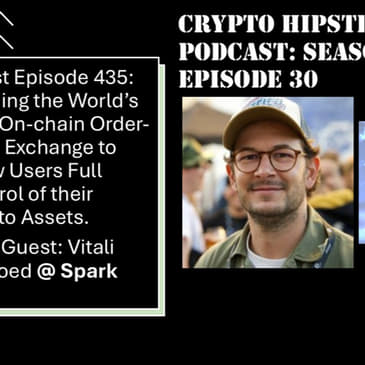

Vitali Dervoed is the CEO of Composability Labs and co-founder of Spark, the world’s first on-chain order book on Ethereum. Vitali is a thought leader in the industry, advocating for the use of Central Limit Order Books (CLOBs) to enhance capital efficiency and attract institutional investors to the DeFi space. His insights on the subject have been featured in prominent publications like Hacker Noon, where he explores advanced trading strategies that could drive DeFi's maturity beyond the capabilities of Automated Market Makers (AMMs).
X: @dervoiedk
[00:00:01] Hello, everybody, and welcome to the Crypto Hipster Podcast. This is your host, Jamil Hasan, the Crypto Hipster, where I interview founders, entrepreneurs, executives, thought leaders, amazing people all around the world of crypto and blockchain. And today I have another amazing guest. He is the CEO and co-founder of Spark. His name is Vitali Dervoed. Vitali, welcome to the show.
[00:00:30] Hey, Jamil. Thanks for inviting me. Great to be here.
[00:00:35] You're very welcome. I'm very happy to have you here. And yes, I'm looking forward to talking to you today. And let's kick things off if you're ready.
[00:00:45] Yeah, sure. Let's do.
[00:00:47] Cool. So first question I ask everybody is, and I get all kinds of amazing answers, is what is your background and is it a logical background for what you're doing now?
[00:01:00] Yeah, absolutely. So I started building software 20 years ago. I had a service company. And somehow very early days it was already fintech.
[00:01:11] So I can easily say that I'm almost 20 years in fintech. Initially, I started building very small applications in .NET and Silverlight, also HTML.
[00:01:23] There were these Microsoft Mobile BOM computers with styluses, and we were building for those. But that was already somehow finance related.
[00:01:33] My first largest customer was Allianz. I think I was 22 at that time. And we were 32 people already.
[00:01:46] And I remember that the entire dev shop was sitting on Allianz. And then Allianz said, Vitaly do one more business.
[00:01:52] And they introduced us to a bunch of other German banks. With Allianz, we were mostly building apps, websites, client server integrations, APIs, mostly on backend.
[00:02:05] And honestly, that knowledge still relates to me today. Because blockchains are distributed databases in its core, plus a lot of plugged infrastructure.
[00:02:15] So in certain sense, my life didn't change much ever since. And we worked with other German banks.
[00:02:27] There were a lot of international integrations, like with Settling Bank, that's the French, with the Chinese, with the Russians, with the Koreans, with the British as well.
[00:02:44] British banks. So that's how I learned how bank industry is even composable.
[00:02:51] I can relate to today's comparison. A lot of people say that blockchain liquidity is fragmented.
[00:02:59] Well, it was for a while fragmented across among the banks as well, until it got composed.
[00:03:06] Systems like Swift totally helped to do that.
[00:03:11] And I got introduced by friends of mine to crypto in, I think, 2016 for the first time ever.
[00:03:20] And I didn't have any interest.
[00:03:23] Okay, that's like some magic internet money, no problem.
[00:03:27] There was a lot of stuff like that all along my career.
[00:03:31] And I didn't pay a lot of attention again to this.
[00:03:34] And then by 2018, we were building a lot of stuff in crypto.
[00:03:43] First, web applications, web2 apps, so to say.
[00:03:48] And then we also started building in Solidity.
[00:03:51] We were building apps for the, well, ICO giants, for the people who raised during ICO era.
[00:04:00] And then also Ethereum scalability solutions.
[00:04:02] Mostly Plasma.
[00:04:04] Everyone was building Plasma at that time.
[00:04:06] Polygon was also Plasma initially.
[00:04:09] One of the ICO giants acquired this company from me in 2018.
[00:04:16] And I had a new team.
[00:04:18] Like I took four people from our original crew.
[00:04:23] And we started building Plasma.
[00:04:25] And then I think in early 2021, I joined Neon EVM team.
[00:04:35] It was Solana EVM composability layer.
[00:04:39] Like Aurora on Nier as well.
[00:04:42] And I was building in Solana for a couple of years.
[00:04:45] My largest gigs in Solana were, well, Neon.
[00:04:48] Then I was working at Rockaway X.
[00:04:50] That's a VC fund.
[00:04:52] And I was doing growth at Mango Markets.
[00:04:55] And I was also working with a bunch of other Solana ecosystem projects.
[00:04:58] But that's kind of normal.
[00:05:00] Especially during the bull runs.
[00:05:03] And Spark is a logical continuation of my previous experience.
[00:05:08] Because I had a lot of knowledge in the infrastructure.
[00:05:10] While building Neon, I learned a lot.
[00:05:13] And, well, how to run an order book exchange.
[00:05:19] I thought, why not combine all this knowledge into something that...
[00:05:24] Why not synthesize this into something like Spark?
[00:05:28] So, over the last couple...
[00:05:31] Like fast forward till now.
[00:05:32] We launched in Maine.
[00:05:33] Okay.
[00:05:33] We were building Spark for almost two years.
[00:05:38] I don't want to dive into, well, technicalities for now.
[00:05:41] But I can.
[00:05:43] Yeah.
[00:05:44] Sure.
[00:05:44] If you'd like to.
[00:05:44] Yeah.
[00:05:45] Absolutely.
[00:05:45] The next question is going to be, what is Spark all about?
[00:05:47] If you want to get into technicalities, that would be great.
[00:05:50] Yeah.
[00:05:50] So, why Spark is cool.
[00:05:51] And Spark is an order book-based exchange.
[00:05:55] It's a spot and perp exchange.
[00:05:58] Spot is live.
[00:05:58] Perps will be live shortly.
[00:06:00] We're going to release the first version before the new year.
[00:06:03] Like between Christmas and New Year.
[00:06:05] And we're going to ship the entire product, I guess, throughout January.
[00:06:10] We're shipping one new feature or update every week now.
[00:06:14] Like, for instance, this week we're releasing a dashboard.
[00:06:17] We're improving the liquidity.
[00:06:18] We're adding a couple more markets on Spark.
[00:06:22] And next week we improve, again, the depth of the liquidity.
[00:06:26] And we lift this beta thing that is right now there in the interface.
[00:06:32] We improve the SDKs.
[00:06:34] Right now it has two SDKs, TypeScript and Rust.
[00:06:38] We're also adding Python support in just a little bit.
[00:06:41] So, there's a lot of work going on.
[00:06:48] So, on Solana, for instance, there was a project called Serum.
[00:06:52] And Serum inspired us to create Spark on Fuel.
[00:06:58] I explain why we even decided to build this thing.
[00:07:02] So, the problem that Ethereum was facing two years ago and still faces today is the adoption.
[00:07:10] We've heard a lot about it.
[00:07:11] Like, hey, Solana is an Ethereum killer.
[00:07:13] When you say Ethereum killer or when you say, like, this blockchain is killing this one, it means it's killing in the adoption.
[00:07:21] Okay?
[00:07:21] It's bringing new people.
[00:07:22] It's bringing new users.
[00:07:24] Here is the thing.
[00:07:25] So, Ethereum has built a lot of epic projects like Aave, Uni, Balancer, a bunch of other AMM-based protocols.
[00:07:34] And the customers are mainly LPs.
[00:07:37] Who are the LPs in Ethereum?
[00:07:40] Two types of users.
[00:07:42] Institutions and retail.
[00:07:43] Institutions are the trading firms like Wintermute and others who put their passive liquidity into AMMs, into the pools and get the yield.
[00:07:53] Get the, well, passive income, so to say.
[00:07:58] And retail.
[00:08:00] And when we say retail, we're targeting the largest of them.
[00:08:05] We're targeting the whales, right?
[00:08:06] We aren't targeting the tuna.
[00:08:08] So, Ethereum whales are, well, ETH holders that are the OGs who bought Ethereum early days and were holding it.
[00:08:15] And they have a lot of it and they have just too much liquidity to constantly hold it.
[00:08:21] So, they decided to, well, why don't I use the, like, great Ethereum ecosystem?
[00:08:26] I can stake.
[00:08:27] I can pull this liquidity.
[00:08:29] I can, again, put it into the lending pool.
[00:08:32] So, that's the customers that these protocols are chasing today.
[00:08:35] Ethereum whales.
[00:08:36] And that was it.
[00:08:39] And essentially, nothing happened after that.
[00:08:43] Ethereum started chasing, well, scalability after that.
[00:08:48] And scalability on the technical level.
[00:08:50] So, it started building, like, L1s, L2s, etc.
[00:08:53] Not on the application and not on the user level.
[00:08:57] So, when I say we're bringing adoption to Ethereum, it means we're bringing users.
[00:09:02] Here's the thing.
[00:09:03] Solana is sitting on completely different user groups today.
[00:09:07] These are people who are using, who are extracting the revenue through active liquidity.
[00:09:15] And the most-star metric that Ethereum is chasing are, well, TVL, right?
[00:09:20] And, like, annualized yield.
[00:09:23] Solana is sitting on volumes, for example.
[00:09:26] And any other high-throughput chain would be sitting on the volumes.
[00:09:30] If you say, what's your...
[00:09:32] You never ask, what's your, like, meme coin TVL?
[00:09:36] That's impossible.
[00:09:37] This metric is too volatile to even focus on.
[00:09:41] You can ask, how much money did you make on trading the meme coins?
[00:09:44] So, when we ask this, we normally kind of mean order book-based DeFi.
[00:09:49] Because you're trading them on the order book.
[00:09:51] So, order book is this tool that improves price discovery for any asset.
[00:09:57] Order book is a very ancient tool.
[00:09:59] All the exchanges initially used the order book.
[00:10:02] It's like, it's a book of orders.
[00:10:04] It was invented in 1500s in the Netherlands and didn't change a lot in its logic.
[00:10:11] It was just, like, digitalized and we had digital exchanges like Tokyo Stock Exchange or New York or NASDAQ, etc.
[00:10:21] Well, today it all exists on the blockchain.
[00:10:23] Initially, and the first project that has built an on-chain order book was Serum on Solana.
[00:10:30] And Mango, where I was also involved, was using Serum order book.
[00:10:35] Serum had a bunch of problems.
[00:10:37] Serum token wasn't very efficient.
[00:10:39] It was inflational.
[00:10:42] And Solana had this binary search tree entirely sitting, sorry, Serum had entirely on-chain binary search tree.
[00:10:51] It was causing state bloats.
[00:10:55] So, how do I explain it in a simple way?
[00:10:58] So, binary search tree is like a tree of hashes, right?
[00:11:03] Like, people create transactions.
[00:11:04] They create orders.
[00:11:06] And then this tree can, well, it represents a matching engine that matches those transactions.
[00:11:11] For instance, I'm selling one Bitcoin and there are 100 people willing to buy an amount equal to one Bitcoin.
[00:11:17] So, this binary search tree matches these orders because it has all the data about it.
[00:11:23] And it happens entirely on-chain.
[00:11:25] Thing is that you need, as you can guess, a lot of computation to match them.
[00:11:31] So, you need, like, big server, big expensive machine.
[00:11:35] And when you run those servers, your validator economy is, well, you have to think about it quite a lot.
[00:11:42] You need to mine it.
[00:11:43] And that's what is causing Solana to crash sometimes, even today.
[00:11:48] And recently we've seen Sui crashing.
[00:11:50] That's the same kind of thing.
[00:11:51] So, on Spark we decided, why don't we remove this part from, well, the chain and build a more lightweight design.
[00:12:01] And we started thinking, okay, what can we do?
[00:12:04] We can build, like, our super well-optimized virtual machine and then, well, rebuild Serum and bring it there.
[00:12:12] Or we can find a virtual machine that can support different types of stateless design.
[00:12:18] So, Fuel has a very cool feature.
[00:12:23] It's called predicates.
[00:12:25] Every virtual machine today can support, it's called stateless transactions or atomic transactions, depending on the chain.
[00:12:37] So, there's a stateless way to match the orders.
[00:12:41] And then you fetch the state, you fetch the order information from the indexer.
[00:12:47] Thing is that you need a bulletproof indexer in this particular case.
[00:12:52] So, Spark is a very lightweight contract, right?
[00:12:55] That matches the orders.
[00:12:56] We have a deposit function, which, like, when you click create order, you deposit funds into the order book.
[00:13:03] Then it has a match function.
[00:13:05] Again, the matching is happening on chain.
[00:13:07] And you have withdraw and withdraw all.
[00:13:09] And that's about it.
[00:13:11] We are fetching the information about the orders from the indexer.
[00:13:15] Right now, we're using two super strong indexers, Pangea and Envio.
[00:13:23] Our team is based in Lisbon.
[00:13:25] And Pangea team is also based in Lisbon.
[00:13:27] So, we can easily meet sometimes and discuss business-related stuff.
[00:13:32] Honestly, we have a solid builder community here.
[00:13:34] And we have a data relayer, Spark Middleware, that relays the transactions among those indexers.
[00:13:41] So, if one dies, another one picks up the transaction and sends the reply to the frontend or SDK.
[00:13:52] And this is what we have right now.
[00:13:54] This is what is powering our SpotExchange.
[00:13:57] This is what is powering our order book.
[00:14:00] Perps built like this will also be, again, pretty lightweight.
[00:14:06] I'll give you an example.
[00:14:07] So, there's GMX, for example.
[00:14:09] If you rebuild GMX to sway the programming language that we use, or if you compare a code base of Spark and GMX, even like that.
[00:14:17] GMX has about 10,000 lines of code.
[00:14:20] So, Spark has around 2,000 lines of code.
[00:14:23] So, when you're using Spark, you're deploying less computation.
[00:14:28] And it costs less to trade on Spark.
[00:14:34] We have a cool roadmap that will help us optimize even further.
[00:14:38] But even now, it's a pretty powerful machine.
[00:14:41] It's like 10 times cheaper than Solana.
[00:14:43] It's 100 times cheaper than Arbitrum or any other EVM-based L2.
[00:14:49] And it's all achieved because we're leveraging fuel stack, fuel VM.
[00:14:57] So, again, it might seem exotic as a technology.
[00:15:01] But when DYDX launched their order book on StartNet, which was like 10,000 times less powerful than Spark today,
[00:15:09] it was also surprising to me how they have rebuilt everything from Solidity into Cairo programming language.
[00:15:17] Well, today, I'm not surprised.
[00:15:47] Interesting.
[00:15:49] So, if you can't do that, if Ethereum can't scale, then what happens?
[00:15:53] Does Solana win?
[00:15:54] What's the end result?
[00:15:57] So, here's the thing.
[00:15:59] I spent a couple years thinking about how we scale Ethereum on the technical level.
[00:16:04] But today, I'm mostly focused on the users.
[00:16:07] So, I will tell you this.
[00:16:10] You can imagine scalability very easily.
[00:16:14] People say that growth lies outside the comfort zone, right?
[00:16:18] And I've been to Bangkok to this event called DeFi Renaissance, organized by probably the best event team.
[00:16:28] ABE, like Headsoft, they built great events.
[00:16:30] Thing is that I came there and I see the same people as on any other Ethereum DeFi event.
[00:16:37] If you go to Solana Breakpoint, if you go to Sui or Aptos Hacker Houses, you see a completely different group of people.
[00:16:44] And they are using the blockchains in a different way as well.
[00:16:47] I mentioned before that Ethereum is chasing TBL.
[00:16:50] So, if you start, if you go head-on Uniswap today to compete with them, you're going to lose.
[00:16:58] There's no way you're going to win.
[00:16:59] If you build something that is completely different, that is disrupting Uniswap,
[00:17:03] and if you bring a completely new group of users, you might scale Ethereum and bring another wave to adoption to it.
[00:17:12] I only see three L2s, three VMs that can power the next wave of adoption for Ethereum today.
[00:17:21] That's Eclipse, Fuel, and Movement.
[00:17:24] Why?
[00:17:25] Because, again, they're bringing a completely different group of users to the blockchain industry, to the Ethereum community.
[00:17:33] Here's the thing.
[00:17:35] The existing Ethereum users have to accept the fact that they need to scale.
[00:17:39] And they have to accept that this generation of the users will be very different from them.
[00:17:50] But this new generation of the builders is also playing by the rules that the OGs have created in this space.
[00:17:57] So, it's a generational conflict that is right now being, well, that has grown within the Ethereum ecosystem.
[00:18:07] But I think it takes a little bit of time and the community will accept it.
[00:18:12] So, that's how I see scalability today, bringing new users, bringing fresh blood.
[00:18:17] Spark is doing exactly this.
[00:18:18] Our users are order book-based traders.
[00:18:22] They aren't LPs.
[00:18:24] They're mostly.
[00:18:24] So, order book-based trading today in DeFi is sitting on very basic algorithms.
[00:18:30] You've seen a lot with AI agents recently.
[00:18:33] There was a lot of talks about the AI agents powering the markets.
[00:18:40] That's because this stack is so simple.
[00:18:44] So, Hyperliquid last week, I think, marked the beginning of the order book DeFi era in, well, in the industry overall.
[00:18:53] It showed many cool practices like launching a token on-chain, launching a protocol token on your own order book.
[00:19:03] Again, it's a fair launch, completely community-driven.
[00:19:06] It allowed to set the fair price again.
[00:19:12] It's a perfect launch.
[00:19:13] It's disrupting the industry in many ways.
[00:19:17] It's disrupting the centralized exchange business because now you don't have to overpay them for listing your token.
[00:19:24] You can list it on-chain, essentially.
[00:19:29] You don't need to overpay the market makers and you don't need to engage in these crazy talks about the KPIs.
[00:19:39] You don't have to watch if they fulfill those KPIs.
[00:19:41] You can launch it on the order book, run your strategies, like run your algorithms that are open source.
[00:19:49] And it's going to do the job just fine.
[00:19:54] And lastly, I think, entire meme coin season was leading to exactly this.
[00:20:00] Because Hypercentral used all the best practices of the meme coin launches by, well, giving the token to the...
[00:20:07] You don't have to be afraid that the VCs will come and dump on you, right?
[00:20:12] So why would I increase the volumes on this asset?
[00:20:15] Anyone would think.
[00:20:17] If I know that there are insiders holding massive amounts of that token and they will be...
[00:20:24] It's the game of who dumps first, essentially.
[00:20:26] While if the token is entirely community-owned, I don't have this fear.
[00:20:31] I can trade more.
[00:20:32] I can increase the volumes and I can increase the revenue for everyone else.
[00:20:36] So hype also disrupts the VC industry.
[00:20:39] And all of this wouldn't be possible without the tools like on-chain order books.
[00:20:46] Now it's just improvement of this stack of, well, building the community, etc.
[00:20:53] Now we can build your business on-chain.
[00:20:57] Spark, I think, is scaling exactly this model.
[00:21:02] So now it's all about why would I list on many centralized exchanges if I can list on many venues like Spark instead.
[00:21:09] Right.
[00:21:09] And again, if my goal, if the goal of the majority of the developers is to power the runway, then that's the perfect way to launch a token.
[00:21:22] Yeah, that makes sense.
[00:21:24] That makes a lot of sense.
[00:21:25] You know, it's interesting you said that, you know, the new users and builders and there's a generational conflict.
[00:21:31] I mean, this whole industry is built on generational conflict, right?
[00:21:35] Right.
[00:21:36] You know, you came in 2016, I came in 2017, and we both said the same thing.
[00:21:41] You said the same thing I said years ago, and that's a blockchain is a decentralized database.
[00:21:46] And I thought Bitcoin was a decentralized database, but I stepped into this world of generational conflict.
[00:21:52] Right.
[00:21:53] So that's what it is, you know.
[00:21:56] But it is important for retail to have, you know, access to better infrastructure too, right?
[00:22:02] Right.
[00:22:03] So why, like, most retail I know care about price and price go up and meme coins and meme coin price go up.
[00:22:11] But why is it important for retail to have better access to better infrastructure?
[00:22:18] Infrastructure like on ramping or trading or like price articles?
[00:22:25] What exactly do you mean?
[00:22:27] Any of that.
[00:22:28] What's your take?
[00:22:34] Well, I think it's a never ending story of innovating, I guess.
[00:22:48] And retail.
[00:22:50] Well, there will never be a perfect wallet.
[00:22:53] There will never be enough decentralization.
[00:22:55] There will never be.
[00:22:56] Also, when you work with the traders, like, for instance, our customers, they are, I would say, greedy people.
[00:23:05] Or like, I can just call them perfectionists.
[00:23:08] But greed is definitely what is powering this industry.
[00:23:11] Thing is, if you minimize the latency, it's never too good.
[00:23:16] You give them like one nanosecond finality and they will still tell you, no, that's too slow.
[00:23:24] So latency became this meme, I would say.
[00:23:27] It's never too fast.
[00:23:29] And then you say, okay, we subsidize gas fees entirely.
[00:23:32] So it's free forever.
[00:23:34] You don't have to worry about the gas anymore.
[00:23:36] And they will still tell you that's too expensive.
[00:23:40] Well, what can I do?
[00:23:41] Well, you can incentivize us to stay on your venue.
[00:23:46] Essentially pay us to trade more.
[00:23:48] Okay, how much do you want to be paid?
[00:23:50] Like, all your money.
[00:23:52] That's like, it's never enough, you know?
[00:23:54] How much do you have?
[00:23:57] For the meme coins, again, I think the majority of the people came to this industry to get rich fast.
[00:24:06] They didn't come to improve your product, for God's sake.
[00:24:12] And if you ask like anyone, what do you want?
[00:24:15] Well, I want more money.
[00:24:16] I want more assets.
[00:24:19] And then you think, all right, if you want more assets, then how do I provide you the best safe, still like secure experience to trade those meme coins, which we will also mint on the blockchain, on the DEXs.
[00:24:34] And give all of you, well, I need powerful oracles that fetch the price super fast and update it on like across all the venues.
[00:24:42] And they need to be secure at the same time.
[00:24:44] So they better fetch the price from several exchanges, right?
[00:24:50] And they need to list so fast that this price discovery is happening across many venues and is updating the feeds among those venues as well.
[00:25:02] And then you think, okay, if it's done in a permissionless way, if people list in a permissionless way, then how can it be secure enough?
[00:25:15] All these questions are like daily routine that you're asking yourself and you need to constantly move fast to not even reply them, but to, well, make it happen.
[00:25:26] Indexing and trading is huge.
[00:25:27] Like Solana has 17 indexers today.
[00:25:31] It's, again, it's so important.
[00:25:34] And we spend so much time building solid indexers that it's a meme by now.
[00:25:40] Like indexers are the APIs between a database and your product.
[00:25:45] They have been existing also in the TreadFi exchanges for a while.
[00:25:52] So, person who builds a blockchain comes to a conference and tells, okay, I'm building the future.
[00:25:58] This is the future.
[00:26:00] Like, I'm so good.
[00:26:02] You can't deny it.
[00:26:03] Whoever it is.
[00:26:05] And yeah, I kind of agree with you.
[00:26:07] Your blockchain is perfect.
[00:26:08] It's great in every way.
[00:26:10] Now, how do I fetch the data and put it into my exchange?
[00:26:13] How do I give it to like show, you know, the volumes or Ethereum price in my interface?
[00:26:20] Well, you need an indexer for that.
[00:26:22] And then all the blockchain builders are committing this mistake all the time.
[00:26:28] I cannot understand why, but I see it like happening every year.
[00:26:32] They start building their own indexers.
[00:26:35] Like, this is why.
[00:26:37] Because, oh, well, I've raised 100 million.
[00:26:39] I can afford it.
[00:26:40] Why would I pay 500k to an indexing team to bring their solution to my perfect chain?
[00:26:46] My chain is even too good for your indexer.
[00:26:48] And I know how to improve it.
[00:26:50] And they start improving and they are indeed for two years and spend a couple million.
[00:26:55] And then they bring a third party indexing team.
[00:26:58] And I see it happening like over and over and over again.
[00:27:04] The answer is blockchain builders are building distributed databases and indexing teams are
[00:27:10] building exactly the services that are fetching that data and giving it to the users.
[00:27:17] So these are different people.
[00:27:19] And to improve the infrastructure, you need to constantly bring new people, new builders,
[00:27:26] new teams engaging with your blockchain, building all sorts of stuff.
[00:27:32] And it's like a layer cake where the first layer is the infrastructure your blockchain runs on.
[00:27:38] So you need like hardware shops.
[00:27:43] And you better not work with AWS from Google data centers because they're damn expensive.
[00:27:48] So you need teams that are running these boutique data centers.
[00:27:54] They have assembled their own machines from like bare metal.
[00:27:59] And they put those servers next to the centralized exchanges.
[00:28:02] So your users in the future can easily arbitrage against those centralized exchanges.
[00:28:09] Then you run your blockchain.
[00:28:10] Then you build a infralabel on top.
[00:28:13] I mentioned price oracles and indexers.
[00:28:16] There's more.
[00:28:16] And then there are apps.
[00:28:18] And then on top of those apps, there are algorithms.
[00:28:20] And then there are users.
[00:28:21] And then there are social apps.
[00:28:23] And you need to constantly work with all that.
[00:28:27] And then improve it again and again.
[00:28:33] Interesting.
[00:28:35] So get rich quick using the right infrastructure.
[00:28:39] Let's say you've got a whole bunch of people who, I mean, there are some coins in the past week.
[00:28:44] You haven't gone up 5x.
[00:28:45] I'm not going to name names, you know.
[00:28:48] But and everybody goes crazy and wow that the price goes up.
[00:28:51] And say it does so fast.
[00:28:55] Like what are the dangers in that?
[00:28:58] You know, of people being rich really quickly.
[00:29:00] Like do they hold on to their money?
[00:29:02] Like how do you like how have you changed the person so that you're more patient going forward?
[00:29:07] Or is that a problem that will affect DeFi's positive growth trajectory going forward?
[00:29:16] Are we talking about the heavy burden of being enormously rich right now?
[00:29:22] Or are we talking about the risks that of centralization again?
[00:29:27] Yeah.
[00:29:28] I would say I would say both.
[00:29:32] Like, you know, having the patience, have the ability to manage wealth once you once you have it overnight.
[00:29:38] Like what are the dangers of that?
[00:29:40] And shouldn't DeFi's growth trajectory be more stable?
[00:29:45] And not so chaotic?
[00:29:47] Like what's the what's the balance there?
[00:29:50] Yeah.
[00:29:51] So the first like having having whales, having like people who got rich very quickly, it actually represents a bunch of risks.
[00:30:06] It depends on, of course, I mean, all the people are very different.
[00:30:13] So here is the thing.
[00:30:14] There was this movie recently called The Bike Riders, completely unrelated.
[00:30:21] And I watched it.
[00:30:23] And then in the end, so there was a guy who was running this motorcycle club and he got killed by a young kid that took over the motorcycle club and turned it into like a drug cartel into a business.
[00:30:39] And this old guy, he couldn't cope with that.
[00:30:43] So I think if you got rich quickly, you need to invest in different projects.
[00:30:49] I think you need to give back to the community just a little bit like a cut of your income.
[00:30:55] Just, you know, go to chat GPT and tell, OK, I have a lot of tokens of this chain.
[00:30:59] How can I improve the efficiency of these funds?
[00:31:04] One of the points will be invest across the ecosystem.
[00:31:07] Even chat GPT will tell you, you will improve the efficiency of your assets by investing into more projects.
[00:31:17] So that's, I guess, a quick answer.
[00:31:19] And then you can, again, chat GPT in the exact thread will tell you other 17 points of how you can allocate the assets among different venues.
[00:31:30] And you will see, OK, so I actually need like to expand the ecosystem.
[00:31:34] In this particular case, so it's like a chicken and egg problem.
[00:31:39] Money works, money powers an ecosystem and it needs to be like active, right?
[00:31:46] For instance, you have a lot of fuel tokens and you have an ecosystem and you better have a large ecosystem.
[00:31:55] And you expand that until the profitability for the investors across that ecosystem.
[00:32:07] Well, I don't know if there are limits for it to grow at all.
[00:32:11] Like you can trade on Spark, you can go to Swayland and you can stake those assets.
[00:32:16] You can delegate again.
[00:32:17] So you need governance.
[00:32:18] You need many things.
[00:32:21] And the successful ecosystem will, well, again, that's a chicken and egg.
[00:32:28] It will be defined by the activity of your whales, of your retail, of your community.
[00:32:34] And it will be defined by what they do with those assets as well.
[00:32:40] I guess it answers the question, right?
[00:32:43] Yeah, yeah.
[00:32:45] My concern is that as we head into 2025, I see DeFi being able to grow.
[00:32:54] But I also think there needs to be some kind of steady growth, right?
[00:32:58] So what do you see for DeFi as we head into 2025?
[00:33:02] What's in your crystal ball for this coming year?
[00:33:05] You know, what are your thoughts?
[00:33:09] OK, that's something I'm thinking a lot about.
[00:33:11] So here's the thing.
[00:33:14] Initially, we've seen the adoption of many trading firms, many institutions, many hedge funds in crypto, in DeFi especially.
[00:33:29] They started migrating from TreadFi venues to centralized exchanges.
[00:33:36] Now, projects like Hyperliquid can easily adopt those people.
[00:33:41] Now, I can still see a shift in, again, on the technical and on the user level.
[00:33:51] Thing is that the strategies those people are using, they haven't been changing.
[00:33:55] So far, DeFi has been adapting to accommodating those users and their tech, their strategies.
[00:34:04] There's a lot of things involved here.
[00:34:06] And it's been a lot, again, of capital invested into growing exactly this user base.
[00:34:14] Now, if you take the guys who started from another end, who started building their strategies on-chain, on the venues like Uniswap,
[00:34:22] or, well, for instance, today we're onboarding the majority of our users from Solana.
[00:34:27] Also move-based chains like Aptos and Sui.
[00:34:31] They have been, so SDKs that the DEXs were using since the beginning are completely different from the tech that centralized exchanges had.
[00:34:41] And you see smaller trading firms that were like Solana homegrown, or they were grown on-chain, essentially.
[00:34:54] And they start, I honestly am very proud to see how their business started to scale.
[00:35:00] Now, if you collide these two user groups, like if you put them next to each other,
[00:35:06] you can see that on-chain traders are easily disrupting the institutional layers that have been huge in this space for a while.
[00:35:16] I'm not surprised, and that's actually, it actually has a name.
[00:35:19] It's called Innovator's Dilemma.
[00:35:20] It's been invented by Clay Christensen.
[00:35:24] It has many books.
[00:35:26] And the thing is that if you take a big business like one of the centralized exchange traders,
[00:35:35] they don't see any interest in DeFi today, in on-chain trading.
[00:35:40] Why? Because these markets are not as liquid as centralized exchanges.
[00:35:44] There's just less opportunity for them there.
[00:35:49] What happens if this segment of the market grows?
[00:35:54] What happens if it scales?
[00:35:55] There's no way these institutions will be able to adapt quickly.
[00:36:00] They work nine to five, five days a week.
[00:36:02] While the kids that have been trading on-chain, it's like a culture for them.
[00:36:07] They don't call it work even.
[00:36:09] They work seven days a week, 10 hours a day.
[00:36:11] And they are easily disrupting the institutions in on-chain trading.
[00:36:15] And their tech is many times more efficient than, well, than that.
[00:36:23] And I see this shift as soon as, well, it's just, you know, as soon as DeFi markets become a little bit more liquid,
[00:36:32] this thing scales easily.
[00:36:36] I see on-chain trading firms growing way faster than they were over the last couple of years.
[00:36:43] The disruption will be happening in this model, I guess.
[00:36:48] There will be some big institutional players adapting to on-chain trading.
[00:36:53] And again, if you go to hyperliquid leaderboard, if you run the wallet analysis among the top traders there,
[00:37:00] you will quickly see that, okay, some of them actually trade on-chain.
[00:37:04] Others mostly stay on the centralized venues.
[00:37:07] Others.
[00:37:10] Interesting.
[00:37:11] I think we're headed to very interesting times.
[00:37:16] Absolutely.
[00:37:18] Awesome.
[00:37:18] So I want to thank you very much for your time today, for speaking with you.
[00:37:22] I love talking to you.
[00:37:23] I learned a lot today.
[00:37:25] I enjoyed it.
[00:37:25] And I have one last question for you.
[00:37:28] It's probably the easiest one I asked you.
[00:37:30] It's how can people find out more information about you, about Spark?
[00:37:34] How can they start to use it?
[00:37:36] How can they do that?
[00:37:40] Well, about me, you can track my Twitter.
[00:37:43] I'm having an active life there.
[00:37:45] And regarding Spark, sprk.fi is the domain name.
[00:37:51] You can go there and study more about the product.
[00:37:53] However, through my Twitter, you can also find all the information about the product I'm publishing quite a lot.
[00:37:59] Awesome.
[00:38:00] Awesome.
[00:38:00] Thank you very much for your time today.
[00:38:02] Thanks, Jamil.
[00:38:04] Enjoy your week.
[00:38:05] Cheers.