
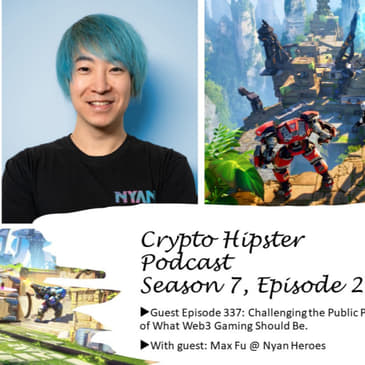

Max Fu is the Chief Executive Officer and Co-Founder of Nyan Heroes and has a successful track record building brands and communities across digital media, web3, and gaming spaces.
In his CEO role, Max has taken the fledgling company to their next phase, having secured $10 million in seed funding from reputable global investors to accelerate the development of Nyan Heroes while growing the team on a global scale with best-in-class talent and a network of strategic partnerships. His vision for their ambitious project aims to challenge public perception of what web3 gaming can be, with a F2P play-to-earn battle royale/third-person action shooter that stands on its own with AAA-quality gameplay, visual fidelity, and balanced competitive multiplayer experiences.
Prior to Nyan Heroes, he served as the COO of Unicorn Pop and collaborated with some of the world’s largest companies: Google, Netflix, and Samsung. Max oversaw operations, strategy, and product development and led multiple teams to execute at a high level. During his tenure, he built digital communities from the ground up, which have grown to 30 million members to date across various platforms, including the YouTube channel which was ranked fastest growing and the most subscribed in Australia in 2019.
Before following his passion in the burgeoning technology sector, he went to school to be a surgeon by earning his Bachelor’s Degrees in both Medicine and Surgery, where he became the youngest surgical trainee in at the time.
He has built a studio of both heavy hitters in the web3 space and veteran game developers from AAA studios including Sony Playstation, Ubisoft, and Bioware. Max, 36, earned his medical degree at University of New South Wales, Australia’s leading research and teaching institution. He is based in Singapore where he cohabitates with his four cats. In his free time, he continues to work with animal rescue organizations like Best Friends Society.
Max supports and regularly donates to Vivita Singapore, a creativity accelerator for kids, and partnered with the organization to create a Roblox Game Development Competition, where youths get to engage with elements of game design and compete for the best game. Max engages in friendly competition himself while playing his favorite MMOs and first-person shooters. Beyond gaming, Max enjoys tennis and satisfies his love of food with local cuisine.
https://twitter.com/nyanheroes
[00:00:00] Hello everybody and welcome to the Crypto Hipster podcast. This is your host Jamil Hasan the crypto hipster where I bring you founders entrepreneurs executives thought leaders artists
[00:00:12] Amazing people all across the world of crypto and blockchain and I have another amazing guest for you today
[00:00:19] He is the founder and director of Nyan Heroes his name is Max who max welcome
[00:00:26] Max welcome. Thank you so much Jamil it's great to be here.
[00:00:31] It's great to have you. Thank you for joining me and I want to kick things off because you have a really interesting background and I want to hear all about it.
[00:00:40] So let's do that. What is your background and is it a logical background for what you're doing now?
[00:00:46] Yeah, I guess on paper it doesn't seem logical but there is a very good reason as to why this has all happened so I've lived a few different lives obviously
[00:01:01] When I was growing up as a kid I always loved video games but growing up in a fairly traditional Asian household there were only a few options for me coming out of high school and that was accountant, lawyer or doctor quite typical.
[00:01:20] So I picked medicine simply because I thought it was the most interesting out of the three and I happened to be somewhat smart enough to get into the degree.
[00:01:33] So I did a six year degree of got my Bachelor of Medicine Bachelor of Surgery and then worked in the medical industry for another seven years after that as a surgeon.
[00:01:45] So mostly focused around gastrointestinal surgery did you know seven years as a initially started as an intern and resident and eventually became a registrar and then senior surgical registrar.
[00:02:00] And yeah it was interesting, it was very intellectually stimulating but ultimately you know it wasn't what I was passionate about.
[00:02:10] So I ended up leaving that industry you know it was kind of fairly sudden actually and most of my colleagues were fairly surprised.
[00:02:19] My parents they almost disowned me but you know I kind of wanted to I guess spend the next 40 50 years of my life not doing something that I hated and decided that I would explore a passion of mine which I'd always been.
[00:02:39] I'd always been keen on doing but never really had an opportunity to explore which was the creative industry.
[00:02:46] I have a pretty, I would say I have a pretty unique creative mind and I'm always interested in creating content and creating products that people enjoy because I really like connecting with users and community.
[00:03:00] So I went into the creative industry, learned everything myself you know the brilliant thing about the internet these days is that you can kind of go anywhere and learn anything as long as you have a will.
[00:03:11] So I taught myself cinematography, film, lighting, GAFA, GRIP eventually found myself in the creative director role worked a lot on commercial work with brands like Samsung, Netflix and Google.
[00:03:28] And eventually set up my own media company as a creative director there as well where scaled it up over eight years, built up a fairly diverse online user base of over 30 million users month to month and created various digital content for multiple verticals including entertainment lifestyle including gaming.
[00:03:50] So my background coming into nine heroes is more on the creative side it's taking my experience as a creative director it's taking my experience as a founder and a business owner in the space, as well as my experience in connecting with users and community on a day to day and bringing them things that ultimately they find joy in that they find memorable, you know and connecting users with amazing unique experiences.
[00:04:20] So that that's how I came into nine heroes. I'd got into the sort of web three seen in around 2017. This was while I was building my media company business. And really it was 2020 and 2021 that got me really excited into all the opportunities that that the Web three industry had to offer.
[00:04:43] And I thought it was a perfect opportunity to sort of take my creative direction experience and skills and skills in business and skills and building communities and start off nine heroes you know we were actually a community based project.
[00:04:56] In the very beginning, we didn't.
[00:04:59] You know we weren't triple a studio spin off the, you know, went ahead and found funding or anything like that we built a community around a shared vision around this crazy quirky idea of cats piloting mechs.
[00:05:14] And that was how we started we found funding after that. And then the studio came after the funding so it was very much a different kind of direction in how things got started, but ultimately you know we started with community.
[00:05:28] Right now we have one of the biggest communities in Web three gaming space. And I think one of the coolest IP so this is, I guess, yeah, a short synopsis of how nine heroes began.
[00:05:42] I love it. I would say creativity is much more is a much more fun and exciting than, then, you know, gastroenterology.
[00:05:52] Each with its own challenges.
[00:05:54] Yeah.
[00:05:56] I'm going to consensus this year in a couple weeks two years ago I signed up to go but I had a bad piece of sushi and I was in the hospital for five days.
[00:06:04] So I'm really looking forward to that this year. You know, I want to talk about nine heroes. You know what's it all about. You know, what's your purpose. What yeah what's it all about and the what does it do well what do I look forward to doing when I start playing your game.
[00:06:21] Yeah, I mean nine nine heroes is a competitive movement shooter where the player controls a small cat piloting a giant Mac.
[00:06:33] It's it's team based so there's two teams and players fight over various objectives on different maps. The game mode itself is probably most familiar to to players that play games like Team Fortress two or Overwatch two.
[00:06:51] Those are probably the closest similarities when it comes to game mode. And essentially, the vision of the game or the project itself.
[00:07:02] We started out with a vision in day one it hasn't changed over the last couple of years at all. And that is to build a high quality game.
[00:07:13] I don't want to say triple A because that term is kind of thrown around all over the place in Web three and it often doesn't mean anything. But a game that is high quality that is clearly built with love and and soul to it that has its own identity that also brings something unique, not only to the Web three
[00:07:33] space, but that would sit on its own, even alongside Web two titles, even the triple A titles that you see on Twitch or YouTube, like the apex legends like the valorance, you know we want to bring something that is comparable in quality, but also has its
[00:07:52] own voice and its own identity.
[00:07:56] Very cool. And your pre alpha demo just wrapped up right. What was that experience like and what were some of the takeaways.
[00:08:08] That was a whirlwind of an experience. We obviously been building heads down over the last just over two years through the bear market as well which had its own challenges, and we recently ran a pre alpha demo via Epic Games that lasted around
[00:08:29] six weeks. We were obviously optimistic internally in the team, we're really happy with the state of the project, even though it was pre alpha and still early. We all felt like it had a great core loop, something that was unique, interesting and fun.
[00:08:47] We were excited to share that with our community as well as the broader sort of Web three gaming community. So we were optimistic we had some some some high hopes.
[00:08:57] However, the pre alpha wildly outperformed even our own internal expectations by many many fold.
[00:09:07] You know we became one of the most wish listed games on the Epic Game Store. We had over 1.3 million user registrations on our website we registered over 700,000 unique active wallets.
[00:09:22] And when the game went live over the course of two weeks we registered over 200,000 downloads. We had over 45,000 daily active users playing the game day to day towards the end of our pre alpha.
[00:09:38] And even though we were only live for two weeks, we actually managed to make it into the top 30 most played games on Epic Games globally. Which as far as I'm aware at least in the web three space I mean if if we were even a web two game I think we would be really happy as a small studio to kind of reach that benchmark but being a web three
[00:09:58] game and seeing those kind of numbers was just mind blowing. And, you know, completely unexpected from from our side. But I think, you know, as a studio we were really happy with the product and I think, you know, that ultimately that's what stood out to to our community as well
[00:10:18] as the people that we were showcasing our game to, you know, we had a lot of positive feedback from not only web three gamers but also web two gamers and content creators that you know this was really interesting it felt really unique, and ultimately was fun that's
[00:10:33] the most important thing. I love it, you know, you don't see a lot of you don't see a lot of companies other whether it be web two or web three cracked at the epic right away. You know so that's really awesome.
[00:10:48] But you said you're talking about your team a little bit mentioned your team. So, and you mentioned that you build a community first so you didn't just add people from web to bring them over.
[00:10:58] So, you know, people came over right. Your team is made up of mix of web two veterans and web three developers. So you have an advantage there with the adoption what's you know what's your advantage and what insights that you have that other games who are just startups may not
[00:11:17] I think it's interesting because building in web three has been quite an eyeopening experience for me. And the thing about web three is a the space moves really quickly.
[00:11:31] Because the space moves really quickly narratives also move really quickly in web three. In fact, a lot of, you know, projects and, and, you know, kind of trends based around narratives alone in web three.
[00:11:50] I think what has happened in the gaming sector for web three. I find it to be fairly interesting because originally, it started out with you know things like axi and was played to earn. And then there was this narrative shift of okay well it can't be played to
[00:12:05] You know you need a good game. You need something that's sustainable something you know where users will just play for fun and then always after a return on their investment.
[00:12:14] That became the prevailing narrative. And now it's kind of the narrative is shifted again. People are talking about well you need to have this D gen mindset or you need to be able to kind of cater to the web three D gen in order to
[00:12:29] You know, you need to have this D gen mindset or you need to be able to cater to the web three. And then there's a lot of things that are going to be played and you know between the first narrative and the one that I just mentioned has probably been 10 other narratives mixed in between.
[00:12:44] You know, simple, simple dude I think I try not to over complicate things. And I look about look at games over the last sort of two decades, even though the format has changed. The monetization has changed.
[00:12:57] The devices have changed. One thing has never changed and that is for a game to be successful it must be fun. I don't want to over complicate things and start kind of over engineering what it takes to make a good game in web three.
[00:13:12] The fundamental core principle is it should be fun. And that's what we've been building towards when when you look at our team composition, we mostly have traditional game developers working on the game and everything that we do when it comes to game design
[00:13:28] visuals, IP narrative law, core loops. It's all done through a traditional web to development, you know workflow and lens. So ultimately what the team is trying to do is to create an experience that is enjoyable and fun.
[00:13:44] We do have obviously some some web three natives working on the team some web three developers as well as business in web three. That's all necessary but we skew web to heavily because ultimately you can you can financially engineer the game as much as you want you
[00:14:04] can create all these flywheels you can create all these different incentives, and you can really leverage that D gen mindset. But at the end of the day, if your product is not fun. It's not sticky. There's no engagement there's no retention or in fact it's just vaporware.
[00:14:20] It's not going to be sustainable. So that's how we operate.
[00:14:27] I remember I played games a long time I love playing, you know, deadly towers I love playing sort of sort of vermilion that's back in Nintendo and you know say days, you know there's one game I played on my computer before that was called King's Quest.
[00:14:42] And I got to the throne I suppose this is you have to romance the throne type the romance the throne and nothing happened. And other people would type it in and then they complete the game and I was like okay this is no longer fun.
[00:14:53] So your experiences, you know.
[00:14:57] So I get I get it I understand.
[00:15:02] So from your rollout strategy, you know, how do you think other web three gaming companies can can navigate because there's a competitive landscaping gaming. You know, a lot of gaming companies in this space I'll have you oversaturated.
[00:15:18] What are the key takeaways that you can offer as advice to other web to web three gaming companies.
[00:15:25] You know her building now, obviously fun is one of them.
[00:15:30] Yes, I think that should be the baseline criteria.
[00:15:34] You know but obviously everyone has their own approach.
[00:15:38] But this is our approach.
[00:15:40] I think when it comes to the gaming space in web three yes, it is getting saturated and yes there's a lot of noise.
[00:15:49] I think my advice is, you know, to ultimately to try and do something that's unique.
[00:15:55] There are a lot of games out there that are sort of copy pasts of web two games with some NFTs and whatnot slapped on.
[00:16:04] Ultimately, I don't think those are the games that are going to onboard these these sort of traditional gamers into web three because, you know, it's it's not.
[00:16:13] There's not enough incentive to leave the game that you've spent, you know potentially years of your life playing and investing into in terms of your time and going into a sort of like a watered down web three equivalent.
[00:16:26] I think ultimately it's it's unique IPs it's unique game game modes unique game mechanics that is going to entice new users to try out your game.
[00:16:38] You know that's that's how traditional gamers behave you know they they only they look for something new they look for something that surprises them or shocks them.
[00:16:45] They look for something that gives them a new experience that they haven't been able to have before.
[00:16:52] I think at the same time, because of the competitive scene in web three, you also do unfortunately, I mean it's just part of the part of the game you have to think of how to distribute your your product because if you just create a great product that's fun.
[00:17:06] You haven't thought about the marketing you haven't thought about the distribution you haven't thought about, well how do we create this kind of social viral sort of flywheel around the game.
[00:17:16] It's going to be very hard to get eyeballs on the game.
[00:17:20] And I think if you can start thinking about that from day one.
[00:17:24] You know, you're probably going to be better off by the time you do actually have a product to showcase.
[00:17:33] That makes sense to me.
[00:17:35] I want to go back to a word you used earlier.
[00:17:38] And that was that was D gens.
[00:17:41] Right.
[00:17:42] You said you said you have to get more and then he asked me before, before the podcast started you asked me and I love the question if I'm a dog or a cat person.
[00:17:52] And I said, there are a lot of D gens who are cat people but that has nothing to do with gaming.
[00:18:00] You know, why cater to just the D gens when they when the meme coins seem more of an appropriate area for the D gens to be because they love the they love the different coins for memes.
[00:18:15] But like how do you separate gaming versus memes and then how do you separate your population of D gens versus game players.
[00:18:22] I mean this is this is one of the hardest things to do in web three gaming because at the end of the day.
[00:18:31] And again, this is just our approach.
[00:18:33] It's not necessarily the same approach is going to work for everyone.
[00:18:37] But our approach is that you know you have to have a good product.
[00:18:40] Ultimately at the end of the day that appeals to real gamers.
[00:18:43] But at the same time, if you want to make a splash.
[00:18:46] If you want to make noise around your product and get eyeballs onto your product in web three.
[00:18:52] Then there has to be some component of your distribution and go to market plan that does cater to that D gen mindset.
[00:19:01] Because I think in web three, you're absolutely correct.
[00:19:05] There's a lot of meme coins a lot of cat coins a little dog coins.
[00:19:10] And those are probably going to get most of the mind share when it comes to D gens in the web three space.
[00:19:16] But of course, you know, web three, you kind of start creating these Venn diagrams of different pockets of people, you know, your target audiences.
[00:19:25] And even though there's a lot of the D gens are in these meme coins.
[00:19:30] That culture permeates into other sort of circles in that Venn diagram within web three.
[00:19:37] So even if you are creating something that's not typically, you know, it's not a meme coin.
[00:19:43] There is still something of that nature of that culture in web three that if you can leverage that mindset, if you can leverage an element of the sort of the memeable nature of web three, the D gen mindset, then you will be able to tap into that element of that core group of users.
[00:20:04] And in some way, I guess, you know, attract them to your product.
[00:20:10] I know for a fact that, you know, there's a there's actually a really big project and it's not it's not our project obviously.
[00:20:19] And I want to, you know, I'll just do a little shout out it's it's monad.
[00:20:24] They're kind of one of the larger infrastructure plays coming out.
[00:20:29] But they have a huge community built around memes.
[00:20:35] And, you know, and I think it's really interesting that they've tapped into that that kind of direction and culture, because it's almost synonymous with web three these days.
[00:20:46] And I think if you can choose to ignore it but I think it's a lot more productive if you weaponize it.
[00:20:56] I'm not ignoring it.
[00:21:00] I've just been like the guy who like avoids like most like social group situations, you know, so it's harder for me to understand what's going on with the with the group, you know, and with that community than it is others.
[00:21:16] But I'm working on it.
[00:21:18] So, you know, I want to talk about go back to the fact that there is a lot of games.
[00:21:25] There are a lot of game companies. There are a lot, you know, and there and there's been talks and there's going to be a talk at consensus saying that you know about mergers and acquisitions in the near future being at the protocol or exchange level.
[00:21:38] I don't know if they should be there.
[00:21:41] I'm thinking there's an opportunity for M&A at the gaming level.
[00:21:46] You know, what is that possibility of gaming consolidation look like to you?
[00:21:51] Yeah, honestly, it's not something that I've thought a lot about, at least in the context of our studio.
[00:22:01] And I think if we if we look at the traditional games landscape and we look at how mergers and acquisitions have played out in traditional gaming, you know, at least so far, it's not a great look.
[00:22:18] You know, there's a lot of mergers and acquisitions that have happened over the course of the last few years.
[00:22:24] And ultimately it's playing out in current and more recent news cycles that, you know, these studios that were part of these M&A's are now winding down.
[00:22:35] And, you know, they also have no choice because, you know, they no longer have autonomy to make their own decisions because they've been bought out.
[00:22:45] I think, you know, for me as a founder and owner of a studio that definitely resonates, not in a good way in terms of if I'm considering doing something like, you know, being acquired or something like that.
[00:23:03] I definitely don't have any plans on that anytime soon simply because yeah, I think we're still fairly early in terms of our studio life.
[00:23:14] In terms of our studio lifespan, we still have a vision and a goal that I would love to kind of continue to drive as the as the visionary and as the founder as the sort of main sort of creating that north star for the team.
[00:23:29] I'm still very committed to doing that. And I wouldn't want that vision to be diluted by another entity kind of coming in and having their own agenda.
[00:23:42] And that makes all the sense in the world to me. That sounds good. So, yeah, you did mention you did mention new opportunities that you think it's exciting and fun to have new opportunities and one of the things that I see as new opportunities is streaming, right?
[00:23:58] Streaming contributors streaming games streaming IP of gameplay. What do you see as the future there? And what can we take? We're going to be the big takeaways from the from streaming.
[00:24:12] I mean, yeah, this obviously I think you could talk about the future of stream but you could also just look at what's happening presently with streaming and how much of a force multiplier it already has been with games.
[00:24:27] You know, it's been a force multiplier with competitive games especially when it comes to e sports and that context. Obviously, the games that tend to do well from in that regard are games that are sort of fast paced high octane, great viewer experience team based as well
[00:24:47] you can kind of create your own narratives. And so sort of that angle wrapped up in e sports and competition has a lot of you know it's shown to already have a lot of potential when it comes to streaming and that is definitely one of the angles that we are going after
[00:25:02] is kind of like that e sports angle that highly streamable high octane exciting game opportunity for outplays at an individual as well as a team based level. We've seen that already have a lot of success.
[00:25:16] There are obviously a lot of other areas that streaming has been a force multiplier for gaming when you think about content creation when you think about, you know, this kind of social element of gaming where it, you know, you have obviously, you know, mmo's mmo rpgs, even sort of role playing like actual role playing
[00:25:37] games or sandbox games where huge communities can kind of come together around one or multiple streamers they're creating communities within their own communities. You know that has been just again in terms of user generated content, a massive force multiplier when it comes to user acquisition
[00:25:55] marketing, you know, roblox for example, they are famously known to have spent zero marketing dollars. Everything is just around community word of mouth content creation and it just kind of snowballs from there. So I think we've already seen streaming play out in in its own kind of way.
[00:26:15] Everyone knows that it's a massive deal when you're creating games and if you can tap into that streaming market, then you know you obviously positioning yourselves to do a lot better.
[00:26:27] You don't have to not all games require a big kind of streaming community. But I guess it's just as part of your business model your business strategy whether you want to do that or not.
[00:26:37] In the future, I think it's only going to get bigger. Of course, you know, online communities online gaming. You know, I definitely think that's going to get bigger. I think in Web three as well. That's also a vertical where there's a lot of untapped potential when it comes to streaming
[00:26:53] is sort of aligned incentives that sort of tokenized economies allows for in Web three. I definitely think at some stage has the opportunity to disrupt that sector and ultimately continue to expand that sector.
[00:27:08] So yeah, very bullish on streaming very bullish on content creation, especially in the context of Web three and our game.
[00:27:16] You did mention something else. I had forgotten about this, but I wrote I wrote about it before and it's been a few years since before COVID was eSports used to have you fill out you know fill out arenas, you know then co would happen then it kind of stopped right.
[00:27:33] What is the current landscape on the eSports and you know go and then going forward what is the projection on it.
[00:27:41] Yeah, I think it depends on whether you're asking eastern or western eSports teams.
[00:27:51] Because the landscape is kind of like night and day when it comes to which which you know part of the world you're in.
[00:28:01] For example, in the east. eSports is huge. And I mean it's big in the west to but I think in terms of the monetization and the business models of eSports in the eastern countries like Korea, like China, like, you know southeast Asia and Asia Pacific area.
[00:28:21] Their monetization models have been proven out to be very profitable, and the revenues kind of speak for themselves. Whereas I think in the west there has been a lot more challenges around that you know there was a lot of money being poured into eSports from a venture capital perspective.
[00:28:43] And I think obviously of late, you know the valuations have come down. I think the business model in the west still, you know, it's undergoing its own struggles and evolutions.
[00:28:59] I don't think they've quite found the right fit, but they are working on it. And so yeah, I mean that for us. I think one of the interesting things about Web three in the context of eSports is that, especially for eSports teams in the west that are still currently experimenting with their business models and
[00:29:20] monetization strategies, I do think that Web three offers them an interesting new option to look into to kind of explore. I think there's a lot more benefit to be had for these western teams to look into Web three as another viable monetization model.
[00:29:39] I think for the east, they're, you know, pretty happy with where they are. They are looking into it but I don't think it's as important for them to rush into anytime soon. But you know we're having conversations with eSports teams from all areas.
[00:29:59] They're very productive conversations. We've already partnered with a few big, big eSports teams out of Europe in the US and we are in conversations with a lot more. I think that there's opportunities to be had, whether you're from the east or the west.
[00:30:14] But I do think that there's a lot more opportunities for the western teams to start looking into Web three in the context of their business models.
[00:30:23] Hopefully do. Well, everything sounds fun to me. So I'm looking forward to it. Playing your game, playing nine heroes and I want to thank you very much for your time today for speaking with me.
[00:30:40] I have one last question. And is how can people find out more information about you, about nine heroes? How can they start to play? How can they participate in their community? How can they do that?
[00:30:52] Yeah, I mean personally I'm not someone that generally tries to stay in the spotlight or anything but of course always happy to do podcasts with amazing hosts like yourself.
[00:31:05] If anyone wants to hear a little bit more about myself and my history, feel free to just search for Max, founder of nine heroes on Google or YouTube. You'll see a bunch of content there.
[00:31:20] For the game itself for nine heroes, I definitely rather you guys look into that one. Follow us on Twitter. That is our main kind of social media handle that we kind of create content around is also our largest community with almost with around 700,000 followers on Twitter.
[00:31:40] We do post all of our major updates through Twitter, but we also have a pretty vibrant discord with, I believe over 400,000 people in the discord.
[00:31:49] So if you want to get involved, follow those. We are actually going live at the moment with our season two pre alpha.
[00:31:59] We have another airdrop event around season two, which is called the hunt for catnip.
[00:32:05] So feel free to check us out on Epic Games Store. You can search nine heroes demo and it'll come up and yeah be keen to get people trying out the game and getting their feedback and you know, I guess iterating on all the community feedback as we as we proceed.
[00:32:29] Awesome. Thank you very much for your time today. Appreciate it.