
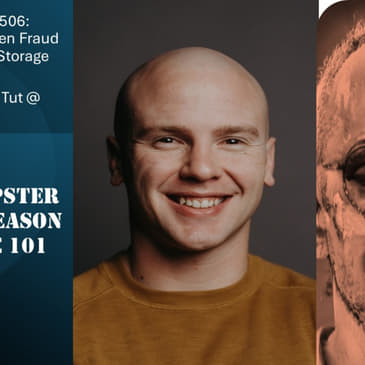

Kyle Tut is the Co-Founder and CEO of Pinata, the leading company in crypto file storage, backed by Pantera Capital and Greylock. Since 2017, he’s been building in crypto with a clear goal: to create trusted markets through verifiable data. From AI to NFTs, Kyle’s work bridges developers, users, and protocols with tools that make data trusted.
[00:00:03] Hello everybody and welcome to the Crypto Hipster Podcast. This is your host, Jamil Hasan, the Crypto Hipster, where I interview founders, entrepreneurs, executives, thought leaders, amazing people all around the world of crypto and blockchain globally. And today I have an amazing guest. He is the CEO founder of Pinata. His name is Kyle Tut. I almost called him King Tut, but it's Kyle Tut. Kyle, welcome to the show. Yeah, great to be here.
[00:00:32] Thank you for joining me. So let's kick things off and I'll ask you first, you know, what is your background and is a logical background for what you're doing now? I would say my early days definitely were not logical. I was just a marketing management undergrad and I wanted to always start my own company.
[00:00:56] Didn't know it was going to be in crypto at the end of the day. So I got interested in crypto at the first startup I was at, which had, again, nothing to do with crypto. But, you know, I had gotten into Bitcoin. I was really interested in smart contracts with Ethereum. And by April of 2017, I decided, hey, I'm going to quit my job and jump into crypto full time.
[00:01:21] I had absolutely no experience in crypto. I didn't know what type of company I was going to create. I just knew, hey, quit my job and I'll figure it out and go along from there. So April 2017, I quit. And then I just started going to blockchain and crypto hackathons based in Omaha, Nebraska. So there wasn't a lot of activity going on. And so I just kind of like flew around to these different hackathons.
[00:01:50] My idea or my thought was as a non-technical person, OK, how can I make sure I understand what's going on in the space and truly understand the technology? So just joined these hackathons, competed with a bunch of blockchain developers and smart contract developers. I basically just did the, you know, the old pitch deck and pitched the projects we worked on.
[00:02:17] But through that experience, I was able to actually, you know, learn a significant amount about what crypto and blockchain is all about, what it was capable of. And it eventually led me to actually, you know, meeting my my co-founder and then beyond that, actually starting Pinata. Awesome. Awesome. So I want to find out what Pinata is all about and what makes you unique. Yeah. So at the end of the day, Pinata is crypto file storage.
[00:02:47] So we operate on a protocol called IPFS or the Interplanetary File System. And we launched with that in back in 2018. The problem that IPFS solves is storing data on chain is really, really expensive. Back in the day, I always said it or the stat was something like three million dollars per gigabyte of data to to store on chain.
[00:03:14] So people and builders all try to push as much data off chain as possible. Now, the problem with that when you do that is you lose the cryptographic verifiability of the blockchain. What IPFS does really well is when you store data on IPFS, it generates what's called a content identifier or a CID. That CID is cryptographically verifiable.
[00:03:37] So the file itself gets a cryptographic verification and then that verification is submitted on chain and it kind of just references it. So it provides this incredible amount of verification and security related to what is the file supposed to be. And if the if the file changed at all, you're able to verify that it changed by looking at the looking at the blockchain and seeing that it doesn't match anymore.
[00:04:07] So that's kind of the fundamental like technical piece of of pinata. But what we do beyond that, again, is just crypto file storage. So images, videos, PDFs, JSON data, whatever type of data ultimately people want to store and use in crypto applications. We are the place to do that.
[00:04:31] So we we manage the files in a very crypto native way where it's based on, you know, your your wallet or it's based on a token and either serving that content or not serving that content. And just make it really, really easy for people to manage manage their files for their their crypto applications.
[00:04:54] Our target demographic that we serve is mostly developers, software engineers that are actually building these products, though. Really, anybody could go in and use our user interface and upload content if if they want to. But mostly focused on developers. Got it. So I used to do something similar in corporate America.
[00:05:19] I built mapping tables and the mapping tables would be the it would be the difference between the database and the application. It would, you know, save a lot of time and cut things down. So I want to find out what the benefits of your approach with IPFS are and if there will be benefits for not just developers, but maybe corporations to embrace and and, you know, bring on, you know, blockchain solutions in their companies.
[00:05:44] Yeah. So like broadly speaking, IPFS isn't just for crypto. Anybody could benefit from this CID paradigm where you actually know what the file is supposed to be. And I guess maybe backing up slightly there. When you store a file up in the cloud or on your computer or wherever in most traditional systems, they aren't actually creating any verification of what that file is.
[00:06:12] And so at any point, that file underneath can be changed and swapped out on you. Now, up to this point in computing, that has never been a big issue. But as we get closer to, you know, AI being able to generate infinite amounts of data, you really want this verifiable append only supply chain of is this file what it's supposed to be? OK, yes, it was transferred over to this person. Cool. Can we prove that the file hasn't changed?
[00:06:40] If yes, you know, did they then change it in some way, even if it's not malicious, you know, you're updating the file or changing the file. You need to have this this perfect supply chain for it. So within the corporate world where we ultimately believe IPFS and blockchain and crypto are going to be used is in instances like that,
[00:07:01] where you can prove that the file makes it from point A to point Z without changing or if it was again, it was verifiable and it was supposed to change by the person that actually changed it. And what that really does long term and wrapping it back into crypto is if you have verifiable data about what's happening out in the world
[00:07:24] and you're very confident and it hasn't been corrupted or hasn't been changed in any way, you're able to have more efficient markets. And so we always kind of think of it as, you know, before it's on chain, it's on pinata and before it's a token, it's on pinata. And if it's on pinata, you have verification that it's real and it is what it's supposed to be.
[00:07:45] And that way, when you're trading a token or exchanging information, you can do it with much more confidence and much more efficiently than the systems today, where it's like, you know, an email over here, an Excel spreadsheet over here and whatever else is happening in corporate America. Yeah. Yeah. Well, I think that the trust as far as blockchain is pretty easy, but the trust as far as AI, that's a different story, right?
[00:08:14] So your storage solutions, you know, help ensure that people can trust AI driven data, right? That's a big problem. Is it a trusting AI? How do you how do you like give people a sense of comfort that you can? Yeah. So this actually goes back to a lot of our initial success was in the NFT space.
[00:08:36] And if you remember kind of the beginning of NFTs, a lot of artists were coming into that community. And what they were talking about was, you know, how do we guarantee that, number one, people know that this is my artwork, but also have provenance around that artwork.
[00:08:55] And that same fundamental idea where you're taking, you know, a file or an image and attaching it to an NFT is basically going to be used to protect against AI at scale.
[00:09:08] And the way that you do that is you have to, when a file is being generated, whether it's on, let's say it's on your phone and you need to take a photo of a claim associated with insurance. So my house just got hit, hit by hail recently.
[00:09:29] And we were using video to to kind of show what damage it did on on the house with AI that can be fraudulently created now on the fly. And every single day, and every single day we're getting closer and closer to that being true. What what we enable is Pinata can actually run all the way out on your device.
[00:09:49] And we are using cryptographic signatures to verify that it's coming from your phone and that, you know, you're generating the the video of the house. And then we can verify that, you know, it hasn't again, hasn't been tampered with from your phone back to the cloud to whoever your insurance provider is.
[00:10:10] And so with that kind of chain of supply chain, the insurance provider can feel comfortable that they are not being fraud, you know, experiencing fraud where you're creating video that isn't isn't true. And so we can do that with both IPFS and the file storage that we enable, but we also use crypto wallets underneath to sign transactions and verify that, hey, yeah, this is coming from this device.
[00:10:39] It was transferred to this cloud. And at no point in there could could a hacker or somebody come in and maliciously try to change change the data underneath. Got it. You use the word fraud. It's kind of interesting because yesterday was the case of Alex Mashensky. A Celsius was sentenced to 12 years for fraud. You know, I was a Celsius customer. So you mentioned hail.
[00:11:07] So, you know, but that that that, you know, I was alarmed by this and I think I saw somewhere there's a 42 percent, I think 42 percent rate of AI driven. Fraud attempts. Right. What's driving that a lot. Some people say it's an alarming rate. I mean, I expect maybe a little bit more. But how can we begin to look for a solution and bring in that 42 percent rate down?
[00:11:37] Yeah. And I think this is where crypto meets AI at the end of the day. So it's, you know, somewhat of a meme of, you know, decentralized AI or whatever. But I really do think that ultimately the cryptography, you know, the word that precedes cryptocurrency.
[00:11:57] Everything that's happening under underneath blockchain and crypto is a perfect complement to combating anything that's happening in AI. AI is infinite. Blockchains are obviously finite. And when you pair those two together, you can, again, create this great new computing paradigm or system where you can prevent fraud from ultimately happening.
[00:12:25] And as I said, you have to be able to do it all the way down to the device that is creating the data. You know, our traditional systems today all rely on the cloud. But the cloud is so far removed from where reality is happening.
[00:12:41] You know, your day to day when you're taking your Instagram photo or whatever you're doing, wherever that data is being generated out on the edge or in the real world is so far removed from where it's ultimately being processed in the cloud that we need to be able to get crypto wallets out on the edge, out on every single device. And start signing every piece of content that is ever generated by any device anywhere in kind of any instance.
[00:13:12] And that that is how we combat ultimately AI fraud at scale. Currently, our systems aren't built for this. So there's going to definitely be a learning curve and it's going to be difficult. But crypto native companies have a unique tool and understanding of actually how to solve for for this problem compared to, you know, the traditional web, if you will.
[00:13:39] So from that perspective, I'm really excited at what's going to be able to happen with crypto. And long term, I'm not concerned about it from an AI perspective. Short term, I definitely am concerned there's going to be issues. At the end of the day, what's going to happen is we're just going to DDoS. AI can DDoS every single system ever created.
[00:14:03] And unless you use the appropriate tools like crypto wallets and things like Pinata and IPFS, you're going to to struggle to combat that with current systems. Got it. You said like you mentioned somewhere in the cloud, right? Not a lot of people know like where that somewhere is or what that something is. And you validate with wallets, right?
[00:14:31] And I remember I had a BRD wallet back in 2017 or 18, you know, and I asked for an audit report and it sent me this report from Amazon. I was surprised that Amazon was in the crypto wallet business, right? So, you know, how do you actually validate data using crypto wallet, right? Wherever it is in the cloud. And especially when like most of the addresses, crypto addresses, they think they're anonymous. They might not be.
[00:15:01] You know, they think they are. But how do you do that? Yeah. So the way that we approach things is we think that ultimately a wallet needs to be on every computer. So if the computer is in the cloud and it's a server sitting in a data center somewhere, it should have a wallet and it should, again, be signing everything. If it's, again, your phone, you know, sitting on your desk, it should also have a wallet.
[00:15:30] But if it's a, you know, a tiny little device that is collecting weather information out there, ultimately it needs to have a wallet on it and it needs to be signing every single file that it generates. And once you do that, you know, then you're actually in a very good spot. And it doesn't actually matter.
[00:15:51] What's great about cryptography and what's great about some of the properties of IPFS is it doesn't matter if it's sitting on AWS's servers in their cloud or it's sitting on a more decentralized system. These same properties still need to ultimately happen because what you want to get to is you want to be able to trust the data itself, not who's holding the data or where the data is sitting.
[00:16:18] And once we move to that paradigm, which is very much a shift away from how the cloud works today, today with the cloud, you have to trust ultimately who you're interacting with. So the service provider like AWS or whatever application that you're using. In the space that we're going, ultimately, the service provider shouldn't matter. And it should really just be anchored down to can I trust the data? Can I trust the file?
[00:16:47] And can I trust the wallet that it ultimately came from? Now, that gets into a little bit broader of a discussion of, you know, are our wallets trustworthy? Are they anonymous? Are they not anonymous? And there's still like ID things that we need to work out. Having a verifiable ID of, yes, this is coming from a trusted device or, yes, this is coming from a trusted person.
[00:17:15] We still need to get better at that, but we at least have the tools and the infrastructure underneath ultimately to solve for it. Got it. We need a paradigm shift. Yep. How do we, yeah, how do, you know, have paradigm shifts even for the most basic things are really hard, but how do you get people, especially on a mass scale, to go through that paradigm shift? Is it because we're going to have a bull market, raging bull market that's going to be happening soon or is it something else?
[00:17:44] So where I think it is already happening and where it will happen, at least first, is getting things on chain. And the most important place this is happening right now is with stable coins and verifying USD. And so, you know, at the end of the day, there is off chain US dollars somewhere, whether it's in the treasury or sitting in a bank or whatever.
[00:18:12] We need to somehow verify and prove that that USD exists. And then we need to ensure that it's connected to the token that is ultimately on chain that people are using to buy and sell goods. And that connection or lack of connection between the off chain reserves and the on chain token is where all of this paradigm shift and these technology changes are happening.
[00:18:37] Because previously before this, you know, if you went out and wanted to buy something, you're using maybe a Visa credit card or, you know, you're using US dollars themselves, the real physical things. And they're operating in a system where you don't need proof that they exist.
[00:19:01] They either trust Visa as the network and ultimately whoever's behind it or you actually have the physical thing. And as we tokenize more and more things, we need better and better ways to prove what these things are. And so that is where the paradigm shift is going to happen in crypto. There's also a parallel world that's happening with in AI where they're talking about creating digital twins.
[00:19:28] How do we create a digital twin of a physical object in the world so that AI, machine learning, robots, whatever can actually operate in this 3D environment? And so those two things are actually from an abstract perspective are very, very similar and require basically the same exact things. And that is where the paradigm shift in computing is going to happen.
[00:19:54] So regardless of, I guess, a bull run or not in crypto, the shift is happening and it's going to use the same tools. I don't think the digital twin is that abstract of an idea, right? Because we've had NFTs, we've had artists make money in NFTs.
[00:20:18] Now the NFTs are becoming more RWA-like where you can actually touch and feel, right? So I could see that happening. Yeah, it's all, it's interestingly all part of the same like, you know, computer paradigm shift. It just, you know, maybe the way that people see it or interact with it, they might not have the full view of it.
[00:20:44] What's interesting at Pinata is at the end of the day, every single application has to manage files somehow. And we work for every single blockchain out there. So whether it's Ethereum or Solana or Bitcoin or whatever, they're all ultimately using us. And then every single use case also uses us. So we have this very like broad, horizontal and vertical view of both crypto and AI at the same time.
[00:21:12] That has given us this kind of view of, you know, where we think ultimately the future is going. And we've just kind of seen it develop very slowly at first, starting in 2018. NFTs kind of like shined a light on the situation. Obviously, NFTs kind of went away there for a bit. But it's continuing to move forward. And at some point, it is going to have that inflection point.
[00:21:40] Yeah, it's moving forward without the hype, which is good. Right. I mean, it's moving forward from a development perspective. So great. So I want to talk about another concept. It's called, when I think of North Korea, I think of hostile hacking. Right. So what's hostile hacking? And how do we eliminate it from both AI and blockchain sources so that we can integrate the AI and blockchain together for a working solution for everyone?
[00:22:08] Yeah, ultimately, I think the way I think about it or the ones that I'm most concerned about are when actors come in and they either take control of your wallet, which would be awful.
[00:22:25] And then they can enact a transaction on chain or ultimately one that's, I guess, less well known, but very, very effective is what's called a supply chain attack.
[00:22:40] And so if you have a website out there and you're going to go to it and you're going to buy maybe some crypto on it, ultimately what can happen is that website, the front end that you're interacting, the user experience, that can all be swapped out by a hacker. And they can ultimately redirect, you know, whatever you're going to purchase into their wallet.
[00:23:07] And I do believe this is going to happen more and more. And it goes back to, OK, if we can't verify, if you can't verify that the website that you're actually interacting with is what it's supposed to be, you are at significant risk of ultimately losing funds. And this has happened multiple times already. It's very common.
[00:23:30] It's actually why a lot of DeFi protocols use Pinata underneath is they can verify, hey, this is the website and you are supposed to use it. But we think it needs to go even further. And you basically need to be always signing both from your end as the user. Hey, you know, I am actually who I am saying I am. And then the person that is sending you the app that is sending you the data is also verifying.
[00:23:58] And so if you have both parties always verifying who they are and why they're interacting with each other, you can then prevent hostile hacking from from happening. And so really, again, we just need to use wallets. Make sure that we trust the wallet.
[00:24:22] And if we have that system in place, we can we can prevent hostile hacking from happening or at least minimize it. I don't think we'll ever, you know, ultimately be able to obviously get rid of all hacking. There's always new games to be played. But we want to minimize the surface area and the attack vectors that ultimately exist out there.
[00:24:44] And in my opinion, the best way to do that is is through using crypto wallets, using things like Pinata and IPFS and just creating verified data from both both parties at all times. I wish I came across you guys back in August. But, yeah, you have you have certain rogue nations like North Korea, you know, their entire economy is based on, you know, revenue from hacking.
[00:25:10] Right. Yeah. You know, how do you prevent it from a from a political geopolitical social perspective? How do you how do you begin to do that? Yeah, again, to me, it all goes back to the wallets and signing things.
[00:25:28] At the end of the day, a wallet that is sitting on your computer is something that you control and gives you agency in a way that our. Traditional systems don't. And I think, you know, going back to what I said earlier, where everything has a crypto wallet installed on it.
[00:25:55] That gives significant amount of at the end of the day, decentralization and significant amount of agency to the to the individual that is operating the wallet. So right now it's, you know, crypto wallets are mostly just used for, you know, cryptocurrency trading and sending tokens from one place to another. But it is kind of the key for managing your, I guess, digital life, if you will.
[00:26:24] Long term, that is where we're going. And with those wallets on your device or in your ecosystem as a person, you have much more control over those versus a system where, you know, it's it's Google or Facebook or whoever, where it's much more obviously centralized under under their control. So to me, it all is boils down very simply to crypto wallets pretty much will solve a lot of these issues.
[00:26:53] But we we need more and more adoption of it. And it can't obviously just be about, you know, trading trading meme coins. I was about to mention meme coins. My next question, I think I probably still am. Meme coins seem to be like a great investment opportunity for people. You know, I look at it from a practical perspective. You know, utility is more important long term. Right. So what is the future of decentralized storage from a practical standpoint?
[00:27:21] And then from an investment opportunity instead of throwing all your money in a meme coin? Yeah. So. From Pinata's perspective, meme coins are just kind of an extension of NFTs. And. You know, we grew significantly during the NFT boom. We powered a significant portion of all NFTs that were created and still do. We are a significant power or.
[00:27:52] You know, we ultimately power all the NFTs. Meme coins were just an extension of that. And we also power a significant amount of the meme coin marketplaces out there. So we have both NFT marketplaces using us and meme coins ultimately using us. We think that both NFTs and meme coins are extremely interesting from just trying to create a new Internet and a different way of both.
[00:28:21] You know, monetizing content and creating, you know, unique ways to interact with digital content. Obviously, they're slightly different models and provide different things for for different people. But we we really do love how they are kind of pushing the boundaries of of hopefully what the what the new Internet is going to look like from an investment standpoint.
[00:28:48] You know, they're they're very boom and bust assets. So you always want to you want to be careful with them. But I do think ultimately they're leading to something bigger. Bigger, I think at the end of the day, what's happening with both NFTs and meme coins is just a ton of different experimentation. And there's going to be winners and models that make a ton of sense.
[00:29:16] And then, you know, we will forget about the things that didn't make sense. But ultimately, I do think they're they're leading to something bigger and better. Maybe, again, it's just they're they're just leading to more crypto wallets being out in the wild. And it could be as simple as that. But I really do think they are. Leading to a new Internet and some type. Got it. Sounds good. Sounds very promising. So awesome.
[00:29:45] So I want to thank you very much for your time today. I enjoyed speaking with you. I have one last question. It's it's easy. How can people find out more information about you, about Pinata? How can they how can they do that? Yeah, absolutely. So obviously, they can check out our Web site at Pinata dot cloud or they can go to X and we are just at Pinata Cloud and pretty much Pinata Cloud across any of the any of the other socials as well. Awesome. Thank you very much for your time today.
[00:30:16] Great. Appreciate it. Thanks for having me on.