
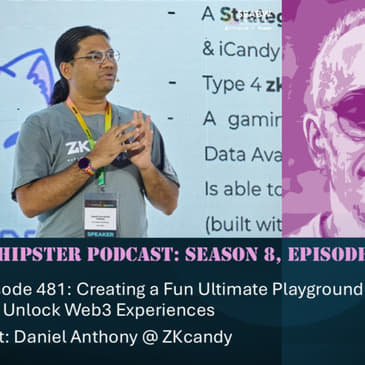

"Daniel Anthony leads Developer Relations at ZKcandy - a mobile-first Ethereum Layer-2 gaming chain. As a former journalist, Daniel has immersed himself in the many aspects of web3 from decentralised storage to censorship-resistant publishing. Today, his role at ZKcandy is bolstered by being an avid gamer in his spare time, resonating with the gripes of today’s gamers and game developers to build an ecosystem that is engineered to scale web3 gaming for the masses.
ZKcandy emerged from a groundbreaking collaboration between ZKsync and the award-winning game studio iCandy Interactive. It's the first gaming-centric L2 in the ZKsync Elastic Chain ecosystem, aiming to enhance the gaming experience with a very fast network and low gas fees using roll-up technology and a strong market-driven gaming ecosystem.
iCandy Interactive is an ASX-listed game developer with over 300 mobile game titles and 400M+ downloads. As the largest game developer in Southeast Asia and Australia, iCandy is supported by a strong network of strategic shareholders, including Animoca Brands, Fatfish Group, Baidu, Singtel, SK Square, AIS, IncubateFund, as well as several Australian and international funds. Their clientele includes industry giants such as Electronic Arts, Naughty Dog, Square Enix, Blizzard Activision and many more."
[00:00:02] Hello, everybody, and welcome to the Crypto Hipster Podcast. This is your host, Jamil Hasan, the Crypto Hipster, where I interview founders, entrepreneurs, executives, thought leaders, amazing people all over the world of crypto and blockchain. And today I have an amazing guest for you. He is a developer relations specialist with ZKcandy. His name is Daniel Anthony. Daniel, welcome to the show.
[00:00:30] Wow, thank you so much, Jamil. I am flattered by that to be, you know, considered to be among these titans. I am a humble developer relations executive here at ZKcandy. And it's a humbling role. It's a humbling day. It feels great to be here. Thank you so much for having me. You're very welcome. So, awesome. So let's kick things off. And I ask everybody the same thing, you know, and I get wonderful answers.
[00:00:53] So my first question is this, is what is your background? And is it a logical background for what you're doing now? I have been waiting a long time for someone to ask me this because sometimes people get surprised. I was a journalist. That was my background. I did broadcast and I studied communication, which is a little odd for somebody who's working in a blockchain company that has and now filling in a role that has to do with talking to developers and software engineers.
[00:01:20] So, no, I don't actually have a computer science background, but I actually took on blockchain technology quite early on in about 2013, 2014, getting curious about Bitcoin. But once Ethereum came out and catalyzed crypto and Web3 to the forefront of a lot of things, it really piqued my interest. Now, regarding the question of whether it's a logical background for what I'm doing now, one of the things we had as journalists is that I used to cover political news. I was with a media outlet called Malaysia Kinney. We covered Malaysian political news.
[00:01:50] And part of the job was a bit of training that we were sent on on something called digital paranoia, which is to be able to be more conscious about how we take care of our digital footprint, the data that we handle, especially when it comes to doing investigative journalism. So as a result, I was taught about encryption. I was taught about how our best practices are, how to use encryption to our advantage, to protect our sources and such. But of course, I was not an investigative journalist. I was more of a political journalist.
[00:02:19] But this information stayed with me. It carried on through my career and always had a strong place in my heart because it really resonated with the idea of press freedom and freedom of information. And that's where the big intersection came in. Blockchain and crypto has been an excellent force for democracy and information freedom in the world today.
[00:02:39] And now that I'm working full time in it, that training that I had all those years ago has not come to the forefront of what I'm doing and also been a big catalyst and motivation for what I do today. I love it. That's great. That's great. Actually, it makes a lot of sense. You know, in order to be a developer relations person, you have to be a good communicator. You know, so it makes sense that a good communicator has come from journalism.
[00:03:04] So that all aligns from what I see, including a purpose, you know, and I want to dig into that, right? Or find out what ZK Candy is all about and then your role, your purpose, your mission and vision. Well, let me start off with ZK Candy first. ZK Candy is a new Ethereum Layer 2 engineered for gaming built in collaboration between Matter Labs, the company and the force behind ZK Sync, the excellent ZK roll-up technology.
[00:03:32] And also iCandy Interactive, which is the biggest game developer in Southeast Asia and Australia. So these two forces are coming together. What happened is ZK Sync came up with this excellent roll-up technology to lower transaction costs, make a lot of things on the blockchain smoother, ultimately to scale blockchains like Ethereum that has been long plagued by, you know, limited block space, etc. I hope I'm not getting too technical for the show.
[00:03:55] But basically, to solve these problems, ZK Sync has come up with their ZK Stack and also their Elastic Chain, which is, you know, some people may criticize this as not the most efficient technology out there. But it has been by record so far. And as far as I'm concerned, one of the best ways to scale Ethereum by upholding the ethos of what it means to be Ethereum in the first place.
[00:04:14] And as such, this new blockchain, ZK Candy, is going to be the gaming epicenter of it because Metalabs approached iCandy Interactive, which is the company I was with prior to joining ZK Candy. And therefore, it said, hey, you guys have the best gaming knowledge. You know, for so many things, you had a huge clientele across big AAA studios, Electronic Arts, Naughty Dog, Blizzard Entertainment. So just to name a few.
[00:04:39] Therefore, all this knowledge brought together with ZK Sync's infrastructure, the kind of code that they built for this. You know, we set out to build the gaming chain that not just scales well, but also upholds the ethos of Ethereum. And it's ultimately engineered by gamers because we keep talking about GameFi and blockchain gaming. We've been talking about that for the last three, four years, but we really haven't seen it take off that much.
[00:05:02] So, you know, now that we've been observers in this space, both in Web2 and Web3, we're kind of coming to the table and saying that, you know, we as game developers are able to now enter Web3 in a way that we can engineer a solution specific to this industry and catalyze it for the game developers and also the gamers of tomorrow. Awesome. You're not getting too technical.
[00:05:34] I have a question regarding blockchain and, you know, ZK Candy. So the role of blockchain so far to me in gaming seems that it has not worked, right? Yeah. Why has it not worked? And what do we got to do to make it work? I really like how you word this question because it's grounded in reality, you know. It's grounded in the reality that it has not worked.
[00:05:58] Because, you know, for the last three, four years as an observer, a user and also a gamer myself, I have been swamped with the social media and also the marketing that's full of buzzwords, full of promises. So we know in this realm of Web3 what is possible. True digital ownership is possible, you know, censorship resistance and such things like, you know, having the ability to not get kicked out of a server or a game just and, you know, have all your inventory go poof the next day.
[00:06:26] Either true, sometimes true no fault of your own. We know this. It's a fact that this is what Web3 brings to the table. But it's like Web3 has brought the ingredients to the table. But who's cooking? Nobody's cooking. You know, we know that's ingredients on the table. We all point to it. We've got the best and freshest ingredients in the whole world when it comes to gaming, yet no one's cooking with it. And therefore, I think I actually was on a previous conversation about this on another podcast where people have asked me why don't I think it has succeeded?
[00:06:53] And I think it's because, you know, I even said at risk of losing my job, but also because I think we've been catering a lot to some of the, you know, groups that have claimed to serve as catalysts, as big, you know, innovation drivers in this scene, but have actually been the ones that have, you know, put the factory into overdrive and caused it all to come crashing down.
[00:07:15] What I do mean by this primarily is something called the guilt system or the scholar system, basically in Web3 games, where it turns gaming into a bit of a sweatshop. You know, one of the key terms that comes out of Web3 gaming is play to earn. So that means, yeah, why, you know, it's the dream, isn't it? I wake up, I play games, I earn money.
[00:07:33] But, you know, when people started to, you know, commodify and financialize and turn this into a business in itself, you would then have people on servers and discords sending resumes pertaining particularly to gaming, saying that, hey, I can play this game for eight hours a day. I can earn you at least this many coins of this currency at this rate. And eventually it became a chore. And when you take the fun out of gaming, that's it. It's self-destruct. It completely collapses. And I think that's what happened on numerous occasions.
[00:08:02] And sometimes this is like, you know, the bit of the sacrificial lamb in the story, because we are now looking at companies trying to see how we can beat this system, how we can, you know, proceed forward, rebuild Web3 gaming with a better, you know, approach to this. So, of course, here at ZK Candy, we are focusing on infrastructure. So, of course, the play-to-earn system isn't really our concern because we are primarily in this for gaming infrastructure, not so much the development of games ourselves.
[00:08:31] But we do have our own in-house games. So we want to lay groundwork and say that, hey, you know, we want to find the projects that are pushing the envelope forward, not backwards in Web3 gaming in order to see, hey, you have an innovative way of approaching something. I want to see it blossom. Let's give you the garden in order for that seed to blossom into something that can work better for Web3 gaming. As you know, we also have been through quite a big bear market in crypto. And this has been, in my words and also in many people's words, a bear market is a builder's market.
[00:09:01] We've seen a lot of people building, a lot of people cooking various things on different levels, some with VC support, some with community support, some just on their own steam, which is amazing and fantastic. And that's why we want to make sure that this, as the bull market, which is expected, makes a resurgence, that we keep the blockchain affordable. We keep the blockchain accessible to these developers, these gamers and these builders to bring this technology to the mass market.
[00:09:25] And in a way that it retains being a democratic and decentralized process instead of rather than being, you know, a game company spent so long building a decentralized game only to have guilds re-centralize it and turn it into a sweatshop again. I hope that made sense. It makes a lot of sense. So I like what you said. If you take the fun out of gaming, it collapses. Well, you know, then what does it become? It becomes drudgery. What is it?
[00:09:55] If you take the fun out of gaming, what is it then? In this case, it becomes a job and it becomes basically just a grind, you know? Now, some games have grinds in them. You know, I've played various RPG games where you have to go and go out, do missions again and again just to get resources, roll for items and statistics and stuff. Yeah, grinds have always been part of games, but some of them have a more fulfilling endpoint.
[00:10:17] But now when you just boil it down to just getting coins and NFTs for just, you know, mindlessly playing it or putting your mind into it, calculating strategies and getting upset when you don't make a KPI. I think the KPI is one of the great terms that we've unfortunately seen creep from business into gaming in this decade. That's particularly something that really tore it down because when I play games, my KPI is I want to have fun.
[00:10:43] But when the KPI is forget about the fun, you've got to earn this much money by tonight or you lose your job, then yeah, that's where it dies. Yeah, I agree. I interviewed somebody last week who said, you know what's missing in gaming? And you said cooks is we're missing the grinders, right? We're missing the middle people who like you have buyers and sellers, but you need people to commoditize the industry as well, right? Mm-hmm.
[00:11:12] So how do you think people get more cooks in the kitchen? Sorry, I would like to correct that. I don't mean that we need more people to commoditize the industry, but it needs to remain in a way that is decentralized. Like if you come in, look at how Uber disrupted the taxi economy. It became such a way that, oh, if I own a car, I can just be a driver part-time whenever I feel like it. So in games, play to earn was probably appealing to the people who just wanted to be like, hey, I got a couple extra hours today.
[00:11:39] Or I played this grind and I got too many of this item, but I need another one. We create this open economy. And another promise that we got many years ago that we've seen some semblance of is interoperability for items to appear in various different experiences, not just games, but trading platforms, staking mechanisms, et cetera. So these are the things that people can cook on the development side by creating these experiences. That's one.
[00:12:05] Instead of just leaving them as promises that still remain on the table years later unfulfilled. But on the other hand, when it comes to the players, the flexibility to do this as something you enjoy, where you can dial in the right amount that you want. So again, no more KPIs. Just dial in the amount. Okay, I feel like playing an hour today. I'll just play an hour today, which is what we've done for video games for decades. You know, if we should use this as a catalyst of freedom and power to gamers rather than this, you know,
[00:12:35] I wouldn't say enslaving, but also it's more like, you know, turning people and turning gamers into workers is coming. That kind of tears the system apart. Of course, you know, if anyone wants to put in the grind and do it, they're more than welcome to do so. But once you start answering to a boss, then, you know, these kind of institutionalization in a decentralized system starts to, you know, become contradictory to each other and they sort of annihilate each other in the process. I would agree to that. I would definitely agree to that.
[00:13:03] You know, you also said that you like to build in a bear market, but we're headed, but we're in a bull. Oh, have you seen, have you looked at CoinGecko this past week and all the prices that are depressed? I don't need to look at CoinGecko. CoinGecko buzzes my phone every five minutes. We're headed into a bear, I think. I'm not sure where we're at. This is a whole new paradigm, but like, is this a time to build?
[00:13:31] Okay, the confusion between when it's time to build and when it's time to, you know, invest and stuff and reap rewards per se. I think that is currently, that has been for the early days of Ethereum, been defined as like, you watch this blockchain that is currently impossibly expensive to build on and you wait for a good time, which is the bear market. Gas is cheap. ETH is cheap. You go in there at that time. But, you know, the disruption that ZK Candy wants to bring to this market is now, forget about all that.
[00:13:57] Gas is less than one gui all day every day. That's what we aim to achieve. It's builder's market every day in ZK Candy because we want to bring that kind of attitude into the process. But prior to this, when you're building on someone else's infrastructure, you kind of are subservient to the market forces affecting that infrastructure. By leveling this out and keeping gaming affordable, accessible, open to all, keeping that infrastructure, which is core to it, because some people can have brilliant games,
[00:14:25] but, you know, it's held up by an NFT transaction that has been stuck for the last two hours kind of problem. You know, ZK Candy wants to break these barriers because this is what we think is really affecting the lowest common denominator, the players out there. Yeah. Yeah. That sounds good. So you keep saying this word, ZK, which stands for zero knowledge, right? And there's ZK Candy, but there's the tech side, there's ZK Roll-Ups, right?
[00:14:53] So how can ZK Roll-Ups offer an improvement to what's been existed today so that we can usher in the next wave of Web3 games? See, I've also got to be clear where technology's possibilities and technology's practicalities are different. So in a ZK ecosystem, theoretically, you can have almost unlimited transactions compressed into a single blob
[00:15:20] during, you know, when it's written to mainnet or the data availability layer. This means that, you know, you can have scalability to exponential levels on a rollout that runs on a ZK infrastructure. And that's something that we focus on building because we want to make sure that, yeah, it doesn't matter whether today you have 10 gamers on your app and tomorrow you become a huge overnight success and have 10 million, that your game, that the whole infrastructure doesn't collapse as a result of this.
[00:15:49] So many games on Steam and other platforms have collapsed on their day ones when people just log in and crash the server because everyone wants to play. We, you know, we make sure that ZK is kind of like an enabler that helps this to not happen because it's able to handle that many much, that much more transacting at one go. But of course, this is still really a theory. And really what's going to happen is by putting this to practice, that's kind of why we exist in the first place, because we want to bring this technology to gaming.
[00:16:16] The biggest test for all of us is going to be when the real market hits. And that's something that we have to brace for impact for. But, you know, we have this in mind. We're not just going to shrug it off and say, eh, market, eh, transaction mempool, eh, blockchain's crowded. You know, like some games just put a little notice in there, eh, blockchain's crowded, wait and see. You know, we want to try and eliminate that, try and bring, you know, as little pain. And one of the best words we use is low friction for gamers, low friction for people who play, low friction for people who want to onboard gamers.
[00:16:45] So you want people to get from seeing a game they like to playing that game as soon as possible. So therefore, the less weighting there is in that equation, the better. Great. So let's talk about the gaming types. There's games on my computer, on my laptop. Then there's mobile gaming, right? There might be other gaming types, right?
[00:17:07] So why is it important to be a go-to platform for the mobile gaming space? So the mobile gaming space is kind of rather the way we are packaging what we're approaching this with. We're using the web. We're using web-based applications, something called progressive web applications. And this case, it means that you almost spend no time installing or downloading these games.
[00:17:35] What this does for game devs is that it eliminates some of the core pain points that we have experienced as game developers at iCandy for many years. And that is the review process of getting into many app stores, be it the Apple App Store, Google Play, you know, even Microsoft Store when we're concerned consoles, Sony for PlayStation, Microsoft for Xbox. So when we build for the web, we build for the users that want to get in quickly. That means just tap a link, tap and play. You know, it's meant to be in that.
[00:18:03] And progressive web apps have come a long, long way in the last decade or so. Coming from, you know, simple applications that are limited to now being full-fledged apps, you even have crypto wallets that function as PWA. So it's actually getting amazing in this current day and age that we think that, hey, you know, games that can be simple enough to operate within this platform, this is the platform for them to absolutely shine, you know, you wait less.
[00:18:28] And the thing is, because blockchain games are meant to be always online, you're connected to an interweb of assets and ownership. So it doesn't make sense to have to download a 200 megabyte game, wait for it to download and install when you don't need to run this offline because you're playing online all the time. So, therefore, the approach here is that it's not so much we are going mobile, we're going cross-platform. But we are mobile first because today, whenever we talk about how is the fastest way you're going to get to the internet, you're not going to say, I'm going to go home and look it up.
[00:18:58] You pull out your phone, you open up Google, you open up ChatGPT, you open up whichever search app that you prefer. You're already looking at something from looking at comparing stuff in a supermarket to seeing an ad. So when you see an ad, we don't even see URLs anymore. We see QR codes because the mobile is that target platform. So now we can just use this to connect dots much more efficiently. What if you could scan a QR code you see in a bus station and boom, you have a game to play while you're waiting for your bus that's delayed by another 45 minutes.
[00:19:25] We can bring gaming friction down. Once again, coming back to one of our core points of being a ZK Rollup is that bringing down that friction for gamers. So now being able to build on the web platform allows us to do that even more. I want to do a hypothetical example. Sure. Because I had a crypto wallet that I thought was decentralized that wasn't, that was centralized.
[00:19:54] And they switched the Ethereum code where if I put it into a new wallet, my old, my balance didn't show up. Like my balance didn't show up. So I found that off later. Apple Store arbitrarily decided to shut down the app. So when I went to refresh it on my iPhone, I couldn't get it back. And that led to me trying to discover where to get access to my account, which led to a phishing hack.
[00:20:23] It lost my money. Sorry. So sorry to hear about that. It lost my money. Right. So I'm over it. You know, it's OK. It's never OK, but it's OK. But I'm thinking, you know, you have you have gamers. You're playing a game. You're building. I'm sure you have NFTs. You have avatars in some of your games and, you know, there's assets. Right. And say Apple or Google Play decides to arbitrarily take down that game.
[00:20:48] You know, how do you protect your players and your users to have their assets, you know, not vanish as well? How do you do that? Well, first of all, as I mentioned earlier, when we use progressive web applications, we are no longer subject to the terms and conditions of these app stores because now you are running a browser. And as far as I'm concerned, there's no browser in the world that tells you, yeah, you can't visit this, this, this and this website, maybe for phones in North Korea. But for the rest of the world, I don't think we've ever seen a browser that's ever implemented these kinds of restrictions.
[00:21:18] So as long as it's accessed via a browser and you're not being blocked, I think the bigger concern is not so much Apple and device manufacturers blocking it. It's more like governments and ISPs that might trigger this instead, which opens up a whole new can of worms on its own. But for this question, I also like to take a little step back and look at Web3 as a whole. Web3, a lot of people misinterpret Web3 as this, as planet crypto. Everything is crypto.
[00:21:45] Everything is coins and meme coins and NFTs and, you know, degenerate gambling. But beyond all of that, Web3 is also known as the permanent web. Because of that, it includes technologies like Arweave and IPFS. And these are content addressed stuff, which is very, very hard to take down. These are technologies that were used to disseminate COVID-19 information to countries that suppress the Internet during the pandemic.
[00:22:09] And also used to distribute academic articles to countries that do not have access to highly gated repositories of academic information. So this can also be used in terms for gaming by hosting these kinds of front ends. Again, I'm going into a bit of a theoretical side of things right now because it's not the most efficient. So that kind of is a little contrary to the ZK Candy mantra where we're trying to keep friction down. But it is possible to actually build censorship-resistant games through this technology, through what Web3 has given us.
[00:22:38] And, you know, while we don't have a need for that yet because Web3 gaming isn't really under-attacked by any institutional means right now. The avenue is there. And right now, building on the web, the Internet has always been an open space. It allows us to live, you know, gamers and developers don't have to live in that constant fear of, like, what happened to you, you know, where an app can just arbitrarily, poof, disappear from the App Store like that, you know,
[00:23:06] or get censored or suddenly you tap that icon and, oh, it doesn't want to open up anymore, that kind of problem. We can mitigate that to a whole new level through Web3. But for us, I think the sweet spot in this middle ground is building on the web for the web rather than building to be for particular devices. So we're not completely device agnostic because when we say we build for mobile, we primarily build for the touchscreen market,
[00:23:30] which may not be as efficient to play with a gaming controller on your, like your DualShock on your PlayStation or a keyboard and mouse. But at the same time, it's like, it's there. The option is there. You have a touchscreen laptop. Yeah, you can enjoy it in the fun as well. Interesting. We don't have a need for censorship or just in gaming, but the avenue exists. I did not know that. So that's something to think about.
[00:23:55] I would say it's a little difficult of an avenue because there's things that are not as capable on the permal web just yet. Like you can't run stuff that requires a server, for instance, because when there's a server, that server can be destroyed or shut down. So it's not a foolproof drop-in replacement solution, but it is there. And hopefully we'll see more development in this in the future. And of course, for the industries that need it most, information, freedom, and democracy would need this much more than games.
[00:24:23] But one day games might be able to benefit from it too. I like information, freedom, and democracy. So that's why. For games, one of the points that I just like to bring up is that this could be a move that can bring the industry towards less rug-pulling. Because currently, one form of rug-pull is a game vanishing after it's been developed. And sometimes this is not completely out of malicious intent. Some of them, it's just they run out of funding. They can't pay for their servers.
[00:24:53] They can't pay for the infrastructure that keeps their games running. And therefore, they have to disappear. But if some games allow for some sort of persistence through serverless functions or something like that, we actually could move a bit in this direction of building a game forever. Building a forever game that lives on the blockchain, lives in Web3 across distributed files, and distributed information and content addressed uploads on the internet. So it's possible. We could probably move in that direction one day.
[00:25:21] You know, I think there's a lot of great things in Web3 that can interoperate with each other. You can mix and match from a lot of different types of things in there. And, you know, so ZK Candy is our own little recipe of what we've, you know, chosen from the best of Web3 to put into a chain engineer for gaming. I like what I hear so far. Thank you. Yeah. Yeah. So some of the areas that are still important because on blockchain and Web3, you know,
[00:25:49] how do you solve challenges related to security, scalability, and identity? You said freedom, you know, I think I associate freedom with identity. How do you do that? How do you solve for that? Uh, okay. So we don't exactly do that. I'll be very frank up front. As ZK Candy, we don't. Because when we want to bring down friction, we actually try to give people something they're already familiar with, which is not necessarily privacy preserving.
[00:26:17] We let them use things like, you know, social login and stuff to generate their wallets rather than... And right now, we already have a system in place for using emails as wallets through account abstraction, which is a great technology that ZK Sync developed on top of Ethereum's EIP 4337. So when it comes to this, you know, it's not really this idea of freedom of identity in Web3, but let's look at things like when people even talk about NFTs in games and such,
[00:26:46] you know, we had a bit of a cycle where NFTs in games went up and down, where a team in Axie Infinity cost over $1,000 at one stage and such. But some people have said that if you look back in the past, that the blockchain does not forget. So even if you have some of the best NFTs or you lose some of the best NFTs, you know, if you had that information recorded on chain, the games you've won, the battles you've been in, you know, all these achievements that you've had through your games, your identity in that wallet follows you, becomes a part of you.
[00:27:16] You know, it's no longer built into a walled garden like that of current game platforms. Like, you know, I don't want to get in trouble to name them now, but basically, you know, when you play a certain game, the achievements stay in that game. We've got some interoperability through platforms like Xbox Live. But now, if they follow you on your wallet, on chain, publicly for the world to see, and because it's etched in time, no one can ever take that achievement away from you, even if the game gets redeveloped. And, oh, they removed this achievement from the game.
[00:27:46] That when you did it, it was etched in time. And wallets eventually become these really amazing player profiles that are truly unique to every single player of a blockchain game. And when it comes to that, yes, this is one of the part where ZK Candy does want to build into, where we have, you know, not just one wallet anymore, because some people may have more than one wallet. Like for myself, I carry a hardware wallet. I also use a hot wallet in my software. So basically, yeah, I can combine those two under one unified identity
[00:28:15] to be like, oh, okay, I played some games with this. I played some games with that. But look at my collective, you know, list of achievements across so many games, across how long I've been playing, because the blockchain is also a clock. It etches things in time. So I can say, yeah, I've been an OG gamer since the early days. I've been one of the earliest players. And, you know, it's an etching of truth. You can't lie about this. If someone really asks you, oh, you really played this game on day one? Yeah, furnish the wallet and prove it. Interesting.
[00:28:42] I like your comment about the blockchain doesn't forget, because I've always been a proponent of the efficient market theory. I used to think crypto was an efficient market. It's inefficient. It's an inefficient market. But why? The premise under efficient markets is the market has no memory. But if the blockchain never forgets, that means it's an inefficient market.
[00:29:10] So with that said, you know, we talked about rug pulls. We talked about inefficiencies. How can you how can you make the creative model so that like all the rug pulling you hear about is meme coins? So that we eliminate the rug pulling from this industry. You know, we make it go towards an efficient market. How can you capitalize on those inefficiencies to build positivity going forward?
[00:29:37] I think that's a challenge for everyone in Web3 at the moment, not just for ZK Candy, but every single person who's been in this industry, whether you've been in this industry for a day or a decade. It's something that I think we have to solve together. So what ZK Candy can bring to the table is that when it comes to games and their tokens, we want to make sure that this is the chain where they can live on. So, you know, when it comes to DeFi, when it comes to things that we do with our coins, that there is ample room for games to grow here.
[00:30:07] And that's why we are building also a grant program for developers, because we want to make sure that, yeah, you come in here. It's not a cash grab chain. You know, currently the trend of hackathons and also cash, you know, people developing is that they'll go and grab a grant and then poof, the game dies. You know, we really want to make sure that games can continue to preserve on true, you know, true bears, true bulls. And I think when you have an endgame in sight, when you have this, you know, building for longevity in sight,
[00:30:34] ZK Candy is a commitment because this is a blockchain. We can't just decide tomorrow, eh, we don't feel like doing it, we pull the plug and that's it, you know. That is going to be a mega rug pull, you know. It's equivalent to a blockchain just going dark suddenly and all of its assets going dark with it. So, yeah, we take, we have, we want to lead by example. We set this long-term, you know, commitment, not just to, you know, to the people of cryptos or the gamers of the world, whether they're from Web3 or Web2, because again, we're trying to lower friction.
[00:31:04] And some people have this endgame goal of lowering friction by so much that you don't even realize you're playing a blockchain game by making, you know, abstracting away everything, putting in social logins and such. But, you know, soon this is going to be the way that we perhaps can achieve some semblance of mass adoption within the gaming industry. And I think, you know, we can push in this direction because it's not just trying to outright scam people by saying that, hey, now suddenly, you know, you got this NFT, you want to play a game or something like that. We can move forward with people,
[00:31:34] choose projects and curate the projects that really build for longevity. You know, it's hard to build a solution to this because malice is something that is impossible to defeat in this world today. It's why people get scammed every single day. Scammers are always one step ahead of everyone else in the industry. So how do we, you know, we combat this? I think we lead by example, set a force for good. Sounds good to me. So this is wonderful. So thank you very much. I want to thank you very much for your time today.
[00:32:03] I enjoyed speaking with you. And I have one last question. Sure. How can people find out more information about you, about ZK Candy? How can they start playing fun games? ZK Candy is currently, as I think of the time of release of this podcast, we are still in testnet, but we are on the verge of launching our mainnet. So, of course, to stay tuned to how that's going to happen, when that's going to happen, and how you can join in on the fun, how you can also, you know, get in and start, you know, playing our games and such, head on over to ZKCandyHQ,
[00:32:33] that's ZKCandyHQ on Twitter, that is our Twitter handle, or discord.gg forward slash ZKCandy as well, to join our Discord server. And, you know, stay in the know, stay in touch, and I look forward to having a chat with people in our Discord server, and also, you know, to finally be out there announcing our mainnet, and having you enjoy what ZK Candy has to offer, whether you're a builder or a gamer. If you're a builder, ZK Candy is open to you. If you're a gamer, we hope you have fun. Awesome. Thank you very much for your time today.
[00:33:02] Thank you as well for having me.