
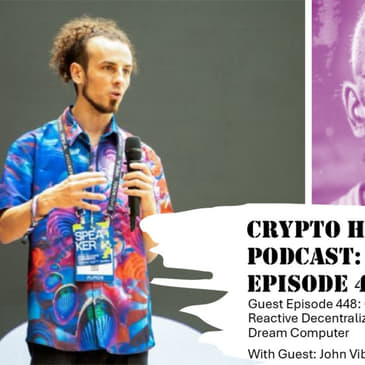

John Vibes is an author and journalist who has been in the crypto industry for over 10 years. He is currently the content lead for Somnia.
Somnia is bringing the entire world’s data on-chain with the fastest and most cost-efficient EVM Layer 1 blockchain ever, capable of processing over 400k TPS with sub-second finality and sub-cent transaction fees. With these capabilities, Somnia is the only blockchain fully equipped for real-time, reactive, mass-consumer dApps that reach millions of users.
[00:00:03] Hello, everybody, and welcome to the Crypto Hipster Podcast. This is your host, Jamil Hasan, the Crypto Hipster, where I interview founders, entrepreneurs, executives, thought leaders, amazing people across the world of crypto and blockchain. And today I have a treat for everybody. I have an amazing guest. I know because I met this man before. I met him the first time at Consensus 2024 in Austin, and we had an amazing conversation.
[00:00:32] And he is the Chief Vibe Officer at Somnia, also the content lead. His name is John Vibes. John, welcome back to the show. Thanks for having me again. Great to be here. You're very welcome. Very welcome. I enjoy speaking with you the first time, and I'm looking forward to this conversation. And for those who didn't hear our first conversation, I want to ask you first about your background.
[00:00:58] Is it a logical background, and what have you been working on since we last spoke, and being part of a dev team now at Somnia? It's probably a little bit of a different background than some people in the space.
[00:01:15] I started out as a journalist covering different topics from technology and activism, things like that, because Occupy Wall Street was happening at the time. Anonymous was happening at the time. This was like 2013. And I was covering those issues and also covering the bailouts of 2008, which was only just a couple years ago at the time.
[00:01:42] So all those interests kind of converged on Bitcoin when Bitcoin started being talked about in the media. I covered it frequently, and then I just, over a couple years, just decided, why not start working in the industry? Yeah, I didn't tell you that I worked at AIG. Oh, okay. Okay. I didn't know that.
[00:02:07] Yeah. I was there during the bailout, but what I wasn't there for is I was there the whole entire time that Bitcoin started, but I didn't hear about Bitcoin after I left AIG in 2017. Oh, okay. So they kept it under wraps internally. I bet they did, yeah. They're probably still trying to do that. I see a lot in the news that all the big banks, while they're buying it, they're saying it's a scam. Yep. Yep. So, Somnia, right?
[00:02:37] Yep. What's great about it? Why is it great, and how's your experience been with it so far? Oh, it's been great. I've been there for about a year, pretty much since the project was announced. And we have been making a lot of developments, and things have kind of changed a little bit since we last talked. Because we were working on the blockchain. The blockchain was kind of under wraps. We couldn't give too many details about it.
[00:03:03] And we were and still are closely connected to various metaverse companies, but that isn't our main focus right now. Although we are going to facilitate metaverses, gaming and mass consumer applications like social media applications are what we're really thinking is going to drive adoption of this blockchain. Great. So you have some updates.
[00:03:32] What are those updates? Can you share with me, including DevNet and others? Yeah, definitely. So we have our DevNet running right now, which has been extremely active, and people are very happy with it, which is good because you never know what's going to happen when you release a blockchain out into the wild. I know that not every DevNet has been successful recently, and some have had some backlash.
[00:03:57] So we're happy that we had a good reception from the community and that their performance so far has lived up to the expectations that we set in the past couple months. We also released an updated light paper, which gives some insight into the technical framework and the infrastructure behind the Somnia blockchain and what makes us unique there.
[00:04:22] One of those things is our multi-stream consensus, which from a high-level overview, every validator runs their own independent data chain, which helps with congestion and throughput.
[00:04:40] And it also helps in times when there's a lot of strain on the blockchain, even if you have a big NFT mint where everybody's trying to get into the same contract at one time. This is designed specifically so there's no gas wars in those scenarios. And this will be especially important when you have applications with millions of people using them, whether it's a game or a social media app.
[00:05:09] And to go along with that, we also have unique compression algorithms and a few other elements that kind of work together to help with the throughput and make it one of the fastest blockchains ever, if not the fastest. That's a big claim. It is. Let them be fast. You said there's been a lull in some of the dev nets recently, right?
[00:05:38] You know, even like, well, it's been a lull in the market a little bit. And even the best chains that are out there, when there's a lull in the market, people badmouth it. You know? So how do you navigate the fact that there's a lull versus what your technical advancements and achievements have been? That's a very good point. I think a lot of this plays into even if you don't have a token out yet, there will be a lot of people who have expectations about the TGE and everything.
[00:06:08] And they want to know when it's happening. And if it's not happening soon enough, then they're upset. And then that's something else that you have to juggle with in addition to the market conditions. But we think that just kind of constantly delivering on new information, giving people new insights into what we're doing, new applications, new onboarding kind of incentives.
[00:06:31] Like, for example, we just announced a $10 million grant program inviting developers to come be a part of that. And that basically gives them some upstart money if they qualify for that. But in addition to that, they also have developer support, go-to-market support, and even intros to investors and things like that as well.
[00:06:53] So I think that campaigns like that, constantly reaching out to the community, bringing new applications and developers in, is a big important thing. Because if you just have a token that people are focusing on, and not all these other things, then they're going to feel like nothing's happening. And of course, the token is always kind of going to be what everybody's looking at first. That's just the nature of how things work.
[00:07:21] But I think at the same time, even if prices are down, or even if the TGE is taking a little bit longer than people wanted, you actually have – people don't feel so bad about it when you actually have some releases and updates going on. And they can still manage to have some enthusiasm for it, which I think actually will be good for the token price as well, because you don't have a bunch of people panic selling.
[00:07:49] You have people who are actually interested in the project. That makes a lot of sense. It makes a heck of a lot of sense to me. So I saw one of the things that you aim to do at Somnia is to bring all the world's data on chain. There are obviously some pros to that, very good pros, and there are some cons. What are the pros and cons to being able to achieve that?
[00:08:13] Well, the pro that we see, the main thing is that you actually – you're able to unlock new use cases with blockchain. Because right now, a lot of the Web3 applications are kind of more Web 2.5, and they're relying on a lot of centralized servers.
[00:08:31] And it's not fully on the blockchain, third-party services and things like that, which it's not only a degree of centralization, but it also makes development for particular use cases more difficult because there's more moving parts to contend with. An example of one of the use cases that we can unlock with higher speeds and better performance is something that we call reactive applications.
[00:08:59] And this is applications that can respond to real-world events or on-chain events without the need for a third-party service like Chainlink. You know how Chainlink, kind of like an oracle, figures out what's going on all over the world and then brings the data back. With Somnia, you can create applications fully on-chain.
[00:09:25] So you can have like a fantasy sporting kind of application that is instantly connected to the scores that are happening in the real world or even something as simple as a membership card or a loyalty card for a brick-and-mortar store.
[00:09:45] You can walk into the store with your cell phone, your cell phone tags some geolocation data, and then you automatically have an NFT drop to your wallet depending on how many times you've been there, how much time you spend there, depending on what the framework of it is. So that's definitely some of the advantages.
[00:10:04] As far as the disadvantages to bringing everything on-chain, that might be interesting to unpack a little bit because, of course, I've just been focusing on hyping up what the advantages are. So if you have thought of any potential disadvantages or heard of any, I'd be happy to talk about them. Awesome. I don't think Sergey over at Chainlink is going to be like to know that he's being made obsolete. Yeah, definitely.
[00:10:34] That's true. That's true. Well, I do think that there will probably still be a need for other kind of Web 2.5 setups. And, of course, you have like the corporate blockchain world where they don't want – they're totally fine with all these third-party services and intermediaries. And actually, that's how they prefer things. And sometimes that setup works good for them.
[00:11:01] And I think that's kind of the beauty of this space in many ways. Even though people get into their tribalism and they think that whatever they're into is going to be the winner, I think that it's just – there are so many different use cases that are possible. And each one – they're going to want to make unique tradeoffs and they're going to have different priorities. So I think that we do fill a specific place for people who are looking for our use case.
[00:11:31] But there are still going to be other corners of the market that can be served by those kind of services. So I'm sure they might take it as a little bit of a threat that we're saying that you don't need them anymore. But hopefully the Link Marines don't come too hard at us, as I said. Nice. No, you don't want that. No.
[00:11:56] So I want to talk a little bit about – you branched off from the metaverse, but I want to talk about the metaverse first, right? You heard about metaverse two years ago. You heard it. You had 14 Super Bowl commercials during the Rams-Bangal Super Bowl. Now you have none. You know, is the metaverse dead? If not, then what's the current state and what's the future?
[00:12:20] Yeah, it's a good question because it definitely did not live up to the hype, at least in the short term, that we saw a few years ago after the big Facebook rebranding. And that was partly because there was just way too much – way too high expectations. And we weren't ready there as an industry. I think that there has still been a lot of exciting things happening.
[00:12:50] So it's not totally dead. It's just been kind of slowly building in the background. And, of course, like Facebook has kind of abandoned their investment in it. At least that's what they seem to on surface. And actually, I think that's overall a good thing for the industry because then it actually is able to build on its own healthy in the right direction. And we've seen a lot of that, especially in Web3.
[00:13:14] Like if you look at what's been going on with the Bored Ape Yacht Club, Other Side Metaverse, which our friends at Improbable and M Squared are involved with, that has been very immersive. They've had a bunch of people in there simultaneously with no problems. They've been having regular games in there.
[00:13:32] I just saw some really cool stuff being advertised on their Twitter pages today or X pages today about how – just some of the clips of what's happening in there. And I know that we – there's another one called Edison, which is also – we've also had some involvement with and helped them out with some of their events.
[00:13:55] They have various events that they run, whether it's people creating Minecraft-type worlds all together at the same time or like a basketball game that they have where a bunch of different people are in the same basketball court all shooting on the same hoops. So these things are there.
[00:14:18] I just – I think it's a slower build than people were expecting and that the investors were hyping up after all the Facebook excitement. Yeah. I interviewed a man a couple of years ago. He had a concert company for the Metaverse, and we spoke again last month, and we switched to – he switched to AI agents instead of Metaverse. What are you seeing with AI agents?
[00:14:45] Well, that is interesting because that is a lot of how the market works, isn't it? People do the hot thing. And the AI agents are definitely a very hot thing. And AI in general, it's going to be a world-changing technology, and we're really only seeing the beginning of it.
[00:15:04] So I think it's a little bit different than Metaverse in the sense that Metaverse is kind of – at least now, very much on the application layer, while AI is kind of more on an infrastructure layer. And you know what I'm saying? Like there's going to be kind of more applications built on top of there. And eventually, there will be applications inside of the Metaverse and businesses inside of the Metaverse.
[00:15:32] But we're just not seeing it progress to that point as quickly. And as far as blockchain is concerned and high-performance blockchains are concerned, it's going to be super interesting to see what happens when these AI agents start getting access to wallets and being able to do things with them.
[00:15:54] I know we have some small examples of them now, but I'm not sure if they are actually acting with those wallets yet or if they're just like collecting money. Have you heard anything about that yet? I have not. I do know some people who got into a couple of AI agents early, and I made really good money. But as far as the application, I haven't seen it yet.
[00:16:20] I like the concept of can an AI agent trade for me so I don't have all these graphs. Yeah, that would be helpful. Yeah, I've seen some attempts at that. Strawberry AI is one I saw a little while back. I'm not sure how far they progressed, but that was one of the things that they were pitching.
[00:16:38] And that is, of course, something that it's going to be very difficult to do on a blockchain that has a whole lot of fees and latency times and things like that. Especially if everybody is using AI agents, you're going to need extreme high performance. Yeah, that makes sense. So that's metaverse. I want to get into the land of gaming.
[00:17:07] I know gaming at least has been pretty huge, right? But there's also those are stories of a lot of hacks where people lost money, right? People got depressed or, you know, what's the status of crypto gaming? Where do we need to be? How do we go from there? I think we're actually moving into a good place.
[00:17:27] And I think that you did identify some good pain points that were early on in especially Web3 gaming because so much of it was built around the financialization part without much attention given to the quality of the gaming. So a lot of them just ended up being basically like yield farms with like games slapped on top of them essentially.
[00:17:51] And that I think you need a good balance between the financial aspect and the gameplay aspect to have a good Web3 game. And it wasn't there earlier. It was way lopsided on the financial side. So I think that with the investment that has come in in the past couple of years and how seriously it is starting to be taken, we're actually starting to see some of these games that people would play even if there wasn't a financial element.
[00:18:21] And that's an important part because it should just be kind of a bonus, not the reason why you play the game. And it can add a whole lot of just value into the game, make them more fun and also, you know, potentially people can make some money off of it. But it shouldn't be something that you treat it like like a yield farm essentially. And that was what was happening.
[00:18:49] And I think that there are a lot of people who didn't realize that they were involved with something like that essentially, you know, and it ended up kind of bad for them because they didn't know what they were getting into. So I think that we're entering a much better place now because, A, people are kind of more hip to that and they know what, you know, they know what to look for. And also that they're just the quality of games are getting better.
[00:19:17] And it's not just, you know, a fancy yield farm anymore. I know early games are built on what they're built on Ethereum. They're built on Polygon. They require speed, right? Yeah. So how do you build that to help the Web3 users and game players? Yeah, absolutely.
[00:19:42] So with the speed element, that's why you've seen the popularity of blockchains like Polygon or Binance Smart Chain, because they, you know, were focused on that high throughput for the gaming, low cost. However, even with those blockchains that are a lot more feasible for gaming,
[00:20:05] you still see this kind of high congestion times and the prices going up. And they might not go up to the level that you see on Ethereum where it's like it's breaking the bank. But at the same time, it's making certain use cases not feasible because of just those extra couple cents.
[00:20:30] You can't just keep these dynamic transactions going back and forth that are needed in like an in-game economy if it's, you know, more than a cent. It should really be lower than a cent if you're trying to do something like that. So that's why that subcent fees is one of the targets that we shoot for.
[00:20:50] And that's why we've also designed the blockchain to kind of excel during those high throughput times and actually just be built to totally avoid that congestion altogether. Got it. That makes sense. So the last thing I want to, not last thing, but the next thing I want to get a label in, and I'm horrible at this. That's why I don't invest in meme coins. I'm not good with the social, you know. That's smart. Thank you.
[00:21:20] How do we improve web-free social? I mean, you're talking to somebody who doesn't understand a thing right now. So, you know, but how do we improve web-free social networks and make them more inclusive to people who don't get it like me, you know? Well, I think this goes back to what we were talking about with the gaming thing is right now it's all just focused on the financialized aspect to where that's like right in front of your face as the main thing.
[00:21:45] And what we need to do is make enjoyable social applications that have that financial aspect as an added bonus and not as the center stage thing. And I think then it'll be a lot more approachable and accessible and it'll make sense because, you know, it needs to actually be a social network where you can connect with people,
[00:22:08] where you can reach people if you're a creator, and where you can find your interests if you're, you know, somebody who's looking for creators. So that I don't think has happened very much, but that's kind of what we need. And I don't think it should just be around showing off your NFTs or your wallet or anything like that,
[00:22:31] because that's, as much as I love NFTs, kind of the whole flexing thing is not something that your average person can really do or necessarily has a positive opinion of. So it needs to be for normal people, not just somebody who has a multiple thousand dollar NFT to show off.
[00:22:55] Right. There was, you know, this past year, my wife and I and our family, we went to Aruba during Christmas. Previous year, we went to Atlantis and we were at dinner and there was four guys who were boarding at the Yacht Club who were at the table next to us. I'd never seen four people at work, not just to the wager before in my life. Wow. You know, and I'm like, okay, so the social network impossible.
[00:23:21] Like right now when I go on X, I don't see as much flexing. I see the people making money are the KOLs, influencers, and the OnlyFans girls. And I'm like, how does a normal person, you know, who wants to build their social network, be able to start participating in this creator economy?
[00:23:44] Yeah. And, you know, I think that points to kind of another one of the issues with traditional social media. And that is because it's the way that the attention economy works and the way that the algorithms are built around it. And I don't think there's really a genuine discovery process. I think that a lot of it is what is going to catch people's attention.
[00:24:12] And, you know, that's usually going to be like heavy flexing or screenshots of the million dollar trade. And it gets even darker when you start going into the political realm and stuff like that, which is where a lot of social media content ends up.
[00:24:33] And I think that this creates an environment where a lot of people are just really trying to outdo each other on like look at the look at me aspect instead of creating genuine content that people resonate with. And I think a lot of this is kind of built around the algorithms that we have in the traditional media. And a lot of that is because these platforms are centralized.
[00:24:58] So I think with a more decentralized social network, there will be a lot more choice on what your feed looks like. And I think generally most people want to connect with their interests. They don't want to be, you know, have people fighting over their attention in this kind of dishonest way, for lack of a better word. You know what I mean?
[00:25:22] And they want to I mean, that's why you kind of see like people are kind of calling on online content like slop and stuff like that nowadays because people are starting to get it. They're starting to see like this isn't really resonating with my interests. This is just being shoved into my feed because they know it's going to get my attention.
[00:25:42] And yeah, I think with more decentralized networks where the user has more control over their own data and their own feed, I really hope that there will be a better discovery process because I fall into that same category as well. When I when I try to put some of my my stuff out there and see like, oh, you know, I'm not dancing around in the right way. Yeah, me neither.
[00:26:13] So, yeah. So how do we fit? How do we like how do we fix those algorithms is a cool question. Like I found the other day that when I post on LinkedIn, only 10 percent of my feed sees it. Yeah, exactly. Exactly. That's why I think we need a natural feed like the way that it used to be. And with the option of curating your feed around interests. What's it? Lens does this.
[00:26:39] The lens protocol, which is a Web3 social media application that used to be on Polygon, but I believe they moved to ZK Sync. Um, and then even in Web2, uh, the Blue Sky now, um, has a more, uh, kind of decentralized open source ecosystem. And you're allowed to like kind of pick your own algorithm.
[00:27:05] You can pick your own feeds and say, I want this group of people in this feed or I want this interests, uh, tab feed to happen. And I think they've started moving, uh, like some of those features to X recently as well. Um, but I, I think that when you have a centralized platform, you're, they're still going to be kind of delivering what they want to you. So, uh, with, with decentralized platforms, hopefully there'll be a little bit more transparency and kind of control from the user.
[00:27:35] Yeah. I like that concept of the million dollar trade. You see one person make a million dollar trade, but you don't see the million people who made the negative a hundred dollar trade. Exactly. And usually they're on the other end of that same trade because, you know, yeah, yeah. So, uh, metaverse gaming, um, social, what other areas have you guys focused on recently that you're going to be continuing to build out? Yeah.
[00:28:02] So those are kind of the primary ones, but we also are definitely going to need a vibrant DeFi ecosystem as well, because all of those kind of mass consumer applications to have that, uh, those economies within the applications. There's going to be, need to be like kind of an outer layer of DeFi for them all to plug into and for the trades to happen across platforms and everything like that. So we're building that out as well.
[00:28:31] And, uh, just generally those kind of like entertainment, uh, based applications and, uh, things where you need a lot of, uh, a lot of transactions to go through very quickly. Uh, we do think that gaming and social are going to be at the top of the list though, because from what we've seen, those are the most in demand and those are the ones that blockchains really aren't serving right now. Got it. Makes sense. All right. So interesting.
[00:29:01] I'm looking forward to seeing what you guys do this next year. So, um, I want to thank you very much for speaking with me again. This has been a wonderful conversation. I have one last question. It's how can people find out more information about Somnia, about you? How can they become, uh, users, clients, customers? How can they, how can they do that? Awesome. Yeah. That's a great question. So Somnia dot network is our website through there. You can find all our community channels, discord, uh, telegram, uh, and social on Twitter and everything like that.
[00:29:31] Um, and then through there, if you're a developer, you can also check out our, uh, $10 million grant program and apply for white. Listening on the dev net. If you're a user, you could start, uh, you know, playing with the applications. We have quests going on for, you know, potential rewards later down the line and things like that. So that can definitely be, uh, a good kind of bonus. And we just are always, we always have new things for people to check out.
[00:29:59] So, uh, they should definitely stay tuned and we should have test net hopefully next month and main net in sometime early this year. We hope maybe Q2. Awesome. Awesome. Thank you very much for your time today. Thank you. Appreciate you having me on.