
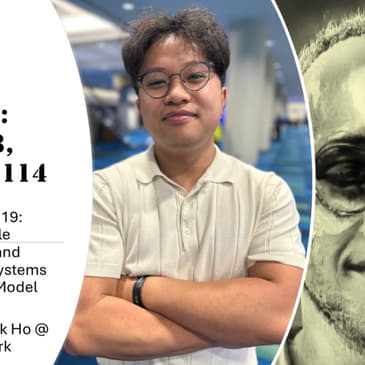

Erick Ho is CEO and co-founder of Function Network, a decentralized AI protocol launching on Base. Prior to this, Erick served as a Senior Software Engineer at Coinbase and advised seed to Series A startups as a Solutions Architect at Amazon Web Services. He focuses on scalable infrastructure and decentralized systems. He holds a Computer Science degree from Louisiana State University.
[00:00:03] Hello, everybody, and welcome to the Crypto Hipster Podcast. This is your host, Jamil Hasan, the Crypto Hipster, where I interview founders, entrepreneurs, executives, thought leaders, amazing people all over the world of crypto and blockchain. And today, I have another amazing guest. He is a co-founder. He's a co-founder of the Function Network. His name is Erick Ho. Erick, welcome to the show. Jamil. It's a pleasure being here. Thanks, Jamil, for having me. I'm excited to talk a little bit more about AI and Function as a whole.
[00:00:34] Awesome. Awesome. I look forward to it. So let's kick things off and ask you first, you know, what is your background and is a logical background for what you're doing now? Yeah, that's a really good question. My background is what I would say is not traditional, but not too unexpected as well. So thinking about kind of like my educational background, of course, did my bachelor's in computer science.
[00:00:59] And then I actually moved over to Amazon Web Services and worked with cloud products for about nearly two years. But you imagine that like that would be like a software engineering role, right? But actually, I chose to go into technical sales. And so this was pretty interesting because I actually was in the startup organization where I helped advise pre-seed all the way up to Series A startups on kind of like how to use area services.
[00:01:26] What do you do after you fundraise? How do you appropriately scale? And I got to spoke to some pretty cool startups all the way from like people sending things up into space all the way into crypto as well. Some of the clients that we had at the time was like on the crypto side, Infera, Alchemy and some other big name clients that you know today in the crypto scene. But yeah, it just be generally broad. It wasn't crypto specific.
[00:01:56] And then I actually moved over to Coinbase after some time on the technical sales side. Technical sales is interesting because you get to learn about the sales process as well, but you actually don't get to do a lot of hands-on building. And so whenever I moved over to Coinbase, I was a senior software engineer where I actually got to build a lot of great products, particularly on the Coinbase wallet side. So the non-custodial wallet. During my time there, we built out indexers.
[00:02:24] We built out a lot of products for millions of users. And I actually got to file a patent with Coinbase along with my co-founder as well. And so, you know, I got a good mix of both cloud infrastructure, even AI, and then as well actual software engineer. And so, yeah, I would say it's a pretty logical background in the sense that whenever you're building out a startup, you know, they say that you wear multiple hats, right?
[00:02:49] And so we're wearing multiple hats on both the sales side, business side, building out our sales pipeline. And then as well on the technical side where, you know, thick and high level vision, architecture, et cetera. And so, you know, got to learn a lot, a lot from the industry, but as well applying that to function as well.
[00:03:08] Awesome. So I want to find out, you know, what Function Network is all about and how you solve the growing disparity between participation and profitability in the AI ecosystem. Yeah, definitely. So maybe it's better off to lean into why we started Function Network, right? And what motivated me to actually found Function Network, of course, is an AI protocol.
[00:03:38] That's what Function effectively is. But, you know, taking a step back and kind of looking at the current market today, right? And you look at the different participants in any AI ecosystem, whether centralized or decentralized, you effectively have like four different actors, right? You have the users, you have the developers, then you have the actual compute providers that are hosting the models. And then what we have is what we call the model creators, right?
[00:04:05] They all need to have significant synergy with each other to really make this flywheel and ecosystem work, right? You need great models to attract developers. And that's what brings in the users. But as well, you need the compute and infrastructure providers to host these models. And, you know, whenever we dig deeper into it, right, we look at kind of like who's making all the money currently right now in the ecosystem, right?
[00:04:35] Especially whenever it comes to AI. It's, you know, the app builders, which are great, right? Because app builders who are creating, for example, effective AI agents, really great chat applications, and like just vertically integrating AI into their app, right? So, you know, you probably see every single business trying to integrate some level of AI into their app to enhance the user experience. And therefore, you know, their product becomes more valuable. Of course, they're making money, and they should be making money for that, right?
[00:05:05] And then as well, you have to compute infrastructure providers. They're responsible for hosting the model and ensuring that, you know, the AI is running constantly, right? And they're currently being paid for that as well. And so like the developers in chat, the application builders, they're currently paying infrastructure providers. But they're also making money. Infrastructure providers are making money. And where we see the disparity right now is that the model creators,
[00:05:30] the person who's actually making the open source models aren't making any funds right now, right? So you think about like the universities, the AI researchers, all these, like, or even indie developers, right? They're all creating these great models. They publish them on Hug & Face. There's approximately 1.8 million different models being published on Hug & Face today.
[00:05:53] And 0% of that revenue that is captured by either like app developers or infrastructure providers are being passed on to the model creators, right? And so that's where we actually see a huge disparity. You know, just naturally thinking about it some more, we think about like what is blockchain really great at and why we built function on top of existing blockchain infrastructure is that we see that blockchain is effectively great
[00:06:19] and have found product market fit in two categories, coordination and payments, right? And whenever we think about like how can we effectively sanitize and ensure that that growth and disparity is actually minimized, we think blockchain is a great way to coordinate this and ensure that model creators are actually paid. How are you going to pay them? How can the model creators get paid the way they should get paid? Exactly.
[00:06:50] That's an interesting question as well because like, right, existing like researchers right now, you kind of think about like who's creating the open source models, right? There's only like maybe four or five different entities in the world right now that are creating open source models that people actually use. And, you know, thinking about them, let me just say them out loud, right? There's Meta, Llama model. There's Mistro. There's DeepSeq.
[00:07:18] And there's distilled DeepSeq versions, right? And, you know, these companies, right, they're creating really great open source models. They perform great on the benchmarks. And quite honestly, they have a lot of revenue from other different products or segments that are already powering them, right? And like probably if I had to take an estimate here, 95% of open source models are currently being like the traffic for them is currently routed to them. And so there's actually not that many open source models that people are using.
[00:07:48] But you have to dig deeper into why, right? Is it because people are creating crappy models that no one wants to use? I don't think so. There's 1.8 million different models on Hug and Face right now. So there's a discoverability issue, right? And there's a lot of great researchers in the space that are currently publishing these models from educational background to research firms. And they're creating these really state-of-the-art models that aren't being discovered. And so discoverability is the issue, right?
[00:08:19] And kind of like the second part to it is, you know, why are they underpaid? You know, we dig into it further. And model researchers, model creators, they're really great at creating really good models, right? They spent their doctorates in, you know, AI research. They spent a lot of time on getting the right data sets.
[00:08:45] They spent a lot of time on getting the right kind of like staffing for this as well. And then, you know, they have to spend money on GPUs, right? To fine-tune the model. And that's a lot of expenses occurred. And then whenever they need to release it, they're either dependent on like external funding right now or like grants from like, the government or just kind of like any sort of educational grant that you would generally get, right?
[00:09:13] To help subsidize and create these state-of-the-art models. But that in itself is not sustainable either. Especially whenever there's that growing gap between compute providers and model creators. If compute providers aren't sharing the revenue downwards to the model creators, then you get misaligned incentives against compute providers and model creators, right? And so that's where we believe blockchain can really help solve, right?
[00:09:40] If you can create a system where it's completely permissionless, and any actor can come in, whether it's the developer, the app creator, the computer provider, or the model creator in itself, and you align incentives there, then you create this effective flywheel. We call it the function flywheel, where basically it creates this great flywheel where the best models are being created open source in a truly sustainable way.
[00:10:07] And that attracts the best developers as well to build on top of. And now you have constant demand, and you also have constant innovation as well to really bring these models to life. And so, you know, model creators right now, quite honestly, they're chasing benchmarks. They're trying to improve it. Perhaps they're being subsidized, but that in itself is not long-term sustainable. Eventually, funding runs out. You start to think about,
[00:10:35] how can I actually make money, right? Or how can I actually truly fund my research? And that inherently proposes a lot of questions. Do I take my model closed source, right? Do I just try to reinvent the wheel as well, and then go out to be also an infrastructure provider? We see some players doing that. Or, you know, perhaps what I do is that I take my model, and I enterprise license it out to these infrastructure providers, right?
[00:11:04] And I've been through the sales process in the B2B world over at Amazon Web Services. If you're a model creator that's trying to license out to compute infrastructure provider, that pipeline is not scalable at all, right? Because you have to focus on one-to-one deals, thinking about kind of like deal structure, sign-offs. There's a lot of corporate red tape to it. And that process can take six months. And that's also where kind of like we see blockchain really sell at.
[00:11:34] Kind of like similar to DeFi, right? You don't have to sign any contracts. You don't have to, you know, provide any upfront information. It's just a simple transaction on the blockchain to really get access to a loan or to swap. In a similar fashion here, model creators can think of it as a similar analogy within DeFi, where like you just put your model on chain, and then you're effectively paid for it. And because the smart contracts or the programmable blockchain
[00:12:03] will basically allow you to settle your royalties over to you seamlessly without any paperwork or any contracts, right? Because it's all done. And so, you know, that's what Function is all about, right? We're allowing for significant coordination at scale and significant payments at scale as well, ensuring that the model creators are truly paid. Got it.
[00:12:29] So I'm doing a quick – I didn't realize Hugging Face had all these models. So I just did – I went to Hugging Face just now really quickly, and I clicked on one of the – like it's not easy to navigate if you're not tech savvy, right? So I clicked on this one thing called Lodestones Chroma, okay? No relation. I just clicked on one of them. And I'm looking at it.
[00:12:55] It's an 8.9B parameter model on a Flux Schnell. It has a 5M data set. Like that's great. It tells you what it is. What do you fix it? Like why? Why am I going to pick this one? And they're all like this. It's the what? It's the technical stuff. I don't understand it. There's a lot of models. No, there's a lot of models, right? Like I mentioned, there's over 1.8 million different models on top of Hugging Face, right?
[00:13:25] And what's crazy about all those models that you currently see on Hugging Face, they're free. Effectively, they're free to use, assuming that you have the GPUs for it, right? Or you pay an infrastructure provider to do it on behalf of you. And so there's a large set of different models to be used. And generally speaking, there's like developers use benchmarks to see how well a model performs, right?
[00:13:52] Just think of it as a test to basically evaluate the intelligence of the model, right? But that in itself has proven that one, benchmarks can be biased, right? And as well, you know, just because a model performs really great on benchmarks, benchmarks are also constantly evaluate, evolve it in itself as well. And so you can't trust purely just benchmarks.
[00:14:21] And so you effectively have just too many choices to use. And for a model creator that actually proposes two issues, right? Which I mentioned is kind of a discoverability issue, right? And then the second part is kind of like, well, how do you actually even get this to even the infrastructure providers or even the developers themselves that are building on top of these models? And Function does solve for this, right? Because Function is effectively a permissionless market where you could bring your model on the market, right?
[00:14:50] And through on-chain, basically traffic, you could see where the most popular models are being used because the developers will come on to Function as well, use the models, and that will show on-chain. And so that helps you kind of filter out exactly, you know, what are popular models? What are people using in the industry to help you gauge as well, you know, which model you should use, right?
[00:15:17] But no, discoverability in itself is still a pretty large issue in itself, right? And, you know, even myself as a developer, you know, sometimes I have to sit back and like, which model do I actually use as well, right? And it's a lot of trial and error. And it just proves to show that this is extremely early. People are still trying to figure out which model is best for them. Applications behind the scenes are also constantly swapping models because if there's a new model
[00:15:44] that comes out, they might change over to it just to see if it helps improve the intelligence. They may also just try to experiment around with A-B testing, you know, try one, okay, and engage it with the other model and see how the response is. And it's a lot of trial and error, right? And so it is extremely early space, but we believe that like, you know, on-chain is all about transparency and instant. And so, you know, function effectively solves for that by allowing people to see where the
[00:16:14] popular models are as well. You said the key word there. You said that I scrolled down that list and you said discoverability. Which one does what? You know, and why should I use that? You know, which one? So you're saying crypto incentives improve discoverability? Crypto incentives can improve discoverability. And I'll tell you why, right? It's that like, you know, let's just say that you start off with this marketplace, right?
[00:16:42] And you look at where traffic is flowing, right? And what you can do as a model creator, this is theoretically, let's talk about the funk token as well, right? We see the funk token as a way to streamline payments, but as well to act as incentives, similarly to how you see it in DeFi as well. And so model creators can effectively put up what we call a bribe, right?
[00:17:07] A bribe is a way for to basically put up some level of upfront payment so that way infrastructure providers can actually host it, right? Because otherwise you have like a chicken and egg problem, right? You create this really great model, but no one wants to host it. And if no one hosts it, no one can use it, right? And so in a similar fashion, you know, you go on Hug and Face, I don't know if you can see it on the right site, but usually within Hug and Face, there's a selection for inference
[00:17:36] providers, which are infrastructure providers, right? And so that particular model that you mentioned, there's a good chance that there isn't anyone hosting the model right now. Because, you know, hosting a model means that I have to take the model that you created and put it on top of my GPUs. And if no one's using the model, then there's no reason for me as an infrastructure provider to host the model, right? But crypto incentives solves that problem as well. Because now model creators can incentivize infrastructure providers to host their model, right?
[00:18:05] And then kind of like moving further down the line here, now that you have infrastructure providers hosting your model due to incentives, now you can also bootstrap the demand. Because now you have actual infrastructure providers hosting the model, which now means that the application developers can now use the model, right? And so there's a big gap there that's waiting to be solved. There's probably a lot of great models out there that aren't being used just for a simple
[00:18:33] fact that it's not accessible for it to be used, right? Even though it's on Hug and Face, it doesn't mean it's accessible to use because no one's hosting them on the infrastructure side. And so crypto incentives definitely help there. There's also data sets on Hug and Face too, right? So how do you know what data sets the best one to? Is it the same issue?
[00:18:59] So the data sets in itself is not necessarily a sector that we're looking to solve right now. There are other data marketplaces that kind of exist out there that's looking to decentralize data sets as a whole. I'll give you some examples. I believe Vana is one of those ecosystems that are looking to basically decentralize data sets.
[00:19:25] But we particularly focus on the whole synergy between developers, field providers, and the model creators themselves. Got it. Got it. So, okay. So I see what you're up to here. It makes sense to me. So I want to find out in your view, in your vision, what a sustainable, decentralized AI infrastructure should look like. Yeah.
[00:19:55] You know, I think it's the same about ecosystem, especially whenever you think about it in decentralized fashion, right? Is maybe two different prongs we could look at it. In terms of like the developer experience, you shouldn't see any overhead or significant cons to decentralized infrastructure. What I mean by that is that basically when it comes to decentralized infrastructure, one
[00:20:24] of the reasons why we are so proud of it, especially as we are in blockchain, is that it can't go down, right? If open AI goes down, any decentralized providers go down, then that's an issue because now your entire application stops working, right? On the AI side. And so, you know, developers should see decentralization as a positive thing, right?
[00:20:48] Because now they get the economies of scale through a decentralized distributed network of nodes hosting the models. And so they don't have single point of failure anymore, right? But as well, the capital providers need to be paid for this, right? Because they're spending a lot of money on their GPUs to host the models. And then as well, you have, and more importantly, is the model creators. That's the big gap that's also being tied into this, is that without models being created, there's nothing to host.
[00:21:17] And therefore, there's no developers to use it. And so, you know, we need to pay the model creators as well. All that revenue cannot just go down to the infrastructure providers. Some of that revenue needs to flow down to the model creators, right? And so, you know, a sustainable ecosystem is that all actors are being sanitized in some form or fashion to participate in the ecosystem, right? Developers are incentivized through having access to the best models they are currently are.
[00:21:46] Compute providers and model creators are incentivized through the funktoken, right? And, you know, the best kind of like analogy I can see to this is kind of like in the NFT space. You're familiar with the NFT space, right? Yeah. So, you know, there had to be someone who created the art for the NFTs, right? And generally speaking, there's something in NFTs like the royalty fee, right? So every time an NFT is bought or sold, some of that goes down to kind of like the artists
[00:22:16] or creators, right? AI researchers are also creators. They create the model, they architected the model, they pushed the, you know, the boundaries of AI research and therefore, you know, they should be paid for people using the model as well in a similar fashion that you will see within NFTs. In the same, similar fashion as a podcaster. Yes. Yes. Podcasters are also creators.
[00:22:43] So, you know, don't hold it, don't hold it to me, but, you know, if function picks off, I guess you deserve a little piece of Funk token as well. You'll get an airdrop. Don't hold it to me. Yeah. That's good to me. Yeah. So I guess the real money right now would be like the developers recognizing what models are the best models because no one's saying what the best models are. It's up to people to really dig in and find out what the gems are, right?
[00:23:13] It's extremely opinionated right now. I would say it's extremely opinionated. You ask like your, you ask the top list of like a hundred researchers or even your friends that are like in the AI space, like, hey, what model should I use right now? And I guarantee you will get varying responses. Of course, there's going to be like top percentiles within like those five different large open source providers, but there's a good chance you're going to get a varying set of responses for sure.
[00:23:44] So do you have any tips on how to find the best models? I mean, right now, Function actually has a developer platform for any developer to hop onto and they can actually get access to the top open source models that we are currently hosting for them. Of course, you know, as we kind of move towards testnet and mainnet, we're going to point that towards our network. Well, we actually host the top of the line state of the art models, you know, that, you
[00:24:10] know, we host Meta, Llama models, Mistro, Deep Seek, Gwen models, all these fantastic models that you can use today. And it's actually all currently free. And we're going to potentially expand to that, right? We actually just introduced Billen into our platform as well, right? And what we're actually going to do is that for every time a developer uses the platform, right? Of course, you have to pay for it. But what we're going to do with that revenue is we're going to shift it down to the model creators.
[00:24:41] And so, you know, as you're effectively like, you know, you want to make sure that the developers, you know, this is kind of a call to action to the developers, right? Is that these open source models that you're currently using to help empower and improve your user experience over in your applications. You know, we have to think long term. We have to think about like, who's creating those models? And, you know, use the models that, you know, well, more importantly, use the models that, you know, aligns best with your application. But let's also make sure that they're being paid.
[00:25:08] So that way they continuously keep making those great models for you, right? So that way you can use them. And so that's what we're doing with kind of like our developer platform right now. We're going to take all that revenue that we create and push it down to the model creators. And in theory, that should also get them to publish more models on our platform as well. So it looks like over the years, AI, you know, has been more of a hype economy.
[00:25:37] Now, I don't think it's hype anymore. I think it's a broken economy, right? So say we fix it, you know, what will AI's future look like if we do fix it instead of like not solving it? Like, and if we don't solve it, then what happens? So really interesting that you mentioned that it's broken, right? It's a scary thought, to be honest with you, honestly, right?
[00:26:07] And I'm sure you're going to hear time and time again, as we see these more centralized actors get more and more market share as well. And decentralized AI is still picking up. You know, there's the AI summer that's going to be picking up in probably like July to August. But, you know, we're still quite very early to decentralized AI. And, you know, right now, I mentioned it already, right? There's only five different actors that are creating these really great open source models that people are using.
[00:26:38] They are not doing it just for fun, right? They are not doing it just to give people access to open source model. It's a way for them to get control and establish themselves as kind of like the market leaders in this. But I'll give this kind of like just a picture to the current watchers today is that what if one day Meta decides, hey, I don't want to do open source models anymore, right? So I'm not going to release any open source models, right?
[00:27:07] Well, what happens then? That's an extreme issue, right? What if they go towards kind of like a closed wall garden approach? And that's the inherent danger whenever you rely on centralized actors as a whole. If their shareholders or, you know, their internal investors, like, you know, this is the bad move here. There's a lot of significant pressure for them to kind of like think more about monetization.
[00:27:36] And, you know, be more wary of their competitors and they go closed source. Then now you're left with like zero open source models. And so now you have actually access to, you know, zero AI intelligence. And that's the inherent scary risk is that truly speaking today, you know, we're too reliant on centralized actors that can change on a web on their approach.
[00:28:01] And that leads thousands, if not millions of developers or applications, you know, left hanging, right? And so open source models is very much a need, right? We want to see open source models continue to innovate. We definitely want to see that, especially over a function. You know, we believe that like AI should be accessible for everyone.
[00:28:27] And so, you know, how do we make the open source ecosystem actually sustainable, right? We know the risk if we continue to keep on relying on these open source actors. But we also know where the gap is when we think about like sustainable open source models as well. And so that's what we're solving over at Function, what we're coordinating with our Func token as well to solve. Basically, the sustainable models are the open source models.
[00:28:58] The state of the art models, there's multiple state of the art models, right? Because I say it's kind of like opinionated. You ask like 100 different friends, like, well, this is technically state of art. Well, no, I disagree. This is actually state of art, right? And so, but whenever you sum it down, yeah, there's only like five different actors that have the quote unquote state of the art models. And you think about like the closed source providers, right? The ones that don't even do open source. There's only like three different players in the game as well.
[00:29:26] So you have OpenAI with their GPT models, right? Closed source. You have a Mistro, no, no, Mistro is open source. Sorry. You have Anthropic, which has their cloud models. And, you know, those are the two popular closed source models that I know that people use today. It's extremely expensive.
[00:29:48] And you're at the, you're extremely at the whim of them just being able to change directions on kind of like where they want to go with their market, right? And so, you know, there's not that many players in space. And I refuse to believe that's the end state, right? I believe the end state is actually, you have this truly open economy with way more hundreds of different actors creating models.
[00:30:13] And, you know, millions of developers using a variety of set of models, right? You know, there's so many different reasons to think about it. But, you know, if there's only seven different model creators out there that people are truly using, it's like, what if there's biases, right? You know, inside these models as well.
[00:30:38] You know, there could be, it was a huge topic whenever you were thinking about, whenever DeepSeek got released, right? It was like, oh, it's DeepSeek more like less trained on Western data, for example, right? And open AI and these other open source models within kind of like the Western world. They're trained on more Western propaganda. And so, you know, the point being is not to go into politics. The point being is more that there's definitely a lot more ways to build intelligence as a whole.
[00:31:08] And just obviously intelligence is going to be opinionated to a certain extent, depending on where you are geographically. And so developers should have the opportunities to choose which one they should be able to use. And it shouldn't be relying on only like seven different actors as a whole, right? Let's expand that to just like there's many countries in the world. There should be just as much models in the world that people are truly using. And the model creators are getting paid. Yeah, exactly.
[00:31:36] And the podcasters are also being paid. I know it's unrelated, but the podcasters have to be paid too. I agree. I'm not going to disagree. I agree with that. So I want to thank you very much for your time today. I enjoyed speaking with you. This was fun and insightful. So I have one last question. So how can people find out more information about you, about Function? How can they do that? Definitely. So you can go into function.network right now and get a good overview of our developer platform.
[00:32:06] We also have our X handle, which is func underscore network. And yeah, you know, you can probably find the founders through LinkedIn by searching of function.network as well. And I'm happy to chat with anyone who's interested in truly sustainable open source AI. And yeah, thanks for having me, Janelle. Thank you very much for your time today. Yeah.