
Technology changes.
People remain remarkably the same.
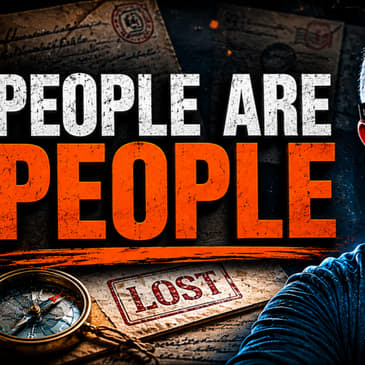
In this solo episode, Jamil Hasan explores the question behind his upcoming book People Are People: What happens to us when the systems around us change?
Drawing from hundreds of founder interviews, years in crypto, recovery, authorship, health challenges, and family experiences, Jamil examines the human side of technological and societal transformation.
This is a conversation about identity, adaptation, continuity, resilience, and the challenge of remaining human in a world that never stops changing.
Because beneath every innovation, disruption, and headline is a person trying to figure out what comes next.
People Are People. A reflection on technology, humanity, and the stories that survive after the noise fades.
[00:00:04] Welcome back to the Crypto Hipster Podcast. I'm Jamil Hasan, the Crypto Hipster, and today is a little different. Usually I'm sitting across from a founder, an entrepreneur, a creator, or a builder trying to understand not what they built, but what building it did to them. But today I want to talk about a book.
[00:00:33] Not because I want to sell you a book. If you've listened to my show for any amount of time, five years plus, you know that's not how I operate. I want to talk about the question that led me to write it.
[00:00:53] So because after closing in on 600 interviews, and more than 800 podcast episodes, including solos and news shows, hundreds of books, 404 and counting, almost a decade inside crypto and the broader digital economy.
[00:01:15] I noticed something that technology kept changing. The people didn't, or at least not in the way that everyone expected. So my new book is called People Are People.
[00:01:41] And the question behind it is simple. What happens to people? What happens to people? What happens to us when systems around us change? We live in a world that's obsessed with systems, right? Political systems, financial systems, not necessarily crypto, not necessarily blockchain, in general.
[00:02:10] Corporate systems, right? Corporate systems, educational systems, technology systems, and blockchain systems, AI systems, social media. Every year, every year someone shows up and tells a new system is going to change everything, right? Sometimes they're right. Sometimes, occasionally, right?
[00:02:40] The internet changed everything. Smartphones, social media, they both changed everything and AI is changing everything. And crypto changed quite a bit, too. Now, here's the thing I've noticed.
[00:03:04] When the dust settles, the most interesting story is not the technology. It's the people trying to figure out how to live inside of it. So, I entered crypto in 2017. Like many people, I arrived because of technology.
[00:03:33] I saw Bitcoin as a database and I built databases for 20 years. So it seemed that way to me, right? I stayed because of something different. I stayed because of humanity. The technology got me through the front door, but the people kept me in the room.
[00:03:58] Now, over the years, I've interviewed founders, developers, artists, investors, inventors, musicians, entrepreneurs. I can actually make a whole entire poem out of how many people I've interviewed, right? So, some succeeded and some disappeared.
[00:04:25] Some became extraordinarily wealthy. Some lost everything. Some changed industries. And some changed themselves. Some are seen as an icon and some are in prison. Right? Underneath all those stories, I kept hearing the same themes.
[00:04:55] These take away the platform and the product and the pitch. I heard the same human themes over and over again.
[00:05:10] And those were fear, hope, identity, belonging, recovery, purpose, loss, meaning. Those are the major ones. None of those are crypto topics.
[00:05:39] They're all people topics. So, when markets are going up, everyone talks about price. They've been going down since October. Everyone's talking about price anyway. Right? But when markets are going down, everyone also talks about survival. But neither conversation is really about money.
[00:06:05] They don't talk about dollars in the same way. Not even gold. They're all about human behavior. They're about uncertainty. And they're about how we respond when the map no longer matches the territory. The territory's changed. What does the map look like now? Right?
[00:06:34] And so, I started moving further away, further and further away. I never started in the beginning talking about price. But they don't interest me. Price discussions don't interest me. I am far more interested in the founder's journey. Because founders are usually the very first people forced to confront uncertainty.
[00:07:02] It's not those who were shielded by corporate systems. It's the people who were on the front line. Those are the founders. They don't get the luxury of pretending everything is stable. They're building in motion. They're testing in production. They're not testing in a sandbox or QA environment.
[00:07:28] The ground is moving beneath them and it's moving continuously. And yet, they, and I'm a founder too, so we, continue. Not because we know the outcome. We don't. But because the work itself matters. The work itself is very critical.
[00:07:58] Changing an entire way the world works is not an easy task. I think about my life and not the podcast and not the books, not crypto, just life. Life. My father was a, he enjoyed the, he enjoyed the horses. He enjoyed going to the racetrack.
[00:08:26] My mother continued to spend her life trying to create continuity inside of a lot of uncertainty. We did not inherit wealth. We inherited something else. An ability. An ability to adapt. An ability to persist.
[00:08:53] An ability to keep moving when the circumstances change. And over time, I started wondering whether that's the real inheritance that most people receive. Not the money. Not the money, but how to be comfortable or at least be adaptable in contradictions.
[00:09:20] Not money. Not property, not status, none of that stuff. Like patterns, habits, stories, stories, and ways to navigate the world. Now, a few years ago, I was dealing with a desmoid tumor that was whipping my butt. Now, I'm getting better, slowly.
[00:09:49] Before that, I survived two heart attacks. Before that, I had depression and alcohol. The recovery, right? Career disruption. I was thrown. I was laid off at AIG. I had losses.
[00:10:09] And most recently, you know, all the uncertainty that comes with long-term medical treatment. So, none of those, none of those experiences, none of them cared what the price of Bitcoin was. None of them cared about market cycles.
[00:10:35] But all of them taught me something about being human. They taught me eventually, every system becomes personal. Personal. Healthcare becomes personal. Healthcare becomes personal. Work becomes personal. Technology, the application of it becomes personal.
[00:11:06] Family, too, right? Because every abstract system collides with a real person trying to live real life inside that system. One of the questions that I explore throughout People Are People is this.
[00:11:29] How do we remain human inside increasingly technological environments? That's becoming a bigger question every day.
[00:11:42] We're entering an era where AI can draw, it can write, it can compose music, it can summarize conversations, create videos, you know, it can automate massive portions of work. And every advancement triggers a reaction.
[00:12:08] Excitement, fear, hope, anxiety, opportunity. Technology changes and it changes constantly. The emotional responses remain consistent. Because the story is not about the machine. The story is about us.
[00:12:39] I don't think that people are afraid of technology. I think they're afraid of displacement. Of becoming irrelevant. Of losing their identities. People are afraid that the thing that they spent years becoming might matter less.
[00:13:08] That's not a technology problem. That's a human problem. And human problems don't disappear when software improves. In many cases they become more visible. They become more pronounced. They become, they slap you in the face and say, hey, I'm here.
[00:13:33] Something else happened while I was writing this book and I stopped paying attention to categories. Crypto, recovery, family, illness, work, creativity. You know, at first, you know, identity, identity. Talking about identity a lot. At first, they, you know, they, they, they look like separate subjects.
[00:14:03] Eventually, they all, to me, look like the same subject. Someone trying to figure out who they are. While the world keeps changing all around them. That's it. That's the book. That's the, that's the podcast. That's most of my writing.
[00:14:32] If the technology were not crypto or blockchain, would the stories matter? Yes. Would the stories be the same? Yeah. The founder's journey stays the same. We could be talking about widgets or blocks. Not blocks. It doesn't matter. Elephants. I often joke that I don't really write about crypto. Right? I write about people who happen to be standing near crypto.
[00:15:01] The same way I don't write about recovery. I write about people trying to rebuild their lives. I don't write about technology. I write about adaptation. I don't write about markets. I write about uncertainty. I write about. I write about. You can apply that to anything. Right? Because the moment you strip away the labels.
[00:15:29] You discover that most of us are wrestling with remarkably similar questions. These questions. Who am I? What matters most? What am I building? What am I leaving behind? The world. My family. Myself. Others. I love. What happens when the thing I've built changes? The older I get. The older I get.
[00:15:59] The less interested I am in becoming an expert. Because not that expertise isn't valuable. It is. But expertise doesn't tell me who someone is. You know what tells me who someone is? Pain. Failure. Responsibility. Integrity. Integrity.
[00:16:29] Scar tissue. When I interview founders now. I'm not listening for the product. I'm not listening for the platform. I'm not listening for the PR pitch. I don't care about that. I'm listening for the wound. Because somewhere. Inside the wound. Is usually the reason. They started building. What they're building.
[00:16:59] In the first place. And that's another lesson from this book. The thing we build. Often reveals the things we're trying to solve. Sometimes for society. Sometimes for ourselves. Sometimes both. Right? The entrepreneur. Building trust infrastructure.
[00:17:29] May be wrestling. With this ability. To trust at all. The recovery advocate. May be wrestling. With staying sober. Having recovery. The author may be wrestling with meaning. The builder. May be trying to build something. Internally. While building something externally. Internally.
[00:18:00] And that makes their story infinitely. More interesting. Than a product roadmap. Or. A partnership announcement. Who cares. About that. When you can find out. Who. The people are. So. As I finished writing people are people. I kept returning to three questions. The same three questions that guided the entire project.
[00:18:30] What happens to people. When the systems around them change. How. Do we remain human. Inside increasingly. Technological. Environments. And what do relationships. Illness. Recovery. Family. Work. Identity. And creativity. Reveal about. Us. Ourselves.
[00:18:58] Those questions are not crypto questions. They're life questions. And they're becoming more and more important, at least to me, every year. The future is going to arrive whether ready or not.
[00:19:26] AI will continue. Crypto will continue. Automation will continue. And new systems will emerge. We already see some of it happening. Old systems will disappear. The headlines will change and the platforms will change and the technologies will change and the pitch.
[00:19:51] The pitch will change and the partnerships will change. But I suspect the central challenge will remain exactly the same. Learning how to be human in a world that never, ever stops changing. And maybe, maybe, maybe that's why I call the book People Are People.
[00:20:23] Not because it's complicated. It's not complicated. It's remarkably simple. Before we become founders, before we become creators, before we become builders, employees, before we become experts, before we become anything at all.
[00:20:46] We are people. We are people. Trying, failing, learning, recovering. Some are succeeding. Adapting. Growing. Continuing on. People are people. And perhaps that's the one system that never changes.
[00:21:21] Thanks for listening. I'm Jamil Hasan. This is the Crypto Hipster Podcast. And until next time, keep building. But don't forget to pay attention to the people who are doing the building. Because in the end, that's where the story always was.