
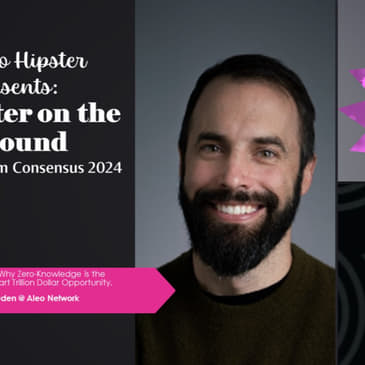

Alex Pruden is the Executive Director at the Aleo Network Foundation. Prior to Aleo, he was an investing partner on the Andreessen Horowitz team where he specialized in cryptocurrencies and blockchain. He also served 9 years in the U.S. Army as an Infantry and Special Forces officer.
[00:00:01] Hello everybody and welcome to the Crypto Hipster podcast.
[00:00:05] This is your host, Jamil Hasan, the Crypto Hipster, where I interview founders,
[00:00:09] entrepreneurs, executives, thought leaders, amazing people in crypto and blockchain.
[00:00:13] And today coming live from Consensus 2024 on the ground.
[00:00:18] And I have Alex Pruden with me who is with the executive director of the Alio Network Foundation.
[00:00:26] Alex, welcome.
[00:00:28] Thank you very much. It's a pleasure to be here.
[00:00:29] You're welcome. You're welcome.
[00:00:31] So let me ask you first, you know, what's your background and is it a logical background for what you're doing now?
[00:00:36] Oh, is it a logical background? I guess that's a subjective question.
[00:00:39] I mean, most people would say probably not.
[00:00:41] But I think, you know, most people in crypto have unconventional backgrounds.
[00:00:46] And I'm probably no different. I started my career in the U.S. Army.
[00:00:49] I was in the army for 10 years, just about, and got interested in crypto at the tail end of that time
[00:00:55] and ended up getting an opportunity to attend Stanford on the GI bill when I got out
[00:01:01] and then ended up working at Coinbase when it was still before it was public as an intern
[00:01:07] and was going to go back there full time and then ended up getting a job at A16Z Crypto.
[00:01:11] So I was in the first crypto fund at A16Z where I worked with Kaye Hawn and Chris Dixon
[00:01:16] and, you know, all the folks there in the early days, just a lot of fun.
[00:01:20] But I really kind of had the startup itch.
[00:01:23] So I decided to leave that after about a year and a half or so and join Alio.
[00:01:27] So I've been here for about four years.
[00:01:29] Actually, Alio was a single company at first, and then it split into a company and foundation,
[00:01:34] which I now run the foundation, but we can talk about all that.
[00:01:36] So from Army to crypto.
[00:01:38] So I don't know. Maybe, maybe not.
[00:01:41] What is your greatest lessons from Army to crypto?
[00:01:45] The biggest lesson I have and this I think I tell this to everybody I meet is like,
[00:01:50] don't underestimate what you can learn over the course of years
[00:01:53] and don't sell yourself short and what you can achieve.
[00:01:55] I mean, when I joined, you know, when I left the Army, I wanted to get into crypto.
[00:01:59] I never took a computer science class, knew nothing technical at all.
[00:02:03] Now I run the foundation for, I mean, arguably one of the more technical projects.
[00:02:06] Alio is a zero knowledge VM, right?
[00:02:10] So building a new layer one with a new VM powered by ZK.
[00:02:13] And, you know, all along the way, I've had to learn how all this stuff works on my own.
[00:02:17] And it's not certainly not easy.
[00:02:19] But again, it's like, you know, it's that saying you underestimate what you can do in two years,
[00:02:23] but overestimate what you can do in two years, but underestimate what you can do in 10.
[00:02:26] Same idea. So I would encourage everybody to invest in their own learning and see where you get.
[00:02:31] That sounds good. That's good advice.
[00:02:33] You know, let's get into Alio, right?
[00:02:35] What's your foundation all about?
[00:02:39] Yeah, so Alio is building a new layer one blockchain that for the first time provides
[00:02:43] the combination of programmability, privacy and permissionlessness.
[00:02:47] So I like to think of it in the context of prior, you know, prior art effectively.
[00:02:52] You have Bitcoin, which founded the space effectively.
[00:02:55] Although Bitcoin, interestingly, as I'm sure you know, is like the 40th attempt at a digital currency.
[00:03:01] But Bitcoin basically created the blockchain space and really pioneered this idea of permissionlessness.
[00:03:05] Any person can interact with a network without going through an intermediary.
[00:03:09] And that was all done through crypto economic security,
[00:03:11] which was, I think, the primary innovation of Bitcoin.
[00:03:13] And Ethereum extended Bitcoin by enabling smart contracts,
[00:03:17] which is powering many of the companies we see around this room here and at a consensus.
[00:03:22] You know, it's just lets you perform arbitrary logic permissionlessly on this blockchain.
[00:03:26] But the missing one missing piece of that is all that logic has to be public.
[00:03:29] All the state has to be public. So you and I have USDC.
[00:03:33] I know you're you. If I know your, you know, your address,
[00:03:35] I can see you're the amount and all your transaction history forever.
[00:03:38] Right. So I think for a lot of use cases, privacy is really helpful for crypto.
[00:03:42] And there were there was a project that extended Bitcoin in the direction of privacy,
[00:03:46] and that was Zcash, particularly was using ZK proofs to add privacy to Bitcoin.
[00:03:52] And what Alio tries to do is combine the innovations of both Zcash and Ethereum into one.
[00:03:58] So we have a privacy preserving programmable permissionless blockchain.
[00:04:05] Interesting. Combining. I haven't heard anybody do that yet.
[00:04:09] Combine Zcash and Ethereum.
[00:04:11] Yep. That's it. That's the short short version.
[00:04:13] Zcash and Ethereum had a baby. It's Alio.
[00:04:16] Great. So there's a lot of things we can talk about there.
[00:04:21] I want to find out first, you have the A16Z background.
[00:04:25] So you have a pretty good pulse on the current, you know,
[00:04:29] fundraising environment in crypto, right?
[00:04:32] What is what is the current environment like?
[00:04:35] So Alio, I mean, I guess I can speak from direct and indirect experience.
[00:04:39] I mean, my time at A16Z was a few years ago.
[00:04:42] And so I don't know if it's that experience is relevant to the current fundraising environment.
[00:04:45] But Alio raised three rounds last time.
[00:04:48] Alio raised was before we had a foundation.
[00:04:50] It was all one company. And that was a couple of years ago.
[00:04:52] Raised to series B in late 2021.
[00:04:55] And I think, you know, seeing some projects that we advise or that are built in
[00:04:59] built in Alio ecosystem or that I maybe see is like,
[00:05:02] you know, through the process of being an advisor to other things.
[00:05:06] It feels like the fundraising environment right now is warming up again.
[00:05:11] I think it was kind of it was chilled for the last year or so.
[00:05:15] And now I think it's starting to warm up again.
[00:05:18] Yeah, it still feels quite early.
[00:05:21] If this is a kind of a bullish cycle, then I think it feels quite early in that cycle.
[00:05:25] But it's too early to tell if it really is or not.
[00:05:27] I think that's kind of how I feel about it.
[00:05:30] And are meme coins part of the fundraising or is that just pure speculation?
[00:05:34] Oh, yeah. I mean, like in terms of sectors that are getting fundraising,
[00:05:37] I mean, I don't follow meme coins super closely, although they're very fun.
[00:05:42] I feel like, you know, I think you have to differentiate
[00:05:46] fundraising between stages.
[00:05:49] I mean, I think a lot of meme coins are able to raise
[00:05:52] money at early stages to launch a meme coin.
[00:05:54] But then I think, you know, you get firms like A16Z, for example.
[00:05:57] You know, they fund like, for example, Solana, like was a company,
[00:06:02] they funded or a project they funded when it was valued at 2.5 billion.
[00:06:06] Right. And that's just, you know, it's hard for me to imagine
[00:06:08] A16Z funding a meme coin to that level.
[00:06:11] Right. Meme coins just don't really rise to that kind of level.
[00:06:13] I mean, I think what firms like A16Z are interested in
[00:06:15] are building the foundational infrastructure and products that enable this to be useful.
[00:06:19] So I don't think I've seen a lot of investment in those areas yet in this cycle.
[00:06:26] Got it.
[00:06:27] So what is the need for Zcash, Ethereum, what's the need for privacy solutions?
[00:06:36] Yeah. I mean, I think that everything.
[00:06:38] I don't think crypto has very many real world use cases today without it.
[00:06:44] I mean, my favorite question to ask at conferences like this one
[00:06:47] are how many people receive their salary in USDC or at Sablecoin.
[00:06:51] And the answer is virtually no one.
[00:06:53] I've met maybe two, one or two people.
[00:06:55] And the reason is people don't like to reveal how much they make.
[00:06:59] It's just a social thing.
[00:07:01] And, you know, that's why bank accounts aren't public information.
[00:07:05] But it's, you know, that's just kind of a social fact.
[00:07:08] So I think even though we all of us here talk about how crypto is the future of finance,
[00:07:12] no one uses it.
[00:07:13] And I think what that reflects is the reality that a lot of the potential is there,
[00:07:20] but most of the value today is speculative in nature.
[00:07:24] And I think if we want to transition beyond that and actually accomplish real world use cases,
[00:07:28] we need to make it useful and we need to solve problems like that one.
[00:07:31] Like why won't people take their salaries?
[00:07:33] Well, because they don't want to reveal their salaries.
[00:07:34] OK, so privacy is a use case there.
[00:07:36] And I think for many payments related use cases, particularly commercially,
[00:07:40] like you imagine running a business that has payrolls,
[00:07:42] maybe have multiple employees that one is making more than the other.
[00:07:44] You don't want to feel the disparity there or you don't want to reveal the contracts
[00:07:48] you have with suppliers.
[00:07:49] So for all those reasons, I think privacy is important just for commercial interaction.
[00:07:52] I mean, if you think about the TradFi, quote unquote, world,
[00:07:55] I mean, privacy by default is the default.
[00:07:58] I mean, your bank certainly knows, but not everyone knows.
[00:08:02] Right. And I think CK is potentially a scenario where you can have a,
[00:08:06] you know, a take advantage of a blockchain based infrastructure
[00:08:10] and all of its advantages while still protecting the confidentiality of your data
[00:08:15] and therefore being able to have better, stronger, trusted interactions.
[00:08:19] And I think this even goes beyond finance.
[00:08:21] You think about just the web.
[00:08:23] You know, one unsolved problem on the web since the beginning was age verification.
[00:08:28] You go to a website like, you know, in California,
[00:08:30] technically it's illegal to visit a social media website if you're over
[00:08:33] or if you're under 13 without parental consent.
[00:08:35] And how do you enforce that?
[00:08:36] You can't possibly enforce that. Right.
[00:08:38] Like every one of these things like a box is like, hey, are you over 13?
[00:08:41] Yes. And there's not a mechanism to do that.
[00:08:43] But with something like a blockchain and CK, you can build an authentication protocol
[00:08:47] taking a real world identity, say a school ID with like a, you know,
[00:08:51] with an NFC chip and you can port that onto a blockchain like Alio's
[00:08:55] and you can generate a zero knowledge proof about the validity of that document
[00:08:57] and about facts about you that are reflected in it.
[00:09:00] And so I think those are just two real world use cases
[00:09:03] that are totally unserved today by, you know, to be clear, I love crypto.
[00:09:08] I think this the industry is amazing.
[00:09:09] It's come an incredibly long way.
[00:09:10] But I still think we're very far from achieving real world adoption
[00:09:15] for real world use cases. And that is really what Alio is all about.
[00:09:17] That is what I'm focused on. That's why we're building the stack we're building.
[00:09:20] And that's why I think privacy and CK and data confidentiality all matter.
[00:09:25] I remember I know a guy who created a company that that helped companies
[00:09:31] do payroll in crypto. They're not around anymore.
[00:09:34] They fit. They went under when we had recent collapse. Right.
[00:09:38] Hasn't been sustainable yet.
[00:09:40] So to get to these use cases, we have to have we have to embed
[00:09:44] sustainability right in the in the infrastructure. Right.
[00:09:48] How do we do that?
[00:09:49] Yeah, well, I think sustainability in that sense, just it has to be
[00:09:52] a it has to be a business people want to invest in.
[00:09:55] And I think, you know, most people don't want to they would rather not
[00:09:59] take their salary in crypto, like for a variety of reasons,
[00:10:02] which means that for financial use cases, like personal financial use cases,
[00:10:08] most people don't find crypto a compelling product.
[00:10:12] Most people in this room don't find crypto to be a compelling product
[00:10:14] other than to speculate on.
[00:10:16] Of course, people there, there's plenty of very proven specular use cases.
[00:10:19] And by the way, nothing against the specular use cases.
[00:10:22] You know, nothing against that.
[00:10:24] It's just I don't think we should pretend that it's something otherwise.
[00:10:27] And I think companies like the one you just mentioned.
[00:10:30] In fact, I'm giving a talk tomorrow about, you know,
[00:10:32] you just look at companies that actually try and build businesses
[00:10:35] on top of this instead of trying to launch a token.
[00:10:39] The disparity between the two is massive.
[00:10:42] And why is that?
[00:10:43] Because the token is naturally the thing that most people just speculate
[00:10:45] on, right? And I think again, the token I'm a very I'm definitely
[00:10:49] not a believer in like the blockchain, not Bitcoin, no tokens kind of
[00:10:53] with blockchain world.
[00:10:54] I mean, I think that was a trend several years ago.
[00:10:57] I'm not a believer in it.
[00:10:58] I do think tokens play an essential role in these ecosystems.
[00:11:01] But if that's as far as we get,
[00:11:04] we're not actually achieving what these things are capable of.
[00:11:08] And so I think we need to ensure to make it more sustainable.
[00:11:11] We need technologies at the base layer
[00:11:15] that enable builders to build applications
[00:11:18] that people actually want in use.
[00:11:22] I agree. So let's talk about that talk you're going to give.
[00:11:25] I think it's titled The Next Trillion Dollar
[00:11:28] Chained Trillion Dollar Opportunity.
[00:11:30] I want to hear all about it.
[00:11:30] Yeah. Well, I mean, you pretty much just heard it right now,
[00:11:33] because basically the thesis is, look, speculative use cases,
[00:11:37] I think have taken us almost as far as they can in terms of the,
[00:11:40] you know, potential value of cryptocurrency.
[00:11:42] I mean, you're getting it. You're seeing this.
[00:11:44] I mean, there's a diminishing.
[00:11:46] You just look at market caps.
[00:11:48] You kind of see a diminishing value for each marginal
[00:11:51] roll up launch or every actual L2 launch or every extra meme coin
[00:11:55] launch or every extra NFT like, you know,
[00:11:57] because people are tapping into the speculative energy.
[00:11:59] But that has limits, of course, because, you know, people.
[00:12:02] Yeah, there's a limit to how much of a speculative
[00:12:06] market you can capture.
[00:12:07] And so to really grow the pie to the next
[00:12:10] trillion dollars here, you know, the total market cap of crypto
[00:12:13] currencies is, I think, around two point five trillion dollars
[00:12:17] to get to the next to get to three or three point five trillion.
[00:12:20] Like you have to do exactly what we've been talking about.
[00:12:22] Build technology that enables use cases like imagine a payments
[00:12:25] business that people really use.
[00:12:27] I mean, Visa collected.
[00:12:29] I want to say it was like
[00:12:31] a couple hundred billion in fees last year just on their cards.
[00:12:34] This right. Imagine if you had a crypto business
[00:12:37] that did payments that globe that worked worldwide.
[00:12:40] That was as frictionless as that,
[00:12:42] that everyone could participate in and was compliant
[00:12:45] because you could add an identity layer onto it.
[00:12:47] I mean, and, you know, you can charge you even a tenth of Visa's fees
[00:12:51] and it would still be an incredibly good business. Right.
[00:12:53] Like, you know, Visa's market cap is five hundred billion dollars
[00:12:56] alone in the Nasdaq.
[00:12:57] So I think we haven't seen crypto businesses
[00:13:01] even come close to that level.
[00:13:03] The most valuable crypto business
[00:13:05] that this is it's kind of like the most valuable crypto business
[00:13:09] that doesn't have a token is Ripple.
[00:13:11] But Ripple's not even a good example because it does have a token.
[00:13:13] Right. Their payments business is very small.
[00:13:16] The reason the business is valuable is because they have a bunch of XRP
[00:13:18] on the balance sheet. Right. So that's the talk.
[00:13:20] The talk is let's use ZK, which is, I think,
[00:13:23] a breakthrough foundational technology to power the next generation
[00:13:26] of applications that solve real problems.
[00:13:28] And why is ZK special there?
[00:13:30] Because ZK enables a technology for developers that's never existed before.
[00:13:34] I can prove to you a fact without revealing why it's true.
[00:13:36] That has no physical analog.
[00:13:38] That has no digital analog up to this point.
[00:13:40] It's truly a breakthrough technology.
[00:13:41] And I think we can leverage that to build things
[00:13:44] that people will find novel and exciting and want to use every day.
[00:13:47] We're talking ZK proofs, ZK proofs.
[00:13:50] Yeah, ZK proofs. Yeah. All right.
[00:13:52] Yeah. I guess these days you have to differentiate between the two.
[00:13:56] Yeah, I think so zero knowledge cryptography generally,
[00:13:58] which can be applied in either ZK proof, I guess,
[00:14:02] in the context you're referring is like more for data confidentiality
[00:14:05] and roll ups are more for scalability.
[00:14:06] Either way, they can do both things and both are applicable
[00:14:09] to building applications that scale that people want.
[00:14:12] Something that baffles me and somebody now
[00:14:14] told me this couple weeks ago still baffles me
[00:14:17] is that the market cap of Apple is three trillion
[00:14:21] and the market cap of all the crypto is two, two and a half trillion.
[00:14:24] Yeah. I don't see how that's possible.
[00:14:27] Like we have so our ecosystem is so huge
[00:14:30] that it's not compared to some of these.
[00:14:34] Yeah. 18 trillion is the total market cap of all of Nasdaq.
[00:14:38] So all the entire Nasdaq index is 18 trillion.
[00:14:41] Most of it, I think 10 or 11 trillion is the top 10, which includes Apple.
[00:14:44] I think Microsoft might be more valuable than Apple now.
[00:14:47] And around, yeah, three channel.
[00:14:48] But anyway, yeah, but I mean, this just goes to show that like,
[00:14:52] you know, we're still in the very early days.
[00:14:54] This is the beginning.
[00:14:56] And I mean, honestly, for me, I've been since being in this space
[00:14:59] and I got into space around 2015, so it's almost been 10 years.
[00:15:02] I mean, I felt at the time I joined that it was late days then.
[00:15:07] And it was it's incredible to see how far we've come.
[00:15:10] You know, and even though I think we're early days, I mean,
[00:15:13] the pace at which this sector is accelerating is really impressive.
[00:15:16] And I think that is one thing that I think is really impressive.
[00:15:19] And one thing that I love particularly about crypto is the open source
[00:15:22] nature of it and that open source nature of it
[00:15:25] dramatically accelerates development. Right.
[00:15:29] And that means innovations or applications or use cases that I find at Alio.
[00:15:34] People can copy that template anywhere else and go after those same use cases.
[00:15:37] And then conversely, I can see, you know, it's like, I don't know,
[00:15:41] like another privacy project, the Zcash, right?
[00:15:43] Zcash finds like really cracks the egg on use cases.
[00:15:46] I mean, we can look at that and be like, oh, how can we make that better,
[00:15:48] faster, cheaper for people and users? Right.
[00:15:51] And this is like the amazing thing about open source software,
[00:15:53] just the pace of acceleration goes so rapidly.
[00:15:56] And I think crypto really embodies that.
[00:15:58] And, you know, again, though, to beat the next Apple,
[00:16:02] to build the next Apple on crypto, like we'll need use cases.
[00:16:05] And that's really what we got to start focusing on.
[00:16:08] Great. So the current state of cybersecurity,
[00:16:12] we had this guy yesterday from the government
[00:16:15] and talking about, you know, the report they just put out,
[00:16:18] you know, on cybersecurity and NFTs.
[00:16:21] And I think half the group left, half the attendees left.
[00:16:24] It was huge negative.
[00:16:25] I was like, OK, I got it.
[00:16:27] You know, what's the state?
[00:16:30] Do you agree with them, you know, that that everything's
[00:16:33] proliferation of crime,
[00:16:37] you know, or is there a benefit to the cybersecurity we have now?
[00:16:41] And how is it going to go going forward?
[00:16:43] I think with regard to crypto and cybersecurity, I mean, look,
[00:16:46] I think like any any technology can be used for good or bad.
[00:16:49] That's just the nature of you.
[00:16:51] Since the fire was vented, right, can be used for good or bad things.
[00:16:55] And I think it's undoubtedly true that bad actors
[00:16:59] use this technology to, you know, profit. Right.
[00:17:05] I think it's very much in our interest
[00:17:07] as individual organizations in the space and as a space as a whole
[00:17:10] to minimize that and to come up with
[00:17:14] approaches to minimizing how people can misuse
[00:17:17] the technology for things that are other than intended. Right.
[00:17:21] You notice I talk about alias use cases.
[00:17:23] One of the use cases I didn't mention was like money laundering. Right.
[00:17:25] So like, I certainly don't want alio to be a place where that happens. Right.
[00:17:29] So I think it's on it's my job and it's the job of all of us
[00:17:32] in the industry to come up with policies to design software
[00:17:35] that can help minimize that.
[00:17:37] And I think, by the way, I actually think cryptocurrency
[00:17:40] and blockchain technology from a cybersecurity perspective
[00:17:44] potentially represents the future.
[00:17:46] And it will be like this this paradigm
[00:17:50] of a distributed system,
[00:17:53] distributed system where everyone has their own key
[00:17:55] and everyone potentially can authenticate, you know, in a permissionless way
[00:17:59] is going to become critically important in the future.
[00:18:01] I mean, just take the developments of chat GPT recently. Right.
[00:18:04] LLMs. Right.
[00:18:05] Think about how easy it makes it now to circumvent a KYC procedure.
[00:18:10] You take someone's I take your driver's license in my picture
[00:18:13] and I put it into that thing.
[00:18:13] I say, hey, make a driver's license that says Jamil Hassan with my picture.
[00:18:17] I mean, literally, it's trivial.
[00:18:19] And I think we're getting to a point where machine generated content
[00:18:22] will be as good or better than what a human could produce.
[00:18:26] And think about the implications of that.
[00:18:27] I just talked about KYC. Think about that for phishing attacks.
[00:18:29] Someone could impersonate your mother and send you an email right now
[00:18:32] with an attachment and they can steal everything that you own.
[00:18:34] I mean, that's going to be the future.
[00:18:36] And I think to to avoid that future,
[00:18:38] we need a more robust mechanism of authentication.
[00:18:42] We ideally want to have a distribution of value
[00:18:46] not in a bunch of single honey pots, but in a cross of like
[00:18:49] relatively secure lockers, right?
[00:18:51] Such that the economics of hacking get turned on their head.
[00:18:54] I mean, if you in fact, if you look at hacking and crypto,
[00:18:56] what has always happened continually, it's been a time and time again
[00:19:00] honey pots of smart contracts that have a lot of value locked
[00:19:04] or individual teams that have like a multi-sig that they didn't secure properly.
[00:19:08] I mean, it's the same.
[00:19:09] And it's the same thing, by the way, when like these guys
[00:19:11] break into credit bureaus or banks, it's literally the same thing.
[00:19:13] We need to get away from that paradigm.
[00:19:15] And that's why ZK and data confidentiality plays a really important role.
[00:19:18] And that's why blockchains play a really important role.
[00:19:20] You can distribute that architecture and you can protect it by making that
[00:19:23] like what's inside the box, you know, not obvious from the outside
[00:19:27] to an adversary. So that's my take on it.
[00:19:30] And AI prevents a user's AI.
[00:19:32] Oh, yeah. I mean, just if you had to like imagine
[00:19:35] you had an authentication scheme based on a real world identity
[00:19:37] like I described earlier, like a bot is not going to be able to pass that.
[00:19:40] Right. Like I let's just take it. Let's take an example.
[00:19:43] I have my passport.
[00:19:44] My passport has an NFC chip on it.
[00:19:46] That NFC chip is issued.
[00:19:47] So the passport is issued by the government.
[00:19:49] The NFC chip has a government, US government digital signature.
[00:19:52] The government says this is a valid passport.
[00:19:55] And imagine I could use that on the Internet to sign a message saying,
[00:19:59] hey, I have a valid passport.
[00:20:00] I am an American citizen.
[00:20:01] I can prove it with a zero notch proof.
[00:20:02] You don't even have to know what it says on my passport. Right.
[00:20:06] That would be a level that would be some.
[00:20:07] That would be, for example, a way you could authenticate.
[00:20:09] Right. That a machine could never do.
[00:20:11] Unless the machine got issued a passport, which seems difficult.
[00:20:15] So that's kind of what I mean.
[00:20:17] A lot of college kids who are 18 using fake IDs to get beer
[00:20:21] with the 21 are not really happy.
[00:20:23] That's so. Yeah.
[00:20:24] And you know, it's true. You can get fake IDs.
[00:20:26] But look, if you look at that, how how relatively hard it is
[00:20:29] to get a fake ID compared to setting up a Google account?
[00:20:32] I mean, it's night and day. Right.
[00:20:34] So there's at least it is it's from for the economics of hacking.
[00:20:38] Totally destroys it. Right.
[00:20:41] It's getting a fake ID is actually costly
[00:20:43] relative to setting up a Google account.
[00:20:45] So I want to thank you very much for talking to me today.
[00:20:48] I have a couple of last questions.
[00:20:50] First of all, is why should somebody come to see your presentation?
[00:20:55] Your consensus.
[00:20:56] And then how can they find out more information about Elio network?
[00:20:59] Yeah. So I want people to come to my to my talk that are interested
[00:21:03] in building the future of crypto. Right.
[00:21:06] Building it and building on building real world use cases
[00:21:10] that solve problems of people outside of this room.
[00:21:14] That's why I want to come to my talk,
[00:21:15] and that's what I hope people take away from it.
[00:21:18] And then was your second question. Sorry.
[00:21:19] How does people find out more about Elio?
[00:21:21] Yeah. So I'm a prudent zero eight on Twitter
[00:21:24] and I you can find more information about Elio at Elio dot org.
[00:21:28] And yeah, I've written a bunch of stuff about ZK, about
[00:21:32] Elio, about crypto generally.
[00:21:35] I have a talk for anyone who's interested.
[00:21:36] I gave a talk actually when I was 16, about my transition from the army
[00:21:40] to blockchain. It's called Baghdad Bitcoin.
[00:21:43] So people can find that on YouTube, I think, or on the 16th.
[00:21:46] I think it's on the website, too.
[00:21:48] So, yeah, thank you very much for the time.
[00:21:50] This is really fun. Thank you.