
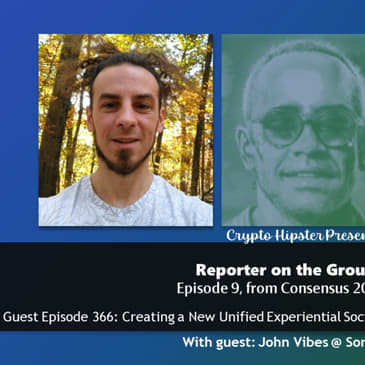

John Vibes is an author and early crypto adopter who is currently working as the Chief Vibe Officer for Somnia, an L1 blockchain and set of omnichain protocols optimized for gaming and the metaverse. John began his journey in crypto in 2013, covering Bitcoin and The Silk Road case as a journalist. He has since written with many crypto publications and influencers, from CryptoGlobe to Bitboy Crypto. Now he is focused on scaling and connecting the metaverse with Somnia.
[00:00:00] Hello everybody and welcome to the Crypto Hipster podcast. This is your host Jamil Hasan, the Crypto Hipster, where I interview founders, entrepreneurs, executives, thought leaders all around the world of crypto and blockchain. And we are live Consensus Day 3, Consensus 2024 here in Austin.
[00:00:17] I have John Vibes from Somnia here to talk to us today about his project. And John, welcome.
[00:00:25] Hey, how you doing? Glad to be here.
[00:00:28] Glad to have you. So let me ask you first, what is your background and is it a logical background for what you're doing now?
[00:00:33] Not really. I've had a very weird windy journey into crypto. I started writing about crypto as a journalist in 2013 just because I had an interest in alternative currencies.
[00:00:47] I also wrote a lot about the Silk Road and the trial that was going on with that. And through the years, I just stayed in crypto. And then I started writing on SteamIt, which was a blogging platform that you paid you in crypto back in the day.
[00:01:03] And then Justin Sun ended up taking over that and it kind of went down. And there was this big fork that I was a part of that was really interesting to just be a part of that history.
[00:01:13] And then I actually started writing for some other crypto journalism websites like Crypto Globe. I've done some ghost writing for some influencers and things like that as well.
[00:01:25] And then I started wanting to get more in on the building side of things. So I worked a little bit in regenerative finance, which is the intersection of environmentalism and crypto, which was a super interesting space.
[00:01:38] And now I am the chief vibe officer. They call me at Somnia because I handle all the messaging and just our general vibe. And yeah, it's we're working in the metaverse.
[00:01:51] Very cool. So how do you find that transition from being a part of content creator to getting into more of the development world?
[00:01:59] I think it's been great because really, it's the same kind of thing because I'm just doing content for startups and stuff now.
[00:02:08] And it's just a different angle of what I was doing before. And actually, I find it a lot interesting because I'm learning a lot more instead of just writing about things that other people are doing.
[00:02:22] I'm writing about what I'm doing and what I'm involved with and what my friends and peers and coworkers are doing.
[00:02:28] Very cool. Very cool. So when I get into what Somnia is all about. Great. What is Somnia all about?
[00:02:35] OK, so we are working on building interoperability and scale for the metaverse. So there's a couple of different moving parts for that.
[00:02:45] First, we're building our own L1 blockchain that's optimized for the metaverse and for gaming.
[00:02:51] And this just means that it could handle the level of transactions that's necessary for that because we don't think that general purpose blockchains can at this point because they're more focused on financial use cases.
[00:03:03] And that's great. We do believe that the future is going to be multi-chain.
[00:03:07] And that is why we are focused on also the interoperability piece, which is why we have this separate product of the OmniChain protocols, which work to connect different metaverses.
[00:03:20] So instead of having these siloed platforms, metaverses can communicate with each other.
[00:03:26] So that's where people can take their avocatars from one world to another or their assets from one world to another without any friction.
[00:03:32] So you're really building a global network of metaverses. Exactly. That's pretty cool. What are some of the challenges with scaling it?
[00:03:42] Well, what we found was that the blockchain piece was a big challenge.
[00:03:47] So we ended up having to build our own EVM L1 from scratch, which is what we're working on now.
[00:03:56] And we have some unique technological aspects with that with independent data chains, which takes some of the load off the blockchain and also making it easier for people to run their own nodes and things like that.
[00:04:11] We'll have a white paper out soon that will have more of the specifics on that.
[00:04:16] But that was definitely one of the biggest challenges that we found, at least on the scale aspect.
[00:04:23] So you're building an Ethereum virtual machine. Yes. But you're connecting to other blockchains. Yes. And so far it's been effective?
[00:04:35] Yeah, yeah. So far. I mean, well, we are rolling out the products in different stages.
[00:04:40] The blockchain is the thing that's going to come last. That's what we're working on.
[00:04:44] And so far we already have the metaverse experiences that people can try out.
[00:04:49] We also already have the interoperability protocols available for any metaverse that wants to tap into it and try it.
[00:04:57] And we also have partnerships with some reputable projects like Google Labs.
[00:05:03] We're building their other side metaverse and that's going to be interoperable.
[00:05:08] And we're working on League Baseball. We have a partnership with them to do their All-Star game.
[00:05:14] So that's kind of more on the application layer and the experience layer.
[00:05:20] And that's what's available right now. The blockchain is what is last on the roadmap.
[00:05:27] And that's probably around the end of this year, beginning of next year at the latest.
[00:05:31] So it's not too far away? No, not too far away. That's good.
[00:05:35] So that's how you connect metaverses. Now I believe you guys believe in the freedom to transact.
[00:05:42] Yeah, absolutely. That's a big part of this too.
[00:05:46] We think that this should be a decentralized ecosystem and a permissionless ecosystem.
[00:05:52] And the metaverse is a very big opportunity.
[00:05:57] It could more than double the size of our global economy just because you're creating all these new economies in a virtual world where the possibilities are kind of limitless.
[00:06:06] So if these are controlled and owned by centralized corporations like we have in the Web2 world today, it's just not going to work out very well.
[00:06:18] It could be really dystopian like the original books about the metaverse.
[00:06:23] We actually put out an article not too long ago about how we want to create a utopian metaverse instead of a dystopian metaverse.
[00:06:30] Because a lot of people don't know this, but originally in the books from the 80s and stuff, the metaverse was kind of a dark place.
[00:06:38] Now we see it a little bit differently and we want to create the utopian metaverse through giving people the power to transact and the power for ownership.
[00:06:50] But not only that, and I might be jumping ahead here, but to talk about how users can remix and collaborate with each other and things like that.
[00:07:02] That's another aspect to this without any barriers between them.
[00:07:07] I didn't see you jumping ahead. I would say I like the comparison of dystopian versus utopian.
[00:07:16] A couple years ago when I was interviewing metaverse founders, the buzz at the time was Facebook's creating a metaverse.
[00:07:24] How do you see Facebook's metaverse being dystopian and what lessons have you learned from them to help create utopia?
[00:07:32] That's a very interesting topic there.
[00:07:35] Facebook, the corporation that they are, the impact that they've had, the way that they've handled the businesses that they operate, it has not been great to say the least.
[00:07:52] I don't think that their handling of the metaverse situation was very responsible because they rushed into a very new and nation space that was just getting started.
[00:08:04] That wasn't ready for prime time. They cast this massive spotlight on it, on something that wasn't ready.
[00:08:12] It was something that they couldn't even get ready. Our technology is way better than what they put out.
[00:08:17] That was kind of embarrassing for them.
[00:08:20] That I think was a big problem with the metaverse narrative, honestly, because it went in this direction where everybody was like, oh, well, this isn't cool.
[00:08:33] It's like, yeah, it's because it's not ready yet. This guy just rushed, jumped the gun.
[00:08:39] Now I think we're getting to the point where the kind of experiences that people expected from the metaverse are actually the capabilities are here to bring it into fruition now.
[00:08:52] That's kind of what we're trying to accelerate.
[00:08:55] What are you doing now without the buzz?
[00:08:57] We're doing it now without the buzz.
[00:08:59] Exactly.
[00:09:00] So it gives you the opportunity to, because there's no buzz, it gives you the opportunity to do it right.
[00:09:06] To do it right, yeah.
[00:09:07] I remember a couple Super Bowls ago, there was like, I counted them.
[00:09:12] Like I was at this party and no one was paying attention.
[00:09:14] There was like 13, I think it was a Bengals Super Bowl game they lost in a rant.
[00:09:19] There was like 13 Super Bowl metaverse commercials.
[00:09:22] Oh yeah.
[00:09:23] And you don't see them anymore.
[00:09:26] So, you know, is it a long tail?
[00:09:29] People got bored and went away or is it, you know, the project just takes time and care to do it right?
[00:09:37] That's what I think.
[00:09:38] And I also think hype cycles play a big thing into that because right now the big thing is AI.
[00:09:43] That's what everybody's talking about.
[00:09:45] And I'm sure AI is going to be really big, but I'm also sure that next year or the year after something's going to take the stage away.
[00:09:53] There's going to be another big thing.
[00:09:55] AI is still going to be playing a big role.
[00:09:57] Just like the same thing has happened with crypto and NFTs and all of these technologies.
[00:10:03] They each get their moment in their 15 minutes of fame to some extent, you know?
[00:10:09] And then they got to get back to work to get another one.
[00:10:11] That's kind of how I look at this.
[00:10:13] Meme coins.
[00:10:14] Yep.
[00:10:15] But meme coins have an interesting perspective.
[00:10:20] People say they don't have any value, but you could say, you know, content creators create things that might have limited value.
[00:10:28] But, you know, you help content creators, right?
[00:10:32] So how can content creators define and help define every element of the metaverse life cycle to help them?
[00:10:40] Awesome. Yeah, that's a very good question.
[00:10:42] And I will say on the meme coin comment, I think meme coins put a value on culture.
[00:10:47] And I think that that's a very valuable thing.
[00:10:50] As far as allowing users to define every element of the metaverse, this is where the remixing and composability aspect comes in.
[00:11:01] So say for example, a user wants to create a costume in the metaverse, right?
[00:11:08] We give them the tools to do that in any unique fashion that they want to.
[00:11:12] They could wear it, they could use it, they could own it.
[00:11:15] But they could also sell it to another person in a metaverse that like that they're in or they could sell it to somebody in another metaverse thanks to the marketplace protocol that we're setting up.
[00:11:25] And then the person who purchases that costume, they can remix it.
[00:11:33] They can change the color, they can change the design, and then they own it.
[00:11:37] So then they can sell it again.
[00:11:39] And now every person in that chain that participated in that creation process gets a piece of the royalties through microtransactions.
[00:11:47] And that could happen with every object in the metaverse.
[00:11:53] The creators will have the ability to kind of play with it in that way, as long as they own those assets.
[00:12:01] How about affiliate marketers? Do they do the similar thing?
[00:12:05] Yes, yes, absolutely.
[00:12:07] Okay. I'm thinking like that's kind of like...I like the royalties aspect.
[00:12:13] In the past in the web too you don't have the creators don't get the royalties.
[00:12:16] Exactly. And that's what we're trying to take that away from the platforms.
[00:12:20] You know what I mean? Like the platform can still get a cut, but instead of like in the video game world now you have platforms who are making billions of dollars selling skins and costumes to players.
[00:12:29] When if the players were able to create and sell them to each other and then remix and sell them back, that would create like a whole new economy.
[00:12:38] Which I think would be even more lucrative for these game companies that they don't even realize.
[00:12:43] How do we look at it for the companies?
[00:12:45] What's that?
[00:12:47] How to be lucrative for the companies.
[00:12:49] Because they could still take a small cut on every one of those transactions that happen in that economy without taking 100% of like them selling to people like they do now.
[00:12:58] But I still think they would make more on that small percentage because the volume would be so much higher.
[00:13:05] I want to find out...that makes sense to me. Two or three years ago there was a wedding in Decentraland.
[00:13:14] I remember that, yeah.
[00:13:15] And half the viewers saw the bride and groom and half the viewers saw just the bride.
[00:13:22] You know, things weren't visual.
[00:13:27] How far have we come since then?
[00:13:30] We've come a long way.
[00:13:32] I mean if you look at the kind of voxel style that you have in like Sandbox and Decentraland.
[00:13:37] Decentraland I think had a little bit better graphics.
[00:13:40] But if you look at what we are doing with Improbable and M2 technology, some of the television screens that we had set up at our booth this week,
[00:13:49] you could see very high fidelity graphics that looked like probably the best video games out there right now because it's all been made with Unreal Engine.
[00:14:01] And a lot of those earlier ones weren't using Unreal Engine.
[00:14:05] And what's the benefit of that is just to have better quality graphics?
[00:14:11] A lot better quality.
[00:14:12] And we can also, using some other tech, we could like synchronize with real world events and that's how we've done some of those sporting events.
[00:14:19] So like where a baseball is hitting in a certain direction in real life, it goes in that same exact like degrees on the field, that same exact direction in the metaverse.
[00:14:31] That's cool.
[00:14:32] I like that.
[00:14:33] Without these big giant glasses right?
[00:14:36] Exactly.
[00:14:37] Yeah you can access it from a computer and things are like a little bit laggy on cell phone right now but we're really working on mobile connectivity as well because we want to be as accessible as possible.
[00:14:48] And we understand where Web3 is blowing up in like the Global South and things like that.
[00:14:53] Like not everybody is going to have a VR headset.
[00:14:59] I just think you know eventually it'll be like you just have stuff beamed into your eyes.
[00:15:05] Eventually yeah, eventually we'll be there.
[00:15:07] But I think that we're probably a little bit farther away than people think than that.
[00:15:12] I think we got at least a decade before we're there.
[00:15:15] Okay.
[00:15:16] Alright.
[00:15:17] I can't even read menus anymore.
[00:15:19] I have everything on very high print on all of my devices, on very high font.
[00:15:26] Okay good.
[00:15:28] So I want to find out data stores.
[00:15:32] What's the role and the future of metaverse data stores?
[00:15:36] Yeah that's a very interesting question.
[00:15:39] So I know that we have one of the things that we're working on with our own blockchain is independent data chains.
[00:15:50] Now I'm not a dev so I've only been relayed this from the devs but I do think that this is one aspect of what we're working on
[00:15:59] that I think is going to be like a big piece of that.
[00:16:05] And what are the benefits?
[00:16:07] It allows instead of all that data to be just on one part of the blockchain, it separates that mission I guess you could say
[00:16:19] to allow more throughput on the blockchain.
[00:16:22] Okay.
[00:16:23] Yeah I'm just starting to think.
[00:16:25] During my corporate days we had a program somebody wrote like 500,000 lines of code
[00:16:31] and we had to, took two years, went in there and got it down to like from running like overnight or two days to like 15 minutes
[00:16:37] by mapping everything out of the code and putting it elsewhere.
[00:16:41] Oh okay yeah exactly very similar logic.
[00:16:44] Okay great.
[00:16:47] So that's the future of that.
[00:16:50] So your current community, your current environment, you know is it live?
[00:16:57] How do people enjoy it so far? What's your community involvement?
[00:17:00] Great.
[00:17:01] How's that going?
[00:17:02] So we're on betanet right now. We've had over 100,000 avatars mitten on our betanet
[00:17:07] and we have a desktop application that people can use to access our experiences
[00:17:14] and through that they will mint their own avatar, become a part of the community
[00:17:20] and there's also quests and incentives involved with that since we're leading up to launching our own blockchain
[00:17:26] and that is kind of the main thing that we're working with right now.
[00:17:32] So your launch is coming later this year?
[00:17:34] Yeah the launch of the blockchain but the metaverse browser is already out,
[00:17:37] the experiences are already out and a lot of those things are just already available for people to use
[00:17:43] as well as the omni chain protocols for developers
[00:17:48] and we'll also have something launching soon called the Somnia Playground
[00:17:53] which will be, people will be able to create their own little world in the metaverse.
[00:17:58] They don't have to buy land or anything like that.
[00:18:00] They can do it for free, just create their own little area to bring their friends into.
[00:18:04] They could go to their friend's area.
[00:18:07] And you don't have to do any development or purchasing like land?
[00:18:10] Exactly.
[00:18:12] Sounds good. Sounds like a great opportunity for people.
[00:18:15] So I want to thank you very much for talking to me today.
[00:18:19] I have one last question.
[00:18:21] How can people find out more information about you, about Somnia?
[00:18:24] How can they be one of the people who build their own worlds?
[00:18:27] How can they do that?
[00:18:29] Alright well go to somnia.network and then join the community,
[00:18:33] join our Discord and first download the metaverse browser as well.
[00:18:39] And if you run into anything come in and talk to the community
[00:18:43] and we'll get you moving along.
[00:18:45] Awesome. Thank you very much for meeting me today.
[00:18:47] Yeah, great to be here.