
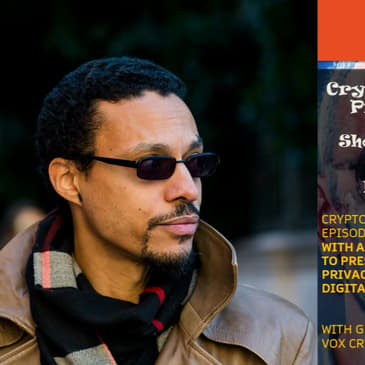

JB "Jor-El" Benjamin isn't your run-of-the-mill developer; he's a tech maverick reshaping the digital landscape from his UK base just outside London. As a Black technologist, he brings a unique perspective to the forefront.
With an unwavering commitment to safeguarding privacy in an era of constant surveillance, JB has introduced the world to Vox Messenger, a trailblazing post-quantum encrypted messenger, and Vox Crypto, an unprecedented group transaction crypto wallet, both renowned for their ironclad protection of personal data.
But JB's story isn't just about code; it's about a relentless passion for digital equity. He's a captivating speaker who exposes the hidden dangers of data collection, providing practical solutions to protect your privacy. Whether it's encryption, cryptography, secure communications, or blockchain technology, JB's expertise is a beacon of innovation with a focus on empowering individuals in the digital realm. When you invite JB to your podcast, you're inviting a true visionary dedicated to ensuring technology serves us all while preserving our most cherished right—privacy.
[00:00:00] , Jamil Hasan, the Crypto Hipster, where I bring you amazing people around the world, founders, entrepreneurs, executives, thought leaders, artists, combination of all three or all five of those things.
[00:00:19] You name it. And today I have an amazing guest. I know he's amazing because I talked to him about five minutes before I started this podcast. And he has many names.
[00:00:30] He's JB, Jor-El and also J-Web Benjamin, the founder of CryoTech. JB, welcome.
[00:00:41] Hi, it's awesome. I mean the name, yeah, unfortunately my name is Miranda Soulong, doesn't fit on any forms and it's actually Jean-Branel Webbenjeman, but everybody just calls me JB.
[00:00:50] The Jor-El thing came because I'm a massive DC fan. I bear the sign of the bat and my youngest son is actually called Cal-El.
[00:00:58] So I actually did think, I didn't almost consider Deed Poli my name and having Jor-El added to the middle, but I was informed by everybody, especially my wife, that this would be mentally insane.
[00:01:07] So I didn't.
[00:01:08] I told you everybody that you were interesting.
[00:01:11] That's great.
[00:01:15] So I keep my word. So let's kick things off and I'm interested in your background. What is your background and is it a logical background for you doing now?
[00:01:25] Okay, so without going into like crazy levels of detail, my background is I'm a kid from a council estate.
[00:01:31] I was born in Birmingham in the 1980s, you know, the height of massive civil injustices.
[00:01:37] I was living on a council estate. In fact, I grew up in Boardsley, which is where the Peaky Blinders are from, but like as you know your listeners will hear,
[00:01:46] I am blessed with the ability to speak the King's English and I do not speak Brummie or Do-Yo.
[00:01:51] I mean, apparently some people find that cool. I do not.
[00:01:54] But this way I wouldn't be a tech CEO now probably if I did speak Do-Yo, if I'm completely honest because it kind of does kind of put you in a narrower box.
[00:02:06] Homeschooled. So while everybody else was going to school in Birmingham and like becoming, you know, God only knows what and actually having a lot of fun while doing it.
[00:02:14] I was stuck at home with my very hyper strict mother learning everything and anything.
[00:02:21] We were writing essays on Decar and Vowdry Yard by Thomas Five and Six.
[00:02:25] We were going to protest marches for freeing the Birmingham Six when I was just but a young child.
[00:02:32] My background was one of modern people would call it like, oh my God, he had such a woke background.
[00:02:37] No, it wasn't woke. It was educated. That's, you know, this, yeah.
[00:02:42] From that I moved to the Midlands, you know, moved to Nuneaton and Warwickshire, went to college here.
[00:02:48] And my background actually started off wanting to be kind of like a filmmaker because as we all know if you have overbearing parents who force you into things like with my mother,
[00:02:56] she was obsessed with me being a physicist. I'm actually really good at physics and I love quantum mechanics.
[00:03:01] But God damn, there was no where I was going to be a physicist. So I moved into being a film filmmaker instead.
[00:03:08] Then I very quickly discovered if you want to get money to make a film in Britain, you will only get money for two types of film.
[00:03:14] Either it's a bumbling romcom with Hugh Grant, you know, before he started playing nothing but evil characters,
[00:03:20] or it's a shoot them up hood drama where everybody is speaking like they're from East London and it's all about black, modern black exploitation.
[00:03:28] I'm no interested in either of those whatsoever. I like Kung Fu movies. I like the Shaw Brothers movies.
[00:03:34] You know, I'm into things like the bride with white hair and Chinese ghost story, not kid old hoods.
[00:03:40] You know, very different speed. Unfortunately you ain't getting no money for that stuff, for that kind of stuff.
[00:03:45] So what do you do? I went into 3D animation and I very quickly discovered that because of my knowledge of physics,
[00:03:52] 3D really made sense to me and I became a specialist in hard surface modeling and dynamic lighting because I was actually creating physics based lighting.
[00:04:01] And when I came out, when I finished my post at the grad degree in 2010, my dissertation was the only dissertation presented at that university which featured artificial intelligence.
[00:04:12] Yes, I was already playing around with adaptive and generative AI back in 2010 way before any way before we were talking about mid journey and Palantir.
[00:04:22] I mean if you spin the clock forwards, I became a PhD candidate at University of Kent.
[00:04:26] And if you look at the PhD proposals I was actually proposing there, I pretty much was proposing mid journey and Palantir style stuff and being called a mad man and told to stay in your lane JB you're really good at graphics man.
[00:04:38] But I have said pretty much what is always said to a black person as soon as they try to do something that's like slightly outside of the stereotype, I not being into music and not entertaining people.
[00:04:48] So in the course of before I even got to building my own company, I was in London, I've pretty much worked every type of job there is.
[00:04:57] I've been a product manager of a 9 million pound project, working for the biggest corporate law in the practice in the world.
[00:05:04] I have been a bricklayer. I have been a building site laborer, I've been a site supervisor.
[00:05:10] I've been a security guard. I've been a senior lecturer of computer science.
[00:05:14] And I've been in the army twice, you know, be and oh, and I'm a member of the Freemasons.
[00:05:19] I do a lot of different things. I find out how all of these systems work.
[00:05:23] Now, during that period, I also met the mother of my children and had four children.
[00:05:29] Without going into too much detail, all I'll say is like almost every black black guy in creation, I've gotten baby mama problems and they are hit. They are literally historic.
[00:05:39] It is what it is. The end of the story is my four children now live with me so it all had a happy ending in any case, mostly except most recent updates but anyway that's a whole lot of things.
[00:05:52] During this period is when I actually started creating my companies.
[00:05:56] Now, I would love to say the Vox messenger and these applications I built, I set out to change the industry. That was my dream and my goal.
[00:06:05] No, it was because I was actually having those aforementioned baby mama problems and I did not want to become like all those other dads who end up a guy that's turning to alcohol drugs or dressing up like Batman and swinging off of bridges going, father's for justice.
[00:06:19] Or any of that kind of like completely lunatic nonsense. I was like, I'm going to do something. I'm going to redo something that if I can't have access to my kids and I can't be there for them now, I'm going to build something that matters for them soon.
[00:06:32] So I looked at what was around and I saw that the biggest problem was exploitation of our personal data.
[00:06:37] I then shook my magic eight ball and did my did my project planning that I do. And I very quickly worked out the where the world would be in the next few years and they would be in the world be desperate for end to end and high end end to end encryption.
[00:06:52] I did not predict the pandemic being the cause of it, but I did predict there would be some kind of black swan event that would create a necessity for reevaluation of our privacy standards as individuals.
[00:07:03] And that's where box messenger came from. I was determined to build something that was different from what everybody else had everybody else has elliptic curve encryption. We went with post quantum what is post quantum it is that lattice based cryptography which is three to 400 times stronger than the elliptic the elliptic curve standard.
[00:07:19] Oh, and hasn't been backdoor by RSA back in 90 back in the late 1990s early 2000s during the EC NIST competition either.
[00:07:32] The algorithms we use our NIST finalists semi finalists we didn't use the NIST finalists because the NIST finalists are all owned by PQ data who's co funded by the NSA.
[00:07:44] Now is a very long answer to your question.
[00:07:47] Very interesting. Yeah, very, you know, you and I are have some similarities here undergrad I studied film business and geophysics.
[00:08:01] Nice.
[00:08:04] So yeah, kind of a little bit of science to me but the film the films that I really focused on where the works of Akira Kurosawa who was Japanese director.
[00:08:16] Kevin Samurai. Oh yes. I mean we got I mean we all know me Akira Kurosawa come on and this isn't it great that we have Zach Snyder pretty much ripping off Kurosawa like mad for the rebel mood.
[00:08:29] I mean it's just it's beautiful. It is. It is.
[00:08:34] We can talk about that all day but we got to talk about the box crypto.
[00:08:40] Cryo tech box crypto what are they all about and why are you considered a tech maverick although I have an idea.
[00:08:46] Okay, so cryo tech is all about high end cryptography and encryption for everybody. Our slogan is privacy is a right not a privilege because everything we do is about making everything accessible for everybody because we're living in a world of digital divide.
[00:09:03] You know there are the haves and the have nots it's pretty much the same as what we've always had the difference being is we are heading to a century of abundance.
[00:09:12] Yes, I know we've got war in the Middle East and yes I know we've got war in Europe and yes I know we're probably going to have war somewhere in Pacific very very soon and then we'll have a whole blah blah blah.
[00:09:22] But the reality is is the stuff that is happening now this is not a time to lose hope. This is a time of absolute and greatest hope why because these are the last dying vestiges of the old empire.
[00:09:35] This is what happens when old systems fail, fail and die. There is conflict there always is and that's what cryo and cryo tech is positioned to basically create the technologies innovations and environments of the world after that needs.
[00:09:51] That's the reason why we have a manifesto and a mode of operation that is focused on privacy before profit humanity before profit ecology before profit ethical artificial intelligence.
[00:10:03] Everything we do is about transparency and accountability now Vox Messenger reflects that that's the reason why we use the highest end encryption and this is the reason why we're very public about what we do with it.
[00:10:13] This is the reason why we can even prove that we even book in sessions where people can have a live stream and they can actually see their messages deleted in real time from user and receiver and the transit server.
[00:10:25] You know, I'm a give you an example what's that claims to be super secure for the consumer. Yeah, for some reason when you join a WhatsApp group they still never been able to solve the problem of not sharing your starting phone number with every Tom Dick and Harry in that group.
[00:10:38] It's a very easy soul. We solved it in Vox Messenger. We have a little switch called your group's privacy switch is on by default. So when you create a group of Vox Messenger, your name and phone number just comes up as access.
[00:10:50] And then when you flick that switch off, your name and picture comes up and is shared with other people in the group. Very simple.
[00:10:56] But it kind of tells you what WhatsApp is all about something so simple something so easy to fix demonstrates you have to think to yourself why wouldn't you fix it.
[00:11:07] And that's when you suddenly realize the purpose of WhatsApp bear in mind WhatsApp claims to be end to end encrypted. But if you can edit a message, it's not end to end encrypted.
[00:11:17] But you can WhatsApp. And now you can on signal since Brian Acton, the founder of WhatsApp has taken over signal.
[00:11:27] Always ask yourself why now with Vox Messenger. We actually invite people to ask us why we tell people all the time question us.
[00:11:36] We are we want to be held accountable. We're not saying what others say, like certain people that do Don Lemon interviews and go, No, I don't need to be interviewed by journalists.
[00:11:46] I don't have questions. Yeah, you do. If you're running tech that lots of people use now admittedly we're not at the million users mark where we're sub 100,000 users on Vox Messenger.
[00:11:56] But bear in mind that's been done. That is with zero marketing. And that's literally all organic growth, all organic pickup.
[00:12:03] No PPC paid for ads only that just pure word of mouth is gathered, gathered that and we are about to start our marketing. So that's about to go even bigger.
[00:12:14] So that then led us to creating Vox Crypto because again, I'm all about solving problems that are these dividers.
[00:12:21] And what's one of the big problems in crypto? The cost of transactions on a theorem that in itself is becoming a form of digital divide, the people who can trade on a theorem and actually make money from it.
[00:12:32] And those that cannot, you know, bear in mind her theorem once it moved to prove a stake largely became owned by the United States.
[00:12:38] That's the reason why the SEC has permanently got his foot on its neck. It is just the way it is they they re centralized it effectively.
[00:12:46] That's one of the things we have to deal with now gas fees what we what I did was I created a smart contract that allows you to say send $50 to 500 different people in a single transaction.
[00:12:57] But it generates individual transactional IDs and you pay a fee that is about 30% of the total price of what it would have been if you'd had to do individual gas fees, which as we know, increase the scalar to the level of lack of resource because it's based on scarcity.
[00:13:12] You see what I mean? So that basically means that's a huge cost saving that basically means staking stuff on a theorem and managing a project on a theorem all of a sudden is brought back to being cost effective again, which it wasn't until we had the smart contract.
[00:13:25] Now the other great thing about this smart contract is there are quite a few competitors out there who claim to be able to do bundle a theorem transfers, but they all have one common feature which is that the way they do their bundling is you send the money to the wallet and then
[00:13:40] that wallet then takes responsibility for sending outwards which means you end up with this juicy, lovely succulent big fat pig of a wallet ready to be hunted down and slain like a suckling pig and all of its juicy money exited from it immediately.
[00:13:58] We do not have such a problem because we think we're again, we think security first. We have created what is called a pass through smart contract. It just goes straight on through to its end destinations and does not stop.
[00:14:11] So hacking our smart contract would be completely pointless. You wouldn't be able to redirect funds with it and there'd be no way of ruggeding it for us.
[00:14:19] Vox Crypto is also part of the launch of our own Vox digital platform assets, which is what other people call a token basically digital platform asset. Now you'll be able to use this token within all of our all of our applications to log in, save your user profile and actually move your user data between applications in our ecosystem.
[00:14:39] You own that data and in the future we're building in the ability so you'll actually be able to monetize that data to data brokers directly from holding this token.
[00:14:52] Very cool.
[00:14:54] I am.
[00:14:57] I tell you, I wasn't thinking about lunch and then and then you talk about juicy suckling pig now.
[00:15:04] Now I want to go to the barbecue place.
[00:15:10] Yeah, have the juices drain from the suckling pig there's like a lot of exploitations in crypto where that's happening right.
[00:15:20] I don't know why that's a particular challenge maybe you can tell me what is it, you know, how do we reduce those exploitations and like, I mean, you know one must have thin pig, but how do you do it?
[00:15:33] Well, first of all, we got to look at your business model. And this is really is literally just as simple as that.
[00:15:39] There isn't the easiest way of making money is to deploy an art is to deploy an application slap ads all over it, and then have people use the application.
[00:15:49] And you make money from their attention of those ads effectively retargeted ads. It's lazy. It's ineffective, and it's irritating as hell.
[00:15:58] And it only makes you know and it makes a few people a lot of money bear in mind Facebook have just been caught in has been revealed in a an announcement today that thanks to a lawsuit that Facebook are involved in it was revealed that Facebook sold everybody's private messages to Netflix for $100 million.
[00:16:20] Now you think to yourself, why would they do that? Well, a it's $100 million people and be Netflix would want it because it means they can personalize what they offer you more directly bear in mind Netflix is not just about films.
[00:16:34] Netflix is also about games. It's also about retargeting those and making sure they expand your multimedia experience across as many devices as possible.
[00:16:44] So that data that they purchased from Facebook has a lot of information. It has names, addresses IP addresses devices device IDs. Do these people have children? Children are the biggest mark and most profitable marketable marketed to group in existence.
[00:17:02] So again, it becomes very important. This one things I say to everybody, whatever product you're buying. It matters who the company owner is it matters what the company is.
[00:17:12] So check, look at the ingredients. If you have a narcissistic spoon fared CEO who is is used to nothing but strip mining resources be they physical intellectual or otherwise, you're going to have a company that releases products and treats his customers in exactly the same way.
[00:17:31] They're not going to give a toss about your safety or what you care about. They're going to care about making making what of you a product. See, this is the point in the modern world that we all that you will live in.
[00:17:45] Everybody who's not a customer of cryo tech Dijin or Gorgon or a Kuma engineering, which my company is anybody who's not a customer of these people is literally being turned into a product. If you're one of my customers, you are a consumer or a prosumer.
[00:18:01] If you're a consumer or a customer at Facebook, your products. These are very different things you are your your experience on Facebook is literally just there to tease more information out of you to manipulate and soft so pure into releasing more information.
[00:18:20] Think of all these people who think, Oh my God, it's fine. I'm going to share some pictures and what of my youngest kid their birthday. Yeah, you know what you can do with that picture now.
[00:18:30] Using AI generative AI and upscaling technology. You can create an image and a 3d model of what that child would look like as an adult.
[00:18:38] And then you can do some deep fake stuff with that maybe you could apply for a driving license for them. Maybe you could apply for a passport for them.
[00:18:46] Maybe there's all kinds of crazy. This is what people need to realize your data is more valuable than any bar of gold.
[00:18:54] Your data literally fundamentally means understanding you and your world and your assets in that world.
[00:19:03] Interesting. Yeah, it is. You know, I got a phone call yesterday. I wanted to know where this person got the information that's like somebody just bought a computer using your name and information on on Walmart.
[00:19:22] And I was like, they had my name, they had my address and everything about me except they didn't have one bank account I bank with.
[00:19:30] They were fishing for that and when I started asking questions of disorder use of profanity and threatening me and I got into a five minute fight or back it was f you back and forth.
[00:19:40] You know, finally they hung up.
[00:19:43] Right.
[00:19:44] But I'm like, does this like I was like go back to Pakistan. You know, I don't know what people come from but like, you know, yeah, I don't feel safe and secure having those companies sell my personal information.
[00:19:55] You know, though one of the important thing is is is privacy. Right. What are what are the in addition to that little tidbit. What are some of the, you know, important issues we're now facing around privacy and what is the future of privacy chains.
[00:20:12] Okay, I would say the biggest thing that nobody is looking at in privacy is actually a two part problem. One, artificial intelligence to virtual reality and the metaverse.
[00:20:24] And you're going to say why are these two different problems. Well first of all, they are they are both areas that require huge amounts of technological and financial investment to be able to participate in at this point in time.
[00:20:39] They are also technologies which are going to which are already consuming 80 to 90% of our attention in the world space already. They're already consuming AI for example is already consuming something like 40% of all world investments, if not more right now.
[00:20:56] And that's even before we start talking about the energy costs. Bear in mind and this is something that people should always remember when they're having arguments with muggles about blockchain.
[00:21:04] Anybody rolls up when you with some half minded accusation that blockchain is bad for the environment because the amount of water and heat that it dissipates in the water that it uses.
[00:21:14] Please refer them to the Nvidia NGX server, which literally requires four swimming pools worth of water to keep cool a minute.
[00:21:25] You know, block chaining doing that people blockchain mining doesn't do that. Your generative AI does that. You know how everybody likes to go on to chat GPT.
[00:21:35] Chat GPT is more of an environmental threat than anything on blockchain.
[00:21:40] So how do we solve the problem of privacy? Well AI is a problem for a start because many of us are swapping how we would give up our data for personalized ads.
[00:21:49] We personalized AI instead. We swapped one demon for another. The difference being is when you're giving your data to a personalizing AI, because you do not know who created that AI and because you don't know how it was trained and nine times out of 10, most of you don't even understand how it works.
[00:22:04] You think it's just unicorn farts and magic.
[00:22:07] When you start ending up putting yourself into a situation where you are literally giving up an exact digital facsimile of your real world self for no reason other than you want to access a fancy headset.
[00:22:21] Now we're moving to an age of abundance, a world where universal basic income suddenly makes sense, a world where robots and AIs do the heavy lifting for us.
[00:22:31] A Star Trek future. But the only way we reach the kind of Star Trek future where we, the individuals, maintain our digital sovereignty and can actually profit from it is if we invest in companies or set up companies and products where privacy and actually being accountable to the end consumer customer is an actual thing.
[00:22:55] You know, I'll give an example. In the EU we have this amazing thing called GDPR. It's amazing. It basically means that anytime Facebook and other people sell your data they can be slapped on the wrist.
[00:23:07] The problem is, the fines for GDPR violations are abjectly pathetic because if you're a company the size of Microsoft or Facebook or Apple or Google paying 75 million or even like 3% of your global gross don't mean diddly to you in the great scheme of things.
[00:23:29] In fact, that is like a Monday evening at the strip joint for most of the CEOs at Google from what I've heard nowadays. So that would have, you know, that whole if you're going to have laws which stop people from doing stuff like selling your data, invading your personal privacy or direct political targeting of yourself and your family.
[00:23:50] These laws are not effective unless they're enforceable.
[00:23:54] Now how do you enforce these? Well, you enforce them either with fines which are so heinously draconian they would be crippling to that company if it ever got enacted.
[00:24:05] Or you take the Chinese approach. You start throwing some CEOs into some like jail clothes in a jail cell and then the chain gang.
[00:24:16] You start throwing some CEOs into a chain gang and you start throwing them in there with bankers. Watch how quickly the industry will clean itself up.
[00:24:22] Better remind, there's a reason why Sweden out of all of the countries after the banking crisis of the early 2000s bounced back in a year and the rest of us are still dealing with it now.
[00:24:31] They stuck all their bankers in jail.
[00:24:34] Same thing applies. You know, if Zuckerberg, if we're at the point where Zuckerberg is being made to turn around and apologize to people because their kids have committed suicide from using his platform, does this not mean he is criminally responsible and then should therefore should be held criminally criminally accountable?
[00:24:52] I fully expect if my tech is used for that, I fully expect that to happen. That's the reason why our policies are all about we are going to be very straight up and open with everything.
[00:25:01] Now, give an example. We're registered by code. Now our obligations if we were hacked or there was a data loss is to let people know in some like, you know, 28 days or 30 days, we will do it within 24 hours.
[00:25:13] We're not going to have people waiting around a month to find out that data is out there being used by God only knows whom.
[00:25:20] But again, it's all about how these companies operate. It's about how the people who built them think and operate. That's the reason they got no issue selling your personal data to the Saudi Netflix for 100 million because, you know, that's their budget for the next strip joint party, you know.
[00:25:41] Makes sense.
[00:25:43] Unfortunate, but it makes sense. You know, but you said you said three words that I want to return to unicorn farts and magic.
[00:25:54] Yeah.
[00:25:58] Earlier, you talked about war, right?
[00:26:03] There's war going on inside of the crypto industry.
[00:26:08] It has and it have not sent I say the haves of the people who got an early in Ethereum have not sir everybody else, especially like the Solana community.
[00:26:20] You know,
[00:26:22] the Solana community seems to be doing pretty well actually I mean the fact they've managed to exit 228 million dollars of stablecoin out of a theorem is kind of an interesting move.
[00:26:33] You know, there are people moving. Why gas fees.
[00:26:39] Yeah, I guess. But then you have then you have all these meme coins right back to the unicorn farts and magic.
[00:26:46] I think we've seemed to forgotten about the importance of the societal impact on blockchain and people are chasing money, right?
[00:26:53] So why should we remind people of the societal impact of blockchain? Why does that continue to be important?
[00:27:02] Okay, fairly easy. I personally and within my companies we've been actually pushing for the public utility of blockchain, particularly within political systems for a very long time because blockchain
[00:27:14] is kind of like AI to some extent. People have this idea that you can use blockchain for everything and anything and it just instantly make it good.
[00:27:21] No, it doesn't. It's like, oh my God, I got a new what should we release? I know let's release a toothbrush that has integrated AI.
[00:27:29] And yes, somebody I'm not joking by the way, this is Phillips have actually done that they've actually released a toothbrush that they boast has neural AI and it's like, dude, just because you put neural in front of AI does not mean it makes it sound clever.
[00:27:44] Blockchain is like has been kind of like that for the longest time unfortunately. What is blockchain? What is blockchain really good for? Well, blockchain is really good for anything that requires a non reputable record of truth.
[00:27:57] Now what would that be perfect for? I don't know.
[00:28:00] So elections may be. What about a blockchain system where once you KYC and AML and actually identified yourself by holding a soulbound token, which is a token that can either be traded nor moved in his lot specifically to your device, you could prove single one to one voting.
[00:28:19] Then combining this not with first pass the post but with proportional representation at a digital level which by the way could be mechanistically enforced using a smart contract.
[00:28:30] You would have an electoral you would have an electoral voting voting system that does not require any third party to manage.
[00:28:37] Oh my God, that does that mean it could be independently verified? Yes. Does that mean that you couldn't manipulate it with fake votes? Yes. Does that mean you couldn't you couldn't possibly manipulate it with a postal vote by a company mysteriously set up 24 hours before the before the count?
[00:28:53] Yes. By the way, I'm referring to the 2019 election. That's what the Tory party did here in the United Kingdom. They created a company called I dox that was open specifically to assist with the postal vote that they'd marked the hell out of and then I dox was closed up at midnight of the same day of the count or records gone.
[00:29:15] So blockchain perfect for anything in politics. So let's look at what another application anything where a system is required to pay people regularly. So HR middle management, guess what?
[00:29:29] Payroll can be replaced by blockchain and smart contracts and you would never have to talk to their snarky selves ever again when they get a cheeky review as HR always does when it's HR the screw that screws the pooch inevitably with people look about not getting paid.
[00:29:43] With blockchain, this could be done mechanically. Now people have heard me say smart contract kind quite a bit. Now for those who don't know what a smart contract is and think that it is unicorn farts and pixie dust got a new one there.
[00:29:55] A smart contract effectively is a form of is a piece of code that acts like a robot. It goes and does something. It goes and does it and no it's not because I use the word robot doesn't mean it's intelligent.
[00:30:06] It's not. It's just a piece of dumb code that uses routines and loops to fulfill a specific function. So for example, you could have it mechanistically coded that when X amount of money hits X council bank account X amount of money is automatically paid to X department on the fulfillment of X supplying X amount of information.
[00:30:27] These would automatically trigger without any need for a human interoperate or interoperator in the middle. Now if we look at how most councils and states operate, it's those connections in between where money gets lost.
[00:30:40] It's those connections in between where you have consultants being paid big fat juicy salaries for pretty much just doing nothing other than sitting around consulting.
[00:30:51] You know, again, another perfect application for blockchain would be medical records in medicine. Oh yes we could overhaul the entirety of the NHS medical system using blockchain if we weren't selling it wholesale to Palantar and the United States of course.
[00:31:08] Yeah, yeah. Yeah, British public health is literally disappearing and becoming a facsimile of the US US health system. How is the US health system going over there? Is it cheap?
[00:31:21] It's two tier. Yeah. Yeah. Yeah. Well, my wife has good insurance with her company so I'm in a better tier but a lot of people.
[00:31:35] Yeah, and we've got the same thing happening here in the United Kingdom. So another perfect use case actually for blockchain would be medical records ensuring that their access is controlled and audited but also ensuring that there is ready access to them by appropriate authorities and practitioners everywhere and anywhere.
[00:31:54] Sorry about another good application is naturally within banking of course. Why? Because you think to yourself, why would you want, why would blockchain be of any use for banking because people want to keep their stuff secret don't they?
[00:32:08] Well actually I'm talking more about the tokenization of property assets. So for example, linking a house deed to a blockchain asset basically means you'll be able to transfer the value of that physical ID.
[00:32:23] So if you were to write them across multiple financial modalities, you would be able to get loans off against it without going through the normal owner's paper driven systems that you would normally have to do in the Web 2 world because the asset is listed and the asset is listed against you.
[00:32:38] You could create a very reliable store of asset value that can be independently verified autonomously using a smart contract thereby reducing the cost of generating loans or offering loans, reducing the cost of offering secure financial services.
[00:32:54] In fact blockchain has a ton of really grown up serious applications. Unfortunately we are all being conned into using it for the worst which is rampant speculation. Now why is that?
[00:33:08] Now if we look at the mainstream media, the mainstream media which we should remember is bought and paid for, yeah, has been telling us that blockchain is the domain of the bad guy, blockchain is the domain of the drug dealer, the human trafficker.
[00:33:23] And while they were telling us this, mysteriously enough BlackRock and Morgan Stanley were building up the two biggest corners of the blockchain in the background for over the last 10 years while telling the rest of us that it was not the way to go.
[00:33:37] Why? Because actually blockchain is the way to go. They just need the rest of us to act like idiots and not participate. Why?
[00:33:43] Because once decentralized banking becomes mainstream, there is no more need for interchange. There is no more need for SWIFT and there is no more need for Visa.
[00:33:54] It's kind of like if you were to completely make cannabis legal all around the world, watch how quickly big oil, big pharma and several other big financial systems come collapsing down because of the pure versatility of the canner plant.
[00:34:11] And it's the same thing effectively with blockchain specifically in centralized finance. There's a reason why the slogan of Vox Crypto is I am the bank because that's what we've done with Vox Crypto.
[00:34:21] We basically create, we're basically putting easy access crypto management in your pocket. And it gets even better. I'm going to reveal a little alpha on your show, which is that by the end of summer there will be Vox Pay.
[00:34:33] And Vox Pay is basically our own bank and you'll be able to apply for debit cards, credit cards, accounts, all the same stuff you can get from a mainstream bank but you're going to get from Vox Pay and it gets better because we're integrated with crypto
[00:34:45] and we understand and know the technology. We will be the only crypto friendly bank in existence where you will do KYC and AML once and when you want to access your money, you access your money.
[00:35:00] When you want to get crypto, you get crypto. Oh, and it gets better because by the end of the year they will be integrated into Vox Messenger which will give us the Western Hemisphere's answer to WeChat.
[00:35:13] I like it. I like that a lot. Since I've been in crypto since 2017, I've always seen blockchain as three things. It's backing the unbanked, it's identity for the unidentified and it's a voice for the voiceless.
[00:35:30] And that's where I like to come in with the voice of the podcast. But it all comes down to diversity.
[00:35:40] Why is diversity and technology crucial? And what are the boundaries we need to stop us?
[00:35:45] Well, diversity is an interesting one because I get this, I ask this question a lot.
[00:35:53] And I've worked in the DEI area and I'll give you an example.
[00:35:57] I was a senior lecturer of computer science at my old alma mater and I was pretty much recruited because I was black.
[00:36:05] And the assumption was made that I'd automatically join the DEIA group and it was automatically assumed that I would play a certain role.
[00:36:16] And unfortunately, that's what ends up happening with corporate level diversity.
[00:36:21] Well, we don't need diversity. We need diversity of thought. That's what we need. Diversity of thought, diversity of culture.
[00:36:28] Race has zip to do with it. But it makes a lot of sense for governments to leverage race at us because how?
[00:36:37] We can divide each other for days, you know, for ad nauseam.
[00:36:40] If we're not dividing, if we're not being divisioned by our genders and what we assume our gender is or whatever,
[00:36:45] we're being divided by the shade of our skin or the shape of our faces or physiognomy.
[00:36:51] The reality is those things are meaningless. What really matters is how we think, how we feel.
[00:36:59] You can have two black people in the same room. They're going to think differently despite the assumption we all look alike.
[00:37:05] You're going to have two white people in the room. Guess what? They're largely going to think differently.
[00:37:10] Unfortunately, the diversity thing I feel is largely used as a cudgel to distract us from the big, the actual big tool,
[00:37:23] the big lever, which is classism actually.
[00:37:27] Racism and all these other things are tools of classism.
[00:37:30] Haves and have nots is all about classism.
[00:37:33] And when you start looking at the world history and realizing the British Empire, which invented the version of classism that is used to this day
[00:37:41] and realize that all the countries experiencing problems now are all part of the British Empire or offshoots of the British Empire before they decided to rebel,
[00:37:52] you suddenly realize there is a kind of commonality between all of these.
[00:37:58] And that's the problem. And that's going to continue to be a problem unfortunately until we move away from the current way of thinking.
[00:38:05] We need to stop thinking of these subgroups and remember that we're one big group and it's called humanity.
[00:38:14] And until Elon Musk goes to Mars and impregnates a Martian woman, that's it.
[00:38:21] And of course that will be the next war. The next war will be the expanse.
[00:38:25] It will be the belters versus the Martians versus the inners.
[00:38:31] You get me, Sasuke? That's the way it's going to go.
[00:38:34] But at the moment until that point, we're all human despite what they may be trying to tell us with all this operation spyglass and all that they've got going on at the moment
[00:38:45] with this whole thing with aliens really here guys.
[00:38:49] Oh yeah, so we've had flying saucers for ages. We're just now revealing it to you.
[00:38:55] Can you please ignore the televised genocide that's going on right now?
[00:38:59] Look at the aliens. Aliens exist everybody. That's all it is.
[00:39:03] It's just a distraction from far more important things happening around us.
[00:39:08] So when people ask me about diversity I say actually we need diversity of thought.
[00:39:13] We're already mixed. The whole idea of individual races becomes completely obsolete I think by 2040 when everybody's mixed anyway.
[00:39:23] So it's diversity of thought. We just need different ways of thinking to solve problems man. That's it.
[00:39:31] I agree. One of the things that this is an audio podcast so people will see the video you said you used to put your Jamaican flag.
[00:39:41] I was in China in 2004. I was hanging out with a nice young lady on my tour group who was from Jamaica.
[00:39:49] And we went to a city in China. I don't remember if it was Xi'an or they had a terracotta warriors or come make big city.
[00:39:57] When I was walking down the street with a young lady, the Chinese men would stop. One man just peed himself and cried.
[00:40:05] I've never seen a Jamaican woman before. I was like that is actual fear.
[00:40:11] Everything else is right. I agree with you. Classism and trying to separate the has been a have nots for the have nots.
[00:40:19] We have this wonderful thing called crypto right and you know some people are getting rugged and we talked about the rug.
[00:40:28] What new people to it need to know certain things to protect their crypto bags right. What do the newbies the traders investors you know need to know to protect their crypto.
[00:40:41] Okay well the very first thing is avoid all crypto chat influencers like the plague avoid most blockchain crypto shows.
[00:40:53] Every time you're on Twitter and you see somebody say oh my god I'm going to give away fiber theorem to the first 2000 people that share their wallets.
[00:41:01] Yeah don't share your wallet because all you're doing is painting a target on yourself you literally bear in mind there is software available on GitHub which yeah it takes a long time to run but theoretically people are out there running it.
[00:41:13] There's a software out there which will automatically enumerate and hack wallet IDs autonomously. So stop handing out your wallet to people okay don't think just because it's a wallet and requires you to sign up that it's intrinsically secure.
[00:41:28] That is not the case something I would say if you're a newbie start studying some behavioral psychology and I know nobody else says this but the reason I say this is because every single big project that rugs.
[00:41:40] Manipulates its community and they go into some high level emotional and psychological manipulations in those places we're talking almost cult levels of manipulation in some of these places.
[00:41:53] I mean you know bear in mind whoever who hasn't been in a crypto project where as soon as you raise your hand and go in something like you know what something does seem quite strange here you get jumped on and caught a fud.
[00:42:03] And then people start to use manipulation to go where if you're not this you wouldn't be saying this they use the equivalency argument to get you to bow down and ignore your better judgment.
[00:42:13] Yeah that happens all the time if somebody is doing that in a project leave the project dump your bag and go because again a community is often a reflection of the culture that the founders allow.
[00:42:29] So if you have if you have a community that is largely dropping the hard and the hard are yeah all day long.
[00:42:37] You know who I'm talking about you know which crypto projects I'm talking about when saying this board Apes yacht clubs milledies those crypto projects you think it's fun to weave in Nazi propaganda into their projects or in the case of the milledies actually we've been quite.
[00:42:54] At times pidephilic and racist commentary into their into their community chats as a way of engendering some kind of like reaction.
[00:43:02] These are not marketing employees yeah these are not marketing tools when these are deployed they're being deployed by people who are incredibly ethically ambiguous people who are ethically ambiguous like that will not think twice.
[00:43:16] I just you not about going into the main community wallet one day and just taking everything out.
[00:43:22] And then they'll turn to your face in the middle of a group chat and say I don't know what happened I think somebody sim swapped me because they're relying on your lack of technical knowledge.
[00:43:33] Most of these by the way just so you're aware and I'm gonna blow this up now 90% of the projects that claim they were hacked because of sim swap.
[00:43:40] No such thing whatsoever.
[00:43:43] They just use sim swap hack and the fact that it was happening a lot as he was aware of just literally getting away with rugging.
[00:43:50] And by the way you'll notice that the so called the whole thing about sim hacking all of a sudden seems to have died off in the crypto chain lately.
[00:43:58] Yeah, because people have decided just stopped using it as a rugged excuse.
[00:44:02] And by the way, ruggeding projects. Another thing I would suggest to your listeners is just because a project is owned by a big name does not mean it's not going to rock.
[00:44:13] I know this personally orange comet was what was at the peak of a theorem one of the big names in NFT projects in a theorem.
[00:44:21] Founded by Gwen Stefani. I mean serious money behind these eyes Dave Broom was up in that place.
[00:44:28] Now these guys they got the AMC licensing for walking dead and and rice's interview with a vampire.
[00:44:35] Massive projects, big high quality animated 3D assets, big unreal five game coming in and they rugged it.
[00:44:44] They didn't just rug us they run five other licensed communities Nazca.
[00:44:49] For example, they rugged them out. They rugged out Scottie Pippins the actual basketball guy.
[00:44:55] They rugged out loads of major licensing names. So just because it's got a big name signed up to it does not mean that it's going to stay chances are it's not actually all they've done is they paid somebody or they've managed to get somebody to come in on the
[00:45:09] drift is the other way to look at it as well. You know if you see a project being pumped by people like Machi and OX poorly, don't be don't you just going to be there exit liquidity guys.
[00:45:20] That's it. If you're a newbie do not fall for their pond X Y OX pond the OX poorly blah blah blah blah blah blah blah blah.
[00:45:27] You know if you're going to do stuff like that you may as well go and buy yourself some hex and listen to that jackass with his watching his gold rings because you're going to get rug died away.
[00:45:36] You know at least with the hex guy he'll smile to your face and go hex and it does keep on doing it.
[00:45:45] Thank you. I have two things that I do.
[00:45:49] The number one is there's simple basic things but number one is, I put all my crypto in a vault with the 48 hour lock up where I can't move it out at the weight 48 hours and usually by the next morning afterwards what am I thinking, you know, that's one and the
[00:46:06] number two is if I use a wallet, I don't put Ethereum in the wild I might have alternative coins in the wallet. But in order to move those all coins I have to have to have a theorem to pay for the gas fees.
[00:46:20] So, you know, if you're going to buy stuff and exchange you deposit your money in exchange you get your crypto you get that thing out and gone literally as quickly as possible because bear in mind in the terms of conditions of every exchange.
[00:46:42] If they hit any financial problems they reserve the right to just take the asset and keep it doesn't matter how much it is.
[00:46:50] I was a Celsius customer I know.
[00:46:52] Oh, I am.
[00:46:55] Okay.
[00:46:57] Yeah, that sucked.
[00:46:59] Yeah, but it was an experience.
[00:47:02] You know, speaking about sucky experiences, you know, I have one further question two questions but one is important.
[00:47:13] I did interview a young lady.
[00:47:16] What's my age so not really the middle age who you know might be asking 52.
[00:47:23] You don't look at thank you. Thank you.
[00:47:26] But like people just your way because this is on audio only he does not look anywhere near 50 I'm not just saying that because he ain't paying me anyway, but he does.
[00:47:34] He legit looking good for video you think it was black actually because there ain't no crack here.
[00:47:39] Thank you. Thank you.
[00:47:41] She was a this woman is a producer of star producer of a movie called Erasing Family.
[00:47:49] Ellie was a director, I was among the credits at the very end of the movie as well.
[00:47:54] And she was in my book, my first book blockchain ethics.
[00:47:58] We talked about at infinite him how blockchain could improve family court.
[00:48:02] And I know prior to our conversation today.
[00:48:06] Yes.
[00:48:08] How can how can blockchain help with the family court situation to make it prove it or or revamp it or whatever.
[00:48:15] How could how could blotchy and be effective here?
[00:48:17] I mean, the way in which blockchain could be effective in family court or legal at all really is the fact that a you've got blockchain that can store data and they can't be interfered with which means it's perfect for evidence gathering.
[00:48:30] And see, we also have types of smart contract which can operate AI.
[00:48:35] So you could actually run a smart contract that is operating legal counsel that is dedicated to that is literally trained just on the data of the individual and that information has never shared anywhere else within the ecosystem or outside because one of the bigger one of the massive problems is also the amount of data that's shared between people.
[00:48:50] Unfortunately, the biggest problem I'm not sure about in America but here in Britain is not so much the family court laws themselves.
[00:48:57] But it's the enforcement of those laws.
[00:49:00] Unfortunately, and we have a you know when you have courts issuing quarters the way they're meant to me let's not get a twist with the British court system as far as I remember correctly at the moment in the High Court Magistrates Court in Holborn London.
[00:49:13] They are already booked up all the way to February next year for family hearings already.
[00:49:18] So the problems that are existing in the family court business aren't largely tech based actually personnel based and they're also cut willingness to act based.
[00:49:29] If you have a court issuing in good faith, core orders with enforcement orders and then the police force themselves are not enforcing them stating to people just go back to court.
[00:49:40] You end up with a system where yes, there is legal redress but there is no actual enforcement of that legal redress and unfortunately blockchain won't fix that.
[00:49:49] That is something that it has to be fixed at an institutional and current and cultural level.
[00:49:54] It's not helped when you know you have an administration that seems interested only in slashing budgets for public legal but why would they do that because again it comes to what we spoke about before classism.
[00:50:08] Those who have and have not law and the rule of law just like privacy for a lot of people is the domain of the wealthy.
[00:50:18] Justice is not for us justice is only for the rich and you only have to look at any legal system look how much lawyers are paid look how much lawyers expect to be paid look how much judges are paid.
[00:50:28] Look at how there is a laissez faire approach to having constant and repeated court hearings why because everybody's getting paid.
[00:50:37] It doesn't matter about the children. It doesn't matter about the parents. It doesn't matter about any of their futures.
[00:50:43] It matters that people are getting paid and unfortunately blockchain doesn't fix that what fixes that is potentially a guillotine Mr Robe spear coming along and they're being what we call a revolution, you know or in a less drastic way a rapid change that leads to more equitable offerings for the public.
[00:51:07] I like that sound to that.
[00:51:09] Oh, yeah, that sounds that sounds like something that should happen.
[00:51:14] So, I want to I want to thank you very much for your time today this has been a wonderful conversation I enjoyed speaking with you very much and I have one last question.
[00:51:26] It's how can people find out more information about you about cryo tech about Vox crypto. How can they become customers how can they do that.
[00:51:35] Very simple. You can if you want to find out about me and I invite people to do so because again, it is important that is important who builds your product and investigate me.
[00:51:46] I have no issue being accountable and giving up my privacy for transparency because that's part of the job at the end of the day if you're going to build this stuff.
[00:51:54] I'm just Google my name JB web Benjamin. My name is so unique there is only one other guy that comes up and Mr J Web and he fought for the American Army in the Civil War and it wasn't the right side wasn't the black friendly side.
[00:52:06] That's the only thing you can find with my name basically but as you can find me you can find all the interviews and podcasts and all my educational background my jobs photos of me like being a goofball in my garage while fixing my car but basically I can clean it up because you should be able to find out about me.
[00:52:23] If you want to find out about our products. You just visit cryo tech dot co dot UK or Vox dash messenger dot app or Vox dash crypto dot app or if you've got Google Android if you got Android just type in Vox messenger or Vox crypto into the Google Play Store or Vox crypto into iOS.
[00:52:41] Yes Vox messenger is not on iOS and it is not going to be there anytime soon because in order to get them to iOS they demand that you share all of your novel encryption algorithms with them now.
[00:52:56] You literally have to give them your source code to actually get onto the Apple iOS store.
[00:53:03] Yeah it's not going to happen.
[00:53:05] Not Vox messenger it's not buddy. No no no no no no no no no no no no no no. If I was going to do that I'd just go open source. You know what I'm saying I mean we are going to go open source when we move to our next version which is fully decentralized we're actually going to be open sourcing the current version and giving it away to people so they can actually practice how to build their own messaging platforms.
[00:53:23] So that sounds great.
[00:53:25] Awesome.
[00:53:26] Thank you very very very much for your time today.
[00:53:29] Thanks for having me here. It's been great. It's been fun. Thanks.