
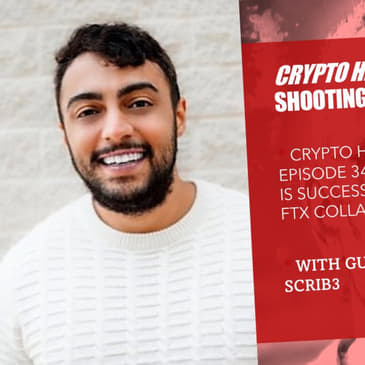

[00:00:00] Hello everybody and welcome to the Crypto Hipster podcast. This is your host, Jamil Hasan, the Crypto Hipster, where I interview founders, entrepreneurs, executives, thought leaders, you name it, and artists all across the world of crypto and blockchain globally. And I have an amazing guest for you today. I'm looking forward to this interview. We're gonna talk about a lot of really cool things. So without further ado, my guest name is Ishan Bhaydani. He is a co-founder and scriber.
[00:00:30] Ishan, welcome.
[00:00:32] Thanks for having me, Jamil. Excited to be here.
[00:00:35] Very welcome. So let's kick things off by asking you first. What is your background? And is it a logical background for what you're doing now?
[00:00:43] Logical is a great question. I guess you guys can help me make the determination of that. I was in private equity before I got into crypto. I had my NPE fund and my brother and I used to run. Nothing too crazy. It was about like low eight figure AUM.
[00:00:59] But yeah, caught the... I was always kind of tangentially in crypto. I call it a Coinbase investor. You know, you buy some coins on Coinbase, watch number go up, all that good stuff.
[00:01:10] I got really deep into the space around 2019 when I had some friends show me early kind of blue chip DeFi stuff, Maker, Aave, Compound, things like that. And that's when I kind of caught the bug per se.
[00:01:22] And, you know, after that felt the compulsive need to spend all the free time I had kind of learning, digging into the space, understanding it. So I guess background wise to answer your question.
[00:01:34] There is a lot of overlap between kind of my background and DeFi just kind of the culmination of all of the things I liked growing up everything from
[00:01:43] finance, business, economics, politics, philosophy. It's kind of this really interesting culmination of a lot of these different areas.
[00:01:52] And so yeah, you know, started getting really too deep in the space. Went through DeFi Summer, which was quite an interesting time in the world.
[00:02:00] And ended up doing pretty well for myself in DeFi Summer. And then from there started to explore what a career would kind of look like in the space.
[00:02:09] Just, you know, built an incredible conviction over time and continue to build that conviction every day. And yeah, today,
[00:02:18] you know, took that a lot of that conviction and turned it into helping projects. Felt like that was my niche in the space
[00:02:24] to help out. Started working with a bunch of different projects just helping them on whatever needed to be done everything from product strategy growth, go to market.
[00:02:33] And then all of that culminated into starting Scribe. And today, Scribe is a
[00:02:38] the one of the largest go to market agencies in the space. We work with Preseed all the way to really large, you know, series CD
[00:02:48] companies on their go to market strategy. Everything from the content that they write to, you know, running their socials to their public relations efforts media relations,
[00:02:57] design, community, kind of you name it under the sun when it comes to go to market. And today we started Scribe with about three people back in November of 22.
[00:03:07] Fast forward today 18 months later, we're a team of about 75 people full time. And so just continuing to grow and help interesting projects in the space tell their story.
[00:03:19] I was going to ask you how you helped them.
[00:03:22] But it's really everything, right?
[00:03:25] Yeah, yeah, I would say the six areas that we focus on and the way we've kind of constructed things is just based on, you know, whether you're a big layer one or layer two or you're a niche DeFi protocol in the space.
[00:03:36] Everybody needs, you know, content creation everything from, you know, helping on their day to day socials to the, you know, the
[00:03:46] messages that they put out online. You know, we do a lot of public relations, right? How you come up in the media, how you work with
[00:03:55] other large organizations in the space and then, you know, working on your design, right? Like design branding, that kind of stuff is just as important as the communicative elements.
[00:04:04] Great community and you know, with growth and business development. So yeah, those are the kind of six categories.
[00:04:10] Very cool. Very cool. So let's see where you mentioned DeFi Summer. That was fun.
[00:04:17] You know,
[00:04:19] we are still living with the effects of FTX and it's fallout and everything, right? How has that fallout forever changed the direction of crypto, including the positive things and the negative things?
[00:04:33] Yeah, so I like to kind of answer this in two parts, which is how it affected me personally and then how it affected the space as a whole. So
[00:04:42] personally, it's quite an interesting story I'd like to think. So I was,
[00:04:48] I had kind of built a thesis around FTX that they were likely insolvent or had some pretty major issues around like October of 2022. So about a month before the collapse,
[00:04:59] I had written a now relatively infamous,
[00:05:02] you know, thread or blog on Twitter about kind of my thesis around FTX being insolvent.
[00:05:07] And it was a mix of things, right? It was a mix of just, you know, executives leaving at certain times, right? From everybody from
[00:05:13] you know, Sam Tribuco leaving to Brett Harrison from FTX US. Everything from looking at like kind of
[00:05:20] derivative volume, looking at the difference between on chain and off chain. So FTX off chain is actually slowly diminishing.
[00:05:27] So they were actually losing market share to on chain derivative products, right? Your GMX's, Gains Network, DYDX, etc.
[00:05:33] And so, you know, that plus, you know, the excessive spending, I think was one of the really big things that we saw
[00:05:39] is just, you know, the amount that they were spending on everything from Miami Heat Arena to failed product launches like FTX NFT to
[00:05:48] you know, the FTX stocks product that they launched. It was just, you know, seemed like flailing attempts to kind of drive revenue.
[00:05:55] And so you start to put all of these small pieces together and it just felt like something was off there.
[00:06:00] And so I'd like to think I was one of the first people to kind of openly say there's something pretty shady going on here,
[00:06:06] infamously put together a pretty large short on FTX in October of 2022
[00:06:12] to the chagrin of a lot of people. A lot of people called me crazy and told me that there was no way because
[00:06:16] Alameda was just making money hand over fist and, you know, and you could see on chain they definitely weren't making a lot of money.
[00:06:22] But I think people when you start to get to numbers that large, things start to get conflated and people, you know, maybe don't realize scale or maybe they
[00:06:33] they don't see scale as clearly. And so, yeah, just so
[00:06:38] FTX goes down in early November of 2022 this tweet thread that I had ended up going relatively viral and
[00:06:46] with that, you know, I kind of gained a little notoriety.
[00:06:49] A lot of people were coming to me asking my thoughts and theses about FTX and why things failed and things like that.
[00:06:54] And that was actually the exact time at which we started Scribe. I think we started Scribe
[00:06:58] like a week before the FTX collapse. I think FTX began collapsing on November 5th. I think it was all done by November 8th.
[00:07:05] Everything was kind of shut down and chapter 11 was filed. We started Scribe on November 1.
[00:07:09] Just like officially kind of quit all of our jobs and our extra endeavors and my co-founders and I started it.
[00:07:14] And so while the whole world was kind of blowing up and, you know,
[00:07:21] most people were doing really poorly. A lot of people lost, I mean, their, you know, their savings, their entire trading portfolios,
[00:07:27] their livelihoods in a lot of cases, right? Lost their jobs.
[00:07:31] Scribe ended up doing really well. And that was actually a really great kickoff point for Scribe
[00:07:34] where, you know, because I ended up getting a little bit of notoriety, people were like, oh, you actually write pretty well.
[00:07:39] Seems like you know what you're talking about. You know, why don't you come help me on my project?
[00:07:43] And so it was a little bit of a kind of duality of man where, you know,
[00:07:47] it was really tough to kind of see all these people going through these things.
[00:07:50] But that was actually kind of a taking off point and a huge inflection point in my personal career.
[00:07:54] So there's the personal side of the impacts of FTX.
[00:07:57] And then there's like the kind of larger ramifications of what happens to the entirety of the space,
[00:08:01] which I think is another really interesting topic. And I think we're still seeing a lot of these.
[00:08:04] I think there's a huge regulatory issue where now, you know, you have Gensler who came so close to,
[00:08:10] you know, working with FTX and, you know, his family, you know, Sam Beck, his family and, you know,
[00:08:15] a lot of these larger people in the, let's call it, you know, left wing of the ecosystem started to,
[00:08:27] it started to bring more fingers and pointing. And you're starting to see this kind of trickle down to a lot of the larger entities in the space.
[00:08:34] Right. You see Uniswap getting AWOLs. You saw Coinbase.
[00:08:38] You're seeing a lot of the kind of quote unquote, like positive players in the space getting served Wells notices because the impacts of FTX.
[00:08:47] The thing that I do think is most interesting that's probably not talked about enough is just the impact on DeFi.
[00:08:50] Right. So I came into space through DeFi. I'm a little bit biased.
[00:08:53] It's, you know, a place that I find the most PMF in the space.
[00:08:57] And I think one of the really interesting outcomes is just the kind of proof of use case that DeFi has.
[00:09:07] Right. Where traditionally it's, you know, a lot of things happened and a lot of money was borrowed.
[00:09:15] But if you remember back when FTX first started to seem insolvent, the first place to get their money back was actually like their on chain loans.
[00:09:22] Right. They had a massive Abra Kadabra loan on Abra Kadabra.
[00:09:25] And, you know, which I mean, funny enough is like magic internet money as the kind of stable coin.
[00:09:31] But, you know, Abra Kadabra in the DGN box got its first loan repaid.
[00:09:34] They were the first ones to get any money back from Alameda.
[00:09:37] And, you know, you saw on chain was the first people to actually get their money back.
[00:09:40] And so I think it's just a proof that on chain finance does make sense.
[00:09:45] And it does have a proper use case where you do have to have proof of funds.
[00:09:48] Right. You do have to actually have the money there and repay it if you want to get your collateral out.
[00:09:52] And they needed to get the FTX collateral out at that time.
[00:09:55] And so while there are a bunch of negative impacts and implications on the space,
[00:10:00] I do think one interesting one was just DeFi works and, you know, you can't really do anything about it.
[00:10:05] I don't have a personal FTX story. I have a personal Celsius story.
[00:10:14] And, you know, one of the things that I didn't get my money out in time.
[00:10:17] And I remember it was like it froze the account on my birthday.
[00:10:23] And two months before that, I saw some influencers talking negatively about it.
[00:10:29] And I was like, these influencers can't cause a run.
[00:10:32] No one's going to listen to these influencers.
[00:10:34] And guess what? Everybody listened to the influencers.
[00:10:37] Right. So I was wrong on that.
[00:10:40] You know, so I think things go back to not just Celsius, but Luna.
[00:10:47] And how are we going to avoid another like I want to see another DeFi summer,
[00:10:52] but I don't want to see another Luna.
[00:10:55] You know, how do we get how do what should we look out for in the market to trigger us to know something's going on?
[00:11:04] I think it's just like more education, which is one of the things that we really tell projects that we work with is just there's never enough education to be done in this space.
[00:11:11] I mean, we're at the absolute like cutting edge of so many industries, right?
[00:11:15] Everything from engineering to financial engineering to, you know, smart contracts to just just fintech in general.
[00:11:24] And so I really just think that there was just a mechanism flaw.
[00:11:29] And I think that was just covered up by really great marketing in the Luna case, where, you know,
[00:11:33] the reason why a lot of people were able to be to benefit so much from the collapse of Luna was because there was a relatively, you know, in hindsight, obvious mechanism failure.
[00:11:43] And people saw that and we're able to exploit that and have a George Soros type of moment.
[00:11:47] But I think like if we just educate people about what risks that they're taking, I think like there's a lot of people that saw 20 percent APY in anchor and we're like, hey, I'm going to, you know, kind of.
[00:11:59] I'm going to put the moon on this, right? And I'm going to, you know, kind of stake my entire net worth to be able to get 20 percent.
[00:12:05] And there's a lot of really infamous stories of people who did do that.
[00:12:08] And there is no free lunch.
[00:12:10] Like they're just, you know, and people continue to come into this space and think that they're going to get this free lunch and they're going to buy this meme coin or they're going to buy this small project and it's going to go 1000X.
[00:12:21] And, you know, you're going to get this free 20 percent APY staking rate.
[00:12:24] And that stuff just it just doesn't happen.
[00:12:26] It's just not there is no free lunch.
[00:12:28] And if you think you are getting the free lunch, you are the free lunch.
[00:12:31] Right.
[00:12:32] And people are going to come and take your lunch.
[00:12:34] And, you know, that's just that's just the name of the game.
[00:12:37] I guess it is pretty PVP in some respects.
[00:12:41] Yeah, there's no free lunch.
[00:12:42] So free anything.
[00:12:44] Everything has a price.
[00:12:45] And I don't usually talk about price, you know, but you mentioned the meme coins and I'm going to talk about price action.
[00:12:51] Right.
[00:12:53] So you have these meme coins and a lot of them have exploded.
[00:12:56] Right.
[00:12:56] Especially on Solana and the Solana ecosystem.
[00:12:59] But there are other ecosystems, you know, but we're not.
[00:13:02] We're seeing the price of the meme coins explode.
[00:13:05] We're not seeing the price of the underlying ones explode.
[00:13:10] I'm thinking they should be.
[00:13:12] They're not.
[00:13:13] Why should they not be or why should they be?
[00:13:15] And what do you think we'll see that reflected in the one?
[00:13:21] Yeah, I think this is a really interesting dynamic.
[00:13:24] And I think the thing to look at and really zoom in on is venture capital.
[00:13:29] Right.
[00:13:29] So, you know, when people think about money coming into the space, I don't think people think about retail money and they're like, oh, retail is going to come in and buy our bags.
[00:13:37] I don't think people realize or think about the implications of the venture capital money that's coming into this space where this is the money that's helping launch a lot of new companies.
[00:13:46] Right.
[00:13:47] And these companies are then the flow of the capital.
[00:13:50] Right.
[00:13:50] It goes from the venture capital funds to these large organizations, these larger organizations that are raising between five and twenty, thirty million dollars to build out their products.
[00:14:00] That money is not going to actual services or it's not.
[00:14:04] I mean, it's going to service in some respects.
[00:14:05] It's not really going to physical assets that are people aren't buying massive computers or they're not buying a lot of infrastructure.
[00:14:16] What they're doing is they're taking that capital and giving it to other people in order in exchange for their labor.
[00:14:21] Right.
[00:14:21] And it's going to mostly people.
[00:14:22] It's going to engineers.
[00:14:23] It's going to business development.
[00:14:24] It's going to operations and marketing and things like that.
[00:14:26] And so the flow of the capital is really interesting in that it goes from venture capital funds to these projects.
[00:14:32] These projects flow it down to their employees and they pay their employees for their services.
[00:14:36] A majority of the funds are used for that are just used for labor.
[00:14:39] And so then what happens with that money?
[00:14:40] Well, that money actually stays within the ecosystem because the average crypto native person who is working at a large crypto startup keeps a lot of their money on chain.
[00:14:47] Of course, a lot of the money sits in Fiat in a bank account and a lot of money flows there.
[00:14:50] A lot of the money is kept on chain.
[00:14:51] A lot of the money is then reinvested back into the ecosystem.
[00:14:54] Right.
[00:14:54] And they're buying a lot of these large projects, Bitcoin, Ethereum.
[00:14:58] They're buying a lot of the big L1s and L2s and they're investing back in.
[00:15:01] So if you think about the flow of venture capital fund, it actually is very cyclical in that it stays in the space.
[00:15:07] And then because it goes down through the people that are working in the space, they actually go back in a lot of times buy more crypto assets.
[00:15:14] And then those crypto assets are then used to drive price up.
[00:15:18] People that bought those assets first sell down.
[00:15:20] They take their profits and then maybe they LP back in venture capital funds.
[00:15:23] So it's a very circular kind of look at a fund.
[00:15:26] There's definitely funds that leak out of there, but it's a very circular motion of funds that happen throughout the space.
[00:15:31] And so I think what's really interesting about the meme coins is that there is not that circular flow of value.
[00:15:37] Right.
[00:15:37] Because meme coins start at zero.
[00:15:39] Right.
[00:15:39] And when they start at zero, you get all of this capital base that comes in.
[00:15:43] It's not a traditional from the venture capital, but it starts in that same way and then it kicks off a flywheel.
[00:15:48] People make money on these meme coins.
[00:15:49] They sell profits and then they invest them into new meme coins.
[00:15:52] Right.
[00:15:52] And so it's almost like a retail version of the venture capital flywheel.
[00:15:57] And so with that flywheel, what's really interesting is that because there's no early investment, there's no dumping of the venture capital investors.
[00:16:06] It's just the people that get in early that tend to end up dumping later or end up taking profits at a later time.
[00:16:12] And so it's almost there's two parallel ecosystems that are happening where there's this venture capital ecosystem where the money is still flowing all the way through circularly and it's going into new projects.
[00:16:22] And then there's this entire retail cycle that's happening where a lot of that money is going into new memes.
[00:16:26] Right.
[00:16:27] People are going in from Dogecoin, it's going into Shiba, it goes from Shiba into Whiff, goes from Whiff into Pepe or whatever kind of the new cool meme coin is.
[00:16:36] And so I think that it's very interesting in that it's kind of two separate ecosystems that are kicking off their own flywheels.
[00:16:44] And now the question that is, is where does the new capital come from?
[00:16:48] Right.
[00:16:49] If we're going to break this flywheel, where is the new capital into the ecosystem coming from?
[00:16:54] Or is it just constantly being recycled where profits are being siphoned out?
[00:16:57] And in my view, it is a lot more realistic over a longer term time horizon when you're thinking about five to ten years and not one to three years.
[00:17:06] To see that happening in the traditional venture capital cycle because we've seen this happen consistently since kind of the start of the internet for the past 25 years.
[00:17:13] Whereas meme coins, we only have about five years of experience seeing these market cycles.
[00:17:20] And so at a certain point, what happens when the wheel stops or if the wheel does stop?
[00:17:25] Whereas in venture capital, it hasn't because there's actual economic value being created there that's helping grow value for all the previous investors and people are actually doing pretty well versus we haven't seen the cycle kind of stop or what happens if the cycle continues in meme coins.
[00:17:40] So bringing it all back in to answer your question, I find that the reason why is because I think it's I think in crypto, a majority of the difference in decision making or thought process and where the space is going is just actually a difference in time horizon.
[00:17:56] If you look on a short term time horizon, yes, meme coins are doing awesome, but it's because that's the name of the game.
[00:18:01] The name of the game is a quick cycle versus when you're thinking about venture capital, it might not seem like the returns are being there.
[00:18:07] But one, the returns are being siphoned off in other ways where they're being used to build other projects.
[00:18:12] So if you think about Ethereum as a whole, yes, maybe the Ethereum market cap has not grown as much as the Solana market cap.
[00:18:18] But if you think about the entire Ethereum ecosystem, which is Ethereum plus its DApps plus its L2s and all of this infrastructure, how much more value creation has happened there than just Solana?
[00:18:27] Well, it's because there's a lot more places where value capturing is happening in Ethereum versus where it's happening in Solana, which is like a couple large DApps and some meme coins.
[00:18:36] So if you look at holistically ecosystem to ecosystem, I think if you take a longer term time horizon, you're actually seeing a lot more growth in the Ethereum ecosystem.
[00:18:43] And let's call it the traditional L1 cycle than you are in some of these newer L1s.
[00:18:51] That makes a lot of sense when being separate flywheels all together.
[00:18:57] Yeah, thank you.
[00:19:01] Thank you.
[00:19:02] I was collapsing it. I was thinking all one cycle, but no, it's two separate cycles.
[00:19:07] So we just have our flywheels. It's good. It's a good way. Thank you.
[00:19:12] OK, so I want to shift gears a little bit because this is important to talk about.
[00:19:19] Looks like the Senate did a pass the bill.
[00:19:23] I don't know if Biden's going to approve it or veto it.
[00:19:28] I'm changing the accounting bulletins from the SEC, right?
[00:19:32] And it changes. It changed the way that banks and other publicly traded entities are expected to accounts to accounting for digital assets held in custody.
[00:19:43] So how will this really impact the market?
[00:19:46] A lot of the a lot of the laser eyes were back on Twitter this week, including the Ethereum ETF potential ruling.
[00:19:55] What are your thoughts?
[00:19:59] I think I think reg is really difficult.
[00:20:01] I think it's just not a place that I personally have a ton of experience.
[00:20:07] And so I find myself kind of just leaning towards and looking and watching people that
[00:20:15] that I have a lot of respect for, that I know that spend a lot of time in this category and kind of building my opinions based on what they think.
[00:20:21] I don't have a ton of first-hand experience talking to senators and talking to a lot of people.
[00:20:24] I actually did talk to a congressman this weekend at a party that I was at, and he is a local congressman in Texas, a state congressman.
[00:20:34] And he had some really interesting thoughts.
[00:20:36] He thinks that it's a the general issue that's happening on a congressional level is it's actually not necessarily a partisan issue where it's right or left.
[00:20:47] It's actually an age issue where it's the older incumbent officials maybe are not properly understanding or grasping the weight of the technology itself.
[00:21:00] And they're thinking about it in a very outcome based like, hey, this is bad for the US dollar potentially, which I think I mean,
[00:21:06] like one just like the idea that crypto is bad for the US dollar is just terrible because having the entirety of the Internet being denominated in US dollars
[00:21:14] through like dollar based stable coins is like the most massive amount of hegemony and power the US can possibly have,
[00:21:20] where if they control all the base unit economic unit of the Internet, it's never going to be Bitcoin.
[00:21:25] It's never going to be sat. Sats are too small.
[00:21:27] Bitcoin is too large.
[00:21:28] Ethereum maybe in some respects and some applications.
[00:21:31] But I really think when you get things like gas abstraction, a lot of Ethereum based applications are actually going to be dollar based.
[00:21:38] And so with that, it's like it's definitely not a like kind of dollar hegemony issue because there's nothing more powerful than having the dollar as the stable unit of account for the entire Internet,
[00:21:50] for the entire Internet of Finance.
[00:21:53] So it's actually when you look at the problem set, it's really a kind of like age mindset, I guess, in that a lot of the older incumbents just don't understand the technology at its core.
[00:22:03] They don't understand the use cases.
[00:22:05] They don't understand the benefits that it provides.
[00:22:07] And they're just looking at negative impacts, whereas you see on both sides, you see like representative Richie James.
[00:22:13] I mean, Tom Emerson is older, but he gets it right.
[00:22:15] You're seeing a lot of the majority of the difference in viewpoint is actually age related.
[00:22:23] You know, like one of the beautiful things I think about crypto is that there's something in it for everybody.
[00:22:29] So whether you're like, you know, very let's say you're very left leaning politically or very liberal, where like there's a lot of interesting stuff about UBI and being able to get equality of access.
[00:22:41] And giving more financial services and institutions to a lot more folks and giving people access that only large institutions traditionally could have.
[00:22:49] There's a lot of that in there.
[00:22:50] There's a lot of equality of access versus if you're, you know, let's say very right leaning.
[00:22:55] There's a lot of like libertarian ideology, like, you know, smaller government, you know, more opportunity trickle down.
[00:23:03] There's like a lot of that mindset and opportunity in there as well.
[00:23:06] And so there's a little bit in crypto for everybody, which is why I don't understand the need to make it a partisan issue.
[00:23:13] It's actually not a partisan issue.
[00:23:14] It's really just an age issue is like generally my take about congressional issues within the space.
[00:23:21] It makes all the sense in the world to me, you know, a lot boomers don't know computers as a totality in general.
[00:23:31] So, you know, the threatens them.
[00:23:35] I don't like to pick on certain politicians in general.
[00:23:40] Right. But there is a politician in Massachusetts who seems to be leading the anti-crypto army.
[00:23:46] Right. And this past weekend, I went up to Massachusetts and for a rowing event and I had food at both chain restaurant and local mom and pop shops.
[00:24:01] Local mom and pop shops. It's interesting.
[00:24:03] They won't accept credit cards.
[00:24:05] They accept cash and Venmo.
[00:24:07] And I'm like, is this really an anti-crypto issue or is there some kind of monetary issue with credit cards and the dollars and big tech in Massachusetts to be the underlying basis of this attack that is crypto?
[00:24:27] I was taken aback.
[00:24:30] I was like, hmm, maybe there's something else deeper here.
[00:24:33] So I want to get if you had an opinion on that.
[00:24:36] Yeah, you know, actually my family's background is actually in retail.
[00:24:40] And so like I've you know, I've been you know, my family's been working at gas stations and running gas stations, owning them for two plus decades now.
[00:24:49] I kind of grew up inside of a gas station, have been working at one on and off since I was, I don't know, maybe 12 years old.
[00:24:54] And so I've seen the impacts of retail.
[00:24:57] So the issue that happens is actually it's actually a credit card.
[00:25:00] It's a it's a traditional infrastructure issue, right?
[00:25:02] Where credit card companies typically charge that two point nine percent fee on all credit card transactions.
[00:25:08] They charge that to the merchant.
[00:25:09] So if you pay for something and you cost, you know, ninety nine cents plus tax comes out to a dollar eight or whatever, two point three percent of that's almost three pennies of that is actually given from the from the pocket of the merchant into the pocket of the credit card company.
[00:25:25] And that's how credit card companies are the largest companies in the world.
[00:25:27] Your Visa, MasterCard, both of these are what top 20, top 25 of the largest companies in the entire world, you know, tens of billions of dollars, potentially hundreds of billions of dollars in some cases.
[00:25:38] These are some of the largest companies in the entire world.
[00:25:40] And so they make all their money on these two point three, two point nine percent interchange fees and the actual infrastructure of you send your payment from one place.
[00:25:52] It goes into a large kind of pool of capital.
[00:25:54] It gets batched together, you have batch transactions and then it's kind of almost in a similar way to like a server or like almost a block chain.
[00:26:00] But it's a private centralized server.
[00:26:02] It gets posted somewhere and then they collect their fees and that kind of makes the whole infrastructure run.
[00:26:07] Now, one of the really cool things about crypto is that we can actually disintermediate the entire operation where you can basically replace the entire traditional interchange like system where credit card companies kind of make all of their money can be totally replaced with crypto, where you can have actually crypto transactions similar to like a Venmo.
[00:26:23] You can have a zero cost or like a single penny per transaction.
[00:26:27] So I believe that in there is a world in the next five to 10 years that we will actually see the cost of transacting come down 99 percent where instead of a two point nine percent fee, it's going to be a straight penny fee, which would bring it down like 66 percent or a world where it's actually a fraction of a penny.
[00:26:45] And it's just the cost of posting on chain, posting on an L2 and that L2 actually post to an Ethereum L1.
[00:26:50] And that L2 is purposely built for credit card transactions.
[00:26:53] And there's some people that are already working on this.
[00:26:54] I mean, you see Coinbase custody that that's doing some or sorry, not Coinbase, Coinbase Commerce.
[00:27:01] They're doing some really interesting stuff here.
[00:27:03] There's a there's a company that I'm forgetting the name of the company, but they actually were doing this.
[00:27:10] They're having like pop up shops and they're working with local coffee stores and they're charging zero percent fee on transactions using the Coinbase app directly.
[00:27:17] Right. So imagine you have a I think very soon you're going to have a world with you're going to have a Coinbase debit card.
[00:27:23] Your Coinbase debit card is going to be connected to your Apple Pay and that Coinbase debit card is going to be a zero fee transaction tool.
[00:27:30] So you're never going to get charged a fee for using it in the future.
[00:27:33] You'll have credit as well.
[00:27:34] You know, credit you'll be able to do as well.
[00:27:36] You'll get credit straight from Coinbase based on your purchasing history.
[00:27:39] And that will also be zero fee.
[00:27:41] So you'll be able to use a debit card on traditional rails for zero fee.
[00:27:45] And it's all going to be powered by some kind of blockchain infrastructure that handles all of the payments and post the payments on an L1 where it's going to be kind of publicly verifiable.
[00:27:56] And then where things get interesting is the new types of applications and infrastructure that's built on top of that.
[00:28:02] And that's kind of the beauty of the entire space, right, is the composability.
[00:28:05] The things that you can build on top of open source, open infrastructure technology is you can build better ways for companies to do their finances.
[00:28:14] Imagine like a fully integrated financial stack where you actually don't need to pull your P&L.
[00:28:18] You don't even need an accountant anymore because straight from your record of accounts and however you're kind of taking in all these transactions,
[00:28:25] you'll be able to connect it to your point of sale software and you'll be able to have a fully fledged P&L real time at any second with instant settlement.
[00:28:34] Another big thing is the time of finality and the time of settlement.
[00:28:39] Traditionally, if you're a merchant and you kind of charge for credit cards, you don't actually get that money in your bank account for about two days.
[00:28:46] And so if you have the certain payments to make, if you have a vendor payment you have to make today and you have a vendor payment you have to make in four days and in six days and 12 days,
[00:28:55] and you constantly have these different payment schedules, it becomes really hard to manage your cash flows.
[00:28:59] Because you have to think about the settlement days of hey, if I got paid on Monday, I actually don't get that money until Wednesday or Thursday in some cases.
[00:29:06] If I get paid on Thursday, I might not get paid till the following Monday.
[00:29:09] So that's four days without money that I've actually incurred and it's just being held because of a traditional T-minus-2 infrastructure for payments.
[00:29:16] Whereas now if you have instant finality, you can make a payment and get access to use those dollars immediately, right within seconds.
[00:29:24] And that's where you get real interesting capital efficiency, becomes a lot easier to run traditional businesses.
[00:29:29] The cost of running those businesses are taken down because interchange fees are now 2.9%.
[00:29:32] Imagine every mom and pop restaurant gas station in the world immediately just gets 3% better margins because the cost of transaction is no longer 2.9%.
[00:29:41] It's now less than a penny.
[00:29:44] That's the kind of things that I'm really excited about.
[00:29:46] We're world use cases no one talks enough about that I think are not 10 years away but are like five years away.
[00:29:52] Well that would kind of crush inflation now, wouldn't it?
[00:29:56] Yeah, imagine putting 3% of money back into everybody's pockets.
[00:30:00] That's where I think on the inflation topic, it's like not enough people think about the production's possibility curve, which is like you learned in every economics class,
[00:30:08] which is just the curve of the amount of labor that you put into an ecosystem and the amount of economic output you get.
[00:30:18] And so it's traditionally just a regular curve, right?
[00:30:21] But what people don't realize is that when you have technological innovation, it actually pushes that curve outwards more.
[00:30:27] So you don't need as much labor but you produce more economic output.
[00:30:31] And so things like AI, things like blockchains, these are going to be massive, massive drivers over the next 10 years to increase economic output without increasing labor and costs.
[00:30:41] And that is how you solve long term inflation and you counteract hyperinflation, is you just have more economic output.
[00:30:47] How do you get more economic output? The most efficient way to just shift the curve, just thinking like traditional economics 101 is just by increasing technology, right?
[00:30:56] By utilizing technology better. Technology is the most efficient driver of economic output in history.
[00:31:01] So more economic power you have, more economic output you have, the kind of better all the prices get, right?
[00:31:08] Prices come down. People always think about inflation drives prices up. What drives prices down?
[00:31:13] Competition and technology, right? That makes things cheaper to produce.
[00:31:16] And so when you get a good balance of those two things, that's when you get better pricing power for your dollars and not just losing your pricing power against inflation and rents.
[00:31:27] No, I love it. It's not just a movement along the curve. It is a movement of the curve.
[00:31:32] A lot of times people forget about that. So thank you again.
[00:31:38] I want to talk about, you mentioned VC, the VC flywheel, right? You explained that very nicely.
[00:31:43] I want to find out the future of angel investing in this industry.
[00:31:49] And then what are your thoughts about navigating this crypto market for the rest of the year?
[00:31:55] Yeah, angel is very interesting. The difference between angel and VC nowadays is getting pretty blurred.
[00:32:03] I think when it comes to angel investing, I think there's going to be a lot more room and opportunity for people to get in earlier into opportunities.
[00:32:16] I think that's one of the big things, whether it's traditional ICOs or IDOs, IEOs or points farming or however people get access to projects sooner or earlier.
[00:32:24] I think that's a good thing, right? Like allowing people to invest in the future of a project earlier and be a part of a community is an incredibly positive benefit that Web3 unlocks, right?
[00:32:33] Now, I think there are issues around consumer protections. Like, hey, candidly, I think a lot of people hate on the SEC.
[00:32:44] And of course, I think the SEC does a lot of things really, really wrong.
[00:32:48] But if we're being intellectually honest, there's a lot of things that the SEC needs to fix in the crypto industry and actually regulate, right?
[00:32:57] There's a lot of things around scams and the way people raise capital and the way that people use the capital that they've raised that are problems, right?
[00:33:05] There's a lot of projects that do the kind of quote unquote slow rubble, which is, oh yeah, we're building out this idea and we're trying and we've raised three or four million dollars from these big venture capital funds.
[00:33:15] And they're actually not really seriously building product or they maybe give it a shot and quit.
[00:33:20] And instead of returning funds back to investors, they just end up, hey, let's just keep payroll going, right?
[00:33:25] And so I think when you start to get into angels investing more, there's a lot more issues there because now it's regular people's money who these are not large venture capital funds who have billions of dollars AUM or maybe burning a few hundred thousand dollars or maybe a million dollars.
[00:33:38] You're talking about average Joes who are putting in 25K out of their life savings and are having that money misrepresented and misused.
[00:33:46] And so I think it's going to be interesting. I think I'm really excited about platforms like Echo where maybe that can solve some of the issues with angel investing where you can have a little bit more insight into what these funds are being used for.
[00:34:01] Echo is a crowdfunding kind of like angel investing platform where you can kind of create groups and groups can build more of a brand similar to how ABC does.
[00:34:10] And these groups can create brands and it's a group comprised of angels. It's almost like an invite, hey, you can come into my investment circle and we can together allocate capital into these certain deals, almost like a crypto native angel list.
[00:34:23] And so I think platforms like that are really interesting because I think it adds a lot more structure. It solves a lot of the problems with how these funds are being allocated.
[00:34:33] But I think like, okay, so I have a lot of friends that come to me and say, hey, I'm thinking about angel into this project. What do you think?
[00:34:39] And my advice to people that are interested in investing early in projects, I do this quite a bit, is why do they want your money?
[00:34:49] If someone's coming to you and asking you for your money to invest in their project, why your money? Why is my money special?
[00:34:55] If this is a great idea, why are there not a line of people outside the door waiting for your money?
[00:35:02] And if there is no line of people that are waiting to invest, that's a problem because why do they need your money?
[00:35:09] And the second thing is, if there is a line, then why do they want your money specifically?
[00:35:15] What value do you bring? And there's a lot of different ideas there behind why.
[00:35:21] It's like, hey, I'm really good friends with the founder. Okay, that's a really good reason.
[00:35:24] Like, hey, you can have a really great relationship that you've built and cultivated with somebody.
[00:35:28] They have a line of investors, but they want you because that's your friend. That's okay.
[00:35:33] Is it you have a specific domain expertise? Hey, I am a really great marketer so they want me on the cap table.
[00:35:38] I am a really great strategist, that's why they want me on the cap table.
[00:35:43] Or I'm a whale and I have a ton of liquidity and they want me to provide liquidity for the project.
[00:35:47] Those are all legitimate reasons. As soon as you start going further down the tail of reasons,
[00:35:54] and they're convincing you that they really want your money for a reason that doesn't make
[00:35:58] coherent sense, you just have to be objective about why do they want my money over someone
[00:36:04] else's money? If you can get money from a big venture capital fund, what value do I provide?
[00:36:08] If there is no value that you provide, again, you're kind of the sucker bet.
[00:36:12] They're taking your money so they can spend it. The chances of you seeing a return on that are
[00:36:17] very little or you're going to be the absolute last person paid out on the cap table because if
[00:36:22] they ever do close down shop and return capital, it's all going to go to the big
[00:36:25] NVCs that invested first and then it's going to come to you. You might as well just write
[00:36:29] that to zero. Understanding the motivations behind people of why they want you in there
[00:36:35] is what I think people need to do a better job as they're angel investing. The concept is really
[00:36:39] cool. Everybody watches Shark Tank and they're like, oh, I'm like Mark Cuban and I'm investing
[00:36:43] in these projects and I'm an investor and I can put it in my Twitter bio and tell my friends
[00:36:47] and sure that stuff's cool, but are you here to make friends and be cool or are you here
[00:36:52] to make money and invest capital in a sophisticated way? There's a very big thick
[00:36:59] line there delineating the two and you just have to know which side of the aisle you're
[00:37:04] kind of playing on. Yeah, I used to have a lot of people on LinkedIn come at me and ask
[00:37:11] me for money and I'm like, I never met you in my life. You don't know who I am,
[00:37:15] you only know what I do. So we have some elections coming up, not just in the US,
[00:37:27] we have 30 coming up this fall. How's that going to, like,
[00:37:34] that's the broad question, but how do you think it's going to impact crypto? I have no idea where
[00:37:40] it's going and it used to be the Bitcoin was a six month, like after six months after
[00:37:45] it happened would take off, but I'm not so sure. So what are your thoughts on the rest of
[00:37:49] the year? Yeah, I think there's a lot of political implications for the cycle right
[00:37:53] now. I think there's the obvious one, which is like the SEC regime, having really
[00:38:00] high quality innovative companies getting Wells notices like Uniswap, like Coinbase,
[00:38:05] like that's not great for business. That's not great for the industry. And so the SEC has a
[00:38:09] pretty big factor. Now, if we get a new regime, then we very, very likely get a new SEC regime.
[00:38:15] And then maybe the way that they think about crypto changes pretty significantly.
[00:38:21] I think that's kind of the low hanging fruit. I think there's like a lot of more,
[00:38:24] let's call it higher brow implications just like economically. If we get a regime that
[00:38:30] wants to really, really kill inflation, then maybe we get higher for longer or maybe we even
[00:38:37] get, I think four weeks ago people were, there was a rate hike on the board. I don't
[00:38:43] think that's the case anymore, but I think like four to six weeks ago there people were
[00:38:47] seeing if there would potentially be a rate hike. But if you get a kind of political
[00:38:54] regime that is a little more growth oriented, that is okay with a little bit of inflation,
[00:38:59] but wants to see economic prosperity, which happens politically. If you want to gain political
[00:39:04] favor, if you want to make everybody happy, you play the short game at the expense of the long
[00:39:11] game, which is you look for short-term growth that gets everybody excited at the expense of
[00:39:16] long-term growth. And so I think there's definitely like that aspect of, hey, one
[00:39:21] regime is going to come in and be a lot more tight-fisted about money. One is going to be
[00:39:25] a lot more economically prosperous. And economically prosperous means rate cuts,
[00:39:29] rate cuts means people are bullish. People are bullish means like market goes nuts again.
[00:39:33] I don't think we'll ever get to like ZERP again, like zero interest rate environments,
[00:39:36] but I think if we get down back to like a two, 3%, my wife just graduated college,
[00:39:47] she got her DO and so graduated post-grad. And so now she's racked up maybe a quarter
[00:39:54] million dollars in student loans at 7%. That stuff becomes really, really tough for the average
[00:39:59] person where now your pockets are a lot tighter than they were because, hey, I have to pay 7%
[00:40:05] in interest rates. That's almost like 1200 bucks a month in interest payments on a 250K loan.
[00:40:12] That's rent on a house, right? That's like a mortgage on a small house. That's rent for
[00:40:16] an apartment for the average person. That versus at 2% or 3% interest rates, we're not
[00:40:22] as conscious, right? Our spending habits are much, much different because now we have another
[00:40:27] $800 a month in disposable income that we get. And so all of these things are massive, massive
[00:40:31] factors that factor into how people think about what they do in the economy, the way they spend
[00:40:36] money, the way they invest in risk assets, the way they save their money, spend it on a
[00:40:42] day-to-day basis, disposable income, all of that. So I guess the point that I try to make
[00:40:47] is that there's a lot of factors to consider, but I think that you have to be prepared for both.
[00:40:55] I think there's a larger debate about, and this has happened recently in the space, about
[00:41:00] are people in crypto single issue voters? Or do you vote across multiple areas? I think, hey,
[00:41:08] I spend all day in the space. I work and my business is directly tied to the space,
[00:41:12] my family's livelihood, et cetera. The ability for me to pay off my wife's student loans
[00:41:16] is all tied to the space. So yeah, it's definitely important for me to understand
[00:41:21] the political concerns of potential candidates. But on the other side, it's like we can't only be
[00:41:29] single issue voters. We're multifaceted people. There's a lot of things that people care about.
[00:41:33] And so I think you should vote for what makes most sense to you. I don't think you need to be
[00:41:38] a single issue voter if you vote in crypto. I don't think you need to be totally, hey,
[00:41:42] I have to look so holistically at everything. You just have to do what's best for yourself and let
[00:41:47] the chips fly where they may, but at the end of the day, you have to be prepared for both
[00:41:51] scenarios, which is what are we going to do in an economically austere time? And what are
[00:41:55] we going to do during an economically prosperous time and be flexible enough to do both?
[00:42:01] I agree. And that makes a lot of sense. So I really enjoyed this conversation and
[00:42:09] a lot of great answers and it makes me think a lot. So appreciate it.
[00:42:13] I want to thank you very much for your time today. I have one last question and it's the easiest one.
[00:42:20] How can people find out more information about you, about Scribe,
[00:42:23] about what you do or become clients? How can they do that?
[00:42:27] Yeah, yeah. I think for me, I'm not as great anymore, but typically when I'm in a good groove,
[00:42:33] I write a lot of my thoughts about the space on Twitter. So you can just find me on Twitter.
[00:42:35] It's just Ishan. You can find me on Twitter there and then Scribe, phonetically it's Scrib3.co
[00:42:45] and you can find out more info about us. We are hiring super aggressively.
[00:42:49] And so if you're interested in having a career in the space, if you want to work with some of
[00:42:55] the coolest, largest projects in the space, everybody from the MetaMasks of the world to
[00:42:59] Aptos, Avalanche, Wormhole, some of the largest, coolest, most interesting,
[00:43:04] innovative projects in the space and you want to help them grow, come do it at Scribe.
[00:43:09] I think there's a lot of really cool stuff that we do. We get to work on the cutting edge of this
[00:43:13] space and we always look for people that are passionate about the space, that care about it,
[00:43:19] that want to eat, breathe and sleep it and that really believe and have the conviction,
[00:43:22] most importantly, that this is the future. This is where the technology is moving. This is
[00:43:28] where the space is moving and this is where a lot of industry disruption is going to happen.
[00:43:32] So if you think that way, then yeah, definitely come check us out and come work at Scribe.
[00:43:37] Awesome. Thank you very much for your time today.