
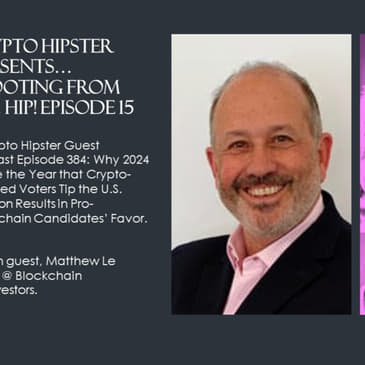

Matthew Le Merle is Managing Partner and CEO of Blockchain Coinvestors.
Launched in 2014, Blockchain Coinvestors’ vision is that digital monies, commodities and assets are inevitable and all of the world’s financial infrastructure must be upgraded. Our mission is to provide broad coverage of the emerging unicorns and fastest growth blockchain companies and crypto projects. Our investment strategy is now in its 9th year and has to date invested in more than 40 pure play blockchain venture funds in the Americas, Asia and Europe; and in a combined portfolio of 750+ blockchain companies and projects including 75+ blockchain unicorns. Our funds rank in the top decile amongst all funds in their respective categories on both Pitchbook and Preqin. Headquartered in San Francisco with a presence in Grand Cayman, London, New York, Zug and Zurich, the alternative investment management firm was co-founded by Alison Davis and Matthew Le Merle.
Matthew is also Managing Partner of Keiretsu - the most active early-stage venture investors backing over 300 companies a year.
Matthew’s career has spanned being a global strategy advisor, professional services firm leader, corporate operating executive, private equity and venture capital investor, and board director. His board work has included Chairman or Non-Executive Director roles in 15 public and private companies and active Advisory Board roles in fast growth companies. Matthew’s board experience includes a broad range of industries including Digital Content/videogames, eCommerce, Fintech/Blockchain, Business Services, Consumer and Retail.
Earlier in his career, Matthew spent 21 years as a strategy, operations and corporate finance advisor to Fortune 500 CEOs, boards and executive teams with McKinsey & Company, and as a practice leader with A.T. Kearney and Monitor Group where he led both firms’ West Coast practices and at Booz & Company. He was also a corporate executive at Gap Inc. where he was SVP strategy and corporate development and SVP global marketing.
Matthew is bestselling author (The Intelligent Investor – Silicon Valley, Blockchain Competitive Advantage, Corporate Innovation in the Fifth Era, Build your Fortune in the Fifth Era, The Ministry of Bitcoin and Second Chance) and keynote speaker. He received a B.A. (Double First) and Master’s from Christ Church, Oxford, and an MBA from the Stanford Graduate School of Business. He was born in London, UK, and is now a dual US/UK citizen and lives in San Francisco and London with his wife, Alison Davis.
[00:00:00] Hello everybody and welcome to the Crypto Hipster Podcast. This is your host, Jamil Hasan, the Crypto Hipster, where I interview founders, entrepreneurs, executives, thought leaders, amazing people all around the world of crypto and blockchain.
[00:00:14] And today, today I have a special treat for everybody. The man I'm about to introduce was my very first podcast guest back in March 2021.
[00:00:25] And he is an amazing leader in this, in the Web3 and crypto blockchain. His name is Matthew Le Merle. He is the founder, CEO, Managing Director of Blockchain Coinvestors and Fifth Era. Matthew, welcome back.
[00:00:44] Great to be here and hope that we can make this interesting for your audience.
[00:00:50] I'm certain we will. So, you know, I want to first touch on your background. For those who didn't hear our first podcast, what is your background and is it a logical background for what you're doing now?
[00:01:03] Yeah, so, you know, over the years you do a variety of things and whether or not they all end up pointing in the same direction is somewhat fate. In our case, Alison and I started our careers as management consultants.
[00:01:19] And we focused on banking and technology. And we've been working on the digitalization of communications and content since the late 80s.
[00:01:30] Our clients back in those days were the world's biggest banks and the biggest technology companies. In my case, the Microsofts and Cisco's and Intel's and later on the Googles and the Ebays and the like.
[00:01:44] And we were helping them roll out the Internet and digitalize communications and content and that process is pretty much completed. We then also worked on digital finance, digitalizing finance, launching things like online and later on mobile payments and banking.
[00:02:05] I became an investor 20 years ago. Internet, fintech focused. Alison became a private equity investor and then a board director including on companies like Fiserv and First Data which are amongst the largest payment companies in the world.
[00:02:22] And all of this then brought us to about 10 years ago, a little bit more now, where we started getting interested in Bitcoin and Satoshi Nakamoto's peer-to-peer cash white paper.
[00:02:35] And for us, the big so what was that we were finally going to have a model, a prototype if you will, for digital money. And of course, since this is all software, if you can digitalize one money, you can digitalize them all.
[00:02:51] So we could see that we were going to enter into a new phase where we added digital finance and commerce to digital communications and content to have a real complete digital economy.
[00:03:04] And that's where we are. We're sort of halfway through that process, but it's a long answer, Jamil. I've done a lot of things. It's not that they were a plan. They just led to this moment and we're pretty excited about where we are today.
[00:03:18] You have a lot going on, which is great. It's fantastic. Since we last spoke, you know, 380 some podcasts later, you know, a lot has happened in crypto, right? What have been some of your highlights for blockchain coin investors since the past three and a half years?
[00:03:40] And, you know, including major updates and then I have a follow up. Yes. Thanks, Jamil. Well, in terms of what's happened to us, we've just been swept along by what's going on in blockchain.
[00:03:56] And so I prefer to answer that question. Some of the great things that have happened in blockchain are that we've continued to see the global rolling out of the technology without question.
[00:04:11] We have the first at scale use cases, stable coins, Bitcoin itself, the beginning of the digitalization of real assets, of course, Web3 as well. And hundreds of millions of people are now using these technologies and products and solutions in their everyday lives.
[00:04:33] And if you're not one of those people, you may struggle to understand why digital finance is so valuable. But those hundreds of millions of people use it every day and they can see that it's quicker, cheaper, easier. So adoption amongst institutions is also been rising quickly.
[00:04:54] But that's a little bit more around investing in things like Bitcoin than it is using the technology to change the way we do our banking, for example.
[00:05:04] That will happen later. And then from a regulatory point of view, you know, it's been a number of years since Europe and Asia really put their heads down. And created pro-innovation regulation. But the US was holding out.
[00:05:22] And as we know, the leaders of our country, including Biden and some of his team, Warren and Gensler and Grunberg, they were trying to slow all of this down.
[00:05:33] The feeling now in Washington is much more constructive and positive with both Democrats and Republicans working together to make this technology one that the US can lead in. Just as the US led in the Internet and the rolling out of Internet technology.
[00:05:50] So I feel like these are some of the things that have happened in the last three or five years that are real, they're substantial, and they just speak to a future where the digitalization of finance is inevitable.
[00:06:07] I said I had a follow up. You are in Silicon Valley. One of the few things that happened over the past three and a half years, one of them was big things, FTX. The other thing were these banking implosions.
[00:06:23] Silver against some others. And you had a bit of background in banking. A lot of people who are VCs and early stage, they did not survive the past couple years. You have. You know, what's been your key for resiliency despite all the turmoil?
[00:06:42] Okay, so there's a lot to unpack in that question. We are early stage venture investors. And as I think you know, but your audience may not know, blockchain co-investors, we have both funder funds. We're up to our fifth funder funds.
[00:06:59] And then we have two direct funds and all of them are blockchain focused. So we essentially invest in the world's best blockchain venture capital firms. And we also direct invest into crypto projects and blockchain companies.
[00:07:16] We're actually an investor in about over 1200 companies indirectly and directly, including 80 unicorns like Coinbase and Ripple and Kraken and so on. So for early stage venture investors, resiliency is to a large extent about diversification. And the reason for this is venture always has a high failure rate.
[00:07:42] 60 percent and more of venture capital backed companies fail. And all venture capitalists have to worry about diversification. We just have scaled it up to a higher level. We are very, very diversified. So in the case of FTX, we had almost we had no direct exposure to FTX.
[00:08:06] A few of our VCs, a couple of them did have direct exposure. But even for them, it was like one out of 30 investments they might have made. So FTX was very small for us in terms of direct and indirect exposure.
[00:08:23] But it was a very big bad situation that was not good for our industry. As you know, it wasn't in Silicon Valley. It was offshore. It had gone offshore because we had regulatory lack of clarity.
[00:08:37] The SEC met with FTX many, many times against limits, I think 12 times is what I recall. But but there was no examination by the SEC FTX. It was an offshore company. So we had de minimis exposure to it. So the best practices of venture are always be diversified.
[00:08:59] That's not just to have a large number of investments. It's also diversification by investment theme and by geography. And we are very diversified. So we have blockchain investing going on in Europe, North America and Asia.
[00:09:14] And we also invest across all the sub investment themes from the base layer of protocols and underlying software infrastructure up to applications like blockchain based gaming or Web 3 that uses blockchain and so on. Very cool. That sounds good to me. Thank you.
[00:09:38] So I want to get into the crux of what you talked about a little bit earlier. You said, you know, the theme has changed in Washington. You know, we're headed into a new election cycle in the U.S. and then in 30 countries around the world.
[00:09:53] And politicians are now finding themselves having to pander to a new voter base. Right. Why is that so? And how has the educated electorate evolved since the last election in 2020? Yes. Well, the macro answer to that, Jamil, is everyone's got older.
[00:10:12] And the reason why that's so important is because four years ago, almost half of the world's population was 45 and younger. And here in America, almost 50 percent of the U.S. population was 45 and younger. They're digital natives. Digital natives are pro digitalization.
[00:10:34] They want their pro crypto, their pro blockchain. They want these products and services. They're also very anti-Tradfied. Seventy five percent or more of digital natives are very unhappy with traditional finance banks, payment companies and so on. So they're not happy with the status quo.
[00:10:55] They want it to be better and they want it to be digital. Now, when four years goes by, several things happen. One is those people do get to be older, which means they represent now a larger share of the country.
[00:11:08] And obviously they represent a larger share of the voters. But they've also become more successful in their careers. They've become older. Some of them have become more affluent. Some of them have become more politically active. And so what's happening right now in America is we're getting ready
[00:11:28] for an election in November. And, you know, the Biden administration thought that this population, these voters didn't matter, that they could be ignored. Worse than that, the Biden administration was very hostile to the technologies that this population really love and want to use.
[00:11:49] And they got away with that over the last few years. But now we're heading into an election. And the electorate wants to be heard. So just to give you some numbers, there's 160. There's 300 million Americans a little bit over. There's only 160 million voters.
[00:12:11] There's any there are estimates of there's between 70 and 90 million people who already have some Bitcoin or some crypto. And most of them are digital natives, but they are voters. So depending upon how you do the mathematics, you could argue it's 90
[00:12:30] million out of 160 million who are actually pro blockchain and crypto. And of those, certainly several million are going to vote around this topic. And so we have certain organizations. One of them is called Stand With Crypto.
[00:12:51] You can go to stand with crypto and sign up if you wish. And more than a million people have so more than a million people. And this is just one organization. More than a million Americans have signed up with Stand With Crypto
[00:13:08] and are saying we want our voices heard around this topic. So now you go to Washington and you're a senator or congressman or congresswoman and you're in a fight to get elected that may be determined by one, two, three percent difference between you and the your opponent.
[00:13:29] You know, maybe it's forty nine fifty one or it's going to be forty eight percent, fifty two percent. It's these these narrow margins and you've got a huge percentage, maybe 10 percent or 15 percent of your electorate who's going to vote around this issue. We call them single issue voters.
[00:13:51] All of us care about a lot of things, but in the case of crypto, many of us are single issue voters and we're going to vote for the candidates that say that they're going to move us into a positive pro innovation, pro crypto phase.
[00:14:07] And so Democrats and Republicans, senators and congresspeople are now standing up and saying we want this innovation. We want it in America and it's going to happen. So those you said 70 percent of Americans are unhappy with TradFi, you know, and half of them are crypto native.
[00:14:30] So what do you think? I guess you're saying the impact of single issue voting is going to be is going to be important, very important. Right. How do you what do you say to the non single issue voters? What do they need?
[00:14:45] Where do they need to consider other people are considering more than just crypto and finance and innovation. They're considered the thing. So what do you say to them to help sway them to you know, to consider crypto as an option, as a voting issue? Yes.
[00:15:00] Well, well, let me say first and foremost that I do believe there are many, many issues and that you need to know which issues you care about. And then you need to make sure your elected officials represent you. And I'm not really that, you know,
[00:15:19] I'm not going to justify single issue voting. I feel like America has a lot of issues and we need to get behind working against many of those issues. It happens that the financial system and the state of the US economy is a major issue for all of us.
[00:15:40] And blockchain and crypto are wrapped up into that as well. So I sound English. I'm actually American myself. I've been an American citizen for decades now. And and I know that in America, some of our most important issues are we're spending far too much at the governmental level.
[00:16:04] We can't afford it, even though our tax rates are high and getting higher in many cases. We're borrowing an awful lot of money to do it. And the burden of that debt is becoming very, very high, a huge percentage of our GDP.
[00:16:20] And we're printing a lot more money as well. And that is actually debasing the value of the dollar. And around the world, we're under attack by others who want to displace the dollar as the global reserve currency or at least want more of their trades not to be
[00:16:39] denominated in dollars. So we have a lot of issues that I've already mentioned that are just to do with finance and the economy and money and how it works. And our monetary system is a little bit out of date. We're still very paper based. We're very people based.
[00:16:57] We're very centralized in the way we do our American banking and payments and investing in asset management. And all of that's going to be digitalized. So America has to maintain its competitiveness on a world scale. And that includes, we have to upgrade our technology.
[00:17:17] We have to upgrade the ways our monies and our commodities and our assets are handled. They're going to have to be digital. They're going to have to move quicker, cheaper, easier. So bringing it all the way back to the level of a voter,
[00:17:31] it doesn't matter where you are in America. You need a strong, viable, robust economy and monetary system. And America needs to be a global leader. And it just happens that blockchain technology is central to that, that future and the rest of the world knows it.
[00:17:51] That's why countries from China and India to the EU and the UK and Switzerland are moving quickly to be leaders in digital finance and blockchain and crypto. America has to as well. So it may not be your top issue.
[00:18:05] You know, you may care a lot more about other things, but I think the economy and the viability of the U S. Financial system has to be one of your top five issues. If you are,
[00:18:17] if you were to take the time to understand just how bad we are right now in terms of. You know, spending too much deficits that are too large borrowing. That's too much and printing too much money driving inflation. You know, high rates, et cetera, et cetera.
[00:18:33] All of those issues. I think every American cares about. And so I think it's important to understand that. I think every American cares about. And so I think you should vote with those issues in mind and
[00:18:45] blockchain just happens to be a solution to a lot of the things I just mentioned. I believe it is too. Yeah, so you, you conducted this study, you know, there are some other areas of research, right? Insights that came out of your study. What are some of those?
[00:19:04] Well, we do a lot of studies actually, Jamil. So there's three we publish every year. You can find them online at blockchain co-investors.com. We also publish newsletters every other week, which anyone can sign up for. And we share perspectives and insights,
[00:19:22] including what we're investing in and so on. In terms of the reports, we do one on global regulation that comes out twice a year. We do one on institutional adoption. What are the biggest asset managers and banks doing with this technology?
[00:19:41] And then we do one on meet the unicorns. Who are the blockchain unicorns? And what do they do? The insights I've already mentioned Jamil. So on the one hand, adoption is increasing very, very rapidly around the world. And we have these killer apps already in plain view.
[00:20:02] In terms of regulation, almost every financial center in the world either has passed or is in the process of passing pro-innovation, pro blockchain regulation. And the U S is trying to play catch up now. And thirdly, in terms of value creation,
[00:20:21] there are more blockchain unicorns than almost any other type of technology. So if you compare, I think there's 150 plus blockchain unicorns. These are companies or projects worth more than a billion dollars. More than 150 of them. There's only about a thousand or 1200 unicorns in the world across all
[00:20:41] areas of technology. And so if you look at life sciences or clean energy or AI, there's a lot more blockchain unicorns than there are from each of those types. You know, I think life sciences come second. So, so this is all what we publish.
[00:21:01] You can read it online. You can download the reports, but the big so what's blockchain is moving fast and we're moving towards a digital financial future. And it's all inevitable. And we and others are participating. A lot of people are still trying to resist all of this,
[00:21:19] but they're going to lose just as the people that tried to stop the internet now ended up losing. We all use the internet today. Even if there were people in the nineties and the zeros that didn't want us to use the internet. I agree.
[00:21:34] I want to touch on each of those three areas briefly in an area that, that might be problematic or needs further. I would like to get further, you know, the discussion on regulations. Right? There seems to be a lot and I'm tuning. I'm tuning most of this out,
[00:21:52] but most people are not tuning it out is this concept of, you mentioned digital currencies of stable points. Right? I what's like a lot of countries are in favor of it. A lot of Mark, you know, President or former president Trump came out and said, Hey,
[00:22:07] there will never be a USDC in the U S if I'm elected president. You know, what, what are the reasons for having the stable coin instead of, you know, just digital us dollar. You know, What's what do you see it as that? Yes. Okay. So,
[00:22:24] so the global monetary system has grown up over time. And it grew out of a paper, a paper age. Which means that. A lot of the processes and approaches that we use. Around the world. To move money, to handle money, to store money are actually very people.
[00:22:49] Intensive and a very paper-based. And that goes all the way up to something like Swift. Swift is the. US bank. The bank that is the most powerful. And that's the one thing that's really important. That's the one thing that's really important. And so, and so on.
[00:23:10] Swift is the. US backed global payment settlement system. That most of the world's big banks and big corporations and governments use to move money. And settle trade and so on. Well, Swift was built off a fax system. That was really about. Communication between banks to inform them that.
[00:23:34] If you're a global payment system. You have to pay a lot of money. And if you're a global payment system. You have to pay a lot of money. Will you. Debit your client with this much money. It was that sort of a thing. Swift.
[00:23:47] Is, is has been upgraded, but it's still pretty old fashioned. It takes several days. To move money. It's quite expensive. To use and it's not as secure or reliable as it needs to be. So that is one of the most sophisticated payment. I think.
[00:24:03] I think that's a good point. If you're an average American. Let's say you came from abroad and you're working somewhere, Texas or California. And you've got family abroad and you want to move some money. You will pay a lot. In maybe,
[00:24:21] maybe you have to use payday services and money, money transfer systems. And you know, your family member may not have a bank account and they may need to go and get money from a. A person that's going to charge them a lot for this money that just
[00:24:37] arrived from the U S so. So these are a couple of examples. So. So they both suffer from the same issues. They're slow. They're costly. And they're not easy to use. Digitalization solves those problems. So it's, it's, you can go back 25 years ago.
[00:24:57] I would have sent you a letter. You would have received the letter through the postal service. You would have read it. And then you would have sent me back a letter that was paper-based. Lots of people were involved. It was slow.
[00:25:09] It wasn't that costly to be fair, but it was slow. And it, and I had to buy a stamp and an envelope. And. And, and, And we were in asynchronous communication because until you receive my communication in, in several days,
[00:25:24] You couldn't respond and I wouldn't get your answer for some days. All right. We digitalized all of that. So, so today I can send an email. You'll get it straight away. It costs basically nothing. And you can send me your response almost straight away.
[00:25:38] We can do real time video podcasts streaming as we're doing right now. And, and the platform's cheap and it works. It's and everyone can listen to it. So we digitalized communications. We digitalized information sharing. But we haven't yet digitalized money.
[00:25:55] So money commodities and assets are still paper-based to a large extent. Half the world's investments are paper-based almost all the real estate, almost all the private investments, almost all the fund investments are paper-based. And even things like moving money is sort of first generation technology.
[00:26:15] So if you understand all of what I've just said, the next step's really, really easy. Just digitalize it. If we had digital monies, natively digital monies that could operate over the internet, We could move money almost instantaneously at almost no cost and anyone could do it.
[00:26:38] And when we started talking about that 10 years ago, in fact Satoshi Nakamoto wrote the peer to peer white paper, peer to peer cash, which became Bitcoin. This was a novel idea 10 years, 12 years ago. It was sort of like, well, will that work? Is it possible today?
[00:26:56] Not only does it work and it's possible, but it's really easy. So you can, you can take a stable coin, tether or circle, and you can move it on a digital platform through digit from from and to digital wallets almost instantaneously at almost no cost.
[00:27:15] And then Coinbase will let you do the same with circle over base and so on and so on. I could keep on going. I mean, there's, there's a number of live, it could be tether over Tron. You know,
[00:27:30] there's a number of ways in which people can move money cheaply and easily in real time that already work. And it's very beneficial. It's beneficial because it's quicker, cheaper and easier. It happens also to be more reliable and more secure, which is also very important.
[00:27:50] And that's why it's going to happen. This is, this is just sitting in plain view, just like emails and messaging destroyed the postal service and paper-based letters to a large extent, almost completely. So digital monies are going to destroy paper-based finance and paper-based
[00:28:13] monetary systems. And we all know it. And so the question is who's going to win? You know, who's going to win? Is it going to be private sector? Is it going to be the public sector?
[00:28:24] Is it going to be the U S is it going to be Asia or Europe? You know, who's going to get, who's going to be the big beneficiary of all of this. And we hope it will be America, which is again,
[00:28:35] going back to everyone listening to this as a voter, please take this seriously, because if America doesn't win this battle for innovation in the global financial system, it's going to cost all of us a lot because we,
[00:28:49] we have benefited hugely since the second world war from the fact that the U S was the global financial leader. We don't want to lose that. Yeah, I agree. I'm going to move into the third section. We'll come back to institutions. Unicorns,
[00:29:09] you report do things and reports on unicorns. There are a lot of people who think that that innovation is going to be driven by AI and not blockchain, but I think they work together. You know, how do you see, you know,
[00:29:27] the next few years playing out as far as that innovation and what role with what AI have will blockchain have and what other perhaps innovation will be present there as well. Yes. So first of all, you're correct, Amil, but let me just step it up one level.
[00:29:44] AI, blockchain, enterprise software, the internet of things. They're all the same thing. They're all the same thing. And what are they? They're all software. So some decades ago we started figuring out how to make computers and software do our work better. And in order to do that,
[00:30:10] we had to build a whole bunch of infrastructure. Later on, we had to connect the world together with the internet, which also was additional infrastructure. And we started gathering more and more data and we started having databases of information and data that was created by this new computing
[00:30:35] infrastructure globally. We knew back then that there was a software technology stack, if you will. And that from data, you would go to data manipulation and management. And on top of that, you would have decision making tools and technologies,
[00:30:54] including what we used to call machine learning and algorithmic decision making and so on. And then on top of all of that, we hoped one day to get to smart decisions and we felt the computer could help with that as well. So software is itself a stack,
[00:31:14] which certainly one part of which is data to information, to insights, to decision making and actions. And we have been using machine learning and other tools for decades now. So this is not new. You know, credit card companies started doing better solicitation based upon models in the nineties.
[00:31:42] Amazon started suggesting your next purchase to you in the nineties. Google started finishing your sentences when you write your email many years ago. And these are just examples. We now call all of that AI, but my point to you is that it isn't really new,
[00:32:05] but it is definitely getting better very, very fast, more capable, faster, more powerful, very, very quickly. So the innovation curve has steepened for AI. And I do think that the innovation curve has been deepened for AI. And I do think that AI just had its iTunes, iPod moment.
[00:32:30] And what I mean by that is for those of you who remember, you could have downloaded digital music in the early zeros onto your own device, but it was really, really difficult. It was really difficult. So most people didn't do it.
[00:32:45] And then suddenly we had Apple introduced the iPod and iTunes and suddenly it was really, really easy. And we all started moving over to digital music. Well, AI has been around for a long time, but it's not been the thing that Jamil or Matthew can easily use.
[00:33:04] It's been very, very hard to access. Then chat GPT and others came along and suddenly you sort of have a search browser, sorry, a search, a search cell. You type something in and you're working with AI and it's so easy. You know, so that's really important.
[00:33:23] AI has suddenly become accessible and easy to use. The other thing that's gone on in the background, which a lot of your listeners may be less aware of is the developers are now building software development tools where the AI does the first coding that they want done.
[00:33:46] It basically helps them write code. And there are AI platforms and tools now that developers can use to accelerate their code development. The reason why that's really important is the same point. If software is eating the world,
[00:34:00] the reasons why that wasn't happening faster were that it required human beings to code and they were in scarce demand and it took them time to write code. Now we've just accelerated that with, with tools, with computers and tools.
[00:34:17] So the rate of software development is also now going up very, very rapidly. So software is eating the world even quicker. So I've said a lot, but what I'm trying to say is it's just part of this same inevitable
[00:34:34] future in which we digitalize everything and we use software and computers to help us do everything we do. And we are moving into that future and blockchain is right in the middle of that because blockchain is another enabling technology. So,
[00:34:50] so AI and blockchain are all examples of next generation software and computing tools and applications. And it's new to the, to the millions of people who are voting this year, even though I, even though I haven't seen it in the last few years, even though I,
[00:35:12] even though it's been around for decades, it's new in usage to the people who are voting now. So, okay. That's a great question, Jamil. All innovations have an adoption curve. And there's a lot of has been written about this,
[00:35:28] but you have pioneers who experiment with new technologies and innovations. Then you have fast adopters and then you have, early adopters and then you have the beginnings of the majority. And then you have the late majority and you have the laggards and
[00:35:47] different models of innovation use different words. But with blockchain specifically, we're not even into the early majority yet. So, you know, we have a few hundred million people using blockchain and blockchain technology or crypto, a few hundred million. There's eight billion people.
[00:36:10] So the vast majority of people have not even really sat down and thought about this topic. You and I have, and we may have been doing this for 10 years and more, but most people have not. So that adoption curve is rolling out around the world.
[00:36:27] And it happens that the digital natives are further ahead. So going back to your question about this election, this is again, why the digital natives really matter. There's more of them than they used to be. They're more influential.
[00:36:43] They care about these technologies and they're willing to vote based upon finding representatives who agree with them and want to represent them. So by the way, that is the notion of democracy, right? We elect officials to represent us in Washington.
[00:37:00] And they are supposed to care about the things we care about. They are our elected representatives. They, they don't come up with their own ideas. They listen to their constituencies and they take to Washington. The things we care about at the local level, wherever we are. So.
[00:37:18] So that's what's happening. The digital natives are way ahead in the election. So they're not going to be able to do that. So that's what's happening. The digital natives are way ahead in the adoption curve of crypto and blockchain.
[00:37:32] They care that the vast majority of people in America are just getting their heads around it. You know, we're not the vast majority. We estimate 70 to 90 million Americans have some crypto exposure, but that still means that 200 plus million do not. So you can see the majority haven't moved,
[00:37:52] but there's a very large minority who are using these technologies every day. I love what you said about the elected officials supposed to be our constituents, you know, we're supposed to do what we asked them to do. You know, it doesn't,
[00:38:08] it hasn't in America seemed that way for the past decade and a half. I'll tell you at least people I know, you know, and I think one of the reasons there is because you have this merge of,
[00:38:21] you know, government and Wall Street together or Wall Street's in government, governments and Wall Street. You know, how do we separate the two? And what's the state of overall adoption from traditional finance? You know, I think I know the answer to that, but, you know,
[00:38:42] what are your thoughts on how to separate the, get Wall Street out of government? Well, I don't agree with that idea, Jamil. I mean, I, I do believe in democracy and I believe that every individual has a voice and you exercise your voice through the voting process.
[00:39:01] So first and foremost, if you're listening to this, if you care about crypto, please take a second to sign up for something like stand. There's a lot of them. I just happen to know stand with crypto quite well. I like them. So that's one, but there's others.
[00:39:18] So, you know, sign up with the organizations that are there to represent you and make sure your voice is heard. What I like about stand with crypto is every time there's an issue, it's they send you an email and then it's very easy for you to click and
[00:39:36] they generate for you a letter or a text that you can send to your elected official and they even give you the name and the contact details of your elected official because your local officials are the ones that need to react to your voice.
[00:39:51] To a large extent, you know, we obviously vote in America at the federal, you know, at the presidential level, at the state level and at the local level. So you get multiple chances to exercise your voice. So that's one point.
[00:40:04] So please take this seriously and tell your friends, you know, this is an election where you really matter if you're pro crypto and if you want this technology in these innovations. Now, the other way America works is through the monetary system in the
[00:40:21] case of lobbying and lobbying support and the funding of elected officials. And here there are rules and those rules make it absolutely permissible for banks or communication companies or hotel chains to make sure that they have the means to also express their voice and they can do that
[00:40:43] through lobbying and they can do it through funding initiatives. And that's true for the unions. That's true for the AARP, you know, that represents seniors in our community and so on. They all have a voice. So I think that's okay.
[00:41:03] So the question is, have we tilted the playing field in America so some people's voices count for more than others or some people's dollars count for more than others? And are there too many dollars in the system?
[00:41:18] And do elected officials as a result tip more one way than another? Because at the end of the day, we should all have our voices heard. And that is a long conversation. I'm not a political theorist or researcher, so I don't know for sure.
[00:41:38] But I sort of sympathize with your tone, Jamil. I feel like it should be back to the people in America. I sort of feel that too. It would be great if our elected officials just got back to the basics of speaking to their constituencies, understanding their concerns and
[00:41:57] representing them in Washington. I think that would be a good thing. And I'm afraid that they've become a bit disconnected. The other thing is a generational issue. So, you know, I'm a little bit older than some of the people listening to this, I suspect.
[00:42:16] I think it's time for the digital natives to find representatives at every level of government that are like them. I think we need a generational shift. I think we need more 40-year-olds or even 30-year-old elected officials.
[00:42:33] And that will only happen if those people are found, if they choose to stand and if the electorate votes for them. I feel like we've got too many people who are hanging on in there at the end of their careers.
[00:42:48] And they may not really understand always the concerns and the issues and the preferences of the next generation. So I do think that we've got a generational shift about to occur. It may not happen this election, but in four years' time, I do think
[00:43:06] that we'll see the moving of power in America to the next generation. And I think that could probably be a good thing. Yeah. I would say I'm 53. I'm not crypto native, but I'm crypto friendly. So that's the next generation, right?
[00:43:31] So I think that's a generation that could be persuaded to see things in the crypto native way. Like how do you think we can bring the rest of my generation on board? Well, so the technology speaks for itself. So let me just make that point first.
[00:43:51] I mean, this is superior technology. It's like you and I didn't have to go and tell all of our friends, you need an email account. You need a messaging account. You should look at downloading your music digitally. You should use Wikipedia. We didn't have to say that.
[00:44:08] The technologies spoke for themselves. They were just so much better. And the same is true here. If you do try and transfer some money to a friend who's on vacation in a pick a location, Africa, let's say they're in Botswana.
[00:44:26] You try and send some money to your friend in Botswana through your bank. And conversely, if your friend has a digital wallet, you try and transfer to some circle or tether to them. It's obvious which is the better, cheaper, quicker, easier. So the technologies speak for themselves.
[00:44:44] So long as we give them the opportunity to demonstrate their power. And that is the problem in America, that our regulatory, our lawmakers and our regulatory system led by Biden and Warren and Gensler and Grunberg, they've been trying to stop this innovation. There's no question about it.
[00:45:05] I mean, they can tell us and they may soon be telling us as early as in the debate on Thursday, they may be telling us that they're open minded and they're willing to take a look. And yes, it's time for some laws around blockchain and crypto.
[00:45:21] The fact of the matter is for the last four years, they've tried to stop this innovation. And so what do we need to do? So I think the first thing we need to do is we need to vote into
[00:45:34] power, elected officials that are willing to have an open mind and willing to have an open mind to innovation and want America to continue to lead. That's the first point. The second point is we should tell our friends that this matters to us.
[00:45:51] That doesn't mean that your friends need to become single issue voters, but if you say to them, look, I really care, do you care? And if they say, no, I don't care, then you say, well, let me explain why I care. Because every vote could make a difference.
[00:46:08] And then we need elected officials that represent their constituencies. And if they do that, then I think we'll eventually get to the right place. I'm absolutely sure of it. I mean, I think we've heard those cliches in the past. America always gets to the right answer.
[00:46:28] It just tries out every other answer first. I think that's the way it works. It's not just about democracy, but America is the best system of government. It just is slower and it takes time to get to the right answer. We're going to get to the right place.
[00:46:45] So if you're a crypto enthusiast listening to this, you are the future. It is going to play out in the direction you want. But can we accelerate it a bit? Yes, we can. Excellent. None of us come with a manual.
[00:47:02] We will eventually get to the right place for ourselves. So thank you very much. I want to thank you very much for your time today. I enjoyed speaking with you again and I have one last question. It's really easy.
[00:47:16] How can people find out more information about you, about blockchain co-investors? How can they do that? Yes, thank you for asking that, Jamil. So we are blockchain co-investors. Our website is blockchaincoinvestors.com. We manage funds. I'm not allowed to talk about the funds on a public podcast like
[00:47:35] this, but obviously if you're an investor and you want to learn more, just go to blockchaincoinvestors.com and you will find it very easy to contact. Now in addition, our website is full of information for people who are trying to learn about blockchain or crypto or what's going
[00:47:53] on in the space. And all of that is easy to find at the same website. There's a tab called Insights and you can sign up for the newsletter. You can watch our webinars and podcasts. You can also, there's a page called Essentials where we have
[00:48:13] links to 20 or 30 things that if you had a long weekend and you were to click on them, we think you'd get pretty sophisticated pretty quickly. So blockchaincoinvestors.com is my recommendation if they want to engage with us directly. We're in plain view. We're very transparent. Awesome.
[00:48:36] Thank you very much for your time today. Thank you.