
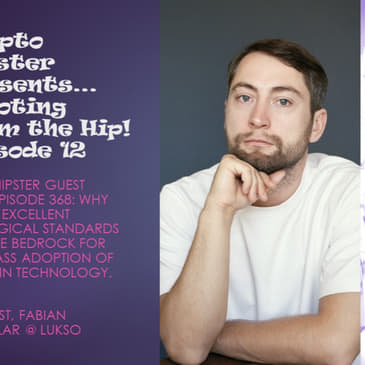

Fabian Vogelsteller was part of the Ethereum Foundation in its early days and helped shape the Ethereum ecosystem from 2015 to 2018 by building the official Ethereum Wallet, the first decentralized web3 Browser and tools like web3.js, the Blockchain space’s most used JavaScript library. In 2015 he proposed ERC20, the token standard that initiated the whole movement around DeFi protocols and created standards like ERC725, a well known Identity standard for Blockchain based accounts. He has since Co-Founded, LUKSO Blockchain, a next generation EVM blockchain based on Casper PoS that is revolutionising the way creators and users interact with blockchain technology in the New Creative Economies. With a series of new tools and standards, LUKSO aims to bring blockchain beyond De-Fi and to its next frontier; mainstream adoption.
[00:00:00] Hello everybody and welcome to the Crypto Hipster podcast. This is your host Jamil Hassan the crypto hipster where I interview founders entrepreneurs executives thought leaders artists You name it all over the world of crypto and blockchain and today I have another amazing guest. All my guests are amazing
[00:00:20] And today I have the co-founder of Luxo His name is Fabian Vogelsteller Fabian welcome to the show Yeah, thanks for having me You're very welcome. Very welcome. So let's kick things off and ask you first
[00:00:37] You know, what is your background and is it a logical background for what you're doing now? Logical background I mean in fact Yes, and no, I mean, I mean my technical background is actually I have been you know a web designer
[00:00:55] Pretty much since I'm a child. So, I mean I was since 40, you know, I created my first website since I was 14 but I actually studied media design and In 2013 I heard about you know Bitcoin got into blockchain And you know transition from the web to
[00:01:13] web design to the web 3 world and Yeah, I mean it's kind of like a distance the more like the transition to Really being coding on web 3 and now being a founder since a few years and that means I do less coding I do more orchestration of
[00:01:34] You know an architecture of ideas In 2015, I was part of the Ethereum foundation I was the lead the app developer in fact of Ethereum and I built back in the day the miss browser
[00:01:49] In 2015 and 2016 that was the first Ethereum wallet. It was the first place where you could run the apps it was the place where Yeah, that was how you interact with smart con in the early days
[00:02:04] It was also the interface that people use for the DAO. The DAO was this This big, you know smart contract that then got hacked and split the theorem into two hence why we have a theorem in a theorem classic And
[00:02:20] Yeah, I proposed ERC 20 in 2015 which is you know the standard behind all tokens And kind of coined this term if your request for comment or ERC Which then kicked off the wave of standardization in blockchain in general In 2018, you know started with my co-founder a project called Luxo
[00:02:42] Which is basically Ethereum but for normies In simple terms or the idea of actually evolving the smart connect standards that we use to build things I mean if you think about the total standard as a smart connect standard a building block tokens
[00:03:02] We are missing in fact another one and that's identity and that's your smart account So on Luxo, which is the project and we have been building the smart connect standards first and Launching then a network that functions like a theorem that launched a year ago
[00:03:22] But with those new building blocks in place and when you have those new building blocks Then you now can do a lot more things so people can innovate a lot more because they have a smart connect count by default and they have tokens and
[00:03:36] and that's kind of like That's a little bit, you know where Ethereum kind of grew into a bit more based on basically on coincidence because In a theory and it was basically people wanted tokens
[00:03:52] We came out with some early ideas out came years to 20 everybody went with it. The network effect happened That's the way everybody's running with it. Every other EBM chain is doing it this way
[00:04:04] And there has not been the place yet where people rethought these things and thought okay, how can we make it right? How can we make sure this thing is actually thought out and not just made up, you know in five minutes and
[00:04:18] How can we yeah and how can we create an ecosystem where we can you know foster these new standards and see what comes out of that So that's kind of the very brief version of you know my history
[00:04:30] That sounds good I have some follow-ups from there, you know that I will ask I will ask you once once I asked you what what makes low less luck. So a next Generation blockchain as opposed to a there. I
[00:04:48] Mean on a chain level it's a twin. That means it literally benefit It's literally a theory on the tech So all the nodes that can run a theorem can also run the next Luxo network
[00:04:59] So it is on that level it's the same the innovation is really on the smart conduct standards You know the smart conduct standards are the agreements that we have
[00:05:08] I mean if you have a program of a blockchain, right and even if for people who don't know what that even means so think of like everybody has a Computer and instead of everybody has different computers
[00:05:19] Imagine everybody's using the same computer with the same memory and the same RAM and the same CPU So now you can buy by like install little programs on this computer and because they understand computer
[00:05:30] They can just talk to each other obviously because they're all little on the same computer, right? And they're running kind of in the same environment. So that's what a program of a blockchain is in essence Except there's no admin in the computer Nobody like controls the computer
[00:05:46] But everybody can install these little programs and once they are installed they function and they do their thing A token for example is such a little program It's basically just a program that keeps in a balance sheet of like, you know
[00:05:59] Which address has which amount number and can transfer that amount number back and forth? What just change it to another address? And you know, we need to agree if we are working on the same computer with the same kind of with programs We can arbitrarily built right
[00:06:17] We need to agree on how these programs work in order that you know Somebody can build a wallet that can show all the tokens or someone else can you know? Build a cool other program that is able to interact with tokens or whatever other standards that people proposed
[00:06:31] So standardization on a completely generic You know blockchain program of a blockchain is key and Our standardization as we have seen with aetherium is kind of what led to the explosion of everything else
[00:06:44] I mean aetherium before us e20 was novel was interesting. There was a lot of like, you know early nerds to tried it out But it was not exploding it by any means fun fact the first explosion came through the ICO wave
[00:07:00] Which like you told me like you kind of joined in 2017 So you kind of joined on the peak of that wave, you know when everybody was You know all like hyped up in Throwing money left and right to whatever, you know random spoken project somebody invented
[00:07:15] Because now it was easy right because of years it was easy that you could just create a token Give it the functionality in your smart kind of protocol and say here. This is kind of necessary here
[00:07:25] And if you want to think that thing is going to be useful. You need to talk in the future So by now kind of that's the idea It quite also a lot of you know problems
[00:07:37] Down the road and a lot of projects that on the end didn't go anywhere And also obviously scams as well, but it's it's the innovation on the the order see greening on the standard that brings brings all these network effects and and this growth and
[00:07:56] The missing piece so far in blockchain is actually our smart account or the way be indirect with blockchain and the way we interact with blockchain today
[00:08:07] Is purely based on the private key and a public key and that's not going to change because that's how blockchain understands who you are but we're using the private key and public key as our as our address and
[00:08:18] If you do that now the wallet address that you have where your assets are sitting Is the is tied to the private key which is a password that you cannot change so now you're tied to the exact same password forever and
[00:08:33] You have only one access which is that one password and you can maybe copy this into different devices But the likelihood that you either lose it or someone gets, you know Device gets lost or maybe somebody gets access to it. It's extremely high hence why
[00:08:49] Using that address as a wallet is not a great idea You want to abstracted away you want to actually have your assets and your whole interactions and blockchain sitting on another address That's a program
[00:09:01] that then can be then controlled by multiple of those keys and multiple devices and you can have access control and Remove some of them add a new one and give different permissions to different of these private keys
[00:09:13] When you do this thing if it obstructs us away and we call that in blockchain account obstruction If you abstract the account away from the private key, then you can suddenly do things that that are you know? Give you a UX the user experience that grows over time
[00:09:32] Gets better over time that can change over time where the private keys or the methods you use to control your account can Improve, you know or can alter over time without that. You need to change the wallet if you will write quote unquote the wallet
[00:09:46] So on Luxo, you know, we invented this kind of Smart phone account and fun fact actually I proposed that early version of that sound up in November 2017 Right at the moment when the NFT standard was proposed as well. I proposed the Ethereum account standard
[00:10:06] I call it if the um, proxy account or something like this That's the kind of foundation for the main accounts that people use in Luxo So in Luxo is not just about hey
[00:10:18] Let's do the same old same old like every other EVM chain. Hey, let's just copy your C20 and use wallets and blah blah No, we build the smart account. We build the tools to interact with the smart account
[00:10:29] We improve the token standards. We basically made a clean slate and then improved on Um what is There and introduce the smart account as a core building block that every developer and user should use by default
[00:10:43] So now you have Ethereum but with the right foundation that has been thought out properly So the usp on luxo if you will is the smart account standards and the network effect you get around around those on luxo
[00:10:58] Rather than on an older chain, they have the network effect. They ran with esc20 Everybody already kind of decided this is what what's going to be And you can't change it anymore because people already
[00:11:10] You know everybody already chose the old so here we introduce the new on the foundation level If you will, yeah I like it I do I because I I mean I do something similar now, but I don't have the account abstraction piece. I provide wallet one about as
[00:11:31] Is intermediary I call it intermediary wallets where I move things from wallet to wallet to wallet But the end of the day, I don't have that at the access point where I could you know do the friendly user things so um You did mention
[00:11:46] Earlier, you know and I don't this is that this is a an unknown area for me because I came in in 2017 the history of the erc20 creation and The split between ethereum and ethereum classic Um, that's a gray area for me
[00:12:04] Could you walk me through the history of the erc20 standard and the creation of the split of the ethereum classic? I mean if you want to have a hiddenness I mean, there's actually a lot of books written about this because it's kind of like the
[00:12:19] They call it the biggest heist in crypto. I mean it what it's kind of like it's funnily connected, right? So erc20 basically was an early proposal I mean so ethereum launched
[00:12:31] And people realized okay, we can also make kind of like tokens or back in the day was called colored coins On a program of a blockchain. So people thought okay, let's do this, you know and vitalik the inventor of ethereum
[00:12:43] Or the one who came up with the initial idea He basically uh Wrote this very early version of of erc20 in the wiki page
[00:12:53] And we had the discussion hey, yeah, okay, so you came up with the idea make a smart contract and the smart contract holds account balances um You know that's a token. So what I did is I took this and put it into a proper specification
[00:13:07] Changed a few things and put it in to discussion In fact erc means ethereum request for comment and the idea is we get comments in we get people to To discuss and then eventually we come up with a standard
[00:13:22] It happened to be the number issue number 20. So that's a pure coincidence I just clicked an issue I created the number 20 it turned out to be the number 20 And I called it erc That on the end this standard proposal or this discussion proposal literally became
[00:13:38] The standard so people just used this as the reference document for the standard and then the name became A thing or two and hence why it's called erc20 Um There's nothing magic about the number 20 except that github chose it basically um and
[00:13:58] What happened is because of erc20 because people agreed on to a token standard Now the thing exploded, you know icos happened, you know, basically people realized oh instead of me making a whole blockchain
[00:14:08] I can just like create this token here and then people realized okay. I can raise money for my idea Lots of people had really good decentralized ideas other people just thought oh
[00:14:18] This is a great way now to to raise money and and not have to do all the building a company set up complicated law legal structure thing um But then the big problem with that came is that they needed to justify a utility for the token
[00:14:34] Which in hindsight led to a lot of projects downfalls because now they basically had to force that utility down the road Making user adoption pretty tough for them Hence why not probably 90 of those projects failed not because they were like bad ideas necessarily
[00:14:52] But because they had to force the utility of the token when all they wanted to do is raise money And if regulators in my opinion would have been open enough to say okay
[00:15:01] You can use that token also for equity probably more of these projects would have succeeded in fact Just because they could have literally just sold it as equity rather than trying to you know force a utility But long story short what happened is
[00:15:17] In fact one of those projects that you know wanted to fund a more decentralized idea was slug it and slug it Wanted to create these smart locks where a smart contract Can be paid and then opens a lock
[00:15:30] And that could be then used for a decentralized airbnb, right? So instead of having airbnb the website and the payment process on everything else just people people install at least decentralized
[00:15:42] Or smart lock that then people can pay in crypto and it will open for a period of time if paid Right, and now you have literally decentralized airbnb But because they didn't want to just raise money They thought okay like let's let's create this DAO
[00:16:00] A decentralized autonomous organization. Let's create a smart contract where everybody can put ether in And then they can vote on a proposal of what these this money is spent on And this is a like a really like kind of a governance contract like a voting contract, right?
[00:16:17] And the idea was the first proposal we will make will be slug it And because we created the whole DAO or like we initiated the smart contract People probably likely give us money too for the first proposal. Let's say at least it was your hope What happened is?
[00:16:33] The DAO happened and uh, uh, sorry he proposed that the thing became overly popular and in fact, uh It collected 150 million dollars in ether and at the time There were three percent of all ether in that smart contract um
[00:16:52] Which is today an even more significant amount but back in the day it was already big because there was nothing ever that raised that much Ever in the world, I think it's the most biggest race crowd fundraise ever ever at the time
[00:17:06] that wasn't very much topped by the four billion dollar of eos and everything else but Um at the time it was a big deal um And what happened is? There was a bug in the code
[00:17:18] So there was a there was actually a security mechanism built into the to the to the DAO And and that was If if there was a proposal made that you disagree with you could actually split up a child DAO with your votes
[00:17:33] Or other people could even follow you in that child DAO and this was a security to prevent that a majority could steal from the minority Because you could like get the biggest voters together. I said guys
[00:17:45] Let's just move all this money to us, you know and like fuck all the address in there, you know Uh, so that this cannot happen before the proposal would be executed. You can literally go into this child DAO and Split up that was a security mechanism
[00:17:58] but that security mechanism also had a flaw which is that There was a code in exactly a line of code which Which is kind of crazy when you removed all the comments. It was the line 666 Which is kind of freaky
[00:18:14] And a fun fact the person who wrote it, you know, christoph jen is a mormon I don't know if there's a subconscious You know play it here. Whatever happened. I don't know but What happened is basically key switched or two lines should have been reversed so
[00:18:34] That allowed an attacker to kind of like withdraw to a child DAO But use the same tokens without they were destroyed at this time he could do it multiple times You could draw more into his child DAO than he was supposed to
[00:18:47] Just because of two lines being swapped. Anyway, what happened is a person figured this out used it and withdrew pretty much I think one third or two third of all that ether into his own child DAO Stealing it this way
[00:19:03] So that was a big deal and because there was such a big deal and now three percent of all ethos at stake You know or like set the two percent of all ether whatever at stake and everybody panicking
[00:19:16] There was the proposal in the community to say okay, we can split it here. We can basically make a fork Where all the ether that are on the code that look like a DAO go into a refund contract and everybody gets the money back
[00:19:29] Or we keep everything as is the guy steals the money and we have to live with like, you know the fact that 2% of all ethos are gone and probably been dropped on the market and Everybody panics and everybody cries and everything dies
[00:19:42] That's kind of you know, the idea of a fork of such a fork in the past was okay The majority will choose one side And then the minority who on the the rest of the chain will follow the majority
[00:19:55] Because otherwise they are kind of their chain is valueless, right? That was the idea So the DAO or this fork in fact Showed otherwise because it showed that there was some a strong core of the community who believed really in the idea of code
[00:20:09] Is law and it shouldn't be changed And they didn't want it to fork while the majority chose to fork So the version of ethereum that you see today is the one actually who forked and refunded the DAO
[00:20:21] That is the main ethereum and ethereum classic is the one where the attacker got the money And those continue to exist in parallel one would have thought okay ethereum classic at some point, you know just disappears because It's not that much
[00:20:37] Difference or innovation but it still exists today. It has its niche community Still around so chains can split and they can split for a long time and still still be a thing and That's what happened with the DAO basically kind of creating that effect on the theorem
[00:20:57] Wow, and that was many years ago. So um Yeah, so standards like people overlook the importance of standards, you know um from what you said are very very important, so What is the important the overall importance of standards and how can they help?
[00:21:17] How can excellent standards or winning standards lead to global mass adoption of blockchain technology I mean on the end the standards is what really like allow different, you know parties Or different, uh, you know protocols or apps to interact
[00:21:36] Together. I mean it's very different to the old world in the old world. We have isolated systems, right? Everybody has the server infrastructure They maybe at best have an api, but if you use the api of another company
[00:21:48] You are always at their mercy because they could change it. They could stop it You know, they can literally kick you out So you literally at their mercy you need to have a great business Agreements and really hope that they are there forever
[00:22:01] When you have standards and you have smart contracts that are just deployed and running in a certain way If you smart contract depends on the on the the standard or the api of another smart contract
[00:22:15] You know that thing will be there forever and it's not going to change so that risk Is gone, right? So now you can build systems that literally incorporate other people's stuff Without fearing that it goes away or stops working halfway
[00:22:29] In the future that changes what you can build So now you can build actually collaborative systems where your wallet can talk to the token and the token can talk to that
[00:22:39] DeFi protocol and that DeFi protocol can call it a lending protocol and this all kind of works in concert And it's all built by different people But still it can work together Flawlessly because it's all based on either standards and these smart contracts that are unchangeable
[00:22:53] I mean what could be unchangeable? Mostly they're not changing Um So and when how does it make things user-friendly? I mean Here we come to the smart from the account, right a smart conner account
[00:23:07] When you abstract away from the private key, you can now build a user experience that is Can be looking like web 2 but it could be even better than web 2 Because now even your phone which has private keys for example in them, you know pass key
[00:23:22] Your face ID all of these are actually generated keys that do signing and then do encryptions and stuff like that So You can have devices Having their keys controlling your profile and that profile or that wallet, you know that smart conner account
[00:23:38] Uh is not just like an internet account, but it's also a wallet at the same time so it can hold things It can hold assets. It can interact with tokens. It can interact with anything on that blockchain And that makes it a little bit more than just
[00:23:53] A profile it makes it also more than a wallet It makes it literally a a decentralized internet account There is the downside though on having a smart conner account or a smart conner profile if you will
[00:24:06] On the end, it is an account or the profile that sits on the blockchain So that means whatever interactions you do when you do transactions. They are visible to everyone um Same like today, you know if you're doing something on bitcoin or ethereum
[00:24:20] Your address is visible to everyone They might not know who's behind it And I don't need to write on my profile. It's me fabian I mean I can do that but I can also have three profiles and have two that are anonymous
[00:24:33] And one that is kind of more public and then have to be a bit more picky on what I do on which right? In the ideal scenario of the future we have blockchains that are fully verifiable and fully
[00:24:47] Encrypted we do not have that right now. We have kind of like a Some that are encrypted in some way using zero knowledge proofs and others that are
[00:24:57] Fully transparent, which is most of them. Um, and there's right now not a mix between the two in a perfect way So this is more a future scenario where you can have That more fully privacy focused but verifiable account in the future. But right now
[00:25:13] Where we are is is at the public blockchain profile that doesn't necessarily need to Point to you as a person but at least points to to some address doing things But it makes everything inherently more social too, right? That's that's
[00:25:28] That's why a wallet and a profile if you mix it together Now you make blockchain social right and now you make these these address transactions social and that's what luxor is all about basically
[00:25:40] I want to get into the social. Uh, the first thing I want to do though was I wanted to find um You know new creative economies you guys mentioned that You know, you help new creative economies. What are those creative economies and how do you help them grow?
[00:25:58] I mean on the end, um, the way we phrase it is is blockchain for social culture and creators and we actually wrote a uh, what 19 called the the blueprint for the new creative economies
[00:26:15] And you know on the end what are the creative economy it's a very broad term because What's the creative economy It's in fact anyone um Yeah, you're greater with your podcast but a youtuber is a creator as well
[00:26:33] Uh an influencer on instagram is a creator as well. Uh, you know if somebody makes a fashion brand Uh, or even just like it's a designer collective. I mean nowadays we have obviously nfts and so on
[00:26:44] So basically whenever you create value or anything in the internet and in a global society That is the creative economy which pretty much entails every content producer in some sort in the world which
[00:26:56] Probably probably everybody in the internet in some version or not if they make money or not So with the creative economy, we really see Obviously the creators that we have today like musicians and you know artists and brands and so on
[00:27:11] But it's also the content creator and it's the influencer and it's the tick tocker of the of today as well so it's When we use blockchain with them, that is the creative economy, right? That's the economy between people which also is an inherently social economy
[00:27:27] Right because if you have artists your followers your fans if you have a brand you have followers and friends But even if you have just people interacting with themselves using a dao structure or some kind of governance or voting
[00:27:40] That is that is also social and that's also the creative economy. So it's a very broad term and it's a novel term But yeah, that's how how luxo started out by you know identifying more to create our economy As as the future where blockchain lies
[00:27:58] And because we have this account the smart money account everything is social hence why social culture and creators So i'm looking at social media For example, you know, you have twitter Telegram you have linkedin you have a whole bunch of stuff. That's web 2 that's centralized really You know
[00:28:22] people are looking for The adoption and the evolution of the centralized social media but to be web 3 to be fully decentralized You know what technological advancements do you feel are necessary for that to happen?
[00:28:37] I mean, so this is exactly where where is it? What are these platforms and these platforms obviously, you know Create a databases where people can post you know and and connect and all of these things But essentially that it is always a new user account, right?
[00:28:52] It's a new account system. That is not your account by the way. It is your access your email and password is your permission to access their platform Right, and if they wish so they just could delete your account at any point in time
[00:29:07] It's not yours at all. Right? They could just prevent you from accessing it. They could literally like Alter the content at will. It's it's a complete isolated. You know, it's like a company is a centralized system
[00:29:19] When we are building a decentralized account when we have a smart account We call it universal profiles when you have a universal profile on luxo That profile that wallet that account Is yours 100 percent?
[00:29:34] If you don't give access to anyone else no one has access the blockchain doesn't have an admin so Nobody can control your account but you And so now you could think of building a linkedin that uses this account at the foundation
[00:29:48] You could build, you know an x or facebook or an instagram that uses the decentralized account at the foundation So now you're creating a whole different system. You're creating a system where the user truly owns the account
[00:30:02] And uh, ideally you don't want to just have a database with posts You want to probably think of some quick decentralized version of a post feed system where people can just post things in some more decentralized version of it
[00:30:15] um, and yeah, when you do that you you have the decentralized version of social media or you know, uh Yeah, but you need the right foundation. That's what i'm trying to get to It needs to be based on that decentralized account. That's step one
[00:30:29] That's the building block number one in that and if this doesn't exist Uh, you just create a clone of the same old same old and call it and decentralize in some form, right? Or it's clunky to use anyway, so
[00:30:43] That's that's where we are starting on the on the network and the foundational standards So that people can build that kind of future And in order to have the foundation and have it built properly The most important thing underlying is the standards for that foundation Exactly
[00:31:02] It is it is this where that's the innovation on lux so it is on the standards level and not only defining these standards but building out The tooling might be built for example a browse extension. That's kind of like the like meta mask just for universal profiles
[00:31:17] Uh, we build out developer tools that can easily interact with this Uh, we're building a mobile app anybody could build a mobile app anybody could build such a browse extension Because it's standardized
[00:31:26] But we obviously built the first version of it and we built and showcase what can be done how it can look like Um, what the website could look like, you know how you can integrate it
[00:31:36] Writing documentation. It's all about the academic education and building the first building blocks for others to make it easier And build cool stuff but it's about foundations exactly. Yeah So now I have to ask I mean
[00:31:52] You said you're building a foundational comparison of you know for identity, um Like meta mask, right? Here's here's my concern with metamask every time i've used it i've lost money You know I used I don't use meta mask. I use crystal and other things, you know, um
[00:32:16] They I know i'm more comfortable with that. But you know What are your standard what are your comparative standard improvements? To to metamask what are those areas? On and how you know, what are you what are you doing this better?
[00:32:31] I mean meta mask is not really the best example because meta mask has been Uh around since many many years. In fact meta mask was born out of Uh, it was kind of like an improvement or a competition to the mist browser
[00:32:45] Back in the day when we built the first lithium wallet You had to run a full node because we wanted to make it a full decentralized way And then metamask was like the idea of okay
[00:32:55] Let's just do the same like the mist browser just in the browser and we don't run a full node We use some external node and that's where metamask came from. Sadly their their ui Hasn't really improved in ages Um, it's it's surprisingly bad
[00:33:12] And because of this bad ui People do lose money, right? They go to a scam page. It says Authorize this website or authorizes token people think nothing bad and pops the wallet just gone
[00:33:24] So it's the ui that's bad, but it's also inherently the problem of these wallets that are purely based on a private key If you make the private key the first class citizen, then you cannot have Permissions you cannot change the private key and still keep the same address
[00:33:41] you can You can literally do nothing besides having, you know your account and move your money around. Um What we are Having is this smart content account that means now
[00:33:52] The wallet if you will which we call a profile that you have in this browser extension is your smart content address The private key that controls it there are many of them your browser extension is one Your mobile app will have another one
[00:34:06] Maybe your three other devices have completely different private keys, but they're all control the same Smart content account and because it's a smart content account. It's a little program We can now even have a key manager with permissions so you can say okay
[00:34:20] My mobile phone for example can execute but it can never change other keys So it can never you know add a new key or change the permission of an existing key So it can just like move my money around
[00:34:31] I could even authorize an app and say okay this app can use my profile But it can only talk to this one other smart contract
[00:34:38] Which I know they need to talk to but it can never talk to any of my tokens or do any any other thing so I can Make them use my profile, but I restrict it
[00:34:47] Which is for example really interesting when you want to go into a game, right in a game You want to ideally not have another wallet in the game with another place to manage stuff and then later to move it
[00:34:56] Out or whatever. You want to be the same profile again in the game You want to come with your stuff and you want to leave with your stuff So now you can give access from that to this game, right? You can basically say here game
[00:35:07] Generate a key I authorize it in my profile give it some restrictions And then I can be me there as well. So that changes everything because now you can have a fluid
[00:35:18] Way of how you move between different apps or games or devices whatnot while being and maintaining the same address on chain obviously, that's not great for privacy reason but it's specifically useful for
[00:35:30] For publicity, you know for collectors for ease of use and for like trying if you're a gamer for example You want to be recognized? Yeah, you want to take your stuff around you want to be the same person everywhere
[00:35:41] It's not about privacy is about publicity. This is literally why you do it. That's how you gain reputation, right? So it's it's that use case really like that kind of more, you know social use case again
[00:35:52] And there's a lot more technical details of why the smart con account is useful and what else it can do is not just uh, you know the permission system But it completely allows to abstract the way You can create any kind of user experience now
[00:36:09] Including social recovery or or any kind of recovery idea you could have you could build it on top of this So you could have a time lock where if you don't have access or when there's no
[00:36:20] Transaction happening for over three months then that other wallet that you have somewhere safe will gain access to the thing instantly Or you could come up with some cool ideas, you know um
[00:36:32] Or have a third party have only access to recover your profile but not move your money and God knows what you want to invent. So it's very flexible very versatile hence why it's a standard right a standard needs to be
[00:36:43] open enough flexible enough to not just function for one thing but functions for Anything ideally But it also needs to be a standard so it needs to be defining something cannot just be
[00:36:55] You know the the total generic system because that then you're based back to the to no standard and no definition, right? No, then you had a generic smart contract. So This balance, you know, that's kind of like the tricky part and we found that balance I believe
[00:37:09] And that what makes universal profiles and luxus so unique It's the first of its kind blockchain that takes this approach Every other blockchain just took the approach of a different name and better consensus and mostly that turned out to be more decent more centralized than decentralized
[00:37:25] And then a different name and then saying the better chain for defy or the better chain for nfts or the better chain for whatever Which mostly just meant that exact same Just a different color and a different name That even rhymes but uh, yeah
[00:37:42] I like it. It is a fine balance between Saying whatever goes And saying, you know, we're flexible. We're going to bend but these are the this is this This is the you know mandate that's that's a it's a tight like a tight rope. So
[00:37:56] Yeah, i'm excited to see how everything plays out in the future so I want to thank you very much for joining me today Um, I enjoyed I enjoy thank you for the history lesson and thank you for explaining to me what you guys do at luck
[00:38:09] So I really appreciate it. I have one last question Um, and it's people find out more information about you about luxo When can they start to use your your standards protocol? How how can how can they do that?
[00:38:23] Yeah, I mean so the luxo network actually is live since a year But the universal profile uh standard and browser extension the main way to interact with it is live since about a few months Uh and very busy or like active is to change this around five months
[00:38:38] So you can go to actually the best place to start is you go to universal profile dot cloud That's where you can see the profiles of other people Uh, that's where you could see the profiles of other people and uh, that's where you can uh
[00:38:55] Uh create your own profile as well. You can insert a browse extension. You can you know, uh Yeah, go indirect with luxo right away and we are basically initially we're subsidizing the gas So that deploying the contract and even interacting with luck
[00:39:09] So doesn't require you to have lux and go to an exchange and do all the hustle you just literally need to create the browse extension and Go go do something. You know, there's a marketplace an nft marketplace
[00:39:21] Um, there's common ground is a chat application where there's all the communities right now People are creating a lot of meme coins. So right now it's nfts and meme coins. That's what people do um
[00:39:32] And if you're a builder you can literally now build anything social on on blockchain and uh, It's the right foundation for that. So As a builder, that's the place you want to go as a user universal profile dot cloud
[00:39:45] Go figure it out create a profile see what other people do and collect and uh, yeah like that's we all go from there I'd say Awesome. Thank you very much for your time today Thank you so much. Yeah