
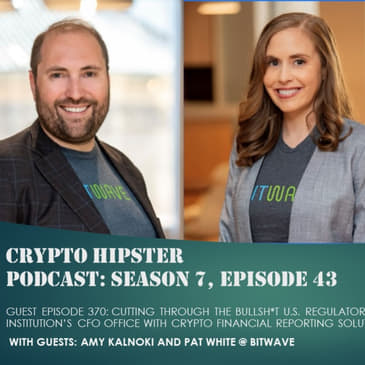

Amy Kalnoki is the Co-Founder and COO of Bitwave, the #1 digital asset finance platform for enterprises. Bitwave automates accounting workflows, enables regulatory compliance, reduces tax burden complexity, streamlines payments, and unifies data with a modern, connected platform.
Amy is a serial entrepreneur and technology industry veteran with expertise in enterprise software sales, accounting, and cryptocurrencies. Prior to Bitwave, Amy co-founded Synata, an enterprise search engine that was acquired by Cisco in 2016.
Amy is passionate about the potential for blockchain technology to change the world, and she is committed to simplifying the complexities of digital assets for organizations. Amy is also a co-host of the podcast The DeFi Daily.
Featured In:
Speaker at Messari Mainnet 2023
Speaker at NFT NYC 2023
Speaker at NFT Paris
Pat White is the Co-Founder and CEO of Bitwave, the #1 digital asset finance platform for enterprises.
Bitwave automates accounting workflows, enables regulatory compliance, reduces tax burden complexity, streamlines payments, and unifies data with a modern, connected platform.
Pat is a recognized software engineering leader with over ten years of experience building enterprise software at Intuit, Microsoft, Five9, and Fortify Software (now HP Security). Pat launched an enterprise software consulting firm (Ally Software) in 2009, which he ran for three years before creating Synata, an enterprise search engine that Cisco acquired in 2016.
Pat has contributed to Bitcoin and Ethereum codes and is deeply involved in several leading on-chain projects. He is a co-host of The DeFi Daily podcast and a University of Southern California graduate.
Featured In:
[00:00:00] Hello everybody and welcome to the Crypto Hipster podcast. This is your host Jamil Hasan the Crypto Hipster where I bring you entrepreneurs founders thought leaders executives artists
[00:00:12] You name it across the world of crypto and blockchain all around the world and today I have I have two amazing guests I usually have one amazing guest today. I have two for your listening enjoyment And this company and I were both at consensus 2024 last week
[00:00:30] Today I have Amy Kalnocki from is the CEO and co-founder and Pat White It was the CEO of bitwave Welcome to the show today. Thanks for having us. Thanks so much. Great to be here. You're very welcome
[00:00:46] So, um, I'll throw it up around Robin. I'll ask you both the same question Whoever wants to go for us can field it, you know Both your backgrounds. I'm interested in that What are your backgrounds and are they logical for what you're doing now?
[00:01:01] That's a good question. Well, I'm happy to get started. My name is Pat on the CEO of bitwave Thanks for having us on the show today. My background is I'm an engineer
[00:01:11] So I I started I got my first computer was like three years old and I've been been programming Maybe not since I was three but but not too far off of that. So I'm a very very deep technologist
[00:01:22] I love computers and I I got into crypto and I went to school for computer engineering and I in my whole enterprise my whole Career has been an enterprise software, but I got into crypto about 2010
[00:01:34] I was this was the Bitcoin white paper hit slash dot and like if you don't you know Slash dot was a really early they're still around but they've kind of lost some of their luster But if you think about like hacker news, you know
[00:01:48] 2020 years ago slash dot was the hacker news of its time and so the Bitcoin white paper made to the front page of a slash dot and Even back then it was eliciting a lot of debate I mean it was a Bitcoin wasn't the first ever digital currency
[00:02:06] It was there was actually a couple of precursors to it They had been proposed and and slash dot was the audience that knew that and it was like even back then
[00:02:13] I guess we'll stick with the hipster theme even back then there was a very hipster response to it of like well this you know This currency that actually came before there was called bits was one they come before didn't work out
[00:02:23] So why is this gonna work out? Like I knew about bits before anyone else did and so Bitcoin I read the white paper it immediately resonated with me. It was a You know for me, I I never liked banks all that much. I don't know
[00:02:36] I yeah, I didn't I didn't grow up with like all the money in the world So like I've always had a mixed relationship with banks and Banks were and so I read this paper
[00:02:47] There was like really anti banking and anti central finance and all this kind of stuff and and kind of got excited about it So I started following crypto pretty pretty carefully back then contributing some code to the Bitcoin core node
[00:02:58] And then I'll let Amy kind of pick up the story from there because we we started working on our first start together Not not too long after that actually Yeah, so, you know my background was also an enterprise software and sass startups
[00:03:11] Pat and I actually have co-founded a few startups before together The first one was in the enterprise collaboration space and then we did one called Sonata that was in the enterprise search
[00:03:22] Space so still like business B2B software while we were working on that one. We had a couple other co-founders That's when I learned about digital assets actually from Pat who like he said was passionate about about crypto and and blockchain and digital assets even back then
[00:03:39] But that was more like 2016 time frame and it wasn't really the right time to start a business a B2B Software startup in this space like the market just maybe wasn't there quite yet So we kind of put a pin in it. We worked on our other startups
[00:03:58] That last company that I mentioned was acquired by Cisco Cisco for a while and then when it was time to leave Cisco after a few years It was more like 2018 time frame and and then that was really the the moment when we thought we could bring together
[00:04:10] Our shared both backgrounds and enterprise B2B sass software and our personal passions for for crypto So I really do think that our backgrounds were a logical Starting off point for the company that we've created
[00:04:24] Because from from day one that the mission of bitwave has been to help enable digital assets for enterprise and and we kind of just started the company by Brainstorming a list and asking ourselves the question like what will businesses need when they start?
[00:04:40] Transacting in crypto and digital assets and day one They need to account for for anything that's moving in and out of the business any asset crypto included So that's kind of what we set off to build
[00:04:51] You both just reminded me of something that I had like I was in AIG until 2017 I didn't hear about it Bitcoin until after I was out of AIG. Yeah Yeah
[00:05:07] And even today there's still this this hesitance in some of the big industries the big the big financial institutions To get too deep into crypto and it's yeah
[00:05:15] I think it's a funny thing to watch from the outside where it's like all of us that are in crypto are Just so passionate about it. We see so much potential and power there and you're like, well, wait, you're not like, you know, mr
[00:05:26] Banker you're not excited about this Like this isn't you're not you're not either terrified that it's gonna completely change the nature of your business or super excited that you can
[00:05:33] You know could rewrite the rules of the financial system and and and and make you know empower people and all these other things Yeah Yeah, it's just interesting, you know But they're being disrupted by it the whole time, you know
[00:05:48] So I want to find out, you know what bitwave is all about and what you excel at Yeah, Ames you wanna Yeah, really we're bitwave Excels is with any business that has a high volume of digital asset transactions
[00:06:05] They need a way to comprehensively track that from an accounting bookkeeping tax tracking compliance revenue recognition kind of perspective So we make a full platform a suite of tools that allows bookkeepers or CPAs or you know Ops and finance folks at companies
[00:06:22] Give them the software tools that they need to keep the books and records that they're obligated to keep as a business When they have that high volume of digital asset transaction yeah, the way the way I like to talk about it is like the day that a
[00:06:38] Company decides bring digital assets onto their balance sheet. So, you know, there's this day where that happens The CTO is all excited They have a new project idea for a token or some sort of digital asset
[00:06:47] Asset system or they want to like get paid quicker whatever it is one of our clients just total aside here Went from onboarding a vendor to having a vendor Completely paid in less than like 30 minutes, you know with the full amount of a vendor being paid
[00:07:05] And I don't know for people that aren't the b2b payment space That doesn't seem like a lot But if you think about doing that in the olden days of like banks, you know in order to get paid as a company
[00:07:15] Bitwave we have to register with your your payment system. We get an ACH deposit That's a penny test that takes 24 to 36 hours to finish We go back we put it in and then you initiate the transfer and then three days later you get like
[00:07:29] The first time you get a payment It is not unusual for that to be a three four five day process to get paid And we had someone one of our customers did that in this was yesterday
[00:07:37] It was soup to nuts like less than 45 minutes to get that done So it's you know, if you're not, you know, we sort of said like there's there's all these reasons people get excited about digital assets but the same time
[00:07:50] All of those things create problems for your CFOs office So the CIO the CTO they all get super excited the CFO something has a bunch of new reporting compliance data tracking accounting tax financial Operations and FP&A problems, you know
[00:08:07] One single currency like USD to thousands and and eat than Bitcoin and different assets that They all have weird accounting rules that go along with them and that they have to be able to track the addresses
[00:08:19] They're sending to and and and who they're interacting with and make sure they're compliant with all these new Treasury Regulations and all of that. So we're bitwave really came is we wanted to help that that CFO
[00:08:29] So everything up and down the CFO stack from FP&A through to just their basic accounting attacks They can you know bitwave can basically help them out with that the day that they decide to bring digital assets onto their balance sheet
[00:08:40] That's good. So people think about it ahead of time as a project manager In my corporate days we used to get you know The areas of the business used to buy software back and just hey, hey, we bought this and we're like, oh
[00:08:56] Okay. Now we got to get to work Now the real work starts. Yeah So one of the one of the key things Last week at consensus and it kind of like was only the key thing during the week Because something happened right afterwards was this This bit 20
[00:09:17] Yeah, let's talk about that those approvals first the bit 21 approval by Congress which was then vetoed by Biden right and Then the SEC recent ETS which will get into afterwards I want to find out about BIP and fit and all these acronym names first
[00:09:33] Well, you think will be the impact to those and what the future of crypto looks like in the US Yes, it was it was a busy week and we should there's even I got this wrong Like last week as I was talking about this
[00:09:45] I screwed this all up because there were so many different bills that went that went back and forth over this So it's it's important to kind of like list them out Really deeply here so there was a bill that was that was passed by by Congress
[00:10:00] Which actually did pass both houses of Congress Which was a I'm trying to I'm looking it up really quickly. So I don't so I don't screw it up here Which was there's basically two bills that went out on is it?
[00:10:13] Pull it out here. I just want to be very very clear on this so one actually passed the house entirely and that one was specifically around this idea of Rolling back the guidance for how sab 121 works. This was there's SEC guidance that went out that was specifically
[00:10:30] That so a long time ago the SC issued guidance called sab 121 you might have heard of it What an eventually what it essentially did was in addition to kind of kneecapping institutional adoption of digital assets
[00:10:42] Or I guess as an effect of that the way what it basically did is it said that if you were holding assets crypto assets on your balance sheet on behalf of a customer You had to hold them as a liability. This is completely contrary to how how
[00:10:58] custodianship works for most Assets in the world. So so Jamal Jamal if you're cussing gold for me Let's say you start up a company that just holds on to bricks of gold for your customers
[00:11:10] You don't do anything with it. You just put it in a vault and you're cussing it for me You do not need to report that as a liability
[00:11:18] Because you are not holding that on your balance sheet. You are providing a service which is custody in this this asset You are not you I am NOT giving you the gold and you do not owe it back to me You are holding it for me
[00:11:31] But but the entire time that you you hold it it is in fact in fact my own property So what sab 121 did is it carved out an exception for digital assets? That said that's actually not how it works for digital assets
[00:11:45] So if you are a bank and you bring digital assets onto your and you are cussing them for your assets You actually have to hold them as a liability That might not seem like a big deal and honestly like most people there
[00:11:55] It's a very technocratic reason why it matters for most people It's not a big deal Like if you if you start a company purely to custody digital assets It does not matter if you're holding as a liability or off balance sheet totally doesn't matter at all
[00:12:07] It's purely a financial wrangling where it matters is if you are a regulated bank The way regulated banks one of the metrics regulated banks is that they are judged by the health of their balance sheet and the way
[00:12:20] You judge the health of the balance sheets. You look at their liabilities versus their their deposits It's a regulated bentz tend to have a actually determined Ratio of liabilities to held assets that they cannot that they cannot exceed
[00:12:35] So if I'm Bank of America and you're expecting that I have you know, 10% of my assets You know, I have physically have 10% reserves if I add a billion dollars Well Bank of America have to be like a trillion dollars But if I had a trillion dollars of crypto
[00:12:51] I suddenly have completely blown up my balance sheet and I I no longer I literally have to like sell a bunch of assets call a bunch of loans in order for my ratio my like my debt to
[00:13:02] My ratio that I need to maintain to be maintained there and so what what sab 121 does effectively made impossible for traditional financial institutions like banks and investment banks and you know
[00:13:15] The a lot of the companies are out there to hold digital assets on their books because they would it would blow up their Traditional banking practice it created this tension between digital assets in the banking practice
[00:13:26] There was then a separate bill which was the fit the fit 21 bill Which was not concerned with tab 121 it was concerned with with the regulatory guidance of what agencies Deal with what particular assets and so this is this has been needed for years
[00:13:44] so like one of the things I love to talk about this is like Government agencies we think of them as I don't know, you know big bag wolves or what like they're these big
[00:13:54] Amorphous things that just exist out there like they're not like government agencies are there's a person that runs the agency There's a budget that gets allocated like they are they are everyone's interpretation of an organization
[00:14:06] That we all live with every single day a company an organization and like any organization their self-perpetuating I mean at the end of the day no one wants to work somewhere that that they then say okay guys
[00:14:15] Next year we're going to shut down this company be and we're all not going to have jobs Like that's just not how human beings work and so government organizations are self-perpetuating that same way And so one of the things about government organizations is that they are not incentivized
[00:14:31] They are not incentivized to have clear delineation of responsibilities unless they are given that by congress And so it is in so if you think about the the different agencies that potentially have purview over crypto
[00:14:43] Are the sec the irs the ftc the consumer protection bureau a little bit Uh, and there's even a couple of other ones that kind of sneak in here cftc commodities futures trading commission That all kind of have a review over different parts of it. Well
[00:14:59] If the lines aren't clearly drawn That is in the best interest of the agencies because that means that that someone does something wrong sam Make bed free goes out there and does something wrong Three or four different agencies can all go after him for what he did
[00:15:11] Like he goes and he issues an ftx token the sec can go after him for unregistered security The cftc can go after him from unregistered commodities or go after ftx as unregistered commodities broker. There's this deep Incentive for government agencies to not self delineate
[00:15:28] Clearly the lines in the sand for what they regulate, but once they don't So fit 21 was a bill that one of the main focuses was actually very very very clearly delineating You know, what's the security? What's not who has purview? What's it? What's a commodity?
[00:15:41] What's not who has purview over commodities who has purview over securities? Who doesn't have purview over anything stuff like that and it basically came out and said very clearly it said Decentralized fully decentralized networks like ethereum and bitcoin where you have, you know high decentralization
[00:15:55] No central player controlling it. They are commodities they fall under the commodities and futures And I might I might have gotten one of the agencies wrong here. Please forgive me But there's this idea that you know, they fall into commodities
[00:16:07] Uh securities that are not in descent that are not decentralized So so assets that have one body that controls them and that were pitched as as profits earning securities They fall under the sec so it just what it did is it sought to clearly delineate lines
[00:16:21] um, it passed the house with a 71, uh with a with a bipartisan majority. So 71 democrats came over to vote for it, which is spectacular Um, but in many ways it was a show vote because there's no way that this is going to get to the senate
[00:16:36] and even if we got to the senate, there's no way we get back to the house for the ratification just because for uh, uh out of committee there Because there's a whole bunch of other bills that are coming
[00:16:44] Do we have a defense spending bill and all these other bills are coming through and congress shuts down entirely to go to go campaign In about a month and a half. So like congress like evaporates in the us
[00:16:54] Uh to go campaign in uh, as soon as like, you know, september rolls around So it was a show bill. It had no chance of really getting out this year
[00:17:01] But a lot of us kind of think that maybe it might get out next year and have a real chance Uh to be to be uh evaluated so those that was the regulatory. Yeah, sorry hams
[00:17:11] And I know I was just gonna add like I think it is a positive thing anytime you see bipartisan, um bills in the crypto space I Uh, I know pat you feel the same. I think it's unfortunate that that digital assets have become politicized
[00:17:26] Um really because I like pat believes so strongly in their potential to help Bring the financial industry into the modern era And so it is really reassuring to me when I see some bipartisan efforts and and collaboration in the space
[00:17:45] I think it's positive to see bipartisan collaboration after many years of Fighting so I can't I couldn't even it's funny that you say because I was trying to rack my brain to think of the last
[00:17:55] Like major bipartisan bill. I mean, it's it's been a hot minute like we don't have a lot of like, uh By person bills and this is a funny one
[00:18:03] It's it's a funny one to say that there's the way I like to think about there's there's like five million single issue voters Out there's the the stat that i've seen is there's like five million single issue voters that they don't care about anything besides crypto
[00:18:15] And like and it's a really true thing That's like if you're a democrat or public you look at that you're like well I don't care like this stuff doesn't matter to me either. Like why would I not why would I not go after those five million?
[00:18:25] Uh, uh, you know voters so I've voted libertarian the past two presidential elections and i'm voting independent this year So, you know, um, that's just me i'm the minority but hey, you know, um might not be a minority by november um, yeah
[00:18:44] One of the things that I think about when I think about banks I think about silvergate And I think about the banks of silicon valley that failed And you know at aig my job was to build the ccar platform
[00:18:57] so, you know, i'm looking at these bank stress tests and i'm like Wondering, you know crypto to me should be an asset. It is an asset You know, um and a deposit but definitely not a liability so
[00:19:11] Once that's once that goes through and I don't know what president biden vetoed it But um when and if it goes through, you know, what do you see as a potential for the future of the crypto industry in the us?
[00:19:25] Ames you want to talk about the the future here? Yeah, I mean I think In order to get institutional and enterprise adoption, you know real big publicly traded companies and highly regulated
[00:19:37] Financial institutions to adopt digital assets fully and for them to fully reach their potential. You need clear regulatory guidance um Businesses don't like to operate in a gray area You know, no one wants to go to jail your financial officer doesn't want to go to jail
[00:19:53] Like no one wants to break the law. Um, and so Um, so until we have that framework that people feel confident in and we get out of this period of this like ever-shifting window of regulations and guidance
[00:20:06] We won't see the full potential of digital assets in the us Realized because because people don't want to operate in the gray area They're going to move to a country or a jurisdiction And domiciled there where they have a clear framework to work in
[00:20:20] Um, because no one wants the rules changing on them midway if you're building a company and a business so I think that it we really it's time for clear regulation and guidance and then The us will continue to be the hotbed of innovation that it always has been
[00:20:37] Yeah, the way i've heard this described that I really like uh, this was a very clever person said this No, I did not come up with this What was that? You know, there's basically three types of risks that businesses take in america and america is still
[00:20:49] For for the the good parts are bad parts of america. You know, we still we still are pretty good at capitalism It's one of our our specialties
[00:20:55] Uh, there's three types of risks that the businesses in america think about they think about market risk technology risk and regulatory risk So market risk is is new coke, right? Like we're gonna launch a product and see if people buy it and that's that's you know
[00:21:08] You know, let's see what happens and and american businesses are exceptionally good at dealing with market risk It is it is what we do. It's it's like it is the core of american business Technology risk is a middle ground. That's to say like, you know, that's like tesla
[00:21:19] You know when they when or spacex is a better one when they said we're going to start a company And we think that in 20 or 10 years or 15 years we can launch a booster and re-land it And that's how we get our competitive advantage
[00:21:31] And we're like we're pretty good at that Like that's a middle ground for for companies like some businesses are great at it. Some businesses are terrible at it But like it's a middle ground across the board american businesses hate regulatory risk because it means something can change a
[00:21:46] you know, uh Trump can get elected or biden can get elected and suddenly The regulatory posture you're in is suddenly not the one that you thought you were in and you've completely changed So businesses hate regulatory risk
[00:21:57] It creates a risk to executives because they can go to jail it creates risk to your business Because it means that you're probably the whims of of politics and the whims of uh of voters Which are you know, that's that's a rough place to be
[00:22:09] And so where we are with crypto is we've we've kind of we've kind of conquered The major technology risks there's obviously we've gone through all the market risks There's a and there's great things still to be done But this regulatory risk that american companies hate is still
[00:22:26] loading out there and until we Truly get rid of that from a a overall perspective like we're just going to still be in this holding pattern Kind of fighting the good fight but but not seeing coca-cola or wal-mart get deep into digital assets because there is no world
[00:22:40] Where they're willing to sacrifice a trillion dollar business or billion dollar, you know Whatever wal-mart is now for uh, you know a 200 million dollar crypto project I'm trying to think back to new coke. That's pretty bad
[00:22:56] I don't know if I ever had you tried it. I had pepsi clear That was the one that made it into my bubble and that was it was terrible Like it was a I didn't like it at all Back club days. I used to drink jolt
[00:23:10] Oh man, jolt was the best. Yeah, that was that was mine as well. That was computer programmers living on jolt Yeah yeah, so moving on from those accounting bulletins and the uh in the vetoes and the
[00:23:23] Impact that the uh, we have etfs now for ethereum and yes for bitcoin Um, what do they both mean for enterprise crypto adoption and what other? You know, uh etfs. Do you think will come down the pipe that will shape, you know enterprise adoption? Yeah, ames you wanna
[00:23:43] Well, yeah, I mean I think the eth one is is coming right and everyone's really excited about that every time I see a uh A report on the volume of money moving in and out of the etfs like billions of dollars a week
[00:23:57] It's real money. It shows what pow is just saying like the market is there I think after bitcoin and eth it might be a longer time before we see other Um coins tokens and assets in in one of these types of funds, but you never know
[00:24:15] Yeah, I think garlinghouse did a speech brad garlinghouse did a speech there where he said um, of course xrp Cardano and I think solana he said might be possibilities. Um, I don't know what the appetite would be for them For enterprises for those three. What do you think?
[00:24:33] You know I I think what we're going to start to see is probably some baskets pop up that are kind of like holding the the blue chip
[00:24:41] tokens, I think that's I i'd be surprised if we go from like bitcoin to eth to like and we just sort of knock out Etfs for each of the major coins my kind of thinking of this is the next big thing will be a basket of blue chips
[00:24:54] Now that's obviously an issue, but that's because I it's I think it's the market for individual assets is a little bit tougher as you get away from eth and bitcoin, but but the market for either blue chips in general which might include like rip on all those or
[00:25:11] eth with with staking yields and rewards Which is the one that really is super interesting because right now it's not actually okay to do a staking reward The current etfs there's a lot of debate here. Don't get me wrong There's a lot of debate here
[00:25:24] But the current thing is it's not actually okay to do the staking rewards off of the eth eth etfs and then earn a yield that way So that's gonna be one of the things that really that has to happen because you know, you put 100 000 eth in one place
[00:25:38] You can't not stake that that's crazy to not stake that crazy crazy crazy So like we need to figure out how you actually put that eth to work
[00:25:46] Uh when you when you get it in one single place and that's that's a big open question on the etf side Trying to think here, you know used to be where like the only option was to buy an eth node And now you have staking you have restaking
[00:26:07] There's lots of other things as liquid staking just How should enterprises look at these these options? You know, um for their business needs It depends on the kind of business. I would say most businesses that are holding a good chunk of eth
[00:26:24] Should certainly be doing something like liquid staking which is that you're paying a fee for someone else to run it Uh, if you can make it work, there's you know, uh, you know companies like figment and coinbase cloud that will
[00:26:38] Uh essentially allow you to stake with your assets on their on their hardware and they'll run a fee like that So at some point there's a you have a significant enough Set of eth it becomes economical for you to run your own nodes running nodes or not
[00:26:50] I run a node on my on my desktop here actually and it's uh, it runs for You know pennies of electricity and I had to upgrade to a higher bandwidth package So let's call it like 20 bucks, but the eth node itself only cost me about 50
[00:27:04] Uh, i'm sorry about 500 to buy the physical hardware for so it's not that bad Uh, it's actually not that expensive giving the the hardware for eth There's a couple of blockchains that are more expensive
[00:27:15] But eth and a few other ones are actually not that not that bad at all Uh, so you can as a business if you have if you have it tech expertise
[00:27:22] You can certainly do it if you want to keep more of your yield and you can commit to one company You can go with the figments of the world
[00:27:28] And if you want to have the easiest ins and outs and the least amount of like wrangling liquid staking is a good option But obviously it presents the biggest counterparty risk. That's that's always something to kind of keep in mind
[00:27:41] Got it. Cool. Okay. Thank you. Um, just trying to just trying to make heads heads the tent to what is going on now You know this post fcx world before it was easy For your money
[00:27:51] Bankruptcy companies and before they become bankrupt and they'll give me a yield now. It's very different Yep, exactly And you know, the other thing is obviously changing the world is is the uh,
[00:28:00] Is interest rates? I mean, I don't know what to tell you like interest rates going up to seven percent Uh has completely changed You know, we went we wouldn't have uh, what was the company that did this? Uh Bit they went out of business. Oh my god
[00:28:14] I can't believe i'm blanking on it because I had some money in them. Um block fee Block fee. Yeah, there you go. Like we wouldn't have you know block fee would have happened if
[00:28:24] You know, it's it would have been very very different today when you have a percent interest rates Like they never would have gotten the traction they got so Yeah I have some friends in my town who are trying to sell their house
[00:28:36] Houses and and you know, seven and a half percents are tough It's tough And for a lot of us, it's the first time like I I sort of joke me
[00:28:45] I was born in the the mid 80s and and honestly, it's the first there was a very brief period of like interest rate spikes in the 90s
[00:28:52] But I was you know, I was I was a kid like I didn't remember that like this is really the first time that an entire Generation. I mean honestly arguably gen x plus the millennials have actually had high interest rates
[00:29:02] So we're relearning a lot of stuff that we kind of forgot about as a as a country Including like there's a reason that that we had such low interest rates like low interest rates are great for
[00:29:14] Uh for the economy for house buying for all this kind of stuff and it's a little it's it's interesting kind of relearning all that stuff Yeah, I ask it because I that brings me into my next question, right?
[00:29:26] We have a new we have a new environment one. It's one side. It's high interest rates. It's a new regulatory uncertainty um, and you know Amid that amid that, you know situation What are some effective strategies for businesses to achieve compliance? And mitigate future risks Use use bitwave
[00:29:52] Make it very very simple No, yeah No, I would say to pat's point. I mean it takes multiple things you need good advisors and experts in the space A lot of professionals in the space have spent now years trying to understand
[00:30:06] That ever shifting framework. I do think to pat's point You need a good software system and internal controls as a company and as a business Have a documented process of how you can do well management and things like that
[00:30:20] To make sure that you are staying compliant and that you're getting good advice and that you are automating it as much you can With a solid software system like bitwave The main thing I often say here is uh, don't not do it
[00:30:33] Like you would you would not be I mean I I would say I would say you'd be surprised But you definitely would not be surprised how many people in crypto we talked to they were like
[00:30:41] Wait, why do you what do you mean accounting and tax? Like I don't need to do any of that crypto crypto doesn't matter You don't need to account for it and like well you know that's that's one opinion and i'm not going to argue with you but uh,
[00:30:53] uh, the irs will and they'll haul your ass into court like So it's one of those things that like do do take it seriously if you're if you're a business Uh, and you want to be doing this do take it seriously
[00:31:04] You know get ahead of it bring in, you know Bring in us bring in software bring in bitwave to to do the work here and we will Uh, we can actually you know help you make sure that you get started on the right foot
[00:31:17] Well, you do you do a little bit more than accounting and tax only you you empower Efficient and secure digital asset management, right? So what are the benefits for them going with your platform, you know? Um, and and in regards to efficiency
[00:31:34] Yeah, so we don't yeah and i'll make it clear. We don't do any custody So we we only do the financial reporting side of it But a big part of that is you know, there's this idea that when you get
[00:31:44] You know some of our customers have 10 000 wallets and that's you just can't you have to think about managing 10 000 wallets Very very very differently. That's you know That's just as you start to scale and you have you know developer wallets and and treasury wallets enterprise wallets and ar wallets
[00:31:58] And you know, we'll have customers have a wallet for every person that pays them Uh, you have to think about it very very differently You have to you have to you have to think about how you manage that differently how you pull all the data together
[00:32:07] How you automate how you automate tracking it all that is just becomes a completely different beast here So that's where you really need something. Yeah, that's where you really need bitwave to basically enable that Enable that use case enable you to do that all all intelligently
[00:32:22] I'm gonna recommend my corporate friends that are I still I haven't talked to many years But you know some of them but um to go with you guys because it sounds good to me. I love it Yeah, that'd be great
[00:32:33] I have I have I want to thank you very much. Uh, yeah, um, we're talking to me today I've got a better understanding of what's going on now with the with the congress and and what you guys do and and and
[00:32:43] You know, I have one last question though Um, how can people find out more information about you about bitwave? How can they become customers? You know, how can they empower their organizations to be efficient? How can they do that? Yeah, absolutely. So come to our website bitwave.io
[00:33:00] That's bitwave.io Um, you can also reach out to info at bitwave.io. We're online on linkedin bitwave platform on twitter Uh, yeah, please reach out We'd love to chat with you hear about what you're doing in digital assets and see if there's a way we can help
[00:33:16] And i'm online at amy kelnoki on telegram on twitter and on linkedin and pat Same for you. Just your first name Yeah, i'm i'm at pat white on uh on uh twitter and I am uh on linkedin
[00:33:30] I'm patrick white on linkedin and and uh, yeah bitwave.io come and check us out We'd love to love to talk to you show you a demo of the product and connect. So thanks so much. It's been really fun
[00:33:40] Awesome. Thank you very much for your time today. Thanks. You know, thank you