
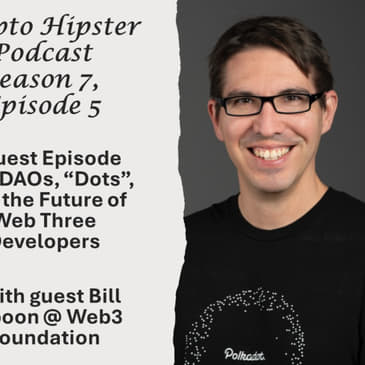

Bill Laboon is the Director of Education and Governance Initiatives at Web3 Foundation. Before this, he was a lecturer in the Computer Science Department of the University of Pittsburgh, teaching courses in software quality assurance, software engineering, and blockchain technology. He is a frequent speaker at conferences on a variety of topics, including cryptocurrency, software quality, and the ethics of software development. He is the author of two books: A Friendly Introduction to Software Testing, an undergraduate textbook; and Strength in Numbers, a near-future novel set in a world in which cryptocurrency has eliminated traditional money. Bill has a BS in Computer Science and Political Science from the University of Pittsburgh, as well as an MS in Software Design & Management from Carnegie Mellon University.
[00:00:00] Hello everybody and welcome to the Crypto Hipster podcast. This is your host, Jamil Hasan
[00:00:07] The Crypto Hipster where I bring you founders, entrepreneurs, executives, thought leaders, authors, artists, you name it all over the world of crypto and blockchain and today
[00:00:20] Today I have a special tree. I have a man from Mizzog from Crypto Valley, Switzerland he is
[00:00:26] we see that I get the title right director of education and governance initiatives at the Web 3 Foundation
[00:00:33] His name is Bill Laboon Bill welcome
[00:00:36] Yeah thank you for having me Jamil
[00:00:38] You're very welcome. I got your title right away
[00:00:41] Yeah I know it's one of the longest titles I've ever had in my life
[00:00:45] It does I think summarize what all did I do here
[00:00:49] Okay wow cool very cool very cool
[00:00:52] So let's start off. Find out first what is your background and is it a logical background for what you're doing now?
[00:00:59] Yes actually I think that my background is unlike a lot of people in crypto it actually makes a lot of sense that I ended up where I am today
[00:01:09] So I was a software engineer. I was doing research on hashing algorithm which is what got me into Bitcoin in the first place
[00:01:17] One of the few people that got into Bitcoin because they were interested in shot 256
[00:01:23] Then I taught the computer science at the University of Pittsburgh including courses on blockchain technology
[00:01:30] I got more and more interested in in blockchain and after seeing a talk by the founder of Polkadot Gavin Wood
[00:01:38] I decided I wanted to jump in full time
[00:01:41] And as you can tell from my accent I am not Swiss. I moved here from Pittsburgh in 2019
[00:01:47] And have been working at Web 3 Foundation ever since
[00:01:51] As I say you don't sound Swiss
[00:01:56] Pittsburgh awesome so very cool. So Web 3 Foundation
[00:02:01] What's that all about? What makes it great? How does the time go overall crypto landscape?
[00:02:08] Yeah so the goal of Web 3 Foundation is to build the foundation of the decentralized web
[00:02:14] And what we mean by this is that whole world of Web 3 where you own your data and have sovereignty over yourself
[00:02:24] And our main focus on doing that is helping to build Polkadot which is one particular blockchain ecosystem
[00:02:32] But we do a lot of other foundational education and research
[00:02:37] In terms of basic distributed systems, technology and cryptography
[00:02:42] We have a whole team of PhDs doing research, producing papers etc.
[00:02:48] We do also a lot of other cross-chain, cross ecosystem events such as Web 3 Summit
[00:02:55] Which we have done a few times in the past and will be doing again this year
[00:03:00] So I think that's really what makes us great is that you know we are not a mailbox here in Zug
[00:03:06] You know we are a large group of people here at the foundation doing research, doing education, helping to grow our ecosystem
[00:03:16] And the Web 3 ecosystem in general
[00:03:20] Great so let me... I haven't done much in a couple of years investigation into the Polkadot ecosystem
[00:03:30] And I know you have a lot of things that have been going on
[00:03:32] So I want to find out what the current state of the Polkadot ecosystem is
[00:03:37] And how does your Web 3 mission allow a Polkadot's mission?
[00:03:41] So the idea of Polkadot is to provide and create a space where people can build their own blockchain
[00:03:48] Or use one of a variety of blockchains that are built in the ecosystem
[00:03:52] So a phrase often that people will talk about Polkadot is it's an internet of blockchains
[00:03:58] We actually... So the basic architecture, you know I don't want to go too much into the technical details unless you're really interested
[00:04:05] We have a central blockchain called a relay chain
[00:04:08] And other blockchains can be built using a framework, the Polkadot SDK, and attached to that blockchain
[00:04:14] So that means they can interoperate with each other, communicate with each other, share in the security, etc
[00:04:20] So right now we have 49 different blockchains in the Polkadot ecosystem, connection to the relay chain, more are coming on all the time
[00:04:29] And many of these blockchains are very focused on a particular vertical
[00:04:34] So we have one blockchain for instance that is a DEX
[00:04:38] So the entire blockchain is used for as a decentralized exchange
[00:04:42] We have other blockchain that is... it is a prediction market
[00:04:45] We have another blockchain that allows people to do social media on chain
[00:04:51] And we have other chains that are essentially smart contract chains
[00:04:55] We need to do all kinds of different things, they're much more open
[00:05:00] So the idea... this is the idea of Polkadot is that if you need a smart contract, something like relatively simple
[00:05:07] You can use one of these smart contract chains that are on there if you need
[00:05:11] But if you need to develop something more complicated or something that requires its own chain
[00:05:15] That's also something you can do in the ecosystem
[00:05:18] We are... one of the most decentralized systems out there
[00:05:23] We have an extremely high Nakamoto coefficient
[00:05:26] So basically how many entities would have... of 93 last I looked
[00:05:30] Which is how many entities would have to collaborate in order to cause problems for the chain
[00:05:35] So there's actually a very decentralized
[00:05:37] We have a very powerful governance system where all decisions are made by the dot holders
[00:05:44] And we are very developer friendly
[00:05:47] So the Polkadot SDK is really powerful
[00:05:51] We always... if you look at like charts by electric capital
[00:05:54] We always are around second after Ethereum in terms of number of developers in our ecosystem
[00:05:59] I think a big reason for that is we've really focused on making it easy and powerful for developers to build on us
[00:06:08] I think two years ago you had six chains and now you said 93
[00:06:13] No sorry the Nakamoto coefficient is 93
[00:06:16] We have 49 chains
[00:06:18] 49 so you've had this growth
[00:06:21] Yes
[00:06:22] So what's led to the growth?
[00:06:24] So I think you know as I mentioned right the developers... developers developers developers
[00:06:30] That's what it all comes down to
[00:06:32] And we have really worked on providing a system that allows developers to do all kinds of things
[00:06:39] So using Rust which also is a very popular language with developers, a lot of people like that
[00:06:45] But we've had a lot of initiatives to help bring people into the ecosystem and bring these developers
[00:06:50] So the Polkadot blockchain academy for instance has held every few months in a different part of the world
[00:06:56] Where people for four weeks intensively learn how to build using the Polkadot SDK
[00:07:01] And then build on Polkadot
[00:07:03] Here at Web3 Foundation we write a lot of documentation
[00:07:08] You know in tutorials to help people learn how to build on Polkadot and understand it
[00:07:13] We provide a lot of grants
[00:07:16] So Web3 Foundation we actually just last year, at the end of last year we announced decentralized futures
[00:07:23] Where we're giving $20 million and $5 million dot to teams who are looking to build things on Polkadot
[00:07:31] So I think all of these are reasons
[00:07:34] But the main goal I think is that we're making it easy for developers to build on us
[00:07:39] And we're making it useful
[00:07:42] They can build things that are useful and we give them the power to do that
[00:07:46] And I think that's the main reason why more and more teams are coming and building on Polkadot
[00:07:50] And having that making a blockchain that joins this growing group of blockchains
[00:07:57] Very cool, very cool
[00:08:00] So I want to find out next
[00:08:04] You said magic words and developers
[00:08:06] And they're very important
[00:08:09] And recently I think it was Monday
[00:08:12] There was an announcement in the UK about ETFs
[00:08:17] And recently in the US with ETFs
[00:08:20] So Bitcoin adoption Polkadot adoption
[00:08:23] How is the recent adoption going to impact developers?
[00:08:29] So I think the big effect is going to be that more developers are going to see blockchain technology in general
[00:08:38] As a legitimate career path
[00:08:41] As something that is something they're excited about
[00:08:44] They see that large institutions are using it
[00:08:47] It's not just a few people playing around in their basement anymore
[00:08:51] This isn't 2010
[00:08:54] I think this is that a lot of people that may not have heard of Bitcoin
[00:08:58] Or if they've heard of it, they don't really know what it's about
[00:09:02] Or what is the real the why of blockchain technology
[00:09:06] And I think that like this is the early phases of a lot of people that are outside the tech world
[00:09:11] That are outside of the traditional crypto space to find out more about blockchain
[00:09:17] The big benefit of it which is that we can have a source of truth without trust
[00:09:23] And I know some of this is very simple
[00:09:26] You know like Bitcoin, it's relatively simple and straightforward
[00:09:30] And there are benefits to that as well
[00:09:32] But I think as people say, wait a second
[00:09:35] So you're saying that we can mathematically guarantee
[00:09:38] That only 21 million bitcoin will be created
[00:09:41] Well what else can I mathematically guarantee
[00:09:43] And so I think as more people think about it, they'll start thinking about other use cases for blockchain technology
[00:09:50] And I see this as sort of way, it lights the spark
[00:09:54] Bitcoin and ETFs, it's a relatively simple thing
[00:09:58] But I think it will be a good impetus for people to look more deeply into this
[00:10:03] And what they can build
[00:10:04] And then of course that's the first step to actually building something
[00:10:09] I agree
[00:10:10] So another step to build is something right
[00:10:13] Is to know what the global state of software engineering development is
[00:10:18] Right?
[00:10:19] So what is the current, like I've seen a lot of mixed things going on based on different chains
[00:10:24] You know, what is the global state of software engine development in Web3
[00:10:28] And some of the opportunities and the challenges
[00:10:31] Yeah, so it is always improving
[00:10:34] This is one of the really interesting things about blockchain
[00:10:38] Right? Is that in general everything is wide open
[00:10:41] And what this means is that failures are also seen and failures are wide open
[00:10:45] Which in some ways is bad, I feel like that people say
[00:10:48] Like oh you know, I saw this bridge failed or there was a problem here
[00:10:52] And that means that a Web3 developers are a bunch of cowboys
[00:10:55] But you know, like these same problems are occurring elsewhere
[00:10:59] And the nice thing about blockchain actually is that it's a very open culture
[00:11:03] And when problems do occur, it's evolution
[00:11:07] Right? You know we learn from those failures
[00:11:09] If you look at some of the early smart contracts sent out to Ethereum
[00:11:14] They were ridiculously full of holes
[00:11:17] And now we understand what those are and we fix them
[00:11:20] This is the same technology
[00:11:22] Excuse me, the same concept as open source technology
[00:11:24] People were very afraid of like putting their code online
[00:11:27] Because oh people will find bugs in it
[00:11:29] But what this has meant is that
[00:11:31] That's a way to harden it
[00:11:33] Right? Like you know battle hardened
[00:11:35] That people can look at the code and find problems much more quickly
[00:11:38] And I think you know blockchain technology has been that multiplied by 10
[00:11:42] Or maybe more
[00:11:44] Right? So what we're seeing actually is
[00:11:47] More and better software engineering applied to this because it is so important
[00:11:52] And people realize like the stakes are very high
[00:11:56] Like the stakes were not nearly as high 10, 15 years ago when this was all starting out
[00:12:00] But now if you look at you know polka dot we have multiple test nets
[00:12:04] We have a canary network where we put code before it goes to the main net
[00:12:08] Other ecosystems do this too
[00:12:10] I don't know how many test nets there are in Ethereum
[00:12:13] But quite a few different places where code is tried out
[00:12:16] Before it goes online
[00:12:18] We see more formal verification
[00:12:20] We see more research interest
[00:12:22] So I have seen like you know increased
[00:12:26] A level of quality
[00:12:28] You know in deploy code in projects
[00:12:30] And I think that's only going to continue to increase
[00:12:34] Now on the other hand right there also you know a lot of malicious people on the other side of that
[00:12:40] But that's you know again that provides like this you know this evolutionary pressure which actually leads to higher quality code in the long run
[00:12:46] I agree
[00:12:50] So it's interesting you said before you said we are not playing in the basement
[00:12:58] Right? It's not what I've seen since March 12
[00:13:02] I've seen a lot of degenerate people playing in the basement and grabbing millions of dollars on different chains
[00:13:09] I won't name the chains
[00:13:11] But you know I think maybe we're going backwards
[00:13:15] Sorry I didn't mean to interrupt
[00:13:19] How do you see this progress?
[00:13:23] So I think like you know all technology is going to be used for a lot of different things
[00:13:27] And so yes this is certainly an aspect of blockchain technology
[00:13:33] And we see how easy it is to make a token
[00:13:37] We see how easy it is to do something very silly
[00:13:41] And I think just like any technology there's always going to be you know some group of people you know quote unquote playing in the basement
[00:13:49] Right? You know even now you look there's people like actually I saw like you know a cobalt which is a very old programming language
[00:13:57] And you know people have been playing around with it and doing fun things with it
[00:14:00] And a new cobalt just got released
[00:14:03] But you know it's also very used a lot in business applications
[00:14:08] Right? You know when I think of a cobalt program I think that's something that's been running at some major bank for the last 50 years
[00:14:15] So I think it's the same thing right?
[00:14:17] So we are seeing this but we're also seeing like governments looking into CBDCs
[00:14:21] You know we're looking at large organizations deploying like you know deploying code to the blockchain
[00:14:28] You know we're seeing you paypal which are very web2 company like they have their own stablecoin now
[00:14:33] So yes I mean there's always going to be people you know like playing around and having fun and doing these kind of things
[00:14:40] But my I guess my point is like that's not all of the industry
[00:14:46] Right? And even though that will always be there just like they're people doing really silly things
[00:14:52] You know with regular you know C++ and Rust and Python and you know cobalt
[00:14:58] You know there are also people doing really cool interesting things pushing the boundaries of what's possible
[00:15:05] And that is what I really you know personally and focused on
[00:15:11] I see like yeah they're people having fun, let them have their fun, they're not bothering me
[00:15:15] You know while we are building the future of the decentralized internet here
[00:15:23] So when it comes to the centralized internet
[00:15:26] You know what trends not mean coins right?
[00:15:31] What trends are you seeing and what do you think will be there along lasting implications
[00:15:38] So I think the biggest trend that I'm seeing lately is DALS
[00:15:43] So distributed autonomous organizations right so the ability to have groups come to a decision
[00:15:50] Without knowing each other, without trusting each other, without maybe knowing even who these other people are
[00:15:55] To come together and have some sort of collective you know commit some sort of collective action
[00:16:01] So you know this is really important in polka dot so polka dot itself actually is we can consider it the world's largest DAL
[00:16:09] Because everything is controlled by dot holders, you know there is no multi-sig of developers that can just update the code
[00:16:16] Everything is approved by dot holders including the treasury which holds almost 39 million dot
[00:16:23] And we use to be spent on different things every upgrade has been approved by dot holders that's 52 upgrades
[00:16:30] Like this is amazing to me that you know when you look at the votes it's you know hundreds of people all over the world
[00:16:37] Many some anonymous, some not you know voting and deciding on the future of this network
[00:16:42] And to me that's amazing right and we see like smaller groups
[00:16:47] And we see a lot of Ethereum there was Constitution DAL which was you know a group trying to buy a copy of the US Constitution
[00:16:54] On we have chaos DAL and ivy, Saxonburg several governance DALs for people that agree with each other politically
[00:17:04] That want to vote on vote on different things together and like pool their voting power make collective decisions
[00:17:10] Sort of like a sub-dial governance right
[00:17:14] And DAL for people that want to contribute to charity
[00:17:20] And we have like you know interesting things you know like there's always going to be people playing in the basement
[00:17:24] We have a Kappa Sigma Moo which is a DAL that is a base membership is based on proof of ink
[00:17:31] You need to get a tattoo to make yourself into a human blockchain
[00:17:35] So I know we're on a call so people won't be able to see I guess I can't take off my shirt
[00:17:40] I have a tattoo that has my address and then a link to the previous person so we're a human blockchain me and 162 other people
[00:17:50] Wait a second I could take the shirt off and show you
[00:17:55] I'm interested to see the tattoo
[00:17:59] One second you may have to edit this pause out
[00:18:03] What's the name of that what's the name of that what's the name of that DAL?
[00:18:13] So that's a Kappa Sigma Moo which is so our Canary Network I mentioned where we put out code before it's audited just for the to try it
[00:18:22] It's a Kusama so KSM and then Kappa Sigma Moo is just like it looks kind of like that
[00:18:28] It's Greek letters
[00:18:30] I know Kusama
[00:18:32] It's very cool, very cool
[00:18:36] So the cool thing about this though is a group of people from all around the world that don't know each other
[00:18:41] But we can all decide that this person yes they got the tattoo they vote on it we all vote as new members come in
[00:18:48] I just think that's really neat right that we've gotten you know again 163 people in total including me
[00:18:55] You know to do this all around the world in a decentralized way entirely on chain to me that that's really powerful right and a real example of alternative ways that we can coordinate
[00:19:08] And I think like you know this your coordination and collective action yeah that sounds very I don't know very utopian
[00:19:15] But I mean I think that's the only way things get done right is to collective action and this is a way to help you organize that
[00:19:22] And I think that's really interesting and I see it being used more and more often both in our ecosystem and others
[00:19:29] Elective action yeah as there are only as strong as the community right
[00:19:35] Yeah, I mean you think about any anything that's done I mean there's some rare exceptions right you know but
[00:19:42] Even like you know Satoshi Nakamoto you know he developed Bitcoin he came up with the idea he wrote the paper assuming it is one person but you know he had a lot of work
[00:19:52] Excuse me a lot of work was done by others in you know in the early days he didn't develop Bitcoin on its own and its modern form
[00:19:58] You know lots of people have have joined and improved the code and done testing and you know kept kept the network running
[00:20:05] There's a lot of people involved in Bitcoin even though people say or people may think oh it's just you know just Satoshi but you think about you know anything else any government entity right not just one person any company
[00:20:18] You know even though we often lie in eyes the leaders of that company like nothing gets done without the work of a lot of people it's very rare that something is entirely out of the mind of one person
[00:20:32] Even Einstein you know he would talk to people and have them help him with the you know with the details of the math and stuff
[00:20:37] And so I think like being able to organize this was one of the early dreams of the internet right when people say hey we can communicate you know and now not only can we communicate but we can organize
[00:20:49] And I find that like really valuable that we can organize in our own way and decide who we want to interact with and what projects were working towards what goals were working towards
[00:21:00] So yeah I think it's just it's really this is a really powerful concept and we're going to be we're seeing more of it and I think we're going to be seeing more blockchains used for this going forward
[00:21:12] My idea of the Dow initially it was like a way for people who were not even thought about to be on the board of something to get an opportunity to be a board director you know
[00:21:24] But it's taking on world of its own really could be used for many things
[00:21:28] Yeah I mean that's that's the thing it's like it's like so many things
[00:21:32] I think I'm 44 I remember like you know the I got on the internet pretty early and I remember like a lot of the early internet pages were just copies of something that existed right
[00:21:44] You know like you know you newspaper like N Y times dot com looked like just a copy of the paper right
[00:21:51] And then we started seeing like oh okay now we can have comments on things and links and not just have all the words on one page
[00:21:58] And we can add images and interactive things and I think it's the same with Dallas is like you know at first they seem like like a board of directors right just they they can control someone else
[00:22:08] And there's a multi-stake they can make decisions and then tell people what to do but we're now seeing that's
[00:22:14] We can do more with that right now that we've just taken copies of what already existed we can sort of evolve
[00:22:20] You know especially with the ability to to autonomous autonomously you do things and not just say right okay hey someone off chain do this but actually cause something to happen right so
[00:22:32] One of my favorite examples in polka dot the developers the main developers of polka dot the technical fellowship are paid on chain from staking rewards that are automatically
[00:22:42] This was voted on but it automatically gets swapped for us dt for tether and the people in the technical fellowship get that's how they get their salary
[00:22:50] It's all done you know they agreed to join this they agreed like here's the salary for the different levels and it's automatically you know as the network goes on and produces staking rewards
[00:23:00] They get a portion gets swapped for us dt and that pays the developers so again like now we're seeing this you know the the machine is continuing of its own accord
[00:23:11] Right that it you know it's building staking rewards as long as people are using the network that pays the developers they improve the network it's a circle than more people use the network because they it's been improved
[00:23:23] And so I think this is what we're going to see more of like ideas we can't even consider right you know because we're still stuck somewhat in you know we have one foot in this old world and one foot in the new
[00:23:35] But yes time goes on we're going to see more and more of these interesting approaches I think
[00:23:43] I agree I agree I see the level of I don't think zest is the right word but the oil or like passion by this by the Gen Z generation you know so as time goes on and the new wave comes up you'll see it I believe
[00:24:01] We got to do things the right way though right so I want to find out your role what your definition of blockchain ethics is you know and why ethics are crucial if you want crypto to be sustainable
[00:24:18] Yeah so you ethics is always a really hard question because not only do people you disagree on what is ethical and what is not you know like even at a very fundamental level right you've got whatever this has been an argument since Plato right and like you know
[00:24:36] They ontological ethics versus utilitarian ethics versus virtue ethics it's a very complicated question that we're diving into here but I do think I'm a big believer that like you know without ethics if we just assumed everybody out there was unethical we wouldn't really get much done right and so I think one this is going to be a very weird approach I think to ethics so I apologize I try I'm imagining my old understanding
[00:25:05] might my old undergrad ethics professor like you know sort of yelling at me for this answer but you know in some ways actually I think one of the things that blockchain helps do is to remove the remove part of the need for ethics or allow us actually to make ethical decisions by by removing some other blockers to that so just to sort of get into that I promise I will this is all foundation will all make sense in a moment
[00:25:34] you know I was just reading to my son the call of the wild right and there are a lot of ethical decisions that have to be made when you are in the middle of nowhere in Alaska in the 1800s right you know it's like all right yeah I steal food someone someone else if you know if I'm going to die or you might my child is going to die and I have to steal food from someone else like hopefully this is not an ethical this is a horrible ethical dilemma and you can discuss it you know for hours but you know in today's world at least you know in a minute
[00:26:04] some you know in America or Switzerland I understand in other places is not like this you know this isn't a dilemma we have to approach right it's not something that happens on the day-to-day basis right so I think similarly blockchain helps us by removing some of these ethical decisions that we have to make and that allow us to be allow us to be more ethical simply because that your decision never never comes up right so like let's say are you
[00:26:34] at the store that I noticed no one's looking.
[00:26:36] It's like, I might be tempted,
[00:26:37] like, I'll grab a gum ball or something.
[00:26:39] But I think, no, no, if I get caught,
[00:26:41] that's really, really bad.
[00:26:42] There's like a restriction,
[00:26:43] a bit of a restriction on my behavior.
[00:26:46] And blockchain really adds
[00:26:48] like a lot of extra restrictions to what you can do, right?
[00:26:51] It says, I cannot send my,
[00:26:53] if I don't have the private key in this account,
[00:26:54] I cannot send the Bitcoin, right?
[00:26:56] This question never comes up, right?
[00:26:59] And so, well, ethics is important
[00:27:03] we have to assume that developers aren't
[00:27:05] like putting in backdoors and all of our code and stuff.
[00:27:08] There are a lot of other ways,
[00:27:10] like in some ways,
[00:27:11] blockchain's have really made ethics easier
[00:27:15] because it moved from like,
[00:27:16] don't be able to can't be evil.
[00:27:17] I can't do this.
[00:27:18] I can't just figure out someone's private key.
[00:27:22] But in the other hand,
[00:27:24] we've made some things,
[00:27:25] some kinds of scams easier
[00:27:27] because blockchain is complicated.
[00:27:29] And so we,
[00:27:31] the most common thing I see on Reddit,
[00:27:32] someone says, I'm having a problem with X, Y and Z.
[00:27:35] And what happens they get some scammer messaging them
[00:27:38] saying like, oh, you have to just go to this website
[00:27:41] and enter your seed phrase.
[00:27:42] And that'll rescink your wallet, right?
[00:27:44] So they lie.
[00:27:46] And then if people understood blockchain a bit better,
[00:27:49] I think this problem wouldn't exist.
[00:27:51] But in some ways we've caused it by making,
[00:27:55] when I say we,
[00:27:56] I mean us in the blockchain industry, right?
[00:27:58] I think a big thing we have to do is teach people this.
[00:28:03] So yeah, so sorry, long story short,
[00:28:05] I can talk about this for a long time.
[00:28:08] I think we can't change human nature.
[00:28:10] I think that most people generally like they try to be ethical,
[00:28:13] they try to be good people.
[00:28:14] There are always going to be those who aren't.
[00:28:17] But I do think there are some benefits of blockchain
[00:28:19] that we help, we help restrict that.
[00:28:22] We don't provide these opportunities for scams
[00:28:25] for cheating,
[00:28:26] for unethical behavior,
[00:28:28] because it's so easy to get caught.
[00:28:29] I mean, blockchains are totally public, totally transparent.
[00:28:33] The code is almost always open source.
[00:28:36] It's hard to cheat in that way
[00:28:37] because of this radical transparency,
[00:28:39] which also is good for ethics, at least if you look at it,
[00:28:42] you're maybe not what's in your heart,
[00:28:44] but what you end up doing, right?
[00:28:45] Because anything you do is going to be visible.
[00:28:47] So you're gonna be restricted from doing anything
[00:28:50] that's too bad.
[00:28:53] But on the other hand, I do think something we have to think about
[00:28:56] is how to prevent these scams,
[00:28:59] because they really are both a barrier for new people
[00:29:03] into the space and just bad in and of themselves.
[00:29:08] I agree.
[00:29:11] I asked, that's a good answer.
[00:29:15] Back in, I've written a 287 books to date.
[00:29:18] In my first book.
[00:29:19] 287.
[00:29:20] Oh my.
[00:29:21] My first book was on blockchain ethics back in March 2018.
[00:29:26] So I'm always interested to hear people's eye answers.
[00:29:28] So thank you.
[00:29:31] But you are also an author.
[00:29:33] You've written a textbook and another book.
[00:29:39] It's very interesting.
[00:29:40] So can you talk about your books?
[00:29:43] Sure, yeah.
[00:29:43] So my textbook, it's a friendly introduction
[00:29:46] to software testing, which is as the Dave implies,
[00:29:49] it's all about software testing.
[00:29:51] So if you're interested in building quality software
[00:29:53] and understanding how to test it,
[00:29:56] when I was teaching at undergrad,
[00:29:58] I couldn't find a good book on the topic.
[00:29:59] So I wrote one.
[00:30:00] So my other book is a novel.
[00:30:04] As you mentioned, Strength and Numbers.
[00:30:05] So it's science fiction, a near future thriller
[00:30:10] that teaches people about blockchain, mostly Bitcoin,
[00:30:13] along the way.
[00:30:15] So as you're reading the story,
[00:30:17] the character is a non-technical person.
[00:30:20] She's an English literature major
[00:30:21] at the University of Pittsburgh.
[00:30:22] Since that's where I taught.
[00:30:24] I knew the university pretty well.
[00:30:27] She learns in order to access some leftover Bitcoin
[00:30:30] from a previous tenant of her apartment.
[00:30:32] She gets sucked into an adventure,
[00:30:34] but as she does, she also learns about,
[00:30:36] and the reader learns how Bitcoin works
[00:30:39] and sees how it's set about 20 years in the future.
[00:30:42] So it's also how has society changed based on
[00:30:48] blockchain technology becoming dominant
[00:30:50] because in this future, essentially,
[00:30:52] traditional money is gone,
[00:30:53] and everything is done on the blockchain.
[00:30:58] You know, when newbies just to come to me
[00:31:01] and ask me to explain Bitcoin,
[00:31:03] I used to refer them to this atoshi way paper.
[00:31:07] It didn't go so well.
[00:31:09] Yeah.
[00:31:10] And then I started referring them to an app called Wizer,
[00:31:14] which has helped walks people through
[00:31:16] and bite-sized chunks on an app.
[00:31:19] What?
[00:31:20] If people read and understand like a novel better,
[00:31:24] I'm gonna get your book.
[00:31:25] I'm gonna read it.
[00:31:26] And I'm gonna, if this,
[00:31:28] I wanna start referring people to the readers
[00:31:31] to your books so they can understand Bitcoin better.
[00:31:34] Yeah.
[00:31:34] I mean, that really was the goal for it, right?
[00:31:36] You know, that,
[00:31:38] well, two reasons.
[00:31:39] One is, yeah, I think it's a lot easier to learn, right?
[00:31:42] As part of a novel, as opposed to just reading a textbook
[00:31:45] or a white paper.
[00:31:47] And also, I think, you know,
[00:31:49] so I wrote it in 2017 just really
[00:31:52] sort of the second or third of the waves
[00:31:55] of widespread interest in blockchain.
[00:31:59] And I think a lot of people were only looking
[00:32:01] at what was happening in 2017, right?
[00:32:03] What's happening then?
[00:32:05] And I do think something we should be aware of
[00:32:07] is like, where are we moving towards, you know,
[00:32:10] with blockchain?
[00:32:10] You know, what is going to be the future of it?
[00:32:13] And I really wanted to explore that
[00:32:15] because that's, you know,
[00:32:16] it's really what science fiction is all about, you know,
[00:32:18] when Isaac Asimov was writing about robots.
[00:32:21] He wasn't talking about what was happening
[00:32:22] in the 30s and 40s and 50s,
[00:32:24] but all right, what could happen?
[00:32:26] Right? And let's explore that and think about it
[00:32:28] and have ideas for it.
[00:32:29] And so that was really the other reason
[00:32:31] is both to teach people, you know,
[00:32:33] what is blockchain?
[00:32:34] How does it work?
[00:32:35] But also what can we do with it?
[00:32:37] And why is it important?
[00:32:40] That's wonderful.
[00:32:41] That's not a wonderful awesome.
[00:32:43] So I want to thank you very much
[00:32:46] for your time today coming on the show.
[00:32:48] I appreciate it.
[00:32:49] I look talking to you.
[00:32:50] Cool tattoo.
[00:32:52] And I have, yeah, you're welcome.
[00:32:54] I have one last question.
[00:32:55] And it's how can people find it more information
[00:32:57] about you, about Web 3 Foundation?
[00:33:00] Laura, more about Vokodot?
[00:33:02] Or 10, you said you're hosting another Web 3 Summit
[00:33:05] or 10 Web 3 Summit this year?
[00:33:07] Yeah, so for more information about Polkadot,
[00:33:10] you can go to polkadot.network
[00:33:12] or Web 3 Foundation or Web 3.foundation.
[00:33:15] Generally, you can find me on Twitter or X, as I guess
[00:33:18] it's called.
[00:33:19] I'm at Bill LeBoon.
[00:33:21] Or if you just search for Bill LeBoon,
[00:33:23] not many Bill LeBoon's out there.
[00:33:25] And so you'll probably find me somewhere.
[00:33:28] And yeah, so Web 3 Summit is happening this August.
[00:33:35] And if you go to the Web 3 Foundation page,
[00:33:37] you'll find the ability to buy tickets.
[00:33:40] It'll be held in Berlin this year.
[00:33:43] For the first time, it's been around for five years.
[00:33:45] We had a bit of a hiatus when COVID started,
[00:33:48] but we are now back and hopefully better than ever.
[00:33:52] Awesome.
[00:33:53] Awesome.
[00:33:54] Thank you very much for your time today.
[00:33:55] Yeah, thank you for having me.
[00:33:56] It's great.