
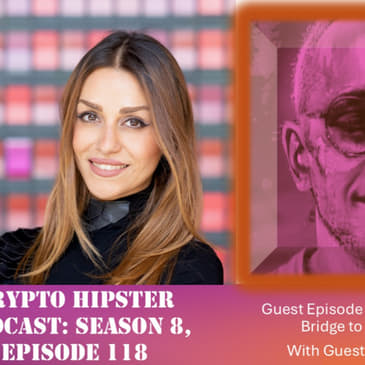

Violet Abtahi
Founder & CEO
Violet Abtahi is a serial entrepreneur and investor with a profound expertise in finance and blockchain technology. She has more than two decades of experience in the financial sector, blockchain and crypto ecosystems. Abtahi is a visionary leader on a mission to bridge the public and private blockchain worlds, shaping the next generation of financial infrastructures.
As the founder and CEO of Platonic, Abtahi spearheads the development of enterprise-grade L1 blockchain solutions, addressing real-world challenges in financial services. Through her leadership, Platonic is dedicated to building the next generation of financial markets infrastructure, in issuance and distribution of real world and native assets on chain, focusing on scalability, security, and innovation.
In addition to her role at Platonic, Abtahi is also the co-founder and president of Enya Labs, a leading blockchain developer, and the co-founder of Boba Network, a prominent public blockchain layer 2 solution. Her diverse portfolio of ventures reflects her commitment to driving innovation and advancing the capabilities of blockchain technology.
Abtahi is not only a successful entrepreneur but also a dedicated investor and advisor to thriving projects with a profound purpose to serve the future of finance and humanity. Through her strategic guidance and support, she continues to shape the landscape of finance, fostering growth and innovation in the industry.
[00:00:03] Hello everybody and welcome to the Crypto Hipster Podcast. This is your host Jamil Hasan, the Crypto Hipster, where I interview founders, entrepreneurs, executives, thought leaders, and amazing people all around the world of crypto and blockchain. And today I have another amazing guest. I have the CEO and founder of Platonic. Her name is Violet Abtahi. Violet, welcome to the show. Thank you. Happy to be here with you Jamil.
[00:00:32] I'm very happy to have you here with me. So thank you for joining me and let's kick things off. I'll ask you the first question I ask everybody is this, is what is your background and is it a logical background for what you're doing now? That's an interesting question when you put the word logical in there. Well, there's a few different ways of looking at this from a theoretical perspective. My background has always been, my strong suit is in mathematics and system design, right? So thinking about
[00:01:01] systems, how far we have come and how far we have come and how can we make them better. And I started in traditional finance, stepped into technology back in 2013.
[00:01:11] And I have never looked back and got into blockchain and crypto in full time in 2015. And it's been one of the most exciting and purposeful rights of my life. But to bring the question to answer to the question of logical or not, I think, you know, we think about the human journey as mind, body, soul, or we bring in spirituality, science,
[00:01:37] science, and human connection, and human connection are the three sides of this triangle that create a meaningful journey as a human. And I can't think of any other way but living life, other than looking at our journey, asking questions of why we're here, how can we connect on a deeper level? What are some of the problems of our time that we can solve to leave some pebbles behind?
[00:02:02] And then looking at my toolbox and thinking about how can I contribute to that solution that I am most passionate and excited about? So I would say logically, spiritually, emotionally on every front. Yes, I think I'm definitely on the right path. Awesome. So Platonic, you founded a company called Platonic. What's that all about? What is your focus, your vision, and your mission?
[00:02:31] So Platonic came about, it's been a long ride, obviously, nothing is just like you don't wake up one day and just create a company in most cases, right? It's a so many different dots connect and bring you to a point of becoming passionate enough about a problem that you want to solve, to put your life and all of your resources and your time into it.
[00:02:51] But a lot of what Platonic stemmed from was this question of, is life enough if we just wake up, work, make money, solve for our basic needs, or be stuck in survival and repeat the loop again? Is that a meaningful enough life to live?
[00:03:14] And the answer, I think, for most of us is no, right? Life is beyond that. We're here to connect. We're here for human connection. We're here as agents of evolution. We're here to answer bigger questions together than we could individually. And to do so, we need to move beyond survival mode. And I'll get into that a little bit later in the questions that you will propose.
[00:03:40] But that was the whole idea of Platonic and thinking about if our financial infrastructures are the foundation to solve a lot of our problems that relate to survival, right? Like clean air, clean food, shelter, healthcare, being able to survive in the world. How do we reimagine these financial infrastructures so that they're built to serve everyone?
[00:04:05] So to me, the next era of economics is really a socioeconomic era, right? One that can serve people that are meant to be empowered. I think that our last economic revolution was the invention of the double entry accounting system in the 15th century, right? Around the same time as the printing press, but the infrastructure gave rise to modern capitalism.
[00:04:31] We solved for some problems, but it was built for, it wasn't built for a borderless economy, for an interconnected world. It wasn't built for digital assets or programmable code because we didn't have access to those technologies back then. But we came along and based on some of the technologies that we had and some that we have built ourselves, we created an era for programmable assets, right?
[00:04:59] An era where our assets and our finances can act, they can enforce, they can fractionalize, they can settle themselves. When assets or intelligence, supply and demand can meet, right? At the right intersection and they can be directly linked by logic without layers of intermediaries or artificial scarcity, if you will, which is something that we're facing today.
[00:05:27] So, I don't think we have a resource problem today, right? But I just want to give some numbers here because I think the context of numbers, the way our brains, we have analytical brains. And when we put things in context, I think it makes more sense for our audience. So, there's a lot of examples of this, but I'm just going to use one of them. So, we have just to show that when we think about survival and coming out of survival, it's a resource and demand problem. But we have enough resources.
[00:05:57] The problem is a coordination problem. And that's the problem we can solve with blockchains and with artificial intelligence and with technology because it's intelligent, right? And it's code and it's embedded and it can break through space and time barriers. So, according to the UN, like these are some statistics, like it would take roughly about $330 billion annually to eradicate extreme poverty, right?
[00:06:24] Now, I don't think that's really an accurate number to look at. I think it's more like not how much we can spend daily, but it is more of how do we solve this problem from a foundational level. But just again, to bring it into context, that sounds like a massive number, but when we realize that that's less than 0.7% of global wealth, right?
[00:06:45] And only about 0.3% of global GDP, we realize that we can solve for this if we bring forward the right technologies. So, if you have over $400 trillion approximately or even a little bit more than that in global assets, but more of them are locked up in illiquid formats, right? And they're gated in systems that are outdated. Or just in crypto alone, somewhere around $1.5 trillion in assets are sitting idle, right?
[00:07:15] Just because of inefficiency of management of collateral, not because of the lack of supply. This is where we think about, okay, if we build systems that are intelligent enough to optimize in real time, how much faster can we solve for the problems of the world, right? How much faster can we invest in food, in shelter, in healthcare, in education?
[00:07:37] So, even if we make a fraction of this capital programmable, composable, and autonomous, all of a sudden, we will solve for a lot of the problems that humanity is facing today. So, for us, Platonic came about to be able to unlock the dynamic systems that can redirect capital based on need, right?
[00:07:59] An opportunity and a trustless logic in a way that we can activate assets that are currently passive and idle. So, supply and demand both exist, but if we have a programmable infrastructure, the fluidity and scale is what we can access. And that's why we launched the company.
[00:08:20] That's why we're excited about this operating system that can embed trust and value and activate a lot of the assets that currently we have, but they're just sitting idle. Awesome. Wow. So, there's a lot to think about there. Trying to think. So, you're saying right now our world is fragmented, and right now we're also living in survival mode.
[00:08:48] So, how do you bring that world out of survival mode? And one of the reasons I joined this industry back in 2017 was because I saw abundance, right? The opportunities for abundance. How do you get us out of survival mode and into abundance through decentralization? Yeah. So, let's look for a minute, talk about survival mode, right? And why this is just such a difficult mode for us as humanity to be in. So, when we are...
[00:09:17] Let me first actually reflect for a moment on the human potential, right? When we look at the human brain, we operate somewhere around... This is what we know. It's probably far more than that. But at the minimum, 10 to the power of 16 operations per second, right? And we have this autonomous nervous system and cardiovascular system and everything that is... We are one of the greatest technologies ever created that we know of, right?
[00:09:44] So, with all the potential that we have as humanity, the amount of creativity that we can have and problems that we can solve when we come together is really immense. But what happens is when we're in survival mode, when we are in fight or flight, whether it's because of lack of food or for hunger or lack of shelter or safety, the nervous system is locked in fight or flight, right? And our higher brain functions are offline pretty much.
[00:10:12] So, the part of brain that is called the amygdala takes over when we're in fight or flight, right? And the pre... Which is like... And the prefrontal cortex, which is the part of our brain that is responsible for creativity, for empathy, for problem solving, for human connection, is suppressed when we're in fight or flight. So, we become very reactive, we become not visionary and become kind of like the rat race, right?
[00:10:38] Like autopilot of that life that is instead of being anchored in love and joy is now anchored in fear and in a state where we can't really be that creative or feel connected. So, just to put that in perspective, that's why it is so important for us to come out of that because when we get our basic needs met, when we distribute the resources in a way that can reach the people that need it, as a race, we can come out of that.
[00:11:05] And when we're not in survival, we're thriving, right? We can solve for more problems. We can invest more of the resources that we have in solving for a lot of the illnesses that are still killing us, right? From autoimmune to cancer to education, that is still like a one-size-fits-all kind of a solution. And I think that's a really exciting life to move towards.
[00:11:27] And the way we look at how we can solve for this with blockchain and platonic or with AI, these are just tools, right? They're not the solution. They're not the why, but they're tools that give us access to breakthrough space-time barriers. Decentralization creates a trustless world.
[00:11:48] You, without any need for any intermediaries, we can really tap into creating worlds, creating markets, creating transactions, sending a supply to where the demand is. And that brings us to sovereignty, safety, and inclusion by design.
[00:12:06] So when we can bring trust and safety and inclusion into code, then we are living in a world where system is really offering us what we need in order to get to the next stage of our evolution as human race. So infrastructure becomes intelligent and secure this way, right? Humans rise out of that fight or flight in a way. And that's where human potential, in my opinion, is unlocked, is in connection and in co-creation.
[00:12:36] And love is the only way that we can actually come out of this survival and come into a world that thrives more. But in theory, when, for example, we'll look back at the past few decades of the internet. What did we do? We really took web pages, right? We took information and we took spreadsheets and we took them into web pages.
[00:12:58] So we created an Amazon marketplace, for example, and we brought low value assets and we said, hey, whatever that you need, whoever you are that's selling it and whoever you are that is buying it, we're going to bring all the tools that you need from payment to delivery to shipment. And we're going to connect you instantly without any space time barriers. With the click of a button, you can find one you need, you can order it and it can come to your door. But we can't do that with a lot of high value assets.
[00:13:25] When we're talking about financial assets, when we're talking about, you know, like your house or assets that are of high value, you can't just put a copy of an asset into the internet. That's where blockchain came along and it's a breakthrough in computer science in a way that you can put the original value on chain here.
[00:13:44] And the moment you tokenize that asset and you bring in trust into it and there's a foundational trust and you add on privacy, which we're going to touch in a little bit together, then you're living in a world where now a few hundred trillion dollars in assets are unlocked and moving. And when assets are unlocked and they can be used as collateral, they can create new assets. They can create yield. They can create more financial abundance.
[00:14:11] And again, with not a fraction of the world's wealth, we can create a world where we can have financial, like universally we can have universal earned income. Yeah. I do want to touch on that privacy perspective. Actually, let's do that first. Okay. Yeah. So privacy, I think of Monero. I think of, you know, Litecoin and Mimblewimble.
[00:14:42] I think of different efforts that have been made in crypto and blockchain over the years to solve the privacy concern while there's other entities out there fighting against privacy. But after all these areas of blockchain, after Satoshi's white paper, we still have not achieved, you know, privacy. So why is that still a critical challenge area? And especially to trust the trustless systems. And how do we get to where we should be?
[00:15:12] And if we don't get there, do we have a social system for people to have abundance? So I want to go back to the beginning of the question where you talked about privacy. To break it down, we have two kinds of blockchains currently, right? We have the public blockchains that are incredible for distribution. But when you put an asset on a public blockchain, for the most part, it's a public asset, right?
[00:15:37] And you're revealing the publicity of the data that is underlying that asset. And on the other hand, we have private blockchains, right, that could potentially be in a private information space, but they might not necessarily commingle with legacy assets or with the public blockchains on so many different levels. So the solution to this is something that can solve on multiple. It's a multi-pronged solution that we require.
[00:16:07] Because when we think about an asset today, I've used this example before, but if I tell you that there is a land on some unknown coordinate on Earth, right, and we don't know how large or how small it is and where it's located and what's around it, what is the value of that land? Unknown. Unknown, right? Like, we have no idea what the value of that land is.
[00:16:30] But the moment I tell you, these are the coordinates, and then you can look and see what is the location, what is the weather, what is around it, what is the community that lives there, what are the businesses that exist there? The data around this land and the data behind it is really what defines the value. So an asset is really the data and its behavior over time, right? So this is how really an asset is defined today.
[00:16:59] And when we think about an asset as data and its behavior, then on so many different levels and in so many different cases, the privacy of that asset actually becomes a real value as well. In so many cases, if the privacy of a data or an asset is revealed, that the value could also be diminished, right? Or the value of interacting with it could be diminished on many different ways.
[00:17:26] And that could come to the financial assets specifically. And the reason why is because of counterparty risk, right? Counterparty risk management is one of the most important elements of the world of finance. Multiple counterparties come together, right? To do something and to create financial instructions and transactions where debt is created.
[00:17:51] There's lending, there's borrowing, and there's more creation of assets and of value. But if the risk is not managed, there's always almost one party that is at most risk. And this is where our systems fail so many times, right? This is where the FTX of the world come out and so many of those problems. And there's a list of those examples that just happened in the world of crypto and in the world of traditional finance,
[00:18:18] where because of the lack of that counterparty risk management, our systems have failed us. And who pays for it? The end individual, right? Because whose money are the financial institutions holding? The individual's assets, right? And these are assets that we talk about hundreds of trillions of dollars in assets that are sitting there. Who has created that over the years? It's humanity's assets that are being managed right now.
[00:18:45] So the only way to really come to counterparty risk management is by putting that in code. Until they are in spreadsheets and in silos, we can't really manage the risk. So programmability and code is something that does unbelievable magical work for us and serves us as humanity if we use it the right way. And the reason to come back to the main point of your question, why it hasn't been solved,
[00:19:13] is that it's an incredibly difficult technical problem to solve from a cryptographic perspective, right? Like you solve for one and then the other side of it can fail because privacy is one of the hardest technical problems in blockchain. Most blockchains were built for transparency, not for nuance. So privacy isn't secrecy, it's sovereignty in so many ways.
[00:19:38] And financial privacy is essential for adoption, right? Especially by institutions. If there is no privacy, institutions will not be adopting to the technologies that we're building. So building it properly requires a mastery of cryptography, like in some cases, your knowledge proof and a lot of logic isolation.
[00:20:02] So if privacy is not a nice habit at this point for us, it must be a programmable primitive for us to be able to scale this beyond what we have scaled so far. And we're getting there, right? I think that it takes a lot of brilliance. There's no shortcuts. And, well, for us at Platonic, because this is about what we're building
[00:20:28] and this is where I am spending all of my time with the team on, that's what we have invested everything into. It's building those privacy channels that enable us to bring these hundreds of trillions of dollars in assets that require privacy and still give them the programmability facets to be able to go cross-border, cross-firm, and be unlocked. Interesting.
[00:20:59] All right. I think I hear it. Speaking to you, I keep picturing triangles. You keep speaking in threes, like sovereignty, safety, and inclusion, and then also spirituality, human, and socioeconomics, and the blockchain. Some people think of it as this boring piece of code or of technology, right? It doesn't do anything, but it's actually the intersection.
[00:21:27] It has created an intersection of social, technology, and finance, right? And financial empathy. And those three things, within those three things, is the solution, I think, right to humanity's illnesses right now. But we're kind of at an inflection point where you're digging down into privacy, and we're at the point where we still face a lot of challenges.
[00:21:54] So how can those challenges be met and solved at this, I guess, word, inflection point? Look, let's just like dive back and just like zoom out a little bit, right? When we look at the human life and ourselves, the interesting thing about us is that we move through the space-time tunnel, right? So time is the one currency that we move with in this realm, although it's relative and there's a lot of things that we can talk about on that realm.
[00:22:23] But the truth is from the dawn of innovation, what we have tried to do is to get from point A to point B faster, so that we can unlock more time for ourselves. From the innovation of the wheel to the rockets to, you know, like how do we get from this point, physical point A to B sooner, to the FaceTime and the phones? How can I hear someone's voice faster? How can I connect with you sooner? To the internet, how can we get, you know, a supply and demand faster together?
[00:22:50] How can we democratize data and information and without having to travel five days to a specific library to pull out a certain book to get access to a certain information, instantly get access, right? So innovation really is about breaking through space-time barriers and in more and more instant connections. But so what? I would say so that we have more time to connect, so that we have more time to take care of each other,
[00:23:19] so that we can have more time to love and not just connect to each other as human, but connect to nature, connect to all of life. And that is the part that we need to keep coming back to because otherwise our technologies will become really soulless. So blockchain is amazing. Artificial intelligence is amazing. The internet is amazing. Biotech, healthcare, our innovations are incredible,
[00:23:46] but all of them to serve us to live longer and more high-quality lives and to be able to connect on a deeper level. That is really the most important thing from my perspective. And I would say when you refer to our illnesses, the core of our illnesses is disconnection, right? The illness of our century is loneliness. And loneliness stems from the lack of human connection. All of us long for that.
[00:24:13] No one wants to have all the resources in the world and live with trillions of dollars alone on a planet by themselves, right? We all prefer a warm cabin with a few people that we love and a beautiful story and some music and candlelight because we thrive in human connection. That's the only way we can live, right? And from value to purpose, like that disconnection is not just from each other and from resources, but it's from our values, our purpose,
[00:24:43] the love that we have for one another. And if we are innovating and we're building technologies without thinking about that why, then we have lost the perspective in so many different levels. So I would break this down to two sides on your question, right? Like one from a technology perspective and one from a human perspective because the tech is the tool, right?
[00:25:09] And the human side is what we do with that tool. So from a tech perspective, I would say, again, let's triangles. Think about the three parameters that we need. We need to build decentralized systems that distribute power, right? And connect us in a meaningful way. We need to embark risk awareness and privacy. There's no doubt about that. We have to embed that. And we have to enable access without permission.
[00:25:38] Everyone on the planet should have the access. Access to our basic needs is our human right. The planet is a sustainable ecosystem that gives us the food that we need. It gives us all the tools to build shelter. It gives us the four elements that are the main things we need for survival, right? By birthright, this is given to all of us. So if we don't have access to it
[00:26:06] and we are in a fight or flight state where we have lack of access, that's lack of the tool in distribution. And that's where technology comes into play. So that's from a tech perspective. And those of us who are building it are responsible to keep everyone in mind. Every single human being that is living on Earth should be kept in mind when we're building these technologies. And that's where I have a lot of respect for decentralized and distributed systems.
[00:26:35] On the human side, however, we need to rebuild the culture. Culture of care, education, meaning, right? Teach not just the technical literacy, but the emotional intelligence of human connection and love and care. That nothing is more important than that. So to me, this moment that we're alive is a golden moment to be alive. It's an incredible moment to be building. We can see the past. We can look at the future. We can build for it.
[00:27:05] And it's not just a moment of technology. It's a moment to reconnect humanity to itself. A couple of things popped into my head while you were saying that. Number one is I had a call with a friend this morning. He has five miles of beach in the Bahamas where it's just him and his wife. I'm like, that sounds wonderful. It sounds wonderful for like a day, you know? Yeah.
[00:27:33] And the other one was I had to go back 10 years when you joined crypto industry. You know, I was in corporate America and across the board, you know, companies were laying off, you know, people left and right, you know? But I think of the job that I was in. I was like, I enjoyed the job. I got to create within the job, but the very fact that I had to get up every single morning, go to the same thing, come the same day, it made things rather boring, you know?
[00:28:01] So, you know, there are people out there who have been out of work. Most of the people got jobs again, but a lot of people have still out of work. And people want to make a difference, you know, and might be on the fence about Web3 or how to join this blockchain revolution. What's your, what do you think is a call to action for those who want to make a difference, who are on the fence, who don't know what to expect? What's your call to action to help them?
[00:28:31] So there's two ways to answer this question. One is from, you know, I love to zoom out and then I love to zoom back in. I think we need both perspectives in order to build and create. From a zoomed out perspective, I don't even think this is a Web3 or a blockchain perspective only to look at, right? My, I think a call to action is look at the problem and core that you truly feel the pain for and find the passion to go and solve for it.
[00:28:59] We have access to so many technologies today that you don't need a certain education, a certain background. You don't need to live in a certain part of the world. You have access to an abundance of information to bring tools to yourself to solve for a problem that you're deeply, deeply passionate about. Because the interesting thing at the beginning of the call, we talked about fight or flight and the part of brain that is responsible for creativity. The interesting thing is that there's like the normal net of the brain
[00:29:28] is this unbelievable quantum computer, right? That we study and we talk about in neuroscience. But then there's the normal net of the heart. And the normal net of the heart is where a lot of our emotions stem from there. And when the communication between the heart and the brain align, from a human biology perspective, I'm talking science. This is not some spiritual talk, which is all the same in so many ways as well. But when there's a heart-mind coherence
[00:29:56] and the neural nets of the body can communicate and every organ and every cell is in coherence with the rest of your cells, you're at your most creative state. You can create solutions you never thought would be possible. And the only way to come into that coherence is by passion. There's nothing more important than passion in life. When you're passionate about anything in life, you get connected to the source of energy you never knew you even have.
[00:30:25] So from a zoomed-up perspective, find what that passion is, right? And it's not an easy blink of an eye thing, but your passion is where you feel the most pain in so many ways in life as well. It's a very interesting road. But to bring it back and more zoomed in into Web3 and the skepticisms, yes, Web3 and blockchain is a tool. And every tool, including ourselves,
[00:30:52] is on a constant route of evolution. It fails to answer some questions. It fails to do some good things. And then it learns. And we keep rewriting the code. And today we're living in an era where the code is rewriting itself. And therefore, the innovation and evolution is happening at a much, much faster pace. So tech is just a tool. So a means to transcend the barriers of time, geography, and control in so many ways.
[00:31:21] But don't wait for the perfect system. Step in and shape it. Web3 is open. And it's alive. It's aliving. It's evolving. So is blockchain. So is AI. It belongs to those who show up with a purpose. Right? So the tool isn't as important as what we do with it. It's really what matters. So if we keep evolving our tools, but in the end don't know what we're doing with it, it won't really matter as much.
[00:31:51] So what matters is what we do with it, what is the problem we're solving, and what will you build for yourself and for the people that you care the most around you for. So the call to action is let's come together. Let's reconnect. Let's look around us. Let's lift each other up. And let's live in a world where all the technical tools are available for us to support those people who are in need.
[00:32:19] The statistics are really mind-blowing. You know, like we speak from a very privileged state here, but there's still a huge population of the world that lives with under $2 a day. That is extreme poverty. You know, there's a huge population of children that are dying of malnutrition. There's a huge population of the world that is not having access to clean water. Water is everything.
[00:32:46] It's 90% of the world and of life itself. We have solved from a macroeconomic perspective. We have solved for a lot of our problems, but we have a lot of room for growth and we have all the tools to do it. So tap into your passion. What I hear you say is if you have a powerful purpose and align it with the technology tools, then anything is possible. Yes, absolutely. Anything is possible.
[00:33:15] When we come together, Jamil, anything is possible, right? It is like what we can do by actually, if you put me by myself in a room and you give me, again, all the resources or all the tools, the passion or the motivation to do things and the capacity is still limited. But you put 10 people with brilliant minds and good intentions, right? And passion in a room. Leave them for 48 hours
[00:33:45] and come back and see what they're going to do. They can write books. They can make movies. They can build technologies. They can solve for problems. And we are meant to come together as an ecosystem. That's how the sustainable life is created on Earth, right? Like there's so much to be said and to learn about nature. When we look at the network of Earth, which is a sustainable network, right? In so many ways,
[00:34:12] the nervous system of Earth is the mycelium network of all the mycelium and all. That's the nervous system of the planet that communicates. And we are that communication, which means every tree, everything that has life and roots under the surface of Earth is connected and it's communicating. And because of this interconnectedness, we can create life. Because of that interconnectedness, there's oxygen. Because of that interconnectedness,
[00:34:41] there's a food that the planet can offer us. Because of that interconnectedness, there's the four elements that exist and life exists. If we break that interconnectedness, humanity won't survive, right? There won't be any room for us to live. There's a reason why there's life on Earth and not on some other planets. It's because of the way this ecosystem is communicating us as humanity. We are also a nervous system of human connections. And every node,
[00:35:11] just like on the blockchain, is our hearts and our brains. These are nodes that are connected on this wireless invisible realm. And what really connects us in that invisible realm is love. Love is the most powerful force that exists. Love is the force that connects all the mycelium network, all the animals. Love is the force that connects us as human. Life is the force that connects us to recreate and give birth
[00:35:41] and continue to evolve as a race. And I cannot think of a more powerful resource for us to fuel us with the passion that we need. And this is the reason why we're having this conversation, you and I. That's what connected us at the beginning, right? Our love for humanity and for connection and for a larger purpose than let's just pay the bills and survive.
[00:36:09] Yeah, sounds wonderful to me. So I want to thank you very much for speaking with me today. This has been a wonderful conversation. I enjoyed it. And I have one last question. I want to come back to what Platonic is. You know, how can people find out more information about you, about Platonic, about what you guys do, your company does? How can they be part of it? How can they do that? Yes. So to bring it all together, like from a very, what we are passionate about as a team
[00:36:38] is unlocking human potential, unlocking deeper connections, right? And when we look at our toolbox and where we have come from and where we have most expertise in and what we're passionate about is unlocking a more abundant world of finance, right? So that there is more resources in the world so that we can solve for our basic needs so that we can come out of survival and we can thrive at the end of the day at a deeper level and can real world assets
[00:37:08] at a pace and at a scale that we have never ever been able to do. So we have brought decentralization and permission, less than permission technologies and privacy and artificial intelligence and small contract technology and a bunch of other technologies together, but as a tool set to tokenize different kind of assets and to be able to monetize them and assets can also move as fast as data is moving today and in a borderless manner.
[00:37:38] That's what we're doing. We are, you can find us at platonic.io, connect with our team. If you are a builder and you're building on the realm and you want to build on our infrastructure and the operating system that we have created, we would love to talk to you. If you're a partner and you're looking to tokenize your assets or, you know, collateralize your assets, we want to speak with you and we want to support you. If you're a visionary, we want to support you. If you're an entrepreneur, we want to support you.
[00:38:07] If you're an investor in this space and you want to invest in the realm, we want to speak with you. So if you are on par with our vision and mission and on any level, we would love to connect with you. Anyone from the team can have a deeper conversation with you, including myself. Awesome. Thank you very much for your time today. Thank you, Jamil. Just one last thing. I want to say thank you because education is a huge pillar of life. Education and culture and technologies
[00:38:36] and tools go together. And with the work that people like yourself do, we're able to spread the message and remember the why, remember the what, remember the how, remember the who, and all the Ws that we need to answer in life. So thank you for the time that you spend. Thank you for your passion. Thank you for connecting with us.