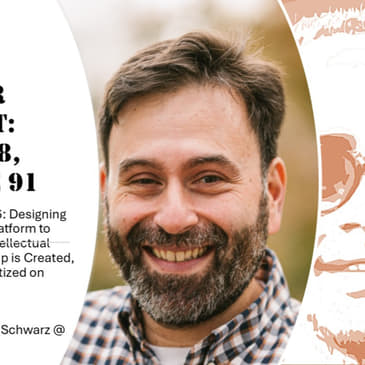

After growing up surrounded by over 20 struggling artists, performers, and art historians in his family and a decade long career as a creative director in NYC ad agencies, Jaime Schwarz filed the world's first NFT patent, "A system and method for identifying virtual goods," to advance the creative industry's security, accessibility, expression, and equity. Now that this patent has been granted, Jaime is the founder of MRKD.dj, the world's only grouped asset NFT music format that carries the rights to the splits and samples as well as the remixes themselves so everyone can truly the music because everyone can now remix, rights included. Jaime is honored to have Keith Shocklee of The Bomb Squad and Public Enemy as the front man and co-founder of MRKD.dj, set to lead the next generation of DJing, collabing, and remixing.As a serial startup co-founder, Jaime has focused on self, company, and system betterment for the past decade while living with his wife and two boys in Hastings on Hudson, NY, serving as a marketing adjunct at CUNY's CCNY and on the board of Wayfinders on the Hudson.
[00:00:03] Hello, everybody, and welcome to the Crypto Hipster Podcast. This is your host, Jamil Hasan, the Crypto Hipster, where I interview founders, entrepreneurs, executives, thought leaders, amazing people all around the world of crypto and blockchain. And today I have another amazing guest. He's the founder of Marked, MRKD. His name is Jaime Schwarz. Jaime, welcome to the show. Thanks so much for having me.
[00:00:30] You're very welcome. Thanks for joining me. And let's kick things off the way I kick things off. I ask everybody the same question, but I get amazing answers that are all different. It's all unique. So the first question is this, is what is your background and is it a logical background for what you're doing now? I did not mean it to be logical, and yet it was. I guess that's the difference between knowing the path and walking the path.
[00:00:55] I was born as the son of a psychologist and a fundraising activist. I grew up in Westchester, New York, Chappaqua, the town the Clintons moved to and took over. And once I graduated from Colgate University with a psych and philosophy double major, I went off to become a copywriter.
[00:01:14] And then just as an ad nerd, I studied at SVA, Chicago Portfolio School, Miami Ad Schools, San Francisco, London, Amsterdam, and New York offices, internships in New York, and then just copywriting, creative directing for the next 12 years. So there was this, I'm going to become a poet. I'm going to become an archaeologist. I'm going to become a psychologist like my dad before me. Oh my God, all these things. Advertising. Advertising is this thing where if I just write a few lines, I can change millions of minds.
[00:01:42] And that was the drive in there is how do I spend my life in psychology and philosophy, but somebody pay me. And somebody paid me for coming in at 10 in the morning with, you know, I'm overdressed with a t-shirt. So being a creative in advertising world was like, it really spoke to me. And always had these goals of winning a Cam Lion and doing a Super Bowl spot and all these things. Once those were done and those were behind me, there's that what am I marketing for question that gets in your head.
[00:02:10] And the more I looked at it, the more I saw marketing as just a means to hypocrisy for any brand. Because I kept on seeing the client saying, tell this story. This is what the market wants to hear. Is that you? Well, no, that's what they want to hear. And then you just get more and more deference away from reality and more and more of a hypocritical bubble that just gets burst when they're called out. So a couple of years ago, Bud Light was woke and not woke at the same time. How did that happen?
[00:02:36] We live in a social media world with open comment threads, people wanting a purpose, mission-driven company. And companies obliging until the reality of living in a capitalist quarter-by-quarter lifestyle hits you smack in the face. So of course, you're hyper-targeting. Of course, you're taking a master brand and splitting it up and saying, whatever you want me to be. We've been heading in this direction for a very long time. What happens with Web3?
[00:03:04] So as I was ending my advertising career and trying to think of what was next, I started building out a new agency called Pro for Bono to work on nonprofit activism, like my mother, to create new lines of revenue for nonprofits. It was the right business model because it was about moving into IP. It was about moving into new lines of revenue as a relationship on a consulting and marketing level with your client. But nonprofits are not the right place to go for innovation.
[00:03:32] So once I kind of figured that out, I jumped into startup land and had the opposite problem where there's no, you know, whatever mission you need me to be as long as I hit product market fit. What's this thing? Product market fit. That's when I knew I had a new thing to follow. I was studying too hard market shift, which was creating this hypocrisy bubble when I needed to find product market shift as a discipline.
[00:03:53] So how do I create a discipline that forces a company to always focus not on finding product market fit, but on finding and keeping product market fit because that's where authenticity lies. So from my limited, you know, myopic perspective, the brand is where that can happen. If the brand becomes the go-between of company and consumer, if we can let the brand speak for itself, all of a sudden it becomes the chief purpose officer, the voice in the back of everybody's heads. You run with scissors, you can hear your mom's voice.
[00:04:20] When you're running a company, you can hear, you need to hear a voice in the back of your head because you're running with scissors all the time when you're running a company. That needs to be the brand voice in the back of your head. So this was a psychological trick that we'd been doing chatbots in B2B marketing. We knew it was coming. Didn't know it was going to be Gen AI and transformer tech, but brand therapy was designed for when conversational media really started.
[00:04:44] And so when it did in 2022, we integrated AI in so that you have a collective intelligence inside the company, brand stewards whose main jobs is to really speak and rag and fine tune with the AI. But also for that voice to be authentic, to have one-on-one conversations with every single consumer live 24-7, 365, which is a great product market shift tool set to make. If you can make a brand that can actually do that. This all lined up in 2022 with, while I was starting to go out on my own, when you work for an agency, they own your IP.
[00:05:15] 2017, I went on my own. I filed the world's first NFT patent. Had no idea that it was the world's first NFT patent at the time. And please, somebody proved me wrong. But in, I think it was November of 2017, I filed and came pending the next year, a system and method for identifying virtual goods. And that was more just another one of those, what's coming down the road? What the hell is Web3? What is this XR, AR, VR stuff? What is this AI stuff? What is this blockchain stuff? Condom computers are going to break it sometime.
[00:05:46] And those turned into the four pillars for me of making sure I was following along. So 2022 became a huge year of not only turning on AI at Brand Therapy, but my patent was granted that year. And so I joined up with Parallel Worlds, which I began to see as so far, transformed it into the world's first spatial transformation company.
[00:06:05] And then created a full company betterment platform to get companies from where they are now through a mindfulness practice that creates the brand speak for itself. And I also co-founded the TeamFlow Institute to then work on the organizational design side of that. So companies can focus on adaptability. Forget AI, all digital transformations, the average intake, 80% of those who pay for digital transformation in a company don't implement it. Why?
[00:06:34] Because look, the teams are not adaptable. You have to make the teams adaptable first. So brand therapy, TeamFlow, and then you can do the spatial transformation that we were offering at Parallel Worlds and all the different tech that goes in there. So that was the journey that got me to this space. If you look backwards, it all makes sense and it was meant to be. And if you look forwards, I had no idea where I was going. Wow. That's intriguing. That's a great story.
[00:07:02] I was going to ask about this later, but you have a whole entire – for Mark, you have Mark DJ, you have Mark Art, you have Mark Projects, you have a whole entire brand of Mark, right? Mm-hmm. So how – I was going to ask you about how you're remixing remixes for the DJ, but how are you, I guess, helping creators, content creators get the benefits they deserve to get? Yeah.
[00:07:29] Well, there's a giant – it's such a – it's so giant there's a disconnect because it's so big you can't see the forest through the trees – system that's up right now when it comes to creatives, aka IP owners. You make something, but how are you promoting it? On a centralized social network, or I should say an oligarchy of centralized social networks.
[00:07:50] So you are using their platform – it's theirs, they own it – to create your user persona, they own it, to collect likes and follows and comments, they own those. And you can garner them as long as you want until they kick you off the platform or they want to restrict you or whatever. That's up to them. That's all the system we live in. We have an idea of ownership. And you and I are old enough to remember owning shit. You know, CDs, cassette tapes.
[00:08:20] Media was defined by the product that you bought it in, and so there was a sense of ownership in that. That didn't mean you have the right to – you know, the NFL says you cannot rebroadcast, blah, blah, blah. You know, you can't go off, go crazy, and the FBI will come after you if you make a bunch of copies of a videotape. But you own your object. We lost that idea of ownership as the cloud started to kick in, as we all basically signed off on owning anything. So we're streaming music. We're streaming our videos.
[00:08:50] We're not owning anything. Anything that you think you own in a centralized environment like Fortnite or Roblox, it's a licensure. It's a way of just saying in a fiefdom, there's the owners, and there's everybody else who works for them for the little bit that they get. And for the little bit that we get, even the influencers making millions of dollars, what are they getting? A platform that they're allowed to keep coming onto with the algorithm pointing more in their direction if they worked for it or not.
[00:09:18] A person who I know who has 100,000, I have about under 10,000 people on LinkedIn. He has over 100,000. He's getting the same amount of likes as I am. What's the benefit? What's the point? Its algorithm is just as much as you need to see to stay on the platform, and then everything else is them pushing. So all creators live in this environment.
[00:09:40] If we move into Web3, where we'll now have a spatial web, we'll now have all these products that we can buy and use in these metaverses like Fortnite and Roblox, the new social media spaces, we'll have gained XR. But we won't have taken advantage of the one tool, blockchain, that can allow us to own our stuff again and actually change that relationship between us and the centralized platforms from fiefdoms into just hosts.
[00:10:09] Places which will have wonderful providence, wonderful products for us to buy and take with us to other places. And so there's a big philosophy around moving us through marked platforms where you can actually own something that has a mark of authentication. And it's really about bringing the NFT into the user experience so you can see what it is that you own for real and having it be interoperably usable everywhere. Authenticate itself, promote itself, sell itself. So the power comes back to the consumer again.
[00:10:40] And as long as we make that switch, we're getting away from this, you know, I think we only have one last chance as we go through these Web2, Web3 evolutions to take it back, to take ownership back. So that's a big impetus for why we're doing all this. And I know that's like a, I just said an awful lot of stuff without a reference point. So that might not make a lot of sense to people if they don't understand what Mark does. Well, I'm going to dig into that reference point. But I think we got to start at the beginning, right?
[00:11:09] So we grew up with ownership, right? And somewhere along the line, that ownership went away. You know, I think, in my opinion, is I own my podcast. And since I own my podcast, I'm able to write books that relate to my, at least it takes me a couple of years to catch up, you know, maybe three now. But, you know, I had the right to create that content and put that content out.
[00:11:37] But along the line, something has changed where people, like I said, they hand over their content to Google or for YouTube. Like, where did that history, where do we go astray? I don't know if it's so much going astray. It's just what was possible at the time. So go back to Napster. And music always leads the way. This is why we focus a lot on Mark DJ in the first place.
[00:12:00] When music digitized, when we got the MP3 format, so we're talking the late 90s, all of a sudden, all music was copy and pasteable. Not, you know, from a mixtape to a mixtape to a mixtape, but copy, paste, internet has it. And that broke the distribution model. So the fact that media was on a physical good meant that you couldn't copy and paste something.
[00:12:29] It required an actual copying across a medium to a medium for that to work. Now that we just copy and paste, that all changed. If you watch the Pamela Lee Anderson story, like, you know, that cover that went from her sex date being on VHS and then how it went onto the online, that's probably a crux moment right there. It's what happens when the medium is now online.
[00:12:58] Media still requires, for IP rights, a centralized platform of trust. We trust Visa, we trust our banks because there's the backing of those things. There's always a centralized form of trust. A ledger that says, I have the right to stream as much music as I want this month from Spotify. I have a ledger that says, I have a replay anywhere I want where I sign into my iTunes to play my Apple TV show that I bought.
[00:13:27] And as long as my Amazon Kindle ownership is up and Kindle is up, my ownership works. Right. But when you've done that, you're now in a space where SaaS can take over. And what does ownership mean? It's a centralized platform saying, you own this. But ownership is now dependent on, instead of a VHS tape, Audible. Instead of a V, instead of a, or instead of a cassette tape, Audible.
[00:13:54] Instead of a CD, Spotify, you know, and you start renting your things. People went through, we went through a whole generation of people buying the digital versions of all these media. But then they had to use the player that was from the platform. iTunes created digital rights management, which saved music from the Napster profile. But what did you get? A licensure for five plays across five different devices. And that was it. It's permission, not ownership.
[00:14:23] That's the, that's the big switch. It's permission. When that changed, that's when we had the problem. To shift from ownership to permission. So they took the ownership for them, for the company, took the ownership for themselves. And you get a lot for it. I mean, you have, you own your podcast. We're talking right now, this is your IP. You own this video. But it's only on your website. If you want to get it out there, you put it on YouTube.
[00:14:50] You put it on iTunes podcast or whatever. And that's their platform. So what you're collecting from them in the social network is value in their pie. Not your pie. Got it. So in order to get value in my pie, I have to create my own website or put it on the blockchain. Put it on the blockchain. And then allow for as many formats as needed.
[00:15:16] So wherever it is shown, it can say, hey, how should I show up here? What format do you need? I'll play it. I'm my own universal player. And that's what I mean by we had to go through this. We needed object permanence. Centralized platforms created the object permanence needed for objects to be ownable in a sense. It's just that they were still owned by either the license holder or the social platform or whatever rights they had instead of the owner. The consumer.
[00:15:47] We redefined what it means to be a consumer.
[00:16:20] Right. We have to live within that reality and then say, well, how do we get trust in the system? So we have a wonderful internet that connects us all.
[00:16:34] But when we're using it with just a blockchain, or I should say the first version of blockchain, where there's an idea that you own that, that idea of ownership is because we've all collectively gotten together on this chain to say, yes, there is no one person that can say you own this. That's the idea of a decentralized system, a proof of work or a proof of stake or proof of time or whatever blockchain.
[00:17:04] There is no one centralized figure that makes that ledger real. It's the participation of everybody that says, yes, we're all backing each other in this space. We're creating our own object permanence. So there's a reason $2 trillion went into the NFT economy and then right out of it in 18 months. The reason it went in is because digital ownership was now possible. We had just lived through 20 years of use of digital media without ownership.
[00:17:33] That's a lot of built up need for ownership and a new way to do it. And you get those initial promises of things like royalties. My art gets resold. I get a royalty. Smart contracts. Oh my God, the object is actually able to say, I'm created by this creator. I'm going to do everything that it tells me to do, no matter how many owners have me. No matter what, I'm always going to give a 5% kickback to the artist or whatever. That's huge.
[00:18:02] There's a reason why that all came in, but there's still rug pulls. There's still extremely complex wallets. And the chains are all just letters and numbers. And what is this? And you need a wallet. You need a blockchain scam. You need a marketplace in order to sell. You can't sell a blockchain object. You have to go to OpenSea or Rarible or whatever to use that. So there was an awful lot of infrastructure problems that existed with an awful lot of promise
[00:18:32] of what could have happened with NFTs. So we've been focused on building to that point. Marked is not the only solution, but it is certainly the most holistic one we've ever come across because that's all we're concentrating on is making sure it is as easy as just buying a videotape or, you know, buying a record. Wait a second. This is not a vinyl album. It's a freaking coaster.
[00:19:00] But I've got an NFC chip in it and I've got my mark on it. So if I tap my phone to it, I'm going to get a... This will be fun to do live. There. We'll get a little thing up there that says, you know, right now this just goes to Mark DJ, just the website. But this could go to your album.
[00:19:27] And if it goes to your album, then it's going to, you know, it's going to where you sign in to say, is this mine or not? So we created Simple Sign-In. So just your wallet is now your name. So jameelhassan.dj. If I just have my song, I went to this concert, I got this music, you tap your phone to it, and then you just sign in. Jameelhassan.dj. And it will show you, hey, do you want to buy this from jamieschwarz.dj? Sure.
[00:19:57] And it will either sell you the actual thing that I'm selling you as a real thing, or did you want to buy a derivative from me? And I'll make a copy because the smart contract allows me to make a copy. And I'll get an affiliate fee for it. Every single consumer becomes a salesperson, an affiliate salesperson. We become user distribution. And that means that we can put all the rights in here, so there's only a thousand of these.
[00:20:24] And I can make only a thousand copies from there of second editions, like any of the other thousand people, or whatever the rules are. But because it's all digital now, we're taking advantage of all the cut and paste and wonderful things you can do in the digital world. With the object permanence that they need to defend that authenticity and defend the rights and all the other things that go with it. Make sense? It makes sense. It makes a lot.
[00:20:51] So I'm just thinking, what's stopping me from, really, from moving my podcast to Mark.DJ or Mark.R, you know? And then also putting it on Spotify so people can listen to it, but the people who demand ownership or demand me to give them a copy or, you know, full rights to it, that I get my royalties. What's stopping? I don't think there's anything stopping, right?
[00:21:19] Well, I mean, things that stop me are just what's part of reality. Like, there's a reason you're on Spotify and iTunes and whatever, the other streamers or Pandora or whatever. There's a set of centralized platforms. SoundCloud is a perfect example, too, even though they're social, where you'd want to go and put your stuff up. In a market, we're no different than that. We're another platform.
[00:21:44] But what we give you with that is the fact that somebody can buy your podcast and then resell it. We're creating a co-creator economy. The problem with any single media industry is everybody that's specialized, a consumer, a creator, a manager, a venue, whatever the industry is, they're all trying to take larger pieces of the same size pie. If you're a gallery owner, you're trying to take a higher commission from the artist.
[00:22:13] If you're a fan, you don't want to buy it. You want to bootleg it. If you're a collector, you want to sell, buy low before the artist is discovered and sell high without giving them a kickback. Everybody's in it for themselves with the same pie. This is about saying, how can we all add money into the same pot because we earn by growing the pie?
[00:22:36] And we all have our own values, which means as a just a plain old art fan, I can now go to a digital twin of art and add a like. I can go to the Lou virtually now and add my like and my comment that will live for 500 years in that 500 year old piece of art moving forward. I've just made my mark on a piece of art. There's a reason I'm going to pay a museum for a ticket to go see something digitally.
[00:23:02] It's the same value as if I went there physically in terms of an interaction point. If I'm a collector, I know that I'm going to have to always have the royalties go back, but I'm always going to have a connection with the artist. I can go back to the artist and say, I bought your piece of art, which has a digital twin JPEG. But can I also get the SVG and the PNG and the GIF because I need this to be more interoperable? Can you sell me those rights? Sure. And the artist sells those extra rights and marks in extra formats. Could I get the immersive version of this? You've seen Van Gogh's open fields.
[00:23:32] Spanish museum has done a virtual reality kind of walkthrough of the fields. Great. Now the estate of Van Gogh, it can't really be the estate, but it's the museum. It's the museum is marking and creating these immersive versions. So for the owner, which is them at the point, but for the owner of the painting, it now has an immersive version of itself. The closest things we've gotten to that are like when somebody bought the Banksy and then it started shredding in the middle of the purchase.
[00:23:59] You can't have a connection between your art once it's gone. You can here. You can go to that dark dot Banksy dot commission and say, I'm never going to know who you are, but could you I've got, you know, I've got this piece of yours. Could you give me some rights to go sell some copies of it? Which, of course, he's getting royalties for whatever it is. The same thing goes for DJs. You know, Keith Shockley from Public Enemy is our front man for for Mark.DJ.
[00:24:28] Imagine going to, you know, Jamil Hassan dot DJ dot Keith Shockley dot commission and saying, hey, could you make me a mixed tape for this party? It's like cameo for music. I've now got a Keith Shockley remixed DJ show for that night at party. That's quite a gift to give somebody or quite an amazing experience to have as a remix commission, you know, versus I was at the show with Keith and we actually spatially recorded it.
[00:24:58] So when everybody who had a ticket got one of these on the way out, the live performance was dropped onto this album. That means that I'm now the owner of something that just happened. And it's sitting on here and I can now sell copies of not just the song, but also the royalties, the splits, the samples. All the tracks that were in there are now available for me to play with, do what I want with DJ remix with.
[00:25:24] And of course, if I make something off of, you know, a remix of his remix or whatever, it's now commercialized. It's ready to go. When CeeLo Green did the the gray album, Metallica and Beatles together, the white and black albums, huge. But it was on a bootleg level. He didn't see any money from that. Got a notoriety, got a record deal, but it didn't get him actual money off of that thing.
[00:25:48] If he had played with all the rights managed stuff in the platform and marked it out, great. Would have been making money off that album. Only 12% of musicians are signed. What are the 88% doing? If you have, if you have, if you're signed, you have lawyers. You remix anything, they take care of the rights for you after the fact. Yeah.
[00:26:16] So my, that ties into my next question, really, you know, there's a lot of copyright and trademark infringement out there. You know, I would love to see that solved, you know? Well, AI is the one making that painfully obvious right now where we are finally moving. I think we're all realizing this from a world where we can say, I know this is real. Let me just go verify versus I have no idea if this is real or not. Let me go verify.
[00:26:44] We're getting to the point now with AI that we just have no idea. And that's the same thing with any bootleg media. Is this right? Do I, can I grab something with this? The marks are there to say, if there is a mark, here's the providence. Whether it's real or not, we'll tell you. If there's no mark, buyer beware. Doesn't mean don't use it. Just you got to go deal with all the backend stuff.
[00:27:14] So you said, you said, you said a phrase a little bit ago. You said affiliate, right? So affiliate sharing, right? What, why is that? Why is it? Well, what is affiliate sharing? Why is it important? And then I'll follow up on that. So there are billions of dollars being exchanged right now in American entrepreneurs' hands through Amazon affiliate stores. A person who has an Amazon affiliate store, it's their website, but it's just a window into
[00:27:44] the Amazon link. But Amazon set that up so anybody can be a shopping influencer and say, buy this through my link and I'll get an affiliate fee. Imagine now you can do that for your art gallery or your jukebox. I didn't buy any of this music, but I'm going to share it on chain. And if anybody buys it through my share, I'll get an affiliate fee. I did buy it. Great. Now I can sell derivatives and get even more.
[00:28:15] And the owner gets the commission. So then that sounds good. With the owner getting a commission. So how can that, like, I know it's just, how could it become like a, like, I know the US is in a lot of debt right now. And some people think the government's bankrupt and some people think the economy is not going to be restored. How could that be part of the answer to restore our economy and grow the creator economy and, you know, be a massive part of GDP?
[00:28:44] Uh, well, we've been in debt since we were born as a country. So just setting that up. But, um, what we live in right now is an economy called conspicuous consumerism. So within capitalism, we all act as people who, when you're buying something as a consumer, that means there is some value chain from globalization. And that doesn't even mean globalization, just mean specialization, where it takes multiple steps to make something.
[00:29:11] Uh, you know, if you, if I buy a notebook of paper, that's trees from somewhere that went to ship to process to somewhere else, that then got packed somewhere else, that got branded somewhere else, and then got sold somewhere else. Every single one of those companies is a value add in a chain. We have a value add production line, whether that happens in 7,000 plate, you know, this phone is 7,000 companies to get to the end point where Apple is then selling it.
[00:29:40] That's a lot of value adds and a lot of different companies getting paid along the way. But then when it gets to the consumer, that's the end of the line. The consumer pays. And that's where the money comes from to pay everybody else down the line. As a prosumer, you're a producer consumer. Where that assembly line never ends. Because I can add value too. Remember when I said at the end of the assembly line, there was also branding, there was marketing. I paid an agency, they created a brand value.
[00:30:08] What am I paying for mostly when I buy an Apple product? The brand. What am I paying mostly for at a Gucci purse? The brand. All that value add comes from the IP built in by those agencies. You can do that too. We have that in influencer culture right now. There are prosumers around right now. They're called influencers. When they take a social media piece and they send it on themselves, they've added value to it. They've added, they've taken the algorithm and said, our little bump of influence in the algorithm is for sale.
[00:30:36] Come through me and I will add value to get distribution out there on a marketing level. Right? I'm a distributor. Now we can do that with music on a one-to-one level where I can share just like an influencer would and commercialize. It's not just for media anymore. It's for products because music and art are both media and products.
[00:31:01] But that means that a product can now be as viral as a piece of media. It can move at the speed of virality from one customer to another. They can purchase from one to another, not just send on. Does that make sense? Yeah. It's complicated. But that changes us from conspicuous consumers to conspicuous prosumers who no longer define ourselves by the objects we surround ourselves with. I'm an Apple guy. I'm an Aiki guy.
[00:31:29] To a conspicuous prosumer who defines themselves by the legacy that they leave behind and the objects that live beyond us. I have a lovely piece of art behind me. It's Albert Einstein on a boat from London to America in 1942, passed down from my great aunt to my grandmother to my mother to me. We all have objects like that, but it's an oral tradition and there's value, sentimental value. If that's all on chain, then I think of all the objects I have as something I have to care about, add value to, and know that it'll be sold on.
[00:31:59] And that while I have it, I'm a steward, not an owner, not a permanent owner, because I don't live forever. This is about indigenous thinking. We're all just part of a way bigger system. And if we can actually add value in the legacy space and we live on through those, I want to add value through all the products that I touch. That redefines my thinking about how I purchase. That means we can now walk around in one sweat pant, one piece, and then our augmented reality
[00:32:27] clothing is the thing changing at the speed of culture, which completely changes all the things across the assembly line. That can be centralized or decentralized too, but it's better to do it in a decentralized way. You got me thinking. You got me really thinking here. All right, let's go. Yeah, I agree with the legacy. I've written 325 books and counting.
[00:32:57] I'm not seeing any rewards right now, but my kids will, I think someday. I'm leaving that legacy for the world. So, you know, how do we, and I get your idea about the products and how we have the movement where I see that, you know, how, how can we continue? Like, I don't know, artists, like I'm thinking of the NFTs a couple of years ago, you mentioned 2022.
[00:33:25] You know, I loved interviewing artists and founders because they were making money for the first time in their lives. You know, it was wonderful. You know, how can we restore the use of NFTs? You know, because we're taking a hit, right? What is the resurgence going to look like and what should it include? Well, the very first point to make, which is a little bit of a disappointing one is artists
[00:33:49] were finally feeling like there was a rectifying moment here where money, they were actually making money off of their art. The problem was they were making money off of a bubble. People were buying out of speculation, not because of the value of their art. That's where the money was coming from. And that was a little bit of a wool. We all decided to pull over each other's eyes because we want artists to be properly rewarded for their work. It is an important medium that deserves recognition and equity, not just equality.
[00:34:19] So how do we do that? After recognizing that one point about that was a bubble, how do we grow it organically? Mark.art is focused on fine art, not NFTs. That doesn't mean we don't do, you know, crypto punks or whatever. It just means we're focused on where is a value that people understand and then adding value to that anchored value. So I really do want to buy that piece of art.
[00:34:45] But now that I can digitally twin it, now that I can tokenize it, now that I can be an affiliate seller, now that other people can promote it for me, now that the art can authenticate it and sell it wherever it needs to be, now that I can go back to the artist and say, add more value to this so I can add more value to it. Now that everybody's working together to grow the pie. We can build a healthier, larger art market where fans are rewarded for all the actions they do.
[00:35:14] And collectors are rewarded for the value add they give to the product. And artists are rewarded for keeping continuous relationships with their customers and upselling. And galleries are focused on multimodal expression. This is also for artists to say, look, you can now make 3D art as well as 2D art. It's not about the art in terms of a canvas. This is a digital canvas where you can express it in multiple ways. And it's still one piece of art. So we're giving more expression. We're giving more ways for the sale.
[00:35:44] We're giving more ways to recruit anybody who already has pent up value to give, to be able to give it and earn from it. So they're all aligned. That is a lot of tool sets that move us from a service economy to an IP economy. We've already done the massive work of going from an industrial economy, before an agrarian economy, to a service economy. The IP economy comes next. And that's part of what you were getting at with all of this debt and everything, where
[00:36:13] we have a very outsized, how do we have, how have we gone from like 18 trillion GDP to 23 trillion GDP in a few years? Where did that all go? The land owners, right? The IP owners. So if we can make sure that people who create IP are the ones who are rewarded for IP, whatever that means, even if it just means I'm liking something, then we're bringing all of us together. We're all aligning and working together symbiotically in an economy.
[00:36:41] It's a much more balanced, homeostatic, symbiotic economy when everybody can work together to value it. That's what I was getting at. You're right. That's what I was getting at. So it sounds like a win, win, win, win situation for everybody. You know? And I like to see that happen. So how do we get everybody on board to see that happen? Well, they can sign up at mark.art, at markkd.art.
[00:37:09] They can sign up at mark.dj, markkd.dj. One of the things that we're really focused on now is making sure that the IP owners, the artists, the musicians who own their IP, the estates that are being stewards over some really important music are able to then get their samples out there for artists to come to. The remix is a never-ending assembly line, too.
[00:37:33] We now live in a world where most instruments already have IP on them because we sample. We're not just taking a violin and playing it, creating IP out of scratch. We're taking a funk song from the 70s and turning it into, you know, Dua Lipa has like, what, 12 licensings per song? You know? But that's because the lawyers are doing that. Everybody should have that access point.
[00:37:58] So we're getting as many IP holders as we can on so that everybody has as much fodder to play with and to have it all automatically taken care of. So we are very much artist and musician-focused at launch to make sure that when people come on, we are providing the world with their art to play with as they want. The restrictions are still up to the artist, how much they're going to allow for things to change or not.
[00:38:27] That's what smart contracts are for. But they also get to decide their royalties. They get to decide how they get used, how they get resold, how multimodal they want to be. Awesome. Yeah, I love the David Guetta remix of Forever Young by Alphabill. You know, I'm thinking, what can he do next? I'm like, Red Rain by Peter Gabriel?
[00:38:50] I'm like, with your platform, with what we're headed into, I think anybody can do a remix of Red Rain or a new great song from the 80s. I've been obsessed with, I think it's Moonlight that did Freebird remix, just the end of it. It's, man, it gets me every time. It's one of those things. But that's, I mean, that's why the front man for our company is Keith Shockley. He's your favorite DJ's favorite DJ.
[00:39:15] I mean, I made that phrase up, but still, the dude has been doing it since the beginning of remixes and is always pushing the boundary of what's technically possible. He designs DJ tables for Pioneer, for JBL, for other companies. He's designing a marked remix plate. So that, imagine, there's IP sitting there. Louis Armstrong, still a little bit of estate left there. There's so much stuff that's just sitting there.
[00:39:43] I just went to a Richard Rogers review yesterday, listening to music from The Sound of Music and Oklahoma and all this stuff. It's still under IP. It's 1928 or so right now. But there's still so much stuff that's out there that can be used as music. We're unleashing just a lot of new instruments onto the table so that everybody can not just play with it. It's one thing to create a platform where it's like, hey, everybody, grab all the music you want. Make whatever you want. It's playtime. It's another to say, you're a DJ. You can sell what you just made.
[00:40:14] Everybody has an access point to be a DJ, even if that just means curating a mixtape. Awesome. Well, I love what you're doing. I love what you're up to. And I think you said it. I want to thank you very much for coming on the show today. I have one last question. I think you already answered it. But how can people find out more information about you and about Mark DJ and Mark Dart? How can they do that? Well, besides Mark.art and Mark.DJ, you can check me out on LinkedIn. There's a smiley bearded man looking at you. Brand Therapy is at brandtherapy.coach.
[00:40:43] And you can find a GPT version of me there. So if you want to talk to him, you can put in anything about your brand and it will become your brand voice. You can have a conversation with it. Awesome. Thank you very much for your time today. My absolute pleasure. Thanks for having me. Thank you.