
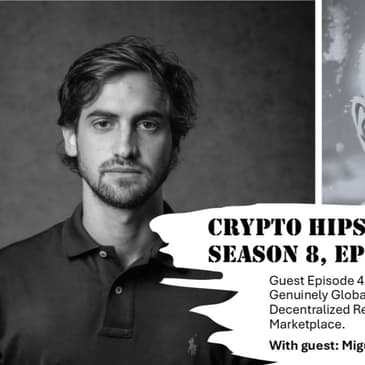

Miguel Buffara, Lead Financial Engineer at RACE
As Lead Financial Engineer at RACE, Miguel blends his technical acumen with financial expertise to build the infrastructure that supports investor onboarding, designs effective governance structures, and models tokenomics structures. Miguel's introduction to the finance industry began as a credit research analyst for Banco BOCOM BBM in 2019, which served as a springboard into investment management. He later honed his skills in managing investments and navigating the complexities of financial markets at METRIX and Apollo Capital. Leveraging the experience gained from the traditional financial sector, Miguel became involved in the decentralized finance space as a portfolio manager, where he strategized user onboarding and modeled investor behavior.
[00:00:00] Hello everybody and welcome to the Crypto Hipster Podcast. This is your host, Jamil Hasan, the Crypto Hipster, where I interview founders, co-founders, entrepreneurs, executives, thought leaders, amazing people, builders all around the world of crypto and blockchain.
[00:00:17] And today I have another amazing guest. He is the co-founder. I didn't ask him for a specific title. I'll tell you his name. His name is Michael Buffara. He is with RACE and he's here to talk about that.
[00:00:33] So Michael, welcome. And maybe you can tell me if you're co-founder or founder or what your role is too.
[00:00:39] Hello, Jamil. Thank you so much for having me here today. Yes, of course. So in crypto, there's a position called core contributor in which is attributed to, you can say it's more or less like co-founders of specific protocols. They're called core contributors.
[00:00:53] So that's my current role at RACE and happy to be here today.
[00:00:58] Awesome. Thank you very much for joining me. So yes, let's kick things off and ask you first, you know, what is your background and is it a logical background for what you're doing now?
[00:01:12] Yeah, it's funny. So my background, I'm actually a civil engineer. So building buildings, building bridges and lots of mathematics involved and also finance.
[00:01:27] So I'm halfway through the CFA also, which is like an MBA in finance, a master's in finance.
[00:01:37] And I have a background in the banking industry. So it's a mixture of engineering and hardcore finance.
[00:01:45] So that's more or less it.
[00:01:49] My dad was an engineer. He was a civil engineer. He built bridges.
[00:01:54] He built bridges.
[00:01:55] So, yeah, it's tough to build bridges. Lots of mathematics and lots of planning beforehand on how to keep the foundation solid to build a skyscraper or a bridge.
[00:02:07] So I love it.
[00:02:09] Awesome. So I would say that you're very qualified to be what you're doing.
[00:02:13] So, and the CFA is no easy task. So very cool. So let me ask you first, you know, what is race all about and your role and what is your focus there and what are you doing?
[00:02:29] So at race, we're trying to solve a problem, which is a global accessibility to high quality assets.
[00:02:36] And it's a problem that most U.S. listeners, it's far from reach this problem from them because they have an amazing financial system.
[00:02:45] They have lots of good assets to invest in.
[00:02:48] So it's easy, but that's not a reality for most people around the globe.
[00:02:53] They suffer from inflation, high government spending and poor quality assets to invest in.
[00:02:59] So at race, we're trying to connect this U.S. financial system to the rest of the world using blockchain technology.
[00:03:06] And so we're building a simple and easy way to connect to the blockchain world for non-crypto natives.
[00:03:15] And inside this infrastructure, you'll be able to have access to all the realm of tokenization and DeFi infrastructure and all of that.
[00:03:25] So with this, we expect to solve this problem of assets in underdeveloped countries.
[00:03:33] So we have actually a huge technology infrastructure ranging from onboarding infrastructure, which is the wallet infrastructure, up until the chain, which is an L2 stack.
[00:03:48] We're built on top of the OP stack.
[00:03:50] We're part of the super chain, which is a group, a community inside Ethereum that's focusing on scaling Ethereum and leaving transactions cheap.
[00:03:59] And in the middle of all of this, there is a tokenization infrastructure, which on ramps RWA assets onto the blockchain rails.
[00:04:10] So it's the full stack infrastructure for asset onboarding and distributing on top of blockchain rails.
[00:04:22] Okay.
[00:04:23] Now you just gave me some more follow-ups.
[00:04:25] I'm going to ask them.
[00:04:27] Not in order.
[00:04:29] I'm going to go to my question I was planning to ask you next, and then I'm going to go my follow-ups because it's going to be a little different with you because you're focusing on underserved countries.
[00:04:41] But I want to find out first what you feel are the current threats to the adoption of tokenized RWAs.
[00:04:50] RWAs.
[00:04:54] So the problem with tokenized RWAs is how you wrap an asset, giving it legal and proprietary rights, legal rights to the token, right?
[00:05:07] That's the most challenging part is how do you basically get the token and wrap it around?
[00:05:12] Like what's the contract behind it?
[00:05:14] What's the token architecture?
[00:05:16] That's the hardest part, right?
[00:05:18] So it's like building a building and a bridge, right?
[00:05:22] It all comes back to the foundation.
[00:05:24] And the foundation of RWA assets is actually the legal structure behind it, right?
[00:05:29] It's super easy to mint a token.
[00:05:31] It's hard to actually give legal and proprietary rights to that token.
[00:05:36] So it's a lot of compliance work and lots of engineering behind the token architecture to leave the token compliant with the legal frameworks of each jurisdiction.
[00:05:46] And just coming back to your question, we're focusing on serving these underdeveloped countries.
[00:05:54] But we're building the infrastructure.
[00:05:56] It's actually tailored for medium to high net worths.
[00:06:00] So everything is engineered to scale, right?
[00:06:04] So currently, what you have in the crypto space is everyone is focusing just on retail, retail, retail, retail, which is microtransactions.
[00:06:13] Our infrastructure is scalable.
[00:06:15] So everything is...
[00:06:17] You're able to on-ramp $500,000, a million dollars.
[00:06:22] It's scalable up to, let's say, $10 million because we are distributing and tokenizing RWA assets.
[00:06:31] So it's kind of like we're serving these countries, but the infrastructure is tailored to medium to high net worths.
[00:06:41] Yes.
[00:06:42] Okay.
[00:06:42] So let's break that into two then.
[00:06:45] Let's talk about the developed economies and the financial entity, the RWA, what the actual RWAs are that you are tokenizing for developed economies, like for the high net worth.
[00:06:57] What RWAs is within your scope of development?
[00:07:02] Yeah.
[00:07:03] So we're working with like five major asset categories.
[00:07:09] So you can...
[00:07:11] Let's start with the smaller ones, which is art pieces, collectibles, timepieces.
[00:07:18] And then you can go like from there.
[00:07:20] There's credit, private credit is also really big.
[00:07:24] There is government bonds.
[00:07:27] And then there's private funds.
[00:07:29] And then there's real estate.
[00:07:31] Right.
[00:07:32] So each one of these categories, there's a completely different way on how to tokenize.
[00:07:36] So we're seeing demand mostly for private deals, tokenized private deals, which they can be then wrapped into a token form and then traded within the blockchain.
[00:07:52] Because they don't have liquidity outside the blockchain.
[00:07:55] So we've seen demand for that a lot.
[00:07:57] We've also have seen demand for collectibles like arts and timepieces.
[00:08:05] So these three areas in which we have seen demand from clients that want to tokenize in this direction.
[00:08:15] So real estate is the hardest part piece to tokenize in which no one has clearly defined a way on how to tokenize it.
[00:08:23] But the path moving forward, I believe it is for real estate in which there's the most demand, but it's the hardest to tokenize.
[00:08:34] Okay.
[00:08:35] That makes sense.
[00:08:36] And then for the developing countries, you said earlier that their investments are not standardized.
[00:08:43] They're hard to value.
[00:08:45] They're hard to value.
[00:08:46] You know, what do you envision being able to capture as far as developing?
[00:08:52] Yeah.
[00:08:53] So developing countries will invest in assets from developed countries.
[00:08:59] So because they're looking for protection from their local governments.
[00:09:03] So we're giving them the on-ramping infrastructure to be able to on-ramp into the blockchain rails and to be able to invest in these assets from developed countries.
[00:09:14] So it's like connecting the both financial systems.
[00:09:21] Okay.
[00:09:22] That makes sense to me.
[00:09:25] So what you're really doing is you're unlocking global access to investments, right?
[00:09:33] So what are the opportunities in being able to do that?
[00:09:39] So for every asset class, there's a different huge opportunity within it, right?
[00:09:46] So if we start with the illiquid assets, you're unlocking global liquidity.
[00:09:52] So you're able to tokenize an asset in one country and lend it against for an institution in another country.
[00:10:02] So this creates an arbitrage for global interest rates globally.
[00:10:07] So let's say I'm a US user.
[00:10:08] I tokenize, let's say, a timepiece or my apartment.
[00:10:17] So in the US, I'm eligible for US interest rates, right?
[00:10:21] So I'm going to give my asset as a collateral.
[00:10:23] I'm going to borrow against the Fed funds rate, right?
[00:10:26] So today's more or less 4% to 5%.
[00:10:30] But if I can tokenize the asset and it's inside the blockchain rails, there's nothing like blocking me from getting a loan from a Japanese institution, right?
[00:10:42] Which it's a completely different interest rate.
[00:10:44] So it opens doors for asset owners to be able to get cheaper liquidity against their assets.
[00:10:52] That's one of the major breakthroughs that blockchain gives, like this global participation in the financial system.
[00:10:59] Another great benefit is that, let's say for a homeowner, everybody knows that home prices are extremely high, right?
[00:11:07] So today, a median American takes more or less more than five years to pay for their mortgage.
[00:11:16] Some of it, in some cases, like California, over 10 to 15 years, right?
[00:11:21] To pay for their house.
[00:11:23] So if you can, let's say, tokenize a building and slowly purchase it.
[00:11:29] Let's say I see a tokenized building.
[00:11:34] So I'm renting it.
[00:11:36] But I slowly purchased in a fractional form the building, my apartment.
[00:11:43] So I'm renting a house.
[00:11:45] I see that the house is tokenized.
[00:11:48] I can buy, let's say, today I can buy 1%.
[00:11:50] And then I slowly build up my equity into the house, right?
[00:11:54] Without compromising in a mortgage, in a fixed mortgage.
[00:11:57] So that's one of the breakthroughs of tokenization, right?
[00:12:01] It allows people to have access to home, like buying a home slowly in this scenario that we live in of extreme high home prices.
[00:12:12] And that's also the case for people willing, let's say, to sell partially a home.
[00:12:18] So I have a house.
[00:12:20] Like, why can't I just sell like 20% of my house, 30% of my house?
[00:12:26] And still live in it, right?
[00:12:28] That's also the case with tokenization.
[00:12:29] So it unlocks new use cases for assets, like globally.
[00:12:35] And I think this brings lots of new use cases that we are not like, we can not even think of, right?
[00:12:44] So, and this is the benefit of blockchain technology because it allows you to play with assets.
[00:12:51] And I believe firmly that this technology will unleash a wave of new growth into the economy by these new use cases.
[00:13:08] Interesting.
[00:13:09] I was thinking about it.
[00:13:11] I'm like, okay.
[00:13:13] I make a home payment every month, right?
[00:13:16] The money to the bank.
[00:13:18] But if it were tokenized, I could, instead of paying an interest rate, or I could pay the interest rate.
[00:13:24] But if the cost or the value of my token went exceeded the interest rate, then that could be applied to pay down the principal sooner.
[00:13:34] Yes, exactly.
[00:13:36] And not only that, if you wish to purchase your house slowly, right?
[00:13:42] Like, let's say you pay $1,000 of rent, right?
[00:13:50] And you slowly purchase your house, right?
[00:13:53] This rent will come back to you slowly.
[00:13:56] So your rent will slowly decrease while you purchase equity on the house, right?
[00:14:00] Because you're paying rent to yourself.
[00:14:03] So you can, like, just grow your home equity slowly as you can, right?
[00:14:10] So as your economics allows you to do so.
[00:14:15] So it's very nice for us leaving this environment of high home prices.
[00:14:23] I like the concept.
[00:14:25] I don't think anybody else is doing it right now.
[00:14:28] Yeah.
[00:14:29] So that's the vision I think most of the people in the RWA sectors are building for.
[00:14:38] But it's a long path, right?
[00:14:40] It's a long path.
[00:14:42] But I strongly believe in the next 10 years, we will get there for sure.
[00:14:48] Okay.
[00:14:49] Let me ask you this then.
[00:14:52] RWAs might be the only, like, why is the RWA maybe the only use case, right?
[00:15:01] That could bridge crypto with the rest of the world?
[00:15:04] Because a lot of people have said it's, oh, no, it's Bitcoin is the only one to do it, right?
[00:15:09] The only one that can do that.
[00:15:10] But you're saying that RWAs can.
[00:15:14] So what, why is it the use case that will?
[00:15:22] So Bitcoin is a great store of value due to this.
[00:15:25] It's code, right?
[00:15:27] We know exactly how much Bitcoin there will be.
[00:15:29] And this is a great advantage for storing wealth, right?
[00:15:31] It basically, you can basically lock your time, your work.
[00:15:39] You know it will be stored in that Bitcoin and no one will print it.
[00:15:44] But you can't live in your Bitcoin, right?
[00:15:47] You can't, let's say, rent your Bitcoin.
[00:15:50] So you can't, you do can rent your Bitcoin, but interest rates on loan your Bitcoin is extremely low.
[00:15:56] It's below sub 0.5%.
[00:15:59] So Bitcoin is not a working asset.
[00:16:01] It does not generate cash flow.
[00:16:03] It's like gold.
[00:16:05] So, but when you combine the blockchain technology with the real cash flow yielding assets,
[00:16:13] then that's where you unleash the power, right?
[00:16:16] Because then you'll be able to get this technology that is digital.
[00:16:23] It's global.
[00:16:25] It's fast.
[00:16:26] And you get this amazing asset and put inside of it, which is real estate or whatever cash flow yielding assets you can think of.
[00:16:34] Then you unlock a whole different game of possibilities in the world.
[00:16:43] I don't know if I answered your question.
[00:16:45] You did.
[00:16:45] You did.
[00:16:46] I'm going to segue into my next one.
[00:16:48] The next one's kind of tough because I'm still thinking about how to formulate it.
[00:16:53] Before we started, I was at the World Bank Summit this week.
[00:16:56] And one day I had to listen to some central bankers talk.
[00:16:59] And I'm like, they're talking about tokenization.
[00:17:02] They're talking about the future of payments.
[00:17:04] And now I want to use blockchain, right?
[00:17:06] None of them talks about Bitcoin though.
[00:17:08] They all talk about blockchain.
[00:17:09] So, you know, if you're building your RWAs or you're building a platform in reliance with the existing system, you know, whether they're trying to improve through blockchain or through Bitcoin, or are you finding a middle ground that's going to be a better profitable opportunity for everybody?
[00:17:33] Yeah, so the infrastructure underlying of our platform is an Ethereum layer 2 scaling solution.
[00:17:42] And the name of the stack is called OP stack.
[00:17:45] Without getting too technical, it's like a way on you to tap into Ethereum's safety and security while still maintaining very cheap transactions.
[00:17:56] So, it's a way in which you can still maintain the security of the blockchain while still having cheap transactions.
[00:18:06] Okay.
[00:18:07] So, you got it.
[00:18:10] So, that's good.
[00:18:12] So, we talked about real estate, right?
[00:18:14] Some other opportunities that you think are going to be future opportunities for improving the global economy.
[00:18:25] Initiative real estate are what and why?
[00:18:32] So, you can think of what do big investors have access to that small investors do not have access to.
[00:18:47] Let's think that this is the general like first principle.
[00:18:52] Okay.
[00:18:52] What do big people have access to that like we retail don't have access to?
[00:18:57] So, private credit, private equity, pre-IPO deals.
[00:19:05] And you can go like even smaller than venture deals.
[00:19:11] Fractional ownership of anything big that requires multi-million dollar investments.
[00:19:22] So, let me start with the pre-IPO deals which is really interesting example.
[00:19:27] So, you see all these amazing companies being sold in a secondary market but you don't have access to them, right?
[00:19:33] So, one great example is SpaceX.
[00:19:37] SpaceX is an amazing company.
[00:19:38] Everybody knows Elon Musk, right?
[00:19:40] The rockets go to space and they come back.
[00:19:44] And most of the people look and like, wow, I wish I could invest in it.
[00:19:49] But it's really hard for people to invest in it.
[00:19:51] What if you could wrap some shares and put it in a blockchain?
[00:19:57] Fractionalize it and distribute it globally, right?
[00:20:01] Why do only large investors have access to it?
[00:20:04] And why only mostly U.S. investors?
[00:20:09] So, that's the gate that the blockchain unleashes is the ability to wrap these assets and display them in the blockchain for investors around the globe to have access to them.
[00:20:24] I don't think I've ever had access.
[00:20:27] Go ahead.
[00:20:28] Sorry.
[00:20:29] Go ahead.
[00:20:29] So, that's...
[00:20:30] I don't think I've ever...
[00:20:31] Go ahead.
[00:20:33] Sorry, go ahead.
[00:20:34] I said, I don't think I've ever had access to private equity or M&A.
[00:20:39] You know?
[00:20:40] Yes.
[00:20:40] So, what would be the benefits of someone like me and you having this access?
[00:20:47] So, these are investments that in portfolio construction are really like wealth generation and wealth preservation in the long run.
[00:20:59] Like, so, everybody knows that the 60-40 portfolio is broken, right?
[00:21:03] Bonds are not working anymore.
[00:21:08] Bonds are...
[00:21:09] Because when you print money, currency debases.
[00:21:11] And most people are saying that you shouldn't hold bonds anymore.
[00:21:16] And that makes sense in this environment.
[00:21:17] So, you should search for alternative asset classes that generate like cash.
[00:21:24] Like serious cash.
[00:21:26] Like cash cow companies.
[00:21:29] And like hedge you against currency debasement.
[00:21:34] And those are private equity deals.
[00:21:35] So, what banks are now like issuing to their clients are these funds which are called like the evergreen funds.
[00:21:44] Like they're funds which are always green to harvest, right?
[00:21:48] It's like funds which inside of it, there's lots of these private equity deals which are always generating cash.
[00:21:54] And they are now distributing this to their clients, right?
[00:21:59] So, they're just starting to do that in traditional financial system.
[00:22:04] But it's in the bulk, right?
[00:22:05] You just buy the fund and there's someone doing the deal for you.
[00:22:10] There's no way you can like get into the deal yourself, right?
[00:22:13] Like select the companies you want to buy.
[00:22:16] So, and blockchain technology allows you to do like basically pick and choose the companies you want to buy if they're fractionalized.
[00:22:24] So, that's some of the opportunities that we're seeing ahead of us to be able to have access to these private equity deals and the pre-IPO deals.
[00:22:32] And these amazing cash flow yielding assets that also gives you a hedge against currency debasement.
[00:22:41] That makes sense too.
[00:22:42] So, let's talk about that currency debasement.
[00:22:45] You know, there are uses, I believe there are uses where blockchain could help RWAs beyond just investment, right?
[00:22:53] For as like, you know, opportunities for people who haven't had it, have been on the sidelines, right?
[00:22:58] How do you see your project and RWAs in general being helpful beyond just investments?
[00:23:13] So, I'm going to give you one example.
[00:23:17] So, there are many industries in which transparency doesn't exist.
[00:23:23] Okay.
[00:23:24] So, to be able to keep a record of the history of an asset in some industry, it's the difference between an asset being valued at 1K than an asset being valued at 100K.
[00:23:40] So, some of the industries are really, we know them.
[00:23:44] Like, let's say, the watch industry.
[00:23:46] There's no way that you can track the history of a used watch, right?
[00:23:50] Like, so, what if you could just use the blockchain to, as a way to track the history of assets, right?
[00:24:01] So, people are also starting to use blockchain in a way to like, just give authenticity of the asset and make sure that all the history is tracked and all the details.
[00:24:12] So, it's similar to the, in the US, there's this Carfax system, right?
[00:24:18] In which all the details of a car is tracked since the first purchase of a car until the car being scrapped, right?
[00:24:25] So, this Carfax model can be applied to all these other industries like timepieces, like art pieces.
[00:24:33] So, this is the value also that blockchain brings.
[00:24:35] So, if you're able to track and give more clarity to the history, value will be given to the asset.
[00:24:52] So, that Carfax thing makes perfect sense to me.
[00:24:55] My wife and I just bought a used car a couple months ago.
[00:24:59] And she really wanted to see the history of it.
[00:25:02] And, you know, so, that makes a lot of sense.
[00:25:07] And it turned out it was pretty clean history.
[00:25:09] So, we lucked out.
[00:25:10] But, yeah, a lot of people don't get so lucky.
[00:25:14] Yeah.
[00:25:14] So, like, it will make a difference in the future.
[00:25:17] Like, the same car, the car who has a clean history usually will be worth more, right?
[00:25:22] So, the same car, no history, can be worth like 20%, 30% less than a car who has like a clean history.
[00:25:28] So, blockchain can help achieve that, like in a serious way.
[00:25:34] Transparency, authenticity, trust.
[00:25:38] Liquidity.
[00:25:39] Liquidity.
[00:25:40] Liquidity.
[00:25:40] And trust, right?
[00:25:43] So, how do you view trust and ethics, I guess, with the building of your platform?
[00:25:53] And, you know, how are you going to be helped to move the needle forward in those areas?
[00:26:00] Yeah.
[00:26:03] Yeah.
[00:26:03] So, we're partnering with industry leaders to create standards for each of those assets in which we establish a way to communicate with these assets.
[00:26:15] So, it's all about building standards.
[00:26:18] And it's so, there's currently in the industry, there's no clear standards for any of the assets.
[00:26:25] It's, we are like in the really, really early stages.
[00:26:28] So, there's no such clear standards for, let's say, a real estate tokenization, for a private credit fund, for institutional fund.
[00:26:36] So, every single player is doing a different way.
[00:26:40] What we are doing at Race, we're aggregating all those players and we're trying to create a standard.
[00:26:47] Okay, guys, let's tokenize timepieces this way.
[00:26:54] This is what the industry leaders are requesting.
[00:26:58] Let's work with them, build a standard and distribute it to our users, right?
[00:27:03] So, we're trying to work with people, leaders in each specific industry to create standards so that we can scale this industry globally.
[00:27:13] So, in the end, what you'll see at Race is people like coming to us with their tokenized assets.
[00:27:24] And we build an infrastructure in which we call the Decentralized Investment Committee.
[00:27:28] It's a committee of experts on each of the areas specific to that asset that wants to be tokenized.
[00:27:34] And they will verify everything since the legal wrapping of the asset until the token architecture, until how much the user is trying to tokenize the asset for.
[00:27:47] So, we're trying to create this committee of experts which are decentralized and tailored to each specific industry that will basically give like a green light to that asset tokenization.
[00:28:00] So, we're trying to create this initial trust in the system and initial framework so that people can come in and say, okay, this asset is good to go without them being technical enough.
[00:28:17] Like to go themselves inside the blockchain and check exactly how the token architecture is structured and without needing to know like if that token has legal and proprietary rights.
[00:28:30] So, a huge problem is that we're seeing in the industry today is that people are just tokenizing without actually putting the provenance of the asset inside the token.
[00:28:40] That's a huge problem because there's not many people in the industry that know or investors that know how to go inside the blockchain, check all the details of the token to make sure that, okay, this token has legal rights.
[00:28:55] This token has like the contract inside it.
[00:28:59] This token has like the contract inside it that links to the wrapping of the token.
[00:29:02] So, I'm safe with the token.
[00:29:04] So, we're lacking this transparency in the industry.
[00:29:08] So, at RACE, we're trying to aggregate all these players and say, hey, go through our decentralized investment committee.
[00:29:17] Let them verify your asset and we will give like a RACE seal to the asset.
[00:29:24] And it's good to be integrated inside our distribution platform to our global users and investors.
[00:29:32] This is what we're trying to create in RACE to create like a global trustless infrastructure for tokenized assets.
[00:29:42] I think that's unique.
[00:29:46] You're decentralizing the expertise and not just the technology.
[00:29:53] That's going to be a game changer if you pull it off correctly.
[00:29:57] You know?
[00:30:00] Yeah.
[00:30:00] I like it.
[00:30:02] What do you...
[00:30:03] No one's doing that yet.
[00:30:06] Yeah.
[00:30:07] So, we're really excited on what we're building.
[00:30:09] We invite anyone listening to this podcast that wants to participate in this decentralized investment committee.
[00:30:17] If you think you have like a unique expertise to a specific asset class and you're open to contribute.
[00:30:24] So, please feel free to reach out.
[00:30:26] Like we're building this for everyone to participate and help us create this global network that creates trust on the tokenization infrastructure.
[00:30:38] And tokenized assets.
[00:30:41] It's only when we create this community of people that work together and that the investors will come and start using this tokenized assets.
[00:30:54] And when investors come, then institutions will also start adopting this tokenized assets to be able to give like utility to the assets.
[00:31:04] Like landing against them and creating other DeFi protocols on top of it.
[00:31:09] I agree with you.
[00:31:11] Makes a lot of sense to me.
[00:31:12] Awesome.
[00:31:13] Awesome.
[00:31:16] So, I want to thank you for talking to me and telling me about this.
[00:31:20] This is pretty cool.
[00:31:21] So, I want to thank you very much for your time today.
[00:31:23] I enjoyed speaking with you.
[00:31:24] I do have...
[00:31:25] Really just have only have one last question.
[00:31:29] And it's how can people find out more information about you, about race?
[00:31:33] How can they become part of this expert panel?
[00:31:35] How can they find out more?
[00:31:37] How can they do that?
[00:31:38] Of course.
[00:31:39] So, the first thing you should do is enter our website, race.foundation.
[00:31:46] It's our main website.
[00:31:49] There inside that, you know all the different projects we're working on.
[00:31:53] And if you're really interested in participating in the ecosystem, you should join through our wait list for service providers,
[00:32:05] the IC committee members, and this website.
[00:32:08] You can find either inside the race.foundation website, the link there to the website,
[00:32:14] or going directly to raceecosystem.com and signing up in the wait list.
[00:32:23] And we can communicate from there.
[00:32:31] And we're also in the social medias like Twitter, Telegram.
[00:32:36] Feel free to reach out.
[00:32:38] We'll happily guide you from there also.
[00:32:43] Awesome.
[00:32:44] Awesome, awesome.
[00:32:45] Thank you very much for your time today.
[00:32:49] Thank you, Jamil.
[00:32:50] Happy to speak to you today.