
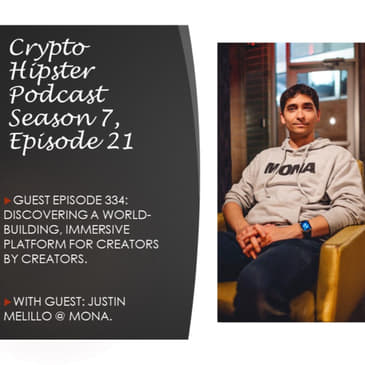

Justin Melillo is an artist, entrepreneur, and angel investor. He is the CEO and Founder of Mona - the leading 3D world building platform and social network. Mona is the medium of the metaverse. A 3D artist and creative technologist for over 12 years, Justin has worked with world-class teams and clients such as Magic Leap, DreamWorks Animation, Drake, CharliXCX, Sia, Lizzo, and Maroon 5. His AR experiences have been viewed over 100 million times across Instagram and Snapchat. https://monaverse.com/claim
https://www.linkedin.com/in/justinmelillo/
[00:00:00] Hello everybody and welcome to the Crypto Hipster podcast. This is your host Jamil Hasan the Crypto Hipster where I bring you founders entrepreneurs
[00:00:09] executives thought leaders artists
[00:00:12] Really talented people across the world in crypto and blockchain and today I have one of those very talented people across the world
[00:00:22] His name is Justin Mililou. He is the founder and CEO at Mona
[00:00:27] Justin welcome. Thank you so much Jamil really really nice to be here really appreciate it
[00:00:36] No problem at all. I'm happy you're here and
[00:00:39] Let's kick things off and I'm really interested about in your creative background
[00:00:43] What is your background and is it a logical background for what you're doing now?
[00:00:48] It's definitely a logical background. I'd say my background is in 3d animation and visual effects. And so
[00:00:54] traditionally trained as a as a 3d artist
[00:00:57] and
[00:00:58] Before starting Mona was actually working as a 3d and VFX professional
[00:01:03] I started my career freelancing in New York and then at Dreamworks animation
[00:01:08] before jumping into the AR VR industry by joining Magic Leap, which for those who don't know is a
[00:01:16] pretty major AR
[00:01:18] Spatial computing startup that has raised billions of dollars for you know, their own AR device basically and so
[00:01:25] Yeah throughout my whole career, you know, I've been building in 3d
[00:01:29] I've made a number of AR VR experiences for some major clients and touring artists as well
[00:01:35] And so all this is basically led up to what I do now as the founder of Mona
[00:01:41] Very cool. And then what is what is Mona and then the Mona verse all about including your mission and your vision
[00:01:49] Mona's mission is to accelerate the growth of the open metaverse by providing tooling for developers and creators to launch their own
[00:01:57] Interoperable immersive experiences and assets. So when we think about the metaverse, you know
[00:02:02] We consider it to be the next stage or the next evolution of the internet
[00:02:06] One in which 3d content is ubiquitous and blends seamlessly with the world around us
[00:02:11] But also gives you the opportunity to be fully immersed inside of different types of experiences games apps
[00:02:18] But you know for this, you know open metaverse vision to succeed
[00:02:22] We have to really break down these barriers and closed ecosystems and walled gardens that
[00:02:27] Current apps are kind of accustomed to and so to do that. We're really pushing forward on
[00:02:34] The mission of interoperability of everyone's 3d assets and so put a little bit more simply
[00:02:39] Mona verse or Mona creates a set of tools that makes it easy for any creator or developer to launch their own
[00:02:45] immersive web-based experience or game
[00:02:48] And all these assets are all decentralized
[00:02:51] sort of an ipfs
[00:02:53] immersive worlds avatars wearables 3d objects game props
[00:02:58] They're all tokenized as nfts and they're interoperable and can move freely between different independent platforms and games
[00:03:05] So to date, you know found a moment 2021 and to date now we have over 20 000 immersive worlds avatars objects that
[00:03:13] You know have been have been uploaded in decentralized and are available to use across the open metaverse
[00:03:18] I know i've seen you got you you've been building a lot in the past few months at least, you know before that
[00:03:27] You have a tool called spaces, right?
[00:03:30] How does spaces work and how can creators of any background use mona to create these beautiful most immersive worlds?
[00:03:40] Yep, so
[00:03:41] It's really easy to get started and it's free as well. And so if you want to create an immersive world
[00:03:47] Or an immersive asset you basically can use any 3d authoring software like blender via cinema 4d
[00:03:53] Or you can even sculpt in virtual reality
[00:03:56] You export those assets as glbs and you upload them to mona where they then get decentralized and become available for the open metaverse
[00:04:04] And available to use in mona and across other apps
[00:04:07] And so for for any creator it's really easy to get started and jump in
[00:04:10] We also have a web-based editor tool called mona create that makes it easy for you to pull in assets that you own and build
[00:04:18] You know on the fly straight from the web browser as well
[00:04:21] So you don't have to know programming languages
[00:04:24] Exactly. Yeah, if you know programming languages, it does make it a bit easier and you can build more customizable more interactive experiences
[00:04:34] But you don't need to know programming languages to build for the metaverse
[00:04:39] Great great so
[00:04:42] Three years
[00:04:43] That was the metaverse was it was it was hot topic
[00:04:47] I remember the super bowl that the rams and bangles through well, you had like a dozen metaverse commercials, you know
[00:04:55] Very hot very hype things have died down
[00:04:59] Considerably as far as the metaverse
[00:05:01] Have died down considerably as far as the hype
[00:05:05] you know, um what in that time since last three years has been built and um
[00:05:11] What is the next frontier as far as the metaverse?
[00:05:16] Yeah, it's a great question
[00:05:18] Um, you know, I would say there was a pretty big moment that happened this year with apple announcing and then and actually shipping their
[00:05:24] apple vision pro
[00:05:26] Um, and so when I think about the next frontier of the metaverse, I actually I think about spatial computing
[00:05:31] Um now, you know arvr is not a new thing. It's been around for you know over a decade and uh
[00:05:39] You know, but what makes this moment exciting is that apple now the you know, most popular
[00:05:44] products
[00:05:45] uh, you know
[00:05:46] producer on earth has now shipped their version of of an arvr device which they're dubbing, you know spatial computing
[00:05:53] And I think this is a big moment for
[00:05:57] This whole concept of augmented reality virtual reality to come a little bit more mainstream
[00:06:02] I would say meta facebook. Uh, you know, they've been doing a great job at
[00:06:06] You know increasing the market share of vr devices by offering the quest
[00:06:11] basically at production costs for for consumers to try to
[00:06:14] You know push the the adoption of vr
[00:06:17] And they've been doing a really great job
[00:06:19] but now with apple coming into the scene, I think you know more and more consumers are going to pay attention and
[00:06:24] You know realize that this is really the future that we're we're headed towards one in which
[00:06:28] 3d assets can blend seamlessly with the world around us
[00:06:32] Where you can wear wear a device and it can uh, you know really augment your everyday
[00:06:38] You know can change and improve the way that we consume content the way that we connect with others
[00:06:43] And so when I think about the next frontier, uh, I think about you know, how can we transition from?
[00:06:50] Viewing content interacting with each other via these 2d interfaces of screens
[00:06:54] And how do we make that an entire experience more immersive because that's that's ultimately what's going to happen is that
[00:06:59] You know rather than us being on the zoom call recording a podcast
[00:07:03] Our uh, you know 3d spatial recreations of of each other
[00:07:07] We can actually feel like we're coexisting in the same
[00:07:10] Real world space or virtual space and it can feel much more natural like an actual in-world
[00:07:16] interaction or interview
[00:07:18] And so with that, uh, this is why we're really excited about 3d
[00:07:22] And why at mono we believe that 3d assets are going to become
[00:07:26] Increasingly more valuable as time goes on as we transition to spatial computing
[00:07:31] You know everyone is going to have a stronger need for 3d and we're already sort of seeing it
[00:07:36] With the number of users that are on different gaming and metaverse platforms spending billions of dollars a year on 3d assets
[00:07:43] And gaming assets and so mono is really investing in this giant ecosystem of 3d ugc creators
[00:07:52] To you know fill the immersive internet with really amazing 3d work
[00:08:00] Made me think of a couple things. Um
[00:08:03] Three when I think of when I think of 3d, I think of going to great adventure or something
[00:08:09] We're you know experiencing that or disney. Yeah
[00:08:12] Yeah, yeah
[00:08:14] It'd be cool if we had a podcast that was three
[00:08:16] um
[00:08:18] but
[00:08:18] Gaming is one area where other areas that you see potential growth in this in the
[00:08:24] near to medium term
[00:08:26] Yeah, gaming is obviously
[00:08:28] uh
[00:08:30] Is a very obvious sort of like beachhead market for for this
[00:08:35] Another one I see is education. I think
[00:08:39] Being able to bring the classroom bring your teacher into your real world environment home environment
[00:08:46] You know, I think that education is is another really exciting vertical for spatial computing and the future of the metaverse
[00:08:54] I also think about uh, you know different business use cases
[00:08:59] Where like I think business training industrial training
[00:09:03] um
[00:09:04] you know, I think about uh, you know education and training on the job for different things that
[00:09:11] Could be more cost effective but also a little bit more intuitive and easier
[00:09:16] more interactive
[00:09:18] Um, yeah, they're they're really a number. I mean every every type of social app that that we have today is going to change
[00:09:25] and
[00:09:26] This is why it's also important and why we really believe in
[00:09:29] investing in developers because they're the ones who are really going to forge ahead and build these types of apps and experiences and
[00:09:35] dream of
[00:09:37] Just ways that we can make our everyday lives better by leveraging this
[00:09:41] Immersive tech i'm going to talk about those developers in a little bit
[00:09:48] Abbie a good point about apple spatial computing. Um, I remember when the first I
[00:09:55] not not
[00:09:57] iPhone but ipad or I you know came out and um, you know
[00:10:02] Everybody was like what is this and it took about a decade, you know for everybody to have an iphone
[00:10:08] Yeah
[00:10:09] What do you see? What do you see in a decade with a spatial with the spatial computing?
[00:10:13] What's the world? What do you how you how do you envision the world?
[00:10:17] Well, I think one of the biggest things we're going to see is the form factor of the devices
[00:10:22] Is going to come down significantly over the next decade
[00:10:26] So right now the devices that are available are more akin to you know, ski goggles, you know
[00:10:31] A large quite large headset that you have to wear
[00:10:34] Um, and over time that form factor is going to get down closer to the size of just a normal pair of glasses
[00:10:42] Um, and then if we look at a decade plus, uh, we're looking at different things like contact lenses even you know
[00:10:48] retina implants
[00:10:50] Um, you know if you think a little bit further ahead as well
[00:10:54] You can consider the future of bci or you know brain computing interfaces
[00:10:59] In ways that we can interact with immersive content just by thinking
[00:11:05] About it versus using a you know a tactile input
[00:11:09] Um, but yeah, I think one of the first things we're going to see is chips are going to get more powerful smaller
[00:11:14] The form factor is going to come down cameras are going to get more powerful with the hardware for cameras
[00:11:19] Uh, and so if you look at something like quest 3 apple vision pro specifically apple vision pro and the quality of their
[00:11:25] pass-through technology today
[00:11:27] That's going to improve exponentially over the next decade
[00:11:30] Uh, and even even today when i'm inside of the device, you know
[00:11:33] The longer i'm in it the the more I forget that i'm just viewing the world around me through the lenses of a camera
[00:11:39] And you know through a screen and so as as that improves, uh, you know as that resolution gets higher
[00:11:45] Um, you know that experience is is going to be even even better and the lines are just going to get further blurred
[00:11:52] Uh between reality and and the virtual so yeah, I would say form factor is going to be one of the biggest things
[00:11:57] Really excited about bci
[00:12:00] And then I also think about the different types of content, you know today, uh, you know gaming is kind of like that first market
[00:12:06] we're going to continue to see more of that but
[00:12:08] uh as
[00:12:09] Adoption increases there's going to be more of a demand for different types of social apps
[00:12:14] You know as we talk about education industrial use cases, but also entertainment as well
[00:12:19] Um, you know being able to sit court side at a nix game
[00:12:23] But the court is actually in your living room via volumetric capture. So
[00:12:28] Um, yeah, I would say as infrastructure gets better hardware gets better. It's just going to accelerate the the growth and adoption of the space
[00:12:36] I'm a sixers fan and that nix comeback
[00:12:40] You know something
[00:12:45] So
[00:12:46] One of the big fights over the past few years has been you know, uh, we
[00:12:52] people who believe in the future of
[00:12:55] uh self-sovereign web3
[00:12:58] individuals
[00:12:59] versus the facebook's version of the metaverse
[00:13:03] Should the metaverse be web3 and how are solo content creators doing compared to these?
[00:13:11] huge monoliths as
[00:13:14] In this area
[00:13:15] Yeah, the metaverse absolutely needs to be web3. I think the internet needs to be web3
[00:13:22] Overall, I really believe in this feature of the decentralized internet
[00:13:26] Placing more more power into the hands of of the actual users creators
[00:13:32] You know self-sovereign ownership over our assets over our data over our social graphs
[00:13:37] All this is extremely important, especially when you then consider the metaverse and immersive worlds
[00:13:44] And so yes, absolutely. That's why you know, our platform is is built on blockchain technology
[00:13:50] Uh in terms of how individual creators are doing I think there's been no better time to be an independent creator
[00:13:57] I think one of the most amazing things that blockchain enables because of its composability
[00:14:02] uh, and because of the ability to
[00:14:05] launch a smart contract
[00:14:07] uh, it
[00:14:08] gives creators the ability to actually become independent artists in their own right by minting and selling their work
[00:14:15] Uh by being able to collect perpetual royalties on their work by integrating different types of new economic flows that are all just automatic
[00:14:24] Whereas in web2, you know, we have to rely on different ways to you know, make agreements and accept payments
[00:14:30] blockchain just makes this entire system so much easier, especially for independent creators
[00:14:35] And I think up until now there have been certain models that have been established in web2. Um things like app store models
[00:14:43] things like
[00:14:45] You know monoliths taking 30 50 cuts from creators who are building work from users who are interacting on their platforms
[00:14:53] And that's that's going to change. I think those models are going to be soon broken down
[00:14:58] and I think blockchain is a great equalizer in this respect and so
[00:15:02] You know in terms of independent creators, uh, we have many who have joined mona a few years ago and are now full-time
[00:15:09] Uh 3d artists full-time metaverse creators because of the ability to you know
[00:15:14] Create immersive worlds and sell them and continue reaping a profit on them even after they've been created once it's a much better
[00:15:21] professional path or I should say much more sustainable path for becoming a professional artist than a traditional model of you know
[00:15:29] Working as a freelancer like I was or working in a studio having a nine to five it really
[00:15:35] Places more more power into the hands of the individual and into the hands of the creator and so
[00:15:41] Yeah, it's a really really exciting time for for people to be building especially to be building in 3d
[00:15:51] Very cool. Um, so I want to get into I want to get into those developers, right?
[00:15:57] um
[00:15:58] I've created a a buildathon, right?
[00:16:02] Um, it's an event or series of events. I want to find out more information about it
[00:16:07] Uh how it can be a spark?
[00:16:09] for for further
[00:16:12] Developers to join in and start building the metaverse
[00:16:15] um
[00:16:19] Yeah, um, so one of the ways mona when I began in 2021
[00:16:22] Um after we were founded to launch the platform, uh our partner protocol labs and filecoin actually
[00:16:28] um, you know, they conducted our first buildathon with us where
[00:16:32] Filecoin put up over $200,000 usd
[00:16:36] To encourage these world builders developers creators to get into the space and start building and tokenizing immersive worlds
[00:16:43] And that was just so amazing. We ended up with with hundreds of new worlds because of that one buildathon
[00:16:49] Um protocol labs then sponsored the next one that we did in the spring
[00:16:53] uh of
[00:16:55] 2022
[00:16:56] Um, and again same similar result. We ended up with thousands of immersive worlds and 3d assets that were then decentralized
[00:17:03] Um, and it was these buildathons these hackathons. They're such a great model to encourage
[00:17:07] Creators and developers to get into the space
[00:17:09] I would say probably about 80% of the creators and devs who came in through those initial hackathons
[00:17:15] And who continue to come in through the buildathons
[00:17:17] Probably around 80 are actually entirely new to blockchain and web 3
[00:17:22] As well, and so, you know, I think they're also a really good opportunity to show
[00:17:26] You know, hey like this is a different model. This is a different way for you to become successful
[00:17:30] As a as an independent creator developer
[00:17:33] And so we really really love
[00:17:35] Encouraging and supporting creators via these buildathons and hackathons
[00:17:41] Were they artists to begin with or would they come from diverse backgrounds?
[00:17:45] Yeah, very diverse backgrounds. Some of them were full-time
[00:17:49] game artists or game developers working at AAA studios
[00:17:54] Many of them were indie developers building their own games. You know, many of them are also
[00:18:00] Professional 3d artists or even just hobbyist 3d artists and creators who like to tinker with 3d or sculpt in virtual reality
[00:18:07] So you really you've got a got a whole spectrum of creators from all different backgrounds and from all over the world, which is really special
[00:18:16] Very cool
[00:18:17] That sounds very cool. Um, so
[00:18:20] If somebody wanted just wanted to join the buildathon or get involved how could they how could they do that?
[00:18:26] How could they do that?
[00:18:28] We run buildathons and hackathons probably
[00:18:31] You know pretty regularly probably around once once every month or once every couple of months
[00:18:36] And we either run them internally just sponsored by mona or we work with different partners
[00:18:40] so I would say if you're someone who's listening and you can benefit from
[00:18:44] Uh, you know the marketing attention of having a large number of developers creators building
[00:18:49] Immersive assets to help promote whatever platform or product you have
[00:18:53] Then if you just go to monoverse.com, we have a partnerships forum
[00:18:57] Just fill that out if you'd like to get involved there if you're creator or dev
[00:19:00] And you'd like to get involved in the next buildathon
[00:19:03] Um, similar similarly go to monoverse.com and sign up for our email lists
[00:19:07] We regularly post emails about new opportunities coming up like this and also join our discord as well
[00:19:14] Which there's a link straight from the website and then you'll be in the know when we launch our next buildathon and hackathon
[00:19:20] Great great so something i'm i'm
[00:19:24] I'm struggling with is you know, i've talked a lot of people who said the metaverse
[00:19:29] Uh what you're doing has a very like long tail like deep tech
[00:19:33] You know, um, and it seems like you've made the whole entire
[00:19:38] Process a lot easier and simpler and faster
[00:19:42] um, you know
[00:19:44] Is is the I guess
[00:19:47] Everything's been expedited or is the future still?
[00:19:50] A long tailed future
[00:19:52] Um, you know or should we be looking at this two different ways?
[00:19:57] I don't think that it's going to happen overnight
[00:20:00] I don't think that we'll just wake up one morning and we're suddenly in the metaverse now
[00:20:05] um, I think what we're seeing is that it's a gradual adoption
[00:20:09] And it's happening in different ways, you know when I when I think about the metaverse
[00:20:13] I like many people have this vision put forth by
[00:20:19] You know stories like ready player one
[00:20:22] And you know that was adapted into a movie and I think it was a really great way to visualize this
[00:20:27] Or you know, if you're familiar with snow crash where neil stevenson first coined the term metaverse
[00:20:31] I think that was that's always sort of been the big idea. Uh these
[00:20:36] Persistent immersive worlds that are all interconnected and allow us to live a virtual life fully inside of them
[00:20:43] Um, we're not going to wake up one morning and suddenly that's it
[00:20:46] But what we're seeing is that uh, we're seeing inklings of what the future is going to look like we're seeing
[00:20:51] You know hundreds of millions of daily active users spending time inside of virtual worlds
[00:20:56] You know whether it's inside of a decentralized platform like monas or inside of fortnight or roblox
[00:21:03] Or many other games that allow you to purchase virtual assets have a virtual identity
[00:21:08] Identity via an avatar connect socially with your friends and spend time inside of virtual spaces
[00:21:13] Uh, this is the very beginning of what the future is going to look like
[00:21:17] And then you know, we're starting to see some other really promising
[00:21:21] First steps towards the direction of full immersion in ar, you know things like magically palo lens
[00:21:26] Of course quest of course apple vision pro and so it's going to be a gradual adoption over time
[00:21:31] I think you know, there is a long tail to it but um, you know today
[00:21:36] You know
[00:21:36] I see a number of companies like mona meeting users where they are where they're at today and where you know
[00:21:42] The most value can be provided as we you know, uh move forward towards this longer vision of spending more time inside of virtual spaces
[00:21:53] Sounds good to me. Um
[00:21:56] So I want to look at your your background includes animation, you know, um
[00:22:03] Over the years, you know, I was a cartoon fan when I was a kid. I loved the smurfs, you know
[00:22:08] Oh, yeah. Yeah, of course
[00:22:10] But now I go to the reason like the animation looks like real
[00:22:13] Right. Yeah
[00:22:15] Yeah, it's a long way
[00:22:17] So what it has I mean
[00:22:20] What do you think the future of animation and vfx?
[00:22:24] our
[00:22:26] fx professions
[00:22:30] Yeah, um
[00:22:32] So it's really interesting because animations began as uh, you know pencil on paper
[00:22:37] Uh photographing individual frames that have been hand drawn
[00:22:41] You know 24 30 frames every second playing back
[00:22:45] Uh, and then you know with with pixar and an apple pushing forward on computer animation
[00:22:52] Um and pioneering this new way to produce an animated film
[00:22:57] um
[00:22:58] You know we we can kind of now see the future of this going beyond what is has traditionally been known as like offline rendering where
[00:23:06] Typically like today you if you're you know in a in an animation or film studio
[00:23:12] Or even if you're if you're just an indie creator if you're using a software like maya or blender and you want to produce
[00:23:17] An animated short typically you have to render each frame
[00:23:21] individually and the computer does a good job of just
[00:23:24] Badging all these frames together and then playing it back in a video
[00:23:26] But what we're watching is actually like 30 frames a second in front of us 30 frames being shown
[00:23:31] every second and um
[00:23:33] What's exciting is that with real time rendering, um, you know, it's accessible through game engines like unity like unreal engine
[00:23:42] Uh, we're starting to see real time rendering the quality of real time rendering
[00:23:46] Get into parity with the quality of offline rendering
[00:23:50] And so what we're seeing is more and more virtual productions happening where movies are sometimes entire movies are filmed entirely on a green screen set
[00:23:59] And filmed in real time or many of the posts done in real time using a game engine versus
[00:24:05] Um, you know having to wait hours and hours for for frames to render on a render farm
[00:24:10] So I think real time rendering is really key for the future of animation of the effects. Um
[00:24:16] But then I also think about ai
[00:24:18] And I think ai is going to just accelerate the creation process even further and offer creators and users a much wider variety of content
[00:24:27] Because of what what can be created on the fly using generative ai, so
[00:24:31] Um, yeah, I see the future being a mixture of um, you know real time rendering plus ai to help aid in the creation
[00:24:39] In the creation process
[00:24:43] Do you have companies like pixar? You have dreamworks?
[00:24:47] um
[00:24:47] Hollywood's a juggernaut, right?
[00:24:50] Yeah
[00:24:51] Do you see the evolution of the independent creator getting you know
[00:24:55] These movies out there in the same way because the tools are the tools are level on the playing field
[00:25:01] Um, what do you see there?
[00:25:04] Yeah, um, absolutely
[00:25:06] Uh, I think you know hollywood. I don't I don't see hollywood going away
[00:25:09] But I definitely see more of an opportunity for independent creators to become successful
[00:25:15] Um because of uh, the tools just having become more more accessible over the last decade
[00:25:21] So, uh, yeah now again, uh
[00:25:24] Now is is really one of the best times to jump in and become a 3d or immersive creator
[00:25:30] Uh, the tools are cheap or you know, pretty much free for anyone to go and create their own immersive real-time content
[00:25:37] Um, and now very easily, uh, you can spin up your own short film or your own film
[00:25:44] Just using your own laptop without requiring much more than that
[00:25:48] And so, uh, I think we'll always have different types of content again
[00:25:51] I don't think hollywood's going away
[00:25:53] Uh, they they built a really amazing machine and they have some of the world's best writers and talent that are creating content
[00:25:59] But uh, yeah, I do see a much larger opportunity today for independent creators
[00:26:03] Especially when you consider the viewing behavior and the consumption behavior of users today with people
[00:26:10] Getting more and more accustomed to viewing short form content attention spans getting shorter
[00:26:15] So I think there's a big opportunity for independent creators to continue to um, you know push out content and grow following by
[00:26:22] Just producing more short form content
[00:26:26] Those would be like
[00:26:28] Added the animated shorts in a short documentary or stuff like that. You see the academy of course, right?
[00:26:34] Yeah, yeah, I think so. Um, but I you know
[00:26:36] I'm also really excited but one of the things that spatial computing enable is going to enable is a new form of content
[00:26:41] creation as well
[00:26:43] Um, you know with your with your phone now, you can actually go out and capture parts of your world using photogrammetry and recreate them in 3d
[00:26:52] Um pretty soon volumetric capture is going to become more and more accessible to the masses
[00:26:56] And so, uh, yeah, I see a new form of content being being born as well
[00:27:01] um, you know, well we're starting to see a few independent creators really really tinkering with it but over time
[00:27:08] Uh, you know
[00:27:09] Spatial computing is just going to give birth to a whole new way of a new generation of content and creators
[00:27:15] Many of them will be independent
[00:27:20] I'm wondering when I went when I when it was a good time for me to switch over to from from
[00:27:25] zoom where we're talking right now at the spatial computing
[00:27:29] I should get involved now if I should apply
[00:27:33] You could yeah, I mean the vision pro makes it makes it possible
[00:27:37] You definitely could mission pro quest like the tech is there it's it's still very early, but uh, you you could do that today
[00:27:45] I'm gonna look into this more after we're done. So yeah
[00:27:49] Yeah, we could do some i'll do some tests with you if you want. I'm happy to yeah
[00:27:52] Happy to work with you on it
[00:27:54] Very cool. Thank you. Um, yeah
[00:27:58] I want to thank you very much for your time today more to be more to be revealed later on but um
[00:28:04] You know my last my last question is this is um, how can people find more information about you?
[00:28:10] About mona, how can they join the boldify? How could I ask that but i'll ask it again
[00:28:14] How can they uh, you know get more details on you or how can they do that?
[00:28:19] Yeah, well, thank you so much for having me jameel. It's really been a pleasure being here
[00:28:23] Really enjoyed chatting with you
[00:28:25] Um, if you'd like to get involved with mona if you'd like to learn more just visit us at monaverse.com
[00:28:30] Um
[00:28:32] Follow us on twitter for all of our um, you know most timely updates so we're on twitter at monaverse
[00:28:39] If you'd like to reach out to me directly my dms. My inbox is open
[00:28:42] You can just reach out to me at justin at monaverse.com
[00:28:46] Also would love to plug we're doing a weekly curated collection of 3d nfts minted on base
[00:28:52] So we're curating work from some of the world's best metaverse creators who are in the mona community
[00:28:57] Uh, and so every week we uh have a free claim
[00:29:01] So you just go to the monaverse.com website and right on the home page
[00:29:04] You can click claim now and uh, you can get a free glb base nft that you can then take with you across mona and across other platforms
[00:29:14] That i'm gonna do right away
[00:29:18] Amazing awesome. Thank you very very much
[00:29:23] Yeah, thank you so much jameel really appreciate it