
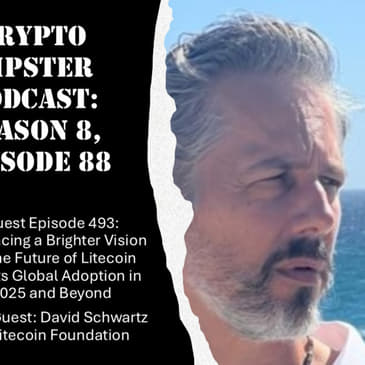

David Schwartz has been in the cryptocurrency space since mid-2017 and is currently both a Board Director and Director of Strategic Partnerships for Litecoin Foundation, a non-profit entity whose sole purpose is to promote the awareness and adoption of Litecoin (and Bitcoin) to the world. David has worked with class organizations within and outside of the crypto ecosystem on everything from Litecoin integrations to partnerships with the UFC, Miami Dolphins and others.
[00:00:03] Hello everybody and welcome to the Crypto Hipster Podcast. This is your host, Jamil Hasan, the Crypto Hipster, where I interview founders, entrepreneurs, executives, thought leaders, amazing people all around the world of crypto and blockchain. And today I have an amazing guest for the fourth time I believe I've interviewed this man three other times. This is the fourth. It's always a great show. Looking forward to it. He is, I'm not even sure what his title is now, but he's at the Litecoin Foundation.
[00:00:31] I believe he's in charge of special projects. His name is David Schwartz. David, welcome back to the show. Thanks, Jamil. It's good to talk to you again, man. Great to talk to you. Yeah. I haven't seen you since the summit last July. Yeah. Back in Nashville. Yeah. Cool. So let's kick things off and ask you first, so the people who haven't listened to the first three episodes know what is your background and is it logical for what you're doing now?
[00:00:57] Yeah. So currently I'm a board director and also director for strategic partnerships and projects for the Litecoin Foundation. Board director since last June, July. Been a director for partnerships and projects since late 2018. Came into the foundation as a volunteer in February of 18.
[00:01:25] And just trying to figure out how to fit in because the Slack channel where they had everybody on was all about development and technical stuff. And I was just a noob investor who wanted to volunteer. So I. My relevance to the space was basically nil other than probably hustle and organizational skills. So just tried to figure out where to fit in and helped put together the first Litecoin summit in 2018. That was in South San Francisco.
[00:01:55] And from there, just sort of latched on doing some project work and it just matured to where it is today. My background is mostly military and government work in the administrative program management and HR fields. So it really has kind of those those experiences and and training have helped me in where I'm at now.
[00:02:24] But as far as like translating that into the crypto space in general was a little hard at first. So, yeah. Interesting. Interesting. So you have had a lot on your plate recently. There's been a lot of focus, a lot of projects going on. So what so what are the update? What's the most recent news coming out of the Litecoin foundation? We were working on what we should look forward to.
[00:02:52] Yeah, I would say probably most recently, at least the last, you know, a few months, there's been two things sort of been concentrating on the most. One would be trying to get confidential Litecoin addresses added to wallets and other places.
[00:03:11] And then also the ETFs that are up for approval or disapproval, however you want to look at it from the from the SEC on the U.S. side. I want to talk about that. Let's let's let's jump into the ETFs first. Sure. Yeah. I know Canary Capital file ETF, I think Grayscale or someone else. You know, I'm interested to see why why you would think they would be disapproved.
[00:03:41] SEC already said that Litecoin is very much like Bitcoin. It's a commodity. What do you what's the census of where it's going to head? I mean, I think they're going to get approved. I don't I don't see why they wouldn't. But you just nothing's ever a guarantee. Right. Like a lot of people thought it was going to get approved by the first deadline. And here we are. Got extended 45 days to May 5th now. Right. So, you know, what were the odds of that of that happening?
[00:04:10] If you were outside of Litecoin and everybody's really into Solana and XRP right now and a few of the others, they probably thought that they were going to get approved first anyway, even if the headwinds were against them. Right. But a lot of that stuff got cleared out in the last week or two on top of that. So now that it's sort of an open field and a lot of those headwinds, they weren't necessarily there for Litecoin, but just in a general sense for the entire market, those headwinds are pretty much gone.
[00:04:39] I would anticipate that, you know, a lot of these ETFs get approved within the next two to six months, however long those, you know, those periods are from the filing and being recognized and having the comments and everything else for each of them. But for Litecoin, I would think you have CoinShares, Canary and Grayscale from the U.S. side.
[00:05:05] And those, I would think all the comments should be done and the moratorium period after that should be done. So I would think if there's no reason to delay them, that they would be approved by May 5th. Right. There's one out of Australia that was filed by Monochrome. I think that one is probably somewhere along those same lines. Right. It's been filed already, if I recall.
[00:05:34] And so they're just, there's their process. And then I think there's a basket ETF where there's already Bitcoin and Ethereum in it from hashtags. That's, they're asking to add like, I think it's five to seven other cryptos too. I can't remember. But Litecoin is one of them. And I would anticipate that by, I don't know, end of July or somewhere in August, that one should be approved too.
[00:06:05] So yeah, you're looking at a pretty busy summer for ETF approvals across the board, not just Litecoin. So I'm going under the assumption that they will be approved. Yeah. Yeah. Say that when they are approved, what's going to become possible? Now with Litecoin, that hasn't been so far.
[00:06:26] I think to this point, like there's been institutional interest, just not as heavy as other cryptos for whatever reasons. I mean, Litecoin, like the foundation itself, we don't necessarily hold a treasury. It's very bootstrapped, shoestring budget type of entity. Right. It's really, we're really focused on just adoption awareness and education of Litecoin.
[00:06:55] There's no, you know, there's no treasury to be throwing money at people to add it to things, which is always an enhancer that you see with like cryptos that come out of nowhere. And all of a sudden it has like, you know, a 4 billion market cap in three days or something. You're like, how in the world does this even happen? That's how that stuff happens. That is not organic. Okay. Just make that clear from the beginning. That is not organic. That is completely money-based driven. Right. So we don't have that.
[00:07:24] So everything that's happened for Litecoin has been extremely gradual and organic. So if people are interested in adding it, they're adding it because they see the value in it. If they're not adding it, it's because there's probably not enough zeros behind whatever they're anticipating to have happen for that to be added. Right. And that's just the way the game works.
[00:07:43] But once you open up ETFs and now you're opening it up to not just institutions, but you're opening up to your grandfather, you're opening it up to your uncle and aunt, you're opening it up to financial advisors and other people who wouldn't have been able to tap into a fryer. That to me is, I don't know if I say game changer.
[00:08:09] It is to a degree, but it's definitely the area that we, you know, excel in, which is retail. So if you look at, if you look at Litecoin statistics, the amount of Litecoin that's actually held by retail, definition of retail would be somebody like you or I and under a certain amount, like we're not a whale or something like that. Right.
[00:08:32] The institutional, I'm sorry, the, the retail side of Litecoin over 51% of all Litecoin is held by retail. Right. So then you have another chunk that's traded and then you have another chunk that's actually whales. Right. And those are going to be your exchanges. And then anybody who was fortunate enough to start mining in 2011 or whatever else, or these mining pools, those are going to be your whales. Right. Right.
[00:09:00] But over half, easily over half is held by retail, which you can't say that for all cryptos at this point. So that, that's where I think you'll see some growth is. And again, it'll probably be gradual. You're not going to have Bitcoin type numbers at the beginning of these ETFs.
[00:09:21] There was a huge concerted effort on the side of many people that have a very large interest in Bitcoin to make sure there was a big push at the very beginning of those ETFs. Right. Record, record numbers like other ETFs in history that have been opened through the SEC did not have those types of numbers. So you're not going to see that from Litecoin. Right.
[00:09:45] You didn't even see that from Ethereum, but there were other reasons for that because Ethereum, a lot of people who may have been interested in doing something like that have their Ethereum staked. And it doesn't make any sense for them to give up yield to go put it in an ETF until those ETFs hold yield. You're not going to see that. So you did see growth in numbers later on, but not at the very beginning. So I think you see something very similar with Litecoin.
[00:10:10] And the numbers obviously will be lower than those two that you saw as well. And potentially going to be lower than even Solana and XRP because the marketing behind those and the sort of money that they have and connections within the institutional spaces are much stronger. So even it's it could potentially be less than those. But does that make it a failure? Absolutely not.
[00:10:34] And the fact that you have three ETFs, single asset ETFs for Litecoin, which is probably the most organic top 20 crypto there is, speaks volumes for it. So you will have the numbers, but it will probably be more organic and slow grinding at the beginning, which is perfectly fine. It's just making sure you don't let the noise that's out there from other people kind of drown it out and make it look like a failure. Yeah, I was on a podcast last week.
[00:11:03] I was actually the guest and they asked me, like, if you're for newbies, what should they buy? I said, well, if you go to if you go to CNBC, you'll see they show tickers for Bitcoin, Ethereum and Litecoin. That's a great place to start. You know, as far as the graduality, you know, let's talk about that. You know, some some important numbers that the Bitcoin nurse or the Bitcoin community doesn't look at is is certain metrics that are really under the under the under the radar. Right. Like hash rate, like different different things.
[00:11:33] What are those key metrics that we're looking at and why are they important? Why do they matter? Well, for hash rates specifically, it matters for a number of reasons. One would be the health of the network in general. Like if you don't have a strong hash rate, you don't have a lot of interest. Right. In mining it. If you have a strong hash rate, you also have a stronger sense of security and what it would take to actually 51 percent attack or try and take over the network and then maintain that attack.
[00:12:03] Like once you attack it, you can still lose control of it. It's just, you know, that whole concept of of a 51 percent attack is kind of demystified a little bit in the fact that Bitcoin cash has been 51 percent attacked. Right. And a few others have. And they're still running now.
[00:12:25] Right. The people that that overtook it, they have to continually throw money at it to keep that hash rate above a certain amount in order to control it. And that so being able to attack it is one thing. Being able to maintain the control over it after that is another thing. But with with Litecoin's hash rate, it's grown exponentially over the last 12 months even.
[00:12:49] But if you were to go back even since the last bull run in 2021, like it's. So many degrees higher than where it was then the hash rate, I think it's over 2.5 percent hash now or something per second. And that's near the record highs and it just continues to go higher. The fact that you have now.
[00:13:13] I think it's like five or I don't even know, five or six additional coins that are merge bind with it on top of that shows that there's security there. Right. So when you're talking about the different hashing algorithms, Bitcoin controls 98 percent, 99 percent of its hashing algorithm, which is shot to 56, the one that was that was created by the NSA.
[00:13:37] And then you have the script hashing algorithm, which is dominated by Litecoin and dominates 98 something percent of the script hashing algorithm. It makes sense if there's a coin that wants to survive on proof of work and its script, it's probably going to tie its wagon to Litecoin. Right. So you look at the mining pools like they are now advertising script mining and they show all the different coins on there that you can that you can get out of script mining.
[00:14:06] And they're all tied to Litecoin. Right. So there's like what is it like like Pepe coin, there's Dogecoin, there's Lucky coin, there's I think even junk coin. I don't know. There's all these different coins and they're all tied to Litecoin's script hashing. Oh, I think Bell's coin obviously is one, too. And so you can get rewards in all of those if you're mining, but it's Litecoin's hash rate that they're all piggybacking on.
[00:14:34] So that should indicate to you the strength of Litecoin's hashing rate, too. I didn't know that Pepe was piggybacking off. I know the others. It's an old Pepe coin. It's proof of work. That's actually. If you go look at F2 pool, I believe they're the last one I saw that had like a post about what coins you can. Get rewards in for for using Litecoin's. You know, they're all merged mine with Litecoin.
[00:15:05] Wow. OK, so that's been a gradual increase. That's been that's been, you know, strengthening over time. What else has been strengthening over time is the use of Litecoin for payments. Yes. Yeah. Yeah. So like. Obviously, earlier on, prior to 2021, Litecoin was in certain payment rails. But a lot of it would have been more like peer to peer, too.
[00:15:36] Right. But as as time went by. Places like BitPay, CoinGate, you have. You know, BTC Pay server and others. They're open source like BTC Pay servers open source. But like BitPay and the others, you would have to have them actually add you as a payment option. And that didn't happen for Litecoin until 2021.
[00:16:03] But it was still already strong as something that was used for payments peer to peer on the Internet. And so that was a solid use case to present to them saying, look, this would benefit you to be able to add it. So they did. And for the last, I think it's 18 months every month, Litecoin is the leading payment option on BitPay. So those numbers continue to increase, even though they've added more and more payment options.
[00:16:30] It still holds strong at like the mid 30s to 40 percent of all payment payments done on BitPay. And now they they have rewards. You can, you know, all kinds of different ways in which they do transactions on BitPay. And a lot of them, Litecoin actually dominates on those. So it is still the preferred manner in which a lot of Bitcoiners move their Litecoin to on top of that.
[00:16:59] From whether it's exchanges or wallets or whatever, they'll convert it into Litecoin and move it because the transaction fees are lower. Got it. So we have a dichotomy. We have we have we have a interesting dilemma because the price of Bitcoin's gone up, obviously. Right.
[00:17:21] And Litecoin, I see Litecoin as more fulfilling Satoshi Nakamoto's vision of being an electronic peer to peer cash payment system than any Bitcoin. You know, so effectively, it's a better payment system. You know, and people are like, when is the price going to go up? You know, I'm like, doesn't the wouldn't the price have to stay low in order for it to be a peer to peer cash payment system?
[00:17:48] So or if the price goes up, then it wouldn't be any longer. How do we how do we deal with with with that kind of situation where we all want the price to go up, but we also want it to be a payment system? Yeah, I think it really is more reflective of whatever the transaction fees would be versus maybe the price of Litecoin, because most people are going to be buying Litecoin based off of a dollar nomination or whatever currency they use. Right. So.
[00:18:18] The only reason why you would also want it to go up are two. One would be for your purchasing power, if you already bought it at like $80 and you want more purchasing power. When it goes up to 100, 150, 200, 250, you obviously can buy more with the amount that you had at 80. Right. But the other reason would be obviously for people that are investing in it.
[00:18:43] So what you end up having is somewhere along the line, those powers that be that have the most influence in the Bitcoin space, because it is decentralized for all intents and purposes. The crypto itself. The ledger is decentralized. The efforts around it, maybe not so much. Right.
[00:19:08] Um, and I think that's where people get lost in all of this is Bitcoin is decentralized. The ledger is decentralized. The efforts around that are not so decentralized. It's matured over time. And just like anything that comes out good at the beginning, as time goes by, people tend to distort it and mutate it and make it into whatever creates power, wealth or control.
[00:19:37] Like those are the things that usually dictate how things go. And so over time, there is a shift in mentality from, you know, sort of this anarchist type of, uh, this is a new form of money. Um, giving the system, the finger, we can do transactions outside of the regular, you know, financial system to, oh my gosh, uh, we need, uh, you know, uncle government to be able to say, this is okay to put into ETFs.
[00:20:07] And now let's get a Bitcoin reserve and all these other things that those are all geared towards price appreciation. None of that's geared towards using it as a peer to peer, uh, network, right? Not to say that it can't because that's how it was built. So there is the functional, you know, the functional aspect of it that still holds true where you can transact it in that manner.
[00:20:30] The problem with that is it becomes more costly to because Bitcoin in and of itself at five to seven maximum transactions per second isn't built for global transactional use like that. Right.
[00:20:44] So that's why you end up seeing congestion and, and rising transaction fees where they're proud of when it hits $4 on average for a transaction for the fee, because there's been times when it's hit 25, 30, $40 for a transaction on average. Right.
[00:21:04] Some of that obviously is based on the total that's being sent, but some of, you know, a lot of that isn't it's, it ends up being a priority based transaction where you end up paying more just to have it put on into the next block. Right. Right. So now there's an incentive for miners to add those transactions because you're throwing extra money at them to do it. Right.
[00:21:27] Um, and so along the way, it was obvious that they had to go more towards this store of value as the primary mantra, right? Uh, narrative for it, because it's not going to fit the peer to peer lightning network is not the answer at this point.
[00:21:50] And so how do you win the hearts and minds of those that have the most amount of money and can appreciate the price exponentially in a shorter amount of time? It's a store of value. It's, it's a reserve. It's, you know, hold it. You don't do anything with it. You just hold it. You die with it. You burn your keys, you whatever, all this different stuff that they say. Right. Right.
[00:22:11] And that's how you get the price you have today and how you will continue to get that, that rise in price that they, when they talk about everything else going to zero against it, that's what they're talking about. Because nothing is going to have that type of price appreciation that Bitcoin will. And that's just the truth, right? But that doesn't solve the other issues we have in society. You need something else for that.
[00:22:37] And so that's where you end up having a Litecoin or an Ethereum or whatever else that solves a problem that Bitcoin most likely is not going to end up solving. Right. So Litecoin solves that, that peer to peer part of it. Not only in the fact that it's faster and cheaper, but now with, with confidential addresses included, it gives it a level of fungibility that Bitcoin does not have. Right.
[00:23:07] So that, that's to me, there's more value in the functionality of Litecoin right now than there is in the price. But as Bitcoin gets included in some of these bigger boy games, like the ETFs and some other stuff, maybe some, you know, maybe some publicly traded companies end up adding it as a reserve asset or something like that. Then, then you'll see some additional price appreciation over time.
[00:23:34] But for right now, like it's been in what a seven or eight year lull where it's between 45 and, you know, mostly 150. And, you know, I, along with everybody else probably thought it would be at a different point at this juncture, but it's not. But I also understand there are other forces at play that cause that price not to be necessarily where it probably should be right now.
[00:24:00] There are some other Litecoiners who have been, who have been calling for a much higher price on who, on, on X, on Twitter, who just got banned from Twitter. So, you know, talk about forces at play. There are, I agree with you. But the narrative has been, the narrative has been Charlie sold. And this was back in 2017, 2018. He sold a long time ago. There's been usage. There's been usage. There's been functionality. There's been utility.
[00:24:29] Not many people are talking about what that is. So, in addition to fungibility, what are the utilities, Litecoin offer? I know some of them that people are not talking about because they want to suppress the price or suppress it. Yeah. Well, I mean, price ends up being the main focus for most people because they're speculating, right? So, usage isn't, unless you're like, you're into it for the usage, usage doesn't necessarily matter.
[00:24:57] Like, we'll put out statistics all day long from the foundation handle, my personal handle, even the Litecoin handles put stuff out. If you go through the comments, they're like, yeah, but what about price? Yeah, but what about price? Like, they don't even care that you're showing them numbers that nobody else is matching in the space that are organic, right? They don't care. So, it's this fight that you got to keep making. You got to keep fighting it.
[00:25:24] But sometimes you just wake up and you're going, I mean, what is the point telling these people anymore? They just don't seem to care, right? It's hard. But I would say, you know, it's in a funny place as a hybrid. It is a store of value still, right? But it's being used more than ever before.
[00:25:47] If you were to take the ratios of growth versus Bitcoin, it has grown more in transactions, you know, per day or 24 hours, however you want to measure it, in month, year. It's grown more ratio versus Bitcoin in transactions, in new addresses, in active addresses, in the hash rate.
[00:26:14] Like, you can take almost any measurable and it either has been outgrowing or is staying on pace with Bitcoin. So, those are not signs of something that has been pumped and dumped and nobody cares about it anymore, right? This is something where the guy that created it mined his coins with everybody else, bought his coins with everybody else,
[00:26:40] and decided that the best way in order to have a fully decentralized crypto was for him to fully divest of it. And then, you know, he donates a lot of those proceeds back into the foundation to help with adoption and growth. I think that's a good story. I don't see why that always ends up being pounded as something where he pumped and dumped and left, and he didn't even sell it all at the high like everybody tries to say, too. So. Yeah, I agree. I agree.
[00:27:08] We've had a conversation about him being a very ethical player. Yeah. And I agree. So, you know, there are, I want to touch on a couple more things. One is we went down the ETF path and the price path. I want to go circle back to what you said in the beginning about confidential addresses. Yeah. So, what is the breakthrough or the innovation there? And how is that going to help?
[00:28:05] Yeah. So, the next block is created. Right. But every time a block is created now since 2022, there's also an extension block that's created outside of the base code, but it's connected. So, it's an extension of the base code.
[00:28:20] And in that block, all the addresses and the transactions that take place are masked so that the individual that owns the address does not have their totals that are within their address out there in the open where everybody can see. And any transactions that occur between these types of addresses are also masked so that everybody in the world can't see them. But they're still recorded within the extension block.
[00:28:50] And at the end, it's sent back to the original block to be recorded along with everything else. So, what this does is it adds fungibility to Litecoin, which means fungibility means one Litecoin equals one Litecoin. You can't differentiate the difference between them anymore. Right. Which was also an issue that Bitcoin to this day still has.
[00:29:13] So, like you can use methods and different programs to determine Bitcoin that may have been used in nefarious deeds, whether that be drug trafficking, human trafficking, all kinds of different stuff. Right. And then exchanges can say, we're not going to accept those Bitcoin or a company could say, we're not going to hold on to those. They become tainted. Right.
[00:29:39] But in reality, when you're talking about dollar bills, when you go into a store, a store is not going to be like, I can see that this was used to pay for drugs out of Colombia at one point. I'm not accepting this dollar bill. Right. Because a dollar bill is a dollar bill. That's fungibility. So, these Mimble Wimble extension blocks provide fungibility to Litecoin, which is not available on Bitcoin. Right. And what it also does is it frees up transactional space.
[00:30:08] It frees up space that's used within a block on one of those, the main blocks, because a lot of this stuff is taking place over here. It saves space over here because it gets consolidated at the end and it's sent back over. Basically, like at the end of the day and you're working at your company, they take all the mail and they take it over to the post office versus somebody going every single time there's an envelope going to the post office and sending it off.
[00:30:32] They're just consolidating it at the end of the day and then they take a big bin and they send it over to the mailroom instead of, you know, doing it individually. So, it saves space on the main block for more transactions as well. So, maybe from a technical perspective then, you said early on that Lightning is not the answer. Well, it's not the answer. Yeah, it's not the answer right now for sure. Right.
[00:30:58] I don't know if it's ever really going to be the answer, but that's still the narrative that's pushed is that it's going to be where all of the regular transactions happen. And the base chain for Bitcoin is really just going to be for big ticket transactions and that's it. That's the narrative. So, then why is Mimblewimble an improvement? Mimblewimble is an improvement because when we go back to talking about how many transactions per second there are, right? Bitcoin does five to seven max.
[00:31:28] Litecoin does 56 max, right? If one of those transactions is hundreds of transactions that were done throughout the day, you're saving transactions. There's a lot of different things that happen there that help it still retain that peer-to-peer payment type of transactional quality, right? I mean, Litecoin does have Lightning capability.
[00:31:57] It's not like it's not there. It was the first one to implement Segwit. It was the first Lightning transaction happened on Litecoin. But there's no need for it. And I don't know when there would ever be a need for it. You'd have to be so congested that there's been days when it's done millions of transactions. And maybe it spiked to four cents for a transaction on average, right? So is it ever going to need Lightning? Who knows?
[00:32:25] But it's there when the time may require it. But hopefully by then, the capabilities of Lightning are much better than they are now because it has been struggling. So I hear the benefits are speed, efficiency, and accuracy. Yeah, speed, efficiency, and accuracy.
[00:32:47] And that extension block also helps with easing congestion and space on the main block. Got it. Makes sense. That sounds good to me. So you said regarding the marketing, regarding the big push that Bitcoin's had, we have an opportunity now coming up in May for another big push. It was called the Litecoin Summit. The last one was really good.
[00:33:17] What should we look forward to at this next Litecoin Summit in Vegas, right? Yeah, heading back to Vegas for like the third time, I think. It will be at Harrah's Hotel. So the idea was last year we had the Litecoin Summit next to the Bitcoin. That was about a block, block and a half away from the Bitcoin conference. Worked out pretty well. People, if they wanted to, could go to both or go back and forth or whatever.
[00:33:46] And so we thought we'd try that again. So this year, the Bitcoin conference is at the Venetian. And we're right next door at Harrah's. And so our first day overlaps with their last day. And so what we do is we normally have two days of talks. There will be some sort of after party. We have a pool party on the second day going into the weekend. So ours is Thursday and Friday.
[00:34:14] And so Friday evening is a pool party. And then if people want to stay later for the weekend for Vegas and do their own thing, you know, that makes perfect timing for that. But we're doing really we're concentrating on four pillars of talks for the most part. And that's privacy, you know, having to do with Mweb again.
[00:34:34] So privacy, the ETFs, payments and trying to push for more remittances type activity on Litecoin. So those are the four that we're really sort of concentrating on. There's still talks around ordinals and NFTs. There's still talks about merge mining and things like that. But those other four are the main pillars of talks, too. Awesome. Awesome.
[00:35:03] I look forward to it. So let's see. Payments and that's a word you haven't heard. You don't hear that much anymore is ordinals. Yeah. You know, I guess they came down with the NFTs. Is there a future for that? Or do you not? I think there is. Like a lot of this stuff is still experimental, right? Like most of it ends up starting out like crypto kitties for Ethereum. Right.
[00:35:33] But I think as bigger players get involved and they're able to figure out how to monetize this stuff on a large scale beyond, you know, meme coins or ordinals or NFTs. Like if they can find a utility type manner in which to use them, then you'll see them come back more in force. Right. So like another buzzword right now is RWAs, right?
[00:36:03] Real world assets. And tokenizing everything. So you hear BlackRock's Larry Fink talk about tokenizing the world. And I think those things are coming. But I think what they're doing is they're looking at past forays into that. However, however it might relate to it. Right. So NFTs could be utilized like some of the.
[00:36:29] You know, some of the programming based off of NFTs or other things could be incorporated into something that's tokenization type of project. Right. Right. There's so many different. There's so many different ways to go about this that I can't see how they don't come back in some way if it's tied to something else. I don't think in and of itself it becomes huge. Like you still see Beanie Babies getting sold.
[00:36:56] You still see other things, you know, of a hobby interest being sold, but never at the fervor at which it first came out. Right. But they still exist. And so you'll still have people who are into NFTs. You'll still have people that are into ordinals. There's people that there's a guy he literally took every book of the Bible and got it onto the Litecoin blockchain. Same thing on the Bitcoin blockchain. There's there's you can keep things in.
[00:37:24] As much of an immortal status, I guess, however you want to put it within the blockchain, like that's kind of the purpose of it. Right. It's a permanent ledger immutable. So you'll find people figuring out ways to put real estate on there, how to fractionalize, you know, somebody owning a piece of something. All that stuff's coming down the pipe at some point. That's what I'd be interested in if I were doing it is like, how do I own a piece of a Monet?
[00:37:52] How do I own, you know, a fraction of an apartment complex where I can get some, you know, passive revenue from it or whatever. Those are all things that I would be excited about. So, yeah, sounds like the future is really bright. So I want to thank you very much for your time again today. This has been a great conversation. I look forward to everything that Litecoin is going to look forward to this year to see how everything works out and plays out. It's going to be exciting. So I have one last question for you. Sure.
[00:38:19] How can people find out more information about you, about the Litecoin Foundation, about the Litecoin Summit? How can they do that? Yeah. So for me, I'm I'm on X at at Daddy Cool 1991. I'm on LinkedIn. If you if you look me up there, you can find me using Litecoin Foundation as probably part of the search. The Litecoin Foundation itself, you could go to Litecoin.com. And that's where you'll find everything about Litecoin.
[00:38:49] You'll find out about the foundation. You'll also have a pop up come up about the summit so you can learn more about the summit from there and order your tickets through through that. There's also an Eventbrite link for the Litecoin Summit. So if you just type that in and search for it on Eventbrite, you should find it with Vegas tied to it. And yeah, those are probably the easiest ways. The handles for Litecoin on X and mostly other other places is just at Litecoin.
[00:39:19] And then for the foundation, it's at LTC Foundation. Awesome. Awesome. Thank you for taking the time again today. Great seeing you again. Thank you for talking to me today. Yeah, thanks. Thanks, Emil. I appreciate it.