
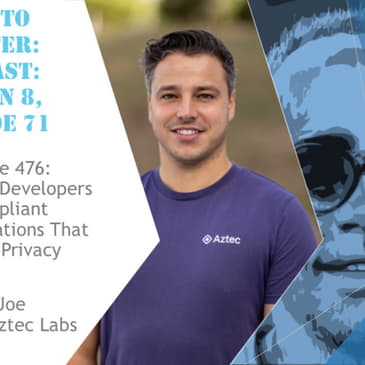

Joe Andrews is Co-founder and President at Aztec Labs, the leading privacy-first Layer 2 on Ethereum that empowers developers to build applications protecting user privacy while ensuring compliance. Joe also serves as Head of Product at Aztec and Product Lead at CreditMint since February 2018. He holds a BEng in Materials Science from Imperial College London and was previously Co-founder & Chief Technology Officer of Radish, a food tech startup acquired by Tovala. Joe is an experienced developer and was an EF9 Cohort Member at Entrepreneur First.
[00:00:03] Hello, everybody, and welcome to the Crypto Hipster Podcast. This is your host, Jamil Hasan, the Crypto Hipster, where I interview founders, entrepreneurs, executives, thought leaders, amazing people all over the world of crypto and blockchain. And today I have another amazing guest. He is the co-founder at Aztec Labs. His name is Joe Andrews. Joe, welcome to the show.
[00:00:29] Hey, thanks for having me on. Yeah, I'm super excited to be here. And yeah, let's get stuck in. Awesome. Awesome. Let's begin. And I begin with asking everybody the same question. I get amazing answers. What is your background? And is it a logical background for what you're doing now? Oh, that's a great question. I went to university and studied material science, which is probably not the most logical for what I'm doing right now.
[00:00:57] You know, it's kind of low level particles and, you know, how tempered glass and iPhone screens is made and kind of all of that kind of low level atomic stuff. But a lot of maths, a lot of science and a lot of kind of like use of computers. And I guess through that, I became obsessed with like computer science coding and kind of fell down like the tech rabbit hole first before the crypto rabbit hole.
[00:01:23] After kind of university, I moved to the US for a considerable period of time and did a few different startups there, mostly in the food tech space. And I've always kind of been, you know, I think excited by ideas that can influence humans, like we're all humans at the end of the day. And so my previous life was doing that around kind of like healthy eating and food.
[00:01:46] And whilst I was in SF, I kind of first heard about crypto and it took a few years, but eventually I fell down the crypto rabbit hole in 2017 by meeting Zach, my co-founder. And yeah, I haven't really looked back since. I think there's more people than you think who've gone from food tech to crypto. I don't know. I don't know what it is about the two, but there's some overlap.
[00:02:11] So I wouldn't say it's a traditional kind of like crypto background, but I think crypto kind of it. It attracts people who want to make a positive difference in the world. And I think that's my routine, I would say. That makes a lot of sense to me. So be healthy, have a mental, have a healthy mindset and healthy food. Yeah, it's all related. So very cool.
[00:02:38] So Aztec Labs, you know, what is it about and how do you empower developers to protect user privacy? Yeah, so we've been kind of building privacy preserving technologies since about 2017. We actually kind of started a slightly different mission.
[00:02:59] We were actually trying to put corporate debt onto Ethereum and kind of, you know, democratize large bank loans and let people kind of have access to those. We realized pretty quickly that the developer tooling to enable strong privacy was just not there. And so we set out to solve that really on the side with a kind of open source project called Aztec.
[00:03:24] And it kind of over the years, we realized that, you know, there needed to be a strong, incredibly neutral privacy layer for developers to build all these amazing kind of world changing applications. And Aztec became our focus from about 2019 onwards. And we kind of pivoted the whole company to focusing on building a privacy network that could power most of the world's transactions.
[00:03:50] So, yeah, our offerings at the moment are we have a programming language called NOIR, which is kind of an easy to use Rust-like DSL programming language for writing ZK applications. And we're building out what we call the Aztec network, which is kind of a fully programmable layer to on Ethereum, where you can kind of deploy those applications and have them settle with full privacy.
[00:04:16] So, yeah, we've been kind of building this for a while. And it's exciting to see how much the technology has kind of changed since 2017, 2019. There's been a few kind of big milestones, but I guess my message today would be that it's ready for the prime time. Like, I think people are building things today that we could only have dreamed of kind of like five, seven years ago. We have amazing things being built in the ecosystem.
[00:04:43] Awesome. I kind of like what you're doing better than putting corporate bonds on a blockchain. Me too. Me too. Yeah. I'm like, I don't know why anybody would buy bonds. Like, you're buying corporate debt and a lot of corporations, especially over the last decade, have made really bad decisions. So why are you going to bail them out? Yeah.
[00:05:02] You know, the original idea was like kind of like trying to, you know, give the average kind of like saver access to like this much higher rate of return than they get in kind of their, you know, JP Morgan account, those things. So it was kind of there was still that kind of like, you know, crypto native values of democratizing that industry and making it accessible to everyone.
[00:05:27] But yeah, I think pretty quickly we realized that like that was just one of N use cases that strong privacy tech could enable. And yeah, the list of other exciting things that are way more exciting than bonds is kind of ever growing. So I agree with you there. Nice. So privacy first technology, how does it align, you know, with the broader vision of the decentralized web?
[00:05:56] Yeah, it's a great question. I think I may say something controversial now, but I think that the decentralized web like either overlooked the need for privacy or took for granted the privacy we have in our kind of daily lives in web two.
[00:06:15] And really kind of my view and kind of our view at Aztec is that privacy is like essential to actually realize kind of the view of like the decentralized web. Like you really can't do all these things that we set out to do 10, 15 years ago without strong privacy guarantees.
[00:06:37] You know, for some people, maybe it's tolerable to leak all this privacy, but for the vast majority of, you know, humans in the world, they already enjoy a sufficient level of privacy in their lives. And to switch to kind of this alternate, you know, decentralized web world, they'd have to give it up.
[00:06:58] And so I think that there's this fundamental tension between the two and we kind of, we view privacy as the enabler to actually realize that vision kind of like 10, 15 years on. So I think we've got a long way without it, but really to go mainstream. Yeah, we need strong privacy solutions built into applications.
[00:07:19] And with that, and in terms of, if you build that in, right, in terms of solutions and the user experience, you know, how can they improve the user experience in crypto, in DeFi, in different areas of watching? But I think by improving, it's more about the things you can do, right?
[00:07:44] So it's about tying your real world identity to your cryptocurrency account, which if you're going to do that on a public network would sound absolutely terrifying. Like it would be kind of like the worst thing to possibly do. But if you think about the sorts of things that enables in the real world, like mortgages, consumer finance, like salaries, like you need to start doing that to have real world use cases exist on blockchains.
[00:08:10] Otherwise, it's just this bubble of speculation where, you know, people are kind of, they're speculating on assets that are derived from non real world value. And what I mean by that is like the value of the kind of native chain. So Ethereum, Bitcoin or Solana, everything is a derivative of that unless you can actually put real assets onto the blockchain. And to do that, you need identities, you need information, which you don't want to broadcast to the entire world.
[00:08:41] And so there's kind of a saying that we've borrowed for kind of some people over the years, but like you don't let people watch you shower. And I think that it's like basic things like that, right, that we take for granted. But Ethereum and public blockchains are the equivalent of just, you know, showering with the curtain open. And that's not a done thing. So, yeah, it's interesting to kind of flip it on its head a little bit and just put it in those terms.
[00:09:11] Interesting. Yeah. I definitely don't want people walking in while I'm in a shower. So, you know, nothing to see here. So, let's talk about you mentioned Ethereum, mentioned Solana, right? There are strengths and there are challenges between the two in terms of scalability, privacy and ecosystem growth, right? What are the strengths and the challenges of those two primarily? Yeah.
[00:09:39] In terms of privacy, I think Ethereum's been thinking about this for a lot longer. And so the privacy solutions are much more developed on Ethereum. I looked at kind of some of the, you know, the early privacy solutions on Solana and they have this confidential token kind of offering. And confidentiality is kind of pretty useless on a blockchain.
[00:10:04] And it's kind of like the sorts of things that Ethereum was thinking about in 2017, 2018. And it's actually, you know, it gives the illusion of privacy, but it doesn't actually provide strong guarantees. If anyone actually wants to find out what's happening, it's quite easy to kind of back out what these confidential balances are. So I think in terms of the privacy conversation, Ethereum is several years ahead in terms of like thinking through how to make that work.
[00:10:34] Kind of adoption and kind of like, you know, where developers are today. I think Solana is catching up fast in terms of, you know, an execution environment that's maybe more cohesive. But I think the Ethereum community is very, very aware of this. And, you know, there's a lot happening behind the scenes to kind of keep Ethereum on top. And so I'm still on Ethereum maxi, you know, we're building on Ethereum.
[00:11:01] But I do think it's kind of useful to see, I guess, for a chain like Solana that's a bit more centrally integrated, maybe not centralized, but it's all happening through kind of like a smaller group of people. They can move a lot faster than a chain like Ethereum that's a lot more entities are doing the work to make it happen. So there's pros and cons to both in terms of how it ends up.
[00:11:30] But I still think that Ethereum is the right horse for now. It's just got so much more reach and adoption. And, you know, if you actually want transactions to be settled on a global layer, I'd still pick Ethereum. We probably both know that sentiment is everything. Almost everything in this industry.
[00:11:53] And two years ago, you know, the Ethereum maxis were discussing on my show how we're going to flip Bitcoin, you know. And now the Ethereum maxis is saying, I hope we survive, you know. And then there's tremendous energy out of ETH Denver. But there's also, you know, some fear of like the future. So where have we come and where are we at and where are we going? Yeah, it's a tough question.
[00:12:23] I think the way I kind of sleep at night, I guess being a bit more of an Ethereum maxi, is looking at the chains that kind of are maybe ahead of Solana. Like Solana is kind of picked up as like this, you know, chain that's growing fast. But, you know, there's stable coins on Ethereum that are bigger than kind of Solana. And so it could happen.
[00:12:46] But I do think that there's, you know, like an interesting thought experiment is like, I think it's gone down a little bit now. But to me, it feels more likely that Dogecoin flips Solana than Solana flips Ethereum. Like in terms of like market caps, like relative market caps. But, you know, I could be very wrong on that. But I feel like, yeah, there's a big delta between them still.
[00:13:13] I think in order for Doge to flip Solana, that would mean that adoption of Litecoin would have to take off. And, you know, it wasn't included in the reserve. It should be. Or Eno just keeps tweeting about the other Doge. And, you know, we'll get there that way. Like, we'll see. Yeah. So I want to find out, you know. So we're talking about, you know, Eli. We're talking about the government.
[00:13:44] I don't trust the government. I don't like the government. But, hey, I'm not into chaos either. But, you know, you blend the private and public states, right? How does that blend enable the next advancements in blockchain breakthroughs? I think it's this notion of kind of being able to prove things about the real world that you don't want to disclose to everyone.
[00:14:12] And I think the example I always come back to is a passport. So passport verification, like in Web2 is done by, you know, me taking a selfie and taking a picture of my passport. And it's in the age of kind of like AI and deep fakes. It's incredibly easy to actually kind of fake that. We've seen kind of examples of it happen already. But most people don't kind of realize this.
[00:14:38] But inside a passport, all of the e-passports, which I think there's like at least 190 countries have signed up for, there's a private key. There's like a strong cryptographic object that is signed by, you know, a weather trust. You may not trust the government, but they, you know, they have signed your passport. And that is kind of mathematically provably true.
[00:15:00] And so how I think about kind of like enabling these new use cases, well, we can verify the signature within your passport on a blockchain now. And we can do that in a way that doesn't leak your passport to the world. And it's this amazing kind of like mix of meeting the world where it is, but with like cutting edge cryptography.
[00:15:25] I think the new use cases that enables is pretty amazing because it lets the blockchain actually be an intermediary. And traditionally intermediaries, you know, they take custody of assets, but they also take custody of information. They create information asymmetry. And that information asymmetry has been missing from the blockchain. And so now with kind of, you know, ZK and these new systems, we can actually use the blockchain as a real intermediary.
[00:15:53] It can custody assets for us and, you know, you know, do programmable logic and smart contracts to release them. But it can also create information asymmetry between two parties. And I think that's fascinating, the types of use cases that enables. What use cases does information asymmetry enable? Let's go through some. Like let's play a game of poker where I can see your card, where I can see your hand.
[00:16:22] And, you know, let's, let's get it kind of like a personal loan where, you know, the whole world can see your income and your outgoings. There's, there's all these things where like, there's a certain amount of information asymmetry that's needed to realize them. Games are, I think, are the best example. Like even the most basic game, like requires hiding information between the two players.
[00:16:48] So I think, yeah, when you kind of look at the world and you look at applications that have some level of information asymmetry, it's, it's kind of, it's kind of crazy to see. Like, you said poker. There are, there are, you know, there's a lot of, there's a lot of poker games online and they're dominated by these, by these AI bots. So if you don't know any better, you're going to lose. Right.
[00:17:12] So how do you get more transparency, you know, embedded in with it, with that security to help people, you know, who are going to, who don't know they're going to about to lose their bank, you know, account. So. Yeah. Let's imagine it a second. Right. So we've got like a game that's been played on chain now, and we just talked about like passports that can be verified in the transaction.
[00:17:41] So you could have some proof of personhood linked to your passport, but this is a real player, not kind of a thousand AI bots. And so, you know, it's not completely foolproof because people can sell their identities and do that. But it's, it's a lot better than just, you know, trusting some web two server where someone's got a thousand bots running and it's kind of raking in, raking in the pot every time. So I think combining kind of these, we think of them as primitives.
[00:18:09] There's all these kind of primitives that can be built. Now you have programmable privacy and ZK built into a system and you can combine them together to, I think, remake most, most applications with much stronger trust assumptions.
[00:18:28] So if I'm playing you at poker, like when, before I agree to let you into the table, you'll at least have proven that you're a human from Connecticut by kind of like doing some proof on your passport. God, I think that would help everybody. So, you know, I've been doing podcasts now for about four, over four years.
[00:18:53] And, you know, I look at, I wake up in the morning, I look at the crypto market and I'm like, it's like, I'm sleeping under a rock. You know, I'm talking to everybody. I'm learning everything. Right. Back in 2017, I read like 2000 white papers. The industry moves so fast. Well, how can people like begin to now like learn what's under the hood, you know, and start evaluating projects based on the important factors of blockchain, which is privacy, scalability. And, you know, how can they, how can they do that?
[00:19:25] I think the advice I would give is kind of look at, look at the developer base. And so there's a few reports that come out around kind of, you know, tracking where developers are going. And it's a pretty good signal of, you know, people have gone ahead of you and have like spent that time to learn. And then it creates a bit of a network effect. Like usually they leave behind some artifacts and some, you know, blog posts, tutorials to make it easier for the next person. Like it's just the whole open source ethos.
[00:19:54] Like there's, there's people who just like to do that and it's, it's amazing to see. But I think, yeah, just looking at, looking at kind of developer hype, it can be GitHub stars. There's a few reports. I think electric capital has one, but that ranks kind of ecosystems based on developer activity. I think using that as a barometer to, you know, aside where you invest your, your Sundays to learn about these things is going to filter a lot of the, the, the signal from the noise. Got it.
[00:20:23] So I'm wondering too, you know, a few years ago, it was beautiful. We had summer, we had DeFi summer. Everybody was like, you know, the DeFi was taken off and it's died down. I mean, I think there's building going on, right? What do you think it's going to take for the next, for the next step in DeFi in getting it out there and having it adopted? What's it going to take? Yeah, I probably sound like a broken record, but I, I, I, I, I, I think it's going to take a lot of things.
[00:20:52] Real world assets and, and kind of bringing, like the protocols are all amazing and they're sound, but they're, they're trading assets that are kind of speculative. And so if we take the same protocols and we apply them to real world assets, I think, yeah. Like take Uniswap, take Aave, take all of these like, like now battle tested kind of blue chip DeFi protocols.
[00:21:15] We need to give them like a fresh, a fresh, like wave of life by new assets that are not derived from Ethereum. And so that's kind of the big unlock, I think is we have the mechanisms. We've, we've really honed in on what works and there's been lots of hacks. There's been projects that have died and, you know, ideas that sounded great, but, you know, never, never got traction. But we know we now have mechanisms that people like, they understand.
[00:21:45] And, and we just need to broaden the asset base, I think is my view. And privacy, privacy obviously enables that. And so that's, that's why we're here. Awesome. Awesome. So I have a couple more, a few, a couple more questions. One, you know, recently Donald Trump announced that, you know, there's a strategic reserve or stockpile. You know, one of the stockpiles is Ethereum. It wasn't a surprise to me.
[00:22:11] It's a, it's, it's, it's not, the Bitcoin maskeys don't like it, but, you know, having the U.S. behind Ethereum, having it, you know, there was already global, right? What's the, what's the next evolution of Ethereum?
[00:22:28] Yeah, I think just on the reserve, one thing I find interesting is the U.S. has a lot of Bitcoin already through kind of Silk Road and, you know, other, other kind of like, like, I guess, times when they've seized Bitcoin. I don't know what their existing national stockpile of Ethereum is, which, you know, could be, could be some good, good kind of like prints on the chart if that, if that actually comes, comes to life. But that's one thing I always think about is, you know, the relative.
[00:22:58] In terms of though where Ethereum's going, Ethereum's kind of evolving into this, this chain that can support the whole ecosystem of rollups. So behind the scenes, there's a lot of work happening to support more data throughput. Like all of these rollups, they rely on Ethereum for security, you know, to prove state transition functions, but they also need somewhere to put their data. Like, you know, what happened in a transaction so users can see what assets they have.
[00:23:27] And at the moment we, this is done through blobs on Ethereum. So they were added, you know, about a year ago now, I think. We only have between three and six blobs per block right now. And, you know, current predictions are we probably need at least 10x that to keep up with demand in the next kind of one to two years. So I think a lot of work behind the scenes is focused on making sure that Ethereum as a kind of like base layer can actually support that.
[00:23:57] I think there'll be a lot more standardization. There's talk of like scaling the base layer and to kind of further the reduced fees. But the one we care about the most is kind of, you know, getting more data on Ethereum so we can use more of it when we have lots of private transactions going through. You know, you brought up the blobs. I remember last year, a lot of hype was talking about the blobs. They rolled out and then you stopped hearing about them.
[00:24:26] Like, so what are they like? I just want to go to a refresher. What they do, what they're supposed to enable, you know? What are they supposed to enable? Yeah. So before blobs, you had to send, you only had one type of data really on Ethereum, maybe two. You had call data, which is kind of like data that's accessible within your functions of a smart contract. And then you kind of had log data, which is like something that was emitted as a result of your transaction.
[00:24:56] And those have kind of different prices associated with them. But they were very expensive because, you know, the data had to kind of be propagated to all nodes. You had to kind of make, like everyone had to execute on the data because it was part of the transactions. And what blobs do is they kind of, they add a new class of data where you can't access this data in a smart contract.
[00:25:22] So it's not like kind of core data where you can, you know, check variables, check balances with, you can read stuff from the data. In blob data, you just have this guarantee that it's there. And so you could, you can kind of like have Ethereum guarantee that, you know, all of the nodes have seen this data. But you can't do any kind of computations really over it unless you use some pretty advanced CK.
[00:25:47] And so this means that for roll-ups, which are doing the execution kind of off Ethereum anyway, and just proving to Ethereum, they have a really good way of telling the world what happened. And so it's a way to kind of really lower the cost of transactions by making, but still get the guarantee that, you know, all the Ethereum nodes have seen this data.
[00:26:13] And so, yeah, it's, it's kind of exciting because it, it, it opens the door to kind of like Salaam level throughput, Visa level throughput. At the moment, we're kind of, you know, we're still at the, I would say toy stage where we only have three blobs or six blobs. But the design is compatible to kind of scale us up to, you know, I've seen some of the forum posts which go beyond 128 blobs.
[00:26:40] And so there's, there's still work to do to get there, but the design is good, I think. So we just need node software to get better and people to kind of do a hard fork where there's more blobs and we'll be good. I think today, actually, there was the Pectra hard fork on one of the test networks added in more blobs. So it's coming. Hopefully towards the end of March, we'll get more on mainnet. And it sounds to me like they could be helpful in privacy.
[00:27:11] A hundred percent. So the, the one downside of, I guess, privacy or encrypting information is when you encrypt information, it actually gets bigger. So private transactions need more blob space than public transactions. And so, yeah, we, we, as kind of like a privacy chain, like if we want to make sure our transactions are as cheap as possible, we need more blob space. Got it. Well, awesome.
[00:27:39] Well, I want to thank you very much for your time today. I enjoyed speaking with you. I have one last question. It is this, is how can people find out more information about you, about Aztec Labs? How can they become, you know, how can they use your protocol to, to empower, you know, to developers use it and users use it? How can we do that? Yeah. So I think the best way to stay in touch is follow us on Twitter. So Aztec Network on Twitter.
[00:28:08] If you want to follow me personally, it's J-A-O-S-E-F. And for developers, I think, yeah, kind of stay tuned. We have a testnet coming very soon and we have lots of build programs kind of around that, ranging from kind of like building things on testnet through to kind of developers who are more just getting started and they want to write their first CK app. I think we have a sprint coming up called the Noir App Sprint, which will kind of be going, going live in end of March, April.
[00:28:36] And so if you're kind of a developer that's heard about privacy, heard about ZK, but, you know, haven't found the opportunity to get started, follow our Twitter and there'll be kind of sign up instructions coming soon. It's pretty accessible and should be kind of a couple of weekends worth of work. So now's the time to really start building these, these amazing apps because the tech's here and it's ready. Awesome. Thank you very much for your time today. Thanks so much for having me. It's been super fun.