
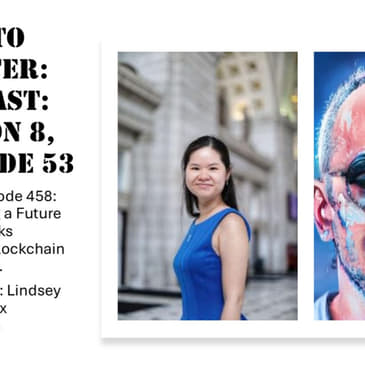

Lindsey Lim is a board member at the Radix Foundation and previously senior director at Circle Internet Finance (issuer of USDC), where she led financial partnerships. Prior to this, Lindsey had a similar role at Calibra, Facebook's crypto wallet, where she focused on building a global on-ramp and off-ramp network.
Lindsey also worked at the World Bank Group for over five years. She was country manager of the Philippine subsidiary of Swedish insurance tech company BIMA MILVIK, and worked at McKinsey and Citibank.
You may reach Lindsey at linkedin.com/in/lindseylim. Please include a note specifying why you are reaching out.
[00:00:00] Hello, everybody, and welcome to the Crypto Hipster Podcast. This is your host, Jamil Hasan, the Crypto Hipster, where I interview founders, entrepreneurs, executives, thought leaders, amazing people all over the world of crypto and blockchain. And today I have another amazing guest. I'm really excited about this interview. My guest today is a Radix Foundation board member. Her name is Lindsey Lin. Lindsey, welcome to the show. Thank you for having me, Jamil.
[00:00:31] You're very welcome. I had a couple of interviews with Radix folks before, and they were amazing interviews. So I look forward to this conversation. Thank you. Yeah, awesome. So let's kick things off and ask you the same question I ask everyone. It's what is your background and is it a logical background for what you're doing now?
[00:00:52] Yeah, I would say so. So I've been in the financial services industry for 16 years. I started out in commercial banking, then I went on to do development and sustainable finance and then fintech. So out of those 16 years, 10 years were in investments, banking and then investment advisory. And then six were in fintech at four different startups, two in insurance and then two in stable coins.
[00:01:20] Yeah. So I think it is a pretty logical transition from commercial banking to mobile finance or mobile wallets, then into stable coins and crypto. Awesome. So I don't get very many people who come on my show who had background at the World Bank, right? So how does someone from the World Bank end up in crypto anyway?
[00:01:48] Great question. Okay. So when I rejoined the World Bank back in 2017, around 2018, 2019, I joined this small team within the World Bank where we were trying to pilot what was called credit passport. The idea was for migrant workers to be able to encrypt their credit histories onto the blockchain. And then when they moved to another country, they can then move their credit history to another country so they don't have to start all over again.
[00:02:18] And then having it on the blockchain ensures that nobody could tamper it. It's immutable. Nobody could change it either for the better or for the worse. So the team I was on at the World Bank had a lot of trouble trying to get senior leadership to understand what the blockchain was. Back in 2018, 2019, there was a lot of suspicion around crypto technology.
[00:02:43] And then I happened to know somebody who was also at McKinsey like I was, who had gone to Facebook's Libra project. So Libra, as you know, was the cryptocurrency project at Facebook. The coin was called Libra and then the wallet was called Calibra. So that McKinsey alum told me that they're going to be working on this Calibra wallet.
[00:03:10] And then this would facilitate remittances to developing countries, including the Philippines where I grew up. So that's how I was sold into the idea of working on stable coins. And that's how I ended up joining Calibra. And then after the Calibra project ended, I went on to join Circle and led financial partnerships over there. A lot of people didn't like Calibra, especially in Congress.
[00:03:40] Yes. Yes. It was very high profile. Yeah. So you believe, I think you believe this and your wife might be in the minority, that stable coins enable financial inclusion. Right. I do. How do they enable the inclusion? Yeah. So I can give you a few examples.
[00:04:00] So as I mentioned, I grew up in the Philippines and I was old enough to remember the Asian financial crisis when currencies devalued. So that's also one of the major reasons why people in developing countries are big fans of stable coins, dollar backed stable coins. It's a hedge against currency devaluation. So that's one way it enables financial inclusion.
[00:04:27] It helps you preserve the value of your hard earned savings and not see it wiped out when your currency devalues. So that's one example. Another example is, let's say I'm a gig worker or a small business owner abroad, and then I sell a service or a product to somebody else. If I were to do it through the traditional payment rails, there would be a lot of fees, right? Like, let's say I accept a credit card.
[00:04:53] But if I were able to accept a stable coin, the transaction would be almost free. So that's a way to help the gig worker or the small business owner keep more of their money. So another form of financial inclusion. And then there's other applications like aid distribution.
[00:05:09] So let's say you're a nonprofit or an international development organization and you're sending, let's say, child care subsidies or health care subsidies to millions of people, right? If you use the traditional payment rails, you'd be paying so much in fees and then that would be taken out from what they would be receiving at the other end.
[00:05:35] But if you were to use stable coins, they would receive more of the money that you had intended to send them. And then lastly, one of the examples that I like the most that very few people are aware of are refugees. So let's say your country is in a conflict zone. The banking system stopped working. There's no way to withdraw anything. The bank ATM and then the bank branches are shut. Crypto and stable coins are a way for you to still move your money.
[00:06:04] Let's say you're moving, you're fleeing your country to another country. You can take your crypto with you. You might not be able to withdraw money from your bank or you might not be able to get a wire transfer from your bank to the next place that you're going to. So those are just a few of the examples of how stable coins really enable financial inclusion. Interesting. I have some follow-ups there.
[00:06:32] I want to backtrack a little bit before I talk about those follow-ups. I introduced you as being on the Radix Foundation. So I want to ask you about that first. And then I want to learn a little bit more about the transition from Calibre to Circle. But I'll ask you about Radix first. Yeah, sure, sure. Okay, so we'll talk a little bit about Radix and then my role there.
[00:06:56] So just to clarify, Radix DLT, it's a decentralized finance, a DeFi platform. And then it provides a full stack for Web3 development. So there's the Radix wallet. There's the scriptal programming language. And then there's the Radix engine for the app development. I sit on the board of Radix Foundation as a non-executive director or what's called an independent director here in the U.S.
[00:07:25] So the Radix Foundation is the holding company that sits on top of Radix Tokens, Radix Publishing, and Archetype, which holds non-open source IP. Just to clarify, so RDX Works, which operates Radix DLT, does not sit under the Radix Foundation.
[00:07:45] So the structure of Radix Foundation is still evolving, but the long-term vision is for the foundation to provide governance for the community and serve the interests of everyone in the network. Got it. Thank you. So you did work at Calibra and you transitioned to Circle. Yes. Right. So what are the – and you worked on stablecoins. So what are the stablecoins on and off ramps and why did you partner?
[00:08:14] Why do you partner with banks and payment processors? Yeah. Sounds good. Okay. So as you know, like Calibra is a B2C product, right? It's a wallet that was meant for individual users. And then Circle is a B2B company. So Circle's customers are institutional users of USDC and Eurocoin. So why do we need on and off ramps?
[00:08:39] So in order for us to receive fiat funds from our institutional or individual customers, we need to use the traditional banking system. So our customers either send it through bank transfers or they use their credit card to send us funds or they could do a wallet-to-wallet transfer.
[00:09:02] And then when they send money, fiat money to us, and then we then create the equivalent amount of stablecoin and send it back to them, that's called on ramping. Let's say the customer says, okay, I no longer want my crypto, my stablecoin. I want my fiat money back. We then use the same partners, those banks, those payment processors, those wallets to send the money back to them.
[00:09:30] So they receive their fiat back and then we destroy or we burn the stablecoin. So that's called off ramping. So in order for people to be able to access the stablecoin, we need an on and off ramp network. And that was my job at both Calibra and Circle. So at Calibra, my job was to make the on and off ramp network for the wallet. And then for Circle, my job was to build the on and off ramp network for the USDC stablecoin and Eurocoin.
[00:10:00] Interesting. So you have experience with on ramping and off ramping. And you brought up a couple of concepts a couple of questions ago when I asked about financial inclusion. And I don't usually, my first of all, but I don't usually think of the gig worker as somebody who is financially included. I guess I'm looking at the fiat world, but it was financially included in the economy.
[00:10:27] I think the gig worker is on the outskirts, right? How do you, how are they considered financial inclusion included if they're on the outskirts? Yeah. So let's say you are a web designer in Pakistan or a virtual assistant in the Philippines or a similar type of role of gig worker.
[00:10:55] You're kind of excluded in a way from the employment markets in other countries, right? But if there was a way to pay you for your gig work in another country because you're efficient, you're cheaper, then it might be feasible for you to enter the labor market in those larger, more lucrative markets, typically in developed countries, right?
[00:11:23] So the problem is that it's costly to pay you and then there might not be or there very likely isn't a way for us to have the same app. Like, let's say I'm the one hiring you in Pakistan and I'm in the US. You and I are not going to be able to vend well each other the payment, right? So because of the lack of shared payment method, you're somewhat excluded from participating in my labor market.
[00:11:50] It would be easier for me to pay somebody in the US who also has Venmo, for example. But due to stable coins, there's now a way to pay you almost for free. And then this enables you to then be included in the labor market where I am. So that's how I view it for gig workers. Interesting. Okay. So I like the way you view it and not the way that I've been viewing it. So I have to duck your way.
[00:12:20] Yeah, I mean, I guess if I pick up on it, I think you were thinking of gig workers as excluded, partly because there's an assumption that they don't have a full-time job. But some gig workers already have a full-time job and then they want to increase their income. So they have like a side hustle on top of that.
[00:12:41] So they're not excluded in the way that this is their only choice, that they haven't been able to get a regular job. This is sometimes a way for them to have a second stream of income or diversify their income streams. Interesting. I like it. So the other thing you said, you mentioned refugees, right?
[00:13:06] Right now in the United States, there is an initiative by the new President Trump to send the refugees back home. If he's sending them back home, you know, is he sending the crypto out of the country? You know, I didn't think of it that way before. But is it a financial inclusion or is it financial exclusion? Also, the crypto aspect of it is cross-border.
[00:13:34] So even if they were, let's say there are refugees that are sent back home, they would still retain the crypto with them. Theoretically, they would still be able to take their wallet either. Maybe they have cold storage. They could still take it with them to another country where they are relocated. So I wouldn't consider it as being excluded when they leave the country, at least in terms of the stable coin. They would be able to take it with them.
[00:14:03] Got it. I ask you that because the next question is going to be about banks. You cross-border. You said cross-border, right? So the biggest challenges, what are the biggest challenges when it comes to banks and partnerships with banks and, you know, the whole banking cross-border relationships? Yeah. So typically there's three major streams when I'm partnering with banks.
[00:14:27] One stream is the contract negotiations, so the legal contract, the commercial terms, the SLA. So that's one stream, the legal stream. The other stream is the technical integration. So we're going to integrate into their APIs or vice versa. And then the other stream is the due diligence stream. So they're going to conduct due diligence on us, and then we're going to conduct due diligence with them.
[00:14:52] So in my experience, partnering with banks for on and off ramps, due diligence is by far the most challenging stream. It takes the longest. There's the most number of questions. It's kind of the long tail of the entire thing. Like you might be done with the API integration before you actually complete the due diligence.
[00:15:14] And the contract might be sitting ready to be signed before the due diligence is completed because of the layers of scrutiny and the lower risk appetite when it comes to servicing the crypto or the stablecoin use case. And when I was doing insurance partnerships, this was far lower of a hurdle, the due diligence hurdle, than it is in stablecoin on and off ramps.
[00:15:43] So they're more comfortable with stablecoins. Pardon? They're more comfortable with the stablecoins. No, no, no. The reverse. So when I was doing insurance partnerships, the insurance underwriters were much more comfortable integrating with us to offer insurance products. Whereas working with banks, it was much, much more challenging to get them comfortable to integrate with us to facilitate stablecoin on and off ramps.
[00:16:13] Got it. That makes sense because I think back in 2017, 18, when I came in this industry, I was an ICO advisor. And we tried to get our rewards token in front of banks. We had conversations, but they were like, oh, this sounds good, but we're not. And we're not ready for that. Yeah. Yeah. Even up to three or four years ago, you know, but now it seems like they are. Right. Yeah. It's getting better.
[00:16:38] Like we can talk a little bit about it with the shifts in the recent executive orders. Yeah. So how did you start to convince banks to partner with you after, you know, when Quipro was less accepted than now? Yeah. So I have like a couple of approaches, but one of them is kind of like a stairs or a step-by-step approach.
[00:17:01] So the first step or the lowest level would be to convince the bank to be your payroll partner. So you would just open a regular corporate account with them. You would store the money that's needed to pay your team or for your supplies or your office rent in that jurisdiction, in that market. So that would be step one. And it's kind of getting their feet wet, getting to know you. And then once they're more comfortable, then we might do step two.
[00:17:31] And step two is asking them if we can hold our stablecoin reserves in their bank. So opening account to store the reserves. And this is very attractive to banks because they want the deposits. And then this triggers them to do more due diligence, more KYC. And then in the process, they become more and more familiar with stablecoins and then your business model.
[00:17:55] And then the next level, which is primarily the goal of my previous roles at Circle and Calibra, would be to get them to agree to let you use their payment rails to receive and send money to your institutional or retail customers. So that's the on and off-ramp partnership.
[00:18:13] So, again, that would trigger another round of due diligence as they learn what kind of customers will be using their payment rails, what are the use cases as to why they're using your stablecoin, etc. And then there's another layer on top of that, a final step on top of that, that very few banking partners have reached. But I think a couple of my banking partners actually reached that stage.
[00:18:37] So after they become your on and off-ramp partners, in some cases, the bank reaches this stage where they're actually excited about stablecoins. And then they think of building their own products on top of it. They think of accepting stablecoins for settlements. So that's kind of like the nirvana, the very few banking partners. But generally, the step-by-step approach is one of the techniques I use or used to use to get banks to partner with us.
[00:19:10] Interesting. Interesting. So you mentioned executive orders, right? So I want to find out what your reaction is to the recent executive orders on crypto, if you see them favorably. Yeah. So we'll focus on a few aspects of the January 23 executive order on digital assets. So there's a few things from that that are very exciting for the industry.
[00:19:36] So one, the order established a working group to develop regulations for digital assets, and that includes stablecoins. The other is that the order promotes the lawful use of dollar-backed stablecoins. Another is that it's promoting fair and open access to banking services for the industry.
[00:19:57] So as you can imagine, for somebody who was in my role doing on and off-ramps, access to the banking industry is the key requirement to be able to establish on and off-ramps. And then also the order is trying to provide regulatory clarity through regulations. And then alongside the executive order on January 23rd, they also repealed SAB 121.
[00:20:26] So this order had required institutions holding digital assets or Bitcoin for customers to recognize a liability. So this made it very complicated for banks to hold crypto or very onerous for banks to hold crypto. And then if our goal or if my goal is for banks to reach that nirvana step, the highest step where they're actually building on top of stablecoins,
[00:20:55] the repeal of SAB 121 helps facilitate them to think about what can they build on top of stablecoins now that it's less onerous for them to actually custody digital assets. So overall, like with regards to the January 23rd executive order on digital assets, I am very, very optimistic. We still need the actual stablecoin regulations. The executive order doesn't provide those regulations.
[00:21:23] But just this past week, the Genius Act, which stands for Guiding and Establishing National Innovation for U.S. stablecoins, has been introduced by three senators. So it's really like the golden age for stablecoins in the U.S. But at the same time, we're kind of behind other jurisdictions like the European Union or Singapore, which already has a clear regulatory framework for stablecoins.
[00:21:53] Yeah, yeah. Micah and I forget the name of the bill in Singapore. But yeah, I understand. I'm interested. You said something interesting. You said the banks want the deposits. Right. So, yeah, I can see that. You know, I can see the one thing, the deposits to they can pay the interest and the small interest they pay. Yeah, yeah, exactly. You know, deposits for them. Yeah.
[00:22:19] But what is your vision about the future of the banking industry embracing blockchain innovation? And with that, you know, decentralized finance, pretty much coming into finance. So maybe you get a little bit more than a quarter percent yield at the bank, which everybody wants yield anyway. So what's your vision for the future? Yeah. Yeah. Yeah. So, yeah. I really want banks to reach the top of those steps.
[00:22:44] So I hope that they can build or partner with tech companies who can build on top of the blockchain and on digital assets. So I hope banks will see stable coins as a new, more programmable payment rail. So like RTP or FedNow, but so much better. So I hope that comes true for banks.
[00:23:02] Then personally, I am very excited about RWA real world assets, especially tokenizing real estate and other investment instruments, because this will, in theory, make them more accessible. And banks have a huge role to play in this space. So for me, that's my personal hope for the banking industry when it comes to embracing blockchain technology. And do you think they'd ever pay a higher yield than they do today? I don't.
[00:23:30] Honestly, I don't, because we're in a declining interest rate environment. So yields are probably going to go down rather than up. Yeah. Yeah. Yeah, that makes sense. So, you know, I know you mentioned a little bit earlier about difficulties getting credit, right? Yes.
[00:23:51] So how do you, what do you think can be done to facilitate them, people who don't have the credit, who credit is a challenge to get credit in the blockchain space? Yeah. So I get this complaint a lot, and you and I were discussing it, how difficult it is to get credit. Even when I'm at parties with a lot of crypto industry folks, they complain about that. So one, as you know, like when you're applying for credit, identity is a huge component of this.
[00:24:21] The creditor needs to know you are who you say you are, and they need to know something about you so that they can gauge your credit risk before they actually give you the loan, right? So because in most cases you are anonymous when you're doing crypto transactions, this has been kind of a hurdle for increasing the availability of credit.
[00:24:48] But one idea that I've been toying with recently is when you on-ramp, when you use your credit card or use your bank account to take fiat and then convert it into crypto,
[00:25:03] in this particular step, might there be a way to link your identity with your debit card or with your bank account and then use that identity to establish a form of credit history or credit risk score for you within the blockchain so that you would be, quote unquote, deemed credit worthy or somebody can gauge your credit worthiness.
[00:25:27] Now, again, the tricky part is that after the on-ramping process and then you do a lot of activities on different chains, then it's now hard. There has to be a way to tag you or to tag those transactions to your original identity so that it becomes part of your credit history. But let's say we were able to solve for that problem, that identity problem and that credit history problem,
[00:25:50] then that would go a long way to increasing the amount of credit to participants in the blockchain. I'm wondering how to reconcile that with the KYC process because if I'm coming into crypto from the fiat world, they're going to do a KYC on me. They're going to have my past history, whatever it was, my credit score, which is okay. It's not stellar. It's not terrible.
[00:26:19] But they would then tie that into the... So how do you leave that at the door when you're creating this new credit system? How do you ensure that there's a blank slate for the new crypto users and you got a different credit score than you do in the TradFi? Oh, so in this situation, it wouldn't be. So in this situation, we would be blending your credit score in TradFi to Web3. So it wouldn't be like a clean slate.
[00:26:48] You would be taking it with you per se because we would be relying on your Web2 identity and your Web2 KYC. So assuming you had been KYC'd, of course, for your bank account and KYC'd for your credit card, we would be relying on that to give you an identity, which means your previous behavior,
[00:27:10] previous transactions or previous risk score would then go with you onto Web3. So it doesn't solve for that. It doesn't give you a clean slate. But it would for people, say, in sub-Saharan Africa where you have community wallets, right? They would be able to start with a clean slate. Yes.
[00:27:39] So if they don't have an existing credit history and then there's a way to ID them and then there's a way to on-ramp them and then maybe link their identity to whatever method they use for on-ramping, then they could slowly build up a credit history, perhaps, through the transactions that they make. Or there could be a way to create an alternative credit score for them.
[00:28:07] There are already companies that are doing different forms of this, by the way. So there would be a way, perhaps, to do an alternative credit score on them based on their behaviors on the blockchain itself. I like it. I like that. I think it's a great idea. Yeah. Very cool. So I want to thank you very much for coming on the show. I enjoyed speaking with you. And, yeah, I had a lot of fun. And I have one last question.
[00:28:36] How can people find out more information about you? How can they get in touch with you? How can they do that? Sure. So you can contact me on LinkedIn. You can search for my name, Lindsay Lim. It's Lindsay spelled with an E. And then my profile picture on LinkedIn will be the same headshot that's used for the podcast. I am currently open to new full-time opportunities, not just in the Washington, D.C. area where I live, but also in New York, Seattle, or the Bay Area.
[00:29:02] If you do send me a LinkedIn connection invitation, please be explicit in the note. Specify if you're reaching out for an interview or a consulting gig or a board seat or a full-time role. Just to note that I'm not involved in the day-to-day operations of RDX Works. So RDX Works has a LinkedIn page, but Radix Foundation, the holding company, does not.
[00:29:27] So on my LinkedIn, it says RDX Works only because Radix Foundation doesn't have its own LinkedIn page. But if you do have questions for Radix DLT, please direct them to the RDX Works team. Awesome. Will do. Thank you very much for your time today. Thank you. Thanks for having me.