
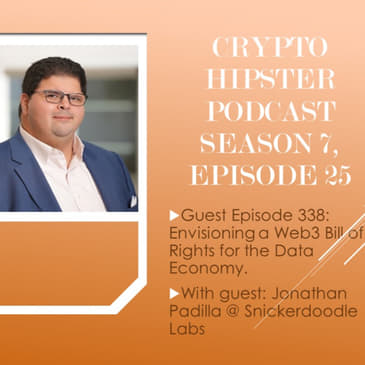

[00:00:00] Hello everybody and welcome to the Crypto Hipster podcast. This is your host, Jamil Hasan, the Crypto Hipster, where I bring you founders, entrepreneurs, executives, artists, amazing people all around the world of crypto and blockchain globally.
[00:00:15] And I have another amazing guest today. There's a little bit of diligence on his background. I'm really impressed. I'm sure you will be too. My guest today is Jonathan Padilla. He is the co founder and CEO of Snickerdoodle Labs. Jonathan, welcome.
[00:00:33] Great to be here. Really, really appreciate the opportunity looking forward to diving in.
[00:00:37] Thank you very much for joining me. Yeah, let's start off and in your own words, what is your background? And is it a logical background for what you're doing now?
[00:00:50] You know, I would say it's probably illogical at face value, but I think given where the space is, it actually adds a lot of capabilities to kind of deal with some of the biggest issues in crypto.
[00:01:00] But my first career was in government. I ran campaigns, I worked in the White House, I was a speechwriter. And that was really from 13 years old all the way until 2016 when I went off to Oxford to actually study degree in government there.
[00:01:18] And so I had this very securitas route where worked in in Democratic Party politics, which is actually kind of anathema now in Web3. But went to Oxford, met a guy who was super early at Ripple, Ryan Tarablini, who's now very involved with the Algorand community.
[00:01:37] He actually runs their venture program over at Algorand. And he taught me about Ripple and that's that was my kind of rapid whole moment into Web3. And wrote my master's thesis at Oxford on energy systems and blockchain, spent a summer in Kenya in between doing that.
[00:01:55] And then I went off to China in Beijing in 2017 at the height of that kind of bull market and ended up writing my master's thesis there on transnational regulation of digital assets.
[00:02:07] And that was used by a number of bigger bodies like the IMF as they looked at how to approach this digital asset space. So I started in the government space, had set up a lab at Stanford with David Maziaras from Stellar and then Dan Benet.
[00:02:21] And, you know, from there, PayPal poached me to come help run their blockchain program. And I went from more regulation and government into building and being product side.
[00:02:33] And that, I think, is obviously a lot more fun. But the biggest issues in the space are regulatory. And how do you deal with government? How do you deal with these things that are causing engineers and product people headaches?
[00:02:47] So I approach it from the lens of how do we deal with government? How do we deal with regulation? And how do we build for those to make sure that we have the best possible chance for success?
[00:02:57] The crux of this podcast is going to be about snickerdoodle. But I would be remiss if I didn't have if I didn't correlate two things together.
[00:03:09] I think you are a democratic speechwriter, and it looks as though from the outside that the Democrats hate crypto. You know, how do you see it? Because your perspective is, you know, you have that experience. How do you see it?
[00:03:25] I actually think there are pockets of hope. You know, for the record, like I'm an elected delegate for Joe Biden for 2024, the convention that happened a couple weeks back.
[00:03:37] I was a delegate in 2020. And that means I get to go to the Democratic convention this year in Chicago. And I'm one of the actual folks who votes for his nomination to be the Democratic Party's nominee.
[00:03:48] And I have had a lot of conversations with Democrats, some who I think probably do hate crypto. People from Senator Warren's staff definitely fall in that bucket. They're not a big fan of me.
[00:04:00] But I've spoken to a lot of people, especially those in California. Heck, I had an email literally just before I jumped on from a new congressman from Rhode Island.
[00:04:08] And they're all reaching out to figure out how does this crypto work? They don't want to necessarily follow the Elizabeth Warren path and what's a good way to get the best possible legislation to balance here.
[00:04:21] So I'm doing what I can to basically work within the party. Chairman Jamie Harrison, who is the chair of the DNC.
[00:04:30] We work with him on a number of these initiatives to kind of bring people and have them educate the party. I'm working on a couple things right now with the Blockchain Association.
[00:04:42] And we're going to plan to do an event at convention over in Chicago in a couple months. And I think the goal of these types of things is to dispel this myth.
[00:04:52] But you're right. The reality is right now, if you look at what Ryan Salkis is talking about, it's probably like an 80-20 split where crypto folks are either for Republicans or for Mr. Kennedy.
[00:05:05] I don't think necessarily that's sustainable in the long term. But there's enough Democrats, especially in California.
[00:05:12] Alex Padilla, who I've known for a long time and I've talked to him about this issue. Adam Schiff, who's going to be the likely replacement here in the Senate for Feinstein's seat.
[00:05:24] These are people who understand innovation, who understand how important this issue is to California. And I think you'd be surprised how much and how willing they're willing to sit down and understand these issues.
[00:05:36] I would love to see that. I would really love to see that. Cool. Thank you.
[00:05:45] So snickerdoodle labs, when I think of snickerdoodle, I think of cookies. What is this snickerdoodle labs all about including your vision and your mission? And how do you solve the crumbling cookie problem?
[00:06:02] So this is where I think a package of cookies literally led to the inception of the company. But the origin story is I ran blockchain strategy, PayPal, my team there.
[00:06:16] We launched Bicell Holder Crypto and then I worked with a group of folks to do the initial designs for PayPal stablecoin.
[00:06:23] That being said, one of the guys that I would regularly report into was a man named Jonathan Auerbach. Jonathan was the former chief growth officer of PayPal.
[00:06:33] He would always be super, super focused on data. He's like, I want to see the data. I want to see the data to justify why we're putting these resources in.
[00:06:42] And my response was typically, we don't have any data. We don't even have the capability to get the data because it's on chain. And this is now four years ago. This is 2020.
[00:06:52] So there's definitely tools that have been built out. I think snickerdoodle solves a big part of this. But there is no data to really understand what consumers are doing, how to engage with them appropriately other than maybe a sliver of a wallet address or some sort of thing where you dox people, which I think is the key.
[00:07:12] It's not cool in the space. We think about what we really are about. So snickerdoodle is the solution to solve that. We see ourselves as a way to be a consumer data platform, really bridge web two and web three to get human level insights.
[00:07:26] And we can do that in a way that's privacy preserving. We have novel uses of zero-knowledge proofs that really not just for web three but even for web two are very powerful for cookie replacements.
[00:07:37] And we think that's a great way to mainstream blockchain because you're using blockchain without people even realizing it for cookie replacement.
[00:07:44] And I think the thing that is really caught on the last quarter is all this infrastructure has gone to sponsored content and digital advertising, which is a way to make web three sustainable beyond selling NFTs or doing a token launch.
[00:08:01] How do we bring in ways to monetize and be this business engine for web three? So that's really what we're doing right now. We have a bunch of this kind of early sponsored content ad tech now live on Warpcast.
[00:08:16] It's getting great reviews and people are super excited, but this is novel. We are able to bring in web two human level data from browser interactions, these types of things, web three on-chain data and allow a business to try to get the best out of it.
[00:08:31] And we're able to target and understand their customer base in a way you would expect as a web two business, but you're doing it natively in web three.
[00:08:42] The cookie problem is that everybody has to opt-in, right?
[00:08:48] That's it. It is an opt-in. That obviously makes scale sometimes a little bit slower. So we have some ways to do that. That's where the local team rewards comes in.
[00:08:59] So it's really this notion of empowering people and putting them in control of their data. But if we do this in a way, the cookie issue goes away for web two.
[00:09:10] And that's a much, much bigger market as we think about the next three to five years.
[00:09:15] Yeah.
[00:09:16] So you said rewards. You're allowing users to monetize their data, right? Which is awesome.
[00:09:23] Right.
[00:09:24] But not everybody thinks of their data as property or something that they own. They think it's just something they have to hand over to Big Tech.
[00:09:33] So how do we change the paradigm? And why should people start thinking of their data as monetization, as ownership?
[00:09:43] This is literally a trillion dollar question. And it's a paradigm shift of us being basically, I would say, almost tricked, bamboos, whatever kind of word you want to use into thinking that it's not really ours, but it is.
[00:09:59] And one of my mentors is a guy named Steve Schwartzman. Steve Schwartzman found a Blackstone. He paid for my scholarship in China as a sportsman scholar there at Tsinghua in Beijing.
[00:10:13] Steve Schwartzman is multi-multi-billionaire, worth more than $13 billion, one of the most influential guys on the planet.
[00:10:22] And the stuff that Steve talks about, he says like there's the biggest thing is data and AI. AI obviously is huge. We spent a whole other podcast on that.
[00:10:33] But like on data, he thinks that the data and acts to data is so incredibly important because it's going to basically power everything here.
[00:10:41] It's the new petroleum of the century. And like this is not novel. This is not a new comment, but you know, this isn't some massive oil deposit in West Texas.
[00:10:51] We are all micro producers of this type of content. And so we have to have a paradigm shift in our head.
[00:10:58] And it's a combination of education. And I think it's a combination of really setting up almost like a new bill of rights so that people understand that they have the ability to push back against big tech and that they have the ability and the right to frankly make money from this.
[00:11:15] I don't know how much this is going to be, but like my idealistic end state 20 years down the line is the value of your data is so valuable that you almost have a form of UBI, universal basic income from your data and its monetization.
[00:11:33] It's not going to probably be enough to do income replacement, but for some people in developing countries and others, it may be enough to be a substantial change to your quality of life.
[00:11:42] And I think that's where we want to go. And you know, that's if you're asking me where I am in 20 years, it's it's less on the business side and more really harping on this to make sure people are getting worth for everything they do.
[00:11:54] Okay.
[00:11:59] Now, this is going to tap into your political writing background.
[00:12:04] But I like what you said.
[00:12:06] I like what you said about we need a bill of rights.
[00:12:09] So you're sitting there right now as they say you got a blank slate.
[00:12:14] You know you're a political writer.
[00:12:16] Write me out of Bill of Rights.
[00:12:18] What does that look like to you what should be included in that Bill of Rights.
[00:12:22] I mean there's a couple of chief tenants, I mean I think the first tenant is you have self sovereignty, and we talked a lot about this in web three.
[00:12:33] You know, you have the notion of the self sovereign individual, meaning that your rights to own and control your content are universal and you can revoke that.
[00:12:42] And so this notion of self sovereignty, especially in the decentralized space is paramount. That's probably tenant number one.
[00:12:50] You know it starts something along that and that allows you to permission and control your data.
[00:12:55] You know, if you permission it, you can always revoke it back at some point.
[00:12:59] So that's probably bullet one.
[00:13:01] I know bullet two is probably something along the lines of a check on Big Tech and giving the consumer the ability to basically say no and impact that because that's where it gets really difficult.
[00:13:17] Like you're forced into things.
[00:13:19] We all have been on a website and you see the terms of the condition and you just kind of click yes none of us actually ever read it.
[00:13:25] But you know you're signing away a lot of things, including the people now realizing that your data can be used for AI models and these things that can be sold without you really ever knowing.
[00:13:35] So there's a lot in there where the ability to track that I think is super important.
[00:13:40] And then I think the last thing maybe just as a brief primer is we have self sovereignty.
[00:13:46] We have the big push back against tech and I think it really focuses on like a communitarian ethos of us as as a network of people.
[00:13:57] And how do we structure that?
[00:13:59] Like DOWs are great examples of that of people having the power to act in community.
[00:14:04] I think having some sort of element there to streamline that adds a lot of gravitas and a lot of organizing power to push back against governments and bigger institutions.
[00:14:15] I think that's an enabling function.
[00:14:17] They really help us achieve that.
[00:14:19] I like it.
[00:14:22] I like it.
[00:14:23] It's a good start.
[00:14:24] I like it.
[00:14:25] You know, I saw something on Twitter the other day like if you pull 100 red ants and 100 black ants in a jar as this at a still pace they'll be fine together.
[00:14:35] But if you shake the jar they'll attack each other and think of each other.
[00:14:38] But it's the person shaking in the jar.
[00:14:41] You know, so I think big tech shakes the jar.
[00:14:47] So we need to unlock, you know, Web3's future, right?
[00:14:51] How do we do that?
[00:14:52] How do we unlock Web3's future of the centralized marketplaces, the centralized exchanges?
[00:14:57] How do we get there?
[00:14:59] I mean, it's still we saw this at PayPal.
[00:15:05] And like the joke we like to talk about was we're building for the block train grandma.
[00:15:11] And like, I don't know.
[00:15:12] I mean, if folks are lucky enough to still have grandparents, like for a long time in the last decade my grandmother would spend a third of her day on Facebook.
[00:15:22] And, you know, there's a lot to read into that.
[00:15:25] You think about what Zuckerberg is facing with the usage there on Facebook.
[00:15:29] But putting that aside for a second, the tech was easy enough that my grandmother had an older iPad and was playing around and talking to her cousins and her brothers and sisters who were still in Mexico.
[00:15:40] And, you know, that 15 years ago would have been nuts to have somebody like that be able to use that kind of tech.
[00:15:47] We're in that kind of spot now with blockchain where it's still the UX and the customer experiences is not where it needs to be for mass adoption.
[00:15:57] So everything from account abstraction to recovery of assets to even safety and mitigating the kind of scams that are still very prevalent.
[00:16:09] I think addressing that and getting this safe for the other 90% of people who want to use this.
[00:16:17] And I'm not talking about just buying assets.
[00:16:19] You can go into Coinbase or PayPal and buy assets.
[00:16:22] I'm talking about actually using the tech.
[00:16:24] How many of those folks who bought assets are actually going on to Lens or how many of them are actually using Defun?
[00:16:31] They were very, very small numbers there.
[00:16:33] So how do we get that group of people to really use the core tech and the future applications like games?
[00:16:39] I think once you do that, that's going to be the big moment there.
[00:16:43] But it's an infrastructure perspective right now.
[00:16:46] We haven't gotten there with the infrastructure.
[00:16:47] Yeah, I had a couple friends who asked me how to buy Bitcoin.
[00:16:53] And I said, you know, go to Coinbase.
[00:16:55] And what's a Coinbase?
[00:16:58] I'm like, so as far as even knowing about how to buy, it's still an issue.
[00:17:06] I'm going through interviews I've had for a couple of years now regarding account obstruction.
[00:17:10] From the outside, I don't see any inroads into improving account obstruction.
[00:17:20] Yet, although a lot of people are working on it, how have you seen account obstruction improve in the past couple of years?
[00:17:27] And where do we need to get to?
[00:17:30] I mean, I think there's a lot of venture investment into companies that are trying to do this.
[00:17:34] And that's probably the first step.
[00:17:37] I think it comes down to like in any good tech having a customer funnel that people can really start using it.
[00:17:45] And that's still the hard part.
[00:17:46] Whenever there's a bear cycle, people disappear.
[00:17:48] I think people are finally paying attention again after 18 months.
[00:17:52] But, you know, it takes time to scale these things.
[00:17:58] And the one thing I would say is going to be a positive is I think the number of corporate institutional folks is every cycle gets stronger and those bring in more customers and more trust.
[00:18:09] So the hope is I think that's going to help funnel the people in who can now use this tech.
[00:18:14] But there's a lot there in account abstraction.
[00:18:16] You know, at Stinkertiddle we're doing a lot on pass keys and leveraging the existing infrastructure from your browser and pass keys to make this super simple.
[00:18:24] So there's a lot of people approaching this.
[00:18:27] I think see people still get nervous around non-custodial wallets just because they could lose stuff.
[00:18:33] Yeah, I agree.
[00:18:37] So we talked about earlier about opting in, right?
[00:18:41] So there's an opt in revolution.
[00:18:45] What is that all about when it comes to privacy?
[00:18:49] Well, this is the key thing.
[00:18:51] Like privacy is a fundamental right.
[00:18:54] Like it's enshrined I think, you know, it's enshrined in the institution by the court case in the 1960s.
[00:19:01] But like when it comes to the Internet, there's been a longstanding trade of convenience and in some cases value for privacy.
[00:19:12] And what I mean by that is like cookies were designed to make the web easier to use.
[00:19:16] That's why you gave up some privacy so you could have recommendations on what you're going to do was personalized.
[00:19:22] The beauty of Stinkertiddle is that we built what we think is a personalization layer that gives you the same level of recommendations with privacy.
[00:19:32] And we're able to do this through some advanced applications, zero-knowledge proofs.
[00:19:37] But that's the beauty of I think what the team on the tech side has really worked on is people expect convenience.
[00:19:44] People expect utility.
[00:19:46] And we want to deliver that while still protecting anonymity.
[00:19:50] And we're able to do that with some technical innovations on our side.
[00:19:53] But, you know, from the macro space, we have to fundamentally believe in this or else you're looking at like a totalitarian regime where every purchase you make with looking to think about U.S.
[00:20:06] D.C. and these types of stable coins, every purchase you make could theoretically be found about, you know, you're going to 7-Eleven, 11-Thirty at night and buying a Mountain Dew and some Red Bull, you know, much for people.
[00:20:17] You want necessarily people to know that among other things.
[00:20:22] I used to buy Jolt. They don't make that soda anymore, but I would go to the club.
[00:20:29] I remember in Four Loko in college. That was the big thing.
[00:20:33] Yeah, keep you up all night.
[00:20:35] Exactly.
[00:20:37] So I want to talk a little bit about ZKPs because everybody has heard of zero knowledge proofs for all, you know, and roll ups and stuff like that.
[00:20:47] But the practical application is something that the average person doesn't know.
[00:20:52] Right.
[00:20:53] So how are you using these ZKPs, you know, building what you're doing?
[00:20:59] I mean, the simplest way to think about a ZKP is it is it is a cryptographic structure.
[00:21:07] So it's just discrete hard math that allows you to have a lot of work there to prove basically that something's there without revealing.
[00:21:18] It's really just a math. It's heavy level math to basically protect privacy.
[00:21:23] That's the simplest way for a consumer to, I think, understand it.
[00:21:27] And the way we use it is, you know, for for cookies and Web to now, it's just basically data files that are readable by sites to basically recommend things to a consumer.
[00:21:39] Could be it could be your browsing history.
[00:21:42] It could be the things you look when Google could be what you read.
[00:21:44] It could be what you buy on Amazon.
[00:21:46] Those are the types of things that cookies are using used for now.
[00:21:50] And what we're basically saying is this cryptographic structure, we can replicate the utility without revealing the underlying information.
[00:22:02] So you get the same level of use that a cookie and Web to would have without basically revealing the individual behind it.
[00:22:11] So for a business, it's great.
[00:22:13] Like you're getting the targeting you want and you need for your to run your business.
[00:22:18] But if you care about GDPR or these other types of regimes that have made it difficult for businesses to comply, you can now be completely compliant with those privacy and regulatory regimes and still get the kind of first party data you need to run a business and target customers and scale and grow.
[00:22:36] So I mean, that's how we're using it.
[00:22:38] I mean, we're a little bit more narrow and focus and my one of my co-founders, Todd Chapman, who's our CTO.
[00:22:45] We spoke last Friday at the Cornell Blockchain Conference about this and it was it was really exciting.
[00:22:52] And, you know, Todd, Todd said this night, you know, I 100% agree with him.
[00:22:56] What we're doing is maybe not the sexiest use of ZKP compared to some of the the roll ups and a couple of these other things.
[00:23:04] But we're in a unique spot that this is something that will scale and grow to millions of customers.
[00:23:12] And I think that's more interesting to have the common low hanging fruit use case, which is protecting the anonymity and privacy of consumers.
[00:23:21] Blockchain is a means to an end.
[00:23:26] It's not the end.
[00:23:27] And if you're using this to be able to browse or be able to engage with other content like that is a home run.
[00:23:35] That is prime directive, whatever kind of metaphor you want to use that is mission accomplished.
[00:23:40] We're able to scale this and use this without people even realizing it.
[00:23:46] I think that's the key, right?
[00:23:48] Is people not hear the word blockchain.
[00:23:50] Don't hear the word.
[00:23:51] But it just it just works.
[00:23:52] Yeah, it just works.
[00:23:54] You know, there was a time period.
[00:23:57] I don't know what happened.
[00:23:59] Amazon was one of those dot com companies in the late 90s.
[00:24:04] And then you didn't really like some people heard about it shopping or heard about books.
[00:24:09] But I didn't really hear that you don't really hear about it becoming them.
[00:24:12] The monster powerhouse that it did until around 2015.
[00:24:16] There's a 15 year gap there that something happened.
[00:24:20] Right.
[00:24:21] Was it just building and how do you relate to it, to what was going on right now with the, you know, the account of session to what you're doing?
[00:24:27] Is there is there a comparison to me?
[00:24:32] Well, like, yeah, I remember people forget this.
[00:24:34] But for like basically that 15 year period, Amazon made no money.
[00:24:38] I mean, they made revenue, but they weren't profitable and they weren't profitable for like 15, 16 years.
[00:24:43] But the revenues were continued to grow year after year.
[00:24:47] I think that 2015, you also have the advent of AWS and the kind of growth of these other sectors, which have just cloud computing has ballooned.
[00:24:56] But they had an infrastructure and they had a user base.
[00:24:59] And this thing is like the user base that allowed them to basically scale and go and gangbusters once they decided to enter new businesses.
[00:25:08] AWS prime in terms of the TV offerings and the online content.
[00:25:13] All these things were only possible because of the user base they had spent a decade plus two decades on was building.
[00:25:21] And I would say like, I mean, you know, being compared to Amazon is always like an entrepreneur's dream.
[00:25:28] We're not going to maybe be that grandiose.
[00:25:30] But what I will say is, you know, we we've built good foundational tech.
[00:25:36] The company was founded in 21.
[00:25:39] A lot of the core engineering and the protocol and how this data is shared and permission is done.
[00:25:44] But that took time. It took resources.
[00:25:46] And we're now in a spot where this isn't basic U.T.M. tracking like a lot of the kind of analytics and Web 3 are doing.
[00:25:53] This is deep cryptography and engineering work that is has a lot of depth compared to, I think, peer group.
[00:26:01] And so we're now in a spot where we're like, we're aggressively scaling.
[00:26:04] But it's taken us two and a half years of time to be in a spot to do this.
[00:26:09] And like, look at example like Warpcast.
[00:26:11] We built a Warpcast ad product in three weeks.
[00:26:14] The reason we were able to do that in three weeks was because it built on two years of hardcore engineering.
[00:26:20] And we were able to use every aspect of our tech stack from the targeting for the permissioning to the are kind of novel crypto economic rate of stake for ranking.
[00:26:29] We can rank recommendations in these things.
[00:26:32] It took us years to develop that and we were able to quickly redeploy that because of the modularity it has and because the team is well versed in making use of the text.
[00:26:43] That makes sense to me.
[00:26:46] It's really good sense.
[00:26:49] You said earlier, I want to touch on this is is a right.
[00:26:54] A is making an impact. Right.
[00:26:56] Right. Yeah.
[00:26:57] Even in my even in my area, you know, you have you have other podcasters who have I don't have I don't use bots.
[00:27:05] I don't have an AI audience.
[00:27:07] They use AI tools and marketing is going to be changed is challenging now, especially, you know, not only the AI, but you have like we said earlier, you have these, you know, politicians like the SEC who sends well.
[00:27:22] Those notices to Robin Hood.
[00:27:24] You know, how are we going to be able to navigate the future of Web 3 marketing?
[00:27:29] We're under like constant uncertainty.
[00:27:33] So there's a there's a couple key things here and I agree with you.
[00:27:36] Like this is one of those paradigm shifts of which I think we can say what are the likely trends.
[00:27:41] But to understand the end state, I'm not sure myself.
[00:27:45] This is what I would say.
[00:27:47] And a lot of it, we've thought about this for a long time, like one governments are very concerned about AI.
[00:27:53] Look at last year, like the government of Italy basically banned chat GPT because it was collecting the data and scraping it from a lot of these sources that were in violation of Italian law.
[00:28:07] You're seeing a lot of folks now have lawsuits against some of these bigger AI companies because they're using data that was proprietary or music or art space.
[00:28:18] Like that's going to accelerate as you start to see more of this.
[00:28:22] Now, one of the things we think and blockchain is critical for this is blockchain is a great way to permission the data to show the provenance of the data and to do cryptographic consent to make sure that, you know, hey, I'm Jonathan.
[00:28:36] I opt into this data model.
[00:28:38] I show this cryptographically.
[00:28:40] You could hold it up into a court of law.
[00:28:42] But at the same time, you know, I'm going to get a residual check every time my data is pinged and it might not be a whole lot.
[00:28:49] You might get a couple of dollars a year, but you are being compensated for your data being used in these large language models.
[00:28:55] So I think that is the future to kind of get around the regulatory risk.
[00:28:59] And I think the provenance and the digital ID aspect is going to be super critical to show you as a consumer.
[00:29:09] This is like AI generator.
[00:29:11] This is part of this kind of AI model.
[00:29:15] And that's that's the other part of it.
[00:29:16] It's like making sure you consent and are compensated one and then two, being able to easily say this is verified from New York Times.
[00:29:27] And this is some sort of techno babble from an AI bot.
[00:29:32] And blockchain is really powerful for that.
[00:29:34] And that's one of those applications where I think you need both to kind of get it done.
[00:29:39] Yeah. So it's a checks and balance.
[00:29:43] Yeah.
[00:29:44] Yeah. Blockchain is a check.
[00:29:46] AI space is often super, super hot.
[00:29:49] I think you'll see you're obviously already we're already in a bubble there where the amounts of money being raised and the revenues are supported aren't there.
[00:29:57] And so it's great probably for the next 18 months.
[00:30:01] But these folks will run out of money and it's going to be super hard to raise again if your revenues and your user numbers aren't where they need to be.
[00:30:08] And we saw that in Web 3 in the last cycle.
[00:30:10] You're going to definitely see that I think in AI except for a couple winners.
[00:30:15] I agree. I agree.
[00:30:17] I'm not I'm not gonna I'm not gonna bet against the video though.
[00:30:23] I think anybody's bet against the videos, you know, hopefully you didn't short it.
[00:30:27] But yeah, I think that's the one universal winner.
[00:30:29] All the other companies are trying to catch up there on the chip side.
[00:30:34] Yeah, I agree.
[00:30:35] So I really enjoyed speaking with you today.
[00:30:38] I'm looking forward to following you guys and learning more about actually, you know, how can we all do that?
[00:30:45] How can we find out more information about you about snickerdoodle labs, about what you're up to keep apprised of new news updates.
[00:30:53] How can we do that?
[00:30:54] We're we're pretty active on Twitter.
[00:30:56] That's probably easiest.
[00:30:57] So if you want to follow Yo snickerdoodle, that is our company account on Twitter.
[00:31:03] And then if you want to see my tweets about a combination of blockchain and Democratic Party politics, you can follow me at J.
[00:31:10] Padilla C.A.
[00:31:11] And you'll see some interesting mixes of things there that don't really make sense, but it makes sense to me.
[00:31:17] Awesome.
[00:31:18] Thank you very much for your time today.
[00:31:21] Well, it's been an absolute pleasure.
[00:31:22] You're looking really forward to staying in touch.