
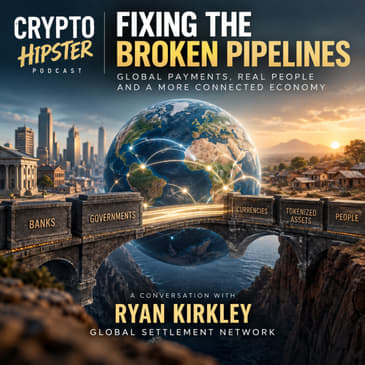

What actually happens after you hit “send”?
Ryan Kirkley, founder and CEO of Global Settlement Network, joins Jamil Hasan to explore the infrastructure underneath the movement of money—and why much of the world still relies on systems that are slow, expensive, fragmented, and difficult to connect.
The conversation moves from cross-border settlement and stablecoins into interoperability, CBDCs, monetary sovereignty, tokenization, institutional adoption, privacy, and the future of blockchain.
Ryan explains why stablecoins are only part of the answer, why institutional adoption requires solving problems banks actually have, and why the future may not be about choosing one blockchain at all.
The bigger question: Can we improve how money moves without fundamentally changing what money is?
[00:00:04] [SPEAKER_00] This is the Crypto Hipster Podcast. This is not a traditional interview show. These are perspective-driven conversations with founders, builders, and independent creators shaping what comes next.
[00:00:27] [SPEAKER_00] We go beyond headlines, beyond hype, and beyond price to explore ownership, freedom, and opportunity in the digital economy. Where builders talk freedom, not price. Hello and welcome to the Crypto Hipster Podcast. This is your host, Jamil Hasan.
[00:00:52] [SPEAKER_00] Today, I'm proud to be joined by Ryan Kirkley. He's the founder and CEO of the Global Settlement Network. Ryan has been working in crypto since early days, but his focus today is on a problem that is much bigger than another blockchain. It's how banks, governments, currencies, and tokenized assets actually settle across different financial systems.
[00:01:21] [SPEAKER_00] So Global Settlement Network is building an infrastructure around interoperability, regulated digital money, and cross-border settlements. Ryan, welcome to the show. Thanks so much for having me. You're very welcome. Very welcome. So, forget technology for a minute. All right. What is fundamentally broken by the way money settles around the world today?
[00:01:48] [SPEAKER_01] Yeah. So, if we zoom out a thousand feet and we talk about the global south. So, this is Africa, South America, and a lot of Asia. Money moves very differently than it does in the United States or Europe. Today, I could send you a Zelle for $2,000. No one blinks. It hits instantly. It's good on each side. In Uganda, for example, a simple peer-to-peer mobile money payment costs 13% and would take roughly two to three days to settle.
[00:02:18] [SPEAKER_01] Now, try moving that money outside of Uganda. It just gets even more expensive and more timely. And so, really, the entire world hasn't quite caught up to the maturity of, I would call, the US dollar or euro financial systems. And secondly, the entire system is designed to cite funds from people at all steps.
[00:02:38] [SPEAKER_01] In most of Africa, they don't have immediate SWIFT codes or immediate currency trading pairs, which means they have to switch everything into the franc, the euro, or the dollar, or the pound, depending on the country. And that all comes with additional fees on every transaction. An average remittance costs 8%. These are the poorest people in the world paying the highest fees to use basic financial infrastructure and pop.
[00:03:05] [SPEAKER_00] So, when you say settlement, a lot of people don't really understand what happens after they hit send. If they hit send here in the US, it's gone. Like, what actually happens and what do people misunderstand the most?
[00:03:21] [SPEAKER_01] Yeah. So, I mean, one of the stats that I always love to say on stage, just kind of for shock value, but it's true. Is that any given moment $4 trillion is parked globally to simply fund these transactions before they occur? The amount of banking that takes for even in the United States, if you swipe your credit card, you are typically touching four different actors before that money actually settles. And that's if it's on the cleanest system possible.
[00:03:51] [SPEAKER_01] The reality is that to send money across the border, you have SWIFT, which is a messaging system, not a settlement system. You have banks, correspondent banks, merchant banks, that each lag to take it. And then you have an FX router that also takes a fee. And so, typically speaking, when we're talking money is monetary settlement, there's a 48 to 72 hour lag on everything but Fedwire and Euroclear, which have a bit quicker systems and kind of interbank operability between them.
[00:04:21] [SPEAKER_01] And so, everything else that we talk about in the world today, largely speaking, is going to take some time. Now, there's some RTS and some more digital money that's moving forward in that. But generally speaking, we're still operating in a T plus two type settlement ecosystem.
[00:04:38] [SPEAKER_00] Got it. So then there's this idea that stable coins here in the developed countries are going to solve every problem in the world, right? But what problems exist that a stable coin can't?
[00:04:52] [SPEAKER_01] Yeah. So I think first it's important to define what a stable coin is, right? And a stable coin is just a representation of money behind it. And so, ultimately, you're still not settling a transaction when you send a stable coin. You're just moving who holds the asset where it's at its original store. And so for a consumer, that is a quick fix. It works pretty well. But when we start talking moving $100 million from JP Morgan to Fidelity, that stable coin isn't what's actually moving, right?
[00:05:22] [SPEAKER_01] At some point, that treasury or that dollar representation has to move to the correct custodian. The second side of that, though, is, and it's in a bigger picture, is as we look at stable coins, we have to have a way to KYC and know who's touching these assets. And so if you send $1,000 to, let's say, Syria, if I want to get that money back from the same business I sent it to, I have to be able to say where it touched, who had it. Did it hit an OFACs list?
[00:05:51] [SPEAKER_01] Did it hit a sanctions list? Yes, no, et cetera. And so then I need to know the counterparties. And that's where stable coins are part of the solution, but they aren't part of the entire answer. It's why we see so many stable coin orchestration layers and so many, like I would call, consortium networks, Tempo, ARC. These are all great things, but they're solving for the fact that a stable coin only gets you so far.
[00:06:17] [SPEAKER_00] Got it. That makes sense, actually, some way. So let's back up for a second. You're focusing on payments and interoperability. And you've been in the industry for a long time. And those have been like what you think is the simplest way to tackle the industry has actually been the hardest, right?
[00:06:43] [SPEAKER_00] So what made you interested in this particular path in the industry? How did you choose this road?
[00:06:53] [SPEAKER_01] Yeah, so I mean, I was actually, I've had a venture studio in this space for now seven years. And I was sitting as a VC looking at deal flow. So it was circa 2021, 2022. And I was seeing a consistent pattern. Every blockchain and every token was racing for capture of market. It wasn't willing to work with each other. It wasn't willing to work across ecosystems.
[00:07:18] [SPEAKER_01] And more importantly, as largely speaking, what was happening is everyone was building a closed system. And so, and whether it's a decentralized open source or not, the end result is you're either on Ethereum, you're on Solana, you're on Canton, you're on ARC. It really, or you're on a hyper ledger or base to network that is, you know, very private information. It didn't really matter what was happening. And so we saw this kind of starting to form.
[00:07:45] [SPEAKER_01] And I started to look for, okay, who's building bridgeless interoperability? Who is building a solution that has identity baked into the blockchain itself so we could have private permission settlement? Who is building the solution that is built for quantum, knowing that NIST standards, which are the government quantum standards, are required by 2030 for all banks? And more importantly is we've seen what's happened with bridge tax almost $3 billion this year.
[00:08:12] [SPEAKER_01] And so that's where we really focus and look to is, you know, how do we connect all these moving parts together in a manner that's actually secure and built for the next 70 years? Today, money runs on 1970s technology. In 2100, it needs to run on 2026 technology.
[00:08:33] [SPEAKER_00] Is it that much in bridge tax? Sorry? It hasn't been that much in bridge. I didn't realize it was that much in bridge tax this year.
[00:08:42] [SPEAKER_01] Yeah. If you look across the entire ecosystem, I mean, we recovered a lot. And that's been the good news is like USDC has had the ability to recover significant amounts and things like that. But yeah, the hacks have gone up enormously. And that's not even getting into some of the Dow drains and various other kind of decentralized ecosystems that have had vulnerabilities as AI has become smarter than us.
[00:09:07] [SPEAKER_01] And so it is certainly something that I think building for a future in which I can type a prompt in and it will spend the next thousand hours trying its best to find a fault in my financial infrastructure. You have to build with a level of security that is government grade.
[00:09:24] [SPEAKER_00] Got it. So we need to connect systems. We need to be able to connect them in a trustworthy manner. But how do you do it without creating another intermediary?
[00:09:38] [SPEAKER_01] Yeah. So our whole thesis and there's a couple of layers of what it means to be an intermediary. In some aspects, you want an intermediary because you want to have third parties verify transactions, right? And participate in the blockchain. Sometimes you want an intermediary purely to say that this transaction is legal and that each side has opted in in the correct manner. Other times you're comfortable with sending the money or the asset to a third party to actually facilitate the movement. Our whole goal is to eliminate that third part though.
[00:10:06] [SPEAKER_01] That third part is where things go wrong, where hacks happen, where bridge breaks happen. And so how we designed this and one of the things that's really unique about us, it's called a lattice proof. So think zero knowledge proof on steroids is the quickest way to describe it. It's using advanced polynomial proofs. But what it can do is it's able to compress the live state of Ethereum into what could actually be inside of a block. And so we're able to take live states of decentralized chains.
[00:10:33] [SPEAKER_01] That allows us to be able to rewrite with atomic settlement, i.e. under 0.06 seconds either side to make it where if I'm moving USDC from one place to the other, I'm able to execute the transaction on both without ever touching the custody on my side.
[00:10:50] [SPEAKER_00] Okay. That sounds like a good technological solution. Right. So at what point does interoperability though become not just a technology problem, but a governance problem?
[00:11:05] [SPEAKER_01] So we take the approach that it's purely and simply a tech problem. Um, now, hey, we can have the decentralized and I would call, you know, the cypher, cyberpunk or cypherpunk kind of conversations about it. But the reality is for most, let's say 95 to 98% of all money that's going to be moving around the world, tokenized securities, etc. They're going to be happening between regulated institutions. And the end goal for them is that each regulated institution has this ability to set its own permissions.
[00:11:33] [SPEAKER_01] So how we designed our network is a dual consensus blockchain with a proof of authority and a proof of stake. Someone like JP Morgan gets to run a super node that holds a proof of authority node that first checks every transaction. If, for example, and we allow decentralized transactions, let's say it's no KYC. We have no idea where this wallet's from. We know nothing. It's not another bank or anything. JP Morgan's nodes see that and they opt out of that transaction.
[00:12:02] [SPEAKER_01] That's huge for the regulatory system because JP Morgan can't touch money from Iran. They can't touch money from China necessarily. And so we allow the regulatory to exist at the singular node level or financial partner or infrastructure level. And everybody else continues to operate on a standard decentralized blockchain.
[00:12:26] [SPEAKER_00] You mentioned China. You mentioned Africa. You mentioned Africa. So I'm wondering if the countries are more interested in controlling their own rails, if it is that becomes also not just in technology or governance conversation or becomes a sovereignty conversation as well.
[00:12:47] [SPEAKER_01] It certainly becomes a lot of sovereignty. And that's something that, you know, I say this is I'm all for stable coins and I'm for the US dollar remaining prominent. That said is, if I'm a country in Africa, I can't run my economy on the US dollar. Right. I need to have the control so I'm not having someone that I don't vote for or doesn't represent my best interests devaluing my currency or hedging against it, etc.
[00:13:13] [SPEAKER_01] And so what we really look at and when we talk to governments and we are building central bank digital currencies, which is a really dirty word in the space. But the reality is why we believe in it is it's this idea that countries are countries and local representation is best. And while certainly a CBDC could be abused, we've also seen currency and bank accounts be abused. I've been debanked four or five times here in the United States alone. This isn't a new problem to be had. Right.
[00:13:41] [SPEAKER_01] Globally, we've seen monetary controls used all the time. If you want no monetary control, by all means, look at look at Zcash and Bitcoin. That's why they exist. But the reality is for most of the world, they're comfortable with a level of control, but they want sovereign local representation on that control.
[00:14:00] [SPEAKER_00] Yeah. I don't know if I've been debanked. I know that my my my wife got a payout of a stock back in like the end of August. And she's trying to been trying to get the credit line closed at Wells Fargo now going on a month and they still haven't released the money. So, you know, I'm like, I can't pay my bill like we can't pay our bills.
[00:14:24] [SPEAKER_01] So we run a global company. We send money everywhere from Uganda to the UAE to Vietnam. And the number of times I've had vendors, contractors waiting two to three weeks for something that was sent because it gets frozen and nobody is able to say where it is because it's in one of four different banks where the actual liquidity is. And it's waiting on authorization from another place. It truly is a system that has holes.
[00:14:49] [SPEAKER_01] And I think that that's the way we look at this is this is how you can provide the answers.
[00:14:57] [SPEAKER_00] So some so so back in the sovereignty, some countries are creating CBDCs, which to me, some of them make a lot of sense for that country. And we're having the adoption of stable coins here in the US. Can CBDCs co-exist with stable coins and tokenized deposits and all that stuff?
[00:15:15] [SPEAKER_01] They can. I actually I think I'm probably one of the hotter takes in the space of like I think stable coins are a natural evolution to central bank digital currencies. And the reason for that is really simple. Why would ultimately as a citizen or anything like that, why would I be comfortable with the private company having more power on the Treasury than the Fed itself? Now, I'm not necessarily a pro Fed guy. But what I'm saying, though, is like I'm definitely not pro a CEO that I can't vote out.
[00:15:43] [SPEAKER_01] I can't do anything about potentially deciding one day to sell all of their treasuries and they could tank the entire dollar. And so I do think that for most currencies, particularly smaller ones, a central bank currency is a natural evolution. The US dollar being very unique and how it's used its positioning and the fact that I do think the the US dollar is moving from reserve currency to a growth currency and how it operates globally is very different. So I think maybe the US dollar can get away with stable coins, maybe the euro, maybe the yen.
[00:16:11] [SPEAKER_01] But for the most part, I think most countries that don't have highly traded currencies are going to err towards CBDCs where the majority of control still rest with state banks and governments.
[00:16:27] [SPEAKER_00] I mean, my concern about that, maybe I should be, you know, because programmable money like does it inevitably create programmable control?
[00:16:38] [SPEAKER_01] No. I mean, it's try to control your USDC today. Could you not really? Right. It depends on what's built into the program from the beginning. And so don't get me wrong. If a country wants to have a very permission, very controllable blockchain built on top of it, theoretically, it could be. But at the same time, in most of these countries, you don't go and open a bank account and send money without it being controlled by the government. The government seizes funds, seizes transactions regularly.
[00:17:06] [SPEAKER_01] And so, you know, I was speaking at SALT a month ago and the topic was privacy. And I was on with Midnight and, you know, obviously a very different culture in terms of what we're designing for. But my answer to them was pretty simple. Privacy is a first world luxury. It is a beautiful thing that I get to care about my privacy.
[00:17:26] [SPEAKER_01] But the guy who wants to be able to buy enough seed to plant his crops for the next year, his biggest concern right now is making sure those payments go through and he's able to get his next order of seed for the next harvest season. And it's like and I think that's the huge differentiator is that in a lot of countries, they have such problems with just KYC and basic like no basic like I am a good person doing the right thing and being able to prove that that their citizenry has everything to gain from this.
[00:17:55] [SPEAKER_01] And hopefully as economies evolve, education increases and democracy increases, then yes, the money becomes more and more free. But ultimately, it's I think it's a luxury to be able to worry about the privacy of money before you worry about does the economy work and does the currency remain stable?
[00:18:15] [SPEAKER_00] That actually makes a lot of sense to me. You said that you said the magic word. You said democracy. And I'm like, OK, we're here in the US. I'm used to democracy. But I'm guessing that, you know, you talk about Uganda early on. And again, maybe maybe certain countries, they don't have it. So what is working with these countries that don't have a democracy have taught you that you wouldn't learn if you just did domestic?
[00:18:36] [SPEAKER_01] So, I mean, I say this is like one of the things that I think the US and many economies don't realize is how almost all of us started with a or we call it a monarchy, a dictatorship and authoritarian lens. We all started there. Even the United States, George Washington, I mean, while he was president for two terms, he was the functional leader for almost 25 years.
[00:18:59] [SPEAKER_01] And that foundation is something that is very important. When you're coming out of, I mean, Uganda is a great example. They had massive civil wars for years. I mean, we're talking 40s, 50s, 60s, basically since independence. And some of the worst, I mean, worst genocides and just war crimes occurring. And then now they've had a leader for about 30 years. In that time period, the GDP has grown 7x. The average, they went from being a country that had starvation to almost no starvation occurring.
[00:19:29] [SPEAKER_01] Education's going up, Kampala, the capital, I mean, has skyscrapers in it, right? It's the evolution of economies and the evolution of countries maturing, both culturally, societally and economically. And so I think that when I talk with these people, I think there's a difference between the person that's actively oppressing and the person that is well aware of the struggles or tribulations that the people have gone through and is being able to think in a 30 to 40 year plan.
[00:19:56] [SPEAKER_01] The UAE is one of my favorite examples. You could have never done what the UAE did in the last 30 years with democracy. This was a leader that was able to do unpopular things with a 30 year vision and look at the transformation that occurred. Just because it's different than what we're used to at home doesn't mean it's bad for people or the country.
[00:20:16] [SPEAKER_01] And I think the other side of this, too, is like, typically speaking, when you see you see the stuff on the news that makes you cringe as an American, whether it's ethically, morally, etc., it's coming from places of economic collapse. It's coming from currencies that are like Zimbabwe when the currency free fell or skyrocketed in inflation, times in South America where that's occurred, etc.
[00:20:39] [SPEAKER_01] These things happen because the currency isn't able to move quickly enough to an economy that doesn't have a significant reserve. And so someone like, I mean, and I won't use names necessarily, but mega hedge funds trading in FX have collapsed hundreds of currencies around the globe over the last 60 years. They're looking at dollar numbers. They're not looking at the human cost by collapsing a currency.
[00:21:02] [SPEAKER_01] And so that's where by giving this ability to say tokenize your gold reserves, tokenize future mineral output and hedge it against your dollar or your shilling or your currency or whatever kind it is. It gives them more control to run a more stable and prominent long lasting currency that is unaffected by political change.
[00:21:24] [SPEAKER_00] So that 30 year vision is really like, you know, very important, but despite the leadership type.
[00:21:32] [SPEAKER_01] I think so. I mean, and I think I also will say it's like the great thing about democracy is sometimes you have a great leader and the bad thing about democracy is sometimes you have a terrible leader. It's the same goes here. You're either a great leader or you're a bad leader. There is no in between despite what type of leader you are.
[00:21:50] [SPEAKER_01] Right. And so I do think like that's something that especially having been blessed to be able to work with so many foreign leaders and meet them and talk with them in private quarters and and really understand what they think of both their country and the world. It changes your perspective, both as an American, but also just as a citizen of the world, realizing that some places really do need to have the stability to be a longer lasting. Position.
[00:22:18] [SPEAKER_00] So I hear I hear two things, you know, in the in me, I don't follow the news. I'm not on social media on X anymore. I haven't been January 1st, but I follow like to like the main narratives going on in the market. One is we're not going to get into it unless you want to is this is the fear mongering around AI. Right. That's secondary to me. Primary is we hear about real world assets and tokenization and all this stuff.
[00:22:46] [SPEAKER_00] You know, what does like if I'm about leadership, what does putting an asset on the chain on the blockchain actually improve?
[00:22:56] [SPEAKER_01] Yeah. So I'll answer both in what's happening today and what the vision is. What the vision is, is that we have the ability to move securities simultaneously across borders, do swaps, create almost a barter economy where a dollar of gold is the same as a dollar is the same as a dollar of oil. The amount of capital efficiency that occurs there is great.
[00:23:18] [SPEAKER_01] The second side is, and this is for people that have either worked in commodities or securities, the amount of paperwork that goes into buying and selling a stock or moving oil from one country to the other, the amount of data you have to have on the source location, every transaction, etc. Putting that all on chain where it can be executed with a flip of the thumb, it increases trust, it reduces cost, reduces fraud. And so ultimately, I think there's a big win.
[00:23:43] [SPEAKER_01] Now, I will counter with this, and this is where, you know, I'm sure I'll get a few tweets from a few tokenization leaders in the space. But the reality is, is what most people have done today is tokenization and name only. We've seen enough stocks, we've seen enough companies in tokenization go public now, and then immediately drop 40, 50%. And the reason is, is that we're not actually moving assets on chain today. Everything is being done in sandboxes, big announcements.
[00:24:10] [SPEAKER_01] The reality is, most people around the world are either operating in a siloed system, you know, DTCC using Canton. It's a huge deal. It's an awesome exercise. But they're using it within themselves. Or it's being done in terms of tests, where it's sending $100 million tokenized security one time between Citi and UBS, etc.
[00:24:33] [SPEAKER_01] And so that's where I think, you know, in the next five years, we're going to see the adoption start to take place, particularly with what DTCC is doing. The, you know, Southern Stock Exchange is going up. Some very cool stuff in Africa stock markets, UAE, etc. There will be a transformation, but it's not quite here yet. And I think we've been celebrating a little too soon, given that we're still probably three to five years out from adoption.
[00:25:03] [SPEAKER_00] Yeah. I mean, I used to work at AIG. And what I'm thinking about is the pieces. There's a department. It's like you have settlements. You have, like, custody. You have compliance. And you have different areas. So if those areas are not adopting, you know, the tokenization processes, have they actually accomplished anything?
[00:25:29] [SPEAKER_01] I think the answer is no. But yes. Because it's the, like, we like in this, we offer a wide range of suite of services from tokenized ID and digital identity, all the way over to security settlement, all the way over to stable coins, CBDCs, and their operability, right? When we go and talk to a major institution, bank, etc., our goal is to get in the door. Our goal is to start the education process and the cultural transformation.
[00:25:58] [SPEAKER_01] It will take a decade for a bank to be comfortable on blockchain. Fortunately, most of them started in 2020, 2022. And we're nearing that timeline of the top trials have happened. The lawyers have written the opinions. The SEC is issuing no action or regulation letters. Hopefully, we get clarity done at some point in the future. And, you know, all said, that will make a huge difference. And so I think the pieces are coming together now.
[00:26:23] [SPEAKER_01] But from a revenue perspective, it's not quite as exciting as we'd like to think.
[00:26:30] [SPEAKER_00] Yeah. Everybody's focused on the revenue and not the building. But, you know, so forget banks for a second. Where do you think the most institutional tokenization will occur? Will it be in private credit? Will it be in securities and commodities? Like where real estate? Like where do you think that that, you know, will happen? Yeah.
[00:26:54] [SPEAKER_01] So, I mean, I think real estate and stocks are the popular answer. And while I think those things will occur, I think what will transform the most is private debt, bonds, and real estate. This idea that a REIT could now have tokenized secondaries, that you could have real-time pricing 24-7 to a real estate fund or a bond market fund, or even a private debt fund, is so incredibly transformative.
[00:27:21] [SPEAKER_01] And the fact that you could then have data feeds going live into these contracts and creating pricing models on things that previously would have to have a 501c or like various different valuation metrics run on them at great expense means that we could finally bring illiquid markets into an era of almost constant liquidity. I think that's really exciting. I think, you know, the perpetuals and futures that we're seeing with like hyperliquid, that's another great example.
[00:27:48] [SPEAKER_01] I mean, they transformed the ecosystem in like 18 months and they're only growing faster and faster. And I think that's where we don't necessarily give enough credit to the boring transformations. We like to see the mass retail adoption, but in the space, I mean, we're forgetting where most of the money is. It's not sitting on the retail side.
[00:28:09] [SPEAKER_00] Yeah. A lot of people in retail, like, they're like, over the years, they've been like, the institutions are coming, the institutions are coming, my bags are going to get pumped up in price. That hasn't happened. You know, so what does today's industry today, you know, still misunderstand about institutional adoption?
[00:28:29] [SPEAKER_01] Yeah. I mean, I think it's the, you know, and I've been, I've been one of the people in the space shouting this from the rooftops forever. The average person doesn't care about privacy. I still use Facebook. I still use Instagram. I still use WhatsApp. I know they're selling my data. I know, I know that it's going out. I know if I say engagement ring twice, I'm going to get a thousand ads for engagement rings the next week. Right? Like, they're clearly listening in and they're clearly, clearly infringing on their privacy. The same thing goes with money.
[00:28:57] [SPEAKER_01] People don't care the government can see your credit card transactions. They don't care that the government can see that their bank account balance. They don't care that the IRS is snooping around. Now, yes, there is a five, 10% population that cares wildly and vehemently about this and they're allowed. The reality, though, is that 90% doesn't, which means for institutions, they don't either. They're worried about doing the things that follow the government regulation, that follow the safety, that follow their risk factors and won't get them sued.
[00:29:25] [SPEAKER_01] And I think the hard part was crypto built all this cool tech and said, hey, we built the best tech, come look at us, as opposed to asking the banks the question, what tech do you need? And so for us, when we started designing this, I mean, fortunately, we had some bank relationships. We got almost 900 pages of RFP documents and requirements from banks of what they would need for a blockchain. And, you know, and we really designed something that no one piece, I mean, other than the lattice
[00:29:52] [SPEAKER_01] stuff, some of the quantum stuff, nothing was revolutionary. There's great examples of different blockchains using different parts, but it was the architecture and putting it all together in a way that we can go to a bank and say, hey, run your private network. And when you want to settle to another private network, we have your solution.
[00:30:10] [SPEAKER_00] God. God. So you've learned a lot since 2013. So what did you believe then that has changed, that you no longer believe now?
[00:30:22] [SPEAKER_01] I mean, so I don't think I necessarily changed my belief. It's interesting. I wrote my economics minor, the thesis on Bitcoin. And I talked about how Bitcoin could represent the first money outside of a sovereign issue that could hold in store about it. I think that remains true today. But I was also never a Bitcoin replaces the dollar person. And I think that's a large distinction.
[00:30:49] [SPEAKER_01] I, you know, my whole time in the space, even how I got exposed to this, crypto has always been used for illicit activities. There is this, you know, libertarian ideal of, you know, you can buy and purchase anything and no one can stop you. I still think there's just as much place for that in society as there is for a regulated and more appropriate kind of system. I think the second thing that's changed, though, for me is really this, like, and I go after it hard, is I think we built a lot of antiquated systems.
[00:31:19] [SPEAKER_01] And I think because we have these tokens, it leads to this cult following on technology that should have been sunsetted eight years ago. And that's hard in this space because, you know, the chains that have been coming out recently and the technology has gotten so much better, yet we're still gravitating towards things that have significant downsides, whether it's Bitcoin as a network itself and security,
[00:31:45] [SPEAKER_01] or if it's Ethereum and its inability to have identity, editable objects, all the way over to, you know, the size of transactions and gas fee. And so it's a, I think if we were, and I think Vitalik does a pretty good job. If you were to ask Vitalik, how would you build Ethereum today? He has a very different answer than how he did. And Ethereum is struggling with the legacy of Ethereum. Solana struggles with the legacy of Solana. And Solana is a much newer chain.
[00:32:13] [SPEAKER_01] And so I think that's the hard part is that the industry focuses on their bags, as opposed to focusing on what actually will drive the technological adoption.
[00:32:23] [SPEAKER_00] I would tend to agree with that. Yeah. Wow. Thank you for putting it that way. I've been trying to say that in a sentence for a long time. So 10 years from now, do people really care what blockchain is used?
[00:32:43] No.
[00:32:44] [SPEAKER_01] I think 10 years from now, you might care. Like you care if you use MasterCard or Visa or MX. I think most blockchains will have to operate in some kind of reward system to incentivize to use your stable coins on it. There may be one or two blockchains that kind of win consortium networks or let's say four or five, right? Like I think it's very reasonable to say Ripple, Canton, ARC, Tempo, TYUSD, Paxos. Like these aren't going anywhere, but they're all going to have five, 10% adoption.
[00:33:13] [SPEAKER_01] They're going to own pockets of settlement. They're going to own pockets of bank-to-bank transactions or industries. And I think that's really where we'll see. We'll see a little bit of that conversation of which blockchain do you use? But reality is it's probably going to turn into how we think of money today. The average citizen couldn't tell you what Fedwire is. The average citizen could not tell you how Zelle moves money. The average citizen could not tell you the actual rails behind Visa, MasterCard, and MX.
[00:33:39] [SPEAKER_01] And I think that's where we'll get to is just like with HTML and CSS and all sorts of computer languages, blockchain kind of goes in the background as well.
[00:33:50] [SPEAKER_00] So let's say we do this interview again in 10 years. Hopefully I can talk to you sooner than that. Let's say we do it again in 10 years, right? Like what has to have happened for you to say we changed the way that money moves globally?
[00:34:05] [SPEAKER_01] Yeah. So I mean, I think for us, the answer is very little. It is purely and simply executing on these contracts and things we're building today that will improve and reduce costs and it will make it faster, quicker, and more secure. But money fundamentally won't change, right? I think that was the key of how we approach this is today, the way money moves is how people want it to move. It's inefficient though.
[00:34:35] [SPEAKER_01] It has slippage and it has delays. You can improve the way it moves, but you're not changing how it moves. At the end of the day, it's still a very, you're buying and selling one thing to the other. You're just getting rid of intermediaries in the process.
[00:34:51] [SPEAKER_00] Well, this has been informative and educational and enjoyable conversation. Absolutely. How can people find out more information about Global Settlement Network and then be able to use your guys' services? Yeah.
[00:35:10] [SPEAKER_01] Very easy. GlobalSettlement.com is our website. It has all of our information and outlook. And then across the ecosystem, it's GSX Network on Instagram, Twitter, and LinkedIn. Got it.
[00:35:25] [SPEAKER_00] Thank you very much for your time today. Perfect. Thanks so much. Appreciate it.