
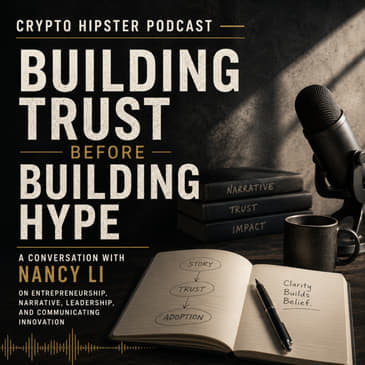

Building Trust Before Building Hype | Nancy Li | Crypto Hipster Podcast
What separates companies that gain lasting trust from those that simply generate attention?
In this episode of the Crypto Hipster Podcast, Jamil Hasan sits down with Nancy Li, co-founder of Sevenfold, to explore entrepreneurship, leadership, and the role narrative plays in building enduring companies.
Nancy shares her journey from discovering Bitcoin in 2013 to helping founders communicate complex technologies with clarity. The conversation explores why many technical founders struggle to explain what they build, how trust is established long before products reach scale, and why humility remains one of the defining characteristics of successful leadership.
Topics include:
• Nancy's entrepreneurial journey
• Discovering Bitcoin and the early Web3 ecosystem
• Building companies versus explaining them
• Why narrative matters more than hype
• Product-market fit and founder identity
• AI versus early crypto
• Leadership, humility, and learning from failure
• Building trust in an increasingly noisy digital world
• The future of Web3 and institutional adoption
Rather than focusing on token prices or market speculation, this conversation examines the human side of entrepreneurship and what it takes to build organizations people believe in.
#CryptoHipster #NancyLi #Entrepreneurship #Leadership #Narrative #Storytelling #Web3 #AI #Founders #Bitcoin #Blockchain
[00:00:04] This is the Crypto Hipster Podcast. This is not a traditional interview show. These are perspective driven conversations with founders, builders, and independent creators shaping what comes next.
[00:00:27] We go beyond headlines, beyond hype, and beyond price to explore ownership, freedom, and opportunity in the digital economy. Where builders talk freedom, not price.
[00:00:50] Welcome to the Crypto Hipster Podcast. Welcome back. Today's guest is Nancy Li. Nancy is the co-founder of Sevenfold. She spent nearly a decade helping some of the biggest names in Web3 think about how they communicate complex ideas to the market. After co-founding one of the industry's earliest blockchain marketing agencies and later exiting that business, she's back building again with a new thesis.
[00:01:18] And companies don't fail because they lack distribution. They fail because they never found the right story. Today we'll explore entrepreneurship, narrative, leadership, and what founders often misunderstand about communicating innovation. Nancy, welcome. Nancy Li. Thank you for having me on, Jamil. Jamil. Jamil You're very welcome. You're very welcome. So I want to ask you first, you know, for what first drew you to entrepreneurship to begin with?
[00:01:44] You know what? I wish I had your typical story. Mine was more so out of circumstance. I think, you know, any, any entrepreneur you ask at a young age, right? You, you want to just make some extra cash and you just do that by figuring out, you know, what, what are the simple economics, right? Of supply and demand. So my first business was technically a dog walking business and a dog sitting business. And that's kind of where I got started. Obviously, that was more so in junior high.
[00:02:09] And then, you know, one thing leads to another, right? You can sell a lot of services and goods as a young kid just to make some extra spending cash. Awesome. So you, you, you, you went into crypto in 2013. Right. You were, you were, you know, what, what, what, why led you there? And then what did you realize that it wasn't just simply a technology trainer with something greater?
[00:02:35] Oh, absolutely. And, you know, I, I also wish I had this crazy story where I came across this Bitcoin white paper. That is definitely not the case. So the way it happened was essentially my parents had a warehouse and these guys rented out a corner, a tiny little corner of the warehouse. Little did I know that they were actually mining Bitcoin for a long time. They were just setting up computers and it just, it felt like, oh, maybe this is just where they work as an office.
[00:03:00] And, you know, between water cooler conversations over the next few months, you know, they would mention the term Bitcoin and I would say, oh no, that's a scam. Not for me. You know, what are you guys doing with your lives type of situation. And I would say it took a solid maybe four months of just, hey, did you think about this? Oh, did you know, this is how the financial world works. And over time they were able to kind of explain more of the philosophical reasons of why Bitcoin exists.
[00:03:24] And honestly, that's honestly what converted me. So at that point, my husband and I, we owned a traditional web to marketing agency and we were advising big brands, right? Like the Fords, the American Cancer Society, Chick-fil-A, you name it. And on the side, I was also a lurker on Bitcoin talk, which was, you know, an OG Bitcoin forum.
[00:03:44] Not a lot of people know about it. You don't need to know about it. But I used to lurk on there and you just meet a lot of engineers, developers that are saying, hey, I'm working on this product, but I don't know how to market it. I don't know how to talk about it. I don't even know what to do in terms of just getting it into the hands of users and other developers. And so my husband and I, we were just consulting and just pro bono consulting individual dev teams on the side and just realized, oh, wow, this is a budding space.
[00:04:11] And there is so much of a need for more creative, maybe non-technical people to be a part of it, to help them translate their ideas into something that is palatable and understood. What lessons from that first agency that you built still shape how you build today? Absolutely. So one of my my early marketing career was spent not in, I would say, traditional marketing.
[00:04:36] It was a lot of guerrilla marketing. So we primarily focused on things like SEO, but also, like I said, guerrilla marketing. So I carry a lot of that with me even to this day. I think when you think about traditional startups, they think, oh, we're going to buy some influencers. We're going to pay for some ads. We're going to sponsor some conferences. However, a lot of companies really don't understand that in the beginning, you obviously don't have budget to do that. So how do you figure out that cold start problem? And through that is guerrilla marketing.
[00:05:05] Right. So there's obviously different tactics that we can obviously dive into and how you get people excited early on with very little budget. And, you know, companies in this day and age, even if you do raise a ton of money, you can scream into the void. But if you don't have early user feedback, early buy in, what's the point? So what were some of those guerrilla marketing tactics or what were some of the lessons that you learned by teaching those guerrilla marketing tactics?
[00:05:33] Absolutely. So some guerrilla marketing tactics would be, you know, for example, a founder being on different platforms like Reddit and even Bitcoin talk. Right. I was saying, hey, this is what I'm building. You know, I in tech, it's been very prevalent of the concept of building in public. It was just taking that concept and replicating it on different social media platforms. So then at that point, you get people asking questions, thoughtful questions of what you're building.
[00:05:56] Right. For example, from 2014, I would say to 2019, the crypto industry was very intellectual. It was a lot of infrastructure wars. It was debating about consensus mechanisms. So it was a very interesting thought exercise amongst, you know, the people in the industry. So oftentimes when a company came out and said, this is what we're building, it was a lot of people just piling in saying, why did you build it like this? Why staking? Why? Why this consensus mechanism?
[00:06:23] And so it's always important when you're in that stage of just establishing trust of saying, hey, this I'm the person behind this company. This is, you know, I pretty much wrote the white paper. I designed, I did the architecture, et cetera. You establish that credibility with people that respect that type of, you know, discipline. And then from there, once you're able to, you know, answer the questions, then you can kind of weave in a little bit more marketing speak of, hey, this, these are some of the things we're thinking about. We're doing, for example, a token sale or we're doing this partnership with this huge company.
[00:06:52] And that way you're able to do a lot of grassroots marketing and get people excited without, you know, spending a ton of money. Got it. Got it. So I recently did some marketing things that were inexpensive. So hopefully they take, we'll see, you know. But I want to find out from you, what have you found is harder, building a company or explaining it?
[00:07:16] Ooh, you know what? Traditionally, I would say, I think it'll always be building a company. And what's crazy about Web3 and crypto as a whole is that we're not building traditional companies, right? When you think about layer ones, they're not building just infrastructure. They're building like a five-ended marketplace, right? Not only are you trying to attract developers, you're trying to get institutional partners. You're trying to get people that are token speculators, right?
[00:07:44] And then, you know, insert three other parties. And so that has been one of the hardest things to do. Nowadays, I tell companies that, you know, they'll want to start a layer one and a layer two. I always say, you have to have at least $50 million and just know the next probably decade of your life is going to be dedicated to this thing. And people laugh about that, but I've seen what it takes to build a layer one.
[00:08:07] And it's not for everyone and truly getting the right teams in place and then having to manage like, let's say, a five-open-ended marketplace is absolutely insane. So founders come to you because they are lost in their messaging, right? So they don't really know. They know they're a founder and they know they're building a product, but they're more important for the founder to be in front of people, right?
[00:08:32] So what stage when you're working with them do founders actually usually know or find out who, not what they're doing, but who they are? You'd be surprised. Sometimes it's early stage as in seed, like seed stage, but then as late as series B. The reason is, is because going back to the intellectual aspect of our industry, a lot of founders are going to be more technical, more engineering backgrounds.
[00:08:57] And funny enough, all that archetype falls into the same pitfalls and the same logical fallacies, right? Common ones include, if I build it, they will come. Marketing doesn't matter. Or once we do this, then people will get excited. And that's the problem, right? And what we're commonly seeing, especially this year, is that a lot of companies are revisiting their brand positioning or their messaging because they just cobbled something together and then just kept going.
[00:09:25] And then they realize, oh shoot, this whole time, the past six years, no one has any idea of who we are, what we are, and they can't explain it in less than, let's call it five sentences. And that's always a red flag. And it's actually very costly down the road because what happens is, let's call it seed stage. They, you know, get a nice website. Maybe they hire a nice branding agency. And it's great having a branding agency, don't get me wrong. But branding agencies, they create language for design systems.
[00:09:51] So then maybe a year or two down the line, they realize, oh my gosh, we don't have a coherent narrative. We don't have a narrative spine. We need to revisit it. And then after they revisit messaging, then they have to redo branding because they realize, oh, maybe we're not just a perp text. We do so much more, right? And so that's the biggest problem that most technical founders fall in in that they're not building the foundation properly.
[00:10:14] Sure, they're building the technical foundation, which is awesome, but the actual business foundation of who are we, what are our mission, vision, and values? How do we articulate that? Who are our different audiences? And how do we talk about what we do and what we're building for these different audiences? Every company I see make that mistake. Even, like I said, even going through all the way to Series B through name brands, name changes, you name it. I guess it gets more expensive or less than as the further you go down the funding route.
[00:10:43] Oh, no, it's true, especially on the agency route, right? You know, a marketing agency charges a seed stage company very different than a Series B, right? And so that's what founders come to find out is that as time goes on, oh my goodness, these retainers, these packages get insane. And they just become more creative exercises and they go on for six months, 12 months at a time. Okay, so would great marketing ever make up for a weak product?
[00:11:13] Yes, we've seen that time and time again, unfortunately. Okay, all right. So then, all right, so let me ask you about your specialty. How do you know, like, how do you know when a story's wrong? You know a story's wrong when it takes you more than two sentences to explain.
[00:11:36] And if you're talking to someone and they keep asking qualifying questions, that's when you know it's not clear. The other way to kind of do a litmus test is if you're speaking to a crowd of people, even just a group of people, are they even interested? Oftentimes, you know, aside from the actual message itself, it's also how it's delivered. We're kind of seeing this in the AI age where you're seeing a lot of companies have founder videos and then you have this spokesperson that doesn't even sound excited about what they're talking about.
[00:12:05] So I would say it's probably, you know, 80% the actual message itself and then the 20% of delivery, enthusiasm, passion. Got it. I've gone to a couple of conferences. I don't go to a lot of conferences. I've been to a few conferences where I've seen people explain the technology. And I used to build technology. I understand it. I'm like, this is brilliant stuff. But the token price, if you look in the market, is very, very, very inexpensive because nobody understands it.
[00:12:34] So how can you bridge that gap between having a brilliant technology and having people understand what that brilliant technology is and kill that disconnect? Absolutely. Simple answer is translators, right? Hence why we have brand strategists, why we have marketers and CMOs. You always need someone to basically look at all the technical aspects, find obviously its strengths, if you will, and then repackage that.
[00:13:04] It's actually very rare for, let's say, engineering teams or technical founders to be able to do that. Granted, it's easier nowadays in AI, but there are other aspects, right? When you think about traditional marketers, right, we are the eyes and ears of the world, right? We're looking at trends. We're looking at other industries. We're looking at what resonates. We're studying competitors. And so, you know, that's where I say as an organization, it's important to have the engineering department, absolutely.
[00:13:31] But it needs to be rounded out with more translators and people that just have a pulse into what's going on into the rest of the world and even just your ideal demographic. Got it. So you would say that AI makes storytelling easier or harder? It makes it easier because, you know, if you were to think a seed stage founder can just say, hey, let's copy and paste our product right into Claude and say summarize it, make it appealing to, let's say, you know, enterprise customers.
[00:13:59] Then you get you have a starting point. However, I honestly rarely see that mainly because, like I said, technical founders usually fall into the same pitfalls of we don't need to do that. Once we throw out all of our features and talk about, you know, all the things that you can do, then they'll understand and they'll become a customer. Got it. So you started in 2013. I started in 2017 when I started an ICO boom, right?
[00:14:24] There's a lot of, a lot of, reminds me, like, I want to find out what similarities do you see between, you know, early crypto and today's AI boom? Ooh, you know what? It's interesting. I think traction is definitely, like, that kind of excitement is actually something I miss in this industry. In 2017, I started, so I bought Bitcoin in 2013 and then my marketing agency in blockchain and crypto was started in 2016.
[00:14:53] So we've done, you know, a lot of ICOs and I really miss that excitement in the early days of, oh my gosh, this could be something big. So I do see that parallel to AI of like, oh my gosh, this could be something big. However, Web3, unfortunately, in the early days of, let's say, 2017 to 2020, fell into a lot of gimmicky, cheap marketing, right? Whatever people could do for vanity metrics and vanity marketing, just to drive hype and FOMO, that's what worked. I have to give a lot of props to AI.
[00:15:23] The AI industry has done such a great job of taking a very technical product, a very intimidating and, you know, sometimes dystopian technology, right? It's very polarizing. And they're able to abstract that away for you, even just for, you know, open AI to develop like a chat interface to make it approachable. That was, you know, groundbreaking.
[00:15:44] So I have to give AI its flowers in a sense that they were able to take a complex technology, make it so practical that someone could really understand the power of it. And then, you know, they branded it well. They do a lot of awesome visuals and they're able to really show the benefits and the power of AI. Where we're going wrong in Web3 is that we're not even there yet. We're still having trouble creating dashboards that work.
[00:16:10] Our UI, our UX is historically, you know, not the greatest, right? We do a terrible job of educating. So when you think about like a traditional marketing funnel, AI has done a great job of just broad awareness and then moving people to convert into actual users. With crypto, we're still maybe at the top of the funnel of just, we're just trying to tell people that crypto is not a scam. And then you pair that with all the hacks and fraud. It's just not a good look. So there are lots of parallels in any emerging technology category.
[00:16:38] It's the same thing with robotics, right? You see a lot of excitement. There's a lot of companies trying to gain foothold. However, you know, every industry has its own tactics of showing, not telling. It's just that Web3, historically, because we're very technical, we're infrastructure driven. We've had a very hard way of doing that. Yeah. You said we've had a gimmicky way too of doing that, you know. So a founder approaches, do they build something in which they think is world changing?
[00:17:07] You know, it's going to change everything. It's going to transform. And you have to give them, you have to deliver to them the truth, right? How you see it without damaging the relationship. Like, how do you do it? Well, that's the thing, right? I don't necessarily have to care about preserving a relationship because as an agency and, you know, as a team, we're very exclusive with who we take on. So a lot of the companies that we work with are well funded, right? They've gone through due diligence.
[00:17:36] So there is, in a sense, like actual money behind them, in a sense that there's people that have validated their idea already. Um, also, you know, because we are in, you know, an emerging category and an emerging industry, I also think there's a palette for it to hear out, you know, any brutal feedback that anyone may have, right? So my job as just not just a marketer or a publicist, if you will, is also the voice of reason. So commonly when companies come to us, it's saying, yes, we need help with marketing.
[00:18:06] Here are our plans. This is what's in the pipeline. But as someone that handles a lot of narrative work, brand messaging, it's also my job to, in a sense, tell them their baby's ugly in some shape or form. And I'm totally comfortable doing that. We should do that more, right? If we all had yes men in this industry, we wouldn't go anywhere. Um, and what helps kind of soften the blow and one tactic that we use as an agency is we take a very data driven approach. So if you're saying, Hey, we're the new deep end startup, right? That wants to do it this way. And we're changing it in these ways.
[00:18:35] I'll say, okay, let's look at all your competitors. Here's all of their positioning, their narrative, what's working, what's not right. And this is why you guys need to approach it differently. Then it's a little bit different than just say, Hey, you, your idea sucks. So it looks as though, I mean, we are, we have more content creators now than we've ever had. Right. Um, everybody's producing content.
[00:19:02] Some people like me are producing material, interviewing intelligent people, but a lot of people are coming up with pie in the sky, you know, content out of nowhere. So is attention becoming, you know, more, I guess, expensive or cheaper? It's becoming more expensive, but also cheaper in many ways. So think of it this way, right? I always like to separate our industry and, and, you know, the time periods from 2017 to
[00:19:27] 2021, um, Oh man, you, you couldn't even beg anyone to be a content creator, right. To talk about these technologies and these products. Right. And then let's say 2020 on, let's call it DeFi summer or NFT summer onwards. You have this huge influx of content creators. So historically, for example, from 2017 to 2021 paying creators, super expensive. I won't name names, but some of these videos are five to six figures for one YouTube video. Right.
[00:19:56] But nowadays, because you have so many micro influencers, content creators, it's in a sense cheaper because it's, Hey, let me reward you based off of how many views you're driving. We can give huge credits to Cluely, um, for, you know, creating content and clipping farms. And so I say it's expensive. Yes, because the scale is much bigger, but it's cheaper. Let's say per content creator, per impression. Yeah. Do you still, do we still have those highly paid influencers or was that a thing of the past?
[00:20:26] It's still a thing. It's still a thing. Okay. Got it. Okay. So, um, let me ask you, I'm going to shift a little bit towards leadership. What, what do you think makes a founder, um, a founder coachable? Humility. Oh, I, it's, it's funny because in tech, often you find a lot of people, a lot of, let's say ego. Um, and that's usually a red flag for any third party partner employee, right?
[00:20:54] When you're assessing a company you want to work with or for, um, is humility. Um, I absolutely love founders that can say, Hey, I don't know everything. Hence why I hired you or hence why I hired this person. The second you have a founder that, you know, pretty much has a strong thesis in marketing. That's usually, you know, either it goes up or most often than not, it, it definitely, uh, falters. Um, and so that's, I would say one of the biggest traits of a profound respect for just,
[00:21:22] not just the craft, but also other departments, for example, compliance, um, marketing, right? Product even. Got it. So when you come, so let's dive in that humility a little bit. So what's changed about you and your humility since you first founded your first marketing company to now? Well, because we are in crypto and emerging technology, you almost are forced to be humble.
[00:21:48] Um, enough bear and bull cycles will humble you. Right. And so I say that more as like a service provider, right? Is that there, you have no opportunity to be egotistical because you can be relevant today and you're dead tomorrow. I think you're cutting out. Okay. I hear you again.
[00:22:19] So I want to find out how, how, how you, how you learn from failure. How I learned from failure. Failure, I would say, I mean, it's, it's really, there are a lot of parallels between failure and marketing, funny enough. So, you know, for marketing, for example, when you test a certain tactic and a certain channel, you obviously gauge what doesn't work and you make improvements and see what works. And then you just double down on that. It's the same idea with entrepreneurship. It's the same idea with, you know, as is life, right?
[00:22:48] You try something, doesn't work, do something a little bit different that obviously works. Double down on that. Move on, you know, so that goes. Got it. Got it. So a lot of, a lot of, a lot of founders today, a lot of content creators, you know, focus on today's algorithms, right? To try to get in front of people, right?
[00:23:12] But how should people think about, you know, building trust and stewardship over the years instead of just focusing on the algorithm? Right. With companies in particular in our industry, I always say we are in the business of trust. Any company that wants to hide behind anonymous founders or, you know, not list the team on the about page, it's just not realistic, right? We're human beings. We are people driven. We're a social society.
[00:23:42] And so when you say, hey, we're in the business of trust, what does that actually look like? Right. Hey, it's actually having a photo in your profile. It's putting a face to a name. Obviously, you know, let's say if you go to events, it's you representing a company. You're the spokesperson. And so building trust starts first and foremost with founders, right? Their image, their brand, founder-led comms, all that good stuff. And then from there, I would say it's messaging. It's narrative. It's saying, what are we? What do we do?
[00:24:10] And why is it important now? Right. And being able to take that and kind of disseminate it into different parts of what you do, whether that's your deck, whether that's your content, whether that's, you know, various sponsors or ad spend that you, you know, want to put resources towards. So building trust is, I would say, actually very straightforward. It's just that a lot of companies fall into the same patterns of anonymity, right? And then we, hey, let's just hide behind features. Oh, let's just hide behind our partners.
[00:24:39] But at the end of the day, good marketing is truly making it clear on what you do, being as accessible as possible, and then making that journey from, let's say, someone that's heard about you into a customer or a partner as quickly as possible. Got it. So you're sitting there. Actually, we're in a bear, I don't know if we're in a bear market, crab bull, I don't know anymore. I take $17 a day and I buy Bitcoin. I don't look at it, you know, but you're looking at the market. You're looking at the market more closely than I am.
[00:25:08] And you're sitting there and you're both optimistic and pessimistic. So what gives you optimism? And, you know, what are you most curious about today that might be pessimistic that you think has a bright future? Okay. So yes, we are in a bear market for sure. However, there are so many crazy developments just day in, day out in this industry. This is stuff we used to dream about even just a decade ago.
[00:25:36] And so I'm just overly bullish on this industry, even more so nowadays. I always say it's funny because we always fall into the same patterns. It's the same cycles, right? From let's say September to December, it rips because all these companies realize, oh, shoot, Q4 is coming up. We got to deliver something for shareholders, token holders, et cetera. Obviously, Bitcoin rips then. And then January through summertime, it's, you know, this fear, this, we don't know, you
[00:26:05] know, token values drop. And we just repeat this every single year. So any company that can do that, do all their marketing product, et cetera, keeping in mind of these market conditions are the ones that truly survive. So as far as things I'm, you know, excited about, there's so much, right? Stable coins are a perfect example. Like I never thought we would ever say, like banks would ever even say the word stable coin.
[00:26:29] I was marketing stable coins when we were arguing about treasury management, whether it was pegged to the US dollar versus algorithmic. So back in the day, you know, stable coins was just very theoretical. It was just saying, hey, you know, the dollar is weak and dumb for these reasons. Why not have a stable coin? Nowadays, you have big banks. Even this week, Swift literally said, hey, we're discussing stable coins. We're going to be implementing it into our system. And so when people, you know, share that they have, you know, they're scared, they're uncertain,
[00:26:59] maybe AI will eat us. We are still so, so early and there's so much opportunity. My only fear now is that a lot of the traditional industries, like let's call it banking or the institutions will actually just acquire or merge us or let's say eat our industry as a whole, right? I was in New York last month and I heard someone very, I would say at the top of Fidelity, basically say, hey, Nancy, you know, this technology stuff is really easy to build.
[00:27:29] Like we can literally go buy a company. We can go hire a bunch of people. We'll get it built. But none of these crypto companies have distribution. And that actually gave, got me a little nervous of saying, hey, you know what? If you look at our current big players in the industry, have they built enough of a distribution, enough of a sticky product to be able to compete with legacy institutions, right? But, you know, they could simply throw resources at it and figure it out. That's a little scary.
[00:28:01] Yeah. Not supposed to be taken over by corporate. So at least there wasn't the initial intention. So how do you align, you know, how do you align the original and the continuing vision of the centralization with this, the fact that they can, the centralized entities can buy it? Right. And that's what we're seeing. This year we have tons of M&A activity and it's only going to speed up. Yeah. Oh, got it. I'll be looking out for that.
[00:28:30] So I want to ask you a couple of final questions. What, the first one is, at what point does a company's story stop belonging to its founder and start belonging to the people who experience it? After product market fit. So in the very beginning, right, when people invest or let's say become an early customer of a company, they're buying into the founder, right?
[00:28:59] So that's, if we were to boil it down to stages, right? That's like literally angel round all the way to, I would say seed stage. After that, that beautiful transition needs to happen. And this is where a lot of companies either do it really well or do it very poorly. And once again, this goes back to humility. Sometimes you have founders that are in the game, you know, just for significance or glory and that's where they can't let go. Right. But then you also have to keep in mind that you're building a company.
[00:29:27] It should be its own entity, its own persona in of itself. And so that's where that transition needs to help. But generally I always say like product market fit. Once you have product market fit, it makes it so much easier to just say, not decouple, but just to, hey, let your company take center stage. Then you've just become a spokesperson of the company versus for the company, if that makes sense. It does. Interesting. I think that would work for a lot of cases.
[00:29:56] So I want to thank you and very much for your time today. One last important question is how can people find out more information about Sevenfold and hire you if they'd like to? Oh, yes. Well, I mean, we primarily work with early stage firms, but we work with, you know, all the way up to series B. We, you know, we, our primary services are just brand messaging, marketing support, and then PR and founder led comms. And so everyone can find us at sevenfold.io.
[00:30:25] And it just for some more background about us, you know, we've been in this industry for more than a decade now. We were the launching team behind Binance US and Solana. And yeah, we have other clients, including Solana, Cybertrace, who later got acquired by MasterCard. We have Trace Finance, Veda, you name it. So as technical or as enterprise, we work with them. And, you know, part of the fun is working with companies that are in the early stages of figuring out, but also helping them on that journey to push them out of the pejorative nest.
[00:30:53] So yes, you can find us at sevenfold.io or you can find me on X at thisisNancyLee. And we're always happy to have a conversation. We do work with a lot of VCs, funds, accelerators, and incubators. So we do a lot of coaching and consulting just for free, you know, on founders that are figuring out, hey, what are we, how do we talk about ourselves? How do we get, you know, how do we solve the cold start problem marketing wise? Awesome. Thank you very much for your time today. Of course. Thank you so much, Jamil.