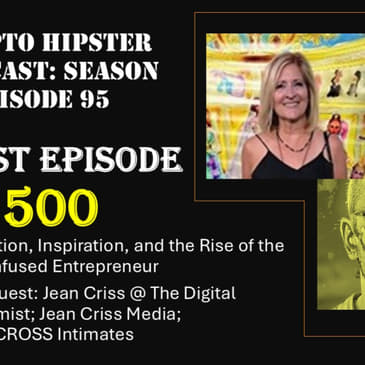

Jean Criss is an author, columnist, digital media-preneur, tech innovator, and fashion designer who thrives on bringing engaging community, content development, emerging techand communications to life. A 5X author, 4X award-winning e-commerce, digital creator, fashion designer, and global leader in support of emerging tech and women empowerment.
Contact Jean for writing, speaking and creative content engagements info@jeancrissmedia.com.
Contact: info@jeancrissmedia.com
Websites: JeanCrissMedia.com and CRISSCROSSIntimates.com
Social sites:Linktr.ee/JeanCriss
Books: https://www.amazon.com/stores/author/B0BR2RQTH9/allbooks?
LinkedIN: https://linkedin.com/in/jean-criss
[00:00:03] Hello everybody and welcome to the Crypto Hipster Podcast. This is your host, Jamil Hasan, the Crypto Hipster, where I interview founders, entrepreneurs, executives, thought leaders, amazing people all around the world of crypto and blockchain globally. And I have another amazing guest for you today. And this woman I know is in my cohort at The Digital Economist, an senior executive fellow. She's the founder of Jean Criss Media and Criss Cross Apparels. Her name is Jean Criss.
[00:00:32] Jean, welcome to the show. Jean Criss Media, Ph.D.: Thank you, Jamil. I'm so excited to be here with you. Jean Criss Media, Ph.D.: Me too. Thank you very much for joining me. I appreciate it. And I think we're in for a treat for this podcast episode. So let's kick things off and ask you first, you know, ask everybody this question. What is your background and is it a logical background for what you're doing now?
[00:00:55] Jean Criss Media, Ph.D.: Yeah, that's always a good question. Good, good place to start. I, is it logical for what I'm doing now? Well, let's see, I'm just gonna go back a few years, but I actually got a computer science degree. And then I got a communications degree. And then I didn't use it. And, you know, I went into tech and I went into media.
[00:01:22] Jean Criss Media, Ph.D.: And then I kind of circled back and went into communications and really focused on advertising and then really started applying tech, you know, the computer science side of it, you know, with tech.
[00:01:40] Jean Criss Media, Ph.D.: And so I think it's kind of come full circle over the years. But, you know, so I'm going to say yes to your answer. It took me a while to get there. But, you know, I think sometimes you have to dabble in other areas and see where your passion is and try out different things. And I've covered a lot of ground. I've covered a lot of different diverse market segments.
[00:02:05] And I've learned a lot through that. But, yeah, I kind of have found some new areas that are I'm passionate about. Very cool. So I want to get into some of that deeper dive conversation. I want to first ask, you know, what is Jean Criss Media all about? What is Criss Cross Apparel all about? And how have you enjoyed your time with the Digital Economist so far? Dr. Jean Criss Media.
[00:02:29] Dr. Anne McLean, Ph.D.: Yes. Well, Jean Criss Media is a creative media services agency. I started that in 2011 when I got laid off from the corporate workplace and from media and television. And then I was diagnosed with breast cancer. And I also started a fashion brand called Criss Cross Intimates.
[00:02:51] Dr. Anne McLean, Ph.D.: And it's a post-surgical brand for women and men. And it's mostly for women. But I created a fashion forward contemporary brand for post-surgical use. And people are using it also for adaptive wear and active wear.
[00:03:09] Dr. Anne McLean, Ph.D.: And now with the Digital Economist, as you know, you and I are focused on blockchain and digital assets and editorial, working with the Center for Excellence. And yeah, I enjoy that. I've always been a writer, a blogger, a columnist, contributing writer.
[00:03:29] Dr. Anne McLean, Ph.D.: And you know, I'm able to utilize those skills with the Digital Economist and also on my own. I'm a five time author. So I think, you know, that's been helpful and I think an asset to the organization. But what I've gotten out of it is I've been with my breast cancer research and focus more so on wearable tech and blockchain.
[00:03:56] Dr. Anne McLean, Ph.D.: And I've been able to, you know, really get some great resources and knowledge working with the group and the organization. And it's been a lot of fun. Dr. Anne McLean, Ph.D.: Yeah, it's been fun. So that's good. And I want to get into your books and I want to get into the fashion wearables a little bit later. The first question I have for you, though, is, you know, you call yourself a tech-infused entrepreneur.
[00:04:22] Dr. Anne McLean, Ph.D.: So what is a tech-infused entrepreneur? Dr. Anne McLean, Ph.D.: Yeah. So, you know, we were, you know, thinking of, you know, I guess my first question to you was, you know, I know crypto hipsters more focused on blockchain and digital assets. I'm like, Jamil, do you really want to have me on your show? And we were, you know, diving in and talking about this.
[00:04:48] Dr. Anne McLean, Ph.D.: And, you know, I started to talk about, you know, what I do. And so as it applies, a tech, in my opinion, you know, a tech-infused entrepreneur is somebody that really focuses on a diverse area of integrating, you know, what I do, which is blockchain, AI, tech innovation, brand innovation,
[00:05:11] really working with a variety of different software apps, streamlining operations, productivity, and pulling all of that together and driving business, whether it be a small business or whatever your product or solution is to make it more productive.
[00:05:36] Dr. Anne McLean, Ph.D.: And as an entrepreneur, you're starting from A to Z, right? You're creating something from the ground up and making it happen. For me, it was product innovation and also a business, a service. So I've done both. And so with having a tech-infused business, you need to know all facets of the business.
[00:05:58] Dr. Anne McLean, Ph.D.: So I have made it a point to stay on top of emerging tech, emerging trends across a diverse area of categories because I'm involved in technology, I'm involved in fashion, I'm involved in publishing. So it requires me to stay on top of a lot of different industries, but I also need to be productive in those. So in short, that's kind of my definition for what I'm doing.
[00:06:28] Dr. Anne McLean, Ph.D.: Got it. So you went from, let's see, the way you shifted your business and your mindset is you went from innovation and ideation to innovation and inspiration, right? How did you make that shift? How did you make that transition?
[00:06:46] Dr. Anne McLean, Ph.D.: Yeah. Well, when I first became an entrepreneur, I really hadn't planned on it. I got laid off, right, in the corporate workplace and I just thought it was time for me to do this. I spent 25 years in corporate from media and tech and I just felt like it was time. I had a lot of changes taking place in my life and I said, I'm going to do it. So within 30 days, I started my own business.
[00:07:11] Dr. Anne McLean, Ph.D.: And so just the idea of starting your own business, you know, people were like, how did you know how to do that? Well, I had a small business before that with just, it was really more of a hobby. I had a jewelry business and I did that on the side on the weekends.
[00:07:27] Dr. Anne McLean, Ph.D.: It's kind of a sidekick business. And I did that for seven years. So I had an LLC before. And so creating this media agency, what I decided to do was to kind of pull together a portfolio of services of, you know, everything that I had done and learned throughout my career in media.
[00:07:49] Dr. Anne McLean, Ph.D.: So taking creative media from digital, online, print, television, you know, I had worked outdoor and radio briefly and really pulling together portfolio of services for clients.
[00:08:01] Dr. Anne McLean, Ph.D.: And I went to market, put together go to market strategy, attended some incubator training, put together that go to strategy and sales funnel, you know, and really put ideas, big ideas into play through that whole process.
[00:08:22] Dr. Anne McLean, Ph.D.: And you really do go from the idea stage to the innovation stage to, you know, taking that imagination to execution. And that's what I did with all my businesses. And once you kind of know that structure of what to do and how to go about it, it becomes easy, you know, becomes kind of turnkey, being able to put ideas into play or, you know, taking
[00:08:51] Dr. Anne McLean, Ph.D.: A concept and making it happen. So I've done that now with quite a few different types of products and services. And that's the, that's the part of the business that I love. I love the, you know, the innovative side of it, the brand innovation, the innovation, more so than the operation side of it, which I'm sure you can appreciate. Dr. Anne McLean, Ph.D.: I appreciate that.
[00:09:21] Dr. Anne McLean, Ph.D.: And a lot of entrepreneurs don't like to do the financial paperwork either. So I appreciate that. Dr. Anne McLean, Ph.D.: And that too. Yeah. But more so, I mean, even though I'm a little bit of a techie, I don't really like doing the technical side of it. I don't like running the back end operation side or working with, you know, the affiliate partners and the back end systems and dashboards of so many different companies that it just takes me away from my day job of what I'm really more passionate about.
[00:09:47] Dr. Anne McLean, Ph.D.: Awesome. So I too left corporate America. It was in 2017, a little bit later. And I immediately jumped into crypto, you know, but going from a corporate mindset to an entrepreneurial mindset, I'm sure you were, was fraught with challenges, right?
[00:10:05] Dr. Anne McLean, Ph.D.: So what were some of those challenges that you faced and how'd you overcome them? Because I think a lot of people are going to be transitioning from the corporate America to Web3. So how did you do it and how could other people be successful and not go through the pain points or challenges that you and I did?
[00:10:21] Dr. Anne McLean, Ph.D.: Yeah. Yeah. Well, there's a lot of challenges go through. You know, you mentioned payment, payment process is one of them, I'm still dealing with that. You know, and I'll be honest with you, I'm still chasing after $100,000 worth of business. And I'm working on it. You know, it's, it's tough. You know, the contract side of business is, is difficult. I think, you know, you learn, as you grow, and you start your own business. You know, I used to have my own contracts.
[00:10:50] And, and then I quickly learned that I have to do things a different way. And so I put different types of agreements in place and, you know, got smart about how I do that. I also learned how to fire business partners, you know, I wasn't afraid to do that if they weren't working with me. And, you know, for the same end goal, then, then it made sense to part ways. And so you have to be tough, you have to know when to say no, and when to, you know,
[00:11:20] test the waters and see if this partnership works. And if it doesn't, you know, to move on and to keep looking for the right, you know, business relationships that are going to, you know, help your business succeed and move forward. You can't do it all by yourself. And I've learned that as a solopreneur. But you also don't have to grow and, you know, become too big too fast.
[00:11:45] You know, I had consulted with one of the Shark Tank guys, and, you know, Damon John, and, you know, he gave me some great advice. And, you know, he said, don't get greedy, you know, just because everybody wants to create a startup and, you know, start with, you know, hiring a dozen people and having a Manhattan office, you know, doesn't mean success. Success means, you know, watching your bottom line and, you know, being lean and mean.
[00:12:12] And that's what I've done. And, you know, I'm not there yet. I, you know, I did have an office in New York, but I had subcontractors. And, you know, I brought people in when I need them. And I still do that now, even post COVID and working out of my home office. I, you know, I know when to bring in resources and when not to what I can do on my own.
[00:12:36] And when I need to, you know, bring in outside partners to help me get something done. So knowing when to ask for help, I think is important too. So those have been some of the challenges and, you know, you just need to know, you know, how to go about managing that part of the business, I think is helpful. And you learn from your mistakes and you learn how to grow as a business owner. Yeah, I agree. It's a little harder in crypto though.
[00:13:08] But I want to, I want to, I want to talk about, well, actually one of your books, you have five books. I want to talk about one of your books. One of your books is called Live Your Dreams. Yeah. Right. What was that all about? Why should people read it? Why should, what lessons can be taken away from it?
[00:13:22] Yeah, there it is. So yeah, Live Your Dreams is really a book about entrepreneurship. It was my third book that I wrote and it was really starting for me to lay the groundwork about how to, when I first became an entrepreneur, kind of the steps that I took to start my own business, how to launch, how to create product, develop, put brands into play.
[00:13:51] Really all the steps that I learned through my incubator training. I went through a six month training in New York that really helped me with other startup founders, you know, figure out, you know, how do you take this concept and this idea and how do you frame it? And how do you, how do you make it into a business? Because I really hadn't done that before. And, you know, coming from corporate, you're not taught any of this.
[00:14:15] You know, you just walk into a client and, you know, the business is running. And so you don't really know that part of, you know, what they went through to get where they're at today. So you're just pitching them whatever it is that you're, you're marketing to them. So, you know, it really took me a step back to say, okay, now this is my own business. What do I want to do? What do I want to, what do I want to market? What do I want to sell?
[00:14:38] How do I get there? How do I build it? And so after I laid out that plan and that strategy, how do I build upon it? So I pretty much documented that whole process and how I got there. So it's my A to Z, how I got there, how I built my plan and put product into play.
[00:14:59] So if an entrepreneur wants to know how to create a startup, this is the book. It's called Live Your Dreams and How to Put Ideas into Play. And it's my third book on Amazon. Very cool. Very cool. I got a bunch. Yeah. More than a bunch. Dozens. Dozens. But let's talk about, you know, you brought up a concept that's important that we're missing in Web3.
[00:15:29] Oh, not missing totally, but it's only been focused on one real area, which is a product. The brand product is, in crypto, it's called NFTs, right? You actually, people will build a product on top of that. You know, NFTs have been down a little bit, but, you know, I want to find out, you know, from a technical perspective, you know, I think NFTs are going to be a business model for branding and development going forward, even though they haven't been recently. What's your view on NFTs?
[00:15:57] How can brand managers and product developers use NFTs for their benefit to grow their business? Yeah. You know, I think it depends on the type of product you have, right? It depends on if you, you know, obviously for, for, if you've got digital art, if you have, maybe you're, you've got a business of vintage clothing, let's say.
[00:16:20] It's probably important for you to, you know, look into the, the NFTs and maybe put that in, you know, some vintage clothing and see what that value is. And then as that clothing moves on and is sold and is, you know, transitioned to other buyers, you know, that legacy is very important to, to have that, you know, NFT built into the clothing. Why not sew that in and somehow into the product?
[00:16:50] For me, I don't know if it's that important. I have post-surgical undergarments that maybe they'll be tossed after 120 days after you wear them. Maybe they'll be donated to somebody else. It's probably not as relevant for my post-surgical undergarments, but so again, it depends on, I think the product or service of what you're doing. I think for art, it's, it's really relevant for crypto. I'm not as familiar, but yeah, it's probably, you know, very relevant blockchain. It's very relevant.
[00:17:20] So, you know, it depends on, I think the industry, the market segment of what you're referencing for, for NFTs. I know a colleague of mine that I work with who promotes an NFT chip that's on your nail and you can have the nail and the nail does so much. I mean, it, it, it works with your iPhone or Android and, you know, can store certain information.
[00:17:49] And, you know, so it's not that the chip itself has to, you know, be information, historical information, let's say it can just, you know, access different types of information of in different data and, you know, be accessible for different apps. So they can be a different functionality. Awesome.
[00:18:14] So part of the digital economist, I attended the, an MIT hackathon in, MIT in November, and we were talking about pulse oximeters. And the problem was that they didn't have a lot of data captured to, for, for evaluating the pulse oximeters. So we, you know, we did okay in the contest, but you make wearable tech, right? How have you incorporated, or how would you think blockchain should be incorporated into
[00:18:44] capturing data so that it's accurate, so people can have historical data or use of the data on how your tech works and how other projects can work as well? Yeah. Yeah. Well, that's something that I'm exploring right now. I don't have all the solutions, but I am right now working on a research project, as you mentioned, with wearable tech and blockchain. And I'm exploring using medical sensors in undergarments.
[00:19:09] And the blockchain hasn't been defined yet as far as the final use, but, you know, the concept is for pre-diagnosis of breast cancer with my intimate apparel, as well as for accelerated recovery with the intimate apparel. So the blockchain would come into play more so for the post-recovery end of it.
[00:19:34] And for measurement of some of that data between the patient and the physician. So right now, I'm in the process of hiring some scientists and some people to collaborate with me on the project and to, you know, put the product into play, as I say, with my business. So, yeah, I'm right now in the throes of that.
[00:19:58] I just attended some training at MIT and at Columbia University and making some headway with the industry and hopefully be able to get some prototypes out later this year. Awesome. I love what people say, you know, there's no use for, there's no practical use case for blockchain. Yes, there is. Here's the appropriate example that there is. There's many uses, right?
[00:20:24] And it's outside of the traditional area because, you know, people look at me when I may have mentioned it and, you know, it's kind of like deer in the headlights. They, you know, it's not your common use, right? So there's going to be a lot of different uses for blockchain, as you'll see in the marketplace. Awesome. Awesome. There's another, there's a use for, there is practical use for something else going on right now. And there's a lot of uses is, is AI, right?
[00:20:54] So you believe, and you said this to me, you believe that, you know, we should think of AI as our co-founder, right? How would that, how would that help build the business is thinking of AI as a co-founder? It's a novel idea. I like it. Yeah. Yeah. So I was explaining to you that, you know, I'm a founder, right? Of two businesses. I mentioned that you can look at AI as your sidekick, your, your co-founder, your partner
[00:21:21] in crime to help you in your day-to-day business. You know, your, your AI tools are your silent partner to running your business because it really is somebody that is here. I mean, yes, you can talk to chat GPT, you can talk to, you know, your AI tools and you can get feedback. You can, you know, run a business working with AI tools.
[00:21:48] You know, what's the, the nomenclature is that everybody thinks, you know, AI is going to, you know, eliminate, you know, their work or their jobs or their, you know, their, their productivity. And I find it just the opposite. I find it that it's really increasing your productivity and it's knowing how to use the right tools and knowing when, what tools to use and, you know, when to use those tools is
[00:22:14] the challenge because, you know, just educating yourself in your category of business and knowing what tools to use is really the benefit that you can have to, to automate your business. And so get educated, get, you know, learn what's out there in your category and dive in because I'm a real proponent of it. And I think it's great. And yeah, look at AI as your co-founder.
[00:22:43] If you're a startup, you're an entrepreneur, that's your tech infused way to run your business. And it doesn't really cost you anything. And you don't have to pay for expensive staff that might not do, that might not be able to deliver for you. Right. Well, I mean, you know, you've got your VA assistants out there, right? You've got virtual help in many different ways and it's your virtual AI, you know, partner.
[00:23:07] So one of the things that I've seen more recently in different crypto, you know, businesses is this concept of gamification, right? Why is it important to make, you know, tech entrepreneurship fun? And why is it important to add a gamification element to what you're doing? Yeah. Well, it's not important. It's not necessary.
[00:23:33] But if you're looking to grow in a very fast-paced growing industry, gamification is one of the leading categories. You know, right now it's a $50 billion industry growing to be, I think it's $105 billion by 2030. You know, I think that there's huge opportunity for skins in many different categories and I'm looking into it for fashion.
[00:24:02] It's another niche category for many different categories for apparel, but I'm looking into, you know, I'm exploring it right now for intimate apparel for myself. It's not just for brand awareness. I'm looking at ways to monetize it. You know, I can do many different ways to create brand awareness for my product, but I want to look at ways to monetize it on the platforms.
[00:24:29] So there's many different platforms for gaming and that's where my research right now is. I'm exploring as well. So I've got a couple different active projects going on. Very cool. That sounds, you know, I'm just wondering how, like you said, it's important to monetize things. So it's important to live in a lifestyle that you'll enjoy because if you're doing something
[00:24:57] and it's not fun and it's drudgery and you don't want to do it anymore. So, you know, as, as the tech entrepreneurship takes off, as cell entrepreneurship takes off, as the techpreneur, you know, takes off. Um, how's, how's it important to embrace the new lifestyle? There's a new lifestyle, right? How, how should people embrace that lifestyle? Yeah. Well, I think you need to be open to, um, you know, just learning new technology, being
[00:25:25] open to different sustainable ways to run your business. Um, yesterday, as an example, I'm part of the women own a business network and I attended a webinar that, you know, talked about the different ways to keep your business, um, uh, you know, running. And it's important to, you know, to know how to run it from a governance perspective, how to run it, you know, from sustainability perspectives.
[00:25:51] We're talking about how to run it from a technology perspective, how to run it from the business side, the operation side. There's different aspects for sustainability across all of these areas that you need to know about as a business owner. Now, whether you're partnering with anybody, if you're working, you know, if you're building your team or building your corporation or your, your business yourself, or whether you're
[00:26:16] working, you know, in conjunction with others, it's still important, you know, even when you go to sell your business that people are going to ask you, you know, what are you doing in these areas? So, excuse me, the lifestyle of how you run the businesses is important, you know, for, for a startup and for entrepreneurship, for the lifestyle of, you know, the tech infused entrepreneur that that should be top of mind.
[00:26:47] As you know, the, you grow this ecosystem of whatever it is that you're, you're involved in. So, I kind of stay on top of that for myself, you know, to, to keep learning about other things that I can be doing for my business. And for me, as I grow and pivot, like I'm doing right now in wearables or gaming or whatever category that I'm doing to make sure that I'm going about it in the right way and the most productive way to be efficient for my business.
[00:27:17] So, as that lifestyle might change for me, you know, that I'm, I'm taking advantage of, you know, the right tools, the right resources, the right ways to go about how to get the job done. Yeah. My lifestyle changed when I left corporate America and you said I no longer wear suits. You know, I'm wearing hoodies. I'm like, okay. So, I went from a suit to a hoodie instead of a hoodie to a suit, you know? And so, opposite everybody, right?
[00:27:47] So, did I answer your question? Were you asking more about personal, how we dress? No, I wasn't asking how, like, how was it? But we're going to have more choices, right? We're going to be having, we're having more choices. We're going to be able to navigate those choices. But how do you stay on track? Because like a lot of people say, oh, it's best to have free time. Oh, it's best to have more money. And I'm like, I look at each day, I'm a successful if I've been committed to my commitments and
[00:28:16] did what I was supposed to do, you know? So, navigating, you know, this new world takes, you know, is filled with challenges. So, that's where I was kind of getting like, we have to choose, right, where you want to be at, right? Yeah. I mean, you know, we've been already, you know, working remotely for a number of years. We've been, you know, if you've had the luxury or the opportunity to, you know, use certain
[00:28:45] productivity tools to be able to, you know, automate your office or your business by going on vacation, working, you know, remotely, doing things like that. Maybe going on a retreat, working remotely, going on vacation, working remotely, maybe climbing in the mountains and getting things done in different ways. I think AI plays a different part in it now because, you know, AI is your partner here at
[00:29:15] home and can be doing things for you, maybe at your desk while you're not here, right? In a different way than we had before. You know, I think about when I launched my business, Jamil, in 2011, if I had the tools then that I have available to me now, what would my business look like today? I can only imagine, you know, how advanced it would be because back then, even though I
[00:29:42] was using automated video production and media production and advertising and tools like that to get my job done, it was different. You know, you don't consider it manual. It was still using digital automated processing, but it was different. And now today things can just be done so much more accelerated, so much more in a different way than how we did things 10 years ago.
[00:30:10] So, you know, if you look at things like that, you know, I just wrote an article about 3D design and production and 4D volumetric film production, and that'll be coming out later this month. And how the film industry has really, you know, gone from your traditional cinematic film production to how it can, you know, you can just all be in a green screen room and film this phenomenal,
[00:30:40] you know, explosive global film production in one room and make it all happen and look like you traveled around the world and, you know, it was a, you know, $50 million production effort. So things have changed. And a lot of it has to do with the productivity tools that are out there. And if you, you know, are interested to stay on top of it, I think that has to do with,
[00:31:05] you know, the education and the learning and the tools that are available to you to stay on top of it. So that's the lifestyle that I've chosen to stay on top of with the industries that I'm interested in. You brought up a great concept. You know, actually, I'll share something I haven't shared before on any show. When I was in my early 20s, I wanted to be a film producer. I wanted to make independent art house films.
[00:31:32] It didn't work out, you know, for me. But it could today, right? It could today because you mentioned it, IoT. You know, Internet of Things, at least 4D and 3D. I'm looking forward to reading the article. So how can we hack our way forward in life through using the IoT? Well, I mean, just even consider your phone, right? Yeah. Everybody's got a phone, iPhone, whatever it might be.
[00:31:59] I was just reading an article this morning while I was having my coffee that, you know, a 14-year-old kid had developed a device that, you know, can, you know, you can buy like a charger that can, you know, wipe it out. And you don't have to keep upgrading your phone anymore to, you know, to stay on the latest upgrade of that phone.
[00:32:23] So, you know, just staying on top of technology and learning about, you know, what's the latest and greatest out there and does it work? Is it the right tool for you? I think testing it and seeing if that's, you know, the right product for you is the first step in the process. But, you know, doing your homework and seeing if that's the right thing. I created a mobile device, you know, speaking of Internet of Things, I created while I had
[00:32:52] my breast cancer, I had a hard time carrying heavy things. So while I was going through that, it was like, you know, somebody needs to come out with lighter gadgets and smaller devices. I was so frustrated carrying so many cords. And, you know, I literally had a briefcase just for all the cords right between the laptop, the couple phones, the tablet, all of this stuff. And I was traveling a lot from Boston to New York. And it was a lot. It weighed on me.
[00:33:19] And I was getting vertigo in my neck from carrying that in my suitcase and so forth. So I developed a mobile device. And it was called YouGo Mobile. Wherever you go, you take this, you know, very small micro-sized device. It's the size of actually the tube of lipstick I've got here. And I wanted it to be extremely small and portable.
[00:33:46] It's something that could fit in a man's pocket, something fit in a woman's little purse at night. And I got as far as creating the 2D design, outsourced the project then to a professional, you know, designer developer to put it into production. And at the time, I did get a utility patent on it. And I had the utility patent for the fashion brand.
[00:34:09] But since my breast cancer saga went on for so long, I had to make a decision which one did I want to put into production and spend my time on. And since the breast cancer line was going to help me, as well as other women in the world, I focused on that and did not put this into production. But I still own the rights to that and am trying to spin it off right now. And that is, you know, I still haven't seen anything on the market like that.
[00:34:38] The concept is that it has a small 36-inch windable cord inside. You press it with a button and, you know, it's one cord that's a universal mobile charger. So, you know, you don't have to be a tech whiz to create different types of innovative things. You know, I think that you just have to be inspired to come up with this, come up with an idea and know how to make it happen.
[00:35:09] So, you know, the Internet of Things includes, you know, whether it's your coffee pot, you know, automating, having it ready for you as soon as you wake up or, you know, your refrigerator restocking, telling you what you need to restock for you.
[00:35:25] You know, there's many different examples of, you know, smart devices that are on the market today that can help you with, you know, getting things done or helping you with your daily life. I see. I see the innovation and inspiration mindset there coming, shining through when you talk about that. So, you know, I get excited about it. That's the side of the business that I really love, that I'm passionate about. Awesome. Awesome.
[00:35:55] So, I do want to ask one more question because you brought it up a little bit earlier and I overlooked it shortly, you know, but I want to talk about it. And that is, you know, innovation for, so you talked about sustainability, so innovation for social impact. So, what opportunities do you think are available with using, you know, innovation and inspiration to make innovative changes in how we look at social impact?
[00:36:23] Yeah. Well, I think there's a lot of green, you know, things that people can be doing these days. You know, whether it be a green event, you know, clean water, whatever type of sustainable, you know, business that you have that can help the environment. You can focus on it. You can focus on it.
[00:36:49] All humans can focus on anything that's sustainable in the world to make an impact for socially and around the world. I think that, you know, if you have the ability to do that, you know, for me, even if it's just recycling bras, you know, being able to, you know, tell people where they can go to donate their bras or to, you know, to recycle fabric as a fashion designer.
[00:37:16] You know, it's all about, you know, finding resources and, you know, upcycling and really making use of what's on the planet today. Awesome. Well, I want to thank you very much for your time today. I enjoyed speaking with you. This has been a wonderful conversation. I have one last question, and this is probably easiest.
[00:37:38] So how can people find out more information about you, about Gene Chris Media, about your apparel line of business and everything else that you're up to? Okay, sure. Well, they can get a hold of me at info at genechrismedia.com. I have my two websites, genechrismedia.com and crisscrossintimates.com. I'm on LinkedIn, Gene Chris.
[00:38:03] And most of my social media sites are, you can find them under Linktree, which is under Gene Chris as well. So I think with those, that information, you'll find me pretty much everywhere. Awesome. And my books are on Amazon too. Yeah. That's right. Pick up one of our books, ladies and gentlemen. So thank you very much for your time today. Thank you. And I'll see you this week.