
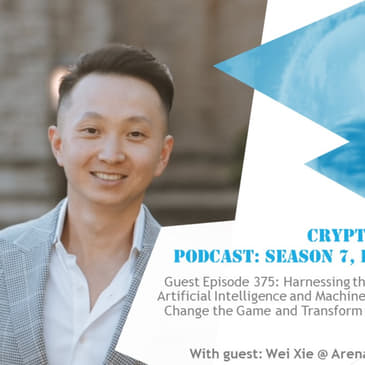

Wei Xie is the COO of ArenaX Labs. Previously, was the Head of Digital Assets at a large Canadian pension fund, focused on investment strategies encompassing digital assets such as cryptocurrencies and blockchain technology, as well as machine learning enabled liquid strategies. As COO at AI Arena, Wei takes charge of all business operations, including Finance, Legal, Marketing/Communications, and overall strategy for the company and its products.
[00:00:00] Hello everybody and welcome to the Crypto Hipster podcast This is your host Jamil Hasan the crypto hipster where I interview founders entrepreneurs executives Thought leaders artists you name it all over the world of crypto and blockchain and today
[00:00:15] I have another amazing guest all my guests are pretty incredible so Without further ado I have this chief operating officer of web 3 AI gaming ecosystem arenax labs His name is Wei Chi welcome to the show way
[00:00:32] Hey, Jamil nice to have nice to be here and thanks for having me looking forward to this conversation You're very welcome. Thank you for joining me and let me ask you Let's kick things off and ask you the first question is about your background
[00:00:44] What is your background and is it a logical background for what you're doing now? Completely illogical for what I'm doing right now. I actually have a tri-fi background Spent over 12 years in finance basically on the asset management side managing portfolio for institutional
[00:01:08] Investor in in Canada, it's a large pension fund and then prior to kind of Co-founding arenax labs was leading a seven billion dollar liquid strategies program investing across the board That is also where I had the opportunity to start
[00:01:24] Investing into crypto from an institutional context as well. So was able to kind of build a network within crypto understand the technology understand the the kind of the vision behind what people were doing in this space and in 20 I think late 2020
[00:01:44] My co-founder and I we started to ideate around what we can do potentially with NFTs Having done a more of a deep dive into what that kind of technological primitive allows And that was like the precursor for AI arena so
[00:02:05] Arena X labs, right? What's it all about including? You know, you're at this unique intersection of web 3 and AI gaming. So Yeah, I think the starting point was we started building a game called AI arena
[00:02:22] I'll touch a little bit about the game and then I'll talk about where the business is today But AI arena is a game where human players are able to train artificial intelligence characters I'd like to describe the game play as a crossover between Super Smash Bros and Pokemon
[00:02:37] When you watch it, it obviously looks like a platform fighting game like Super Smash However, the core game loop was one where human players are training AI models It's like a Pokemon based game loop where you're training a character to become better at something
[00:02:53] However in our game because these characters are artificial intelligence models. They can basically learn anything So it's an incredibly vast kind of search space in terms of Discovery of what you can actually teach your characters and then what you're trying to teach them is to how to become
[00:03:10] a better fighter in this platform fighting game So in the process of and in the journey of building this we solved some very challenging kind of machine learning problems along the way to build a game like this
[00:03:24] And where we are now from a business standpoint is there's actually three different Segments if you want to call it AI arena is still the title that we're producing and bringing to market shortly In q2 this year. We're also starting to roll out our gaming infrastructure called ARC
[00:03:42] What ARC is is basically a an SDK that now We're offering to third-party game studios whereby we can start to integrate this type of AI training game loop into other games
[00:03:55] So we've been starting to build a pipeline there of clients that will be using ARC as a solution You know these do you span the gambit of large to small size game studios developing different types of game experiences
[00:04:08] And then the third segment of business is a machine learning competition platform called Psy It is meant to target more sophisticated AI researchers or machine learning engineers On Psy there will be multiple different environments think games and what these
[00:04:27] Researchers and engineers are able to do is go on go on a platform and basically build their own AI models To compete in these competitions So it's kind of like digital battle bots But there's a variety of different game environments for people to challenge themselves with
[00:04:45] And the idea behind Psy is to attract The best and the brightest that are kind of working within the machine learning space and give them a forum to really express themselves and Have them push the envelope on model design
[00:05:03] And see who can come up with the most unique and interesting models to tackle really difficult problems that are basically framed as gaming departments, so those are the three segments of the business that we're building today happy to
[00:05:15] Elaborate or kind of go down any one of these paths. I Prefer to go down all three paths. Um, let's see first AI arena. I want to start there been in sign arc later, I
[00:05:31] Want to know what the play pitch is and why must people play this game? They people play could play any games right a lot of games. Why must people play this game?
[00:05:42] Yeah, I mean at a high level is there's nothing like this that's ever existed the core game loop of training an AI Through what a process called imitation learning whereby the AI is really learning how to play the game through watching you By your demonstration
[00:05:57] It's kind of similar to how you would teach a child how to play soccer or Train a pet to do tricks, right? like the starting point is to actually demonstrate actions for them to replicate and then the
[00:06:12] in addition to that what you're allowed to where you're able to do is you're actually able to You know help explain to the AI or sensitize how it's learning the information based on different types of levers That it understands that it can kind of
[00:06:30] Change as variables. So depending on how you dial these levers in terms of sensitivity It learns the information differently. So the combination of demonstration and this configuration step Creates what I mentioned before is a vast kind of research space of things that it can learn
[00:06:48] so it's almost like there's no theoretical ceiling in terms of how we can create a very kind of bespoke or unique AI There is almost an infinite combination of different types of things that you can teach your AI
[00:07:05] So what what it lends us out to is a extremely competitive game and we designed it as such Because people can just use their creativity and ingenuity to really train different types of AI's and what we want to see in the central competition is
[00:07:22] Who's able to kind of train the most exciting AI and people are coming at it from all different angles and we call it an evergreen like, you know Infinite game because it never ends. It's kind of like chess
[00:07:34] Right where you just new people are always playing and then once in a while Someone comes to the scene and they're there, you know figure out a new way or play style and they can Completely change the you know the complexion of the competition itself
[00:07:49] So that's that's been an experience with AI arena Completely different novel game experience I think we're at a moment in time where AI is very exciting and more people are looking to explore ways of interacting with the technology and we think gaming is a
[00:08:04] Fantastic medium and within gaming we think we have one of the most unique applications of AI in terms of how we used it to Create a new gameplay experience But but really, you know, we hope to kind of start
[00:08:18] You know help to perhaps launch a new category within games And this is why you know, we think AI arena is really exciting And this is kind of the feedback that we receive from early players in the game. It sounds exciting
[00:08:33] It sounds like it's the first of its kind Usually it's the AI teaching us stuff and we're teaching the AI so that's pretty cool. Um That sounds like I'm interested So Okay, say side and an arc
[00:08:51] How could the great intelligent game flow? I mean you already talked about that. But how do we How do we like? Imitation learning right? What's that all about? How are you helping? You know with that and what are the potential?
[00:09:04] What's the potential and possibilities because of imitation learning? Yeah, so imitation learning at a high level It's actually a subcategory of reinforcement learning And when reinforcement learning for people who don't know it is this field of machine learning where it
[00:09:20] It almost kind of mimics how humans learn which is really through a reward function So you're not necessarily training The AI in the way that you would train like a supervised learning type model You're really setting for a reward function where it's like plus one point
[00:09:36] For these types of things and minus one point or minus there's a there's like a reward function and I don't see function basically and then you allow this model to kind of interact with an environment and kind of almost figure
[00:09:49] Out on its own how to behave with the objective of maximizing the reward, right? Like I want you to maximize the total amount of points so What imitation learning is is is basically an accelerated version of this where?
[00:10:04] Traditional reinforcement learning it takes a very long time for an AI to kind of learn an effective policy If you just allow it to discover it's almost like you're jamming billions of years of evolution
[00:10:15] Into like a very short period of time and hopefully that it like figures it out eventually it will but it takes a lot of computation And potentially kind of resources to get there
[00:10:26] In imitation learning what you're doing is you're actually injecting an expert into the learning loop and that expert is actually The human so what you're able to do is you're able to shrink down the the time it takes for the AI to learn an effective
[00:10:40] Behavioral behavior because the expert in the human can help short circuit some of the things that it's inevitably going to make in terms of mistakes
[00:10:49] Right. So if you abstract this idea to AI arena what you're doing is instead of letting the AI just figure out figure it out on its own You're saying okay. I want you to try to get the AI to learn
[00:11:01] Okay, I want you to be like here's a situation. You are close to your opponent. I'm going to show you what you do in this situation Right. So you actually demonstrate the action of punching your opponent when you're in close proximity to it
[00:11:16] This is now a data that you're creating for the AI model to learn from It will now learn that information from you because you help to accelerate its learning in that particular context so that it doesn't have to like
[00:11:29] Just through pure brutal trial and error figure it out, right? So that's the that's the process of imitation learning What what what is actually interesting about it is it actually makes it You know to gamify this process actually is extremely fun because as you can imagine
[00:11:47] It like the analogy like of a pokemon game like pokemon is a is a huge Kind of franchise that yeah people like um endear themselves to There's this magic about being able to train someone else or something else to be able to do things
[00:12:03] And see them continue to evolve and progress Again in this case, we just made that training loop so much more powerful Right in traditional training-based games You can maybe teach your character a few different things or they come pre-programmed with a menu of
[00:12:19] A few different attacks or defense and you're really just like cycling through that in AI arena It's like I said, you can teach it anything It's like you're teaching a child and they they're they're infinite in terms of what they're able to learn
[00:12:31] So this is a radically different type of strategy that's embedded into how you pursue training in AI And it actually makes like the game loop extremely interesting So we we see imitation learning. I mean, obviously it has a lot of applications in the domain of machine learning itself
[00:12:49] But in a gaming context first and foremost is a very interesting Game loop that we think we can take many different types of games and embed this type of game loop into it um, and yeah, and uh, and it also like from a technical standpoint
[00:13:06] We've also developed capabilities around The the ability to actually make our models run very efficiently So that you know users with very modest computers can run the game on browser Um, we actually allow like our clients who use the arc sdk
[00:13:25] To leverage our models and in doing so they're actually saving tremendously on compute And data storage costs because our models are so efficient at processing information And we solved one key problem that exists in reinforcement learning which is this concept of catastrophic forgetting
[00:13:42] and um in layman's term what it is is that machine learning models have this problem whereby Um left to its own devices. It has a very difficult Time or it has it's very difficult for it to arbitrate or balance Prior information with new information
[00:14:00] So in traditional machine learning what happens is people just could accumulate ever larger data sets And the data set warehouses almost as you can imagine like the sum total of collective experience that
[00:14:13] Has ever been registered and you pipe all of that data into a model to hope that It's storing all this information and it could you know, you know, make useful inferences out of sample on on applications It's extremely taxing from a resource and perspective like most small companies
[00:14:31] Do not have the ability to accumulate data sets that large in order to can they pay for it? And then the compute resources necessary to process models at that size is enormous
[00:14:42] What we have done is with our models we actually have this ability for our models to learn Retain information and you can actually discard old data You don't have to store it and the model itself has learned that intuition and the intuitions embedded in the model
[00:14:58] That it can take on into the future Without having to worry that it forgot like historical memories And at the same time you can still marginally improve it So you're going to still teach it new things and you can actually control how much it forgets about things
[00:15:13] And how much you can learn new things so that capability? Uh is is quite unique We think it's a proprietary solution that we've come up with and there's going to be a lot more application areas
[00:15:25] Gaming in the future. So this is an area that we're going to distribute it Explore and help other studios come up with better experiences and better kind of cost efficiencies and managing kind of ai-based games I see the benefits I see it pretty that's pretty cool
[00:15:43] What I also see is what people are afraid of um You know we teach the ai the ai learns who we are they learns everything we do and then they Catastrophically forget that we're the master they become the master um
[00:15:59] You know, what's how do you prevent that? You know, and how do you prevent people from being afraid of that happening? Yeah, I mean in our context it's very constrained to a game-like environment so um the existential risk of our ai
[00:16:15] Companions over overthrowing us as masters is uh rather Minute in our context is is not is not the models aren't powerful enough to pose a threat. Um However, I think the question is more writ large ai as a theme and and the The the way that is progressing
[00:16:36] I think a lot of people are debating where all this goes and certainly there is this scenario of How do we control ai when it becomes? um so powerful that it can effectively make its own decisions
[00:16:50] um, and what are some of the uh kind of the the the boundaries or rules or fail-safes that we need to have in place to ensure that Um, their ultimate objective function isn't at odds with human existence or continued human existence um
[00:17:07] It's a it's a profoundly challenging question to answer. I don't think anyone has the answer necessarily Um, I think generally I take a bit more of an optimistic bent. Um, I think um
[00:17:20] A lot of this comes down to thoughtful engineering. Um, but also how we think about developing um ai and machine learning systems and this not this particular problem, but this theme of like We believe a version of the world where a more democratized um kind of
[00:17:42] Approach to model design will yield better benefits for the ai industry but humanity at large I think right now one of the biggest challenges confronting the industry is that there's a consolidation of power in very few companies
[00:17:57] But even more so than that there's a very myopic perspective in terms of what constitutes good technology And to reduce that into you know, a couple of punch lines right now. The entire field is focused on larger and larger models
[00:18:13] um and large language models and generative models like that's literally where all of the attention is um, and we don't actually we think that's actually a negative in terms of progression in the industry because
[00:18:26] Um, it's not to say that llms or generative models are not useful. They absolutely are but there are Equally as exciting and interesting categories within machine learning that have not received Nearly as much enthusiasm and as much attention
[00:18:44] And our areas that we believe will yield much more impactful results Going forward on a forward-looking basis So part of the mission of what we're doing at arena x labs is to
[00:18:56] inspire the next generation of talented young individuals to come into the ai and machine learning space first potentially through a game as this kind of discovery portal where they can learn more about the Intricacies of ai what it actually is how it learns how you can actually
[00:19:16] um, you know Tune it to help it perform better Through a game like ai arena Um, and then ultimately move on to something like sai which is for a more sophisticated audience Right so where you can actually start to build your own ai models
[00:19:32] And what we hope to see in sai is creativity come to the fold and expand the surface area of ai technology Whereby we can start to fill the gaps of the areas that are under discovered or under explored because there's such an overwhelming
[00:19:47] Bias right now in the industry to focus on Rather small segments of the technology So in in doing so what we hope is we have this slogan on the sai side is that we're making solving artificial general intelligence as a general problem more fun
[00:20:06] And we fundamentally believe that model variety and different types of models Ie not just large language models, not just generative models Is the key to an accelerated path forward to artificial general intelligence? And that diversity will yield more robust um kind of results for
[00:20:30] Um humanity to solve some of the problems that you you mentioned um Because there's just more I guess like more shots on goal, right? And there's there's more variety for people to kind of explore
[00:20:42] And there could be solutions that come through those channels that are critical and important for some of these profound problems that you're posing Brief follow-up, I think is brief. Um I know
[00:20:55] Ai is part of the machine learning process. You said there are other areas of the machine learning What are what are what are those other areas? So okay, so artificial intelligence is like a banner term with uh with reference to Basically like systems like algorithms or systems
[00:21:18] That have very very powerful kind of Ability to kind of perform tasks where it feels like it's you know You know approaching like human intelligence, right? That's the whole concept of what artificial intelligence is as a field machine learning
[00:21:36] Within that is a subcategory of artificial intelligence is a particular approach to building Models to have this type of ability to solve problems within machine learning. There's different types of model call it architectures
[00:21:51] Right different types of models and the reason why there are different types of models is At least right now there is no universal model that can solve every single problem. It just doesn't exist
[00:22:02] So what happens is there are different types of model architectures that are designed to specifically solve different types of problems more effectively And large language models are a category of models, right? And there are very evidently things that large language models cannot do
[00:22:21] But what we're discovering right now is actually large language models do have um A lot of use cases where we can actually integrate it into other instances where It does add value to those processes
[00:22:33] um, and I think we're in the early stages of this kind of like discovery renaissance of the capabilities of a lot of a lot of these types of models and early on Llms have taken a leadership role And because there's so much money to be made in llms
[00:22:49] I think our view right now is unfortunately most of the talent are just going to where the money is right going to Where the attention is? So what that means is less people are actually exploring What other types of model architectures?
[00:23:06] Can be created to solve similar problems better or completely different types of problems more effectively And if our ultimate goal is artificial general intelligence, which is a again a blanket kind of term to refer to systems that are basically At or beyond the level of human intelligence
[00:23:30] We believe that we need to discover and explore more types of model categories and you know invest more resources and You know incentivize more people to actually do the research in these areas than just llms um, so
[00:23:48] That that's what I was trying to get at in terms of different types of model architecture Just there's many many different types and i'm not suggesting that there's no research being happening in all these other categories there are but um the preponderance of
[00:24:01] Attention resources tower is going to llms at the current moment And we think that we need to skew it a little bit more to the other to the other areas That answers my next question. I think
[00:24:14] Um, you're harnessing collective intelligence and I was about to ask you what if the what if the collective isn't that intelligent? You know, oh what if the collective isn't that intelligent? Um Is interesting um yeah, I think look coming from a National market background. I'm
[00:24:33] very sympathetic to that comment. Um, I think I think um I mean humans as a collective At different moments in time can obviously exhibit completely irrational behavior Um, so collective intelligence i.e things like market apparatuses can fail in those in those moments, right?
[00:24:55] Because behavioral distortions of biases take over um If we're crowdsourcing human intelligence to try to build better systems I think all on the margin relative to the alternative. I think it's more robust and better um However, it doesn't mean that it's invaluable
[00:25:13] Um, I mean one of the areas that's actually really interesting just just looking at things like llms and um Applications or systems like chat gbt, etc Is this concept of bias? right and a lot of times if you if you um compare these different types of
[00:25:31] uh prompt engines From each other and there's a lot of research done on this You can almost reverse engineer the bias that was embedded into the model in terms of how it was trained um and sometimes it you know, there's uh non-trivial expressions of political perspectives there are
[00:25:51] prejudice Embedded in these models in terms of the outputs that they create uh, those are those are really important issues to consider right and Uh, you hope that things like a market mechanism or competitive structures will help to um You know create more diversity and allow the best
[00:26:14] Version of these systems to be voted in by the market And again, I don't know like it's not a guarantee. So i'm not suggesting that it's not um fallible. It certainly is but I do think um
[00:26:27] it's like the worst of all you will see in some ways right where it's like, uh, it is uh, Compared to all the other options is the least worst one. So I guess we continue to go with it um, but but I do think that um, there are
[00:26:42] Incredible amounts of latent untapped talent around the world and part of the mission for something like psi and even ai arena is to try to reveal um these bright minds and give them a platform to really shine And and and giving the opportunity to really make contributions
[00:26:59] Um to a very exciting field that's going to have profound implications for for humanity I love it. Um You said two magic words there you said untapped talent, right? Right now, uh, there is Uh ai or an ai skills crunch, right
[00:27:21] What are the challenges with like standard recruitment tools? You know, and how do we how do we solve it? Yeah, um, I think there's two primary challenges. I mean the core challenge is there's just not enough people
[00:27:35] Um at like the grassroot level that are being funneled into the ai field And maybe maybe it's a problem that with time will solve because the market is already creating this signal that
[00:27:51] Is incredibly lucrative to get into the field right now, right? Like the you know, your average ai engineering these Large ai companies and tech companies are getting seven seven figure pay packages, right?
[00:28:02] This is this is the market and what that indicates is a severe supply and demand imbalance in human capital um, so I think one of the issues is to build Uh, you know inspire youth so that they want to pursue something like this
[00:28:20] That's the first point and then from a I guess to your direct question Which is like what are the gaps right now in terms of traditional? recruitment channels and identifying talent Um, I think historically, um ai talent has been largely um
[00:28:36] You know, uh kind of sourced through official pipelines and channels those being academic institutions Um, well, I don't think there's anything wrong with that. I think you know academia works Um to to a large extent It does I still do think that academia gets skews towards um
[00:28:58] Eliminated surface area of talent discovery, right? There's only so many spots that um, um, uh are created in these programs in these kind of like phd research organizations Where we think that there are naturally kind of self-motivated Even like potentially self-trained people
[00:29:24] Many times perhaps in emerging markets where they never even have the opportunity to apply to A credible western academic institution to get discovered by these companies um So I think that that funnel is rather limited. I'm not saying that it's not effective
[00:29:41] It's just we can expand the surface area and create other funnels to discover talent um, and then the other thing about Psy and ai arena as a talent discovery mechanism In our opinion is that it's very meritocracy based like in You know in traditional kind of job markets
[00:30:05] People can you know Edit what they how they present themselves, right? um in AI arena and Psy you can't edit the results of how well your model performs either it's good or it's not right It's going to be on a leaderboard as well
[00:30:23] Um, and it's there in the public sphere So what you can be assured, uh, is that the top model that's performing in a lot of these competitions and challenges are in fact Uh the best models right and the person that created them Must know something
[00:30:42] Right must understand the basics must Um, so it's a it's a way of it's a quality filter that we feel like is more authentic um and transparent because there's no You can't really you know
[00:30:57] Dress that up. Um, it's either if it's good or it's not it's performance based So we we do we do truly feel that something like Psy As we grow and create a network around it over time
[00:31:11] Will be a platform where some of the best and in fact, in fact probably all of the best Companies come to try to identify to talent early on um
[00:31:21] Because you can see that like there would be enormous motivation to do so because for sure that pipeline of talent discovery is Very high friction. It's hard to find these people um, and if you can attract all of them in one setting
[00:31:36] And already have a mechanism to filter out Who's really good that's incredible Value that you're discovering, uh, delivering to these uh the demand side of that talent pool, so um, yeah, we're quite excited about the
[00:31:54] Application of these type of systems and networks to the discovery of new talent in this field Awesome I think it was march I was about to go to the nvidia conference and about to go to their other trainings and I didn't go
[00:32:09] But they said, you know, I was like that it should be something as good as to learn ai learn these models Um, and then this is a prerequisite to take these classes where like these different platforms that I never heard of in my life And i'm like, right?
[00:32:22] I don't know that you know um but You know there there is This hype well, that's it in crypto, right? There's this hype around a couple things one's meme coins that don't kill her
[00:32:35] You know, the other thing is is ai everybody slaps the ai on on their token and But they're not building anything with ai. So How do we move beyond how do we move beyond the make pretend beyond the hype? You know and see real value
[00:32:51] Not just yeah, but real value accrue in the combination of web3 and crypto in ai It's a great question. I don't know if I have the answer myself other than to say that um That that's what's really
[00:33:07] I hope separate, uh, you know separates us and set us apart from our competitors in web3 is that We've always been very authentic in terms of the fact that we're pushing the envelope on ai and actually creating proprietary technology um, I
[00:33:22] Agree with you. I mean sometimes it's very frustrating for us Um as like good actors in this space to see that other people are being very Uh, what do you call it? Opportunistic in marketing and really just recycling very very uh commoditized
[00:33:42] um use cases of ai aka like a Llm using like chat tbt api and integrating it into something and calling their product ai product Look, I mean definitionally is it an ai product? Yeah, but then again like most products are ai
[00:34:00] So what is the difference between what you're building? uh, and what other people are doing so I think you know, we believe that over time like um the cream rises to the top, right and we just have to trust in the fact that What we have done
[00:34:16] Is we have already solved really difficult problems in trying to build a radically new type of game that We think other people are going to be confronted with those problems later on We're just a few years ahead of everyone because we did it first
[00:34:35] And I think this is what we're discovering with arc right now as we work with Clients and we're starting to discover Many different things where oh actually arc can be used to solve this problem as well Whereas we thought was okay arc is really
[00:34:53] This kind of product or where we can help studios develop these New game experiences and it's still fundamentally that but within that there are other problems that they're confronting When integrating ai that we have already solved when we built arc as a backbone for ai arena
[00:35:11] so I think I think you know, we believe that that's going to ultimately shine through and as we um work with A variety of different players in the gaming space and beyond um
[00:35:27] Yeah, I think I think arc as a product is really going to shine through and then what the market is going to start To understand is that You know arena access builds real ai technology and without going into the details like we're working with
[00:35:40] Some large game studios in integrating arc. Um, they haven't been announced yet Um, but I would submit And say how many web 3 game studios or web 3 technology companies? Are actually Licensing their technology to large tech players and not the other way around right
[00:36:02] That I think is the litmus test That you have to take Because I can guarantee you 99 of the web 3 ai projects are using Ai tech that was created by a large incumbent web 2 company What we are doing is we're creating proprietary
[00:36:19] Proprietary technology that will be used by the incumbents But we happen to start and went through That is the fundamental difference That's a pretty darn good litmus test so if I ever heard one, that's great. Thank you. Yeah wonderful So
[00:36:38] I want to thank you very much for your time today I really enjoyed learning from you and speaking with you and this was great. Um, I have one last question
[00:36:46] Um, and it's really simple compared to everything else. How can people find out more information about you about arena x labs? Um about you know arc And play your games. How can they do any of that? Yeah
[00:37:01] So if you're interested about the company just go to www arena x labs.com visit our website It has some high level information about all the things that we do Um, if you're more interested about ai arena the game You can go to um ai arena.io
[00:37:19] Which is the game site and from there you can um, you know join our discord join our community and start to learn Kind of the intricacies of how to start to participate within our community And ultimately kind of get access to the game
[00:37:33] Um, so I think those are the official channels. We're also quite active on socials. The primary Outlet is twitter or x You can find us there at um Our our handle on x is ai arena underscore Um, that's our main kind of twitter account where we broadcast information
[00:37:53] About the game and you can follow, you know, the latest and the greatest with what's happening in ai arena there um And yeah, I think those are the official channels and through that you can probably find my my personal contacts as well as
[00:38:06] The other co-founders and learn more about the team Awesome. Thank you very much for your time today Appreciate it great to be on. Um, take care jimmy