
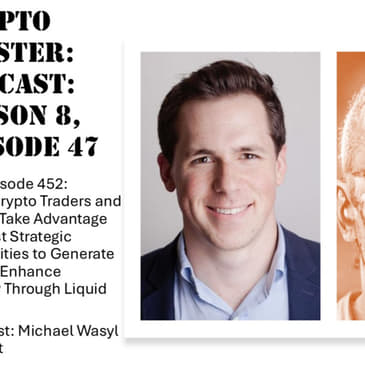

Michael Wasyl is a business development professional with 10+ years across fintech, digital assets, and entrepreneurial ventures. Michael has sourced and evaluated fintech investment opportunities for ConsenSys Capital, managed go-to-market for influential startups in the space and supported message compliance and forensic trade reconstruction analytics for some of the largest banks while at Bloomberg. Michael is also a managing partner at DeerCreek, a strategy advisory for top blockchain foundations.
Bracket is a leading DeFi platform focused on liquid-staked assets and strategy management. It is designed to simplify and improve the use of Liquid Staking Tokens (LSTs) and Liquid Restaking Tokens (LRTs). The platform provides users with tools to maximize yields while maintaining exposure to ETH. Bracket’s innovative token, brktETH, creates fungibility among various LSTs, making them more flexible and efficient as collateral.
[00:00:03] Hello, everybody, and welcome to the Crypto Hipster Podcast. This is your host, Jamil Hasan, the Crypto Hipster, where I bring you founders, entrepreneurs, executives, thought leaders, and amazing people all around the world of crypto and blockchain. And today I have another amazing guest. He is the co-founder and CEO of Bracket. His name is Mike Wasyl. Mike, welcome to the show. Happy to be here. Thanks for having me.
[00:00:31] You're very welcome. Happy you're here. And I'm looking forward to this conversation. So I start out my show with the same question for everybody. And I get wonderful answers. The first question is this, is what is your background? And is it a logical background for what you're doing now?
[00:00:50] Right. Okay. Yeah. So background is pretty interesting. I grew up in a small town in New Jersey, and on the border of Pennsylvania. And at the time, I was going to the College of New Jersey when I got out of high school. And I got really lucky. And Bloomberg, the financial data company, they ended up recruiting out of the College of New Jersey, because a lot of their early employees at the data center were from there.
[00:01:19] They recruited from there in the late 80s, early 90s. And so they still kept that legacy. Usually they're recruiting out of Ivy League schools and all that. And we got really quite lucky by just being there. A couple of friends of mine, a lot of whom rather are still in crypto and run a lot of companies that you might be familiar with. It's kind of funny.
[00:01:38] But yeah, I ended up taking an internship at Bloomberg. I'm very fortunate to have that opportunity. And from there, I landed on a team that was called Bloomberg Vault, Message Compliance Vault.
[00:01:53] And which basically what we were doing was reconstructing trades, reconstructing messages specifically for the Bloomberg Terminal. So I had God's eye view to a lot of stuff on the Bloomberg Terminal. I was like a 22-year-old being forced to do some of these searches for in-house legal and our partners and banks.
[00:02:15] And so dealing with like high, high pressure or things like that nature. But really what we were doing was kind of replaying trades. And this is where I got my first exposure to encryption, because I was responsible for just managing some basic, basic stuff like FTP file transfers, things like that. And I was like, this is interesting. And I had to read up on it, learn about it just so I knew what I was doing. And through that process and through some friends of mine really discovered Ethereum.
[00:02:43] I had known about Bitcoin for years. My brother was big into Bitcoin, but I was exploring things that were in the encryption space, just at the surface level. And just as you would, you're Googling things and you end up finding some of these assets. And I was like, wow, Ethereum as a global financial layer is in a global settlement layer is absolutely terrific.
[00:03:06] After seeing what was going on at these institutions, financial institutions, I was upset by it. You know what I mean? It was harsh. You know, London, we all these things during that time. It's like 2012, 2013, 2014, 2015. That whole period was tumultuous. And it was, I wouldn't say devastating, but it definitely pops your naivete a little bit, right?
[00:03:31] It says, okay, actually the real world, there's a lot of stuff going on in it. You see traders doing things that are good and what have you. And without going into too much detail, that just wasn't for me. And so I ended up, I ended up leaving Bloomberg and really trying to get into working on blockchain and create, especially Ethereum full-time. It took a couple of years, to be honest, took a couple of years, but late 2017, I ended up at ConsenSys where I just, realistically, I was just calling everyone I could at that firm.
[00:04:00] I was just, you know, I was, they probably could tell you I was a total pain in the butt for like a year. I wouldn't leave them alone until they're like, all right, let's bring this guy in, give him an interview. And I ended up kind of working on the small team that was like niched in the token foundry group. And they, ConsenSys Capital, I believe it was called. It was like this little enclave within the ConsenSys hub and spoke model that was responsible for bringing in new deals.
[00:04:24] And so I ended up getting hired by my now co-founder, Peli Wang, to do sourcing. So finding new projects, evaluating projects in crypto, reading all the white papers. And it's kind of funny, you call them white papers, but most of these were just total joke, right? Like this is the era of ICOs. So it was not that close. But you got to learn what was working, what wasn't with users.
[00:04:48] And that's where I got most of my, you know, FaceTime with this industry where talked to, you know, we were some of the first people inside some of these large banks talking about actually transporting rails to blockchain rails. So some of these big banks, we were inside of having these conversations. And that was really exciting because everyone would take your call, right? But that was when crypto was like super, you could open the door with it just by saying a word. And so it's kind of like what AI is now, right?
[00:05:18] And it's the hot, it was super, super hot. It was just something they wanted to figure out, learn about. So education was huge. And then, so we ended up staying there for a bit, a little over a year. And then we left, my now co-founder, Peli Wang, and I, we actually started a consulting firm called Deer Creek, which we worked with the top foundations in the space advising specifically on business development and research related issues. Just staying in our lane, of course, that's kind of where we had our most expertise.
[00:05:47] And then in 2021, we met our co-founder, Jason Blasier. And we started the early day bracket, just kind of experimenting with things on chain. And that's kind of how we got started and a little bit of my background. I got a trivia question for you. Okay, I'll do my best. What was the, what was the name of the College of New Jersey before it was a College of New Jersey? Trenton State. Yeah, yeah. Okay. I'm, I'm, I'm a Jersey guy.
[00:06:16] I mean, we, you know, originally, at least I grew up there. So yeah, it's, it was Trenton State. Teachers College, pretty much. Yeah. Yeah. And what town were you in? I was near Princeton, Montgomery. Montgomery. Okay. Yeah. If you're familiar, it's like on the, it's like probably two towns away from Pennsylvania. And then I ended up moving to Bucks County, PA and live in there for a while. But yeah, it was like central Western. I grew up in Burlington. Oh, okay. That's, that's real close. You throw a, you shake a tree and someone from New Jersey falls out.
[00:06:46] So that's. Yeah. Everywhere you go. I'm a Connecticut now, but yeah. So I want to talk about bracket though. You did say, you did say something interesting about trading and I want to come back to that later. I wasn't planning to ask you, but I need to ask you, but I'll ask you later. The first thing I want to ask you about is I want to ask you what bracket is all about, including, you know, what is state of liquid staking? Yeah. Yeah.
[00:07:11] So in the early days of bracket, this was prior, like right before FTA collapsed, derivatives on chain were like the big, the big thing everyone was pushing for. It was a, it was, it was a great thing to push for. I mean, highly like high, high speed, lots of transparency. Um, it was a, it was a cool place to build. And that's where we started building, building kind of like niche options products. And we had some support for market makers and such.
[00:07:39] And during that time, you know, when FTX finally popped, obviously no one saw that coming really. And it sucked the liquidity right out of that. So all the on chain options, derivatives really took a huge, huge hit. And that included us. And we had to retool as any startup would you say, okay, well that original idea that hit the, you know, hit the, I want to use bad words, but it was bad. And, and, um, and so we, we ended up looking at the markets again and saying, where can we
[00:08:06] fit in with our knowledge, expertise and, and acumen to make a dent in Ethereum and actually do something great. And we looked at, okay, where's the money flowing? And it's, it's liquid staking. So this goes into your second part of your question around liquid staking and the state of liquid staking. And at the time, 2022, like late 2022 ish, we were, um, at 23, we were looking at Lido and saying, you know, this asset is amazing. It's providing access to, you know, a block rewards on a consistent basis.
[00:08:35] And, um, it's something that people should consider right as a holding, because it's basically giving you ETH plus your, your block rewards. And a lot of, I think individuals, including myself, didn't really understand the mechanics of liquid staking, um, beneath everything, like how it worked. And it took me some time to really learn, talk to the large validators who run the actual nodes, understand they're, they are professionals. They run a business and there's a process to, uh, managing these kinds of like derivative
[00:09:03] tokens, these, you know, liquid state tokens that ended up, uh, representing that, that stake in accruing block rewards for you, instead of having to run your own node and direct 32 ETH and managing that it's really pain in the butt. So it was like, this is a cool product. And, um, over the last, over the next year or so, uh, we started looking at what else was coming out and liquid staking as we were building. And it was very clear that, uh, people were experimenting with how else can they use Ethereum
[00:09:29] security to kind of, in, to kind of, uh, create new ecosystems around it without having to bootstrap that economic security for yourself. Um, that's yet to be seen, right? I think we're, we're, we're watching to see if these restaking, uh, type tokens are going to really, or ecosystems, eigenlayer, et cetera, symbiotic are actually going to produce any real tangible benefit and rewards and such. It's still really early for that. And there's a lot of like capital interest.
[00:09:58] Um, but I think it's speculative still, we don't have the, like the proof positive that that's going to work at scale, considering a lot of slashing risk that comes along with providing this kind of secondhand security to eat, which could be, you know, difficult, but we think that staking in general is, is the hot tool besides stable coins on, on chain. It's really the best next thing. I mean, you have passive yield or passive, they call it block rewards, right? But, um, that's, that's where we think the market is today.
[00:10:27] People are basically saying when, what can I do more than just eat, you know, I'm using eat, but I want to be able to just sit on something that produces, uh, kind of a base rate, just like a treasury would in the traditional world. And that's what, that's what we really perked our ears up and said bracket. Should be looking at this. And we ended up considering this as like the base for our product, which we wanted to help
[00:10:48] the average kind of passive, uh, crypto investor user to get access to yield on top of this product and say, can I use my LST like, like Lido or like RE? Can we aggregate those into a single asset bracket basically to make it easy just for everybody to have one asset and then deploy that, um, into strategies run by professionals, um, to generate
[00:11:15] a rate over that and say, I'm actually getting more productivity out of my base asset, a little more risk, right. But, but more productivity out of it. And so that's where we are. That's where we're heading. And that's what we're launching. Great. So, um, right now, I guess there's more, it's more, uh, deficit, I guess deficit or difficult now for stakers to optimize yields in staking pools, I guess, cause there's a lot of competition or what would be the reason for that?
[00:11:44] So, um, a couple of things I would say the number one reason is there just aren't a lot of, um, aren't a lot of use cases quite yet for the state assets. Um, what is really popular for people to do is something called leverage looping where they will take, uh, Steeth and they'll, and they'll borrow against it, buy more or take more USDC, put it in again, loop it, loop it, loop it, basically levering, essentially levering yourself up in a lending protocol like Aave or something.
[00:12:09] So, um, there's really, if you look at the rates of, uh, supply for these ST, you know, STE through RE or whatever, it's very low. It's like, you're not getting paid very much to do that. Um, versus, you know, USDC where you can get like eight, seven, 8%. Um, and it's variable, um, of course, in these lending protocols. So there aren't a ton of use cases for the state assets besides just holding them. And it's changing. Like there are some more pools, there are some more strategies. And we're definitely in that group. I would say we're in that group of like folks trying to produce something else,
[00:12:39] on top of these things. Um, and just, you know, ETH in general. Um, but staking provides this like engine and that's where I think the market needs some help because they're just, um, it's just not, it's a sophisticated topic. The average user maybe doesn't quite understand past the staking component. Like I've discussed this with many, even sophisticated crypto people. And a lot of them don't even understand staking that well, or, you know, or, uh, liquid staking that well. And so there's definitely an educational gap that, um, there needs to be, you know,
[00:13:08] it needs to be bridged, but we're trying to make it easy enough. And that goal is it's, it's not an easy goal, but the goal is to make it so easy that you don't really, something you don't know it's there, but you don't necessarily have to care if you don't want to. Uh, that is that liquid staking tokens are the under, uh, are they kind of like asset that's creating this base, you know, two, 3%, um, in your stack essentially. Um, but yeah, there's, I would say the number one issue is just lack of use case in DeFi, lack of liquidity for those use cases, despite staking assets being in the billions.
[00:13:38] I think those holders are potentially a little bit more risk averse. So talk like actively trading your, your staked asset, um, in a more speculative way as collateral is, I think a little difficult for people who hold a lot of their kind of, they just park assets there just for the rewards. They're not really actively deploying them. And so the only step you can do above that is something passive as well, right? Say, oh, well, you deployed here, you get a little bit extra.
[00:14:05] And that's kind of where we are because there's no asking someone to do something speculative with these assets is probably, uh, going to be difficult unless there's an outsized return in form of like a token airdrop or something. That's what we're seeing. Like with the restaking world is basically folks are deploying their restaked assets, um, in order to get more token rewards, which could be outsized, um, from these, uh, projects that are, that are like attaching themselves to eigenlayer, whether they're real or not, it's, it's, it's not even important to them.
[00:14:34] They're just saying, I'm going to get their, their, you know, they're like locusts farm, you know, like farmers are going in there saying, I'm going to just scoop up any tokens that come in here, take the risk because I'll get 50, a hundred percent returns or whatever, right on that token. When I go dump it somewhere, which is not sustainable in my opinion, but, but that is the model that a lot of these guys are trying to do to bootstrap these economies. Um, in the meantime, by just attracting attention, uh, we're taking a slightly different approach and our approach is more sustainable, long-term growth of, uh, of these assets with kind
[00:15:04] of highly curated opportunities. So I think we're ultimately going up the ladder as far as who's going to be interested in what we're doing. It's not the super D gen probably in the next, you know, six months, it's going to be, um, somebody who's a little bit more mature, who has some money and wants to park it in something more professional. Um, that's where I think our trajectory is going. And I think it's just in response to the two worlds in crypto, highly speculative token
[00:15:29] based, mean based that's hard to beat in a bull market and then kind of more passive, more, um, uh, less risk on the far right hand side, you know, with just stake assets. And then we're kind of falling slightly beyond, you know, between the two as far as, you know, extra yield on top of those. That makes sense. So now I'm at a fork here in the, in the conversation, because I can go, I can ask two questions at the same time. I'm going to start with the, with the world conservative question.
[00:15:58] You know, um, so say there's enough interest and say there's enough liquidity, you know, and you know, it's working properly and well, what can, what is possible, you know, with this, with the state assets other than just holding them and getting restricting rewards, what do you see as the potential products or services down the line that are possible? Yeah. Yeah.
[00:16:25] And you gotta be careful with stacking and rehypotification risks as well. Like one of the things that I think was called out from some of these other guys is, you know, taking a staked asset and restaking it, um, using it for another, uh, piece of security, you do end up getting like double slashing exposure, which is just a risk for the holder, right? You're just, if you get slashed, it's, it's, it's a double risk. And there's some other issues as well.
[00:16:51] Um, but I think the general consensus here is that staked assets provide a base rate, which it, which is productive in and of itself. It would be like, if you're, um, if you were allowed to use a treasury bond as collateral for another investment, um, you'd be like, that's pretty good idea, right? I could do this because I can get an additional, you know, a couple of percent on top of my, you know, 4%, you know, money market. That's fantastic.
[00:17:19] Um, now there's probably more risk in crypto to be, to be truthful, you know, truthful and honest is more risk in crypto, even with each staking and there would be in treasury funds, but it is similar in concept. And so the world we see is powered by the world we see in the next year is basically powered by the block rewards of state staking networks, whether that's Solana or Ethereum or, or whatever, those assets produce something that is native to blockchain can, cannot be replicated in TradFi.
[00:17:48] So you can't, like when you say, well, how do you compete with asset management of, you know, in TradFi, they're going to show up, right. They're going to show up eventually and they're going to, they're going to figure out a way to get access to on-chain, um, you know, on-chain assets like Ethan Bitcoin. And, you know, that's true, but they, they need to figure out a way to integrate with the, with the block rewards on chain. There's no way to do that off or there's no way to do that in their world. So they have to kind of interact, they're forced to play with us if they want access to the capital base or they want to share in that capital base.
[00:18:18] One of those exciting opportunities, I think that I'm really looking forward to in our industry and hopefully through us at one day is the, um, exposure to uncorrelated assets on chain. So you have ETH, you have your block rewards, and then maybe you can get access to a reward or a yield from an, our real, they call it real world assets, but really just like TradFi related, uh, yield that that's super exciting because you can get what some call uncorrelated.
[00:18:46] You know, you can argue one way or the other stock market these days, how things are correlated, but let's say there is uncorrelated, um, you know, it's quite a corporate or something like that. You can get access to, um, you know, with using your, your ETH based assets or even Solana based assets one day as collateral that are already producing a native reward. That's exciting. Right. And that, some of those ideas were started by like friends of mine that are the company centrifuge, like those early days where they're trying to bridge in external products into crypto for loans.
[00:19:13] They're specifically loans, but I think there are more complex products now that are making their way on and even more tokenized stuff. That's what's exciting to me because once tokenization, uh, is, is allowed essentially by the government in Western markets specifically, you're going to see a ballooning of these assets, you know, and I don't think they're going to necessarily be native first. They'll be like mirrored, like, um, mirrored assets, uh, to digital twins, kind of like what treasuries are today. They're not natively issued on chain. They're just twinned and held somewhere in custody.
[00:19:40] Um, but even starting with those where you can trade them, um, on chain, that's super exciting. Have that, having that kind of exposure bridges both the best of both worlds. You have a productive network producing a native rate from the activity on that network, which cannot be replicated outside. Plus you have the best of the trad five world attached to it. And I think those two elements could come together really nicely. And that's why we created bracket eat because today it's aggregating the LSTs that we think are like the best in the industry, right?
[00:20:10] When people want to put it, wanted to put into our protocol, but tomorrow, um, that world's going to be more complicated. There's going to be more assets. And I don't know about you, but most people don't have the time to kind of sit through all those and figure it out. And they kind of just want a broad exposure to it, which that could provide, but it also provides a single, a single asset, a source of liquidity for, um, that's back to a hundred percent one-to-one by collateral, um, for the exposure to, or kind of with the exposure to the trad five stuff.
[00:20:38] So you can use that asset, um, as you're, as that base rate accumulating, you know, aggregate, and then go off and, and use that to get exposure to some other, um, area you want, or just stack on top of it with, with, with someone else's, uh, you know, like a strategy manager's efforts to make, to make something. So that world is really great. And the second thing I would say that attaches to that as a, maybe a third thing that I mentioned, um, or didn't mention yet is that, um, I think automation is going to be a huge role.
[00:21:06] I play a huge role in our space very soon. Active management, which is, you know, someone actually pushing buttons and setting things up is fine. And probably the default for most products on chain, especially in, um, strategy management and vaults, but I do, uh, besides the simple ones that are automated. Um, but I do think like more complex automation is coming as far as trading bots, as far as agents, um, people are building these tools to basically be faster than you, right.
[00:21:34] As an active manager, you'll never be able to beat it. And so our platform is in, is built in a way where we're completely agnostic to who's, who's doing that, right. It's just that we, we, we, we, we look at it from a, um, tenant perspective, like, okay, who's, who's going to be a tenant in the marketplace. And that's brackets walls, basically the marketplace infrastructure and every, and everything else is a plugin. So that modular kind of thing. And that's where I think, um, things are very competitive and it will, we'll just have to see what, what comes out.
[00:22:04] But I think that's the next step that I'm looking forward to for using these collaterals as, um, on chain is like, how can we get efficient? Cause markets are in crypto are not efficient. Really. They're just extremely, it doesn't, it's difficult. It's really difficult. There's not enough liquidity yet. So we're dealing with those problems, but exciting. I was, I was, uh, a Celsius customer back in 2021.
[00:22:29] So I would take my crypto, then get loans and then use those loans to get more crypto. It works. It worked until you get a margin call. Yeah. And that's, and that's a, that's exactly right. Like crypto is one of these kind of unfettered places for it's rediscovering all the problems of the late nineties and in derivatives and, uh, lending and before Dodd-Frank and all this stuff and before transparency and clearing and centralized clearing.
[00:22:55] It's like, we're discovering crypto is discovering these issues. Now, crypto is kind of like more of a, like a pure capitalist world where it'll just eat you alive. There is no bailout. You know what I mean? And that's it. And people learn their lessons or don't, right? We've seen that too. Uh, and, uh, so that's a good thing and a bad thing because people will get racked and come back or get wrecked and never come back. Not learning from these issues and, uh, or learning from these issues and trying to do something else.
[00:23:23] So I agree that, you know, we're going to enter a period of time probably where we will see more regulatory action that trickles its way into the DeFi world and tries to apply some rules. But, um, in a, in a system that exists by definition outside of the traditional financial rails, none of those safeguards have ever been placed systemically. And they really can't because you're talking about a network that they don't control, which
[00:23:51] is great for freedom around the world and people getting access to these tools, which they should have access to. Um, but also bad because bad actors who have malicious intent. And unfortunately there are those people out there that have malicious intent to it or because mistakes happen. Um, this is a zero sum game. It's people don't realize how difficult it is to develop in this space and make no mistakes because you can't on contracts, you can't make one mistake or, you know, some malicious actor that's looking at you as a honeypot will try to drain you, you know?
[00:24:20] And so it's very, very PVP. It's very, it's very difficult. And so, um, I think that actually does hold, uh, some of the money in capital and the, from the traditional world back from going on chain public on public chains. Just, it seems like a, like a minefield and they don't, they don't love that either. So that's a valid point. Yeah. So let me go, let me, let me, let me shift to the other side of the fork. Yeah. And something, go back to something you said earlier that I want to talk about.
[00:24:49] You said, um, sure bad activity with trading overnight. I woke up at like three o'clock in the morning and looked at X and there were a bunch of, a bunch, like my whole feed was filled with this traders who claim they built bots on deep seek that were making a lot of money. And you don't like one ETH or one salon into a thousand salon is, and you don't have to do anything.
[00:25:16] Then they put their, their steps through as you have to code this, you have to do this. Oh, and I turned last night, the Trump coin just came out and I made 2700 X on that. I was like, the Trump coin came out 10 days prior to deep seek, you know? Um, and that deep seek caused the market to, to, to, to tank, but how do you prevent this malicious activity and these lies by these, you know, traders, but they're not really, they're like
[00:25:45] when they're hooking people into, you know, to try to, you know, use, how do you, how do you prevent that? Yeah. I think the only thing you can do is okay. People, when you add a complexity to a system, um, let's, let's call this, um, let's, let's think about it like, uh, a base and then building a stack on top of it. Right. So you have the network, you have Ethereum, which you have to have some trust that the
[00:26:11] nodes are, I mean, the system is built in a way that trust is, is, is minimizing trust. Let's say that, um, such that, uh, you, you hope that that 51% of the network doesn't try to attack and take, and that has, you know, happened in some networks before. Right. But there's that trust assumption and there's, it's minimal, but there is a trust assumption. Then you go up another layer and you have, uh, let's, let's call them protocols. Right.
[00:26:37] In this, in this case, uh, DeFi protocols that are doing lending, borrowing decks, whatever, uh, they may or may not be incentivized to behave maliciously. Most of the better ones are obviously audited and funded. And there's big names behind it, which associates trust and, and longevity, which builds more trust. So there you have another trust layer on top of Ethereum's network or other networks, you know, pick your, pick your poison. And then on top of that, you have more complex tools.
[00:27:06] Like I would say probably us, you know, for instance, which says we're, we're, we're actually, uh, just a basic marketplace. But the folks who use our marketplace and our infrastructure are trading on these other protocols, right? Like, you know, DEX is, or they're staking LP. So there's not, there's basically, okay, I'm, I'm trusting that this particular strategy management, either it's a contract or it's a, or it's an active manager, right? In the case of an active manager is before is behaving on my behalf.
[00:27:35] Well, um, now a DeFi, you could kind of do things that you can't do in TradFi, which is, which makes something safer. For instance, not all gloom and doom. Like for instance, in our protocol, which we find to be really innovative and cool is that we have a whole system in which funds, you know, shouldn't leak because it's basically going from multi-sig to multi-sig, you know, these like giant multi-sigs to a policy managed wallet that ends up in the, um, in the control, uh, for trading, uh, in the strat of the strategy manager.
[00:28:04] But the policies are managed, uh, mostly by a quorum between the two parties bracket. And so like, there's no one party that has full custodianship. There is no one party that has full policy management control. And, and because of that, uh, you, you have at least more safeguards for that, for that type of capital control. And so that's something that's built on top of it. But as far as like traders behaving maliciously in the, in the space and lying and manipulating,
[00:28:33] um, because of the pseudonymity of our space, uh, there, there's no, like, you know, you can't really prevent that. Uh, if you don't know who that wallet address belongs to, you can create a new wallet address easily. You know, it's not that hard to create a thousand wallet addresses and obfuscate the funds in many ways. Um, that particular set of risks is almost unavoidable. And so the public manipulation is where you have the, a lot of your problems.
[00:28:57] It's basically them going out and saying some, some things that aren't true, paying people to say things that aren't true networks of people who are paid and their business is to say things sometimes that aren't true, that confuses markets and makes them move. And they move faster than other markets because crypto is 24 seven. So it's, you, you can't even, a human being can't react. And I think, I think you see where I'm going with this is that in the next year or two years trading. Yes.
[00:29:23] There will always be individual trades, smart kind of a long trades, which we don't require computers for, for AI to figure out. But if we're talking, uh, extracting inefficiency, um, when markets do get more efficient in crypto, they will, you're going to move to the, look what happened to regular markets. You got algos and that's exactly what's going to happen to crypto. We're going to have smart bots that basically are doing everything, plugging into APIs and
[00:29:47] trading and doing LP management on Uniswap because human beings just can't react fast enough and behave well enough. And I think that's where your efficiency will come in. But the new scams, the, all the promises made by, you know, traders or folks who are kind of trying to move the market a certain way on a meme coin or something. You're never, ever going to get away, get away from that. Um, in my opinion, in this space, it's, it's impossible. Like there's just too many people that can stay anonymous.
[00:30:13] And, and what we're trying to do is just alleviate some of those concerns by having some safeguards in place so that, um, if we want to accomplish what we want, if people want to accomplish what we're offering, they can be assured that at least there's, there's some safeguards that are definitely more than what other folks are doing. Um, and that's the best you can, you can offer in a space. That's kind of still in its infancy as far as allowing, um, you know, these kinds of products to flourish and experiment with.
[00:30:39] And that's what ultimately we're excited about is in the next couple of years, I think true asset management on chain will start to happen. And everyone's kind of thinking about that because tokenization is going to happen. Larry Fink is like, it's going to happen, right? We're going to tokenize these assets and we want to move them on chain. And so there you go. The next stage is doing asset management of some kind and there needs technology and builders who know the on chain. And that's where, you know, we, we want to provide value. Awesome. You know, I, I think that it's important.
[00:31:08] Um, sounds to me like when you say it's important for, you know, companies, for institutions, for, you know, especially like wealth managers such to have an effective DeFi strategy where they're not chasing yield, but they're actually managing it properly. Um, so what are some of the key strategies? What, what, what recommendations you have for DeFi strategy and what do you think implementation
[00:31:36] will look like from that institutional perspective that is conservative and smart and not chasing? Yeah. Yeah. I mean, I can't give any financial advice or, you know, I'm not a, I'm not a, a, a, a mutual fund person necessarily or an asset manager, but I will say this on, I've been in DeFi a long time. And I could say that since really the beginning, and I could, I could say that there are plenty of opportunities for, um, for actors, you know, good actors, bad actors, whatever to
[00:32:05] produce a yield based on any efficiencies that are still around. Like we talked about, so we're talking arbitrage. We're talking deep leggings of certain stable coins, repegging, you know, the market is the market will be efficient if there are opportunities for yield. Right. So if, if, if, if, if, if still PVP, um, if you can make money by putting a stable coin back to peg, it will be done, right? It will be done unless there's a systemic problem that is fundamentally unmooring the
[00:32:32] asset from its face, you know, like what happened with the terror crisis, um, with, you know, save that, uh, smart actors and that and managers and, uh, traders will repeg assets. There's that there's, there's always, um, Delta neutral trades, uh, basis trading, things of that nature. You see Athena doing a similar concept with the stable coin. Um, they issue their own stable coin and then they allow you to stake it basically to get a basis trade yield. Um, and they're doing that, you know, I, I don't want to say anything kind of negative
[00:33:02] about it, but it's off chain. And so you don't know a hundred percent what's happening and there's other, there's definitely there's risks. They're doing things off chain, which is another, another layer of risk, but, um, on chain, there's plenty, there's still plenty of opportunity up to a certain threshold. DeFi is not the biggest market, right? So a lot of banks will trade the, the total market cap of DeFi in a day, right? Like it's, it's not, it's not, um, it's a spot. It's a tiny spot, but that will grow.
[00:33:31] We'll look back at this moment and laugh. And we have this conversation would come back in 10 years, 20 years and be like, wow. Like that was a teeny, teeny, tiny little, little thing back then. And we were excited by it, but look at it, look what it is today with real assets coming in. And so, uh, native, I think, uh, native asset management is becoming a big trend from the asset managers. I speak with like the big guys who are doing things for real and trad fi then are experimenting with, with DeFi and saying, I don't have the infrastructure to like expand my base.
[00:34:00] They're like, I could take capital. Like I, like any hedge fund could, but I don't have the infrastructure to like host a platform, which is everyone's dream, right? Because there's basically a passive income potential there from a flat fees associated with just being on a platform, uh, no performance fees, but you know, flat fees, just fixed fees. And that's, that's attractive because then you can start tacking on higher margin product to that platform in order to, you know, maximize the profitability. But in the beginning, it's like, how do you grow this thing?
[00:34:29] And that's where a lot of the larger, um, the funds don't, they don't have a lot of time to build this stuff, test it. And the expertise needed to build these products is not as, um, it's not as available as you would think, you know, it's again, zero sum game. So it's difficult to actually develop these things. And so I think that's, that's like what I would say for the passive kind of larger funds,
[00:34:54] existing tradify guys that want to expand their defy exposure to beyond hedge fund clients. Um, you're talking about a whole world of people on chain who are not used to that world. They don't either don't have exposure to it. They're not high. They're not super high net worth or, um, they, they simply don't, didn't grow up in that world, right? They grew up in the, in the, in the crypto world. They got wealth in the crypto world and they don't really want to leave, right? They don't want to leave on chain. It's fun. It's, it's, it's, how could you go back after coming to this space?
[00:35:23] How could you go back? It's, it's full of craziness, but it's like the most exciting thing you've ever done. Right. And so it's like the, it's just an amazing space. So good and bad. Um, but it's amazing. And I think those people just don't want to like move, move off or, you know, have these like traditional conversations with, with, with these folks. And so how do you create a platform like bracket that has plans for specific onboarding, all the stuff you would need, uh, KYC, eventually all that stuff we're planning to have because we want to be in the real world. Right.
[00:35:52] But how do you make it attractive to on chain people who have, who are looking for these like more long-term passive plays who are not as a, you not looking to you as like, Oh, you're going to make my money speculating on memes on your platform. Like it's not pump, pump fun. Right. And it's, it's, it's, uh, a little more mature. I think it's cool, but it's a little more mature. And, um, I think that's missing in our space a lot. There's a, there's a handful of, of, uh, different flavors of competitors out there that are, that are doing similar things.
[00:36:20] Um, but I think we're definitely in that, and we're definitely going to be a player in that, in that space of, of helping these folks make longer term, maybe a little bit lower yields than you would see in like memes and stuff, but kind of that passive stack, which is super attractive because you just said it and forget it in many cases. And the strategy aims to have, you know, a hundred percent, uh, each exposure at all, you know, at all times, at least it's trying to, um, it has, you know, uh, you know, there's
[00:36:47] a history to look back on eventually, like in six months you can say, okay, this performed at like, so, and then you have on-chain records, right? You could see where the money moves. You could see where your funds are anytime that level of transparency is good for crypto people. Is it good for TradFi people? Maybe, right? Maybe not. Right. So, so, uh, that's one other thing to cross on the threshold, but for crypto people, they love that. They want to see that. Awesome. Yeah. I like it. I like it a lot. So, um, very cool.
[00:37:16] So I want to thank you very much, uh, for taking the time to speak to me today. I have one last question. It's really easy. Um, how can people find out more information about you and about become a user-signal platform? Sure. So, um, bracket.fi is our website and it has all of our links to docs and such. And I, I encourage everyone to educate themselves on, on everything. So, you know, go ahead and read our docs and learn more about bracket, our, our kind of,
[00:37:42] uh, a direction bracket ETH and the initial opportunities we're offering for eligible users. And that's a best way to start. And then of course, bracket underscore five, I believe it's our Twitter, but all the links are on bracket.fi, our website. Thank you very much for your time today. Thank you so much.