
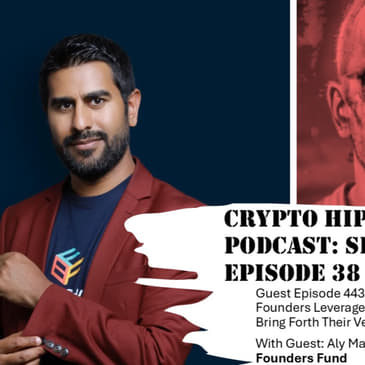

Aly Madhavji is the Managing Partner at Blockchain Founders Fund which invests in and venture builds top-tier startups. He is a Limited Partner at Loyal VC and Draper Goren Holm. Aly consults organizations on emerging technologies such as INSEAD and the UN on solutions to help alleviate poverty. He served as Senior Blockchain Fellow at INSEAD and was recognized as a “Blockchain 100” Global Leader.
He is an internationally acclaimed author, publishing three books, and a columnist for leading Web3 publications. Aly served as a board member of Soluna Holdings (NASDAQ: SLNH) and on various advisory boards including the University of Toronto’s Governing Council, which manages a $2.5B budget. He is a mentor with Orbit Startups, an elite accelerator program operated by the venture fund SOSV with $1.5B+ AUM and the Mobile Only Accelerator (MOX).
Aly holds a Master of Global Affairs as a Schwarzman Scholar from Tsinghua University (清华大学), a Master of Business Administration from INSEAD (Singapore and France), and a Bachelor of Commerce with Distinction from the University of Toronto.
- Facebook: https://www.facebook.com/BlockchainFoundersFund/
- LinkedIn: https://www.linkedin.com/company/blockchainfoundersfund/?originalSubdomain=sg
- Instagram: https://www.instagram.com/alymadhavji/?hl=en
- Youtube: https://www.youtube.com/channel/UCVCRgXA7LaTDxsQ_b3J85bA
- Twitter: https://x.com/blockchainff?lang=en
- Website: https://blockchainff.com/
[00:00:03] Hello, everybody, and welcome to the Crypto Hipster Podcast. This is your host, Jamil Hasan, the Crypto Hipster, where I interview founders, entrepreneurs, executives, thought leaders, amazing people all around the world of crypto and blockchain. And I have another amazing guest to kick off 2025. And I'm looking forward to this fresh new year, and I have an amazing guest today.
[00:00:27] So my guest's name is Aly Madhavji. He is the managing partner at the Blockchain Founders Fund. Aly, welcome to the show.
[00:00:36] Thanks so much, Jamil, for having me, and Happy New Year, everyone.
[00:00:40] Awesome. Happy New Year. And yeah, let's start. Let's start. You know, I actually have the same question for everybody, but I get amazing answers.
[00:00:49] You know, so the first question is this. What is your background? And is it a logical background for what you're doing now?
[00:00:58] Yeah, great, great question. So I'm Canadian by background, born and raised. And, you know, my parents moved to Canada, to Vancouver, as refugees from East Africa.
[00:01:14] So Kenya and Uganda, so Kenya and Uganda, and, you know, came with very little, as you can imagine, as a refugee, you know, escaping, you know, Idi Amin, if some of you might be familiar, war and terror and, you know.
[00:01:32] So, and so growing up in Vancouver, I started a lot of different small businesses as a kid.
[00:01:40] So just different ways to make money, everything from, you know, different sorts of entertainment.
[00:01:48] A lot of people might remember like torrenting and that whole phase.
[00:01:53] And so I was very big on, you know, all of those different aspects from Napster to LimeWire to, you know, all sorts of other torrent sites.
[00:02:02] And doing that to computer networking and, you know, programming, made a game in the middle and all sorts of different things that I was sort of experimenting with and trying along the way.
[00:02:14] And, and then ended up, I guess, fast forward a little bit, ended up joining the Canadian Air Force very young.
[00:02:26] So at the age of 17, did my undergrad at the University of Toronto.
[00:02:35] And, you know, ended up actually very early getting an internship to PricewaterhouseCoopers.
[00:02:43] So PwC ended up, I ended up working very many other jobs at the same time.
[00:02:50] At one point I was working eight different jobs simultaneously.
[00:02:54] So, you know, always into, you know, what can you do to push the barriers on sort of human mind, human psyche.
[00:03:02] And post-graduating at the University of Toronto, stayed at PwC, got my accounting and finance designations there, moved from Toronto to New York, and then from New York to working all across North and South America.
[00:03:17] Lived in Brazil for a while and moved into corporate turnaround, turnaround one of the largest construction companies in Brazil.
[00:03:26] And, you know, simultaneous that, you know, ended up going down the rabbit hole on Bitcoin, more from an ideological perspective.
[00:03:40] And, you know, and then also used to write a lot in my free time, published three books in the education space, two of the main, some of them on Amazon.
[00:03:49] And then used to serve on the board of directors of the University of Toronto, a multibillion dollar institution.
[00:03:55] Then did a short stint at PayPal, did an MBA, did an MBA in SEAD in Singapore and France, one of the leading business schools.
[00:04:04] And then started a startup, raised through as a capital, got our team to 40 people.
[00:04:09] So that was in the Web3 space.
[00:04:10] That was a crypto exchange.
[00:04:12] And then once we exited that, we started Blockchain Founders Fund in 2017.
[00:04:17] And here we are, I guess, eight years later, with now over 180 companies under our belt.
[00:04:25] So, wow, that's awesome.
[00:04:31] That's a lot.
[00:04:31] That's great.
[00:04:33] You started in 2017.
[00:04:35] The same time I started, I was an ICO advisor.
[00:04:39] My company didn't last too long in that SEAD space, right?
[00:04:46] What, first of all, I want to find out what the Blockchain Founders Fund is all about, including your mandate and your mission.
[00:04:53] And then also find out, you know, how you've been able to manage to stay in that early stage space in such a volatile industry.
[00:05:06] Yeah, it's a good question.
[00:05:08] I mean, it's never easy.
[00:05:10] But, you know, when I entered into this space, you know, we had just exited the exchange.
[00:05:16] And, you know, one of the big things that I saw myself, you know, with was sort of the skill set to help scale startups.
[00:05:26] And that was what was, you know, that's what I was passionate about.
[00:05:29] That's what I enjoyed.
[00:05:31] Minsur, the other partner, had also previously sold a marketing branding agency.
[00:05:36] And so pairing sort of those two sort of vast skill sets, we were able to basically roll up our SEADs and support founders.
[00:05:44] And so a lot of our philosophy was always let's, you know, not only support founders with capital, but let's support them by rolling up our SEADs and helping them solve the biggest problems.
[00:05:54] And so early on, the idea was, OK, well, instead of scaling one startup, let's scale two.
[00:05:59] And two became four and four became eight.
[00:06:02] And, you know, I think there's a lot of time and that we invest.
[00:06:07] But it's also about how do we bring some of the best and brightest people around us from our network to help support these companies.
[00:06:14] We do run what we call the BFF Global Expert Network, which supports our portfolio founders.
[00:06:19] And then, you know, we continue to, you know, just help our founders solve some of the biggest problems.
[00:06:27] And, you know, that's worked pretty effectively.
[00:06:29] We've had a number of major hits across the portfolio over the years and continue to.
[00:06:35] And so, you know, we've been pretty excited about that.
[00:06:38] And we love being early.
[00:06:44] Awesome.
[00:06:44] So the love of being early, there are opportunities, right?
[00:06:50] So what are the biggest opportunities for blockchain founders today?
[00:06:55] And why is it not just crowdfunding?
[00:06:59] Yeah, that's a good question.
[00:07:01] I mean, a lot has changed over the years, right?
[00:07:03] So if we go to, you know, before when we had the ICO boom, I mean, there was a lot of merit to it.
[00:07:10] But a lot of that funding was coming directly from the public.
[00:07:14] So you didn't typically have a lot of private sales back then.
[00:07:18] You might have had some small ones, but you pretty quickly went to public funding.
[00:07:22] And most of the funding came that way.
[00:07:24] And it's continued to evolve to less and less public funding to no public funding over the years.
[00:07:32] And partially that's because of the worries around regulation.
[00:07:39] Having said that, you're seeing maybe a little bit of a comeback on it, but not entirely yet.
[00:07:45] But I think that, you know, there is a very big benefit to consumer products with a strong alignment of consumers involved in it, you know, in multiple facets.
[00:08:01] But, you know, it's continued to evolve.
[00:08:03] I think there's also a lot more projects these days, which I think just creates a lot more noise for everybody to filter through, right?
[00:08:13] Like we filter through, as an example, you know, 300 to 500 projects above.
[00:08:20] And that creates a lot of volume for us to go through.
[00:08:24] But I think, you know, anyone that's, you know, doing these days, it's just you've got to really, really filter through to find the one, two companies that you think are going to, you know, really take off or have the skill sets, not only from an idea perspective, but to actually execute on them sometimes.
[00:08:43] Interesting.
[00:08:43] So I think one of the big things right now is AI agents, right?
[00:08:52] How do you stay up top, like, you know, that's been developing for a while, but how do you stay on top of what the new subsectors within the crypto industry are?
[00:09:03] Like, how do you do that?
[00:09:06] It's a good question.
[00:09:07] I mean, I can go deeper onto, you know, some of the cool things that we're investing on as well.
[00:09:12] So I think from the perspective of, you know, AI agents, I think there's a lot of potential.
[00:09:20] Like we're, you know, you know, we see a future in which, you know, people have companions or, you know, someone that's sort of something that's learning from them, be able to act, you know, alongside them, right?
[00:09:34] I think we're still probably a little bit early.
[00:09:37] I think some of the tech is already there, but I think we're probably still going to take some time to, I think, fully get there in terms of some of the ways that, you know, we're all talking about it.
[00:09:45] But, you know, some of the other things that, you know, we're really interested in, for example, we invested in a company called Rilla, which is basically decentralizing live sports streaming.
[00:10:01] And so if you think about, for example, live sports, right?
[00:10:06] Like say we're all watching the Super Bowl.
[00:10:10] The day that we're all watching the Super Bowl, all of us are streaming it.
[00:10:14] So, you know, in a city like Austin, Texas or New York, you know, every single building, 50% of the people are probably trying to live stream the same thing.
[00:10:24] And what would make a lot more sense for all of us not trying to stream that directly from the internet service provider and almost do it in a way that was similar to torrenting, right?
[00:10:34] Or, you know, basically working off of, you know, local, basically like uploads, downloads, right?
[00:10:41] In a similar way, but in real time, right?
[00:10:44] And I think that can actually help save a ton of internet costs, but also help to feed content in a way that allows us to with lower costs, but also even greater access.
[00:10:57] So I think that's really, really cool.
[00:10:59] We also just invested in a company called Koi, which we're very, very excited about.
[00:11:05] What Koi is really doing is building the world's largest supercomputer.
[00:11:09] And if we think about, or at least when we think about what is the greatest problem of our time or what sort of is the biggest barrier to human advancement, right?
[00:11:22] Going forward.
[00:11:24] To us, it's essentially the advancement on AI is going to be the biggest correlated factor to the advancement of humanity.
[00:11:35] And so if you can then work on, well, what are the biggest barriers to AI advancing?
[00:11:41] And then when we look at that, we were basically like, okay, well, there's a number of factors that basically become barriers to the advancement of AI.
[00:11:50] But you could think about anything from, you know, GPU, you know, capacity, right?
[00:11:56] And the ability to train models more effectively.
[00:12:00] And you could say, well, what if we could aggregate that across every single person's computer in the world, that would be dramatically bigger than the world's biggest supercomputer, right?
[00:12:10] So in the same way that, you know, if you have a washing machine or dryer, you probably use it twice a week.
[00:12:19] And the rest of the time it's, you know, not used.
[00:12:24] You've probably got a 99% inefficiency ratio, right?
[00:12:28] Or unutilized ratio.
[00:12:29] In the same way, the GPU on your computer might not be used 95% of the time or 90% of the time.
[00:12:36] Then you could say the same thing about your CPU.
[00:12:39] You could say the same thing about like any sort of compute.
[00:12:41] You could say the same thing about file storage.
[00:12:44] Like there's all of these resources that are hyper underutilized that we all own.
[00:12:50] And what if we could start to aggregate those resources more and more effectively and use those to run all sorts of functionality.
[00:12:57] Whether that's, you know, your own types of, you know, cloud and localized cloud for others to tap into, to all sorts of other functionality.
[00:13:06] So, you know, we think this is actually a very important innovation that's happening and that needs to happen to help move things forward.
[00:13:17] There's all sorts of other really cool things.
[00:13:19] You know, we've got investments across entertainment, RWA, so real world assets across, you know, all sorts of different parts of AI, DeFi, et cetera.
[00:13:34] Interesting. So initially came from, or one of the places you live in the world was, you know, was Africa.
[00:13:42] Right. And with the advancement of AI, and I look at where my podcast is, the countries where my podcast isn't listened to.
[00:13:50] It's a lot, it's the countries where they don't have access to electricity, you know, still.
[00:13:56] Right. So how do you overcome, in order to advance AI, you would have to be able to offer or help advance electricity or access electricity.
[00:14:06] So how do you, how do you help do that in this world?
[00:14:10] That's still not, you know, there isn't a lot of, I know you're going to Davos next week.
[00:14:14] It's going to be a topic there. Right.
[00:14:16] How do you, how do you enable the access to the things people don't have yet that should be, that other people take for granted?
[00:14:23] Yeah, this is a really, really good question.
[00:14:26] And I have, you know, some of my own opinions that are actually quite, quite strong on this.
[00:14:32] But, you know, I think one of the, so we actually worked with the United Nations quite closely and put together one of the flagship reports on how blockchain and crypto could help achieve the UN sustainable development goals and help alleviate poverty.
[00:14:47] And, you know, one of the big things that really pulls back society is the ability to access credit.
[00:14:55] Right.
[00:14:56] And we're not talking about large amounts of credit.
[00:14:58] If you're in the Western world, you know, you might be able to borrow half a million dollars or a million dollars to buy a home or two million dollars, you know, depending on different levels of collateral, et cetera.
[00:15:07] Right. But if you're in, you know, parts of, you know, the developing world, you know, you might not be able to access $200 to start a little store.
[00:15:20] And even if you have a good ability to pay it back, you know, if you've never missed, say, like a phone payment or all sorts of other things that there's already history on.
[00:15:28] Right. So we're not talking about there being zero history.
[00:15:31] And this is actually quite frustrating and sad.
[00:15:38] And so, for example, we've got companies like Credit in our portfolio.
[00:15:42] So K-R-E-D-E-T-E, that's really changing the world on this.
[00:15:47] And they've got already hundreds and hundreds of thousands of customers that they've issued and helped issue loans to.
[00:15:53] And these are microloans.
[00:15:55] Very high payback rates.
[00:15:58] And they're actually working with banks and microfinance banks to help turn their portfolios more effectively into being able to issue microfinance loans effectively.
[00:16:08] And this has actually been working really, really well.
[00:16:11] And they've got, you know, stable coin rails sort of in the background that helps you to move money cross border, helps move money home to different countries, et cetera.
[00:16:20] And this is actually working very, very well.
[00:16:24] So one of the things that I think crypto does better than anything out there is crypto really allows for the ability for anyone to have a bank account.
[00:16:40] Right.
[00:16:41] If you think about a wallet and anyone to have borrowing, lending and savings products, which are the core sort of banking products.
[00:16:46] Right.
[00:16:49] And one of the big challenges, and I'm not saying there's no reason for this, but one of the big challenges historically, I think it's been anti-money laundering rules.
[00:16:59] And AML rules are there for a reason.
[00:17:01] Of course, you don't want the, you know, terrorist financing and you don't want the drug financing and all of that.
[00:17:06] But you can't also be okay with cutting out a billion people out of a system and say that, yeah, this is probably all in the same bucket.
[00:17:16] Like it's really not.
[00:17:18] And, you know, this is a big problem I think that exists where a lot of the Western world has sort of decided that, you know, these categories of people all fall into that.
[00:17:32] So one of the important things to know from a banking perspective is Western banks don't typically work with the banks in some of these developing countries because of these anti-money laundering rules.
[00:17:49] So if the bank, say like JP Morgan Chase is working with a bank in Zambia, right?
[00:17:57] If that, if JP Morgan Chase sends money to this bank in Zambia for a customer, JP Morgan Chase needs to know what that customer then does with it or what happens with that money at that bank to the next customer.
[00:18:09] And if they can't trust the information from that bank in Zambia, they would rather cut that bank off entirely.
[00:18:15] So now they no longer work with that bank in Zambia.
[00:18:17] This is actually the big problem.
[00:18:19] And this is what actually cuts off banking access from a lot of the world and then cuts off credit and all sorts of other things.
[00:18:26] And, you know, I'm a big proponent of how decentralization actually just leapfrogs the entire banking system on this and can actually create a completely alternative system.
[00:18:38] That doesn't violate these anti-money laundering rules from the perspective of the intent, right?
[00:18:44] Which is stopping drug financing and terrorist financing.
[00:18:47] You can actually get, you know, and just start go help people start businesses and start building their lives and getting credit and, you know, feeding their families and having their kids go have a good education.
[00:18:58] And these are the things that really matter, I think, at the end of the day.
[00:19:01] And I really think that this technology has the potential to leapfrog that and it's already starting.
[00:19:09] Interesting.
[00:19:10] Very interesting.
[00:19:12] You said you did a stent at PayPal, right?
[00:19:16] Yeah, short stent.
[00:19:18] Okay.
[00:19:18] So they offer this opportunity now to get a business loan, right?
[00:19:24] So I think I'm okay.
[00:19:26] I think I have enough crypto collateral to be able to pay back a loan, right?
[00:19:31] Like, mathematically, I do.
[00:19:34] But when I say I don't have an income or a salary and ask them for a loan, they're like, we're not going to give you that.
[00:19:39] We're not going to extend that to you because you don't have any money.
[00:19:42] Like, I have all this liquidity that I can, all this liquidity, I need liquidity.
[00:19:47] I have all this collateral I can use.
[00:19:48] So what is it going to take for these traditional institutions, these banks, to see that crypto is collateral that can be used to pay back loans so that founders can have liquidity that they can put into their business and build the startups?
[00:20:07] It's a good question.
[00:20:09] And I actually don't know if it matters.
[00:20:12] And maybe here's why.
[00:20:14] I think these banks are, you know, behind, right?
[00:20:19] And you've already got platforms like Aave and others that are going to continue to get better, that are going to continue to have better UI, UXs, that are going to become easier for people.
[00:20:31] And people ideally will take that collateral and put it into decentralized protocols.
[00:20:40] And it'll probably be safer than centralized, you know, exchanges or venues, right?
[00:20:46] And we've seen a lot of issues on that, right?
[00:20:48] Sales is blocked by FTX, et cetera.
[00:20:52] And I'll hopefully put it into decentralized protocols, be able to get stable coins, USDT, USDC, et cetera.
[00:20:59] And you'll be able to easily take that USDT, USDC and be able to go get cash from your bank account.
[00:21:05] And I think that's gotten a lot better over the last, you know, decade where, you know, before every time you try to interact with some of this stuff with the traditional banking system, your accounts have got shut down.
[00:21:16] Now, I think we're mostly past that.
[00:21:21] And you'll be able to just, if you needed cash in the real world and you needed, you know, US dollars or British pounds or whatever currency you need, you'll be able to go convert that pretty easily.
[00:21:32] And then you'll need to convert back, obviously, and maintain your collateral, you know, if prices go down or whatever.
[00:21:40] But I think we're already, in a lot of ways, getting past that.
[00:21:44] I wouldn't say the experience is perfect yet.
[00:21:46] We're far from it.
[00:21:47] But I don't think we're actually going to need the banks to even issue, you know, loans based on that collateral.
[00:21:54] Because I don't even think I'd want to give my Bitcoin or give my digital assets to a bank, right?
[00:22:00] I think you're much more riskier with a centralized venue in that way, as we've been burdened many times in this industry.
[00:22:09] That's true.
[00:22:10] That's true.
[00:22:11] So I want to shift gears.
[00:22:14] I want to change topics a little bit.
[00:22:16] I want to talk about your venture program.
[00:22:19] You know, you help founders.
[00:22:21] You help early stage founders who want to leverage blockchain to bring their vision.
[00:22:26] So how does your program work and how do you help those founders?
[00:22:31] It's a good question.
[00:22:32] So we don't think of ourselves like an accelerator or anything like that, right?
[00:22:39] I think the big thing for us is like we're a venture fund and we're looking for the best and brightest founders to go invest in.
[00:22:47] And we'll never want to work with a company that we won't invest in, right?
[00:22:52] So oftentimes we're like, hey, can you sort of help advise us and help sort of move this forward?
[00:22:57] And, you know, we're happy to, you know, if we meet at an event, we're happy to give you some quick advice or things like that.
[00:23:02] But we're not going to go spend our time scaling companies on advisory.
[00:23:07] Like we focus on investing.
[00:23:10] And if we're willing to put our money where our mouth is, then, you know, we're then willing to support those companies, right?
[00:23:18] And if those companies are, you know, a bit further ahead, they, you know, have a clear path to growth and, you know, they've got some sort of product market fit.
[00:23:28] They've got, you know, you know, like that sort of aspect.
[00:23:31] Then that venture program is probably less relevant realistically, right?
[00:23:35] And we'll support those companies regardless.
[00:23:38] We'll help move them forward.
[00:23:40] If they're earlier on and they're still sort of figuring out those aspects around product market fit and product development and go to market.
[00:23:48] And those are areas where we've got a lot of expertise in.
[00:23:52] Where that might also even include like launching a token to support the ecosystem, et cetera.
[00:23:58] You know, then we're happy to roll up our sleeves and support those founders.
[00:24:01] And, you know, some of the big things that we do across the team is one, really get down into the strategy and help work through the strategy.
[00:24:11] But two, it's really a bias for action, right?
[00:24:14] And so making sure we can support these companies to actually go to market, go get real feedback, continue to iterate, make sure there's proper feedback loops in those products.
[00:24:24] And, you know, as much as possible that, you know, support these founders to get the capital they need, not only from us, but from other great funds in the space.
[00:24:34] And so we'll support our founders around those aspects as well.
[00:24:40] And then aspects around like, you know, making sure we continue to scale and grow.
[00:24:45] So that's kind of how we get involved with our companies.
[00:24:50] And it's been very, very successful.
[00:24:55] And I love it, right?
[00:24:56] At the end of the day, like, where do I want to spend my time?
[00:24:59] It's building things that we think are going to change the world and working with founders that we think are some of the smartest in the world.
[00:25:06] Awesome.
[00:25:06] So what should we look out for in Web3 as far as investment opportunities, as far as trends?
[00:25:15] As far as opportunities in 2025, this new year?
[00:25:21] It's a good question.
[00:25:22] I mean, I think right now we're at actually at a fairly interesting point.
[00:25:26] And this is more our internal take on this.
[00:25:29] I don't know if we've actually talked about this a lot anywhere.
[00:25:33] But we think we're at this sort of interesting point, right?
[00:25:35] So you've got Bitcoin that's done really well, probably gone on a track from, you know, basically 15, 16K all the way up to, you know, 100.
[00:25:45] Right now.
[00:25:47] But only really, I would say even until November of 2024, you had a position where Bitcoin was doing really well and your vast majority of altcoins weren't.
[00:26:00] Right?
[00:26:00] Some were.
[00:26:01] But if you take anything from mid cap down, probably weren't doing as well.
[00:26:05] You had projects like Avalanche, Cosmos, many others that were probably even trading under where they were when Bitcoin was at 20, 25K.
[00:26:12] So, you know, you had this interesting sort of, you know, I guess dichotomy of what was happening in the market.
[00:26:23] And now we've had this macro shift with US elections.
[00:26:27] Whether you're sort of pro-Trump or not, I don't know if that really matters because we're looking at this from a business perspective, right?
[00:26:34] So, you know, you've now seen Bitcoin break into new highs.
[00:26:37] But I think you're starting to see an entire pro-business movement happening.
[00:26:43] And I think you're starting to see that really shift into, you know, very interesting opportunities where from an investment perspective, what we're seeing is there's a lot of really good companies that struggled to raise over the last, you know, six months.
[00:26:57] And that's because venture capital had become, you know, fairly slow, right?
[00:27:02] It slowed down a lot.
[00:27:03] But you had a lot of these really good companies that hadn't raised.
[00:27:06] And then you had this macro shift in November, so about two months ago.
[00:27:11] And now, right now, what we're seeing is actually some really interesting investment opportunities that have almost like a lower valuation, but really interesting traction still.
[00:27:22] And those opportunities are still going to be around, I think, for a couple of months where you'll still see some interesting things that have really strong traction that aren't overpriced.
[00:27:30] One worry is, of course, you know, deals are going to continue to get overpriced as the cycle continues to hype and people get really, really excited.
[00:27:38] And the further along you go into that cycle, the more and more dangerous it can be, obviously, from an investment perspective.
[00:27:44] So you're investing higher and higher on that cycle and potentially higher and higher towards that peak.
[00:27:51] But I think the real important thing is then look for fundamentals, right?
[00:27:55] So look for incredible products, look for things that you would use, that you understand, that you can see that people love, right?
[00:28:02] It should be a product that you're like, hey, this is better than anything else I've seen, right?
[00:28:06] And I use this and I would continue to use this and, you know, maybe look up a couple of competitors and try it out.
[00:28:12] And so that's been actually very, very impactful.
[00:28:17] I do continue to see AI being a strong narrative in this trend.
[00:28:22] I think Deepin has got a crazy amount of potential.
[00:28:25] Deepin being the basically making efficient these underutilized assets that we talked about earlier in the call.
[00:28:33] And that can be all sorts of different assets, whether that's, you know, phones and computers to all sorts of other things.
[00:28:42] You know, I think there's companies like High Velo, for example, that are going to help consumers to aggregate all the best deepins.
[00:28:49] So you don't even need to then go learn about all the best deepins.
[00:28:52] High Velo will do it for you.
[00:28:53] You install one thing on your computer and it'll basically, you know, capture from all of the best different deepin protocols as an example for you, right?
[00:29:03] So there's already really cool things like that coming out, which I think is going to help to simplify that user experience.
[00:29:09] I think there will probably be a comeback on DeFi.
[00:29:13] I think, you know, people have been burned a lot from these centralized platforms.
[00:29:18] I think DeFi still has a massive, massive potential, like we talked about, to change the world and, you know, is, I think, inevitable to continue to move forward and continue to thrive.
[00:29:30] And so I think we'll have a sort of a resurgence around that.
[00:29:34] Yeah. And then I think there's still a lot of interesting opportunities around tooling and just things in the back end, like very interesting sort of B2B products and tooling that, you know, are helping to move the industry forward so that things just don't need to continue to be rebuilt and rebuilt and rebuilt by every company.
[00:29:53] And they can just be streamlined, right? And that's what you saw in Web 2.0 that made things really effective, right?
[00:29:59] Like AWS came in or cloud service providers came in and did the cloud.
[00:30:03] And Zapier came in and helped with everything from connecting different platforms and APIs, API calls and different things like this.
[00:30:09] And so you need some of this tooling in the Web 3.0 space.
[00:30:16] And I think it's starting to come out, starting to make it more effective.
[00:30:20] And we'll continue to see that side do quite well.
[00:30:25] I look forward to it. I look forward to 2025.
[00:30:27] I'm excited to see what everything happens and it's going to be fresh and new.
[00:30:33] So it'd be great. So I want to, I want to thank you very much for speaking with me today.
[00:30:40] I enjoyed, I enjoyed our conversation immensely.
[00:30:43] I have one last question.
[00:30:44] Really it's, yeah, it's how can people find out more information about you,
[00:30:49] about the blockchain founders fund, what you're up to, keep up to date,
[00:30:53] or how can they be one of your portfolio companies or any of that?
[00:30:57] How can they do that?
[00:30:58] Absolutely. So, I mean, you can always reach out to me on LinkedIn, Ali Madhavji or Twitter, Ali underscore Madhavji.
[00:31:09] And you can also check us out on our website, blockchainff.com.
[00:31:13] You can see about our portfolio there.
[00:31:15] You can see us on Crunchbase or many other, you know, sites that'll go through, you know, what we've invested in.
[00:31:20] And we do publish content every single week, typically as well on innovative things that we're seeing in the Web3 space.
[00:31:30] And on our website, you can share information less than what you're working on.
[00:31:34] If you are working on a cool startup, we do look at all of them.
[00:31:37] Of course, it can also be helpful to directly connect with one of us at an event or, you know, one of our experts, one of our LPs.
[00:31:45] You know, all of those different angles can be helpful.
[00:31:47] If you meet founders in our portfolio and you ask them to connect us, that's also a good angle.
[00:31:53] But yeah, always looking for the best and brightest startups and want to learn more about, you know, what you could be working on.
[00:32:00] Awesome. Awesome. Thank you very much for your time today.
[00:32:03] Perfect. Thank you. And happy new year again to everyone.