
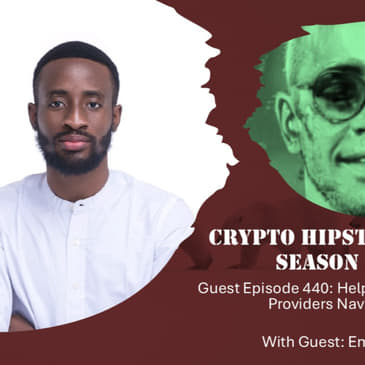

Emeka Mgbenu (Eh-meh-kah Mig-beh-nu), Senior Product Manager at Sumsub
As a Senior Product Manager at Sumsub, Emeka is responsible for delivering sustainable, innovation-driven products tailored for crypto, web3, and blockchain companies. He has over 5 years of experience in finance in crypto, building products for a variety of use cases, such as banking, savings, lending, payments, crypto, and compliance. Emeka holds a bachelor’s degree in economics from Covenant University. He currently lives in London, UK.
Sumsub Travel Rule Course: https://sumsub.com/courses/sumsub-learning-center-travel-rule-compliance-course/
Full list of Sumsub courses available: https://sumsub.com/courses/
Sumsub 2024 Fraud Report: https://sumsub.com/fraud-report-2024/?utm_source=newswire&utm_medium=media&utm_campaign=fraud-report_2024
Check out Crypto Hipster's Top 100 podcast ranking for 2024: https://blog.feedspot.com/cryptocurrency_podcasts/
[00:00:00] Hello, everybody, and welcome to the Crypto Hipster Podcast. This is your host, Jamil Hasan, the Crypto Hipster, where I interview founders, entrepreneurs, executives, thought leaders, amazing people all over the world of crypto and blockchain. And today, I have another amazing guest. He is the Senior Product Manager at Sumsub. His name is Emeka Mgbenu. Emeka, welcome to the show today.
[00:00:31] Thank you. I'm happy to be here. I've watched a few episodes before this, so it's always a very enlightening conversation that you have with your guests.
[00:00:39] I'm looking forward to speaking with you today. This is going to be wonderful. Let's kick things off. I'm going to ask you first, what is your background and is it a logical background for what you're doing now?
[00:00:51] Definitely, I would say. So my background is solely in product management, but more specifically in the fintech space.
[00:00:59] I've been doing this for five to six years now. And, you know, that experience has spanned across banking, lending, savings, crypto, and finally compliance.
[00:01:09] So it is definitely the problems I was solving before in terms of, you know, building these solutions and fighting fraud.
[00:01:16] You know, it's all, you know, full circle moments to, you know, what I do now at Sumsub where, you know, we're at the forefront of, you know, fighting fraud, keeping companies safe, you know, just ensuring that they stay compliant.
[00:01:29] They get compliant and remain compliant, you know, as things change in this very fast paced society or industry that we find ourselves in.
[00:01:41] Awesome. Awesome. So I want to find out, you know, what Sumsub is all about, including your vision and mission as a company, and then what yours is in your role.
[00:01:51] Yeah. So Sumsub on its own, just again, just a brief overview. We are a full cycle verification platform. And the goal is to, you know, secure the whole user journey with KYC, which is know your customer, KYB, transaction monitoring, fraud prevention, and travel rule.
[00:02:09] We, one of the core things that we do is, you know, we use AI to fight AI fraud. So things like, you know, deep fakes and, you know, fake documents, we have systems in place that are able to, you know, detect this, flag this, and, you know, for the companies that we work with, stop these, you know, fake people from getting into the door.
[00:02:28] So we've been around for eight plus years now, and, you know, we have over 2,500 clients across, you know, a number of fields, you know, predominantly fintech crypto, but then also across like transportation, e-commerce, and most interestingly, gaming industries.
[00:02:45] So that is who we are in terms of, you know, what we do. We've transitioned. So we first launched as a KYC provider, and we've just evolved with the market, I would say.
[00:02:57] And now we do, you know, full cycle verification and do things like transaction monitoring as well. I think one thing that stands out in a way is the products that we build make it very user-centric, or make it very easy for customers to, you know, onboard users in the shortest amount of time.
[00:03:15] And not just onboard users, but also, you know, onboard risky users in some cases, and not really like exclude anyone from the process.
[00:03:23] So that is kind of a backstory of who we are in terms of, you know, as a product and whatnot.
[00:03:31] In terms of our vision, I think this is really important because we're focused not just on providing the technology to do a lot of these fancy things, but also, you know, we want to move the needle significantly in terms of even things like regulation.
[00:03:46] So for context, in the last year, we have had a report that's been used to create regulation in Mexico and Singapore.
[00:03:54] So that is, I think, on our end, a very big vision for us is to go beyond building these fantastic solutions and push the needle.
[00:04:04] We still want to build the solutions, but it is very, and we still do this and do excellently well at this, but it is very dynamic, I would say.
[00:04:14] So while we're building these solutions, we are making it as easy to use as possible.
[00:04:20] And then we're also making it as customizable as possible because, again, we cover, you know, multiple regions.
[00:04:26] We process different documents.
[00:04:29] We handle different scenarios.
[00:04:31] And the goal is, you know, you have this one solution that does everything for you as a business.
[00:04:37] You know, so obviously your overhead costs are lower.
[00:04:39] The process is similar.
[00:04:41] It's a lot easier to do, you know, and so on and so forth.
[00:04:44] So that is the goal.
[00:04:46] And, yeah, that's how we, that's why we wake up every day and we're ginger to come to work.
[00:04:53] Awesome.
[00:04:54] So you said something.
[00:04:55] You said use AI to combat AI fraud.
[00:05:01] You know, a lot of people are scared about AI fraud and think there's no way to combat it.
[00:05:07] So how do you do that?
[00:05:09] How do you use AI to combat AI?
[00:05:11] I mean, so for starters, if we think about like what AI is based on, AI is based on, you know, data models.
[00:05:18] And so lots of training have gone into place.
[00:05:21] And there are all these, you know, documentations and all this knowledge repository stored.
[00:05:25] Now, if we take something like, you know, deepfake, detecting deepfake injections, for example, that have been created with AI.
[00:05:33] There's a couple of data points that you can take from a video, you know, in terms of like, is there a mask?
[00:05:39] You know, are the backgrounds consistent?
[00:05:41] And these have been, again, these are patterns that we've seen over and over again.
[00:05:45] The same thing for a document, you know, are the edges blurred?
[00:05:48] You know, has there been some form of graphic editing software used in the metadata?
[00:05:53] Don't want to get too technical.
[00:05:55] But those are scenarios or those are like a few other points that we look out for.
[00:05:58] And then there are other things as well.
[00:05:59] The fact that we've been doing this for so long means we also have our own repository of, you know, fraudulent attempts, you know, fake documents, you know, fake people, impersonations, you know, so on and so forth.
[00:06:12] So all this data combined is solid weapon.
[00:06:16] And then you just have to build, you know, infrastructure on top of that, you know, that sees these patterns and, you know, checks them and solves it.
[00:06:25] That is one way we can spend the next 20 when he's talking about because fraud is broad.
[00:06:29] But I'll keep it at that for now.
[00:06:32] Okay.
[00:06:33] Sounds good.
[00:06:33] Because, yeah, I might bring you back to talk about AI specifically for a half hour or so, but I want to get into something else right now and get into the travel rule.
[00:06:43] You know, what is the travel rule all about?
[00:06:47] And why is it challenging for users and virtual asset service providers to keep up with all the intricacies?
[00:06:54] Because it seems like there are a lot of details flying around out there.
[00:06:58] Yeah.
[00:06:59] Yeah.
[00:06:59] So to answer this, I would go back to some, like, historical context.
[00:07:03] So the travel rule was birthed out of something called Recommendation 16 by the FATF, which is the Financial Action Tax Force.
[00:07:11] This is a, you know, global anti-money laundering watchdog that typically gives these directions and recommendations, you know, and then regional jurisdictions and regional regulators kind of take from that big body of work and craft their own local laws.
[00:07:27] In essence, what it is, is it is a way to, for companies to confirm and screen counterparty data.
[00:07:38] Now, unlike traditional institutions where you always know who you're sending to, crypto is pretty much anonymous.
[00:07:45] You know, what it addresses is a string of numbers, you know, and there's no way to know who it belongs to.
[00:07:50] Now, travel rule specifically affects, again, licensed exchanges.
[00:07:54] So if you have a license in a jurisdiction, you know, the regulators want to be sure that, first of all, you know who you're sending funds to on behalf of your customers and you know who your customers are receiving funds from.
[00:08:05] You know, and you're screening these people to ensure that they are not risky.
[00:08:08] You're also screening the funds to ensure that they are not from, you know, dark net marketplaces or all these sort of, you know, risky stolen assets.
[00:08:17] And if you are finding things and flagging them, you are making the necessary reports to the regulators.
[00:08:24] So that is the goal.
[00:08:25] It's information exchange, but it's also checking this information thoroughly, like identifying who is paying information, you know, checking source of funds, you know, and so on and so forth.
[00:08:38] In terms of the second part of your question, like why is it difficult?
[00:08:44] It's a couple reasons.
[00:08:45] First of all, this is a pretty recent regulation if you think about it.
[00:08:50] I mean, while the FETF regulation was made like in 2016, it has taken time for different regions to implement this across port.
[00:08:59] So the UK implemented theirs in 2023.
[00:09:02] MICA is coming into effect for the EU in 2025.
[00:09:06] And there have been different jurisdictions and different kind of like paces.
[00:09:09] So what that does is it creates a scenario where, and we call it the sunrise issue, where, you know, VASPs are on the same page in terms of communication, in terms of how they interact with certain things.
[00:09:22] And if we think about it, we have 94 jurisdictions and we have 65, you know, VASPs or 65 jurisdictions who have passed travel rule legislation.
[00:09:35] Now, passing the legislation is different from when the legislation kicks into effect.
[00:09:40] So you can pass legislation and you have a, you know, one year, two year grandfathering period before VASPs comply, for example.
[00:09:47] And when I say VASPs, I mean this is a legal term for virtual asset service providers.
[00:09:52] This can be your exchanges, your unrapped off ramps, your payment providers.
[00:09:57] Basically, anybody who is licensed and touches crypto is technically VASP or marketplaces and so on and so forth.
[00:10:02] So that is one challenge where we see, which is this sunrise issue again, because it creates a lot of operational overhead.
[00:10:10] And a lot of times when you drill down to the original, you know, legislations, there can be gaps in terms of how to deal with certain scenarios.
[00:10:22] There can be different approaches.
[00:10:24] So a regulator in the UK might have a different set of requirements and a regulator in, you know, UAE has a different set of requirements.
[00:10:32] So there is confusion or for how VASPs would, how much data they can send, for example, from one jurisdiction to another, you know, or what checks they have to do and how extensive it is.
[00:10:45] Now, where there is uncertainty, it definitely causes a scenario where, you know, VASPs are scared to lose business, you know, and it's very uncomfortable at the top.
[00:10:54] So that is one of the challenges.
[00:10:56] Another challenge is, and this is super important, is a lack of interoperability.
[00:11:02] So for context, and we all think crypto, when these rules were created, you know, a lot of people went off and did their own things.
[00:11:12] So a lot of, you know, people built their own protocols.
[00:11:15] So now we have four, five, six, seven different cover-up protocols who are all built differently, who are all built with different infrastructure.
[00:11:26] And who can't talk to each other.
[00:11:28] So what that means is, you know, if you're a VASP and you use protocol A, it's highly unlikely you can talk to a VASP who use protocol B.
[00:11:36] Because they are on a different network, they can't communicate to each other.
[00:11:41] And again, just to piggyback on some sort of as well, because this is a problem that, you know, we're tackling head-on in terms of making travel roads interoperable.
[00:11:52] I think our goal is to build the SWIFT system of the crypto network, where regardless of the protocol that you're connected to, you can communicate with other protocols.
[00:12:05] So a VASP in the UK can communicate with VASP in Japan on different protocols entirely.
[00:12:12] We've done this by, you know, doing integrations with GTR, Code, Cigna.
[00:12:17] These are all protocols, by the way.
[00:12:19] And we will keep on adding more as time goes on.
[00:12:23] So I didn't want just to talk about the problems without talking about a bit of the solution.
[00:12:29] So hopefully this helps.
[00:12:32] I have a practical question now.
[00:12:36] Say you said, and I want to get into the interoperability, but from a traveler, you know, say you want to leave the U.S.
[00:12:45] and come to, you know, a European country, say Netherlands or Switzerland or whatever.
[00:12:51] And I'm flying across the ocean and I have a crypto wallet on my iPhone and that has $10,000 worth of crypto in it, you know, and I don't declare it.
[00:13:05] Or what do I need to do as a traveler on the plane?
[00:13:10] Do I have to declare the crypto I have in my wallet?
[00:13:12] Do I have to disclose that?
[00:13:14] Or can I still be anonymous?
[00:13:15] And if I'm not, I have all this to disclose.
[00:13:18] Can I get into trouble?
[00:13:19] Because I didn't.
[00:13:20] Yeah, so definitely.
[00:13:22] So it definitely depends on the type of wallets.
[00:13:25] In this case, you know, I would limit it to hosted wallets.
[00:13:29] So what that means is, you know, let's assume you have a wallet on an exchange like, let's say, Binance or Coinbase.
[00:13:35] If you're leaving jurisdictions, if you're traveling, there is no need to declare these assets.
[00:13:42] You know, what happens is your assets are domiciled with a legal entity in a particular region.
[00:13:48] So even if you travel from the UK to Netherlands, your funds are domiciled with the, you know, Binance or Coinbase UK entity, for example.
[00:13:57] So it doesn't necessarily, when we say travel in the context of travel rule, we mean the information about the transaction traveling across.
[00:14:06] And not necessarily the owner of the wallet address or the owner of the cryptocurrency traveling.
[00:14:11] So you would not have to declare your crypto.
[00:14:14] However, certain, you know, cryptocurrency companies might put in rail guards in place to prevent you from accessing their services in other regions.
[00:14:25] You know, so maybe you use a VPN, you get blocked, or you can't open the apps in the UK or in the US, depending.
[00:14:32] But whenever you come back to your home country, your funds do not travel with you.
[00:14:37] Your funds are domiciled with the legal entity where you registered them.
[00:14:41] So it's a different conversation entirely if you are now sending those funds from a UK legal entity, VASP, to, let's say, an entity in Netherlands, for example.
[00:14:51] Let's say you relocated permanently, not like your own vacation or anything.
[00:14:59] Got it.
[00:14:59] But like a trust wallet.
[00:15:02] Yes.
[00:15:02] With unhosted wallets, which is like trust wallets, MetaMask, you typically don't have to do anything.
[00:15:08] Those are very jurisdiction independent, I would say.
[00:15:13] Okay.
[00:15:14] Got it.
[00:15:15] So interoperability is one knowledge gap, right?
[00:15:18] And you're working to that and to make a solution for that.
[00:15:21] But I'm sure there are other knowledge gaps.
[00:15:24] You know, what are they?
[00:15:26] And then I want to get into your course after we talk about what those knowledge gaps are.
[00:15:34] Yeah.
[00:15:34] So aside, aside interoperability, I think the main knowledge gap is really just around the, like what this is and why it's important.
[00:15:44] I think for context on the surface, the name is very somewhat deceitful.
[00:15:49] You know, I've had people walk up to me at conferences, you know, asking about, you know, does this, is this a travel, when we say travel rule, crypto travel rule, they're asking, is this a crypto experience company that can allow me book flights?
[00:16:04] You know, so first of all, the name is quite misleading.
[00:16:09] Because again, it's a pretty new regulation that isn't quite mainstream.
[00:16:14] So the first knowledge gap is actually breaking down and understanding what the concept is, educating people on what the concept is, why it's important.
[00:16:24] What are the implications for not, you know, what are the implications for not, you know, doing X, Y, Z, for not meeting these requirements?
[00:16:30] So that's the first step.
[00:16:32] New concept, we have to educate, educate, educate.
[00:16:35] So it becomes, you know, very mainstream at the back of our minds.
[00:16:39] And now a second challenge would definitely be the interoperability issue, which is what we've raised in the past about, you know, we've talked about it quite a bit, about there being so many different protocols that don't talk to themselves and VASPs are kind of left holding the bag in terms of, you know, what do they do next?
[00:17:00] And then the third thing I would definitely say would be in a lot of regulations, there is something that is called like a risk-based approach, which is basically when your regulators tell you, you know, here you have a blank check.
[00:17:15] Try to do everything possible to ensure that you are safe.
[00:17:18] We're not going to tell you exactly what to do, but based on these scenarios, do everything within your best interest to, you know, prevent fraud, so to speak.
[00:17:28] Now, a risk-based approach is very broad.
[00:17:33] And sometimes VASPs need help in terms of, first of all, defining what a threshold is or what countries they are willing to work with in terms of, you know, where the VASPs are domiciled, you know, or which type of users should they allow to send transactions above certain amounts.
[00:17:53] So it is this extreme customized risk approach that sometimes gets muddied up and is very confusing.
[00:18:04] In the real, in typical compliance, it's always a red, go, red, stop, green, go.
[00:18:12] You know, if there's XYZ signals, stop.
[00:18:15] If there's ABC signals, you know, go.
[00:18:17] But with travel rule, it is very complex.
[00:18:19] There's so many things you have to consider, you know, the risks of the VASPs themselves.
[00:18:24] You know, is a VASP risky?
[00:18:25] Have they been in the news for, you know, fraud or antimony or, you know, data-provided concerns?
[00:18:31] You know, is the user itself risky?
[00:18:34] You know, did they register from a country that you're not quite sure of?
[00:18:38] You know, is the amount in question suspicious?
[00:18:42] You know, based on the user's historical transaction, is this an anomaly?
[00:18:48] Is this normal?
[00:18:49] So there's lots of different scenarios that, you know, VASPs have to do to ensure that they are safe.
[00:18:56] And again, this is where, this is a problem.
[00:18:59] And this is also somewhere where some sub is also focused on in terms of solving this for VASPs by giving them the tools to,
[00:19:06] first of all, define what these very complex parameters are and then automate the process over time.
[00:19:13] Yeah.
[00:19:14] We will stick with three for now.
[00:19:15] I think that should be sufficient.
[00:19:17] Oh, it is.
[00:19:19] It is.
[00:19:20] I want to get into your course.
[00:19:23] I haven't seen until now a travel rule course.
[00:19:28] And it looks pretty thorough.
[00:19:29] And a lot of people over the years told me they've made a class and this is great.
[00:19:32] I'm like, I'm looking at your course.
[00:19:34] I'm like, to me, it looks like a must take.
[00:19:37] You know, why must people, like I think it is, why must people take your course and why it's important for them
[00:19:44] and their careers going forward in this crypto industry?
[00:19:48] Yeah.
[00:19:48] So the first thing about why the course is so important is, I think for us as Sumsab,
[00:19:55] and when I introduced Sumsab, I talked about the fact that, you know, we're always trying to go, you know,
[00:20:00] just beyond providing tech solutions.
[00:20:02] We're trying to make a dent in the space, you know, educationally, legally, and so on and so forth.
[00:20:07] So this is one of our many attempts to, you know, increase the knowledge gap, to reduce the knowledge gap, I mean,
[00:20:13] to expand the horizon, to contribute.
[00:20:16] But it's a free course, by the way.
[00:20:17] So this is, you know, fantastic addition to a space where there aren't a lot of resources
[00:20:24] or there's still a lot of ambiguity around the course, so around the concept.
[00:20:28] So that's the first step.
[00:20:29] That's why people should take the course.
[00:20:31] It's for everyone from a beginner who has never heard about this, like a newbie compliance officer,
[00:20:37] to your MLRs and your CEOs.
[00:20:40] It breaks it down significantly well.
[00:20:43] It gives a lot of context, you know, historical context as to why this is important, how it was important, and so on and so forth.
[00:20:51] So that's the first bit.
[00:20:52] The second part of why the course is super important is that we don't just,
[00:20:59] travel is complex in the way that it has been implemented in different ways in different jurisdictions.
[00:21:05] So the UAE has implemented differently, you know, Japan differently, UK differently.
[00:21:11] The course summarizes and gives a bright eye view of all these different jurisdictions.
[00:21:18] Again, some of the knowledge in the course has come from our own experience as some sort working with crypto clients for years.
[00:21:26] So we work with crypto clients who are, you know, global, you know, who have clients in all these different countries,
[00:21:32] who have subentities, you know.
[00:21:34] So we have a lot of context and we've put that context into the course in terms of this is how, you know, travel world works in XYZ regions.
[00:21:42] So it is not a pigeonholed course.
[00:21:46] It is a course that gives you a global reach and educates better.
[00:21:51] The third thing that this is super duper important is we provide guidance and practical insights from, you know, lawyers,
[00:22:02] you know, tech people like myself and even players who are already implementing travel role.
[00:22:09] So in the course, we have people from exchanges who have talked, who talk about, you know, how they implemented it,
[00:22:15] the challenges that they faced.
[00:22:17] We have lawyers give a legal opinion and we have, you know, I'm on the course as well.
[00:22:21] So I'm talking about the technical side, you know, how to handle scenarios and so on and so forth.
[00:22:25] It is, it is firsthand experience.
[00:22:28] It is not theoretical.
[00:22:30] That is also very important as well.
[00:22:33] And I think the last thing is just based on the last thing and why the course is so important.
[00:22:39] And I should take it is there's also a strategic element in the course as well.
[00:22:43] You know, so while we're showing you the practicals and while we're talking about what to do, what happens,
[00:22:48] there's a strategy, you know, in terms of, you know, as a VASP, while travel rule is important,
[00:22:54] you know, you have to go one step further.
[00:22:56] You have to be looking at the full picture.
[00:22:58] You know, you have to understand your user journey end to end in order to prevent fraud.
[00:23:04] So we give, again, a couple of strategies around how you can do travel rule,
[00:23:09] but also how as a VASP, you can, you know, fight fraud.
[00:23:14] You can be like, you can be fraud proof in a way and you can keep on modifying and changing
[00:23:21] and adapting as things change.
[00:23:25] Yeah.
[00:23:27] That sounds great.
[00:23:28] So I'm thinking, I was going to ask you, kind of figure out how to ask you this,
[00:23:33] because I want to ask you about best practices, but I don't want to, I don't want you to give
[00:23:38] me the cliff notes because I want people to take your class, including me.
[00:23:43] I'm going to, because it seems really important to do.
[00:23:46] So from a VASP perspective, you know, what, how can, what's some of the best ways that they can deal,
[00:23:55] like they can look at their user journey and then look at their legislative or regulator side
[00:24:01] to come up with the best approach for their business?
[00:24:07] So one, one strategy I would say will be obviously having a, you know, a comprehensive, you know,
[00:24:15] bird's eye view of what you want to achieve as a VASP.
[00:24:18] Depending on the type of VASP that you are, this will be different.
[00:24:22] So you have to, as a VASP, you have to define your user personas.
[00:24:25] You have to understand your types of users.
[00:24:27] You know, so the first step will definitely be look at your data as a VASP and understand your users,
[00:24:32] understand where they're coming from, understand their behavior, you know, and so on and so forth.
[00:24:37] Data is gold.
[00:24:38] You know, and this is one, one key way where VASPs can, that's, that's, that's the starting point,
[00:24:46] you know, in terms of having as much data as possible about your customers and then using that to decide the type of customers that you have.
[00:24:54] So that's, that's on the one hand.
[00:24:56] At SumSup, we, we do this because we have a KYC, you know, service.
[00:25:02] So when a customer is typically onboarding with us, depending on the customer settings,
[00:25:07] you know, we have an idea of who he is, you know, his ID card details, how old he is,
[00:25:12] sometimes how much he earns, you know, where did he log in first from, you know,
[00:25:17] all these data points, we'll call them like biometric data points, you know, on one hand, that's super important.
[00:25:22] You know, and then next, as the customer grows, you know, there begins to be patterns.
[00:25:27] Now, 95% of fraud happens after the onboarding stage.
[00:25:32] So it's one thing to onboard a customer, but you cannot, you know, just let the customer go.
[00:25:39] So we, we, we have something called, and this is, this is a plug for another product,
[00:25:42] but it's something called like a dynamic risk scoring where, you know, as a customer, you know,
[00:25:49] grows, transacts on your platform, you know, logs in, logs out, you know, makes transfers,
[00:25:55] sends crypto across, he has a dynamic risk score.
[00:25:57] So if they are setting things that the customer does, then that score is changed.
[00:26:03] And what we're saying to, to our client is, you know, this customer might not, you know,
[00:26:11] check him out, ask him for more information.
[00:26:13] And there'll also be times when, you know, there is fraud committed and you have to block those users.
[00:26:18] So that is one example of, you know, how just understanding, first of all, getting that data,
[00:26:24] storing it, using it wisely, and then using it like dynamically.
[00:26:27] Can help us stay ahead and be, you know, super, super compliant in this space.
[00:26:34] I think that's important because whenever I look at the compliance section,
[00:26:39] the crypto news location, always issues with, with compliance.
[00:26:43] So that's good, you know, and so with compliance, right.
[00:26:48] What's the best, what do you think would be the best compliance efforts holistically
[00:26:54] across the crypto industry?
[00:26:58] I think across the crypto industry, specifically, you know, regulators have done, have done a lot.
[00:27:04] You know, this year has seen a lot of, you know, crypto adopt, mainstream crypto adoption.
[00:27:09] We've seen a lot of rules come into place.
[00:27:11] You know, we've seen a lot of institutional adoption.
[00:27:13] And that has brought, you know, kind of like a regulatory eye.
[00:27:17] You know, crypto is no longer the wild, wild west as it was in a couple of years ago.
[00:27:21] So on one hand, you know, that, that, that, that is great.
[00:27:24] And that is a solid foundation.
[00:27:25] If, if we talk specifically of like travel rule and, and so on and so forth, you know, some things that would help would definitely be,
[00:27:34] you know, I want to say like consistency of data.
[00:27:36] And this can be consistency of data from a VASP attribution standpoint.
[00:27:42] For context, what the VASP attribution is, is the ability to identify a VASP behind the wallet address.
[00:27:50] So if you have an account with Binance, you have a wallet address.
[00:27:52] And there are ways to identify that this wallet address is owned by, let's say, Binance on your behalf.
[00:27:59] Currently, that process is done with blockchain analytics providers, but it is not always a hundred percent.
[00:28:05] And if we think about travel rule, the first step to even communicating with a counterparty VASP is you have to know who you're communicating to.
[00:28:14] Again, in crypto, there are no central repositories, just like we have in banking, where you put an address in and you get a name back.
[00:28:21] We don't have that in crypto yet.
[00:28:23] That would be a good step in terms of making it a lot simpler for compliance officers.
[00:28:29] You know, somebody has to go build that.
[00:28:31] We're doing our bits here, but that would be super important as well.
[00:28:36] The next thing would definitely be education.
[00:28:40] And the education here will more be with regulators and policymakers.
[00:28:45] Because the people who are making the laws need to understand the technology behind it.
[00:28:49] Need to understand the limitations and need to know and keep up with the trends.
[00:28:55] Some of this is happening in some jurisdictions with, like, sandboxes, you know, and so on and so forth.
[00:29:01] But it needs to be deeper.
[00:29:03] There needs to be more.
[00:29:04] It needs to be a conscious effort by both sides to handshake and share information and collaborate.
[00:29:10] So that is the second thing I would say that's super important.
[00:29:14] The third thing would be interoperability.
[00:29:16] And we've talked about this as well.
[00:29:18] You know, just making sure that everyone can communicate with each other, regardless of where they are.
[00:29:25] Regardless of the jurisdiction that they're registered in.
[00:29:28] Regardless of the type of VASP that they are.
[00:29:31] You know, there needs to be that, you know, interoperability issue being solved.
[00:29:38] And when we look at these, again, these are a few suggestions.
[00:29:44] There's also, like, counterparty due diligence.
[00:29:47] When we say due diligence, what we mean is the ability to understand who owns a VASP.
[00:29:54] You know, who are the beneficial owners of that company?
[00:29:57] You know, where are they registered?
[00:29:58] Are they exposed?
[00:29:59] Are they politically exposed to people?
[00:30:02] Now, you can get that data from a variety of ways.
[00:30:05] But the issue will be recency of that data as well.
[00:30:08] You know, how recent is the data?
[00:30:10] Has ownership structure changed?
[00:30:11] And so on and so forth.
[00:30:12] So these are some of the, I want to say, like, challenges.
[00:30:17] These are some of the things that make it difficult.
[00:30:19] I think we need to improve.
[00:30:21] But ultimately, we have to achieve a balance between, you know, robust regulation and, you know, innovation and moving fast.
[00:30:31] Got it.
[00:30:32] That sounds good to me.
[00:30:36] I forget who I spoke with.
[00:30:38] It was a few podcasts ago about that, you know, that easy to use for a customer, not using a wallet address, but using just a name.
[00:30:46] There is a company.
[00:30:49] So I just can't recall the name of the company.
[00:30:52] But they have started on that.
[00:30:56] So that's good.
[00:30:57] So awesome.
[00:30:59] So I really enjoyed speaking with you.
[00:31:02] I want to bring you back in probably the winter to talk about AI some more.
[00:31:06] This has been a great conversation.
[00:31:08] But how can people, one last question.
[00:31:10] So thank you very much for your time.
[00:31:12] So my last question is this.
[00:31:15] How can people find out more information about you, about SumSub?
[00:31:19] How can they take your course?
[00:31:21] Because they should.
[00:31:23] How can they do that?
[00:31:25] Yeah.
[00:31:25] So our course is available on sumsub.com, S-U-M-S-U-B.com.
[00:31:30] We have, you know, courses around travel rule.
[00:31:33] And we also have other courses around, you know, KYC and travel share monitoring.
[00:31:37] So that is the first step, you know, to reach us.
[00:31:40] The course is free.
[00:31:42] So please, you know, sign up.
[00:31:44] Once you're done, you will get a certificate, you know, to show that you've completed the course.
[00:31:48] And you would learn a lot.
[00:31:51] In terms of myself, you can reach me on LinkedIn, Emek and Benu.
[00:31:55] And, you know, I think one thing to add as well for SumSub is, you know, we are always publishing reports.
[00:32:02] We're always contributing.
[00:32:04] And we've seen, and we actually have a report coming up in early 2025, which will be a crypto report where we would analyze, you know, global verification and digital fraud, as well as share some of these tips on how, you know, VASPs can build better onboarding flows, how they can protect themselves from scams, how they can stay compliant.
[00:32:27] We publish these reports typically every year.
[00:32:29] So we have one coming up to 25.
[00:32:32] We did have one coming up to 24 as well.
[00:32:35] So these are the resources, I would say, that people who want to be abreast in this space can do.
[00:32:41] So following SumSub on our social media platforms so that you, you know, you are first in line for getting these, you know, details on these reports when we drop them.
[00:32:51] And then also like passing the courses and whatnot.
[00:32:55] And then if there are any VASPs who want to do business with us as well, you can always book a demo with us via our website as well.
[00:33:03] Awesome.
[00:33:04] Thank you very much for your time today.
[00:33:06] Thank you very much.
[00:33:07] This was very nice.