
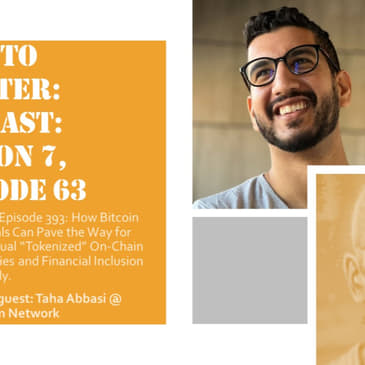

[00:00:01] Hello everybody and welcome to the Crypto Hipster podcast. This is your host, Jamil Hasan, the Crypto Hipster, where I bring you founders, entrepreneurs, executives, thought leaders, amazing people all around the world.
[00:00:14] I have an amazing person on the other side of the world. He is coming to me from Dubai, on video that's a beautiful and I'm looking forward to this interview today. I have the co-founder of Ferrum Network, Taha Abasi, Taha Welcome to the Show.
[00:00:31] Thank you so much Jamil for having me here. I am in Dubai, but that's the beauty of crypto, right? We're all connected from the weather we are in the world. I was really looking forward to this discussion and excited to chat with you, man.
[00:00:44] Awesome, awesome. I'm excited too. Let's kick things off and ask you first. You know, ask everybody's similar question, but the amazing answers. What is your background and is it a logical background for what you're doing now?
[00:01:00] Great question. I love that year, this is how you start off the interview with the other host's brother because it gives a lot of insight. By background, I've had the blessing and privilege of doing some really cool things before I got involved in crypto.
[00:01:14] Some of it is just hard working grid, but a lot of it is just lost. You're in the right place at the right time. I think it's not all cryptos about something. You hear about Bitcoin at the right time back in the day.
[00:01:26] And even now, you know, it's a call. So for me, I have a software engineering background. I went to school for that and I started off. I like to say I started programming when we still had physical keyboards on our phones now everything is fed screen.
[00:01:38] So I actually started out with web development after I completed my schooling. And then I got into an iPhones came out and the app store was a lead. I got the iOS development and Android and then I got into software architecture.
[00:01:51] And through some of the work that I was doing, I had some of my colleagues in connections out here in Asia.
[00:01:58] I had the opportunity to work as a project CPU for National Geographic Channel where I got to build the world's first zero carbon footprint race platform for them.
[00:02:08] That was the ticketing system to participate in the earth they run they do every year in honor of like the environment and to protect the earth they do this run and they wanted to give people tickets by actually doing carbon offset action.
[00:02:21] So that was really cool and then I also had the opportunity to contribute to Swift which is the open source programming language used created by Apple, a bit all over iPhone apps.
[00:02:31] And then perhaps one of the coolest thing is myself and the teams that I led got to work on the Mars 2020 in Europe emissions where we actually got to work on some automation testing and work on the Mars rover that was sent out to Mars.
[00:02:45] And this actually about a year ago the latest iteration of it was sent out. So this is before crypto, but I was always involved from a technical standpoint in the blockchain industry and did some work fair in Singapore areas, while which got recognized I got a chance to give a TEDx talk about how blockchain could be used to save lives.
[00:03:06] And to great barriers instead of just for at that time it was for like all it's about as drugs and hiring hitmen, there's all people thought of Bitcoin as right.
[00:03:16] So I've had this interesting journey and then I found Farum actually invested in Farum by first so I was in this so community member got on a government community and then I really loved what Farum is all about so I came on more full time in 2021 and it's been an awesome journey since then.
[00:03:36] So zero carbon and we're going to talk about what Farum network is all about and what you do regarding or ordinals on the Bitcoin blockchain network right.
[00:03:48] Yeah, yeah, we're going to get into that if you want, we can start there now I guess that's the urinals are huge so would you like to get into that? Yeah, what's Farum all about and then it's going to get into the urinals.
[00:04:00] So it's really easy to explain what Farum's all about because it's described in the name so if you're a geek about anything scientific which I am so Farum is actually the Latin word for iron is the 26 element on the periodic table.
[00:04:15] And the reason we chose this name because iron has a unique ability one of his key attributes is that it infuses the most amount of elements with the least amount of friction.
[00:04:25] And that's why we chose this name the ethos of Farum is collaboration of a competition is that in our operability protocol it looks to build tech and infrastructure that removes.
[00:04:35] That various to the mass adoption of that three at large and this spans across payment settlement information movement music art and many of the areas because we're to infrastructure providers you're not going out building all these solutions.
[00:04:47] We're providing the infrastructure so others can build on top of it right.
[00:04:51] So Farum is about connecting all the different layer of ones all the different d-ups all the different d-f i protocol as musicians artists who want to get their voice out into the world in a decentralized way.
[00:05:02] And we are to once providing the infrastructure sort of like the business behind the business to make that happen. That's what our ethos is about and we say that our success is dependent on the success of all of the layer of unsaprojects crypto and large.
[00:05:16] The success of those individual initiatives right so that's why we work very collaboratively even when people that you might think we should be competing with be collaborative in enhanced things for the betterment of the humanity.
[00:05:28] And that's something has been really exciting which is why or knows I guess we can get into that now as or knows started to bring attention back to Bitcoin you know Bitcoin is what started all off even this podcast.
[00:05:38] Farum itself none of it would have much meaning without the white paper that was released by citizen October 30 was to the native you know like that's what kicked it all off.
[00:05:48] So while Bitcoin was started off as like this simple use case of a transparent peer to peer payment settlement with removing centralized stress parties.
[00:05:58] It kind of stayed away for a while and other ecosystem still got us we all know but ordinals are bringing sort of that attention back to Bitcoin because they're giving away to tell Bitcoin story they're giving away to have on chain permanence with art on chain prominence with information stories.
[00:06:13] And also giving away to scale Bitcoin. Bitcoin has a scaling limitation which I know we're going to get into as all and what's happening now to ordinals to ruin through L2s and other things that even Farum is contributing to R&D and development of it's going to allow to scale Bitcoin and scale crypto at large in my opinion.
[00:06:34] I wasn't planning on getting into the scaling issue but I'm going to. My next question is going to be how well ordinals pave the way for the creation of unique tokenized versions of individual big points with specific attributes and then impact big coins, functionality and scalability.
[00:06:59] That's a great question. So I think ordinals in this sense for folks that are you know, you have like this adoption chart get like these early adopters that get into things just because they are like super interested in us and then the mass adoption and the escarp like comes a little bit later.
[00:07:13] So for those early adopters they already understand that the rare sats with the attributes you already have ordinal theory assigning a serial number every single sat that has been created this is what ordinal theory was all about when Casey Rodermore launched it.
[00:07:26] He essentially was able to give away the uniquely identified every single situation that has been mind and created right so now you can track the the Bitcoin or the situation is ever initially great advice to do she not about himself then the ones that were first mind but how thinly which of the first hour block mind by someone.
[00:07:43] Other institutions are not coming you can identify the pizza sats which are using on May 22, 2010 10 thousand Bitcoin was used for just two large pieces and those stats have some pteles story of Bitcoin.
[00:07:54] You know human beings are all about story this is why we refer to each other I call you gemilely you call me taha you don't call me one I don't call you two numbers while they have some value.
[00:08:04] The story the names are last name tell us something about our lineage something about our family we are story telling beings we've always told story even before we had a very language.
[00:08:15] So ordinals in my opinion are divided tell Bitcoin story and that story telling mechanism is the way to share with the world.
[00:08:22] Why crypto and big coin and decentralized currencies are the way of the future why they can actually question the narrative of inflation the accept inflation to be the norm.
[00:08:33] We accept that cost of cars cost of rent cost of mortgage cost of food eggs milk is just going to go up the same way we accept that you need a breed air to live but that should not be the case and in order to articulate that we can't articulate it by sharing the white paper because it's very technical.
[00:08:50] It's in a sense to the average users very boring but if we can share a story share the story of music of art and then use that educate people about how.
[00:09:00] The price of houses in the US for example in Bitcoin has fallen since 2018 like you need it you need a lot less Bitcoin to buy house be a lot more dollars to buy house.
[00:09:10] So now you can have a story based conversation so that's why I'm very bullish and ordinals I think ordinals are giving that way to share that story and if you want to dive anything into more specific and get as technical as do wander as specific as we want as long.
[00:09:23] I do the first ball question is basically you can do an ordinal or NFT on every single Satoshi that's ever been created.
[00:09:36] Yeah exactly you can you can inscribe it on every single Satoshi you can inscribe it on a set of stats and it really gives you the freedom of people who are doing really really cool things where they're inscribing a parent inscription on one Satoshi.
[00:09:48] Then they're inscribing a bunch of child inscriptions which reference each other so it's kind of creating a whole programmable art world and programmable information world that is stored in permanent switch there's a key difference by the way between ordinals.
[00:10:02] The art and information historical ornals versus like NFP outside of the ecosystem so on a theorem as an example which is one of the largest NFT marketplaces and ecosystem for salana is one of the other ones as well.
[00:10:15] And there's many other spotting up but ERC 721 and ERC 1155 is sort of protocol that they find the standard of what is an NFT on the EVME ecosystem.
[00:10:25] They do not require that the storage of the metadata in other words whatever information you're storing but they're talking in a hard a jpeg and mp4polar music they do not require that that has to be stored on chain.
[00:10:39] So in order to be ERC 721 I love to you. It doesn't have to be stored on chain that code itself and a contract should but the reference data can be stored anywhere else so most reputable projects use something called IPFS which is a decentralized data store.
[00:10:53] It stands for interplanetary file system and it's a good solution but it's not on chain it's a separate solution right and many other projects that are not as happy to them all or maybe for other reasons they choose to store it on AWS as three buckets or even Google Drive in some cases.
[00:11:10] So while people don't realize that in some cases you may be paying a lot of money for an NFT and if the administrator of that NFT collection
[00:11:18] forget to create a credit card bill for the Google Drive or AWS storage. You're a metadata has gone and this is very different from how ordnals works. This is a huge difference.
[00:11:28] And this was attempted to be solved in the Ethereum side with its subscriptions but it really just took hold and took off with ordnal theory and with the ordnals protocol then producing it on Bitcoin.
[00:11:41] Okay, so what you're saying is that all the ordnal data for Bitcoin is on chain. Exactly exactly it's inscribed on chain which is what makes it very valuable very scarce and very expensive as an example.
[00:11:58] A four mega expression or a four megabyte of large inscription is a big deal on Bitcoin right now to inscribe something on the layer of Bitcoin for megabytes is about 64,000 dollars
[00:12:08] In transaction fee that it costs inscribed that whereas doing an IPFS you know a couple of cents maybe a dollar at some point.
[00:12:15] So data which is forcing developers engineers and even artists of working with some artists who are learning really cool engineering techniques to compress their art and compress their data without losing quality
[00:12:26] Right because in artists you don't want to compromise with the quality of your work. So there's some really interesting innovation that's coming out of that and then of course the L2 scalability the other elements that are being developed and has support a call are going to further give way to allow you to have like on chain music albums on chain streaming perhaps at one point and much more that that you know perhaps we can't even imagine right now.
[00:12:49] I'm just wondering where the role of lightning network and tap through will be able to come into the ornals. That's a great question. In my view like you look at lightning and what is done is don't wonders for the payment settlement with the state channel right like.
[00:13:07] When I went over to Hong Kong earlier in May for Bitcoin Asia it was the coolest thing where I could give them some Hong Kong dollars and they gave me this like tap to pick art which was loaded with some sats.
[00:13:18] And then I could go around the entire conference and pay for things just by tapping and it was being insats instantly. The state channels that powered by lightning network and BTC base server which is an open source software right. So lightning is done tremendous.
[00:13:33] You know service to the community by doing that I think it will continue to evolve but I do believe the lightning is more in my view of a single purpose. with those state channels being more payment settlement based.
[00:13:45] I don't really see lightning being the way to stream music on chain or to we are on chain. Maybe it will evolve to it but for me that's like trying to say again
[00:13:54] an airplane drive really fast, like sure a CAD drive fast but why would you want it to let it just fly? You know like let it just do a fast take off from the runway and then
[00:14:04] sort of the sky is that it's a different use case so in the case of lightning I think that stays there. In the case of dappur, dappur is what's enabling it's just a way
[00:14:15] of enabling use cases like ordnals and brews to come on. I think the true use case dappur visors which is a collective of developers actually have a big fan of those guys part of their community as well. They're launching initiatives to develop
[00:14:28] improvements to the Bitcoin for protocol itself such as the Bitportrony proposal and OP CAD proposal which will allow you to have true L2 state variations on Bitcoin. So in the case of EVM ecosystem you have Ethereum which is a layer one and
[00:14:44] arbitrom which is a layer two. Arbitron essentially is able to process a bunch of transactions really quickly I really love costs but then it secures them by sending them and you know essentially
[00:14:55] sending a report of those transactions I'll keep the analogy simple back to Ethereum. Now you can do that part on Bitcoin but what you can't do on Bitcoin is Ethereum is then Ethereum actually has
[00:15:05] a contract itself on change one which closes the loop and says that this report that Arbitron is sending me back is valid and is compliant with the structure that I expected it to come back. On Bitcoin's such functional checks don't exist yet Bitcoin is very single use case
[00:15:21] send a payment to sure you can sign things on Bitcoin you can say that yes I have settled my L2 transaction of Bitcoin you can do this today but Bitcoin doesn't actually have any way to
[00:15:31] enforce that way the way Arbitron is sending me back data it doesn't have any way to check this as an example. So with OPKAT you're going to be able to allow Bitcoin to say yes this data that's coming to
[00:15:44] me is good and this data that's coming to me will wait something is wrong here it doesn't comply fill the transaction so it's going to give Bitcoin functional transactions this is going to enable
[00:15:55] so many use cases because you then get past the transactional and the cost and the skill will be limited to the L1 while still being able to benefit from the security of the L1 and I'm really
[00:16:05] bullish on this and fairer is actually contributing to the research and development here even implementing it into our all of our own solutions and we're excited it makes us every day excited ago create some really cool stuff for the community and for a public.
[00:16:20] You know last week I talked to a company that I talked to one of the founders of a company who was building a custom Oracle on Bitcoin so I think you're going to be able to have that data capture
[00:16:31] really soon. Absolutely absolutely I love that I would love to connect with them actually it sounds awesome yeah we'll do that offline. So you know what you want to tell me it goes against the narratives
[00:16:47] it goes against the narratives that Bitcoin is only a store value and it's not used for Satoshi's vision appeared appeared network but if you create those ornals and the music and all this budding ecosystem of art and culture and everything on Bitcoin that does correlate to
[00:17:08] Satoshi's vision doesn't it? Yeah it's a very nuanced conversation is actually happening with the core contributors right now this is the four evolution of Bitcoin versus against the evolution of Bitcoin discussion I wouldn't even call them camps because part of what makes Bitcoin great is that
[00:17:25] there's no one deciding party we all decide together. What has made Bitcoin the most prominent was dominant chain you know we talk about BTC dominant charts and then it sits up 50% well that's really
[00:17:35] saying is that Bitcoin's value as this one asset is one chain is greater than 50% of the tangible market gap of all other chains and their assets combined right that is massive how did that happen
[00:17:47] that happened because Bitcoin for many many years over a decade and a half almost at their point has stuck to simplicity to a simple use case to reliability to security there's no easy way to hack the Bitcoin wallet even though there has been acts of dollars and other
[00:18:03] ecosystem but do this date other than a fishing hack a technical hack for Bitcoin has not occurred to this day yeah right that we that we know off at scale so and that is because it has been kept simple
[00:18:14] even the proposal I'm talking about the OPEC app proposal actually initially this protocol was included in the Bitcoin core bicitoshi and was removed in 2010 because of the same fears that it will
[00:18:25] make the protocol complex and introduce more well and brooders so why are we talking about this now I think Bitcoin needed that phase this second and a half phase to establish this resilience
[00:18:37] to establish this stability and security at that time the number of nodes running for far less the capital at stake was far less and the game theory has played out now now the amount of capital
[00:18:47] securing Bitcoin the amount of nodes securing Bitcoin even when you look at the node amount of nodes running the chart has gone up into the right extremely just at this having with the roots for
[00:18:59] the call coming out so the security and the state of Bitcoin has evolved and just like anything else we need to have a discussion where do we go from here so I think this solution of OPEC
[00:19:10] is really exciting because it only introduces about a five code lines chain to the protocol itself to Bitcoin core layer when itself it doesn't say that on Bitcoin layer one you need to add all of these
[00:19:22] interesting functionalities and D5 apps and all that what it says is that you can use it to enable L2s to add those functionality and then sell them on Bitcoin so keep Bitcoin itself
[00:19:33] add some changes to support that true verification security but keep this changes to a minimal and add the extra changes to more experimental L2s and side chains that may come along right
[00:19:45] which I think is a happy medium of this you know my new step evolution again once small step or Bitcoin one great step for crypto all over right and I think it can be really nice and we can
[00:19:57] experiment with that and see where we end up. I like that one small step for Bitcoin one giant leap for crypto. I think I'm going to put that on my wall. I might get a short part out I love it too.
[00:20:19] All right you're gonna have you're gonna have a lot of increased that allude with Ordenol's right if they take off which sounds like they are in the will. How can the narratives
[00:20:32] of Bitcoin network a slow as like these other chains can have come out with it say they're fast or then everything like that error likes to launch our fast right how does the Bitcoin network
[00:20:43] which is you know the narrative of slow handle the increased data workload. I think it shouldn't be faster. Bitcoin L1 itself should not be faster. It's the slowness adds to the security. The time and a block time the difficulty just disappeared every two weeks all of these
[00:21:01] mechanisms have proven over the last decade and a half that this is solid it is as hot proof as you can make it it has security benefits it has game theory benefits so I think it should remain
[00:21:15] that way. This is where I'm in favor of L2 experimenting to add scalability and speed and efficiency and I think that's where that role lies. scalability of Bitcoin will max out at about 100 million
[00:21:27] users, 100 million transactions even and the reason that that is the case is because you lead to you end up going to a space where transactions cost and transaction processing times will render
[00:21:38] the network useless so to scale beyond that to bring a billion users to Bitcoin which is in my opinion the pathway to brain of billion users to crypto at large even to users or ferramet itself
[00:21:50] you need to add scalability solutions while adhering to the security benefits of Bitcoin as broad and that's where L2 is going to play a huge role which is why whether it's OPK at with
[00:22:00] this before 20 proposal or another proposal let's say this one doesn't work out. I'm very bullish on this because there was already part of the initial protocol it has the greatest chance of consensus amongst all the developers in the community that's discussing and already there
[00:22:14] teams like ferramet itself and other teams developing to make it a reality so there's a greatest chance of being adopted but if this doesn't I know there's enough capital resources and effort being put to bring something else that will bring L2s to a very efficient
[00:22:29] which will bring the scalability and speed or Bitcoin I can see an art specific chain, a music streaming chain, a payment settlement chain all of them being developed as an L2s of Bitcoin and
[00:22:39] even other chains, ferrams goal will very enabling is rewarding to contribute over a dozen chains we're making all of those chains essentially an L2 of Bitcoin by settling them on ferram and securing them through Bitcoin with the same role of process right so this is where I see
[00:22:54] the future going. God it's the ability of side chains you have state chat, you know this concept I don't know that is state channels so I'm sort of finding out what that is.
[00:23:06] Yeah in a sense the easiest way I explain state channels is like a limited period side chain it's not exactly accurate analogy but you don't need to set up a whole infrastructure let's say V in you what's happening with Bitcoin and lightning because in lightning
[00:23:19] or communicating saying hey I want to create something and return I will send you something that's all it is and it's going to be for a limited time so once those requirements are met that state
[00:23:28] channel closes there's a limited period connection instead of a constant roll-up so this allows lightning to do payments with peers again and again because every time a new payment peer state channel 2 is state channel opens up there's a payment that happens it sells on
[00:23:41] Bitcoin onwards with the next state channel so it's a it's a side chain that pops up and goes away is the pay I explain this analogy. That makes sense because it doesn't clog the network
[00:23:52] it makes us to me that you haven't limited like at all in for purpose yeah make sense exactly so the other another you know not going Bitcoin has been you know it's only a store value
[00:24:06] and it's only for money right but one of the three three promises of a blockchain technology are banking the unbanked and a voice for the voiceless and identity for the unidentified right simply ordnals can be used to create on-chain identities right fostering a more trustless
[00:24:33] and transparent ecosystem how does that I'll this question they like literally gives me clues to be talked about this recently at a conference in Lisbon for single known as the non-pungible conference where we actually launched the ordnals passport and and I say we launched it but it doesn't
[00:24:50] belong to us we launched it in the same way of Bitcoin is launched we made it everyone's passport we open source say we made it and I'll for profit and the passport I'll send you the pictures of this on the
[00:24:59] first page it has the regular passport picture and it has an artist that contributed the artwork we're stealing the photo of the person and running away with it so flipping the concept of identity
[00:25:09] it has to identity save and the passport changes the name to everyone's name is Satoshi Nakamoto and the theme is we are all Satoshi and why do we do this we we try to tell the story that
[00:25:20] bid ordnals bid Bitcoin itself it gives you the ability to choose your currency that's number one Lynn Alden talks about this that our currencies are assigned to us based on the country we are more
[00:25:33] we don't get to choose them so the monetary policy that we are assigned the financial access that we have and a lot of those currencies going to a decline especially if they're not in the top 10 market cap of
[00:25:43] the currencies that they claim even faster take the case of Venezuela or Argentina where you go in and you give $10 and they give you like tax full of cash and the next day it's more top we're 25%
[00:25:55] less in the extreme volatile times so what Bitcoin allows you to do no matter where you are in the world right and through Bitcoin crypto at large but Bitcoin specifically being the one that kicked it off
[00:26:05] it gives you the ability to choose your currency and it gives you the ability to choose a currency with a monetary policy that cannot change it has a big supply no matter what you do in the
[00:26:15] court for the less supply is going to remain 21 million it is going to continue with this having cycles that we're having roughly every four years this thing will not change so it gives you
[00:26:24] that choice to pick a currency where I gave an example earlier that is increasing in value housing the US for example about six or a Bitcoin many years ago now about six Bitcoin is a
[00:26:34] median price of the house versus in free out $250,000 house a median price of a house now is about $500,000 so that the cost is going up if you're earning a flat but in Bitcoin it's so much less
[00:26:45] and through Bitcoin we speak about crypto or logistic, speak about fair amount of other projects in general so that's where I think Bitcoin does serve as a payment mechanism not just store of value now
[00:26:58] the reason we think of it very differently is because we think of it in a way that we are only looking at our national currency the US dollar is very volatile like for example when I was in Tanzania recently
[00:27:09] it lost 25% of the value and the shielding lost 25% of its value against the US dollar so you could say shielding is very volatile in the country it's not but in the global market
[00:27:20] I would convert about $180 and I would get up for her in thousand shielding a week later I could earn $140 and I would get up for her in thousand shielding this is very volatile in that
[00:27:30] sense so Bitcoin short wallet the outside but if you're saying that this airport cost me 500,000 sets it cost me 500,000 sets in that economy we're only looking at Satoshi's when you can compare it to something else sure you could have more volatility but within the transaction itself
[00:27:47] there's not as much volatility so I think this conception will change if you will stop looking at eventually Bitcoin in the way of Bitcoin versus dollar I think people once they have more access to Bitcoin and Sat's in general and other crypto assets in general stablecoin,
[00:28:02] sperum other assets that you may think of they'll think in those tokens and think how much this cost so you might have a 500 sets maybe a couple hundred thousand, a couple hundred thousand
[00:28:13] USTC or whatever of a certain item that's how we would think of cost in terms of giving identity and by ornals are giving an identity is because you don't really if I give you a serial number
[00:28:24] of a sat like serial number five hundred million two hundred thirty six thousand four hundred and thirty six you're like what is that but if I say that this this stat is where your ordinal passport is inscribed on which is your unique passport number that is something readable
[00:28:38] you might have passed for number 23 you might have your Satoshi ID you might have an ordinal PFP or favorite PFP on there and it might be the way to get you access to different conferences
[00:28:48] to different VIP events to perks online now you have something the storytelling aspect that talk about you have a way to identify that this is my passport it belongs to me it's not just
[00:28:58] a long number that I can't relate to and it gives you an identity regardless of whether you're the macei tribe or the hazabi tribe in in tazani over we actually met with some hazaitri
[00:29:10] folks who speak in the click language you know their names are like like this and they don't have their names they can have an identity through ordnals because we can assign them a passport number is an example or any other mechanism somebody also invented the ID through big
[00:29:24] coins or ordnals they can assign them a bit of an identity to receive payments without having to know who they are you can verify that they're good people and then you can assign the entity
[00:29:33] and move on from there so I think these problems can be solved they just haven't been solved and adopted at scale yet so people have their doubts naturally but it's going to happen because
[00:29:45] you look in the pattern of the past people had the same doubts about the internet if you look at interviews from 1990s people were like what is this internet thing I can just write a letter
[00:29:53] why do I need to send an email you know it gets serene with the post office is there is a post office going to go away but we have email all these questions came out but look at us you know many years
[00:30:02] later about three decades later and we have a space for each thing and we're continuing to wow I just thought of this I mean so what you're saying is that you mentioned the click people
[00:30:22] you know you have people from the furthest reaches of the earth who you know don't have access to anything really you know and what you're saying is that Bitcoin could be used as a last mile solution
[00:30:34] for people over the world 100% how do you give somebody who doesn't have a ID card who doesn't have a birth certificate they don't even count their age in years they count their
[00:30:46] age in events like I was born in the year of the big earthquake I was born when there was they didn't even say year actually that's an idea that I was born when the big earthquake at
[00:30:55] the fence I was born when there was a great migration that came through our area unusually little it should have gone through the other area I was born when there was a great drought this
[00:31:04] is how they measured right and their their names they they have no proof of their existence of the then they are so how to get someone like that to get part of Spain in the global economy well
[00:31:16] sprite will not give them an account because you can perform property I see they don't have the infrastructure do that brain tree paypal they all cannot do that but Bitcoin can now how do you
[00:31:25] do that while ensuring that you're still compliant they can't see any about this is where we want to work with regulators this is where I have an interest instead of you know I'm very much about
[00:31:35] rebelling against the status quo but I also understand and appreciate the fact that governments have a role to play they have a role to provide safety for their citizens to ensure that you know
[00:31:46] bad actors are held accountable so I could go and work with the government and regulating and to be using I hope others will join me in this mission to say yeah this had Zabi tried in the remote
[00:31:56] regions of Tanzania they're not bad actors they're not looking to cause anyone harm they just want to sell their goods and services so we can vouch for their identity and we can give them a mechanism to receive payments in shilling which are being transferred through Bitcoin for example
[00:32:11] somebody starts a payment their true that credit card striped power application in the US the USD gets converted into a crypto asset whether that be firm bitcoin stablecoin gets converted over into shilling through a settlement provider other and is a great use case in this case to
[00:32:27] convert assets into currency and then phased them locally in their cash currency which they can use to live their life and do commerce locally that problem can be solved to Bitcoin and through
[00:32:38] ordinals and in fact already is we are starting to make some adverse early stages and this is my call in a way on this podcast on the crypto hit ifster podcast or any others I want to join
[00:32:48] me in this mission because we want to work together with other builders that want to provide these solutions and build something hopefully that will be able to contribute to the better
[00:32:57] amount of humanity even a little bit I think that'll be a big impact. I love it I love it it's great awesome yeah I'm blown away so we did say you did say magic word there he said regulators
[00:33:16] I'm in the US and regular try and try and let triggers try to you know to what's the word do regulatory capture over the past couple years of bitcoin and you know we had these ETFs and
[00:33:26] everything come out and now Wall Street is leaning toward embracing it but we're not fully there yet right we will be I believe someday you know but how will regulators approach ordinals and their impact on the financial system because anything that's impact the financial system has faced tremendous
[00:33:44] resistance to how do you think or knows what fair what they have regulators. Yeah so I was warning Pakistan living in Utah the US now and being a US citizen even if you're doing business outside of
[00:33:56] the US you are subject to the same regulation and compliance rules you have to follow being a US citizen so I was actually meeting with our lawyer in Singapore and unfortunately and this is something that
[00:34:07] should be discussed and I'm glad that this would be changed now with some of the policy in an area but the US I'm happy that it's been changed but the SEC was not making good rules or any rules
[00:34:18] to tell us how to comply like for crypto companies there was no clarity and how because you can't be compliant we want to be compliant we want to follow the law we want to follow the rules
[00:34:27] but there's no clarity on how to perceive it now this is like playing this was filing the cases that they were filing but they're stand with crypto initiatives I think regulators have a natural friction because they're backed by lobbyists and the biggest lobbyists are the same banks who
[00:34:42] feel at threat to their existence with decentralized crypto but what I've now found in some of my meetings in Lisbon my conception was that this direct payment settlement was going to be a problem
[00:34:56] for companies like Visa and Mastercard even but what I learned is that their sections in Visa and Mastercard were actually looking forward to adopting crypto because one of their biggest expenses is fraud handling charged backhandling the reason credit copies are 2% 3% and foreign countries like
[00:35:12] Tanzania 5% is because they have a huge cost in fraud planes and charge backs which is why they have to charge these administrative fees but crypto you can solve that so in terms of regulation I think
[00:35:24] or noes will probably not see the day of light in terms of regulation conversation for probably another few years because they're still in their infancy but as they start to become mainstream
[00:35:33] and as you start to see billions and liquidity flowing into or noes and using or noes of the means more than just art but also the means for identity as it means for transactional payments
[00:35:42] as it means for securing L2 state verb because it is an example I think they will come into the conversation and I'm very bullish with an narrative in the US now I think they will make a favorable
[00:35:54] conversation rather I don't think all policy will be favorable but I think they will be open to conversing with crypto experts with folks who built in this space and I hope a lot of my colleagues
[00:36:03] a lot of the folks who obviously have a lot larger stake in crypto have been around longer than us will engage in that conversation and make some policy that will be better for everyone but I think
[00:36:12] regulation is going to come out and I think it's good for regulation to come out as long as it's reasonable regulation as long as it's not fear-bonging regulation it's one that encourages innovation and that puts in the controls that are needed to protect the citizens from harm.
[00:36:30] I just had a wild thought and you might have a take on it I'll ask you. I'll tell you how the thought that came in my head because you mentioned the front prevention departments of visa mastercard. Elizabeth Warren, a politician here has had her anti-cripto
[00:36:48] army regime against crypto and I always thought it was she doesn't like crypto or she doesn't like the cryptocurrency community and she doesn't like visa or mastercard. What if she doesn't like visa or mastercard and she's against crypto because she's against them
[00:37:03] what's the potential with that? I have an Elizabeth Warren and I like to be a little cautious of having extreme stance against people. Her policy is big for her viewpoint very clearly and she's constantly spoken about making crypto regulation but when she's making crypto
[00:37:24] regulation it's going on stage with Jamie Diamond and the heads of the banks that crypto is again. So it's kind of like saying I'm going to regulate the auto industry and I'm just came
[00:37:37] out of a meeting with the train industry to make regulations against auto industry. It isn't the favor of the train industry to make regulation against auto industry because it will provide
[00:37:46] more customers to the train industry. So it makes no sense if you want to regulate the auto industry you need to bring into experts who are spending their blood sweat in tears making the automobile industry more efficient providing transport means to the community to the public and
[00:38:01] obviously making a business use case and work with them to make those regulations. What I would like to see Elizabeth Warren do is instead of working with just the Wall Street banks and just
[00:38:14] Washington DC is to engage in a conversation with Coinbase, engage in the conversation with Metamass consensus, engage in a conversation with all of the builders and crypto who are some of her citizens. My sister lives in Massachusetts. I'm my mother lives in Massachusetts. I visit there
[00:38:29] but I'm not a fan of Elizabeth Warren but I will turn into a fan of hers if she says hey crypto people engage in a conversation about how we can make the community and their fund safer,
[00:38:39] how we can provide value to the community through crypto regulation. We are not against regulation. We are against bad regulation especially one that is made within the agenda by people who are interested in not aligned with the success of crypto. The success of crypto trends, the current
[00:38:56] status quo and unless Jamie Diamond and JP Morgan all these bankers who do have some respect for because they have created a financial system that allows me to flourish around the world but
[00:39:09] unless they have invested interest in the success of crypto they're not going to make the best regulation for crypto. So I think there needs to be a balance, there needs to be a circuit with financial settlement experts with crypto experts with government experts coming together
[00:39:23] and as a collective making some regulation which I think would be a better regulation that comes off for the people rather than a single sided agenda that would be pushed. That sounds a good
[00:39:33] answer for every politician, every regulator that seems like a good way for everybody to do this. So, indeed. Yeah, thank you very much. I want to thank you very much for your time today.
[00:39:47] I really enjoyed speaking with you and this has been a wonderful conversation and I have one last question for you and it's really simple. I have to be able to find out more information about you about Therom Network. I can start to hold Oracle or Nulls, or Nulls,
[00:40:06] not to make do that. The best way to find out more information about me is to follow me on X, my profile is H-A-A-M-A-H-A-B-B-A-S-I and if you want to learn about Ferram the protocol
[00:40:20] that I can compete with you, you can just go to Ferram. That works on our website and you'll learn about all our social, their telegram, my Twitter and you can get to learn all about it there.
[00:40:29] That's best and the easiest way to get yourself an ornal to start off is to get yourself an X-Wrest wallet. That's X-V-E-R-S-E. Gave yourself an X-Wrest wallet and then head over to Magistrat
[00:40:41] or Magicallyedon and find the least expensive ornal and just find a way to transact and purchase that because just doing that act is going to give you so much learning about how transactions occur
[00:40:52] on Bitcoin if you've never done one, what it takes to purchase an ornal, and what it takes then to hold and secure the ornal for yourself. If you have any questions, be sure to me my Twitter DMs that I will be happy to help you throughout that journey.
[00:41:07] Awesome, thank you very much for your time today. Thank you so much for having me, Jimil.