
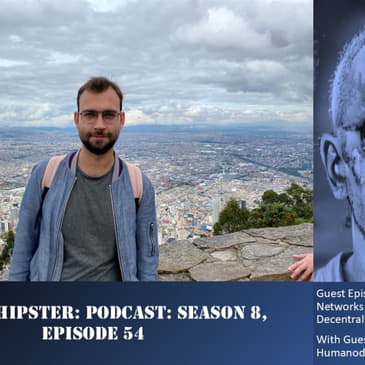

Victor Vernissage, a researcher at the intersection of macroeconomics, blockchain, AI and decentralized governance and a co-founder of multiple crypto ventures, including Citadel.one staking app, DeSci/Fi project Episteme, and Humanode, an AI-driven biometric protocol that has authenticated over 500,000 humans.
[00:00:00] Hello, everybody, and welcome to the Crypto Hipster Podcast. This is your host, Jamil Hasan, the Crypto Hipster, where I interview founders, entrepreneurs, executives, thought leaders, amazing people all around the world of crypto and blockchain. And today I have another amazing guest. He is a researcher and he's a co-founder of multiple crypto projects. His name is Victor Vernissage. Hopefully I got that right. Correct me if I'm wrong.
[00:00:31] Victor, welcome to the show. Hey, thank you very much, Jamil. So it's a French pronunciation. It's Vernissage, but you got a nice try. Thanks. Thanks for inviting me. It's a real pleasure. Bonjour and you're welcome. Thank you. So let's kick things off. You know I asked, I guess, all the same question. Oh, yeah, and I get amazing answers.
[00:00:56] So let's kick things off with the first question is, what is your background and is a logical background for what you're doing now? Well, I'm an economist at heart. Macroeconomics is one of my favorite sciences, I would say. And pretty early in my life, I encountered crypto, which was over 10 years ago.
[00:01:20] So it was very logical due to the fact that back then I was living in Russia. And, you know, decentralization is kind of inside of our hearts, really, because things are really bad, still very bad. So with the background in economics, I quickly went into creating traditional IT startups, Web2 IT startups.
[00:01:47] But once I encountered crypto, that was it. It was the path for me forward, you know, I think in terms of economics, in terms of the future of humanity at the same time, because back then I had a slight depression, I would say, and crypto almost healed me. Just the idea of crypto.
[00:02:17] Okay, now you got my attention. It almost healed you. What was wrong and how did it heal you? Oh, it was a pretty weird one. Everything was pretty nice in my life. I just went out of university. I was figuring out what to do next, reading a lot. Already was trying my first project.
[00:02:41] And then I stumbled upon, I was reading a lot of Yudkovsky's Rationality. The book is called Rationality from AI to Zombies, which is the compilation of around 300 articles in logical order, in which he pretty clearly leads to the fact that artificial general intelligence is coming.
[00:03:10] And most likely it's going to destroy us. Unless we do two things, try to mathematically describe human values and give us through the artificial general intelligence. Or we have some methods of control. And it sounded like with crypto, we could at least do the second part. Because most likely 99.9% will fail in the first one.
[00:03:42] Interesting. Interesting. So, it saved me. Crypto saved me too. How was that? I had two heart attacks at the end of 2018. One was the RCA and one was the LCD, both widow makers, right? So, I was in the hospital after the second one and I had $10 left in the bank and I bought some Litecoin. And that gave me hope for a future. And I'm like, okay, I better stay alive.
[00:04:11] You know, and I have. So, you know, just buying just that tiny bit. All for hope. You know. Nice. Yeah. So, I can get into talking about that for days. It's not my podcast. It's yours. So, let's talk about Humanode. You know. What's Humanode all about? What makes it incredibly interesting? Crypto is not decentralized.
[00:04:41] Full stop. We do have decentralized technology. But it's all either based as a consensus mechanism on proof of stake or proof of work. Which are based on capital. Capital is not decentralized. Hence, these networks are not decentralized. And that's what Humanode is about. It's about creating a blockchain where peers are actually equal in terms of computation and governance, voting power as well.
[00:05:10] Which we couldn't actually understand how to do back in 2017. When we got that understanding. But in 2020, we figured it out. So, we started Humanode. And imagine it as a network of equal humans running their servers and maintaining the ledger of truth. Which is the blockchain. So, interesting.
[00:05:40] Interesting. So, you have the original idea by Satoshi Nakamoto or even before that of decentralization. Right? So, that idea is dead. Right? Or you think it's dead. And how could we... Why do you think it's dead? And how could we resurrect it? I think that it's not completely dead. There are still people who care. However, new people coming into the market don't care about it at all.
[00:06:11] Centralized things win in crypto over decentralized things. Because they're easier. They have better user experience. They get all the users. How can we get it back? I think we do need a major catastrophe event in crypto. In order to get back to their original values. Because for now, people are completely okay with the centralized sequencers in layer 2s.
[00:06:39] They get more users than decentralized layer 1s sometimes. And an average user thinks if it's crypto, it's already decentralized. Which is not. So, they don't care at all. How do we get it back? I think we do need major catastrophe. That's the only way for people to realize that we have to value decentralization more than we do now. I have a book called Overcoming Crypto Catastrophies.
[00:07:08] And the contents in that book talk about FTX and Celsius. I guess BlockFi too. You could throw them in there. Those were crypto catastrophes, right? What do you see as a catalyst for the next catastrophe? What could that possibly be? We're a lot safer now, you think? Or, you know, there are some areas that maybe we're not. So, what could that next catastrophe be and why should we be prepared for it?
[00:07:39] Well, I think that what happened with FTX, Celsius, and whoever else, that was not really about crypto, right? So, it kind of was crypto market. But they were completely centralized. They were managing users' funds. And I'm talking about the fact that, well, at least current networks, they don't manage user funds.
[00:08:04] But in L2s, sometimes it's possible to kind of, if you get the Layer 2 multi-seek, you can wipe out all the funds that people transfer to this Layer 2. Luckily, it never happened because there are many people in multi-seeks. But, frankly speaking, I don't see an imminent catastrophe coming like that.
[00:08:30] Unless all of the multi-seek signers of Layer 2 are very bad at security, which hopefully will not happen. But another catastrophe that can happen, not anytime, but we don't know yet how far in the future it will be, is that when we do have AI agents who are good enough in order to earn money,
[00:08:58] they will quickly become good enough at earning money so that they have enough to buy out a proof-of-stake network, let's say. And imagine if we really have artificial general intelligence, which can be wealthy enough to buy out Ethereum supply, become the biggest Ethereum staker. And now Ethereum doesn't belong to humans anymore.
[00:09:28] This sounds far into the future and only guys like Elon Musk and those who own AI companies say that AGI is coming. I think it is not. It will be completely different neural networks from large language models we have now. But it may come anytime in the next 25 years. Okay, that's one possibility.
[00:09:56] So the AI has become strong enough where they could wipe out Ethereum and do it maliciously intentionally. Yeah, they can at least stop Ethereum if they need it. Luckily, we have finalization in our layer 1s, almost all of them, which means you cannot actually change the history of the blockchain when it's already finalized.
[00:10:23] But yeah, they can capture our networks. The power in them. I can think of two other possible things. Okay, that's interesting. One is quantum. What would be the role of quantum in overtaking and destroying blockchain networks?
[00:10:50] The role would be to probably figure out the private keys, just then take the funds out of them, which is still impossible with the current tech we have. But again, the rate of development accelerates crazily. For now, quantum tech is still good for randomization, so to say, for prediction of multiple outcomes, millions of outcomes.
[00:11:22] But it's still about random things, not about deterministic things. So quantum could be a problem, but we already have math, which is quantum resistant. So there is lattice cryptography and math available. Just not many blockchains or crypto projects use it because it's computationally heavier than what we use right now. But we do have means to resist quantum computers.
[00:11:53] Got it. And the other one is very, very, very, very, very far-fetched. I can't say very enough, but say there was a grid attack, you know, and that injured somehow like a lot of the real estate in the U.S. and therefore bankrupted BlackRock, which then bankrupted MicroStrategy. How would that impact things?
[00:12:24] I firmly believe that Bitcoin going to zero, almost zero, whatever, would reboot our industry, make it stronger. I'm very thankful for what Satoshi Bitcoin did in the past, but we all understand that it's already an archaic technology. So I'm waiting for the flippening,
[00:12:53] which is the term for Ethereum surpassing Bitcoin for the last eight years. I still hope it will happen. But MicroStrategy can go down much sooner than BlackRock and even without its help. That's something I'm afraid of can be the end of the cycle. Yeah, that's the only risk right now. But, you know, that's very, you said Bitcoin is very old technology
[00:13:23] and people have been waiting for the flipping for a while. And, you know, but there's new technology out there. There's biometrics, right? And you said you believe that all humans are equal. The founding fathers of the United States would disagree with you, but, you know, based on populations and demographics. But, you know, how are all humans equal and how do you provide equality through biometrics?
[00:13:53] Well, humans are equal in their rights, but not in their abilities. And at the same time, well, I think everybody has the right to be a part of the financial system. Unlike the world we live in now, where we even don't have access to financial instruments like shadow banking instruments. People don't even know what shadow banks is and they hold most of the dollar supply in the world.
[00:14:23] But apart from that, okay, back to your question. So there are multiple ways to find out if there is a unique and real human in front of the computer or not. And biometrics is one of them. Biometrics, well, the most accurate biometrics right now is iris scan. The thing that we have in the eye
[00:14:52] that the world coin with the orb have. However, you have to have a specialized device. It's not very inclusive. So at HumanNote, we decided to go with facial recognition, which is the most accurate biometrics we have that does not require specialized hardware and anybody could use with their smartphone and even three megapixel camera.
[00:15:20] So we checked out, before starting HumanNote in 2020, we checked out the accuracy details, right? This is important thing to know. And the error rate, basically the possibility that there will be a person in this world who looks so similar to you that once he verifies himself, you will not be able to verify yourself because like one human, one node
[00:15:49] is one in 125 million. It's not zero. Biometrics are not deterministic. They are still the game of probability. And with the scale, the probability of error grows. But it's totally enough to have a blockchain network with even million of nodes, which is unheard of in our industry right now. So how does it work?
[00:16:18] Pretty easy. Imagine you're running a blockchain node, like in proof of stake. You set up a small server, cloud server, home server. But to become a validator, you have to get authenticated through biometrics. So you basically locally connect to your node, you scan your face, and then you can become a validator.
[00:16:47] That's pretty much it. You can become part of the consensus and part of the governance as well. That would give people who are shut out from the traditional financial system an opportunity to be part of the new one. Well, people are kind of all shut out from the traditional financial system, I would say.
[00:17:16] Because unless you're a high net worth individual, you can get access to many financial instruments. But here, yeah. Basically, it will not only... You know, we already can have access to finance through our blockchains, okay? Through Ethereum, through Solana, whatever. However, people do not control these blockchains. And all the fees that they pay
[00:17:45] and all the block rewards go to wealthy for-profit companies who are either exchanges or professional validators. So in Humanoat, we're talking about giving the infrastructure back to people. Like in early days of Bitcoin, when people were mining in their flats. And it was very hot, of course. You could live in like 40 degrees while outside at zero
[00:18:15] because you're mining so much Bitcoin. But yeah, I'm talking about not giving just access, but the control over infrastructure and decision-making. Interesting. So I have a little bit of a conflict here with the... You know, actually, if you could help me. Maybe I'm still seeing this.
[00:18:42] You said that you are waiting for the flippening. You know, and I think maybe so am I. And, you know, it might be Ethereum or it might be Solana. You know, in either case, you know, you believe that consensus can be agnostic. However, with the proof-of-stake networks like Ethereum, like Solana, you have the whales who are more influential in the networks, don't you? Like how can it be agnostic
[00:19:11] and it be Ethereum? Well, sometimes whales don't care about staking, right? Because staking doesn't give them much, especially if the network is big enough. It gives them like 3-5%. And they are actually better off using other DeFi protocols than just stake Solana or Ethereum.
[00:19:40] So distribution of infrastructure of the financial system doesn't mean that you cannot stay wealthy or be wealthier than others because there is still a thing like money. There is still a thing like resources and assets. And one can have a thousand times more than others, still be a whale. But at the same time, you know, you're a whale with the positive externalities, so to say. You're a whale.
[00:20:10] And when you're doing a transaction, the transaction fee is distributed equally to the people, not just to the big validators of the network. So it's kind of... If you look at the world, which is going to come sooner when people continue losing jobs because we automate things better and better each year, there is one way out of it, which is just give people free money,
[00:20:39] just helicopter money, universal basic income. However, it doesn't give people any meaning, right? They feel like they're pets, not actual contributors to the society. And now imagine when people feel, oh, we are the guardians of the financial system. We hold these servers in our home, which are the servers supporting the ledger of truth. And we get money,
[00:21:09] not just because we exist, but because we support the financial system of the country or a decentralized network or the world, whatever. At least there is some meaning in people's lives, even if their skills became, well, not needed by the economy. All right. I'm tending to agree with you. So I have a question I wasn't planning to ask you, but I should
[00:21:38] because a lot of people in the world think that wealth is just simply the quantity of money they have. You know, what's your definition of wealth? And yeah, how can a person be wealthy and sovereign without having a massive quantity of money? I've just recently seen a photo of,
[00:22:09] you know, a green empty land with a small house and a pond. And this is my definition of wealth, it said. Yeah. So I'm not really sure we need money that much as other types of wealth, other types of capital. Okay. So there is financial capital, but there is also social capital. There is capital like, I don't know,
[00:22:38] community capital, so to say, the place you live in, the people you see around, the places you can go to. There is a lot of capital apart from just money. Imagine if we live in a world without money. There will still be a thing like capital and wealthy people. And well, what's the definition?
[00:23:07] Everybody has their own definition. My definition would be, well, I want to be surrounded by a lot of intelligent people, scientific communities and fun things to do around, cultural things to do around. And of course, well, high nutrition food which keeps us energetic and alive.
[00:23:37] Yeah, that's important, right? A lot of people lose their health to gain money, right? So you can't take it with you. You know? Or if you're Michael Saylor, maybe you would be buried with cash, but, you know, who knows? Well, he's getting out of cash, Bitcoin only. That's right. That's right. That's true. Good is not Bitcoin cash. Right. Or Bitcoin SB, right?
[00:24:09] You know, so I want to find out about this because I know it's a term I've heard for years, but I don't know what it is. All right? And I don't understand. Maybe I do in a ways, but I don't understand. Sybil attacks. When I hear the word Sybil, I think Sybil Shepard, Shepard, Moonlighting with Bruce Willis TV show in the 80s and 90s. It's not that. So Sybil attacks, what are they and what are the best ways to prevent them? So Sybil attack
[00:24:38] is basically an attack on reputation system where a person tricks it by creating multiple accounts pretending he's not one user, but 100 or a thousand users. And this term exists for a while. However, I would say we only well, it gains popularity right now. Mostly because of crypto incentives
[00:25:08] that we have for the users to participate in our networks, to use our products and all these things. So whenever there is a new network or a new protocol launching in crypto, there is an airdrop to early users. It is already a rule of thumb, otherwise community will hate you, go away and you're dead as a company. So here is where we see most of the Sybil attacks and Sybil attack is basically one person
[00:25:37] sitting in front of a computer and trying to automate the process of using the network by using software and pretending to be thousands of users, not just one user to gain the rewards disproportionately from the protocol at launch or later. So what are the ways to fight it? There are majorly I would say three ways. Number one is
[00:26:07] data analysis. It's like fighting Sybil attacks after they happened. So we're using social graphs to figure out if there is a cluster which looks like Sybil because from this wallet a lot of funds were distributed to this hundred of wallet then they all use the protocol then they all claim the rewards and send them back to that wallet.
[00:26:37] For example. Right. So this is what Layer Zero did and they were analyzing it with different partners still got a lot of Sybil accounts still. Then another popular way is well not that popular actually biometrics more popular now but there is social vouching which is people who know each other
[00:27:06] vouch for each other that they are real and there is a nice protocol like that called circles which creates kind of local money for like that people can create and unless you are verified by other people in the circle only you can use this money which is completely useless. So that's an interesting project by
[00:27:36] Gnosis and the founder of Gnosis Martin is personally looking over it they're building it for many years because they want to get it right so it's also a very interesting experiment but yeah in 2020 in crypto there were two companies who started to work on biometrics solution for Sybil attacks because in biometrics basically you have a thing like Apple ID which is just binding
[00:28:06] yourself to your phone and it actually doesn't get out of your phone and it doesn't help you fight Sybil attacks because there are no neural networks and machine learning to compare people to one another so in biometrics in terms of Sybil attacks we live on two types of technologies number one is search and matching so to say this is like the neural networks that compare people
[00:28:36] one to this is an ongoing war against generative AI that is happening in biometrics and so far we didn't lose it and currently in human for example
[00:29:06] I can't say for world coin but for human node we have 50 plus modules just to figure out if there is a real person in front of the camera during the like five seconds that you spend to scan your face all these modules work and they check if you're not a deep fake if you don't have a mask on your face or if it is not a kind of wask figure from the
[00:29:35] museum of Madame Tussaud which are very expensive high quality but they still don't go through thanks to things have been in training for the last almost 10 years more than 10 years interesting interesting so in five minutes you can tell everything about somebody that doesn't scare you
[00:30:08] yeah trying trying to that scares a lot of people really so why are people scared I don't know people I I we'll see you know but it's an interesting time that we're living in and you know I do I do want to thank
[00:30:38] you you made me think of a few like this is really good you know we think of several things today so thank you very much for speaking with about you how can they find more information about human node how can they start to use you know your platform how can they do that human node.io is the website
[00:31:08] that we have and you can find everything in the menu you can become a validator you can become a biostaker which is an interesting thing a little bit socialist but we disproportionately give more rewards to small stakers than to big whales which is kind of strange but hope it will work out and yeah
[00:31:37] you can basically try to help us get there it's a very non-profit project we're not a billion market cap probably because we're kind out of mainstream but hopefully we will be there because we're building this for almost five years and we will not stop awesome I appreciate it looking forward to seeing all the great things that you do
[00:32:07] thank you very much for your time today thank you very much it was nice to have you on your podcast sorry