
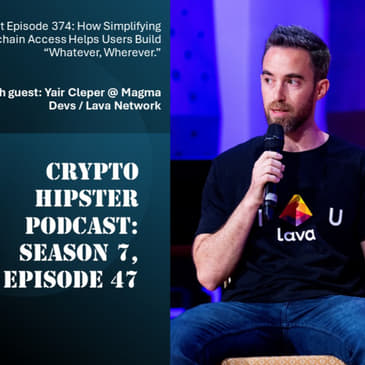

Yair Cleper, CEO and co-founder of Magma Devs, the initial core contributor to Lava Network, Yair is an accomplished serial entrepreneur having started his first company at age 21. Prior to focusing on crypto and co-founding Lava, he spent 6 years as the solo founder and CEO of Supersmart—the worlds first cashierless supermarket checkout technology. Supersmart processes $1.5B a year for top retailers in more than 9 countries. Other startups he’s co-founded include Ogmenti (Augmented Reality) and Octopai (Business Intelligence) for which he raised more than $50M, and hired hundreds of employees and had in general 2 exits.
[00:00:03] Hello everybody and welcome to the Crypto Hipster podcast this is your host Jamil Hasan, the Crypto Hipster where I interview founders, entrepreneurs, executives, thought leaders, amazing people all over
[00:00:16] the world of Crypto on blockchain all around the world and today I have an amazing guest. He is the CEO of lava, his name is Yer, Flipper, Yer, welcome to the show. Thank you Jamil, thank you. Actually
[00:00:35] initial code contributor, it's love and network. Awesome, awesome. We're going to find out what that means today. I want to ask you first about your background, what is your background and is it a
[00:00:47] logical background for what you're doing now? You know I'm always trying to make sense in what am I doing? Every day I'm waking up with this question actually what makes your heart sing,
[00:01:00] which is my passion. So I'm you know all the time trying to see if I'm achieving that day by day but actually my background is going back to Compute Engineering. I'm born and raised in Israel
[00:01:14] and study Compute Engineering in a special program of the army and I started my first startup when I was 21. Something in building websites actually and yeah following that I sold this startup three years later started a couple of other initiatives and actually three years ago
[00:01:42] my co-founder started doing MIV bots in Web3 and he just drug me and you know since I fell through the rabbit hole never looking back again and I found this this wall evolving in an immense pace and we were looking from the beginning on what are
[00:02:06] blockchains, right? What's the core infrastructure? How how how depth are going to build and how many blockchains are going to be in the future? And I think that's what brought us to to build love.
[00:02:21] You just present him with a follow-up you know I see today I see the market tanking people talking about capitulation and what do you think are going to be the number of blockchains in the future?
[00:02:33] Yeah you know so when we started three years ago there were a couple of L1s obviously L2s and I remember a couple of OG's telling me there's going to be a consolidation at the end of the day
[00:02:49] you're going to see only a handful of blockchains there but during these years you see different narratives such as modular narrative chain obstruction you see eigenlai are coming with AVS
[00:03:02] and at the end of the day I thought what is very unique with the blockchain is that they are kind of about to serve a specific purpose right? They represent communities, they represent people
[00:03:16] and what we believe in love is that you know the the future holds 100 and thousands of different blockchains right? If you open out today coin get or you see I think more than 11,000
[00:03:34] different currency there but in the future as many as a application you have on web too this and many more you're going to see on web three and each and every one of them are going to be represented by a blockchain doesn't matter its applications specific one
[00:03:55] roll up you know even obviously for example wallets or stuff like that but we are going to see more and more blockchain and that's the problem that I think the web three world is going to face
[00:04:13] the same team is starting their idea and building the blockchains pinnick it up but all of them have the same problem how do they track no drivers? How do they bring depths to build and how
[00:04:27] you make it scalable resilient and super fast for those devs and depths to build upon those okay give me some good follow up questions there I'm going to first ask you though about lava
[00:04:44] what is lava all about what do you do spectacularly well? Definitely so I think the proof is in the pudding and our customer is the one to say if we do it spectacularly well but you know we
[00:04:57] are focused on the delivering execution uh my co-founder and I at three times founders and you know we from our background we like to build scalable products so the first thing we did is to understand
[00:05:11] that there is a big gap on the way uh today blockchain early teams are facing right because once they spin up their own blockchain they need to spin the info they need to actually layer that will allow the apps to connect and interact with them read write transaction
[00:05:31] come up with you know swaps uh if you open the wallets the wallets needs to query the blockchains what are the gas prices how do you start making transaction how you read the history all this
[00:05:44] start of things and this is when they initially they came to us if we can build a unified layer that aggregate no runners to actually kind of put their infrastructure there and able
[00:06:05] to communicate directly with the depths we are able to solve this problem so imagine you know you have I think the best analogies kind of Amazon for web three services right because Amazon today
[00:06:20] are connecting the the the shoppers to merchants that can sell any kind of items so lava is connecting data consumers to data providers that can sell any type of data and this is
[00:06:38] the most crucial layer that we feel is a bit abandoned in web three so if I'm for example opening my wallet right the wallet is self-quiring the blockchain in order to read the data to make transactions
[00:06:55] to buy an NFT all of that are basic activity but then how who is the provider behind the sins so what lava is doing is aggregating all of those provider for a specific blockchain
[00:07:10] helping the chain itself the ecosystem to defy a pool of incentives and give those incentive back to the providers reward that based on the quality of service and what is actually the
[00:07:26] service that they brought so it's kind of an Uber for notes if you think about that. Interesting an Uber for notes I like it I like the concept I don't know what no runners are so
[00:07:41] I'm asking about that first you know what are actually no runners and how do they help the blockchain community scroll. Yeah so every blockchain is you know is consisted of a hundred and thousands of different nodes doing a different operation they can validate they can be just
[00:08:00] providing service and at the end of the day in order to interact with the blockchain you need to run a note that was the first premise of of every blockchain right permissionless you run a blockchain and then you can connect but today because there are hundreds and thousands
[00:08:20] of different chains it's very hard to spin up your own note and nobody is willing to do that so different providers starting providing this service but once they did that and they were supporting
[00:08:31] the last bull run the services became very centralized right so think about you know censorship resistance thinking about scalability you know proof of data if the data maybe is not from the blockchain that they provide and this is this is the way blockchain are working that is very
[00:08:54] different from the internet we know today today if you want to serve for no web you just type www.google.com right and that's an in blockchain it doesn't work like that because every blockchain is
[00:09:07] a separate internet and you need to run back you need to run a note in order to get there another to interact with it and so love is kind of this you are real that protocol behind the
[00:09:21] URL that's serving that because today when you are serving the web you don't know where the blockchain where the servers are hosted right you don't know which version of HTTP you use and this is kind
[00:09:35] of the thing we want to do we want to aggregate on the one hand the all the note runners that have access to a specific blockchain and the other way at the other end we want to aggregate all the
[00:09:48] needs all the demands of the different apps for the data on this blockchain and we are making them interact as a marketplace and we wanted them based on the on the service so love in a natural
[00:10:01] connect the no runners to the chains and help all the apps to build much more scalable resilient and fast apps see you're really going to be the Google on web 3 google i started with the amazon
[00:10:24] because it's a good marketplace the analogy right it's a permissionless amazon because at the end of the day we are open source every chain can take lava spin up its own infrastructure invite the
[00:10:37] node runners put a pool of incentives there and make the life of the chain easier today when a chain spins up you know everyone needs all every chain needs to start to talk
[00:10:52] to the providers how much you contract in me the contracts are for a locking contracts for one year they rewarding them not based on the service it's the quality of service so we take this burden
[00:11:05] away from the chains when chains are spinning up right they have hundreds of things to deal with but this infallio which is super crucial for them imagine that we're taking this burden away from them
[00:11:22] i love it i love the concept i'm trying to think of areas that i think would be problematic um one of them is you at 10,000 different chains which means you have a dozen or two dozen different Oracle networks so consolidating information to provide to those chains right
[00:11:45] so you're going to have you're going to have unreliable data because the data across all those Oracle networks are different so you're so you need to so one of the important things is data
[00:11:58] and data with different sources and different means of getting it is going to be unreliable so in i bel sometimes sensor you know some governments will tell tell those nodes providers you know
[00:12:13] we don't we want to sensor those kind of customers because x, y and z right or at the end of the day uh you know the data is not scalable suddenly one of the chains doing an adro right so there is a massive
[00:12:28] usage but it's unavailable for a handful of providers so with lava you have dozens of providers that they see this kind of growth in demand and it's a marketplace so when there there is a demand
[00:12:44] there is a supply yeah i agree i i i see that my problem is how do you tackle disparate data that's different and uniform and make a uniform or that's the bread and
[00:13:00] butter of lava and you know we i think we organized the top minds and experts in building open source you know cyber security experts and and software developers we wanted to tackle exactly those few things to bring accountability and data reliability for the chain so every
[00:13:22] node was joining lava he needs to stay clever for accountability and during doing that we sample the different queries right the different requests to the node and benchmarking them without the knowledge obviously of the node provider we benchmarking them to other providers
[00:13:45] so making sure that the data is 100% correct it's up to the latest block and that's being you know we i'm describing it to you now but this is being done automatically behind the scenes
[00:13:59] so according that maybe you know one two more words after so imagine now you're opening the wallet you want to see the different you know tokens you hold there in a specific chain right
[00:14:14] so the wallet query a specific provider that is being chosen according is quality of service and score right as if as in Amazon you're going to choose the best merchant there and following the transaction is finished we the the lava protocol aggregates all the data about latency availability
[00:14:38] reliability of the data and this makes the the final score and reputation for the specific provider so at the end of the day uh the provider who has better service will obviously receive
[00:14:54] more service in the future and more customers now I understand why you said Amazon that makes sense rely it's a year scoring all the participants based on yeah so the same way Amazon does
[00:15:08] God it that's a good I like it you know and another thing if you talk about Amazon that I remind you're reminding me right now so think Amazon wants to go to a new country let's say they are in
[00:15:22] Portugal right now this is kind of a new chain once to launch and you know once to launch a market place in Portugal so instead of how do you build this initial marketplace right so it's always the
[00:15:37] problem with the market but how do you bring the merchants to bring supply how do you bring the user the shoppers to bring demand right so imagine what is what lava is doing is helping you
[00:15:49] those chains to create a pool of incentives so this pool of incentive can create like a hundred thousand dollars or one million dollars incentives for providers to join and put shop this market and because lava has aggregated thousands of different providers they will join
[00:16:11] Portugal to join and serve because they see the initial pools they have a skin in the game and they want to be the first one who's joined up this is exactly how we eliminate the burden
[00:16:26] of bootstrapping this infrastructure. You brought us another concept said I think about now your companies focus on building whatever wherever right you know helping helping devs to build whatever so whatever wherever you mentioned Portugal and that brings up a whole slew of
[00:16:54] you know questions regarding you know at a country level at a macro economic level and cross borders right how do you deal with those risk political risks country risks you know regulatory risks
[00:17:10] yes so you know in general lava lava network is an open source protocol right so the change themselves decided how to implement the lava we call it a spec the lava specification right
[00:17:27] so for example in a country is that you have a list of all fuck right of like the chain decide if providers are supporting of fact or can offer for example and non-off fuck spec and this is
[00:17:45] very very elastic and it depends on the chain itself. Imagine like different modules that once implementing the infrastructure the chain can decide to do so we are agnostic to that like the lava protocol is agnostic providing both both of the things and obviously no any other problems
[00:18:06] with their regulatory it's interesting you mentioned oh fact um I was I was confused them being on the oh fact list for years took me to the years to figure out that I'm not the guy that that's on the
[00:18:25] oath act list right so you know the the the the the web to world and their you know regular is far behind far behind web three you know how do we catch them up get them up the speed
[00:18:43] you know so that they can that I'm a proper test of paper be comfortable with how the soil works in every revolution that you see there is always fear and I think at the end of the day the
[00:18:56] regulators trying to save and their goal right is to make sure that the millions that investing and believing in web three not gonna get into right pools or people will miss a handle the things so
[00:19:10] I think obviously they have good intentions and but whatever technology every technological revolution is bringing it's a lot of concerns peers and you know in the in the pace that technology is evolving
[00:19:26] today we need to address that from the get go work with the regulator in order to see how we come to a place there is a balance right how we come to a place that there is enough reporting
[00:19:39] but it doesn't stop the innovation right and the novelties and yeah I think you you know what you see today with the SEC and you know different fights you have through different ecosystem
[00:19:55] like you know as a new cover in the last three years it's gonna be super interesting how everything evolve you see the ETF right now the Bitcoin ETF the beginning of the year and suddenly
[00:20:06] the the E-fury Committee F just also coming up I think the regulator has a lot on their stake to deal with and obviously I'm not I'm not envy them our goal from the beginning in lava was to see
[00:20:23] what are the needs and to support the adoption if somebody wants to build an app build a app why it needs to start building his own cloud infrastructure right it doesn't make sense it doesn't
[00:20:38] not not a single app has the resources to start spying up their own nodes so our our core mission here and I think that's what you dimension before is to allow anyone to build whatever
[00:20:52] wherever doesn't matter which chain doesn't matter what but with lava you have a facilitated infrastructure that allows you to build it. I like it I want to talk about those developers because I can tell
[00:21:09] you what I've seen in the past several years is every new chain or every new project trying to reinvent the wheels that are leveraging what exists you're leveraging what exists right and one of the
[00:21:23] biggest you know arguments I've seen is this whole entire concept of modular versus monolithic right why is the focus now one modular networks you know it depends who you're asking right
[00:21:38] because at the end of the day it's all definition and what I learned personally in web free is that this is a narrative world right if you hit the right narrative it can go viral and then everyone
[00:21:53] going to speak about that whereas it doesn't it doesn't mean it's really different from the narrative that was one year ago just a different label that suddenly was adopted so you see not only
[00:22:06] monolithic modular you see chain obstruction led by Ilia from near is also a stronger you know strong influence in the AI world and and you see that there are the different narratives at the end of
[00:22:23] the day I think that was it's very unique for the lava network it touched it doesn't matter which doctrine you choose it doesn't matter what you believe in you need to read right transaction okay
[00:22:38] you need to read right the data and you cannot build your own infrastructure at home so you need to utilize the existing infrastructure and that's how in general we want to simplify
[00:22:52] this thing you see in a new chain up up and coming right and you want to build this next crazy depth on top of that we want to shorten the process of you executing that delivering this service
[00:23:07] and refraining from you to need to run your own infrastructure at the end of the day you know when you see the depth rushing to a specific ecosystem they use the public infrastructure of each chain
[00:23:25] who's maintaining that today is the chain himself but also the chain has a lot of things to do so that's how in the last half a year actually even more one year ago chain started to reach out
[00:23:40] to us and said but what are you what you doing actually with lava it's a lovely good right you are just picking up the fastest no-drunter that closes to the location of the depth and you get a fast
[00:23:55] response for them and you make those no-drunter as accountable so at the end of the day you are probably good because you're not biased towards one specific providers right if
[00:24:07] Google is serving this need you're not they doing that the best you're going to give the service to them if it's you know even jamilet is home running and no then making it the fastest and best
[00:24:23] reliance service you should get more service right so it's all based on the quality of service and back then you know how far ago we introduced this concept of public infrappals okay we call it
[00:24:38] incentivized public RPC just didn't want to dive into the technical details but imagine a public that the chain defined incentives invite no runners to join and connecting all the depths that needs a service to them and this will really eliminate the need to even ask
[00:25:00] are you supporting on it the modular the magnetic and that's how I'm coming back to the original question see you don't see this the modular future you see a hybrid future
[00:25:16] I see a modular future in the in the sense that everything you build we need to remember the values of web three and why why we all super enthusiastic about that right Composibility right the the permission is permission assess the fact to let everyone build whatever wherever
[00:25:44] and with you see this kind of you know shared security now with the with the eigenlair right and an AVS and you see dozens of different chains also supporting them so what are saying at the end of the day
[00:25:59] I'm a core believer in the modular if it served the purpose of bringing depth to be whatever forever got it I like a couple things you said too you know it is a it is a narrative world right
[00:26:23] right now obviously the narrative is mean coins but diving beyond that you know is everybody knows what that is right um that would be on that it had been two two narrative levels that have been
[00:26:37] constantly talked about for the past few years that I haven't yet seen come to fruition as far as their potential one is a count abstraction which you mentioned and the other is ZK right how do you see
[00:26:55] the future of those playing out and your role it helping to make them become you know the potential that they could be so you know in other narrative you see now is the AI right
[00:27:09] you see you know all those crazy evaluation of web two companies let's say that trying to develop from XAI of Elon Musk right now just got the deck of how much they're raising it's insane insane
[00:27:28] and there is like this kind of bull market of innovation right bull market of implementation different feeds that's gonna serve different purposes in the future right so you know we we started working with near like around half a year ago and I think near is you
[00:27:55] know one of the oldest monolithic chain that since then I was pushing the narrative of the count abstraction and together you know with sharding and now with the AI implementation we've seen that happening over lava right because near is one of the first adopters we started with
[00:28:15] Evmus, Acceler and here and near spin off the incentive pool of lava and invited providers to join and I can tell you that you know since the beginning of the year we've seen billions of realays already serve with near and you know hundreds thousands of dollars being distributed
[00:28:41] to the different providers so it's a real money that goes back to providers and not necessarily the loudest providers you know even someone as I mentioned before at the developer at home that
[00:28:53] is super techy and he build this amazing tech and infrastructure and devops you should get more service right because he's just doing a good service and I know actually no mentioning names but
[00:29:09] I know also a team of two people not only one is techy and they support more than 40 chains and on lava they reaching the top providers like we just see that you know you cannot trick the numbers
[00:29:22] you cannot trick the latency and you cannot trick the tech so at the end of the day what happened in year is that we are we were managing to connect you know millions of transactions and the users
[00:29:38] to the blockchain via lava we simplified that we became the go to RPC provider the go to Infra on here and it's just in a few months so now when the AI evolution is coming you know it's going
[00:29:56] to be even more demanding to do this kind of you know calculation and all these different computational level is in a different degree who's going to serve that I believe the answer
[00:30:12] to that will be love in the next month you know people are scared of AI you talked about fear earlier you know and I was thinking that AI somewhere has come in this year it's
[00:30:27] likely not I mean I don't know maybe you know what do you see as the I mean in a lot of a lot of crypto projects are put in the name A.I.E. on it with the hopes of you know getting a lot
[00:30:43] of money but we're not there yet right so what's going to take to be able to to get to the AI future that people do envision that they are afraid of or why shouldn't they be afraid
[00:30:57] look I you know I heard the Larry Page couple of years ago speaking about speaking of conference and mentioning this AI coming of revolution in tech I think it was 2017 and it said that in every revolution every technology revolution that's coming
[00:31:21] up it's taking jobs but it's creating a new more jobs right you see the industrial revolution in the previous century you see you know cars being presented and everyone was on horses
[00:31:40] you know no no no one will use that right but the adoption was parabolic right and as we progressing this space is just getting faster and faster I'm sure you've seen the last
[00:31:54] the chargept for all it's really like speaking with almost a human being it's insane the world the this feeling that it gives you and I don't know if I'm you know I'm super
[00:32:12] in a agreement with what what I heard Larry Page saying in this in this conference because it will take a lot of jobs right especially the AI it's something different than what we've seen
[00:32:29] because at the end of the day people are good in two things human being right if they good in physical work and they good in intellectual work right in something to understand you
[00:32:41] you need reasoning right you need to conclude this leads to another leads to another so the difference for from my interpretation right from the previous revolution technology revolution what in the industrial revolution that in the industrial revolution they took the physical they replaced
[00:33:01] the physical strengths of people with machines but now they replace the understanding capabilities of people with machines and these sounds carry as fuck as you said before and you know I think that it's gonna be super interesting I'm not I don't feel at the moment
[00:33:28] the one to predict but I'm definitely looking at trends and not trying to be more the populist right and the most the more popular prediction but more the accurate one and when it's going
[00:33:43] to lead us and the future what we call a future is not so much so far from us you know it's the next five years probably I love the parallel between the industrial revolution of up to soon
[00:34:00] Claire's jungle with today's intellectual revolution of a book yet to be named yeah I like that a lot makes sense in the first person to lay it out like that so appreciate thank you
[00:34:16] wow a lot to think about right so and you are you are in Israel right yeah I'm based in Lisbon that's why I gave the Portugal example but okay yeah great awesome yeah the team you know so
[00:34:37] the foundation of lava it's based in Cayman and we are actually the magma devs just re-branded the name magma devs in this is the initial call contributor around the 20 engineers experts and software developers I'm based in Portugal originally obviously from Israel
[00:35:00] and my co-founder is in New York and yeah but the team is distributed we adopted the the doctrine of web-tree people who can work from everywhere and I think it's unfold amazing
[00:35:14] Portugal is an amazing hub but I like the visits from time to time to New York which yeah it's one of the capital's of crypto and out awesome well I appreciate it and I'll talk to you
[00:35:30] and I want to thank you very very much for your time today I think I have one last question and that's just how can people find it more information about lava about you start using
[00:35:44] you know you're not working in part of this Amazon-esque environment and revolution how can they I can do that definitely so you know I'm I'm always available on Twitter feel feel free to reach out you know I'm only one of the of the lava the lava network that
[00:36:07] is being developing that currently there are other groups that also helping the protocol to grow and this being an amazing year especially since the lava network the foundation announced them point system it helped everyone to connect the wallets into lava and earn points so it's super
[00:36:28] simple everyone that has a wallets can do that and yeah I think what exciting for us now is that mainit is coming very soon and the lava foundation also announced the lava token
[00:36:45] so community is growing you know all the metrics looks super super promising and I invite you whether you are there whether you're in non-dev the lava foundation is presenting a lot of different
[00:37:01] roles and tasks for people to do and yeah I think you know you can find us on the lava net work at Twitter and our discord is also very very active so feel free to join there
[00:37:18] awesome thank you very much for your time today thank you jemil I happy to be here and thank you for the thorough questions and yeah looking forward to then next uh we're on cycle