
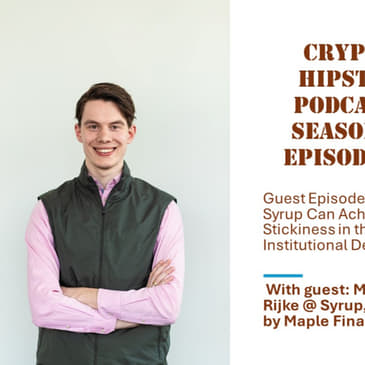

Martin de Rijke is Growth Lead at Syrup, a new protocol unlocking Institutional Yield in DeFi. Syrup is powered by the Maple Finance Secured Lending arm. Go to syrup.fi for more information.
[00:00:01] Hello everybody and welcome to the Crypto Hipster podcast. This is your host, Jamil Hasan, the Crypto Hipster, where I interview founders, entrepreneurs, executives, thought leaders, business managers, artists, you name it across the world of crypto and blockchain.
[00:00:19] And today I have an amazing guest. He's coming to us from Amsterdam. I'm looking forward to this interview. For Maple Finance, I have the business operations manager, Martin DeRike. Martin, welcome to the show. Thank you. Great to be on air. Thank you for inviting me.
[00:00:37] You're very welcome. Thank you for joining me today. And let's kick things off. And I think it was how I heard from you because you went to because you went to consensus, right? Right. Yeah, that's correct. And what'd you think?
[00:00:52] Yeah, I thought it was really good. I think it was one of the best conferences of this. I mean, probably the best conference of this cycle.
[00:01:00] And I think from, you know, there might have been a better one last cycle but we are, we're getting up there. So that's good. The vibes are good energy is good.
[00:01:09] The people are building. There's new people in the space. You know, things are things are growing. Traditional finances slowly but surely, you know, starting to put their footsteps into these conferences as well.
[00:01:23] So we were very, very happy with the results. And the other thing that was good is that, you know, but we aren't yet to the levels where it's so frothy that, you know, there's like a lot of, you know, people that are that are, you know, not really building, right?
[00:01:38] That are not really in it for crypto. So I thought the quality of the audience was really high. So we had, you know, a ton of good conversations. We had a ton of good partnerships coming out of it. New users.
[00:01:49] Basically every conversation was high value. So we're really, plus we had a breakfast, a pancake breakfast. And it was, you know, extremely oversubscribed.
[00:01:59] So there are like hundreds of people looking to attend, but we only had like, you know, 50 or 75 seats. So it was a good problem to add.
[00:02:09] Yeah. So next time I'll give you some words of advice. The other people who weren't able to attend, we had to go to Starbucks and stand in a long line. So if you could have like a bigger room next time, I'm sure you'd fill it.
[00:02:21] Yeah. Stay tuned for Paris or sorry, Brussels this year. ETHCC. I don't know if you're going to be coming, but we're actually going to do a much bigger event, you know, simply because of the oversubscription on the breakfast.
[00:02:36] We're going to do a several day breakfast. Let's call that. It's going to be good. Very cool. So let me ask you first, you know, about your background. What is your background and is it logical to what you're doing now?
[00:02:52] That's a great question. So guys in 2015 I bought my first Bitcoin. So I was always fascinated by finance, you know, since I was very young.
[00:03:03] You know, I looked at Bitcoin. I was like some magic internet currency. I asked my grandparents what it was and they were like, we have no idea. So I just started looking into it and quickly understood that this was going to be transformational.
[00:03:18] So, you know, got into it and in 2017 really became active. So I've always been doing it on the side and only in 2022 actually made the career move into crypto.
[00:03:30] So now, you know, working at Maple, you know, doing operations as well as currently being responsible for growth on the syrup side. So which is more like our, you know, DeFi product. Very cool. Very cool.
[00:03:46] So yeah, so I want to find out what you guys do, you know, what Maple Finance is all about and why you've been so successful so far. Yeah, so we are really an institutional DeFi marketplace. So we basically do lending and borrowing.
[00:04:04] So borrowers come to us and they can post our collateral and get loans against it. And all borrowers are institutions. So, you know, just the big names in the space.
[00:04:14] And then on the lender side, they're basically high net worth individuals and institutional lenders that deposit their funds and, you know, to earn a yield. So what we really do is we are basically the flag bearer for bringing institutions really onto the blockchain.
[00:04:29] So not just institutions, you know, buying the Bitcoin ETF, right, which is still all like traditional finance. We are really about bringing institutions on chain and actually earning their yield on chain.
[00:04:40] So we work with a lot of the big institutions in the space that I'm sure you know. Obviously, I can't really disclose specific names, but, you know, it's really all the big names.
[00:04:50] You don't need to discuss individual names, you know, but you chose to focus on on chain companies as opposed to bringing, you know, big traditional finance Wall Street guys into Web3. You've chose to focus on crypto native institutions, right?
[00:05:12] So how was that decision derived? And apparently it's been a really good one, right? Right. Yeah, so we so we aim to do both just in the short term. It's a little bit less friction to bring like the crypto native folks on Maple, right?
[00:05:28] Because they are already familiar with the blockchain. They're familiar with, you know, how to use wallets and how to use custodians and things like that.
[00:05:38] But we are also bringing the more traditional firms onto Maple, which is also it's not just it's not just due diligence from their side, but it's also very much education, right? Like explaining how the blockchain works.
[00:05:51] So we really do both. But obviously, you know, most of our growth has been on the crypto native side. Great. So I want to talk about a little bit about that growth. You launched Syrup recently, you know, what is Syrup?
[00:06:06] And my question says, why will people have a fine attachment stickiness in the institutional crypto market? For sure. Yeah. So Maple institutional landing is available for institutions, right?
[00:06:22] So you need to be accredited and accredited investor to get access, which is a pretty high bar for folks like you and I to meet. So what we do at Syrup is we basically open it up for everybody. Right.
[00:06:33] So it's permissionless. So you don't need to upload your passport. You don't need to be accredited. You just connect your wallet and you make a deposit, but you still have access to the same yields as that you have on Maple.
[00:06:44] So you still benefits from those institutional high quality, consistent, sustainable yields that you have seamless DeFi access, which then also enables all of the other benefits of DeFi. All right. So you can put it in an AMM and you can unlock liquidity.
[00:07:00] You can put it in the lending and borrowing protocol and use it as collateral and borrow against it. You can do looping strategies to earn additional yield. So it opens up all these beautiful DeFi primitives. And it's really a bedrock yield asset that generates institutional high quality yield.
[00:07:20] You said a word there that I don't recognize. You did say borrowing and lending. I know what that is. You know, looping. You said looping. Right. What is looping? Correct. That's a great question. So borrowing and lending is just, let's say you have ETH, you post it, right.
[00:07:39] You borrow against it. Right. So that's borrowing and lending. And what looping is, is that you do that a couple of times. So you basically loop your borrowing and lending position. So what you would do, for example, in this case, is you would post your syrup USDC, right.
[00:07:54] Which is like a 15% yield. Let's call it. That's like our target APY. That's what we have generated over the past three months. But you would post that as collateral and then you would borrow stable coins against it.
[00:08:07] So let's say you would borrow USDC against it. And on those USDC, you might pay, let's say, 5% just for the simplicity of the example. So that means that you have like a 10% spread, right. Because you're earning 15% on the syrup USDC, but you're only paying 5% on the borrowing position.
[00:08:30] And what you can do with those stable coins, you can again put them into syrup USDC, right. Which is like 15%. And then you can do that a couple of times, right. You can apply it again as collateral.
[00:08:39] And if you do that a couple of times, you can actually earn much higher yields. And this is how a lot of, this is why a lot of people use DeFi. Right. So for example, there are TNAP positions.
[00:08:49] They, you know, the reason why the DAI pool was so quickly filled up is because people were using this, right.
[00:08:56] To essentially lever up their positions. So I mean, you know, we wouldn't necessarily be endorsing that, but there's just a subgroup of people that love to, you know, lever up their DeFi yield positions. And I think it's something that should be available.
[00:09:10] All right. So let me see if I get this and I want to see if there's a difference between what you do and what I used to do. When I was a Celsius customer, I would have money on the Celsius platform. I would take a loan, right.
[00:09:27] With that loan, I would, I mean, it would be then I would take the money and I would put it back into the Celsius and I would take a loan off that money.
[00:09:35] And I'll keep doing that until I got to zero left to put as a deposit for a loan. The problem there was that there was TVL total value locked under the market tanked.
[00:09:48] I got a margin call, you know, luckily I went to them. I got a margin call. I was able to cover. So how does what you're doing an improvement with looping with margin margin calls to TVL?
[00:10:01] What are the requirements? You know, what's the what's the what's the improvement? For sure. That's a great question. And to your point, like it's it is a risky strategy, right? So, you know, this is really not an endorsement, but I would just say is accurate as well.
[00:10:15] Like that could be margin calls. The main difference here is that, you know, in the ideal situation like syrup, USTC and USTC are like the same the same value, right? Because they're both USTC, the nominated assets.
[00:10:29] So if you put if you deposit Bitcoin and borrow USTC, then obviously, you know, Bitcoin and USTC are, you know, very different values at all times because Bitcoin can just go up and down.
[00:10:41] So I would say that is the main benefit. If you have a yield bearing version of a stable coin, assuming that it will stay back right to the stable coin, which is that's a big assumption and obviously a risk that everybody needs to take into account.
[00:10:55] But that's the reason why it is different. So and that's the reason why, for example, a lot of people are doing this with staked USDE like the Athena token.
[00:11:08] OK, so you're doing a stake. If they're doing with stable coins and I was doing it with Aave Bitcoin and Chainlink. So it's much more volatile to do with non stable coins. Correct. Correct. That makes sense.
[00:11:28] OK, so there's a long tail path of bringing capital markets onto decentralized block. And you said you do both. So are the natives and then your goal, you know, is bring is bring capital markets onto decentralized block chains.
[00:11:43] And that's going to take I don't know that's a liberally that's a very longtime project. Right. What does that look like to you? How do you do it? And what does it look? You know, what does that path look like?
[00:11:55] Sure. That's a great question as well. And I think that's the beauty of block chains is that it can bring people together globally. And, you know, it's it basically creates global efficient markets where normally things would be very siloed.
[00:12:09] Now, you know, you can actually bring everything on the global block chain, which enables new use cases.
[00:12:15] And I think the main way we're currently doing that is that we that we, for example, we have a receivable spool on Maple, which brings, you know, tax receivables on the block chain.
[00:12:26] And I think that is a really exciting space is to bring a lot of those real world assets on the block chain and make them, you know, globally available for folks.
[00:12:36] At the same time, I also think there's a lot of challenges in that particular domain, you know, like liquidity and duration and things like that.
[00:12:45] So what we have currently seen on Maple is that most success is actually just in our plain crypto native over collateralized digital asset lending strategies. And the reason is because they are shorter duration. So if you want liquidity, you can have it in like 30 days, right?
[00:13:03] You're not locked up for a year or two years, which happens a lot with like the real world loans. Right.
[00:13:09] When a business takes a loan like, you know, that they don't want to have it for 30 days that they want to have it typically for like a year or more. So I think that it is a long it's going to be a long grind.
[00:13:21] And, you know, we are really finding our product market fit in the crypto native vertical. And, you know, we can scale that out over time, right? And add those additional real world verticals to the mix.
[00:13:34] Which is also, yeah, I think the beauty and the elegance of the platform in that different pooled elegance can also come to, you know, bring those different strategies on the block chain.
[00:13:45] But for now, I would say, you know, the first bridge is really bringing those shorter term corporate loans on the block chain. Like that's really what, you know, what actually there is actual product market fit between DeFi and real world assets.
[00:14:01] That sounds like that sound. That sounds good. You said they said a magic word there. You said durability. A lot of people try to achieve durability and a lot of people don't achieve their ability. Right. How do you how do you get it done?
[00:14:16] Yeah, so I think it's it really comes down to most of our team comes from traditional finance and has worked at all the big financial institutions. And, you know, you can say what you want about that, but it's it's really high quality and proper credit underwriting. Right.
[00:14:33] There have been certain systems and procedures that have been built in over decades, often learned through pain.
[00:14:40] Right. Like the traditional system had a lot of blow ups and failures, but, you know, that also resulted in new regulations and new procedures and new ways of doing things and new standards that have been adopted.
[00:14:52] So we definitely want to learn from all of that and bring that into our business. Right. And that's also why most of our team actually comes from traditional finance and brings all of that to the table.
[00:15:03] So what does that mean? You know, we have very good procedures for, you know, all of our commercial and credit operations. Right. So we check all the balances of borrowers. You know, we underwrite them. We checked our financials, things like that.
[00:15:21] And at the same time, we have, you know, very sound procedures for what digital assets require, which is 24-7, 365 monitoring. Right. Because prices move at all times, including over the weekends. We have relationships with OTC desks to sell collateral in case there will be a liquidation event.
[00:15:41] We have automated margin goal setups that send margin goals to borrowers in case you just explained about your marginal situation. Right. Like that's also something we need to handle.
[00:15:53] We need to handle, but on that scale with these institutional counterparties and then, you know, making sure that those margin goals are met. And if not, we need to proceed to liquidation.
[00:16:01] So all of those processes are all set up robust. You know, they're tested, you know, over the past year or so. And now we're actually bringing that to a wider DeFi audience.
[00:16:18] Yeah. So there was a lot of knocks on DeFi back a couple of years ago that it didn't work.
[00:16:25] Right. But when these companies all imploded, you know, payments were made like effortlessly and flawlessly between the failing companies, you know, because it was all on a smart contract and wasn't subject to subjectivity.
[00:16:44] You know, so, you know, what are the benefits of having, I guess, the DeFi on chambered or is on chambered definition? What are the benefits of setting up these processes, you know, and helping the web two companies transition there some of their processes to web three.
[00:17:05] So that's automated and automatic for them. For sure. And that's a great question. And that's basically the second part, right? So the first part is like all this institutional traditional finance taking all those lessons on board and like implementing the good things.
[00:17:19] But obviously, what are the issues there? Lack of transparency, you know, lack of automation. It's not global. All these different systems are not talking to each other.
[00:17:29] Like the infrastructure is very inefficient. Right. And everybody knows that. And that's why everybody came to work at Maple. Right. Because they were like, this is not sustainable. You know, it's there's so many issues. Now, the beauty of the blockchain is to your point, everything is global.
[00:17:45] Everything is pretty much instant. You know, like we like to complain about, you know, like one minute settlement times, which, you know, obviously it should be shorter and, you know, folks like Solana are building that.
[00:17:57] But in traditional finance, it can take much longer than that. So and it also brings all the transparency. So that's the beauty of Maple is where all the loans are transparently on chain.
[00:18:09] So you can see at all times are the borrowers actually performing to their obligations? Like are they actually paying interest? Are they repaying principal when the loans are called?
[00:18:19] What is the life status of collateral? Right. Are actually are the loans all over collateralized or in fact, you know, are they not? Right. So everybody can keep us accountable. It's not a black box like Web2 or I'll see if I used to be.
[00:18:34] And it's really all transparent on the blockchain, which, you know, keeps us honest and keeps all lenders informed about the actual status and what's actually happening with the capital that they provide. Very cool.
[00:18:48] So I'm going to look at what you talked about, like, you know, when we were at consensus with the big talk of the town was the current regulatory environment, how U.S. Congress had just passed a bill overturning this really, really shady or crappy accounting rules.
[00:19:07] And then the day after everybody went home, President Biden vetoed that. Right. So we're back in the we're back in the uncertainty. You're back in the uncertain, unregulatory environment now. So and regulators don't like for some reason, at least in the U.S., don't like defied yield.
[00:19:24] They like only banks providing yield and the banks provide like a quarter of a percent if you're lucky. You know, so how do we navigate today's defy yield opportunities in this uncertain regulatory environment? Yeah, that's an excellent question.
[00:19:41] And also something that I don't think anybody has the answer to. Right. So it's really difficult to to know, because to your point, it changes every day basically or every week like there's new stories.
[00:19:53] And I think there's a lot of division as well in the regulatory bodies themselves. So you obviously see people leaving these regulatory agencies, people have different opinions that they're voicing publicly. I think, you know, a lot of the Congress itself is very divided.
[00:20:10] So I think it, you know, I think everybody needs to, you know, decide how they vote. Right. In the end, we are living in a democracy.
[00:20:20] And, you know, I think everybody, if it is an important enough issue to citizens, which I think it is right to many citizens. Like I think in the U.S., we are more than 50 million people help crypto with this Coinbase campaign.
[00:20:33] So I think everybody just needs to, you know, vote with their feet. And then I think it will get sorted. I mean, the optimistic side of me has always believed that the U.S. is going to get it right.
[00:20:45] And let's be honest, like the U.S. is really the main place that matters. Right. Like if the U.S. gets it right, like everybody else is going to get it right as well.
[00:20:54] But I, you know, in the end, for whatever reason, the U.S. just always seems to make it happen and attract all the innovation. So we are definitely not betting against the U.S. Like the Maple Nexus is also in the U.S., right.
[00:21:08] Like a large chunk of our team, a large chunk of our clients are all in the U.S. So we very much believe that the U.S. is going to get it right. But how that is going to happen exactly, we don't know.
[00:21:22] But you know, it will happen. And I think you're starting to see a lot of positive signs already with the Bitcoin ETF, the Ethereum ETF. A lot of the big institutions like BlackRock are obviously, you know, flag bearers for the industry now,
[00:21:40] which is a huge change from one year ago. So, yeah, we are optimistic. And personally, I'm also a very optimistic person by nature. But you know, I think it's also rooted in reality at this stage. I think you're right.
[00:21:57] You know what it looks like though is anybody's guess, right? You know, trial and error. If I should get there. But you said something. You said vote with your feet.
[00:22:12] I don't know what it looks like in the Netherlands or what it looks like in certain European countries this coming fall. In the U.S., we have a presidential election. I think somebody told me there's about 30 elections, you know. So we have a really dynamic political environment.
[00:22:31] We also have an environment currently this week in crypto where the prices have crashed, you know. So, you know, the question is, what does the rest of the year look like?
[00:22:43] You know, and what are going to be the opportunities in DeFi as we go into this election cycle? For sure. I think that's a great question. I would say there's just so much innovation happening every day.
[00:23:00] Right. So if you look at the number of new projects, the number of existing projects that are shipping new features, the amount of capital coming in, the amount of talent coming in. I mean, it's just incredible.
[00:23:11] Like if you look to the amount of talent coming in from all these different industries into crypto. So I think it is like a ball that you hold under the water. Right? Like the longer that the price stays flat or trans sideways or whatever,
[00:23:24] like the harder that ball eventually is going to come out of the water and the higher it's going to go. And the reason is simply because fundamentally so many good things are happening. Right? If you look now, for example, to this Coinbase smart wallet.
[00:23:35] I mean, that's super exciting. I saw the other day like a new Solana wallet where you don't have to, you know, store your own keys anymore. But it essentially just uses your fingerprint, you know, to store your keys. And it's still fully non-custodial. Right.
[00:23:52] So it is still fully self-custody. Right. Like nobody else is holding your keys. I think these type of innovations are needed to bring everybody onto the blockchain. So I think most importantly, everybody just focus on building.
[00:24:05] Keep building. Keep shipping product. Which is what we have done as Maple. I mean, at the bottom of the last bear market, we were essentially at zero TVL. Right. We had to start from scratch. But you know, we kept building.
[00:24:17] We kept, you know, grinding. We kept finding new users. And slowly but surely, you know, you will find product market fit and you can really start scaling. So I think that's the key.
[00:24:28] And right now we're at the most exciting point, I think, of the cycle, which is the point where, you know, not everybody has entered yet, but you know it's going to come and it is going to come.
[00:24:41] And at the same time, there's just a lot of opportunity and there is sufficient capital and sufficient users actually got something off the ground. So I think it's like we are at the best time ever if you really zoom out. I think so too.
[00:24:57] And it is kind of like that early dial up internet phase where you have that screeching sound and you're waiting for the phone line to work. But eventually everything became, you know, iPhones and androids. So let's talk about those retail users, right?
[00:25:18] They're going to come right but they're going to come via, they're not going to come via meme coins. They're probably going to come through point programs.
[00:25:27] You know, what is the future of point programs and Web3 and why is it a massive opportunity not just for retail but for for Main Street as opposed to Wall Street? For sure. That's a great question.
[00:25:42] And I think, you know, at Serapy, to start there, we also have a point program and, you know, to incentivize users, right? So we have to like 15% yield and then on top of that, you know, users can earn drips.
[00:25:56] Now the way that we have structured it is incentivizing actual long term users, right? So if you, for example, commit your capital so you lock it up for a certain amount of time, you will get additional drips.
[00:26:08] Or if you then use your Serapy USTC token elsewhere in DeFi with one of our partners, you're also going to get additional drips, right?
[00:26:17] So I think the key of a point program is to incentivize real usage of your protocol in the way that it's supposed to be used. For the way that, you know, for like what its intended build is and what is our intended build?
[00:26:31] Our intended build is for you to earn long term yield, right?
[00:26:35] So you can enable consistent, you know, long term yield as well as for you to use it elsewhere in DeFi for your liquidity needs or, you know, if you want to level up or, you know, have any other strategy.
[00:26:50] So I think that is the key to ask as a project is, you know, like what am I trying to build? And then you want to incentivize the behavior in users that you want to see.
[00:27:00] I think a points program is an amazing way to get off the ground because in Web2 we have seen that, you know, those networks are dominated by network effects in the sense that the larger you are, the larger that it is to kick you off the throne.
[00:27:17] Right? So try to displace Facebook. I mean, even the CCP hasn't been able to successfully do that with TikTok, right? Despite unlimited resources, essentially. So I think the key is that the only way to break through those network effects in Web2 is to actually have those incentive programs.
[00:27:38] To incentivize your first users to use your product, while the product is probably going to be worse than whatever mega competitor there is out there.
[00:27:47] But the only thing that actually does make it better is because you got an incentive as an early user and you're part of the long term success of that product. So I think that is the key is aligning your users with the long term success of the product.
[00:28:05] And what I think works well with point programs is also utility. So what utility can you offer your users or the point programs? For sure. For sure. I think that's aligned with the point around what do you want your product to be used for?
[00:28:28] And how can you incentivize that usage, right? So it's not just mercenaries, but it's actually real users that give you feedback loops on how you can improve your product.
[00:28:39] Because in the end, it's mostly pilots. It's just beta products and the beta phase that are trying to find product market fit. And this is a great way to gather with your users to iterate yourself to a place where you can actually get mainstream adoption.
[00:28:53] And the reason that the users are using you is not just because they like it, but also because there's an incentive on the other side. Well, that makes all the sense in the world to me. So that sounds really good.
[00:29:06] So one last thing I want to ask. I have two last questions. First one is this, is I get people who are experts in DeFi because I enjoyed DeFi Summer a few years ago so much and I've been dying for it to come back and hasn't yet.
[00:29:22] When do you think we're going to see the next DeFi Summer? What's going to be the catalyst for that to happen? Yes, that's a great question. I mean, I would say that we might actually be in a DeFi Summer at the moment.
[00:29:35] Obviously not price wise. But I think sometimes fundamentals lead price and other times price leads fundamentals. It's an eternal debate like nature versus nurture. But I think if you look to the fundamentals, Aave recently crossed 20 billion in DVL.
[00:29:55] I mean, 20 billion, that's a lot of money. That is just a small scale economy like a small European country. That is enormous. I mean, Athena went from zero to what is it? I don't know, like 3 billion or so in the matter of a couple months.
[00:30:13] So I think we have just gotten so used to 2 billion, a billionaire, a billionaire that it almost starts to become a little bit desensitized to it. But what it actually means is like those are gigantic numbers.
[00:30:27] So I think the main thing is that the prices might have not caught up yet in DeFi itself, which I think the main reason could just be that it's because of fundamentals. So a lot of these projects are now valued based upon fundamentals instead of based upon narrative.
[00:30:46] So if you look to the AI tokens, for example, it's all narrative. There's not much actually being built and in those type of cases, prices can really outrun themselves. But once you can actually see the fundamentals, things typically become a bit more reality.
[00:31:03] So that's my take. But I think innovation itself is really flourishing in DeFi. I like to take. I like your assessment. I like that. You know, you're the first person that talked to who said, you know, yeah, interesting. Thank you.
[00:31:22] So thank you very much for your time today and talking to me. I enjoyed speaking with you and I have one last question. It is how can people find more information about you, about MapleFance, about syrup? How can they become users and clients?
[00:31:39] Great question. So just go to syrup.fi and we got all of our links there and you can sign up as well for early access.
[00:31:47] And if you listen to this once we're live, so then you know, you can make it a part of the talk if you want. It sounds like I want to. So thank you very much for your time today.
[00:31:59] 100 percent. It was a pleasure. Thank you for having me on.