
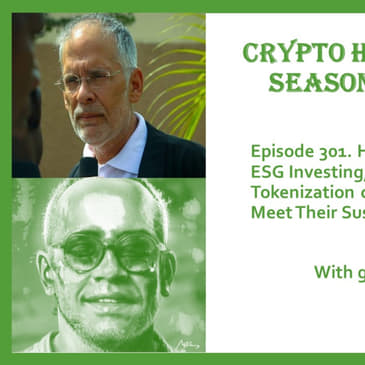

With 40 years of international cross-industry problem solving experiences, Daniel Steeves maintains his focus on the strategies of the leading edges of emerging technologies.
He has provided direct technical and business architecture leadership for over $1.5 billion in successful cross-disciplary tech programs. Daniel works directly with investors and business owners and mentors startups with his hybrid enterprise/sme/founder points of view.
https://twitter.com/danielsteeves_
[00:00:00] Hello everybody and welcome to the Crypto Hipster podcast. This is your host,
[00:00:05] Camille Hassan, The Crypto Hipster, where I bring you founders, entrepreneurs, executives,
[00:00:10] amazing guests really from all around the world of crypto and blockchain.
[00:00:15] And I have a repeat guest today. He spoke to me a couple of years ago. Really awesome conversation.
[00:00:21] He is, and there's no title to describe this, meant strategy expert, 10 years ago when I was living in London working in the fintech sector mentoring working with startups and growing businesses. So I'm a Canadian, I've been in Canada, I've been in the Middle East 12 years in London, 7 years in Germany and since we last DeFi startups. Not certainly unusual for all of the rug pulls because that's part of the red flags that you should look at, but also because the space was far less defined and you had a little bit more flexibility. Now, if you
[00:03:04] want to attach your name to something, you Dubai is kind of a wild west without regulation. Singapore is quite regulated but it's a separate state and it's under a lot of pressure both from China and from America and they tend to follow these policies. Switzerland is a place that doesn't worry about that type of pressure
[00:04:23] and are pretty much the leaders in you clearly couldn't trust FTX, but you couldn't trust Binance either, as it turns out.
[00:05:40] Right.
[00:05:41] So does that mean you can trust Coinbase or is that company based in America a trickier
[00:05:47] one to work with? Made in the EU is better than not made in the EU. Made in Switzerland is better than not made in Switzerland. Singapore to European and American investors and consumers and companies is less clear. Dubai is less clear. Switzerland is just like, oh yeah, we can trust them.
[00:07:02] The chocolate's good. as one of the experts and one of the jurors at a very large international accelerator program called MassChallenge Switzerland, which has an American counterpart, and I'm also one of the jurors and mentors at Venture, which is the oldest and largest here in Switzerland. So through MassChallenge, turns out one of the companies I was mentoring in, as one of the many experts that they had, it was my first question was why are you in an accelerator? But it's part of the way to step to get into Europe because this is part of the question and challenge for any of these companies is to get themselves spread a little bit further. So as we continue to talk, I found out about his second company, which is also in pilot operations. It's a
[00:09:44] heating ventilation, air conditioning, HVAC, AI building solution, which will deliver 30 You've got these two projects with the same founder, different co-founders and operations team going after ESG from a different angle. Now, none of this to any of your listeners so far sounds like crypto. Unknown to me, one of the reasons he was most interested in me was because of my crypto background. So I've been helping him with these businesses and the messaging and the like,
[00:11:00] and we're looking at the different ways
[00:11:02] to particularly scale up the AI category in the ESG space. Both of them allow their clients to hit three, four, and in some cases, five or six of the UN Sustainable Development Goals. And we're looking at a model to help the customers actually realize the value from the carbon
[00:12:20] credits, particularly in countries like India, Chile, Morocco, where we've already got a
[00:12:26] footprint and are looking at expanding. you might earn at a lower level because you would have executed the project anyway because a, it's a lower price impact and b, you're simply going to save a bunch of money. So you didn't need, I might say no, somebody else might offer me 12 and it's based on the project level. So, to me there's a severe lack of clarity in this for the outside players, the companies that are trying to do business
[00:15:01] and earn some value from the projects that are coming from
[00:17:47] the solar thermal company, Tenza Heat, the AI will be supplying the knowledge that we have in both of these websites and the trade facility to come. We'll have, rather than more accessible is also what we need to do for our clients. We want to help them to get through this process. We'll earn in the space of doing that, of course, because we're facilitating it like any other service provider would. They'll be incentivized to do it with us because they will
[00:19:02] pay a little bit less for their services if that, to invest in each of these projects.
[00:20:24] Carrying on from that, the projects themselves, as in you words they'll pay an extra few points to have an insurance coverage on it to some level, all to be determined with our ensuring partner. We started the discussions. So we want to create a crypto economy that drives its own projects in,
[00:21:41] creates the value for the token holders it's tacked to the value of EU carbon credits but when I look at what the token value is I don't understand it, I don't understand the mapping, it's even more confusing than USDT, right? Like for a long time I used to believe BUSD had $1 for every dollar they had with USD little bit further, have another bit of a discussion, there's always a slight altering. To my understanding of it, there's always these tiny little adjustments, even within the different standards that you're going to work for. might be. And even this is still not clear that they're the perfect choice yet, right? But I'm pretty certain that anything that
[00:25:40] you're going to have that you're going say, well, it was FTX bankruptcy, right? No, it wasn't. It was Terra Luna. Terra Luna lost its peg being stable because a lot of hedge funds in Chicago wanted it to die.
[00:27:04] And so they made it that way. And what that this is part of the approach that a couple of them are trying to take.
[00:28:20] Gold standard, as I mentioned earlier, and replanting, and we're also for the moment going to stick only with mathematically, empirically provable history data, baseline data, current data
[00:29:44] to prove the results, right? Because you can't So, if anything is easily scammed, it will be scammed and we've never learned that lesson before. We certainly learned it in the crypto world. In the crypto world, scams and rip-offs are really just re-maskings and repackaging of most of the other scams that already exist people will chase it after you. He said, I've done it twice. And both of his projects, I knew he earned money, stole money and shut down. So the prevalence of this type of stuff combined with all of
[00:32:20] the lobbies against crypto, all of the lies to you, right? So the banks, the governments, the controls, the scams,
[00:33:43] the element of politicians trying to protect citizens, I walk away with a bag of euros, good luck ever tracking anything. You give me a bunch of Bitcoin, if I want to do something with it, it's going to move, it can be tracked. I mean this is the whole point of what the blockchain is, right, I mean, I'm not going to talk on the podcast or blame upon the pandemic for all of the views around gender, but all of this stuff happened when people started, the people that were interested, started learning more, reading more, and started realizing their capabilities, their abilities, their rights, their feelings, etc. When you have time to think,
[00:37:31] But our project, no. When we launch our cryptocurrency and we're going to be first looking for a couple of whale type investors, right, to people to help us build this thing up because we're
[00:37:34] working on the model, we have the businesses that will drive the commerce in, all of this
[00:37:39] is getting mapped out, the white paper is constantly under adjustment right now because I think it's 60, let's say it's 50 euros and you put in 100 euros, you will get 1.75 or 1.5 of tokens that are each equal to one European market carbon credit, stable.
[00:39:07] Stable to its market value. We've picked this one because it's just simpler to say and 25 cents will go into our utility token. Initially, all of the money will be used for investing but those tokens that those people hold are the ones be money from the insurance and so on. All of the profits owned by the trade, a significant amount of that profit will be split into two pieces. One will have a nice strong LP so the day trading is allowed and is enabled but when you have revenue events coming along two or three times a year they're like a dividend event people tend to hold and once we've because they hope that the value will go up or companies that are using it to offset their own carbon emissions, which by the way is where Tesla used to and probably still does make most of its money. Not selling cars, selling... Selling carbon credits. Yeah, not all of're investing in something that is a stable value that we don't touch or control and that is projected to having gone down this year because of adjustments in how the EU did stuff which
[00:45:40] will reduce the supply. The expectation is that it will by next year potentially go from those revenue events we would bring you up to one full token. But if we do that, then that carbon credit token becomes a security as opposed to a utility. So, instead of increasing the value and confusing people because it's not yet stable and when will it be, you'll get 0.75 of a dollar's
[00:47:02] worth of that token, not your full's so different than what you just said,
[00:48:20] is it's like we have a two-lane highway and we have a just print more, right? In our case, we're going to have this stable token and we're going to mint one each time we buy one. So, it's a different type of contract, right? But it also will have the triggering mechanism that they can't be minted in this,
[00:49:40] like the digital twin from the original electronic registry and we're going to continue to work with any of the supply chain on the solar thermal side to ensure that that's as good as it can be. But everything is replaceable, recyclable, it's a 25-year lifespan, it's an amazing type of stuff. We'll have some other conversations and you can have a chat with the founder of that business,
[00:51:01] those businesses at a future time as we chatted. But those two circular economies, need to ensure that we aren't positioning ourselves as proponents either way of our own projects or the others. It's almost like it's going to be a wall that you can walk up to and look at and read the stuff and ask questions if you want to, but you buy, sell the, you know, the standard thing you saw on so many LinkedIn posts about this is not
[00:52:23] financial advice. That doesn't really protect Yeah, that'd be great. So one last question. It's really easy one. How can people find out more information about you, about your companies, or how can they
[00:53:41] chat with you?
[00:53:42] How can they do that?
[00:53:45] My LinkedIn profile is open and talk to you about your contacts in the hospitality sector, in the industry sector and all of this stuff because it's the type of product that just should roll out and start to make. I love it because you can install it and start saving money and pay for it with the money that you're saving. To me, this is
[00:55:01] one of the best business models you could ever think of. If you have your big tall building that