
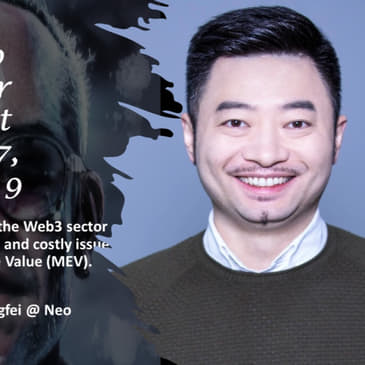

Da Hongfei
Title: Founder of Neo and CEO of Neo Global Development
Bio: Da Hongfei is the Founder of Neo, an open-source, community-driven blockchain platform designed to welcome developers into the Smart Economy. Hongfei operates as CEO of Neo Global Development (NGD), the executive arm of the Neo Foundation that is committed to developing the Neo protocol and its supporting ecosystem. He is seen as a luminary in the Web3 space and as a blockchain pioneer in Asia. Hongfei received his education at the South China University of Technology, receiving degrees in technology and English.
[00:00:00] Hello everybody and welcome to the Crypto Hipster podcast. This is your host Jamil Hasan, the Crypto Hipster where I bring you founders, entrepreneurs, executives, artists, you name it, across all over the world of crypto and blockchain.
[00:00:15] And today I have an amazing guest from around the world for me. He is coming to us from Singapore. His name is Da Hongfei. He's the founder of NIO. Da, welcome.
[00:00:30] Hello Jamil. Finally, yeah, finally we made it.
[00:00:34] Finally made I'm happier here. Looking forward to this interview and yeah, I'm really excited. I woke up early this morning in my time to have this and it's great. So I'm looking forward to it.
[00:00:44] So let's kick it off.
[00:00:45] What's the time? Yeah, what's the time to are you? Which part are you? Are you in the US?
[00:00:50] I'm in the US New York time zone. So exactly 12 hours.
[00:00:55] Yeah, we are. We are actually on the like a different pole of the earth. The longest flight is from Singapore to New York, 17 and a half hours.
[00:01:10] Oh wow. Yeah. I once flew to Hanoi from the US. That took 20 hours but because we had a four hour stop.
[00:01:23] So yeah, I'm happy you're here. So let's kick things off and ask you the first question. What is your background and is it a logical background for what you're doing now?
[00:01:37] On the paper, I think it's not logical. I studied English and technology in my college, which is in Guangzhou in China.
[00:01:51] The university is called South China University of Science and Technology, but I was majoring in scientific English.
[00:02:02] So basically I'm not a same student. I'm more like a liberal arts student.
[00:02:12] So I got a Bachelor of Arts, not Bachelor of Engineering or Science.
[00:02:18] But during my college years, I was very interested in two things. The first one is computer science.
[00:02:30] I went to college in 1997. That's the year where internet became not popular, but become like let's say ordinary in colleges.
[00:02:49] But we still don't have internet access in our dormitory. We need to go to the so-called computer laboratory.
[00:02:57] It's like an internet cafe to use computer to use internet.
[00:03:02] So I immediately found for love with computer science. I spent a lot of time there studying it.
[00:03:11] I started C-language. I taught assembly language to myself and I started to write viruses in assembly language.
[00:03:26] And I was the moderator of the computer cybersecurity board of the BBS, the bulletin. That's an old thing from my university.
[00:03:40] So computer science is one of the two things. I spent a lot of time during my college.
[00:03:48] And the second thing is my hobby or my things I like is economics.
[00:03:58] I discovered a blog which is in Chinese and the title of the blog website is called New Institutional Economics.
[00:04:12] So I read a lot, not by textbooks but read a lot blogs articles in economics.
[00:04:21] So I gradually strongly influenced by the Austrian School of Economics, the New Institutional Economics.
[00:04:31] So that's the two aspects that I spent most of my time during my college years.
[00:04:39] And then after I graduated, I did not go to an internet company or tech company.
[00:04:50] I started to do educational consultancy by myself.
[00:04:56] I funded a small company. It's like a small business, only around 5 to 10 employees helping Chinese students.
[00:05:08] And until 2011, I came across a blog. Again, this blog is about Bitcoin.
[00:05:23] I remember I stayed very late that night, maybe 4 or 5 o'clock.
[00:05:32] I was just fascinated by the idea, by the technology, by the economic parts behind it.
[00:05:42] So then I spent a lot of time learning about it.
[00:05:47] Visiting the BitcoinTalk.org, BBS for our forums.
[00:05:54] So that's how I discovered Bitcoin.
[00:06:02] Wow. And you founded NEO.
[00:06:06] So what is NEO all about? How did that transition from Bitcoin to NEO start?
[00:06:15] How has NEO evolved over the years?
[00:06:21] In 2012, there was a post on the BitcoinTalk.org website, the forum.
[00:06:30] It was posted by a Chinese guy. His nickname is Brian Cat.
[00:06:38] He wrote that currently people are mining Bitcoin using CPU and some of them are using GPU, an FPGA.
[00:06:50] But those equipment are still slow.
[00:06:54] He is a doctor in a major Chinese university, a good university.
[00:07:02] And he asked for Bitcoin to crop something to build the first ASIC miner machine in the world.
[00:07:14] I did not remember how many Bitcoin he was funded.
[00:07:21] But I think it's equivalent to maybe one million US dollars something.
[00:07:29] At that time, that's a big sum of money.
[00:07:32] And finally he did it.
[00:07:34] And he also issued a so-called stock, a virtual stock of his company to the investors.
[00:07:43] So the funders not just get an ASIC miner,
[00:07:48] they also get the share of his company.
[00:07:53] And they made maybe 100 times in a couple of months.
[00:08:01] So I think it's an enlightening moment for me.
[00:08:09] So we decided, we thought it's a very interesting idea to do crop funding using cryptocurrency, using Bitcoin.
[00:08:18] But it's not easy because setting up a company and then issues virtual stocks
[00:08:27] and they issued it on a centralized website, not on the blockchain.
[00:08:32] So we decided maybe we can do something like a service.
[00:08:38] We can do a blockchain which is focused on crop funding for crypto projects.
[00:08:45] That's how NIO was born.
[00:08:49] That's crop funding for crypto.
[00:08:52] That sounds smart, good idea.
[00:08:53] So initially the tagline of NIO is Bitcoin plus Kickstarter plus Nasseq.
[00:09:14] I like it.
[00:09:17] That's 2014.
[00:09:19] We started maybe half a year after Ethereum.
[00:09:27] So that brings us to today.
[00:09:31] Over the years, your prices, I looked at your price on CoinGecko the other day.
[00:09:37] You're about $15. Your high was 600 something, right?
[00:09:41] But you're always low.
[00:09:43] You have made transformations and made changes over the years.
[00:09:46] One of the changes is NIOX.
[00:09:49] It's a side chain, right?
[00:09:52] What is it all about and how do you drive interoperability using it?
[00:09:58] Yeah, the current management of NIO is called NIO-N3.
[00:10:04] N3 is very independent from other blockchains like Ethereum or Solana.
[00:10:12] NIO has its own virtual machine called NIOVM.
[00:10:17] We wrote it for a scratch.
[00:10:20] NIO has its own smart contract system.
[00:10:23] We support Python, JavaScript, Go language and C-Shop.
[00:10:30] So we have a completely different smart contract system.
[00:10:36] It's a nice feature.
[00:10:38] It's a good try, a good exploration.
[00:10:42] But the problem is Ethereum has a huge ecosystem.
[00:10:48] And there are so many developers from the Ethereum,
[00:10:52] has an Ethereum solidity back.
[00:10:54] It's difficult for NIO to attract those developers
[00:11:00] and to let them know the nice, the good, the best features in NIO.
[00:11:04] So we decided to build an EVM-based, EVM-compatible side chain called NIOX.
[00:11:13] And we changed the consensus mechanism to NIO's consensus mechanism,
[00:11:21] which is called DBFT or delegated BFT.
[00:11:25] And then we also added a very interesting feature.
[00:11:31] We call it NTMEV to solve the toxic MEV problem within the Ethereum ecosystem.
[00:11:43] So NIOX is in a nutshell, NIOX is EVM compatible.
[00:11:50] It has the NTMEV feature and it has DBFT consensus.
[00:12:01] Very cool. Now you just said something interesting to me.
[00:12:04] You said you want to solve the toxic problem within the Ethereum ecosystem.
[00:12:09] What is that toxic problem?
[00:12:11] It's called MEV, minor extractable value.
[00:12:17] There are different definitions about MEV,
[00:12:20] but in simple words, it's the unfair advantage that the miners have.
[00:12:29] They can use it to steal or to...
[00:12:40] They can use the unfair advantage to make money,
[00:12:45] which comes from the ordinary novice users.
[00:12:51] And according to some statistics,
[00:12:58] I believe in 2020, if my memory serves me, in 2022,
[00:13:04] the total value of MEV is around 400 billion US dollars.
[00:13:10] That's for one year.
[00:13:12] So it is commonly believed that the accumulated MEV
[00:13:17] or historical MEV exists one billion US dollars.
[00:13:25] It's very much like front running in the traditional finance market.
[00:13:33] Yeah, it's very interesting because I've seen what I've seen recently
[00:13:41] in the market is the growth of Solana and growth of some other chains.
[00:13:48] One of the things that they said is that the Ethereum developers
[00:13:53] have grown complacent.
[00:13:55] I wanted to find out first, and I will follow up with the MEV,
[00:14:00] but how can blockchains like yours, like Neo,
[00:14:03] like others globally welcome new developers?
[00:14:06] And what's possible if you do attract those developers
[00:14:09] who don't have that unfair advantage, who can't front run,
[00:14:13] who can only work on development? What do you see?
[00:14:17] I think the reason, the rational behind our effort to eliminate MEV
[00:14:26] is not about attracting developers.
[00:14:29] It's more about to provide a level playground for ordinary users.
[00:14:35] Regarding developers, I think we need more applications to attract developers.
[00:14:45] Blockchain developers are still rare.
[00:14:50] I don't have exact number, but I believe maybe one in 1,000 developers
[00:14:57] or IT developers are blockchain crypto developers.
[00:15:01] We need more adoption. We need more application to attract those developers.
[00:15:07] One of the trends in US I saw recently is especially in Bay Area.
[00:15:13] As many developers, entrepreneurs are more interested in AI.
[00:15:18] They left the crypto sphere to do A and B.
[00:15:22] But with the price rising of Bitcoin in the past few months,
[00:15:30] I think maybe some of them will be back.
[00:15:36] I see that too, but I see developers going also to AI slash crypto projects.
[00:15:42] I see that too.
[00:15:44] I see developers going to AI and crypto projects.
[00:15:48] I see developers going to AI slash crypto projects.
[00:15:54] What are your thoughts on that?
[00:15:59] I think AI and crypto, there are definitely cross parts between AI and crypto.
[00:16:06] But I think to some extent I agree with Vitalik.
[00:16:13] I don't see that there is a necessity project to combine AI and crypto together.
[00:16:22] It's like crypto plus anything. It's not like that spatial.
[00:16:28] You need crypto to do AI or you need AI to do crypto.
[00:16:33] You definitely can combine those two great technologies together to do projects.
[00:16:37] But it's more like a narrative. It's more like a storytelling, marketing,
[00:16:44] fans, things like that in my opinion.
[00:16:49] There are some schools of thought that saying that the dangers of AI
[00:16:56] can only be managed or solved using crypto.
[00:17:03] The dangers of AI? Only one.
[00:17:05] The dangers of AI can only be solved by using crypto because it shows proof of
[00:17:14] effect where AI could be a narrative.
[00:17:20] I don't really understand the logic behind that statement.
[00:17:26] I think one of the most realistic cross-discipline between AI and crypto
[00:17:36] is that AI agents, they will not use credit card.
[00:17:41] They will not use your bank account or maybe your PayPal to pay for you.
[00:17:46] They definitely will use their digital currency to make the payment on the internet.
[00:17:51] And I believe that digital currency will be crypto.
[00:17:56] Got it.
[00:17:58] I want to go back to this idea of the persistent issues with the MEV.
[00:18:06] How do we solve them once and for all?
[00:18:10] Is Dan Coon going to help solve that or are there going to be novel approaches
[00:18:19] like Neo and others going to be able to be the one who makes the final solving
[00:18:23] of those persistent issues?
[00:18:26] The origin of MEV problem issue is coming from the privilege of miners.
[00:18:36] They don't have the power to change your transaction, but they have the power
[00:18:42] to reorder all the transactions in one block or even in the past few blocks.
[00:18:48] They can arbitrarily order in favor of their own interest.
[00:18:57] I think the spirit of blockchain is to eliminate unnecessary power or unnecessary privilege.
[00:19:08] Everyone is equal and even the miners, the bookkeeping power is decentralized between miners.
[00:19:18] So I think eventually we need a way to eliminate the power to order transactions in their own favor by miners.
[00:19:32] There are a few ways to do it.
[00:19:34] One way is to encrypt all the transactions until the order is set and will be written to a block.
[00:19:46] This is called encrypted mempool from the Ethereum community.
[00:19:55] With NeoX we use this method and we call it sealed transaction or envelope transaction.
[00:20:06] The transaction was put in an envelope.
[00:20:09] It's encrypted when it's passing in the peer-to-peer network.
[00:20:16] The consensus nodes need to agree to reach consensus in what order those transactions will be recorded on the next block.
[00:20:27] Only after that they have the ability to decrypt the transaction and then to write it in the next block.
[00:20:36] That's how we solve the MEV problem.
[00:20:41] The order is determined before knowing the actual content of the transaction.
[00:20:47] They have no way or no motivation to order transactions in different ways.
[00:20:56] I have an analogy of the envelope transaction technology.
[00:21:05] It's like from HTTP to HTTPS.
[00:21:09] In the HTTP days or the request, the website you visited are plaintext.
[00:21:16] You just send a request to a website that I want to visit the home page.
[00:21:23] Then everyone on the route can see your request.
[00:21:29] But in the HTTPS era, everything, all the communication between you and the server encrypted.
[00:21:38] Only you and the server knows what you are communicating about.
[00:21:43] So envelope transactions are somehow like that.
[00:21:47] Before it was written in a blockchain, it is encrypted.
[00:21:53] It is only decrypted after written into a blockchain.
[00:22:00] So you're encrypting and decrypting before it hits the blockchain.
[00:22:04] So when it hits the blockchain, it's probably encrypted and decrypted?
[00:22:07] Yes.
[00:22:09] That makes a lot of sense to me.
[00:22:11] There is a byproduct of this envelope transaction.
[00:22:18] It's not just bringing anti-MBV feature, it's also anti-sensory.
[00:22:25] Because the miners, the consensus nodes do not know what's the content of the transaction.
[00:22:31] They have to order it, put it into a proposed block first before knowing what the transaction is about.
[00:22:43] I like it from a security perspective.
[00:22:46] Yes.
[00:22:48] It first eliminates the privilege from the miner.
[00:22:53] Great.
[00:22:55] So I want to go back to something you said earlier on.
[00:22:58] You said you started in earnest in 1997.
[00:23:01] Right?
[00:23:03] That's when I was in grad school, when I got my master's degree in finance and traditional finance.
[00:23:10] Not the finance, right?
[00:23:13] When I look at traditional finance, one of the things that I think would help them is zero knowledge proofs.
[00:23:22] How do you think zero knowledge proofs can help revolutionize traditional finance?
[00:23:28] I think zero knowledge proof or zero knowledge can change the crypto industry a lot.
[00:23:42] But I don't know whether it will be that useful in traditional finance.
[00:23:47] Because traditional finance is more based on, it's not based on mathematical proof.
[00:23:54] It's based on trust.
[00:23:58] It's based on trust at third party.
[00:24:00] It's based on regulations oversight from government agencies, based on check and balance, based on the relationship between major institutions.
[00:24:16] So I think ZK will be much, much more useful in the trustless world.
[00:24:25] In the crypto world.
[00:24:29] I agree with you.
[00:24:31] One of the ways to eliminate MEV is if every transaction is a zero knowledge based transaction, it will also eliminate it.
[00:24:45] But that's not practical today.
[00:24:51] Maybe in two, four or five years, that will be possible.
[00:24:59] My background is AIG.
[00:25:02] My corporate background was AIG, right?
[00:25:05] And the world got into trouble with all these exotic derivatives according to default swaps and everything.
[00:25:10] I'm just trying to think on a traditional finance is based on trust, but you also have products that people can't understand.
[00:25:18] So how would they apply well to derivatives in the crypto sphere?
[00:25:25] How would they get more exotic?
[00:25:28] How can they be help?
[00:25:31] You mean zero knowledge and derivatives?
[00:25:34] How do they work together?
[00:25:36] Yeah, how could they?
[00:25:38] Let me think.
[00:25:42] I think the ZK knowledge actually can be adopted by almost every blockchip.
[00:25:50] Today, we are mostly using ZK or ZK proof to do layer two to breach the layer one and layer two.
[00:26:01] But if generating a ZK proof is cheap enough, we can have all the transactions to be in ZKP.
[00:26:16] So you don't need to really tell the blockchain what the transaction will be.
[00:26:24] You only tell them the state after the transaction and you include a proof to prove that the transaction is legit.
[00:26:35] So in that sense, not just derivatives, but every transactions like transfer or issue a token or buy an NFT, anything will be private.
[00:26:51] You don't know what they did.
[00:26:53] You only know the state after the states.
[00:26:59] Great.
[00:27:01] Thank you.
[00:27:03] I could go down this rabbit hole.
[00:27:05] I'm not going to go down the rabbit hole with you.
[00:27:07] I'm going to change the topic a little bit, make it a little bit easier for my to really do something and that is I want to talk about social.
[00:27:15] Right?
[00:27:17] We have seen an emergence of a few things.
[00:27:20] Social Fi and recently meme coins and other social platforms.
[00:27:26] Right?
[00:27:28] Why have we seen that emergence?
[00:27:31] I think it's all about incentive.
[00:27:34] A lot of people they play social fight, not just because it's a better social media platform.
[00:27:42] I think most of them because they are making money.
[00:27:46] They are speculating on this platforms.
[00:27:50] But speculating is not, I'm not using it as a negative sense.
[00:27:56] There is a huge speculation of the point in the world, even with ETF investors.
[00:28:03] It provides liquidity.
[00:28:06] It provides money for the developers, for the entrepreneurs like me like us.
[00:28:14] I think the first reason they emerge of social fight is that it's a good way to throw investors for speculators to play with.
[00:28:26] And then I think privacy is also a strong requirement for the future social platform and also anti censorship.
[00:28:36] I think it's because of that thought that people are using those social fight platforms.
[00:28:50] You said something else interesting right there.
[00:28:52] I hadn't thought about this because you said people are using ETFs to speculate.
[00:28:59] And when I think of ETFs, I think of conservatism.
[00:29:06] I think of a solid conservative.
[00:29:11] I don't think of speculation in the same sentence as ETF.
[00:29:14] But you just said, so why do you see it that way?
[00:29:17] Bitcoin is an asset of high velocity.
[00:29:27] I would say it's a risky or more risky asset compared to many of the traditional asset classes.
[00:29:40] So people who invest in Bitcoin, I think they are more risk taking.
[00:29:50] If they want stable return, they probably will invest in other things.
[00:29:56] So in that sense, the people investing in Bitcoin ETF are more speculative than people investing in other more regular asset classes.
[00:30:17] That makes sense to me.
[00:30:19] Something I just thought of is we don't think really in the US about the world.
[00:30:24] I agree. But comparing investors in the crypto world, they are definitely more conservative, more mainstream.
[00:30:35] That is true.
[00:30:37] One of the things that we don't really think about here, I don't because I'm speculating, I'm interested in investments that have a return.
[00:30:46] We don't really think of it as a risky investment is stable coins.
[00:30:53] The role of Tether is much more different in Singapore than it is in the US.
[00:30:59] What's the app for these stable coins like Tether and why is there a huge deal in Singapore?
[00:31:09] I think Tether and other stable coins like USDC has a different user demographic.
[00:31:21] Tether is more popular in Asia. Part of the reason is there are many countries in Asia that have foreign currency regulation.
[00:31:36] Their citizens cannot freely convert their own currency into US dollars or other foreign currencies.
[00:31:46] So Tether is the easiest way to make international payment.
[00:31:53] So not just the crypto users are using Tether.
[00:31:57] Many ordinary transactions are done by sending Tethers around.
[00:32:03] Some of them are not using Ethereum blockchain, they're using Tether because it's cheaper.
[00:32:11] The transaction fees are cheaper.
[00:32:14] I think USDC is more European focused. Tether is more Asia focused.
[00:32:25] I didn't think of the foreign currency risk. Yeah, that makes sense.
[00:32:27] Okay, so I have a couple more questions.
[00:32:35] First one, everything we said so far, what do you see as the future of NEO in the global merging landscape?
[00:32:44] NEO X will be the first attempt for NEO to do something to emerge with the bigger crypto ecosystem.
[00:32:58] We will have more efforts to develop new technologies from NEO X.
[00:33:06] NEO X will be the test field for new technologies for NEO.
[00:33:13] If the technology is proven, we will put it to NEO Manit the answering.
[00:33:21] We are gearing up to gear up our development.
[00:33:36] Sounds exciting.
[00:33:38] I want to thank you very much for your time today.
[00:33:43] I really enjoyed speaking with you and hopefully someday I can get back to Singapore as I was there in 2004.
[00:33:52] I have one last question, probably the easiest one I've asked you.
[00:33:57] How can people find out more information about you, about NEO, about NEO X?
[00:34:02] How can they become a developer?
[00:34:04] How can they do any of that?
[00:34:07] You can visit our website, neo.org.
[00:34:13] You will find all the contact information, the white paper, technology documents about NEO.
[00:34:21] You can find amazing projects built on top of NEO like Flamingo, Dex, DeFi and other projects.
[00:34:30] Just visit neo.org.
[00:34:34] Awesome. Thank you very much for your time today.
[00:34:39] Thank you very much. Thank you for having me.