
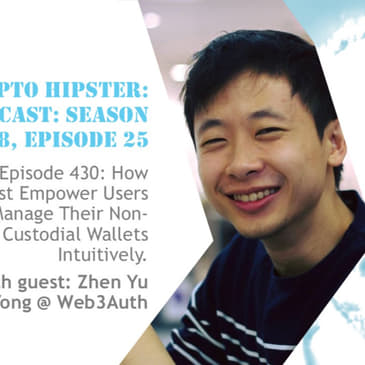

Zhen Yu, CEO & Co-Founder, Web3Auth
Zhen Yu Yong is the CEO and co-founder of Web3Auth, the leading non-custodial auth infrastructure that enables Web3 wallets and applications to provide a seamless user login experience to both mainstream and native Web3 users. Prior to Web3Auth, Zhen worked on various Ethereum Foundation projects as a researcher for off-chain scalability — where he built one of the first cross-chain bridges called The Peace Bridge, between ETH and ETC.
He met Vitalik Buterin face-to-face in 2016 and then decided a “decentralized computer” made sense. He was previously a Firefighter in the Singapore army and started learning programming on his days off. He studied finance at Singapore Management University.
About Web3auth
Web3Auth is the leading Wallet-as-a-Service (WaaS) provider that empowers every user to manage a non-custodial wallet intuitively. It leverages on enterprise-grade Multi-Party Computation and Account Abstraction tooling, alongside social logins, biometrics, OIDC, FIDO for a familiar yet seamless user experience.
Web3Auth works with Fortune 500 brands (including NBCUniversal, Fox.com, McDonald’s), leading Asia conglomerates (SK Planet, Square Enix) and Web3 pioneers like Trust Wallet, Metamask, Sky Mavis, Kukai, Skyweaver among others. To date, it is proud to be supporting thousands of Web3 projects with more than 20 million monthly users. The organization is growing beyond Series A, and backed by Sequoia Capital, Union Square Ventures, Binance, and more.
[00:00:00] Hello, everybody, and welcome to the Crypto Hipster Podcast. This is your host, Jamil Hasan, the Crypto Hipster, where I interview founders, entrepreneurs, executives, thought leaders, amazing people all around the world of crypto and blockchain. And today, I have another amazing guest. He is the founder of Web3Auth, coming to me from Singapore. His name is Zhen Yu Yong. Zhen, welcome to the show.
[00:00:28] Hey, hey, Jamil. Thanks so much for having me. It's been a pleasure.
[00:00:32] You're very welcome. You're very welcome. I'm looking forward to this interview. And let me ask you first, I start off with the same question for everybody and always get amazing answers. The first question is this. What is your background? And is it a logical background for what you're doing now?
[00:00:50] Logical. I mean, many founders come from many different backgrounds. I would say mine is relatively logical.
[00:01:03] So, leading up to where I am, leading up to founding Web3Auth, at least. So prior to Web3Auth, I used to work at the Thurm Foundation, and I did that for about a year. And then before that, I worked at Visa.
[00:01:19] So that was basically my first job as a software engineer there. And before that, I was studying. I actually started out as a business kid, but I knew how to code from young and had started a couple of other smaller companies before going to university.
[00:01:42] In business school, I kind of went into that. Didn't really like it very much. So I decided to go the computer science route and decided to just lean into that instead.
[00:01:53] And I think when you have a mixture of when you're in business, as well as you can program or you can code or you're technical, crypto is kind of like a good merger between economic and computer technology.
[00:02:10] So it seemed quite a natural fit for me to pursue. And I think when I first heard about when I first got into crypto, I mean, I had heard about Bitcoin and I mined some Dogecoin because I was a ridditor at that point.
[00:02:27] And I'm not sure if you saw the Phantom Doge to the Moon. If you haven't, take a look at it maybe after this and all. It's fantastic. It was the Dogecoin launch trailer and it was amazing.
[00:02:42] So I play around with those, but I think really what gripped me was a theorem. The dream of coordinated compute across the world was super interesting to me.
[00:02:54] And a state machine that just could continually move forward. That was super interesting as well. Vitalik was super cool. And yeah, I mean, that's really what got me in.
[00:03:07] So I would say it's pretty logical because, you know, like technical finance background, then kind of a payments job, a theorem foundation, what they're all.
[00:03:22] Makes sense. Makes to me, it's logical. What year were you mining Doge?
[00:03:27] That was, I think, 2016.
[00:03:33] So that was before they merged by Litecoin and Dogecoin.
[00:03:37] Yeah, that was before.
[00:03:39] Okay. Because I could see the payments angle. I could see Litecoin and the interest of Dogecoin and Litecoin.
[00:03:44] But then, you know, when I came in 2017, initially I was at Bitcoin and then I became an ICO advisor, right?
[00:03:55] So the thrill of the ICO and the, you know, the early C capital thing made me interested.
[00:04:01] And your interest, you started in Bitcoin to Ethereum was because of the possibility of global computation.
[00:04:11] Yeah. I mean, it was just a very, as someone who was technical, it was just very interesting to me, I think.
[00:04:18] And that was what, yeah.
[00:04:20] I mean, I wasn't affected by the financial crisis until I wasn't affected by, you know, yeah.
[00:04:30] So like, it, I think a theorem was what really sold me into going into this full time and really pursuing a career.
[00:04:42] Interesting. Okay. So I want to find out then what Web3Auth is all about and then what makes you a pioneer in the wallet solutions arena?
[00:04:54] Yeah. So, I mean, Web3Auth is a wallet as a service solution and the leading wallet as a service player.
[00:05:03] And what that basically means is, you know, every user and every application requires a wallet to interact with the blockchain, right?
[00:05:17] And wallets aren't easily accessible at this point in time.
[00:05:23] First off, you've got tons of different wallets, right?
[00:05:26] MetaMask, TrustWallet, Wow, Phantom, you know, the list goes on, hundreds of different wallets that people want to use.
[00:05:35] Secondly, a lot of these wallets are needlessly complicated in that they, you know, everybody's familiar with the seed phrase experience if you're in crypto.
[00:05:46] It's complicated. It takes ages to set up.
[00:05:49] People lose seed phrases all the time.
[00:05:53] So what we do is we basically, first off, we always allow people to connect with what's most convenient to them.
[00:06:00] And also, if you're just starting out, we push an embedded wall experience, which basically allows an application to issue a wallet that's accessible via a user's,
[00:06:16] but that's accessible via user accounts that users are already familiar with.
[00:06:23] This can include email, this can include the phone number, it could be the Gmail, Facebook login, any OAuth login whatsoever, right?
[00:06:34] So we peg on the OIDC standard. That's the historical or the traditional standard for authentication in the Web2 space.
[00:06:56] So you're tying people's email to their current seed phrase, making it blinked there.
[00:07:07] Essentially, yes.
[00:07:08] To their public private keepers.
[00:07:11] And, you know, under the hood, behind the scenes, all of this is powered by MPC or multi-party computation.
[00:07:19] It's the golden standard for custody, right?
[00:07:23] So people like Binance use it internally for their internal custody management of crypto.
[00:07:30] Coinbase uses MPC internally.
[00:07:34] Lots of your different institutional custodians, VCs, and all use MPC to secure their accounts across different chains.
[00:07:41] We're basically taking the technology and democratizing it such that any user can access this and utilize this sort of zones.
[00:07:50] So right now, say Coinbase, say use Coinbase, I'm not able to access that MPC computations, right?
[00:08:02] But you are enabling your clients to be able to do that?
[00:08:06] Basically, in a way, yes.
[00:08:10] Okay.
[00:08:11] So I want to find out how your multi-party computational threshold signature scheme works
[00:08:18] and why people should use it over these, you know, organizations that you name, like, you know, like Coinbase and like Binance.
[00:08:26] Why should they go with you?
[00:08:29] What's the important breakthrough that they're going to be able to have?
[00:08:32] So, I mean, first off, like, basically, Binance doesn't offer the MPC too outwardly, right?
[00:08:39] It's not if you as a user can use Binance MPC.
[00:08:42] Their infrastructure and their setup isn't designed to do that.
[00:08:46] They don't offer it as a service, at least don't sell it.
[00:08:52] Whereas their infrastructure also isn't designed for individual, like, to individual users.
[00:08:59] Ours is, right?
[00:09:00] It's designed for scale.
[00:09:02] It's designed for businesses to integrate into their applications and then for users then to be able to use it on their own different setups.
[00:09:08] Now, MPC and TSS is just a very complicated way of saying a multi-factor key.
[00:09:15] It's just like a multi-sig but off-chain, right?
[00:09:19] It's a technology that allows us to take a user's private key and split it into different factors.
[00:09:26] Now, the most prevalent or common type that we see is the two of three setup.
[00:09:33] Basically, the user uses a social account.
[00:09:37] So it might be Google, Facebook or something to secure your account.
[00:09:43] That's the first factor.
[00:09:44] The second one is they use their device.
[00:09:47] And the third one is they use maybe another factor that's like an OTP, you know, SMS OTP or like another social or an email.
[00:09:57] And these three, any two of these three basically can access the user's account, right?
[00:10:04] And that's all typical split.
[00:10:08] I like it.
[00:10:09] I haven't seen anybody be able to access their wallet through Facebook yet.
[00:10:13] So I think it's ingenious.
[00:10:17] Yeah.
[00:10:18] I haven't seen that yet.
[00:10:19] I've only seen like WhatsApp or something like that.
[00:10:22] But if you could do this through social media, you know, that's the future, right?
[00:10:27] So I want to ask you this then.
[00:10:32] Digital ownership.
[00:10:33] Why is it important to make digital ownership and identity human centric?
[00:10:41] So in particular, I think human centric, what you just stated is kind of like our mission, right?
[00:10:49] So first off, crypto has so many benefits.
[00:10:52] And us in the crypto space feel that.
[00:10:55] And the benefits start from, you know, like the ability to self-custody digital assets, to own your own footprint, your own assets, your own data.
[00:11:16] To all the way to like more concepts, like access to liquidity markets, right?
[00:11:22] Access to instruments that people not in the US may not typically have access to.
[00:11:31] It also includes the ability to do remittance, to do payments, to not be beholden to centralized payment networks and credit card providers and so on and so forth.
[00:11:45] And it's a great alternative to existing financial systems today.
[00:11:48] Now, those benefits are fantastic, right?
[00:11:52] But there is a barrier to the next billion users really hopping onto crypto.
[00:12:00] And that barrier ultimately at the end of the day is a mixture of, first off, use case and need, right?
[00:12:08] Like the use case and need needs to be 10 times more attractive than what's existing today, right?
[00:12:15] For somebody usually to go, okay, I want them.
[00:12:18] I can't just be a bit better.
[00:12:20] I would say that today crypto is already a bit better than current payment networks.
[00:12:24] Because like payment networks just charge businesses, what, 3% to 5% for every fucking transaction that you do, right?
[00:12:32] And that's an insane amount if you think about it.
[00:12:34] Whereas in crypto today, on like L2s or on Solana or on cheaper networks, you are paying well less than 5%.
[00:12:43] So I already think that it is more efficient than existing payment networks today.
[00:12:48] But is it 10x better?
[00:12:52] Is that in certain cases perhaps, but in certain cases not yet.
[00:12:59] And we need to get to the point where use cases are 10x better, such that people want to swap.
[00:13:04] Next is all the infrastructure and all underlying that, that adds that use case needs to be, I mean, naturally for something to be 10x better, part of that is a fantastic user experience.
[00:13:20] It is something that is intuitive to the end user.
[00:13:23] It's like, you know, like I might have some, a product that's 10x better, but I have to, like, I don't know, spend a week to learn it before I can use it.
[00:13:36] Relative to something that's, and that just basically reduces its value because I have to spend a week to try to do it.
[00:13:47] Relative to something that maybe is like, you know, 5x better, but I can do it instantly and get that instant gratification and feeling of trying it out.
[00:13:57] It can go viral, blah, blah, blah, blah, so on and so forth.
[00:14:00] And that actually makes it a 10x better product at the end of the day.
[00:14:06] So I think, so being human centric is basically thinking about end user.
[00:14:13] It's thinking about their security, thinking about the experience, the seamlessness of it.
[00:14:19] And really tailoring the wallet and key management experiences and the crypto experiences to what these individuals need.
[00:14:30] You know, it's interesting.
[00:14:32] I went to the World Bank Summit last week in Washington, D.C.
[00:14:37] And I'm sitting there and I'm like, they're talking about the topic is payments.
[00:14:43] And I don't know who's going to come to speak.
[00:14:45] Well, they have a panel and the panel is all the major central bankers.
[00:14:50] And they're talking about how they're making payments faster and cheaper and better using blockchain.
[00:14:58] Right.
[00:14:59] But one word they didn't say, they didn't say, none of them said Bitcoin.
[00:15:03] They're all trying to build their own, you know, private blockchain on their fiat currency.
[00:15:11] So when I look at crypto, I'm like, you know, we are 10x better.
[00:15:17] But why do you think, why would you think that we are compared to some of these central bankers views of the world?
[00:15:29] So I think that, don't get me wrong.
[00:15:40] I mean, so, you know, in this ecosystem, we have lots of different players.
[00:15:47] And I think a lot of the initial, the initial thesis of Bitcoin is an alternative financial system to replace the existing financial system.
[00:15:55] And it was like, you know, burn all the banks, burn centralization.
[00:15:59] Everything must be decentralized and all.
[00:16:02] And as much as I do believe in decentralization, I also do believe I'm not like, it's not one or zero.
[00:16:10] Right.
[00:16:11] There are benefits to centralized entities, equivalent, and from the ability to, you know, signify bad actors, protect customers on a much more dynamic level, move a bit faster than the code level, blah, blah, blah, so on and so forth.
[00:16:37] So now, but when it comes to the benefits of why a public network might be 10x better, I think it comes to, first off, naturally accessibility.
[00:16:51] If anybody can secure the network and anybody can, anybody can use the network, anybody can reach the network.
[00:17:01] I think that just means that more people can access it, more people can get value from it, and more people can use it, which just automatically means more utility and a better like ecosystem.
[00:17:16] Right.
[00:17:16] Secondly, I think if an ecosystem is how public has the right incentives and continues to grow in a public domain, right, it's a lot stronger in a way.
[00:17:34] Because it's a lot, you know, central entities grow and die based on the individuals that push them forward.
[00:17:45] Something and a structure that continually moves forward, for example, maybe like a democracy, if I were to compare it to that, right, these structures that continually to move forward don't, right, or are longer lasting for sure.
[00:18:03] And I think that definitely also has value.
[00:18:07] And then, and then I think just specifically compared, and then I think third might just be like the trust factor, right?
[00:18:18] The ability to be able to, don't get me wrong, when you use Bitcoin, you still do have to trust things.
[00:18:25] You have to trust that the incentives are in the right place in the long term to guarantee that it is sufficiently decentralized.
[00:18:34] You have to trust the miners don't fuck you over.
[00:18:37] You have to trust the core developers, like, don't screw up the protocol, you know, yada, yada, yada, yada, right?
[00:18:44] There is still trust in Bitcoin, but that it's a lot less than, it's a lot less and it's a lot more decentralized than trusting, like, a couple of banks or consortium of banks or consortium of individuals.
[00:19:06] With what you, with, with, with, with, with, with your payment, with your payment network or your payment setup.
[00:19:15] So, I mean, I would say those are the things that I find attractive.
[00:19:20] I think it's more interesting to talk about things which aren't as attractive, though, right?
[00:19:27] You know, like, systems like Bitcoin, Ethereum and all, one of the big things that these public networks have to do is DDoS prevention, which is in the form of the gas fee and transaction fee that people pay.
[00:19:45] Now, this naturally is something that people aren't used to.
[00:19:48] People aren't used to paying for a fee to send something on Venmo or send something on PayPal, right?
[00:19:56] They're used to it being free because merchants have always absorbed the cost and merchants have always paid for this cost at the end of the day.
[00:20:07] And the fact that this isn't the case in crypto results in it being top for people to onboard onto and absorb that for themselves.
[00:20:24] I agree.
[00:20:25] Definitely agree.
[00:20:28] Also, all the protections that a bank might offer you, right?
[00:20:32] For example, like, if a bank notices that you're doing a large amount of withdrawals, yes, they limit your funds.
[00:20:41] And if those withdrawals are authentic, you would get irritated.
[00:20:46] You'd have to call in.
[00:20:47] You'd have to release the funds and all that.
[00:20:50] But in a crypto world, if your wallet is completely hacked and drained, I mean, you would just get drained, right?
[00:20:58] All your money would be gone.
[00:20:59] And you'd have no way of getting it back.
[00:21:05] I know about that, too.
[00:21:06] So, yeah.
[00:21:10] So, I want to stay on this area of the trust deficit.
[00:21:15] Because I still think there is a continuing trust deficit in the blockchain industry.
[00:21:25] And I want to find out what you think is causing it, how we solve this challenge.
[00:21:31] And then I'll tell you my perspective.
[00:21:33] And I want to get your opinion on my perspective.
[00:21:36] What's the definition of a trust deficit?
[00:21:42] That's a good question.
[00:21:44] People still have a lack of trust in the industry.
[00:21:47] I mean, people lost a lot of money during the Celsius, Voyager, BlockFi, Three Arrows Capital days.
[00:21:57] So, I say, you know, a lot of skepticism still.
[00:22:01] Oh, I see.
[00:22:03] Yeah.
[00:22:04] I mean, yeah.
[00:22:07] I mean, I think, and I think, I think you've just, I mean, I think FTX and all of this and everything that happened in 2022.
[00:22:20] Oh, was it 2022 or was it 2023?
[00:22:25] 22.
[00:22:26] Everything that happened at that point was super unfortunate for the industry.
[00:22:31] I think, I think any new industry crops up with a certain number of bad actors, you know, scammers, people who aren't really here to be building for value and to be here in the long term or to be contributing positive value to the world.
[00:22:52] Crypto, unfortunately, has, as an ecosystem, I think we're doing worse than other, like, technology pillars in terms of just that one angle, in terms of the ability to be able to introduce griefers, to be able to enable.
[00:23:14] So, enabling financial freedom also means it's a tool that is fantastic, but tools can be used positively and tools can be used negatively.
[00:23:25] As much as Bitcoin and the blockchain and all of this has been used to, like, give millions of people access to a different financial construct and financial system as an open financial market.
[00:23:43] It also has allowed, it also has allowed bad actors to earn off these from hackers, right, that may hack your funds.
[00:23:54] North Korea is very well known to be a group that has hacked multiple different institutions, not just individuals from, like, tens of millions of dollars, or even hundreds at this point, actually.
[00:24:09] There's been, you know, like, companies that have been over-leveraged, BlockFi, Celsius, Three Arrows, FTX, you continue to list them all.
[00:24:19] There's been, like, over-aggression in sales when it comes to NFTs that have made people have a distaste for them, especially in the gaming and luxury sector at this point, right?
[00:24:40] It's been, so, I think, you know, like, there's money laundering, and there's all of this.
[00:24:48] People use it to sell drugs.
[00:24:51] On the dark net, you can, like, assassinate somebody by paying in Bitcoin.
[00:24:55] You know, it's, tools can be used for good and bad.
[00:25:01] And unfortunately, there have been a lot of people using it for bad as well, more so than other industries.
[00:25:07] Just like how AI can be used for good and bad, AI could be used to help people learn, help people be more productive, efficient.
[00:25:16] It also can be used to scam people, right, to pretend to be someone else, to create deep fakes of people.
[00:25:27] It's, our industry suffers this, but it seems to have suffered it more.
[00:25:32] Yeah, that makes sense.
[00:25:34] That makes sense.
[00:25:35] It's, my point and my perspective is, we have an election coming up next week here in the U.S. for a new president.
[00:25:44] And over the past four years, it's been countless attacks by the SEC, by, you know, different politicians.
[00:25:52] There was an operation called Chokepoint 2.0, which may or may have been a thing, to try to, you know, have centralized players knock down this industry and cause mistrust and distrust.
[00:26:05] You know, if we clear away these actors who are against our industry, does that open up, how does that open up opportunities where we haven't had them over the past few years?
[00:26:22] Well, I mean, it's very easy to go, okay, banks don't want us, blah, blah, blah, and all that.
[00:26:29] But I also feel like the world is gray.
[00:26:33] There's, you know, a lot of crypto tends to be very anarchist and goes like, oh, decentralized entities, we don't want them, blah, blah, blah.
[00:26:41] But I would argue that people talking about crypto, even crypto being so deeply ingrained in our politics today, it's already a success, actually.
[00:26:51] If you zoom back to the previous election, there was no mention of crypto at all.
[00:26:55] Nobody cared because nobody wanted to care, right?
[00:26:58] Now people are talking about it.
[00:27:00] And that just is a great indicator of growth.
[00:27:03] So I would just first say that it's actually a good thing that we're even in the conversation at this point in time.
[00:27:09] Now, whether or not, yes, there are parties which are super against crypto.
[00:27:14] And that's really unfortunate.
[00:27:17] And perhaps, you know, Americans should be voting.
[00:27:20] I can't vote.
[00:27:22] But Americans should be voting or people who care about crypto should be voting for that party which they deem, you know, would help us in that regard.
[00:27:32] And actually, it's funny because Web Thrilloff actually supported the NFT project, Donald Trump NFTs.
[00:27:40] I managed to be invited to go to like the gala dinner with Donald Trump.
[00:27:46] Anyways, but I think regulation and us being in the spotlight can be seen as very negative on onset, but also could potentially be very positive.
[00:28:01] If you take a look at it, it's like, you know, the difference between Coinbase and Binance, I would say, right?
[00:28:10] Binance has been an entity that's always flouted the rules, always wanted to build fast, just get it out, just provide it.
[00:28:19] And there's space for that.
[00:28:20] And that's fantastic.
[00:28:22] And, you know, large entity and it's fantastic, right?
[00:28:25] But Coinbase, on the flip side, has always wanted to welcome regulators, has always been trying to create regulation, trying to create structures which have been positive and open, right?
[00:28:40] Like, not just not creating regulation to stifle competition in the US, not creating regulation to like, I mean, I'm sure some part of them want to do that at the same time.
[00:28:51] But like, you know, there is regulation for good.
[00:28:57] And I just, I welcome more people paying attention to us, paying attention to us, paying attention to how we can make industry more healthy for the end consumer in general, which should be SEC's job, which the SEC has been handling terribly poorly, but, and could really do a lot of improvement.
[00:29:23] But, but, but, but, but regardless, I do think it's, you know, it's great that people are just paying more attention to us as a whole.
[00:29:33] I like that perspective.
[00:29:34] That's a really good one.
[00:29:36] Yeah.
[00:29:37] When you're, when the, when you're not on the outside, you don't see it that way, but that's good that you do.
[00:29:42] And I didn't see it that way, but yeah, it makes a lot of sense.
[00:29:46] So thank you.
[00:29:47] So you did mention the Donald Trump NFT.
[00:29:52] I'm not going to ask you about that specifically, unless you want to share.
[00:29:56] But I want to ask you more generally, how have you helped DeFi gamers, NFTs and metaverse projects thrive?
[00:30:05] And what do you envision for the, the sectors going forward?
[00:30:10] Yeah.
[00:30:10] I mean, so, I mean, we, we've empowered tens of thousands of developers in the space.
[00:30:22] We have over a hundred thousand developers on our platform building.
[00:30:27] And we've powered, we power like, you know, tens of millions of wallets on all of these different applications.
[00:30:35] On these thousands of different applications to access these wallets.
[00:30:39] And I think that's how we've really contributed here.
[00:30:44] We've made it easy for DeFi projects, for games, for NFTs to not just sell to existing Web3 consumers, but also Web2 consumers where possible.
[00:30:57] For example, with Jupiter, we launched Ape Fest, we saw in, in, in, in token 2049.
[00:31:04] With, with, with, with Sequence, with, we, we, we launched a TCG card game.
[00:31:13] With, with, with Metasyn, we launched a game in China, which weren't targeted towards your Web3 crowd.
[00:31:20] These are targeted towards Web2 individuals, which, which really just want to do, to trade, to interactive meme coins, to buy NFTs that represent themselves and the identity.
[00:31:38] So, I mean, it's, yeah, I mean, it's just, we've just provided access to these applications.
[00:31:43] And that's all we do.
[00:31:44] One simple, small thing.
[00:31:49] Is that, the, the, the ramifications and the, and the downstream effects are not, are not small.
[00:31:56] So they're pretty important.
[00:31:58] So it's, that's pretty cool.
[00:32:01] I saw a game last week, the new game, but I think by Avalanche, I don't know what it's called.
[00:32:07] But apparently it's got really good reviews and a lot of people are using it and empowering, being empowered in gaming.
[00:32:13] So that was cool to see.
[00:32:18] So, yeah.
[00:32:21] So I want to thank you very much for speaking with me.
[00:32:23] I enjoyed speaking with you.
[00:32:26] I have.
[00:32:28] Thanks so much for the time, Jamal.
[00:32:29] I appreciate it.
[00:32:30] Yeah.
[00:32:31] I have one last question.
[00:32:32] It's really easy.
[00:32:33] How can people find out more information about you?
[00:32:35] How about Web3Off?
[00:32:37] How can they use your wallets?
[00:32:39] How can they use the platform?
[00:32:40] How can they get them?
[00:32:42] I got Web3Off.io or Web3Off on Twitter.
[00:32:46] And if you want to contact me personally, if you're for each other, Zen, Zen, Zen with a Z-E-N and then Z-H-E-N, which is how it's actually spelled.
[00:32:57] You on Twitter.
[00:32:59] Awesome.
[00:32:59] And yeah, no.
[00:33:02] Thanks so much for having me.
[00:33:04] Really appreciate the time.
[00:33:06] And thanks, Jamal.
[00:33:08] Awesome.
[00:33:09] Awesome.
[00:33:09] Awesome.
[00:33:10] Thank you very much for your time today.
[00:33:11] It's been a pleasure.
[00:33:12] Take care.
[00:33:12] See you.
[00:33:14] Thank you.
[00:33:14] Thank you.
[00:33:14] Thank you.
[00:33:14] Thank you.