
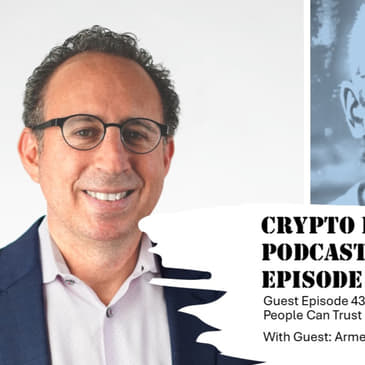

Armel Leslie is an Executive Managing Director at RF|Binder, an integrated marketing communications consultancy that acquired his prior PR agency, Peaks Strategies. He has been in the financial services communications arena for 25+ years with deep experience across the capital markets ecosystem -- including asset and wealth management, financial technology and market structure.
[00:00:01] Hello everybody and welcome to the Crypto Hipster Podcast. This is your host, Jamil Hasan, the Crypto Hipster, where I interview founders, entrepreneurs, executives, vault leaders, amazing people all over the world. And today I have a repeat guest. A repeat guest from a few years ago. I'm looking forward to this conversation. This man lives not too far from me. His name is Armel Leslie. He's a PR executive. Armel, welcome to the show.
[00:00:31] Hey Jamil, it's good to see you. Thanks for having me.
[00:00:34] You're welcome. It's great to have you back. So let me ask you first. I know you started, I asked the same question to everybody. I asked you, what is your background and is it a logical background for what you're doing now?
[00:00:48] Yeah, I mean, absolutely. I've been in the communications space for about 25 years, always on the agency side, never in-house. And I've been in the financial communications kind of capital markets arena for those 25 years.
[00:01:04] So, you know, fast forward to about seven years ago, through some work in financial technology, obviously led me into the crypto arena. And from there, I've definitely been active in doing a quarter digital assets or tokenization or Web3, whatever the flavor of the day is.
[00:01:25] I've been active in the business. I've been active in the business. I've been active in that space. I've been active in that space. Certainly not a purist in terms of representing clients in that space, but have done a lot of work in that area.
[00:01:37] And I think the capital markets background has been helpful. Most of the clients I work within that space are more the builders, the infrastructure providers, those providing custody and other services.
[00:01:50] So there's a lot of kind of traditional elements of the businesses that I've worked on in the past, which are helpful as the melding of traditional finance and DeFi come closer together.
[00:02:08] So, by trade, you were a copy editor. Along comes 2017. You see this, something happening in the crypto markets. What piqued your interest to get involved?
[00:02:21] Yeah, well, just to clarify, I was never an editor per se. I was always, again, helping maybe ghostwriting for clients, but more on the PR side and helping clients get into the press.
[00:02:35] You know, again, just a progression of being in the industry, being in different sectors, being in financial technology. I was lucky enough to get involved with some great players early on who were in the space.
[00:02:48] I got involved with an exchange early and then a firm that was doing some market making and some other trading and algorithmic trading.
[00:02:57] So it was, again, as you said, a natural progression of the businesses that I'd been involved in, but certainly piqued my interest because I could see the level of talent, the level of capital that was coming into the space.
[00:03:13] I remember kind of working with a trade body in the space early on and just seeing, again, the pedigree of the firms that were in that space.
[00:03:22] And again, for me, that was always realizing that, sure, you have the native crypto players that are important.
[00:03:30] But when this industry really institutionalizes, it's going to be the traditional players that are going to step into that space and really make this, again, a mainstream industry and with utility for everyone.
[00:03:44] And today you have BlackRock involved and every investment bank's involved and Boney, a really traditional firm is custodian assets.
[00:03:55] So I always looked at it from the point of view of those firms who I've always been more familiar with in my career getting in the space.
[00:04:05] And I was involved early on in the late 90s, early 2000s in the hedge funds space, in the alternative investment space, representing clients in that space.
[00:04:17] I did a lot of work in that space and I saw a lot of parallels between that space and the crypto industry.
[00:04:23] Number one, a lot of mythology and misunderstanding about what's going on in the industry.
[00:04:29] A lot of media and other people who were against those certain industries for whatever reason, obviously, you know, talking about risks and other things in the industry.
[00:04:41] And the necessity for groups to step up and start educating, right, which is happening slowly in the crypto space.
[00:04:51] And I think as people are educated, they understand what's going on.
[00:04:55] They see the utility day to day and how this is changing and making their worlds better.
[00:05:03] And just how everything is ultimately becoming digitized.
[00:05:07] Again, the mythology behind it is being replaced by reality.
[00:05:14] So, again, I saw a lot of parallels in the work that I've done in the past to help firms build brands, educate their end users.
[00:05:25] And, yeah, it's good to see the industry obviously has grown up after some carnage, obviously.
[00:05:33] And I think it's definitely an acceptable asset class.
[00:05:38] And I think people are seeing, again, the real utility of blockchain technology.
[00:05:44] Awesome.
[00:05:44] You brought up one of my favorite topics.
[00:05:47] Well, yeah.
[00:05:47] Actually, I'm thinking back to second grade.
[00:05:50] At first we had these workbooks, right?
[00:05:52] We had the mythology, the Greek mythology.
[00:05:55] And that was my favorite subject.
[00:05:59] But I want to talk about mythology.
[00:06:04] Part of mythology is this idea that only crypto natives should be in the industry, right?
[00:06:10] And you said traditional players are getting in.
[00:06:12] So, what's the importance of building a brand in, we're in a new industry, so a national industry.
[00:06:18] You know, what's important to retain trust in that industry?
[00:06:22] And why is this industry not just for crypto natives?
[00:06:25] Yeah, look, I mean, again, this is for everyone, right?
[00:06:28] If you believe that monies and commodities and everything is going to become digitized over time,
[00:06:34] then everyone's going to be involved in accessing this technology over time, right?
[00:06:41] And I think the native brands have to, as you say, they have to build trust.
[00:06:46] They have to lead with education.
[00:06:48] They have to educate this next cohort of users as to what the benefits are, right?
[00:06:55] And, you know, the traditional players are obviously much better at that.
[00:06:58] They have bigger budgets.
[00:07:00] They have seen the benefits of building brands over time and building trust over time.
[00:07:06] And I think, you know, those firms with the biggest content engines, if you would, are going to be the ones who are going to thrive,
[00:07:16] the ones that are putting out content consistently, both their own proprietary content,
[00:07:21] and in addition to educating, you know, folks such as yourselves, getting on podcasts, being on broadcast,
[00:07:27] being in the media in general, speaking at conferences, because everyone has to make the case.
[00:07:32] Everyone has to make the case for adoption.
[00:07:35] And, you know, it's much easier now when Bitcoin's hitting 100K, but, you know, there'll be bear market cycles again,
[00:07:42] and there'll be other incidents that will happen, you know, where people will have to kind of clamp down on this.
[00:07:49] But ultimately, if you're going to be a leader, you have to be at the forefront of this,
[00:07:54] and you have to take the time to educate.
[00:07:57] And obviously not just pump your own book, but help people understand, you know, what's going on, right?
[00:08:04] And, you know, the importance of content is critical.
[00:08:08] I mean, look at Robin Hood.
[00:08:10] I mean, Robin Hood now has their own media organization, right?
[00:08:17] Basically, their own digital publication.
[00:08:21] A16Z, you know, the big VC fund that's very active in the space,
[00:08:25] has been for a few years, been very involved in building their own content and, you know, hiring an ex-Fortune editor a couple years ago to go and help them do that.
[00:08:35] So people are realizing that there's a combination of obviously being out there in the third-party media for validation.
[00:08:44] You know, but in today's day and age, you can become your own publisher, right?
[00:08:49] On your own social channels, on your own channels, through Substack, through speaking at events, through doing pop.
[00:08:56] You know, you are essentially a publishing company in addition to being a crypto company or investment bank or whatever it is.
[00:09:05] So it's all about finding the right messaging and constantly delivering that through, you know, many channels that people have today.
[00:09:16] There is a dichotomy there, right?
[00:09:18] So you got to trust somebody.
[00:09:21] Well, you don't have to trust somebody.
[00:09:23] You can trust something, which is a technology.
[00:09:26] So blockchain was created so you don't have to trust anybody.
[00:09:30] And what you're saying is trust is important.
[00:09:33] So what's the trade-off in that dichotomy between not trusting anybody and trusting everybody?
[00:09:41] Yeah, look, I mean, I think what these brands have to realize is that the average person, myself included, is not going to understand the deep in the weeds technology behind a lot of cryptographic technology and blockchain technology and everything else.
[00:09:59] And we don't have to, right?
[00:10:01] I mean, it's like when you go buy something on Amazon, you hit buy and you buy your sweater, right?
[00:10:08] But you don't have to really understand what's happening on the back end with the payments and the logistics and everything else.
[00:10:15] You just know that you're going to hit buy.
[00:10:17] In two days, a package is going to arrive at my front door, right?
[00:10:21] But I trust Amazon.
[00:10:22] I trust them to deliver, right?
[00:10:25] So I think, you know, companies, again, don't have to get that deep in the weed where they have to think that everyone has to understand the ins and outs as to what they're doing and how they're doing it.
[00:10:36] They just have to simplify the message and help their users understand why it's good for them, right?
[00:10:43] It used to cost you $54 to wire money from South Africa to the US.
[00:10:50] Now you can do it for 15 cents using a stablecoin.
[00:10:53] That's all someone has to know, right?
[00:10:56] But do they have to know how that actually works?
[00:10:59] No, right?
[00:11:00] I actually just wrote a blog where I speak about this and speak about messaging.
[00:11:09] And in a lot of instances, companies get too bogged down in the weeds when they're creating their messaging, right?
[00:11:18] Especially if the messaging is driven in-house by them, their sales teams, their engineers, everything else, because they're so deep.
[00:11:27] And they should be, right?
[00:11:28] Because they're building.
[00:11:30] Oftentimes, it's better to bring in a consultant, you know, such as myself, to look from the outside and say, look, you know, that's all very good.
[00:11:40] You know, if you're speaking to an engineer who understands what's going on.
[00:11:43] But you need to boil this down to the lowest common denominator and make this make sense.
[00:11:49] Again, depending on who your audience is.
[00:11:51] So, in a lot of instances, it's simplifying the message, right?
[00:11:57] Not making it more complicated.
[00:11:59] And yes, you're right.
[00:12:00] There's the whole thing with trustless and DeFi and everything else.
[00:12:05] But, you know, you and me both know that, you know, this industry is only going to get to where it will get to with the big traditional players stepping in.
[00:12:42] I agree.
[00:12:44] You know, you also said that you worked with hedge funds early on.
[00:12:49] So, let me talk about the melding of firms' traditional finance and alternative investments.
[00:12:56] You compared this to hedge funds.
[00:12:58] And I remember back in 2017 and 18 and 19, I tried to build a consulting business and we're pitching hedge funds and I failed miserably, right?
[00:13:06] So, why do you see hedge funds being more and more active?
[00:13:09] Why do you see them, you know, adopting blockchain as it becomes more mainstream?
[00:13:15] What do you see as the path and what do you see as the path forward?
[00:13:18] Yeah, well, we can unpack that a few ways.
[00:13:21] Well, number one, in terms of hedge funds investing into crypto, I think they definitely will.
[00:13:28] I think the macro players will and are, right?
[00:13:32] If you're having asset classes that are making big swings, both, you know, going up and going down, it allows them to go both long and short, right?
[00:13:43] So, I think they will continue to invest in the asset class.
[00:13:46] And obviously, Bitcoin is the obvious one.
[00:13:48] And there's ETFs and there's futures on the CME and everything else, right?
[00:13:53] So, there are investment products that they can actually get in there and invest in.
[00:13:58] And as they continue to, it creates more liquidity, which is great for everyone, right?
[00:14:04] But the parallel I was also making kind of on point two is when I look at the hedge fund industry and all the mistrust that there was around it and all the people, these are unregulated pools of capital and they're risky, they're going to blow up the markets.
[00:14:21] That was similar to the messaging around crypto, right?
[00:14:25] Risky, people use it to funnel money around and everything blows up and it's using too much energy.
[00:14:32] And so, all the detractors always try to throw these things out there, you know, which lazy people may buy into without doing the work and doing the research, right?
[00:14:45] But over time, kind of the truth emerges and people realize that there is validity and a reason for why smart people are investing in blockchain or investing in hedge funds, right?
[00:14:56] And for many years, hedge funds had a bad rap and then, you know, slowly kind of people realize, well, hold on a second.
[00:15:03] If my grandmother is kind of comfortably retired and she was a teacher from California and her pension fund is allocating to hedge funds, then, you know, they must know something that I don't know, right?
[00:15:16] And it's the same thing, you know, if you look at the crypto industry, it was always they're using too much energy and, you know, and the dark web and everything else.
[00:15:25] And, you know, slowly but surely people start to see, again, what the real applications, the real world applications are.
[00:15:34] And that over time, a lot of the bad players get weeded out and the strong players emerge.
[00:15:41] And with that, the strong brands will emerge.
[00:15:44] There'll only be five to 10 extremely strong brands in the digital asset space in five years.
[00:15:53] Only five to 10 cryptos or five to 10?
[00:15:55] Well, again, across the digital asset space, you know, you know, just people who are providing services into the space.
[00:16:03] Obviously, there's going to be a lot more M&A.
[00:16:06] There's certainly going to be a lot more companies going public.
[00:16:10] You know, you won't have 20 exchanges and 20 custody providers and, you know, and 20 technology providers and everything else.
[00:16:19] It's going to, you know, there will be consolidation.
[00:16:24] There's no doubt about that.
[00:16:25] And so those companies that want to go public or want to get acquired one day are going to have to start building strong brands in that space.
[00:16:33] And the traditional players are going to have to build brands, allowing people to realize that they understand the space.
[00:16:39] And they could be good partners.
[00:16:41] You know, if they choose to be the acquirer or choose to get into the space themselves.
[00:16:47] Okay.
[00:16:48] So you mentioned we had some downturns.
[00:16:51] The most recent was a couple of years ago with FTX, right?
[00:16:54] That was brought on by the failure of Terra Luna, which people are new.
[00:17:03] They might not know the history, but some people think that was, you know, liquidity crisis.
[00:17:08] That was, and some of the people will think that Terra Luna was shorted by a whole bunch of hedge funds in Chicago that caused the liquidity crisis, right?
[00:17:16] So if the hedge funds embrace crypto now, you have less shorting, you have more mainstream adoption.
[00:17:24] Who becomes the face of that mainstream adoption and who do people go to to say, hey, they're embracing it now.
[00:17:30] Let's go forward with it.
[00:17:32] You know, what are your thoughts in that area?
[00:17:37] Well, look, I mean, you know, in order to make efficient markets, you have to have people on both sides of a trade, right?
[00:17:45] And regardless of how that token or whatever you want to call it went down, it went down because it had a faulty premise, right?
[00:17:54] And it wasn't built with anything real behind it.
[00:17:57] I think what people are realizing now, especially with tokenization and again, firms like BlackRock getting heavily involved and other private equity firms that are tokenizing parts of their funds and real estate firms that are tokenizing.
[00:18:11] So people are able to get access to different investments.
[00:18:15] People are looking for crypto and other things to be backed by something, right?
[00:18:21] So if it's backed by a real world asset or a hard asset, then I'm more comfortable if it's just smoke and mirrors, right?
[00:18:30] So I think you said, again, you know, I keep saying BlackRock, but it's the biggest asset manager in the world.
[00:18:35] And you see a lot of press around them getting involved in the space, talking about tokenization, having ETFs and everything else.
[00:18:46] So players will emerge and will continue to emerge.
[00:18:49] You'll certainly have speculators who are kind of in it to profit from rising prices and falling prices and all the power to them if that's what they do in terms of trading.
[00:19:03] But, you know, at the end of the day, people, both institutions and retail investors are going to trust the household names, the Fidelity's, who, by the way, has been very active, obviously, in the crypto space, right?
[00:19:18] And have a separate division.
[00:19:21] And the BlackRock and the BlackRock and the Vanguards and everything else.
[00:19:25] And I think you're going to see some traditional players who've been a little bit slow to get involved, have to now play catch-up.
[00:19:34] I think the reason why MicroStrategy and BlackRock and other companies do well is because they pay a dividend to their shareholders.
[00:19:43] It's one of the basic things, right?
[00:19:45] People like dividends, even though it's maybe 10 cents or whatever to share, right?
[00:19:51] How important is giving back?
[00:19:53] Like, they give back, right?
[00:19:55] How important is giving back to help develop that trust?
[00:19:59] Yeah, again, as these crypto firms, whether they're native or more traditional, that are now getting more involved in the digital asset arena, you know, they're going to have to use all the same tools that all other firms are using in the PR space, you know, to build goodwill and loyal customers and everything else.
[00:20:19] So, they're going to have to get involved in, as I said, education, in lobbying, which they certainly are doing through trade bodies here in the U.S.
[00:20:27] There was obviously a huge shift in perception by politicians, which actually, you know, certainly helped to, you know, to win some seats in Congress and the presidency.
[00:20:37] And a lot of that was some good work by some very smart people and trade bodies.
[00:20:43] But, you know, it's everything from lobbying to philanthropy and everything in between.
[00:20:49] Right?
[00:20:50] Again, you know, are you going to see a major academic chair at a university endowed by a big crypto player?
[00:21:02] Right?
[00:21:03] And are there going to be more classes taught, not just at MIT and those sorts of schools where you would expect it, right?
[00:21:11] But at more mainstream colleges, you know, City University of New York, are they going to have classes sponsored by XYZ?
[00:21:19] And they're going to have classes sponsored by a corporation teaching this next generation of individuals about crypto and about digital assets and about Web3 and even NFTs and all these different, you know, ways to gain exposure into this asset class.
[00:21:36] So, again, it's going to be all the same tools, just a different industry, right?
[00:21:42] Education, philanthropy, lobbying, you know, policy.
[00:21:47] And again, having content, having content for people to learn more about what's going on.
[00:21:55] I think it was 48 crypto-friendly politicians ran for office this time and all 48 won.
[00:22:03] So, that's saying it right there.
[00:22:07] Absolutely.
[00:22:07] I mean, if you look at this next generation, right, of people between 18 and 40 or 50 who are now voting and will be important demographics for the next 25, 30 years, you know, these are all people that are adopting new technologies.
[00:22:27] They're obviously using AI on a daily basis.
[00:22:32] And so, you know, it's time to embrace the future, embrace technology.
[00:22:39] And again, just convince people that it's accessible and there's utility in doing it beyond just the speculation.
[00:22:48] Right.
[00:22:49] So, you said, you made an interesting point.
[00:22:51] I remember back in 2017 and 18, I wanted to talk about, I published a book in March.
[00:22:56] My first book was in March 2018.
[00:22:58] I wanted to talk about it at universities.
[00:23:00] I emailed a bunch of universities and a bunch of them emailed me back and said, how dare you even contact us?
[00:23:06] You know, and you said, you know, you need university adoption other than just the MITs.
[00:23:12] So, how do we achieve that?
[00:23:15] Like, to bring every university up to speed with the MITs of the world, how do we get the deans and the administrators to change their perspective?
[00:23:28] How do we get them there?
[00:23:31] Well, I think a couple of ways.
[00:23:32] I think as they see their students and their incoming freshman classes and everything else being more in tune towards digital assets and new technologies, they're going to have to offer classes to, you know, to keep them engaged.
[00:23:47] I think you have big firms who endow, you know, different chairs and professors and classes to do that.
[00:23:57] And conversely, people, if the universities themselves don't want to do it, people have their own educational seminars, right?
[00:24:05] Just sponsored by their organization.
[00:24:08] Have, you know, have a three-day virtual seminar or just have, you know, have an archive of educational material that people can tap into, right?
[00:24:18] I remember it's probably, you know, 10 or 15 years ago, going back to the hedge fund industry, this whole designation emerged where someone could achieve, I think it's the CAIA, which shows that they've been through a certain alternative investment course to understand the industry.
[00:24:34] So you'll probably have other courses emerging and I'm sure are emerging where you can go and get a designation that you've studied and you've learned the basics or even, you know, more sophisticated elements of digital assets and other things.
[00:24:50] And you get some certification, you know, which is actually, you know, next to your job title, next to your name and people respect it.
[00:24:58] And it's an organization that they respect.
[00:25:00] So I think these are all the things that are going to start emerging now.
[00:25:04] And there's a lot of opportunity for people, you know, to take that step because as you say, it's emerging.
[00:25:12] It's not crowded.
[00:25:14] And that's what people have to start thinking about as they think about building a sustainable brand.
[00:25:20] Yeah.
[00:25:21] I remember when I first started this podcast, the Crypto Hipster Publications, that summer, I took a FINRA exam.
[00:25:28] I did a class in the FINRA exam.
[00:25:30] I was one of the first hundred people to pass it, you know.
[00:25:34] And the thing was, it went over Bitcoin and it went over Ethereum.
[00:25:38] And it didn't go over everything else.
[00:25:41] It really exploded.
[00:25:43] So, you know, how do you, from speaking, from a content, from all that perspective, keep up, you know, with the landscape when it is just like, you know, like the big bang explosion where the universe is created and ever expanding?
[00:25:58] You know, how do you begin to create something that encompasses everything?
[00:26:04] Or can you, is that possible?
[00:26:05] Well, I don't think you have to encompass everything.
[00:26:09] I think as the industry matures, things get, people get weeded out.
[00:26:13] Bad players get weeded out.
[00:26:14] Bad products and technologies get weeded out.
[00:26:17] And as you say, these, you know, these useless tokens and everything else and the FOMO and everything else gets weeded out.
[00:26:23] Right?
[00:26:23] So, you took a great course on just the two biggest tokens out there.
[00:26:28] Right?
[00:26:29] But if you did it, if you did it now, there'd probably be half a dozen of them.
[00:26:34] Right?
[00:26:35] But again, you know, you could have a course just on tokenization of real world assets.
[00:26:41] You could have a course on understanding investing in cryptocurrencies and tokens.
[00:26:46] You could have a course on NFTs.
[00:26:49] Right?
[00:26:49] And, you know, NFTs are a lot more than just digital images of bored apes and other things.
[00:26:57] You know, there can be so many other applications to NFTs.
[00:27:01] Right?
[00:27:02] And, you know, people understanding how they can leverage their own music publishing and sell their own rights and everything else.
[00:27:15] So, that's just helping people understand.
[00:27:17] Right?
[00:27:17] So, it's a combination of people creating new products and curating what's out there.
[00:27:26] Because as you say, there's a lot out there.
[00:27:29] But it's about boiling things down and, you know, finding your niche.
[00:27:34] Right?
[00:27:35] If you want to build a brand in something that's related to your business within digital assets, you just have to kind of find your sweet spot.
[00:27:45] And there are a lot of sweet spots.
[00:27:46] So, I remember when I was interviewing NFT creators.
[00:27:53] These are artists who were the first time in their life for making money.
[00:27:57] And that was really exciting.
[00:27:58] You know?
[00:27:59] So, what do you see as the future, you know, hot thing, but, you know, opportunities that have been untapped so far?
[00:28:12] And what do you see as the next wave as we head into what I hope is going to be a prolonged bull market?
[00:28:19] Yeah, look.
[00:28:20] I mean, I think it's just people finding new utility.
[00:28:24] Right?
[00:28:24] The technology is there.
[00:28:26] It's being proven.
[00:28:28] There's been many, you know, proof cases or use cases proven.
[00:28:35] And as you say, now it's up to people to just find new ways.
[00:28:39] But again, it has to have utility.
[00:28:42] It has to be real.
[00:28:43] It has to help someone that used to spend $10 doing something that now needs to spend $1.
[00:28:50] Right?
[00:28:51] Something that used to take five hours that now takes five minutes.
[00:28:55] People need to start seeing that happening.
[00:28:59] Right?
[00:28:59] And I think the industry is now at the point where it's been around for long enough, where there's enough research can be done.
[00:29:07] That's less of an experiment.
[00:29:09] And they can start putting together data points and proof points and showing people, you know, what's going on.
[00:29:17] Right?
[00:29:17] And just illustrating how this is for everyone.
[00:29:23] It's the future.
[00:29:24] It's the next technology.
[00:29:28] And just how you had, you know, you had the internet and web two and now you have web three.
[00:29:34] Right?
[00:29:35] And as long as you can just show people how their lives are going to get better from this and more efficient and how transactions will be more frictionless and quicker and cheaper.
[00:29:48] You know, then I think it's a win-win.
[00:29:50] Yeah.
[00:29:51] I agree.
[00:29:52] Well, this has been wonderful.
[00:29:54] Thank you very much for talking to me.
[00:29:56] I have only one more question only.
[00:29:59] Yeah.
[00:29:59] And it's easy.
[00:30:00] How can people find out more information about you, about your firm, about what you do, how you can help them?
[00:30:08] How can they contact you?
[00:30:09] How can they do that?
[00:30:10] Sure.
[00:30:10] I'm pretty active on LinkedIn.
[00:30:11] So you can obviously just find me on LinkedIn.
[00:30:14] And our firm URL is rfbinder.com.
[00:30:20] So, yeah, easy to find.
[00:30:23] And drop me a DM on LinkedIn and we can chat.
[00:30:29] Awesome.
[00:30:30] Thank you very much for your time today.
[00:30:32] Jamil, thank you.