
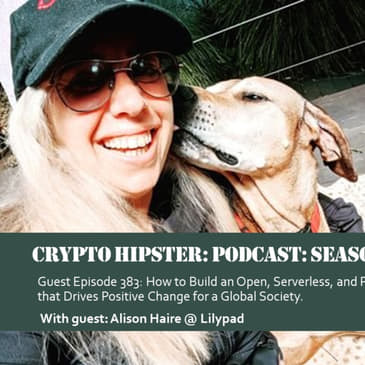

Alison Haire is CEO and Founder of Lilypad - a groundbreaking serverless & permissionless distributed compute network which provides internet-scale compute to both web3 and traditional tech. She is dedicated to building out open infrastructure with democratic access to technology & driving positive change in tech culture. Alison has a background in enterprise software engineering, technology consultancy and R & D projects, with an overriding passion for building open infrastructure enabling access to science & technology that can drive positive change for society - something web3 is uniquely positioned to help achieve in the next decade.
[00:00:00] Hello everybody and welcome to the Crypto Hipster Podcast. This is your host, Jamil Hasan, the Crypto Hipster, where I interviewed founders on entrepreneurs, executives, thought leaders, artists, everybody across the world, Crypto and Blockchene all around the world.
[00:00:15] And today I have a guest coming to me from all around the world, from the other side of the world. I'm in the US and she's in Australia. And I welcome Ali Har, who is the founder of Lilypad. Alison, Ali welcome.
[00:00:34] Hey, thanks, Jamil. Yes, we live in the future here at Australia. So if you need to know my need like a lot of numbers or quick tips or you know where the Crypto Hipster Podcast going, we've got to come in.
[00:00:50] Just kidding, just kidding. And I thank you. Thank you. It's great to be here. Jamil really exciting times for us as well. We've just actually and you'll be the first to hear this Jamil. We've just today launched our incentivized testnet as well. So I'm really good timing to be jumping on a podcast to chat about it with you.
[00:01:13] Awesome. I'm going to boost you up a couple spots and get this out soon or then expected that. I'm going to ask you first and you know who just joined us with my dog, she just joined us.
[00:01:26] That's sort of Doug. I have a, I have a mini Bernie doodle. Oh, that's so cute. I have a, I just recently bought a great day to actually so she's still a puppy, but she is like it's because a lot of her door already five months old.
[00:01:44] She's a, awesome. So let me ask you first then, you know, what's your background and isn't a logical background for what you're doing now.
[00:01:55] Yeah, look, I think so. I think no life journeys are straight path in general and I think he kind of accumulates skills from a spectrum of different places that you can, you know, utilize in your future roles as well.
[00:02:11] And it sometimes just comes together that way. So my background, I actually ran a cafe in my 20 so nothing to do with technology.
[00:02:22] I like to joke a little bit that I did it the wrong way around as well. You supposed to have the text start up first and then you retired to a cafe, but I did take a first.
[00:02:32] And I actually then retrained into mechatronic engineering and computer science after I sold that so I still think that a lot of the skills that I learned just running a business in general are coming in handy for me, not just now, but came in handy over my the past you know 15 years or so as well.
[00:02:53] So when I was at you need doing the electronic engineering computer science so I founded it started up there with another friend of mine. We went to the accelerator, we had folks interested in funding us.
[00:03:07] Unfortunately my business partner wasn't interested in taking outside funding and I wasn't interested in bootstrapping for the next three years so we decided to call it quicks there. And I moved into the corporate world really so I started work at Accenture.
[00:03:23] I was actually working on a niche project there on AI ops project that was deployed to a lot of the Fortune 500s in Australia.
[00:03:33] And so learn a lot of skills both coding and consulting with clients there that helped me kind of lay the groundwork for my tech career anyway.
[00:03:45] And then moved into a R.D. project with the University of Sydney physics lab they just some really really interesting nanoscience there and we were working with the defense force on some sensor technologies so some really cool ML powered actually sensor technology there so IOT and ML combination.
[00:04:09] And I shout out to the engineers and research as they are just really really big friends. I love working with those kind of people as well and they then got approached by IBM actually so I was working across a full spectrum of.
[00:04:25] You know blockchain AI cloud all all the usual suspects DevOps as a I would say a pre sales engineer a little bit there so helping out of clients integrate the technology.
[00:04:39] And as part of that this is where I really came across hyper ledger blockchain as well and that's when I filled down the crypto revenue so it was a little bit later than from a police on your podcast but maybe came out from a little bit of a different direction so.
[00:04:55] I felt down that hyper ledger rabbit hole started watching some videos there we even did a like meet up and then came into the public blockchain space.
[00:05:05] And you know I was just really impressed by the innovation and the values that I saw there really that was what really grabbed my attention of course I did some speculating as well.
[00:05:19] But the main thing that I grabbed my attention was definitely just that you know the kind of technology that people were building and the recent table building it and just that it was such a close-knit innovative community.
[00:05:35] So I started applying for jobs and it was interesting because I was. IBM had just acquired red hat and one of the narratives that IBM was going with at the time was you know cloud anyway you should only write dot is we have to move it anywhere.
[00:05:55] You know this kind of narrative and it was really interesting because red hat over she can kind of achieve that I mean as sure it's getting better and better. But you know IBM missed a cloud race and this was there really play really.
[00:06:11] And then I was looking at friend co labs and far coin interviewing with them and it was just a kind of natural fit I'm like you're trying to own your own daughter distributed everywhere but.
[00:06:24] These guys are building it from the ground up you know these are they're building it decentralized first not just tried to kind of put a square pay going around hole and charge for it.
[00:06:36] So yeah I was lucky enough to accept the role with file coin and I worked there for the last two years.
[00:06:44] And one of the things I did initially was lead the de-extradogy for a FM so the file coin virtual machine launched in I think it was much less to you but I was working on it for almost a year before that.
[00:07:00] And putting a team and strategy together for our kind of go to market developer experience. Once we kind of launched I moved over then to this project called back here which I'm not sure if you've heard about back here is a peer to peer compute project.
[00:07:18] It was founded at a critical labs and the guy that ran that David around sheep. He's one about devices on the Leapard skill he was the founder of well the lead on Kubernetes back in the day so he knows a lot about his distributor computer systems.
[00:07:38] And obviously has been very impactful so he was building back here as a kind of better version of what he'd previously built and a more decentralized version.
[00:07:49] And he has his own enterprise arm of buckwheat called Expanso to just a quick shout out for for that team there so he's he's still founding and running this still building back here out as well.
[00:08:04] And we use back the other foot but sorry I am jumping ahead a little bit there so you know the first thing I do that was coming from this smart contract world.
[00:08:16] Coming from this place where we've got all this storage and data in file coin and now like we want to make it useful right so compute was just like this obvious answer one of the first things I did was.
[00:08:29] You know I made something silly right and made and I generated NFT and this was really early in the kind of AI slash crypto phase so this like blog article kind of a little bit viral it.
[00:08:43] And it's really cool and like our people are interested in this people want to do this so.
[00:08:47] This was kind of a catalyst for us building out this bridge I think you'd call it a relayer between smart contracts and being able to use compute on the back of our public network.
[00:09:02] Back the out though was really not designed to be an incentive compute layer so you know just had some volatility with some you know hardware on the system not getting paid for doing that just playing around for that.
[00:09:17] So very unreliable right and this is where we still have went well you know clearly compute is an infrastructure need for an open web so let's build this out and looking up to get some backing for a protocol labs to initially start this project.
[00:09:35] And built out the initial kind of version of little pad that added some incentives and thought through some of how it would provide trust in a permissionless compute system because if anyone can like supply.
[00:09:50] A GPU to the network or hardware to the network how do you know that if you want to run a job on networks and rather than just rent out a GPU if you want to run a future one this network.
[00:10:03] How do you know that this random GPU that could be in Australia or you know is going to actually run the job that you asked for and not just kind of send back anything in order to get rewards so part of.
[00:10:18] The difficulty with permissionless systems as you know I think it's a no brain art that a distributed compute system. And I'm sure it is like both from cost perspective or a done the team perspective or liability expected like practical and ethical reasons.
[00:10:37] But one of the you know main challenges is how do you implement this verification well so sorry I feel like I've got a refuge of it so I'll just I'll just pull us there and give you a chance to ask me questions.
[00:10:50] Yeah I'm absorbing what you said you said a lot and we have a lot. Yeah absolutely once again on the roll like yep let's go.
[00:11:00] Yeah well you've had trying to try and to fix the compute issues with the yeah yeah so absolutely yeah ballad points so what we're our main focus here is on creating a distributed compute network that can run.
[00:11:16] Really large scale compute so not just kind of run a little bit of server as code. But run anything that you can containerize basically so that means AI inference jobs like SD and cell or video text of the text of voice I've seen some you know really cool.
[00:11:39] You see in the AI is moving at such a rapid pace it's absolutely insane but sorry someone creating an opera out of the other day it was just amazing so all of these jobs require compute and because it's been just such an explosion.
[00:11:57] Access to compute has actually been kind of limited I think you know that this is a true narrative when you see like reference and things going. Hey so my GPU today is like you know what is it you.
[00:12:13] What I've written is so you know I think that's it and all you got people like Elon Musk talking about you know how the shortage is. You know worse than drugs or something he had some we'd quite about anyway. Elon. Let's not start on that topic.
[00:12:34] Let's not so. It's interesting because I went to consensus 2024 right. Yeah. I was a spectator in the panels on AI and no one who's investing in AI had a good grassal what's going on in the industry they're all like on home.
[00:12:59] But there are current capacity issues and I'm thinking that your project addresses the capacity issues. What are those capacity issues and how do you solve it?
[00:13:10] Yeah definitely one of the issues is capacity and look from up purely you know have an engineering background so I've heard of a purely engineering perspective or you know.
[00:13:24] We can solve this over time engineering and it could always really we can solve this over time in the BDRAMD until the little stuff releasing more and more chips they would have scaled up performance.
[00:13:38] So this is probably a temporary capacity issue you know, it could run for quite a while though.
[00:13:47] So definitely giving access to folks that want to play around with AI and want to develop solutions with AI is a core part of our mission so we definitely want democratize access to that high capacity compute.
[00:14:04] And it is an issue so I think you know folks would have seen even if you're not really into this you know if you just use chat jbt would have seen it go down that's capacity sure right generally.
[00:14:17] You would have seen a lot in the news about you know these bottlenecks around AI because of not enough compute.
[00:14:26] So this is one thing that we're trying to solve we actually have looked at the crypto industry and look we're not the only ones and a lot of people run their own service here run their own hardware and especially coming from file calling which was you know probably the largest DP and.
[00:14:43] Carthsea deep in network and the largest deep in around you know it's these GPUs or access to hardware there are a lot of people out there with hardware.
[00:14:56] And the other thesis is our hardware as a personal consumer is also getting better and better like if you look at the specs on the.
[00:15:05] Mac before I'm a Mac user say the Mac before that's going to be able to run like really high powered AI jobs so our chips are getting better and better so why not enable folks to contribute to a network like this a peer to peer network which.
[00:15:22] In general is cheaper so it's like. Air bay and base probably not a good example these days but what's a part of time you know it disrupted the industry and made prices cheaper because I was peer to peer.
[00:15:37] And in a similar manner they we can do or distributed networks like a little pad can do that as well. So we can help solve the capacity issue by just making it more efficient so I like to say it's not really a capacity issues so much as.
[00:15:57] A kind of lack of a good way to connect the current capacity as well that's not very elegantly put but it's more of a.
[00:16:08] You know connection issue that an occupacity issue are I'd say there's a lot of GPUs out there in the world that I'm getting fully utilized and they could be. You don't need to be elegant no one knows the. Correct and on that's that works well so thank you.
[00:16:27] Um. And the next answer if you if you answer honestly, it probably be the US government but this is my question. What are the forces that play that could disrupt the rapid evolution of AI and hamper in scrolls trajectory besides the.
[00:16:47] No, look I think that's it's not just a US government either I think. This is a bit of a delicate subject as well but I think if you look around in general where at a place in history and in society. Where it's really important that we build systems.
[00:17:14] That don't allow exploitation I think we if we look back at the last 100 years of how we have grown.
[00:17:26] You know we've kind of moved off the path of where those ideals started and we need systems which we can develop in technology and which is one of the reasons that I was so attracted to the crypto and web free space in the first place.
[00:17:40] We have this technology that we can codify these rules into and make it fairer. Now I think this applies really importantly to you know this is one of the original missions to file.
[00:18:02] And right to make sure data is accessible to make sure folks have sovereignty and now I think it's really really important to do with AI as well open source AI.
[00:18:20] You can't have corporations owning the AI breakthroughs we can't have governments owning AI breakthroughs this should be owned by the people and the direction we want to take with it should also be something that the people have.
[00:18:43] And so the power to help direct so to speak we should be deciding if the rails of chapter pt for example are okay or not or perhaps there's different communities that decide different parts of those rails are applicable to them and want to run that way.
[00:19:03] For a computer system can do you can say as a hardware provider that these are my values and I didn't want to run jobs that backstores values are so that's what I'll do.
[00:19:17] And then you have these natural kind of villages that's free up around that developments but going back to the overall picture of AI development and I think there's something that another one of my advisors are really elegantly explains as well his name Peter Wagner is the founder and CEO of an economy.
[00:19:37] If you get a chance check out his videos around community AI because he just has a way of taking you on this journey that really. Fluttu in the face basically of hey, but AI is super powerful and we all need to have a say in how AI works.
[00:20:03] We all need to be able to access the code to check this security of it we all need to be able to access the code.
[00:20:10] You know to do things you know to decide which way we want to go with it and apart from that as well as individuals we often have subject matter expertise.
[00:20:24] The big corporations don't for example someone on our team I had a research actually Stanley Bishop is involved really heavily in rare disease research and he is looking at systems like Lily van to soul some of these rare disease problems and to enable universities to cooperate and collaborate with their data without.
[00:20:52] Keeping a private but enabling models we make together so you can really accelerate the speed to a solution for some of these problems and that's true of even small things in society as well.
[00:21:08] So if you are only have access to closed AI models then people can't do that we can't accelerate these solutions and this is what technology's for technology is a tool to help bring our society to a better place in my opinion.
[00:21:24] And one of the reasons I went into it and we look back like things like the printing press things like the IBM computer.
[00:21:32] These things have really things like washing machines these things have fundamentally changed how we set up as a society kind of as you go through code without the internet for example what we have done.
[00:21:44] So you know, this is what technology does it fundamentally changes how our society operates so it's really important if you care about that to be a part of you know pushing forward the parts of it that you want to see exist.
[00:22:00] That's what way people so that was a bit of a wild answer but I believe it took you on a little bit of a journey of what we believe in there. I love the journey I'm really especially intrigued now of the treatment of the rare diseases.
[00:22:15] Yeah absolutely you'll have to get stand on your podcast and have a whole conversation with him about that he's amazing. I would love to. So my next question is going to be this you know but I do want to come back to the to the rare disease later.
[00:22:34] There are growing there are growing compute demands right that's just growing my leaves and bounds you know there seems to be more I mean to me and seem to be more bots and algorithms than people.
[00:22:48] That's growing you know how can we how can we keep up with it with the exponential velocity and growth. With that seem to be like to boundless.
[00:22:59] I could not I'm not sure I can answer that actually I'm not sure in what respect did you want to keep up with it I suppose like as a human bait until I become a robot I think I can't keep up with.
[00:23:16] I'm sorry maybe you can refine what respect do you mean keep up with that compute demands there's going to be there's going to be boundless compute demands and I know.
[00:23:28] The ability for us to work on the hardware software is going to be less than the then in the demands so how do you know.
[00:23:39] Yeah look I think it's the same to be honest I'm going to answer the same way as I run my startup you just kind of be briefly prioritizing a lot of this that you want to use these things for.
[00:23:50] I look and I think the other way to keep up with some of this exponential growth is with systems like us is with distributed compute is by crowdsourcing from the community. We can do a much better job if we're efficiently coordinating and you know we have.
[00:24:12] Far more access and far more power to provide if we have a layer that can coordinate what is already available so I think that is definitely one way that we can help.
[00:24:23] I'm mitigate access and availability of some of these capacity and the exponential demand for it so that's why one of the reasons we're here is also not just because of the fundamental things that I believe in in technology in the way forward but also this is a really practical way to provide an answer to some really practical problems that are cropping up.
[00:24:48] Yeah I. I think so so. Thank you. I want to know your thoughts on the future intersection of AI crypto because a lot of people and every single person I talked to has different perspective so I love to see I love to learn yours.
[00:25:09] Yeah 100% we asked this question we were recently at East global hackathon in Sydney of the on from Australia and I was really great timing that we happened to have launched a little pad and been able to participate in the first Australian hackathon by a global I was just really thrilled to be that.
[00:25:28] And we asked this question of many people that had a quite a few conversations there as well and yeah how long has a piece of string.
[00:25:38] But yeah the intersection of AI and crypto there's just so many different parts of it there's underlying this how do we build a decentralized technology stack that supports decentralized AI so we are hoping to do that.
[00:25:56] And we're going to be a part of that mission anyway by providing a decentralized compute stack that can run AI and we don't just run AI we can run other computers just.
[00:26:07] You know AI is a big topic at the moment and and definitely for a good reason so we are focused on it.
[00:26:14] But you know so part of that is distributed computer system but then we're going to need distributed storage systems to for the data we're going to need privacy for the data we're going to need to enable.
[00:26:27] verification for that data provenance for that data there's also we're working on a fun use case at the moment with textile basin. Who are to file object storage by a file quasi decentralized object storage they've started building with basin.
[00:26:46] And we're working on a use case at the moment where we've kind of hit the limit of the synthetic data that we can build in order to give model small potency more power more ability to solve problems.
[00:27:01] So generating synthetic data has become a problem as well and it's you know something that distributed crypto networks can help solve.
[00:27:10] Which is really interesting right so it's like a snake eating it's so tail a little bit there but I think it's become a really interesting problem and then.
[00:27:20] So this is like kind of the fundamental stack or building out an open infrastructure that supports this decentralized AI ability and then on the flip side there's things that blockchain brings to.
[00:27:36] AI that it AI is going to need like AI also has its own problems like how do you know if.
[00:27:45] That video you just watched was real or a deep fake how do you know this podcast wasn't generated by chat GPT I happy to hold up a piece of paper or something at this point.
[00:27:59] You know you know and these are problems cropping up for anyone that has some sort of brand associated with them as well and makes them money that way so celebrities obviously come to mind initially but it's going to become a bigger and bigger problem we can't trust that.
[00:28:17] That article that just came out was from our elected official or you know the votes in election how you know we can't provide that provenance just something that.
[00:28:28] Blockchain does inherently well then we're in a lot of trouble with that as well so I think the intersection of blockchain and AI is just really critical and why we're saying so much focus and so many events pop up around it's not just.
[00:28:44] A large word but I think there's you know some critical work that crypto can provide to AI and one of those ways is in making AI are more open and more distributed more able to be access by.
[00:29:02] And the other way is probably proof of humanhood and proof of providence. So lots of ways that crypto and AI intersecting. Hopefully that adds to you the question. It's a bit of a meander there. It answers a beautiful thing. Thank you.
[00:29:19] I'm just wondering, you know, there's so much data. There's so much thing that can be, like for the people you mentioned before, rare diseases. For the people who do have to try to obtain like that, right? How do you know how can you tell which data is accurate?
[00:29:36] Which data was real, which data is fake? You know, and what is the best place to help people understand more about their rare diseases? I'm sorry. A really interesting question. I think that the rare disease research, what's currently happening? It's there's a bunch of silos.
[00:29:55] So there's research happening in silos. I'm unable to share their data. So I'm able to collaboratively work on a bigger piece of this system. More than that there's fake data coming in there. It's more about there's no collaboration able to happen.
[00:30:15] Despite all these folks that are really passionate about solving the problem. So things like being able to generate models from integrating the data from all of these places without revealing the data is something that we can just about do now, which is super powerful.
[00:30:42] Because we have research coming in from, you know, places all around the world and focused on solving a specific problem. Then, you know, you can just imagine like how much more powerful or had how much quicker we can get to
[00:31:03] some conclusions or answers based on having access to a model that integrates all of the data without revealing that data, without giving away any IP, it might be associated with the funding for that data and that type of thing.
[00:31:20] So I think in terms of the rare disease, when especially this is what we're at, and it's super powerful to be able to do things like that. I really am going to have to send Stan Bishop, our head of research to talk to you about that one though,
[00:31:37] definitely more of an expert than me. I like it so you're saying that this silos were going to be close to a breakthrough soon to breakdown silos to disparate organizations to share information collaboratively. Yes, exactly without breaking the rules of the data sovereignty, for example,
[00:32:02] like in some of the data that can keep privacy of the data, but still share it for the great good. I'm looking forward to that. That's a great. I have a couple last questions, so one goes back to your background.
[00:32:23] You have an engineering background, then you work in a cafe and then you went to Accenture. So how did you do it? I started in a cafe. Actually, I came out of, I actually started in an arts degree, so straight out of
[00:32:35] school, I went into an arts degree as you do. I actually studied philosophy and politics and those sort of things. So I think that's actually a really great background to critical thinking in general as well. Then I, it's honestly but I accidentally fell into owning a cafe.
[00:33:02] I ended up writing that for about eight years on the beautiful coastline of Australia up mid-North coast of Australia here and then sold that and I'm like, well what am I going to do?
[00:33:15] Really, I took a bit of a detour by owning that cafe. I've always been quite academic, so I went back to university and retrained, absolutely loved working on engineering problems and scientific problems, loved talking about ideas. So university was a really a fun experience to
[00:33:38] man. I think due to having a bit of mature age and having run my business as well, I was quite entrepreneurial while I was there. I was leading other initiatives at uni at the same time
[00:33:51] as studying as well. Then I went into the corporate world for a while. Here we are launching the Leapad which I feel like if I look back at that past is kind of a culmination of all of those aspects. The social science degree definitely is link and crypto,
[00:34:12] for thinking about anthology and how people interacted with the media. The leadership experience from my cafe completely different field of course, but definitely gave me a lot of understanding into what helps motivate people and how you build things well. Then moving into my academic background and then the
[00:34:37] corporate technology world kind of had these layers of experience that hopefully will stand being a good step for getting really put up and running and have a fantastic team that we built, so shout out to them, to that have expertise across the whole range of AI and crypto
[00:34:58] as well. So AI and ML researchers, cryptographers, tokenomics experts, game theory experts, and then of course wonderful engineering team, marketing team. We have expertise from across abroad spectrum of places, but this is really a more
[00:35:18] safe faceted project. Hopefully together with this amazing team we'll be able to launch something really impactful here. Sounds wonderful, I have a little more oxygen background. I want to thank you very much for your time today and I won last,
[00:35:45] well last question. I know you're lost your test net or you're sending to test regulations, but how can people find it more information about you? How can I do that? Thank you for being a wonderful host, you know. I want to find out more information.
[00:36:03] Our discord is probably the best place to interact with us. That's at lilypad.tame slash discord. We'll get an invite and you can discuss anything you like with us there.
[00:36:15] The other way is straight to our docks or blog. So lilypad.tac is our URL and you'll be able to find links to all of the different blogs, the tutorials, the docks, anything you'd like to do there.
[00:36:32] If you do want to start participating in the incentivized test net, so obviously that means that rewards, you can accumulate rewards before we launch to remain it, which we're aiming for the
[00:36:45] Q4 of this year. We'll launch a token as well. So if people want to contribute in the meantime and earn rewards for doing so, the first step is obviously onboarding GP providers, but there will also
[00:37:00] be a lot of different tasks for folks that don't have hardware or that are non-technical but believe in this mission at one contribute. So check that out at mullipad.tac slash incentive net.
[00:37:12] Because I'm straightened and we like to shorten everything. Thank you very much for your time today. Appreciate it, Javille. I have a lovely day.